Book Review: Walking in the Spirit

Walking in the SpiritI’ve enjoyed listening to the music of the Steve Pettit Evangelistic Team for years, and have had the privilege of hearing Steve preach in my church a number of times. So when I saw he had written a book titled Walking in the Spirit: A Study Through Galatians 5, I wanted to read it not only because I felt I could trust it (as much as one can trust a human author), but also because this is a subject and a passage I have thought about and wrestled with for years.

Most Christians are familiar with the last few verses in Galatians 5 that talk about the works of the flesh and the fruit of the Spirit. But the context of the chapter, indeed of the whole book of Galatians, has to do with Christian liberty. Some were telling the Galatian believers that they had to keep the OT laws to be a Christian, which is legalism. But some who had gotten hold of the truth that they were no longer under that law went too far the other way: “For, brethren, ye have been called unto liberty; only use not liberty for an occasion to the flesh, but by love serve one another. For all the law is fulfilled in one word, even in this; Thou shalt love thy neighbour as thyself” (verses 13-14). Pettit says true Christian liberty is walking in the Spirit, as opposed to license on one hand (being a slave to one’s flesh) and legalism on the other (being a slave to the law).

Pettit takes us step by step through Galatians 5 and discusses what legalism and Christian liberty are, what it means to walk in the Spirit, the battle between our flesh and the Holy Spirit, the difference between what the Bible calls our “old man” which was crucified when we believed on Christ and the “flesh” that we still battle, and the evidences of the flesh and fruit of the Spirit. He discusses what our relationship to the law is and what use it is (conviction of sin, for one: “I would not have come to know sin except through the Law; for I would not have known about coveting if the Law had not said, “You shall not covet” [Romans 7:7 NASB]. But the law can only tell us it is sin. It can’t fix us or change us. It’s the diagnosis, not the cure).

It’s hard to summarize a book like this beyond that, so I’ll just share a few quotes that stood out to me:

“Seeking to add to the work of Jesus actually takes away from it” (p. 6).

“The flesh seeks to twist a true understanding of freedom into an opportunity to gratify the flesh’s desires. But Christian liberty is freedom from sin, not freedom to sin. When Christians begin to focus on their own personal rights and freedom from restraints, liberty is abused” (p. 14).

“Walking in the Spirit demands a constant pursuit of and response to God’s Spirit. To be complacent and indifferent about one’s walk is to put oneself in a place of spiritual peril. No one is impervious to the allurements of the flesh” (p. 26).

“We are not so strong that we do not need to be warned, and we are not so weak that we cannot be free. We experience this struggle until the day we die” (p. 15).

The Christian life is not about trying harder to obey the law; it is realizing that we are enabled to obey God by the power of the indwelling Spirit” (p. 47).

“The fruits of the Spirit are of such a nature that, when they are present, the law is no longer necessary” (p. 48).

“Sanctification is the process of submitting to the Holy Spirit as He works to produce this fruit in your life, so that your daily life matches up with who you really are now in Christ” (p. 81).

The book is written as a Bible study, with discussion questions and blanks to fill in answers. It would work well in a group study: in fact, some of the questions would have been more profitable with a group contributing their insights.

The book did clear up some things for me or reminded me of things that I know but need to go over again from time to time. There were a couple of places I wish he had gone into a little more detail. But overall I found this book to be not only thoroughly Biblical but also intensely practical.

(This will also be linked to Semicolon‘s Saturday Review of Books.)

 

Yielding

I’ve been going through Steve Pettit’s book Walking in the Spirit: A Study Through Galatians 5 recently, and it brought back to mind this post I wrote about 6 years ago. Sometimes I need to remind myself of past lessons. I thought I’d share it again here as well, with a little tweaking.
______________________________________________________________

I had finished reading Romans several days ago and Galatians this morning, and truths from both of them were in my thoughts.

There are two verses in Romans 6 that talk about yielding:

“Neither yield ye your members as instruments of unrighteousness unto sin: but yield yourselves unto God, as those that are alive from the dead, and your members as instruments of righteousness unto God” (Romans 6:13).

“Know ye not, that to whom ye yield yourselves servants to obey, his servants ye are to whom ye obey; whether of sin unto death, or of obedience unto righteousness?” (Romans 6:16).

While I understood and agreed with those verses, there was one aspect that troubled me in regard to my “besetting sins,” and that was the word “yield.” I was thinking of it as a synonym for “let” — in other words, don’t let yourself sin, but let yourself do right. “Let” seemed appropriate for yielding to sinful impulses — it is all too easy to let the flesh do what it wants to do — but it seemed I couldn’t just “let” myself do right. I rather needed to make myself do right, often with a lot of prayer and struggling with the flesh.

Tied in with those verses from Romans was this one from Galatians 5:16-17 that I just read this morning:

“This I say then, Walk in the Spirit, and ye shall not fulfil the lust of the flesh. For the flesh lusteth against the Spirit, and the Spirit against the flesh: and these are contrary the one to the other: so that ye cannot do the things that ye would.”

I thought of the word “walk” in terms of taking a series of steps, and walking in the Spirit as taking those steps under the Holy Spirit’s control and direction while verse 17 acknowledges that conflict between flesh and Spirit.

A picture came to my mind of coming up to a yield sign in traffic. What do you do when you see a yield sign? You put on the brakes and you let the people in the other lane have the right of way.

And suddenly it became clear: the whole idea of yielding to God involved stepping on the brakes of my flesh (only made possible because of His gracious enablement) and letting Him have His way, not just in the big decisions of life, but my everyday walk and choices.

I don’t know if that distinction helps or makes sense to anyone else, but it was a light bulb moment for me.

Have Thine own way, Lord! Have Thine own way!
Thou art the Potter, I am the clay.
Mold me and make me after Thy will,
While I am waiting, yielded and still.

Have Thine own way, Lord! Have Thine own way!
Search me and try me, Master, today!
Whiter than snow, Lord, wash me just now,
As in Thy presence humbly I bow.

Have Thine own way, Lord! Have Thine own way!
Wounded and weary, help me, I pray!
Power, all power, surely is Thine!
Touch me and heal me, Savior divine.

Have Thine own way, Lord! Have Thine own way!
Hold o’er my being absolute sway!
Fill with Thy Spirit ’till all shall see
Christ only, always, living in me.

– Ad­e­laide A. Poll­ard

(Photo courtesy of FreeFoto.com.)

The Rupture of Self

From an old e-mail devotional from Elisabeth Elliot:

Sometimes our prayers are for deliverance from conditions which are morally indispensable–that is, conditions which are absolutely necessary to our redemption. God does not grant us those requests. He will not because He loves us with a pure and implacable purpose: that Christ be formed in us. If Christ is to live in my heart, if his life is to be lived in me, I will not be able to contain Him. The self, small and hard and resisting as a nut, will have to be ruptured. My own purposes and desires and hopes will have to at times be exploded. The rupture of the self is death, but out of death comes life. The acorn must rupture if an oak tree is to grow.

 It will help us to remember, when we do not receive the answer we hoped for, that it is morally necessary, morally indispensable, that some of our prayers be denied, “that the life of Jesus may be plainly seen in these bodies of ours” (2 Cor 4:11 JBP). Then think of this: the agonized prayer of Jesus in the garden went unanswered, too. Why? In order that life–our life–might spring forth from death–his death.

~ Elisabeth Elliot, A Lamp For My Feet

 Verily, verily, I say unto you, Except a corn of wheat fall into the ground and die, it abideth alone: but if it die, it bringeth forth much fruit.
John 12:24

Public domain image, royalty free stock photo from www.public-domain-image.com

(Photo courtesy of Public Domain Images.)

31 Days of Inspirational Biography: A Devout Muslim Encounters Christianity

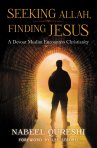
SeekingIn Seeking Allah, Finding Jesus: A Devout Muslim Encounters Christianity Nabeel Qureshi first gives a window into a loving and devout Muslim home, with all its practices, disciplines, and teachings, as well as a peek into the perspective of growing up Muslim in a non-Muslim culture.  Wanting to be a faithful representative of Islam, having been taught critical thinking in school and having a mind geared for it, he often turned the arguments of some of his Christian classmates on their heads, bringing up aspects they had not thought about before and were not ready to defend.

In college God brought to him “an intelligent, uncompromising, Non-Muslim friend who would be willing to challenge” him, someone who was “bold and stubborn enough” to deal with him but also someone he could trust “enough to dialogue…about the things that mattered to [him] the most.” Nabeel and his friend, David, were both on the forensics team and knew how to get to the heart of an argument and draw out and refute key points. For the most part they did this with each other’s worldviews good-naturedly, but when a given topic became too heated, they’d table it for a while. Muslims particularly have trouble with the reliability of the Bible, the deity of Christ, the Trinity, and the connection between Christ’s death on the cross and how it atoned for others’ sins. For three years Nabeel studied the Bible and its claims and others’ claims about it, fully confident that he’d be able to disprove those claims, and then to study the history of Mohamed and the claims of the Quran, fully confident that Islam would be justified. Though he was obviously biased toward the Quran, he really wanted to know the truth. He discovered the Bible’s claims were justified and Islam’s to be on shaky ground.

For some time he resisted acting on this knowledge. Being a Muslim was a matter of identity as well as religion: his whole life, everything he had always believed, his relationship with his family and community, everything would be turned upside down if he became a Christian. Yet he could not continue on, knowing what he now knew. In one of the most beautiful and touching passages in the book, he was seeking time to mourn before making the decision he knew he had to, and he opened the Bible for guidance this time, not simply to look for information to refute. He came to Matthew 5:4, 6:

Blessed are they that mourn: for they shall be comforted.

 Blessed are they which do hunger and thirst after righteousness: for they shall be filled.

Nabeel writes further:

There are costs Muslims must calculate when considering the gospel: losing the relationships they have built in this life, potentially losing this life, and if they are wrong, losing their afterlife. It is no understatement to say that Muslims often risk everything to embrace the cross.

But then again, it is the cross. There is a reason Jesus said, “Whoever wants to be my disciple must deny themselves and take up their cross and follow me. For whoever wants to save their life will lose it, but whoever loses their life for me and for the gospel will save it” (Mark 8:34-35).

Would it be worth it to pick up my cross and be crucified next to Jesus? If He is not God, then, no. Lose everything I love to worship a false God? A million times over, no!

But if He is God, then yes. Being forever bonded to my Lord by suffering alongside Him? A million times over, yes!

All suffering is worth it to follow Jesus. He is that amazing.

I feel I must comment on one aspect of the story that I questioned at first and I am sure other readers might as well: When Nabeel mentioned early on being “called to Jesus through visions and dreams,” I admit I inwardly winced and wondered what kind of story I’d be reading. For reasons too long to go into here, I am of those who believe that once God gave us His completed Word in writing, then dreams, visions, tongues, and the like fell away as unneeded.  The few modern instances I have ever heard or read of that seemed most in line with Bible truth were in cultures which didn’t have the Bible, often didn’t have a written language at all. Another problem with relying on dreams Nabeel discovered himself: one questions what it really means (his Muslim mother and Christian friend had completely opposite interpretations for what Nabeel’s dreams meant), wonders how much was due to wishful thinking, asks “Could I really hinge my life and eternal destiny on a dream?” etc. If that’s all he had to go on to become a believer, I would question what he was really trusting, but these dreams came after years of intense searching and study. In an appendix by Josh McDowell on this topic, he states, “Dreams and visions do not convert people; the gospel does,” but he explains, “In many Muslim cultures, dreams and visions play a strong role in people’s lives. Muslims rarely have access to the scriptures or interactions with Christian missionaries.” As in Nabeel’s case, “the dreams lead them to the scriptures and to believers who can share Jesus with them. It is the gospel through the Holy Spirit that converts people.”

One of many passages that stood out to me was in the chapter “Muslims in the West,” which described how Muslims view the West and Christians and, because they think both have corrupting influences and Westerners they are against Islam, they tend to keep to themselves. “On the rare occasion that someone does invite a Muslim to his or her home, differences in culture and hospitality may make the Muslim feel uncomfortable, and the host must be willing to ask, learn, and adapt to overcome this. There are simply too many  barriers for Muslim immigrants to understand Christians and the West by sheer circumstance. Only the exceptional blend of love, humility, hospitality, and persistence can overcome these barriers, and not enough people make the effort.”

I didn’t agree with everything Nabeel’s Christian friend said in the section about the Bible, in regard to believing some sections in the Bible were added later and not part of the original canon, but I do acknowledge that some do believe that.

There are multiple good aspects of this book: the window into another culture and mindset and the understanding of the difficulties a Muslim would have in coming to Christianity; the example of David and other friends who shared truth kindly and politely rather than belligerently or condescendingly, who genuinely cared about Nabeel as a friend rather than a “project”; the  wealth of information Nabeel found and shared from his studies which give a valuable apologetic (supplemented by several appendices>); and the touching yet agonizing conversion of a soul truly hungering and thirsting after the one true God.

(Reprinted from the archives. I hope regular readers will forgive my doing so with so recent a post. I was going to just summarize but then didn’t feel I could leave anything here out.)

photo 3(2)

For the 31 Days writing challenge, I am sharing 31 Days of Inspirational Biography. You can find others in the series here.

31 Days of Inspirational Biography: The Last CIM Missionaries in Communist China

In 1950, Arthur and Wilda Mathews and their 13 month old baby, Lilah, traveled to Hwangyuan, China. China had fallen to Communism, and other missionaries were leaving, yet the Chinese church had invited them to come, with the approval of the Communist government. They felt this was a miraculously opened door God would have them go through. Yet, when they arrived, they could sense that all was not well. The Christians pastors who met them were strained, and they discerned that between the time of their invitation and arrival, the Chinese learned that association with the white people would be a liability under Communism, not a asset. The Mathews then thought perhaps, if they could not be a help to the church, they could endeavor to evangelize the unreached Mongols in the area and nearby. They had a few weeks in which to minister, but soon found that they were restricted in ways they could help. They endeavored to set up an inn with which to reach the Mongols, but Chinese troops took it over the day before it was to open. Arthur protested, but soon found it would have been wiser to have said nothing. In two days a policeman came to the mission compound to announce that no one there could do village work without permission, and the white people were forbidden everything: they could not have meetings outside the compound, they could not give out tracts or dispense medicine. They were restricted to the mission compound.

They finally decided that since they were more of a hindrance than a help, they would apply for exit visas. They thought, since the government did not want them, they would be allowed to leave quickly, and so gave away or sold dishes, curtains, etc., keeping just the bare minimum to function until they could leave. Arthur was summoned to the police station and asked to sign a statement that he was for world peace. He had heard of another missionary having to sign some document before leaving, so he signed without thinking much of it. The government official then asked what contribution Arthur was then willing to make toward world peace, outlining a plan in which Arthur would go to India and essentially be a Communist spy. Arthur realized that the Communist definition of world peace was a world dominated by communism, and of course could not consent.

A government official called Arthur in and promised his exit visas if he would do something for them, like write a report of five other missionaries. At first Arthur did write glowing reports of the missionaries in question, but someone told him he dare not turn that in: the Communists would change what he had written but keep his signature. So Arthur threw his report in the fire and told the official he could not be a Judas. The official then told him that he could have given him a pass, if he had cooperated, but now a charge had been laid against him which must be investigated, and “investigations take a long time.”

Thus began a two and a half year ordeal. Their provisions from their mission were frozen by the government, which made Arthur submit a report of what he would need, and then they doled out to him much less than what the report said he needed. Every victory they mentioned in a letter seemed to be immediately challenged by the enemy of their souls: once when they wrote what a blessing Lilah was, she then came down with scarlet fever, and they almost lost her. All of them had turns being ill. Eventually they were told that no one could speak to them, and they could only leave home to draw water from the creek and get food.

They wrestled with the “what-ifs” and the frustration of what they called “second causes,” finally coming to the conclusion that they had to trust that the Lord was in control and had them there for a reason, though it was hard to discern that reason when they were so restricted. Yet the Lord did use them even when they could not speak to the people. The few weeks they had had to minister before restrictions set in, people knew their hearts and saw their love. When the Mathews could no longer speak openly, the people saw them in tattered clothes, persecuted, attacked by illness without much medical aid, laughed at, jeered, humiliated, doing menial, degrading work just to survive, tantalized by the government offering release and then not giving it or doling out money that was theirs in the first place. They saw the Lord provide miraculously for them in many ways. Yet more than that, they saw them endure graciously and joyfully until, finally, the Mathews became the last CIM missionaries to leave China.

Green-Leaf-in-DroughtHow the Lord provided for them and ministered through them in unexpected ways are some of the most exciting parts of the book Isobel Kuhn wrote of their story titled Green Leaf in Drought. She says,

But most amazing of all was their spiritual vigour. Whence came it? Not from themselves: no human being could go through such sufferings and come out so sweet and cheerful. As I was in a small prayer meeting… one prayed thus: ‘O Lord, keep their leaf green in times of drought!’ I knew in a moment that this was the answer. Jeremiah 17:8: “He shall be as a tree planted by the waters, and that spreadeth out her roots by the river, and shall not see when heat cometh, but her leaf shall be green; and shall not be careful in the year of drought, neither shall cease from yielding fruit.” That was it! There was an unseen Source of secret nourishment, which the Communists could not find and from which they could not cut them off…That is needed by all of us. Your drought may not be caused by Communism, but the cause of the drying up of life’s joys is incidental. When they dry up — is there, can we find, a secret Source of nourishment that the deadly drought cannot reach?…Is it possible for a Christian to put forth green leaves when all he enjoys in this life is drying up around him?

The answer, by God’s grace, is yes!

(Reposted from the archives.)

photo 3(2)

For the 31 Days writing challenge, I am sharing 31 Days of Inspirational Biography. You can find others in the series here.

31 Days of Inspirational Biographies: Rosalind Goforth Learns Submission

I mentioned in yesterday’s post a little book by missionary Rosalind Goforth called Climbing, one of my all-time favorites. She and her husband were missionaries to China from1888-1936. She had written his biography, and then by request wrote Climbing about missionary life and furlough from her perspective. I think one thing missionaries would want us to know is that they are not “super-Christians,” but rather people “of like passions” as we are, and this humorous incident in Rosalind’s life illustrates not only that but also the importance of being consistently in God’s Word so it can speak to you.

The following is the most notable incident connected with this habit of memorizing Scripture. I give it, for, judging by the effect it has had upon men and women to whom I have told this story, it touches a vital point in the relation of husband and wife. It certainly brought to my husband and myself a lesson never forgotten.

Our children were all away at school. We were together carrying on aggressive evangelism at a distant out-station. The room given to us was dark and damp, with the usual mud floor. The weather, had turned cold, and there was no place where one could get warm. I caught a cold. It was not a severe one, but enough to make me rather miserable. The third or fourth day, when the meetings were in full swing and my organ was taking an attracting part, I became possessed by a great longing to visit my dearly loved friend, Miss H., living at the Weihuifu Station, some hours run south on the railway. But when I told my husband what I had in mind, he strongly objected and urged against my going. I would not listen, even when he said my going would break up at least the women’s work. But I was determined to go and ordered the cart for the trip to the railway. As the cart started and I saw my husband’s sad, disappointed, white face, I would have stopped, but I wanted to show him I must have my way sometimes!

Oh, what a miserable time I had till my friend’s home in Weihuifu was reached! Miss H. gave one glance at my face and exclaimed: “Whatever is the matter, Mrs. Goforth! Are you ill?”

My only answer was to break down sobbing. Of course I could not tell her WHY. Miss H. insisted on putting me to bed, saying I was ill! She made me promise to remain there until after breakfast.

The following morning, while waiting for breakfast, I opened my Testament and started to memorize, as usual, my three verses. Now it happened I was at that time memorizing the Epistle to the Ephesians and had reached the fifth chapter down to the twenty-first verse. The twenty-second, the first of the three to be memorized that morning, read: “Wives, submit yourselves unto your husbands as unto the Lord.” I was, to say at the least, startled! Somehow I managed to get this bravely memorized. Then going on to the twenty-third verse, these words faced me: “For the husband is the head of the wife even as Christ is the head of the church: and he is the Saviour of the body.”

For a moment a feeling of resentment, even anger, arose. I could not treat this word as a woman once did, putting it aside with the remark: “That is where Paul and I differ.” I believed the Epistle to the Ephesians was inspired, if any portion of Scripture was. How could I dare cut out this one part to which I was unwilling to submit? How I managed to memorize that twenty-third verse I do not know, for all the while a desperate mental struggle was on. Then came the twenty-fourth verse: “Therefore as the church is subject unto Christ, so let the wives be to their own husbands in everything.”

I could not memorize further: my mind was too agitated. “It just comes to this,” I thought, “Am I willing, FOR CHRIST’S SAKE, to submit my will (in all but matters of conscience) to my husband?” The struggle was short but intense. At last I cried, “For CHRIST’s sake, I yield!” Throwing a dressing gown about me, I ran to the top of the stairs and called to my friend, “When does the next train go?”

“In about half an hour,” she replied, “but you couldn’t catch it and have your breakfast.”

“Never mind; I’m going to get that train!”

My friend insisted on accompanying me to the station; we ate as we almost ran. With what joy I at last found myself traveling northward!

On reaching my destination, imagine my surprise to find my husband, with a happy twinkle in his eye, standing on the platform!

“Why, Jonathan,” I cried, “how did you know I was coming?”

His reply was simply a happy, “Oh, I knew you would come.”

Later I told my husband frankly all I had passed through. What was the result? From that time, he gave me my way as never before, for does not verse 25 of the chapter quoted go on to say: “Husbands, love your wives, even as Christ also loved the church, and gave himself for it.” A new realization of the need of yieldedness came to us both, which brought blessed results in our home life.

I don’t think she is saying at the end that her little adventure “paid off,” but rather that God used the incident and their conversation together to open both their eyes to each other’s needs.

Though I am sure it wasn’t funny at the time, I always find this story humorous and I am glad she “told on” herself in her book. But beyond the incident itself, it shows how the Lord can guide and correct us when we are regularly in His Word.

(You can find this book on sale at Amazon and various places, but the text is also online here.)

photo 3(2)

For the 31 Days writing challenge, I am sharing 31 Days of Inspirational Biography. You can find others in the series here.

Book Review: How I Know God Answers Prayer

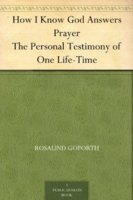
How I Know God Answers PrayerI think I first read Rosalind Goforth’s first book, How I Know God Answers Prayer, maybe in my twenties, so about 30 years ago. I don’t remember how many times I have read it since. It is a testimony of how God has answered prayers both small and great in her life through the years, spurred by people’s occasional response that perhaps what seemed an answer to prayer was just a coincidence that would have happened anyway. She wanted to demonstrate through a lifetime of her walk with God that prayer is just a child of God asking her Father for what she needs, and seeing Him answer – not always just the way she originally wanted, but with love and wisdom nonetheless. Of her three books, including Goforth of China (a biography of her husband) and Climbing (a book she was asked to write concerning some of her own experiences and perspectives), Climbing is my favorite, but this book is very good as well.

Since I was reading it this time for Carrie’s  Reading to Know Classics Book Club, I tried to view it as others might who have not read it before.  For the first time I thought perhaps a little of the effect of what she relates might have been lost by the description of events taken out of context. For instance, when she writes near the end about finding “that the Lord could guide me even in trimming my hat to his glory,” some people might think, “What?” In Climbing, one of the difficulties she underwent was criticism of her dress when she would come home on furlough. There was no Internet, Facebook, or even Wal-Mart in those days to keep up with what was going on in the fashion world back home, and she had no idea what would be stylish or out of style or different from the last time she had been there. It is really ridiculous that people would criticize under such circumstances, but they do. Once when a lady offered to get new outfits for her when she was home, she was relieved, until the lady brought her garments entirely in black, which she evidently thought was appropriate for missionary ladies. Jonathan told her she looked like she was in mourning, but she felt she couldn’t refuse the gifts without causing offense. She didn’t necessarily want to be up-to-the minute in the latest styles (in fact, when Merry Widow hats were in style at one point, she thought they were ridiculous and tried to find a way not to wear them), but she didn’t want to be a distraction, either, as they visited churches and conferences. In that book she relates some of God’s leading and answers to prayer regarding that whole issue, represented here just by the sentences, “I found the Lord could guide me even in trimming my hat to his glory! That is, so that I could stand before an audience and not bring discredit to my Master.”

She mentions the anti-foreigner sentiments and some of the dangers involved, but I don’t know if readers will understand just how pervasive and dangerous it was. China was a very closed-off country then, and anything “foreign” was suspicious (one reason why Hudson Taylor advocated dressing like Chinese rather than British). She does mention here that one of the ways she and her husband tried to combat this was to hold “Open House” where they’d let their neighbors come in and tour the house so they could see there wasn’t anything dangerous about them. In one of her other books she writes that one of these times, someone saw her daughter’s dolls in her bed and spread the word that the Goforths kidnapped children and shrunk them. It seems ridiculous now that anyone would think that, but it was a very superstitious and suspicious time. Rumors like that could at the very least cause people to avoid them, and at the worst set off a powder keg of anger. Sudden mob violence was not uncommon, especially leading up to the time of the Boxer rebellion. I remember reading in another book (I forget whose) about a missionary having in her school a skeleton for educational purposes, and then trying to decide how best to dispose of it so people wouldn’t think they had killed someone. Trying to preach a gospel that the people were probably going to react negatively against at first in such a setting indeed required a lot of prayer and faith.

But even with some events taken somewhat out of context, she presents a testimony full of grace in how the Lord dealt with her. Some of the answers she relates were major –  a sudden breakthrough in her husband’s grasp of the language when he was discouraged and near giving up, found later to have happened right at the time that a group in his old college had met to pray for him, response in meetings found to have happened when others were praying (incidents that should remind and encourage us to pray for others), healing when all other help had been exhausted, protection from danger, especially in their escape during the Boxer rebellion. Of the last, she was asked why God spared them so miraculously but not others. She responded:

Truly a vital question, which could not lightly be set aside! Humbly and prayerfully we pondered this “Why” in the light of Scripture. In the twelfth chapter of Acts, we read of Herod’s succeeding in putting James to death by the sword, and directly after comes the story of how Herod was hindered in carrying out his intention to kill Peter who was delivered by a miracle. Then who could read that marvelous eleventh chapter of Hebrews with its record of glorious martyrdom and miraculous deliverances without being thrilled? In face of these and many other passages, while still unable to answer the “why,” we saw our Almighty God used His own prerogative to glorify His name whether in the glorious martyrdom of some or in the miraculous deliverance of other.

I referenced this a few months ago in a post on our pastor’s cancer, how God heals some but not others, for reasons only He knows.

Such big and dramatic answers to prayer can be thrilling, but what touched my heart even more were the smaller, “everyday” answers: a lost key found, provision for clothes, a gift of fresh fruit, the need for a telephone and a coat and help during a speaking engagement when she felt ill.

Some of the incidents were deeply personal, such as the time her husband wanted to go touring out among the people, and she said no at first, for the safety of the children (smallpox was rampant and the Chinese then had no thought of keeping sick people home). She had to learn that “‘the safest place’ for myself and the children ‘was the path of duty.'” Though several of her children died from other causes, none died during this time in their ministry once she yielded to the Lord about it. Another personal situation was finally understanding what it was to rest in the Lord and trust Him for salvation from the power of sin and not just the penalty of it, after feeling like she had been on something of a roller coaster spiritually for 40 years.

Something else I thought some people might have a problem with in reading her book were the times she mentioned prayer being hindered by a wrong attitude or bitterness on her part, or, in one instance, the fact that she felt God allowed something to bless her for responding in a right way. These days what we often hear is that God deals with us on the basis of His grace, not our “performance.” That is true. Yet there are instances in Scripture, even in the New Testament, of disobedience hindering. We’re told that some people are sick and some have died because of partaking of the Lord’s Supper in a wrong manner, that we should reconcile with our brother before offering a gift to God, that confession of sin is a part of praying for healing, that we can’t expect forgiveness if we don’t forgive. We’ll never be perfect, but we can’t expect the Lord’s blessing if we are hanging on to known sin. As to the other, does God ever do a special little something for us when we obey in some area or do the right thing? I don’t know – I can’t think of a Scripture reference that deals with that exactly in the New Testament. We tend to think, especially when reading the Old Testament, “Be good and God will bless me, mess up and He will come after me hard.” But even there Job experienced great calamity even though he was doing everything right, and the wicked seem to prosper even when they are not obedient. Ultimately everything that God allows comes from His wisdom, love, and grace. But I have felt at times, especially in my very early days as a Christian, that some blessing or answer to prayer came just after taking an important step in the right direction, not as a reward or as God patting me on the head for doing right, but just as a little encouragement from a Father to His child. Don’t we do the same for our children? When we see them struggle in an area and do the right thing, don’t we give them some kind of encouragement, even if it is just a smile or a nod or a thumbs up or a “Well done”? Of course, we need to do right even if no one seems to notice or care or no “blessing” comes in response. I don’t think this nullifies the fact that it all comes from God’s grace because we can only obey and make right decisions with His grace. (I’ve written earlier that grace does not nullify the need for obedience but rather enables it. See Of grace, law, commandments, rules, and effort and What grace does not mean). God blesses us far beyond our ability to obey as it is, and obedience should be an outgrowth of love and reverence for Him rather than a “work” to “earn” blessing. This is too involved a topic for this post, but I feel sure she isn’t advocating that prayer and obedience are like vending machines where we put in out part and then expect God to do His – not at all.

Since this is a testimony of answered prayer, naturally most of the anecdotes involve those answers. Yet she also shares some times when God didn’t answer, at least not in the way she prayed for. In one instance, years later she could see and was thankful for the fact that He hadn’t granted a particular request, one that would have changed the path of her life away from China. In other instances, like healing that did not come and the deaths of several of her children, she continued to trust even though she couldn’t understand.

I don’t think Rosalind shared any of these answers to prayer with the attitude, “Look at me and my wonderful answers to prayer. Aren’t I special?”  I think she would have been horrified that anyone would think that. I think rather, she just wanted to show forth His provision and willingness to take care of His dear children’s needs, like the psalmists, whose testimony was, “Hear what great things the Lord has done and how He delivered me.” Every Christian walking and talking with God would have a record like this whether written or not, though admittedly probably not with situations like being delivered from an angry mob on the list. But like the Ebenezers I mentioned a few weeks ago, we should all be able to look back on those times where God met with us, provided for us, and answered prayer for us in a way that only He could. It’s good to share things like this with our families, so they know God didn’t just meet people’s needs back in Bible times, but He still does today. Such things redound to His praise and encourage us in the Lord when “when I remember you upon my bed, and meditate on you in the watches of the night;  for you have been my help, and in the shadow of your wings I will sing for joy.  My soul clings to you; your right hand upholds me” (Psalm 63:5-8).

photo 3(2)

For the 31 Days writing challenge, I am sharing 31 Days of Inspirational Biography. You can find others in the series here.

Reading to Know - Book Club

(This will also be linked to Semicolon‘s Saturday Review of Books.)

31 Days of Inspirational Biography: Darlene Deibler Rose learns “faith stripped of feelings, faith without trappings”

Evidence Not SeenLast year I wrote about Darlene Deibler Rose’s testimony in the book Evidence Not Seen of being a missionary in the Philippines and then imprisoned as a POW during WWII. This is one of my all-time favorite biographies. This year I wanted to share just this one excerpt. The following takes place after Darlene has been incarcerated by the Japanese for some time:

 I knew that without God, without that consciousness of His Presence in every troubled hour, I could never have made it…Quite suddenly and unexpectedly, I felt enveloped in a spiritual vacuum. “Lord, where have You gone? What have I said or done to grieve You? Why have You withdrawn Your Presence from me? Oh Father—” In a panic I jumped to my feet, my heart frantically searching for a hidden sin, for a careless thought, for any reason why my Lord should have withdrawn His Presence from me. My prayers, my expressions of worship, seemed to go no higher than the ceiling; there seemed to be no sounding board. I prayed for forgiveness, for the Holy Spirit to search my heart. To none of my petitions was there any apparent response.

 I sank to the floor and quietly and purposefully began to search the Scriptures hidden in my heart…

 “Lord, I believe all that the Bible says. I do walk by faith and not by sight. I do not need to feel You near, because Your Word says You will never leave me nor forsake me. Lord, I confirm my faith; I believe.” The words of Hebrews 11:1 welled up, unbeckoned, to fill my mind: “Now faith is the substance of things hoped for, the evidence of things not seen.” The evidence of things not seen. Evidence not seen — that was what I put my trust in — not in feelings or moments of ecstasy, but in the unchanging Person of Jesus Christ. Suddenly I realized that I was singing:

When darkness veils His lovely face,
I rest on His unchanging grace.
In every high and stormy gale,
My anchor holds within the veil.

On Christ the solid Rock I stand;
All other ground is sinking sand.

 I was assured that my faith rested not on feelings, not on moments of ecstasy, but on the Person of my matchless, changeless Savior, in Whom is no shadow caused by turning. In a measure I felt I understood what Job meant when he declared, “Though He slay me, yet will I trust in Him” (13:35). Job knew that he could trust God, because Job knew the character of the One in Whom he had put his trust. It was faith stripped of feelings, faith without trappings. More than ever before, I knew that I could ever and always put my trust, my faith, in my glorious Lord. I encouraged myself in the Lord and His Word.


photo 3(2)

For the 31 Days writing challenge, I am sharing 31 Days of Inspirational Biography. You can find others in the series here.

31 Days of Inspirational Biography: Rosaria Butterfield

I don’t know when 148 pages of someone’s life story has impacted me more. There are sections where I have sticky tabs and markings on several pages in a row.

Unlikely ConvertThe Secret Thoughts of an Unlikely Convert: An English Professor’s Journey Into Christian Faith is Rosaria Champagne Butterfield’s story of how she, as an atheist, leftist, feminist, lesbian professor specializing Critical Theory, or postmodernism, and whose specialty was Queer Theory, who hated Christians, encountered and embraced the truths of Christianity in what she calls a “train wreck” of a conversion.

After a few pages detailing how she came to her professorship and worldview, she describes a kind and inquiring letter from a pastor in response to an article she had written.

The Bible makes it clear that reason is not the front door of faith. It takes spiritual eyes to discern spiritual matters. But how do we develop spiritual eyes unless Christians engage the culture with those questions and paradigms of mindfulness out of which spiritual logic flows? That’s exactly what Ken’s letter did for me – invited me to think in ways I hadn’t before (pp. 8-9).

The letter had invited her to call him, and after a week, she did. He invited her to have dinner with him and his wife at their home, and she accepted. She was also at this time doing research for a book on the Religious Right and figured he could answer some of her questions. “Even though obviously these Christians and I were very different, they seemed to know that I wasn’t just a blank slate, that I had values and opinions too, and they talked with me in a way that didn’t make me feel erased” (p. 10). Thus began two years of regular meetings and studying Scripture before she ever set foot in a church, which Ken and his wife knew would probably be “too threatening, too weird, too much” (p. 11) for her. “Good teachers make it possible for people to change their positions without shame. Even as Ken prayed for my soul, he did it in a way that welcomed me into the church rather than made me a scapegoat of Christian fear or an example of what not to become,” (p. 14.)

Gradually she came to believe, but she knew it would cost her. “I clung to Matthew 16:24, remembering that every believer had to at some point in life take the step I was taking: giving up the right to myself, taking up his Cross (i.e., the historicity of the resurrection, not masochism endured to please others), and following Jesus.” “I learned that we must obey in faith before we feel better or different. At this time, though, obeying in faith, to me, felt like throwing myself off a cliff” (p. 22). “One doesn’t repent for a sin of identity in one session. Sins of identity have multiple dimensions, and throughout this journey, I have come to my pastor and his wife, friends in the Lord, and always the Lord himself with different facets of my sin” (p. 23).

She tells of a woman she knew and counseled who was in a Bible-believing church but was in a secret lesbian relationship. Her secret denied her the help and prayers of other believers and only resulted in shame and pretense. When Rosaria asked why she didn’t share her struggle with anyone in her church, she replied, “If people in my church really believed that gay people could be transformed by Christ, they wouldn’t talk about us or pray about us in the hateful way they do” (p. 25). Rosaria then asks readers, “Do your prayers rise no higher than your prejudice? I think that churches would be places of greater intimacy and growth in Christ if people stopped lying about what we need, what we fear, where we fail, and how we sin” (p. 25).

Rosaria was a tenured professor in subjects that would now radically change because of her conversion. When she let it be known that she was now a Christian, both she and her gay friends felt she had betrayed them and turned traitor. “I…was alert to the reality that God had ministry waiting for me. I prayed that I would be strong for the task at hand. Yes, I was still a laughing stock in the gay community. Yes, I was still a traitor and an example of what not to be. But so too was Paul the Apostle shamed among Pharisees, and I trusted that God would take my life and make a place for me” (p. 50).

The rest of the book tells how God did just that, both in her career and ministry to others, leading her to marry a pastor, to eventually adopt four biracial children, and to become a homeschooling mom.

Along the way, she shares an eye-opening perspective of what Christianity looks like to others. For instance, when she moved to a community where there were Bible verses on bumper stickers and placards, instead of it looking like people were sharing a bit of light, it looked to her like the community was for “insiders” only. Christians seemed like “bad thinkers” or even anti-intellectual to her before this journey, using Scripture to shut down conversations rather than to shed light. Unfortunately, that is too often true: instead of truly discussing what the Bible has to say and being “ready always to give an answer to every man that asketh you a reason of the hope that is in you with meekness and fear” (I Peter 3:15b), some Christians take offense at being asked and use Scripture to bludgeon. I’ve known some who have been turned off, not so much to all Christian truth, but to Christian community because of this experience.

One theme that comes out throughout the book is the willingness to engage people who are different from us in any way. Thank God the pastor and wife who first shared Christ with her looked past her butch haircut and gay and pro-choice bumper stickers to the need of her heart. But even after she became a Christian, she ran into this phenomenon in various churches. When her husband was the guest speaker at a church and she was getting out of the car holding one of her adopted children while the other was asleep in the car seat, a man said to her, “So, is it chic for white women to adopt black kids these days?” After asking him if he was a Christian, she said, “So, did God save you because it was chic?” When her husband started pastoring a small church plant made up mostly of college students, families would come for a month or so and then leave because of a “lack of fellowship” with people just like themselves. I could step on a small soapbox here: I get so discouraged when people within the same church only want to fellowship with people just like themselves — same age bracket, same marital or parental status, same way of educating or disciplining children, etc., etc.

If I shared everything else I marked, I’d be nearly rewriting the book here, so I can’t do that. But here are just a few more things that grabbed me:

“Since all major U. S. universities had Christian roots, too many Christians thought that they could rest in Christian tradition, not Christian relevance” (p. 7).

“When we read in the book of Romans, “And we know that God causes all things to work together for good to those who love God, to those who are the called according to His purpose” (8:28), we are not to be Pollyanna about this. Many of the ‘things’ we will face come with the razor edges of a fallen and broken world. You can’t play poker with God’s mercy – if you want the sweet mercy then you must also swallow the bitter mercy. And what is the difference between sweet and bitter? Only this: your critical perspective, your worldview. One of God’s greatest gifts is the ability to see and appreciate the world from points of view foreign to your own, points of view that exceed your personal experience”  (p. 125).

“Many people in our community protect themselves from inconvenience as though inconvenience is deadly. We have decided that we are not inconvenienced by inconvenience. The needs of children come up unexpectedly. We are sure that the Good Samaritan had other plans that fateful day. Our plans are not sacred” (p. 126).

When a teenage girl in foster care with mental illness heard a pastor speaking about God’s call, afterward she “approached Pastor Steve and said, ‘Steve, I hear voices all the time. How do I know the difference between hearing the voice of God and hearing the voices of my own sick mind?’ Pastor Steve said, ‘Dear one, we all have the check the voices of our own sick mind with the Bible. Daily. You are no different’” (p. 128).

One thought that came to mind while reading the book was, “Why don’t we see this happening more often?” If the gospel is the power of God unto salvation, and it is, then why don’t we see such transformative conversions more often, and why are those raised in Christian culture often so anemic? Sometimes I long with the Psalmist “To see thy power and thy glory, so as I have seen thee in the sanctuary” (Psalm 63:2). Is it because we don’t share the gospel in a kind and loving way enough? Or is it because not many people are truly willing to examine the claims of the Bible and bring themselves under its authority? Maybe both. I’ve seen online encounters where non-Christians have as much of a “smackdown” way of encountering Christians as Christians do encountering them. I know I would have been scared to death to engage someone like Rosaria before she was saved: I’d have been afraid that I wouldn’t be able to answer her questions and she’d be able to run rings around me with her reasoning ability. But I have to remind myself that those whom God brought across her path with just the right thing to say at the right time were operating under the leadership of the Holy Spirit, not their own wisdom and insight. Sometimes we look for a formula: we see articles or pamphlets about “How to witness to atheists” or whomever else, and those can have some helpful points, but we can’t memorize a script and then present it to people. We need to share a Person and show His love to others and trust Him for the right words to say and pray for His working in hearts.

Rosaria writes now from a Reformed Presbyterian perspective, and since I am not from that perspective, I’d disagree with a few minor points here and there, but I am not going to nitpick about them. I do believe Christians can agree on the big issues and agree to disagree about smaller ones.

There is a condensed version of her testimony here, but I do encourage you to read the book as well. I was one of my top ten books read in 2013, and it is one of my top ten of all time.

And if you think of it, you might pray for her ministry now. I’ve caught a few news items since reading this book where she has gone to speak at a university and faced student protests from those who are close-minded about her message. She understands where they are coming from because she used to think the same way. May the light of God’s truth open many more hearts.

(Reposted from the archives. I was just going to post a quick summary – but I couldn’t. 🙂 )

photo 3(2)

For the 31 Days writing challenge, I am sharing 31 Days of Inspirational Biography. You can find others in the series here.

Book Review: Why We Are Not Emergent: By Two Guys Who Should Be

EmergentThose of you who read here regularly and have seen Why We Are Not Emergent: By Two Guys Who Should Be by Kevin DeYoung and Ted Kluck on about five different Nightstand posts are probably thinking, “Yes! She finally finished it!” When I was trying to read a bit here and there in 10-15 minutes offhand segments, it wasn’t working, but then I committed to trying to read a chapter, or at least a section, as many mornings as I could right after my devotional time. Once I really got into it, I loved it.

I would say this is a highly valuable book to read even if you don’t know (or aren’t interested in) what the emergent movement is all about, because there are tendrils of it popping up all over the place, and it is good to have Biblical thinking about these issues.

This book caught my eye because some years ago, when I first heard anything about the Emergent or Emerging church, I was active on a Christian message forum online and asked if someone could tell me in 2 or 3 sentences what it was all about. No one could, or at least, no one did. All I got were book recommendations. I wasn’t interested enough to read a whole book about it at the time. Fairly recently I saw this mentioned somewhere with the comment that it was a fair treatment, so when it came through on a Kindle sale, I got it. But then it sat there until the TBR challenge motivated me to add it to my books to be read this year, and then until just recently.

I don’t know much about either author except that DeYoung is a name in the “young, restless, Reformed” crowd. None of those adjectives fits me, but I do enjoy reading some of those folks and can work around those areas where I disagree with a Reformed view of things.

The Emergent movement or church is kind of hard to pin down, because it is not a denomination and there is no national spokesperson. But DeYoung and Gluck have done extensive research into the books and messages of those who identify themselves as  emergent and addressed some common themes (there is a distinction between those who would call themselves “emergent” and “emerging,” but for the purposes of this book the terms are used interchangeably). They discuss, from emergent writings, the good points, the valid concerns the emerging church has, and the problems they see with some of the emergent viewpoints and practices and why.

I have so many areas highlighted that it is going to be hard to share just a few things.

The authors begin by acknowledging that defining the emergent church or movement is like trying to “nail Jello to a wall,” but after reading some 5,000 pages of writing on the topic, they’ve identified some basic trends. They’re quick to acknowledge that not everyone who calls themselves  emergent will agree on every point and that they even share many of the same concerns as those in the movement, but while they “affirm a number of the emergent diagnoses, it’s their prescribed remedies that trouble us the most.” The emergent church is basically what postmodernism looks like applied to church, valuing questions more than answers, mystery more than authority, Christian living more than doctrine.

Here are some quotes that stood out to me:

For emerging Christians, the journey of the Christian life is less about our pilgrimage through this fallen world that is not our home, and more about the wild, uncensored adventure of mystery and paradox. We are not tour guides who know where we are going and stick to the course. We are more like travelers…the destination is a secondary matter, as is any concern about being on the right path…The journey is more wandering than directional, more action than belief, more ambiguous than defined. To explain and define the journey of faith would be to cheapen it.

[To the emergent] Christian life requires less doctrinal reflection and more personal introspection.

The emergent view of journey…undermines the knowability of God…emergent leaders are allowing the immensity of God to swallow up His knowability.

 Mystery as an expression of our finitude is one thing. Mystery as a way of jettisoning responsibility for our beliefs is another thing. Mystery as a radical unknowing of God and His revealed truth is not Christian, and it will not sustain the church.

One emergent leader writes, “Drop any affair you may have with certainty, proof, argument – and replace it with dialogue, conversation, intrigue, and search.”

There is a place for questions. There is a time for conversations. But there is also the possibility of certainty, not because we have dissected God…but because God has spoken to us clearly and intelligibly and has given us ears to hear His voice.

It is not a mark of humility when we refuse to speak about God and His will except in the most ambiguous terms. It is an assault on the Holy Spirit and disbelief in God’s ability to communicate rational, clear statements about Himself in human language.

The mantra “God is too big to understand and the truth too mysterious to know with certainty” is not just a confused humility. It has dangerous pastoral implications…Uncertainty in the light of our human limitations is a virtue. Uncertainty in light of God’s Word is not.

[Emergent leaders] confess to having “mixed feelings” about the Bible…They don’t want to use the traditional terms – authority, infallibility, inerrancy, revelation, objective, absolute, literal…They would rather use phrases like “deep love of” and “respect for.”…[To them] the Bible is not the voice of God from heaven and certainly not the foundation (foundationalism being a whipping boy among emerging Christians of a philosophical bent). Rather, the Bible “spurs us on to new ways of imagining and learning.”

[Emergents] pit information versus transformation, believing versus belonging, and propositions about Christ versus the person of Christ. The emerging church will be a helpful corrective against real, and sometimes perceived, abuses in evangelicalism when they discover the genius of the “and” and stop forcing us to accept half-truths….Our fullness of joy is dependent on believing, embracing, and treasuring the sentences that Jesus spoke. The sentences do not save us. The life, death, and resurrection of Jesus save us. But without truth-corresponding propositions like “this is eternal life, that they may know you the only true God, and Jesus Christ whom you have sent” (John 17:3) and “I have manifested your name to the people” (v. 6) and “I am praying for them” (v. 9) and “all mine are yours, and yours are mine, and I am glorified in them” (v. 10) – without these precious theological statements communicated and understood by verbal utterances, the joy of Jesus will not be fulfilled in us.

It simply isn’t true that orthodoxy as a right belief is nothing but a perverted Greek idea. John wrote his gospel..that people…might believe that Jesus was the Christ and by believing have life in His name (John 20:31)…There are certain truths that must be affirmed in order to be a Christian…There is no question that Paul believed in orthodoxy. “Follow the pattern of the sound words that you have heard from me, in the faith and love that are in Christ Jesus,” he told Timothy (II Timothy 1:13).

If the good news is an invitation to a Jesus way of life and not information about somebody who accomplished something on my behalf, I’m sunk. This is law and no gospel.

Yes, we do see through a glass darkly; we do not fully understand God…God is greater than we can conceive – but what about the 1,189 chapters in the Bible? Don’t they tell us lots of things about God that we are supposed to do more with than doubt and not understand? Aren’t the Scriptures written so that we might believe and be sure of what we hope for and certain of what we do not see and even proclaim this faith to others?

To the Emergent, Christianity is a story from which ethics are gleaned, rather than a life-saving proposition.

Christ was wounded for our transgressions and crushed for our iniquities. That is the heartbeat of the gospel. It is not the heartbeat of the emergent gospel.  Rather, the cross is a moral example.

Forgive me for not putting notations of where those quotes were: on the Kindle app is just says “Location 250” or whatever, and I started out putting that, but it was just too clunky.

One of the best parts of the book is the epilogue, where the writer sums up by discussing some of the seven churches in Revelation 2-3 and their application to us. The church at Ephesus was praised for being doctrinally correct and intolerant of those who brought false doctrine, but they were unloving. The churches at Pergamum and Thyatira were loving but tolerated false teaching.  “Their love was blindly affirming. The big problem at Thyatira was tolerance. They tolerated false teaching and immoral behavior, two things He who has eyes as piercing as fire and feet as pure as burnished bronze is fiercely intolerant of (Rev. 2:20). Jesus says, ‘You’re loving, which is great, but your tolerance is not love. It’s faithlessness.'” Each church was praised for its virtues but rebuked for its weaknesses. The need is not be be doctrinally correct or loving, but doctrinally correct and loving. We have to be careful in addressing the faults of one side or the other that we don’t magnify those and minimize the virtues and swing the pendulum too far the other way.

There is so much more I wish I could share. I’ll close with one last quote:

As a Christian man, specifically as a husband and father, I need truth. I need to worship a God who makes demands on my character, with consequences. I need to know that Christianity is about more than me just “reaching my untapped potential” or “finding the God inside me.” I need to know I worship a Christ who died, bodily, and rose from the dead. Literally. I need to know that decisions can (and should) be made on the basis of Scripture and not just experience. These are things that give me peace in a world of maybe.

An excellent review of this book is here.

(This will also be linked to Semicolon‘s Saturday Review of Books.)