Laudable Linkage

Laudable Linkage

Here are some of the good reads found this week:

I Feel an Imprecatory Prayer Comin’ On. “Growing up, I never heard anyone mention imprecatory prayers, which are mostly found in the Psalms. What are they? Imprecatory prayers are prayers in which you ask God to send calamity or hardship upon someone else.”

What Does the Bible Teach About Demons and Spiritual Warfare? HT to Challies. “I haven’t done this, but I suspect that polling our youth groups about whether or not the devil and demons are real would have troubling results. Perhaps a poll among youth pastors would fare similarly. It’s simply something we don’t talk about. And I get it. But it’s also a very important topic, and is far too dangerous to overlook.”

Why We Do What We Do. What the Bible teaches about our desires and the way they can change after we become believers.

I’d Never Do That!” I haven’t read the book mentioned, but I appreciate the application about offering help with humility.

Praying for Dreams to Come True, HT to Challies. “Dreams and desires are like butterflies in our hands. We cannot hold onto them too tightly or we will crush them. But if we hold them with open hands, at the right time, God will breathe the breath of his Spirit and they may launch and fly.”

How Marriage Vows Work, HT to Challies. “This distinction matters because marriage is sustained by more than warm feelings. When a couple faces challenges—as every couple will—they need the foundation of clear, mutual commitments rather than memories of how they once felt.”

How to Respect the Dignity of Loved Ones with Dementia, HT to Challies. “Contrary to what we might think, the gift of presence is perhaps most significant in the advanced stages of dementia. It is not infrequent at that time for loved ones to feel that their visits do not count for anything. They assume that they won’t be recognized or their visit remembered, which may be precisely the wrong conclusion.”

The Etiquette of Speech, HT to Challies. “There are three grave errors I think we can fall into when it comes to speech etiquette, and we should be wary of each of them.”

Wounds That Cannot Wholly Be Cured. “I’ve never known grief as strong or wounds as deep as I have been through this year. In January, my youngest brother died unexpectedly. It has been a season of loss and heartache that far surpasses anything that I have yet experienced.”

A. W. Tozer quote

The Bible is not an end in itself, but a means to bring men to an intimate and satisfying knowledge of God, that they may enter into Him, that they may delight in His Presence, may taste and know the inner sweetness of the very God Himself in the core and center of their hearts. A. W. Tozer, The Pursuit of God

Friday’s Fave Five

Friday's Fave Five

This has been an up and down kind of week. I was in atrial fibrillation for about fifteen hours one day. And I am on my third round of antibiotics for a stubborn case of cellulitis. :/ Today I am focusing on the good things with Susanne and friends at Living to Tell the Story.

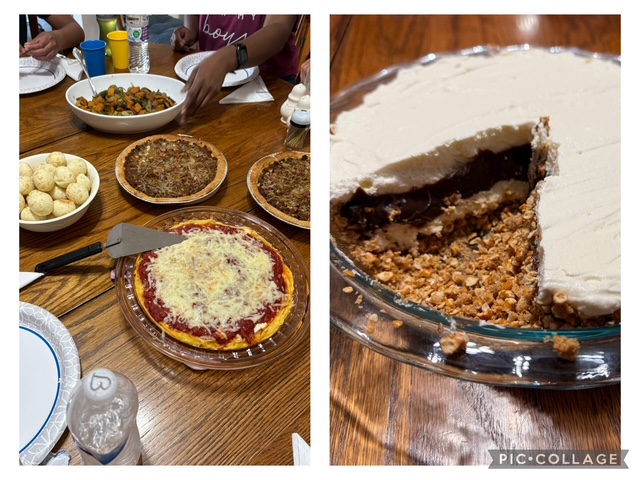
1. Pi Day. 3/14–the number of pi–is as good a day as any to have pies. 🙂 We started the morning with a breakfast quiche Mittu has sent over with Jason and Timothy when they came to watch the lunar eclipse the night before. Then I made spaghetti pie (thanks to a link from Susan) and Brazi bites while Mittu made hamburger pie, vegetables, and chocolate pretzel pie.

Pi Day

At some point during the night, I heard Mittu say she was glad she married into a family of nerds. 🙂

2. Winning a gift card. Speaking of Susan, I won an Amazon gift card from a give-away she had.

3. Safety in storms. One night this week, our area was predicted to receive severe storms and possibly tornadoes. Thankfully, all we got was some rain. But at one point when we had the TV on, we saw the local news channel had preempted all scheduled programming to cover the storms. They said a possible tornado was heading to the town where my youngest son lives. We called him to let him know and discussed the best places in his house to stay if a tornado did come. He only got hail. None of us lost power. We were very thankful.

4. Snail mail. With digestive issues from the antibiotics I’ve been taking, I haven’t been to church in a few weeks. A couple of sweet ladies sent me cards. Then my friend Dianna and I both mentioned liking a particular author (Michele Phoenix), and Dianna asked if I’d like to have some of her books by that author. I got her package and a lovely note last Friday.

5. Friends who pray. I’m so thankful to have friends I can email or text with prayer requests.

Bonus: The first day of spring. I’ve been looking forward to this for weeks. 🙂 Even though it was overcast and cool, it’s a promise of better weather to come!

How was your week?

Review: The Silmarillion

The Silmarillion by J. R. R. Tolkien is a collection of stories and history which precedes The Hobbit and The Lord of the Rings in its setting. Wikipedia says a draft of it was written after The Hobbit’s success, but it was rejected by the publisher. Tolkien went on to write The Lord of the Rings trilogy. After his death in 1973, his son, Christopher, edited, arranged, and added material to publish this book in 1977.

My volume has a foreword by Christopher, in which he says the notes and stories in The Silmarillion, though it wasn’t called that at the time, date back half a century earlier and were added to by his father even in his last years. Christopher writes that his father came to view this book as seeming like a compendium from different (fictional) characters, added to through the years. That helps account for differences of style and tone through the book. It also contains a few separate works and a short summary of The Lord of the Rings at the end. One of these stories was “The Rings of Power,” which the recent series is based on. Taken all together, this provides the history of Tolkien’s mythology.

This edition also contains a very long letter from Tolkien to an editor friend “justifying and explaining” why he thought The Silmarillion and the Lord of the Rings should be published together (for what it’s worth, I think it was wise to separate them). Christopher said he thought this letter was “a brilliant conception of his conception of the earlier ages,” so he included it here are well.

Tolkien says here that he dislikes allegory and writes in the style of myth and fairy tales, though he acknowledges both of those genres use allegorical language. These stories have to do with “Fall, Mortality, and the Machine,” though also with “Art (and Sub-creation) and Primary Reality.” (p. 2, Kindle version). He writes “I believe that legends and myths are largely made of ‘truth’, and indeed present aspects of it can only be received in this mode” (p. 2). C. S. Lewis said something similar: after he had written directly about spiritual truth in Mere Christianity and other books, he wove some of the same truths in stories.

The Silmarillion covers the first two “ages” of Tolkien’s stories, beginning with the creation of the world by Eru, also called Ilúvatar. The angelic-type being he created, the Ainur, then created other things through music. But “it came into the heart of one of them, Melkor [also called Morgoth], to interweave matters of his own imagining that were not in accord with the theme of Ilúvatar; for he sought therein to increase the power and glory of the part assigned to himself” (p. 4).

Some of the Ainur went to live on the world their music created. Later came Elves, called the Firstborn, and later still Men, called Followers.

Much of the book is good vs. evil, the rise and fall of individuals and empires. Some of it is written as history, but a few stories are interwoven.

I thought these lines were particularly apt:

Reward on earth is more dangerous for men than punishment! (p. 2).

There are three phases in their fall from grace. First acquiescence, obedience that is free and willing, though without complete understanding. Then for long they obey unwillingly, murmuring more and more openly. Finally they rebel–and a rift appears between the King’s men and rebels, and the small minority of persecuted Faithful (pp. 2-3).

The title comes from three rings, called the Silmarils crafted with the light of the Two Trees of Valinor before Melkor destroyed them. Melkor stole them and put them in his crown, but battles are fought for them later on.

In the latter part of the book, Sauron, something of a disciple of Melkor, becomes the main villain. He creates the “one ring to rule them all” which figures into The Lord of the Rings.

The wizards and hobbits don’t come into the story until the last few pages. Gandalf shares a line which will become a theme in LOTR: “Help shall oft come from the hands of the weak when the Wise falter” (p. 307).

I listened to the audiobook, read well by Andy Serkis, who played Gollum/Smeagol in the Peter Jackson LOTR films several years ago. I also have the Kindle version, and I think it might have been better to read it than listen to it. Though I enjoyed the audiobook, I found my attention wavering in the historical parts. Plus I think seeing all the names would have helped cement them in my mind.

Many individuals and groups have more than one name, which makes for some confusion at first.

Christopher Tolkien added an index of names as well as “family trees” of some of the main characters in the back of the book.

I was inspired to read this book after seeing the first two seasons of The Rings of Power. I’ll never be an expert on Tolkien lore, but that wasn’t my aim. There are several sites online where we can look up particular people, groups, or events in his books. But reading this did give me a better understanding of events in the LOTR. Some things clicked into place, like Aragorn’s heritage, the buried shards of a sword which are found in the later books, the ancestor of the evil giant spider Shelob, who attacks Frodo, the giant eagles who come to various people’s rescue, etc.

So, though this book doesn’t flow as well as The Hobbit and The Lord of the Rings, I’m glad I finally read it.

(I often link up with some of these bloggers.)

Why Doesn’t God Heal Everyone?

Why doesn't God heal everyone?

One of the greatest mysteries we grapple with is why God heals some people, but not others. A friend and I were discussing this recently. As usual, my thoughts continued long after our conversation, so I decided to share them here.

A few years ago, our pastor announced in June that he had liver and pancreatic cancer. He was gone before the end of summer. He was in his prime, pastoring a church with a love for his people that I have rarely seen matched. Two of his daughters got married that summer, and he was able to walk them both down the aisle. But he would have been a terrific grandfather in the coming years. He seemed to have so many years of usefulness left, it was puzzling that God took him home.

Another former pastor’s grandson underwent an excruciating battle with leukemia, which he eventually lost despite hundreds of people’s prayers.

Others experience disabilities for the rest of their lives, either from birth or from an accident or illness.

We can never know all of God’s reasons for what He allows. But here are a few:

We live in a fallen world affected by sin, so there will be illnesses and death until God redeems the earth. Christians aren’t exempt from these effects of the fall.

None of us is guaranteed a long life. We need to be ready for eternity.

God’s perspective. A seemingly early death is not a tragedy to God: it’s a head start on heaven as He welcomes His loved one home.

God enables us to minister to others through what we suffer. Joni Eareckson Tada has been paralyzed since a diving accident fifty-seven years ago. I don’t know of anyone who has done more to help the disabled community, bring awareness of what disabled people suffer, and glorify God in the midst of suffering. Those things probably would not have happened without her accident. When she speaks, we listen, because we know she has proven what she’s speaking about. She’s not mouthing empty platitudes or theories.

God’s strength is displayed through our weakness. Paul famously prayed three times for God to remove an affliction from him. But God answered, “My grace is sufficient for you, for my power is made perfect in weakness” (2 Corinthians 12:7-10).

Healing was not Jesus’ primary purpose. Jesus healed multitudes of people during His time on earth. He demonstrated compassion and power as He did so. But He said His purpose was to preach the gospel (Mark 2:32-39).

God’s glory displayed. When the disciples asked whether a man’s sins or those of his parents caused his blindness, Jesus said, “It was not that this man sinned, or his parents, but that the works of God might be displayed in him” John 9:1-7). Similarly, when Jesus received the news that Lazarus was sick, he said, “It is for the glory of God, so that the Son of God may be glorified through it” (John 11:1-4).

Jesus wasn’t grandstanding. He wanted to show people who He was so they could believe.

Since Jesus is glorified through healing, it’s even more puzzling that He would not heal everyone. But sometimes He is glorified more by displaying His grace through His people’s trials, as He did in Joni and Paul’s lives.

Suffering strengthens and develops us. The apostle Paul wrote, “We rejoice in our sufferings, knowing that suffering produces endurance, and endurance produces character, and character produces hope, and hope does not put us to shame, because God’s love has been poured into our hearts through the Holy Spirit who has been given to us.”

Trials keep us dependent upon the Lord. We always are dependent on God, but sometimes we forget. Sometimes we need His help in areas other people never think about, but that continual dependence is a good reminder that our strength comes from Him. Paul said his “thorn in the flesh” was given so that he might not become conceited over the revelations that had been given to him.

Suffering prepares us for glory. Paul wrote to the Corinthians, “So we do not lose heart. Though our outer self is wasting away, our inner self is being renewed day by day. For this light momentary affliction is preparing for us an eternal weight of glory beyond all comparison, as we look not to the things that are seen but to the things that are unseen. For the things that are seen are transient, but the things that are unseen are eternal.” Paul is not being dismissive when he calls our afflictions “light.” He’s saying that they’ll seem light compared to the glory to come.

Though all of these factors help at times, they don’t satisfy at other times. I’ve been ministered to by what Amy Carmichael wrote in Rose From Brier (emphasis mine):

But, though, indeed, we know that pain nobly born strengthens the soul, knits hearts together, leads to unselfish sacrifice (and we could not spare from our lives the Christ of the Cross), yet, when the raw nerve in our own flesh is touched, we know, with a knowledge that penetrates to a place which these words cannot reach, that our question is not answered. It is only pushed farther back, for why should that be the way of strength, and why need hearts be knit together by such sharp knitting needles, and who would not willingly choose relief rather than the pity of the pitiful?

…What, then, is the answer? I do not know. I believe that it is one of the secret things of the Lord, which will not be opened to us till we see Him who endured the Cross, see the scars in His hands and feet and side, see Him, our Beloved, face to face. I believe that in that revelation of love, which is far past our understanding now, we shall “understand even as all along we have been understood.”

And till then? What does a child do whose mother or father allows something to be done which it cannot understand? There is only one way of peace. It is the child’s way. The loving child trusts.

I believe that we who know our God, and have proved Him good past telling, will find rest there. The faith of the child rests on the character it knows. So may ours, so shall ours. Our Father does not explain, nor does He assure us as we long to be assured… But we know our Father. We know His character. Somehow, somewhere, the wrong must be put right; how we do not know, only we know that, because He is what He is, anything else is inconceivable. For the word sent to the man whose soul was among lions and who was soon to be done to death, unsuccored, though the Lord of Daniel was so near, is fathomless: “And blessed is he whosoever shall not be offended in me.”

There is only one place we can receive, not an answer to our questions, but peace — that place is Calvary. An hour at the foot of the Cross steadies the soul as nothing else can. “O Christ beloved, Thy Calvary stills all our questions.” Love that loves like that can be trusted about this.

Perhaps we wouldn’t be able to understand even if God did explain why He allows such severe pain and loss. But the more we know Him, the better we can trust Him. Like the psalmists, we can pour out our anguish to Him, then remind ourselves of His love and mercy and care for us.

Psalm 46:1

(I often link up with some of these bloggers.)

Laudable Linkage

Laudable Linkage

I went from just a few shared reads last week to a longer list today. I hope you’ll find something of interest here, along with some time to read.

That’s Just Your Interpretation,” HT to Challies. “This is a common response when discussing Scripture, isn’t it? ‘That’s just your interpretation!’ No matter how clearly the Bible speaks, this objection seems to persist. But is it true? Can we really understand the Bible? This question takes us to the heart of the Christian faith and invites us into a discussion about the clarity and authority of God’s Word.”

Ten Truths to Empower Your Prayer Life. “My introduction to prayer came at the age of seven. I was spending the weekend with my grandmother and had slept beside her, snuggled deep into the covers. As the early morning light filtered through the curtains of her bedroom window, the sound of her whispered prayer broke through the fog of my fading sleep. . . . In the years since then, I’ve learned much about this sacred privilege. Today, I’d like to share ten truths I’ve sought to apply in my own prayer life.”

The Greatest Show: Is Your Faith Performance? “The desire to have a godly reputation isn’t wrong, but the danger comes when our focus shifts from genuine transformation in Christ to carefully crafted perception. It’s a tale as old as time and worth pausing to ask: do you care more about appearing faithful, gracious, and surrendered to Christ than actually walking in an authentic relationship with Jesus?”

Be Faithful Over Little: A Different Vision for a Life That Counts, HT to Redeeming Productivity. “But God hasn’t purposed for most people to be world-shapers. The vast majority of our faithfulness and work for the Lord will be exercised in the small, often boring, and monotonous rhythms of life.”

Between Two Worlds: Suffering, Safety, and the Cross, HT to Andrew Le Peau. “The predominant institutional approach to suffering is often one of avoidance—from institutional marketing that equates flourishing with the absence of suffering to personal postures that treat suffering as an unwelcome and harmful interruption in one’s development. Institutions can lessen burdens but not eliminate suffering. No mentor, policy, program, or system can insulate students from grief, disappointment, or hardship. A culture increasingly focused on removing discomfort does not necessarily make people stronger; it often leaves them more anxious and unprepared for suffering when it inevitably comes.”

A Denier Redirected: Living Out the Greatness. This discussion about living in a godly way in an ungodly society dovetails with my own reading about Daniel and how he did so.

This Vice Is One of the Key Predictors of Divorce: Yet, It Is Oddly Understudied. It’s a vice running rampant in society these days.

Coming of Age. “You could tell me that no matter what a mother loves her children, but it takes a story to show me how painful that could be and what it means. Or maybe you tell me that it’s good for my children to suffer losses and failures; that they’ll learn how to pick themselves up if they only get to experience life’s challenges. I’d say it makes sense but it takes a story for me to understand the real value behind it. I could learn as I go and fumble blindly along the way, or I could walk in the shoes of many mothers who’ve gone ahead of me and have a story to tell me of how to become the mom of adults.”

What Did We Gain and Lose by Livestreaming? HT to Challies. “What began as a temporary necessity has become an expected staple of the church’s ministry. As people began returning to worship, committees and the session debated whether livestreaming should continue. If so, for how long, and for what purpose?”

C. S. Lewis quote

Obedience is the key to all doors: feelings come (or don’t come) and go as God pleases. We can’t produce them at will and mustn’t try.–C. S. Lewis

Friday’s Fave Five

Friday's Fave Five

It’s been a fairly low-key week, but a pleasant one. I’m joining Susanne and friends at Living to Tell the Story, not just to “look on the bright side,” but to cultivate gratitude in large and small happenings on good and bad days.

1. First daffodils of the season! They’re not my favorite flower, but they’re the first ones that bloom in our yard. They’re a sign that spring is almost here! For that and their cheerful look, I love them.

2. Dinner and flowers. Jason and Mittu brought over some barbecued chicken, macaroni and cheese, and salad as well as miniature pink roses one night.

3. Health Progress. Thanks so much for your prayers and kind words last week. I’m on a second round of antibiotics for the cellulitis. I saw the doctor for a follow-up visit Thursday, and he was pleased with how it looked. It’s hard for me to tell, because it looks better one hour and worse the next. So it was reassuring that he thought it was headed in the right direction. My prayer is for continued healing and that I won’t have to take a third round of antibiotics.

4. File organization. My desk has a built-in file drawer, and I realized that much of its content was not the kind of thing I needed close at hand. Plus, I wanted to make room for other things I did want close by. I was finally able to work on that this week, sorting through the files, throwing some things away or finding another home for them, and clearing some things off my desk into the newly created space..

5. The lunar eclipse. I figured my husband and I would wake up from our pre-bedtime naps on the couch in time to see something of the lunar eclipse. But then Timothy asked if he and Jason could come over and watch it here and then sleep in the RV. So the guys had kind of a watch party, complete with Jim’s telescope, portable fire pit, and s’mores. I went out around 2 a.m., when the moon was about 3/4 eclipsed.

How was your second week of March?

Review: What’s a (Dis)Organized Person to Do?

What's a Disorganized Person to Do?

Stacey Platt’s What’s a (Dis)Organized Person to Do? is subtitled 317 Ideas, Tips, Projects, and Lists to Unclutter Your Home and Streamline Your Life.

Stacey is a professional organizer and runs a company in New York with a wide variety of clients. One reviewer described this book as an organizer’s Pinterest board.

The book is organized according to different rooms in a house, except that the last chapter deals with trips and moves. Yet within each chapter are tips not just for the physical objects there, but for saving time and energy. Scattered throughout the book are one-hour projects, like organizing under the sink, the junk drawer, the bathroom vanity, or making a master grocery list.

I appreciated that the book was filled with specific tips, though some principles were discussed. Many books on organizing/productivity/time management that I have read are filled with broad principles, or are so rigidly organized as a whole system that they are overwhelming. This books lets you pick and choose what works best for you.

The book is probably meant to be dipped into as a reference resource rather than read straight through as I did. But I didn’t want to miss anything. 🙂

Some of the tips didn’t appeal to me; some I already used; some seemed like overkill. A few were outdated (this book was written in 2010. But I marked many tips to remember.

This appears to be the only book Stacey has written. I didn’t find a website for her. I did find one with her company name, but I am not sure it’s hers.

I can recommend this book as a good resource if you’re looking for organizational tips.

Let the Humbleness of Jesus Deflate Our Pride

Let the humbleness of Jesus deflate our pride

It’s strange that we’re so prone to pride. We didn’t create ourselves; we have nothing that we weren’t given. “What do you have that you did not receive? If then you received it, why do you boast as if you did not receive it?” (! Corinthians 4:7).

Even when we do something for the Lord, we have to be careful of wanting notice and praise.

It’s not wrong to want to please our loved ones or to know whether we’ve done a good job. C. S. Lewis clarified in Mere Christianity: “Pleasure in being praised is not Pride. The child who is patted on the back for doing a lesson well, the woman whose beauty is praised by her lover, the saved soul to whom Christ says, ‘Well done,’ are pleased and ought to be. For here the pleasure lies not in what you are but in the fact that you have pleased someone you wanted (and rightly wanted) to please. The trouble begins when you pass from thinking, ‘I have pleased him; all is well,’ to thinking, ‘What a fine person I must be to have done it.'”

I’m not sure if pride is one of Satan’s temptations because that seems to be his first sin, or because he knows it is one of the things God hates most (Proverbs 8:13).

Or maybe we wrestle with pride because of our flesh, what the Bible calls “the old man,” which is in rebellion to God. “For the desires of the flesh are against the Spirit, and the desires of the Spirit are against the flesh, for these are opposed to each other, to keep you from doing the things you want to do” (Galatians 5:17).

Looking up passages about pride and humility are a big help in keeping the right perspective. But recently I heard another avenue of thinking that shed new light.

I had the radio on earlier than usual one morning and caught part of a program called Glad Tidings with J. Allen Blair about pride. He pointed out the insidious nature of pride and the fact that we can’t overcome it without Christ. He shared Philippians 2:5-8:

Have this mind among yourselves, which is yours in Christ Jesus, who, though he was in the form of God, did not count equality with God a thing to be grasped, but emptied himself, by taking the form of a servant, being born in the likeness of men. And being found in human form, he humbled himself by becoming obedient to the point of death, even death on a cross.

To have His mindset, to humble ourselves like He did, Mr. Blair pointed out several aspects of Jesus’ humility contrasted with areas we usually take pride in:

  • Pride of birth. When Jesus came back to His hometown, people said, “‘Is not this the carpenter’s son? Is not his mother called Mary? And are not his brothers James and Joseph and Simon and Judas? And are not all his sisters with us? Where then did this man get all these things?’ And they took offense at him” (Matthew 13:55-57).
  • Pride of wealth. Jesus said of Himself, “The Son of Man has nowhere to lay his head” (Luke 9:58).
  • Pride of respectability. It was said of Jesus, “Can anything good come out of Nazareth?” (John 1:46).
  • Pride of personal appearance. “He had no form or majesty that we should look at him, and no beauty that we should desire him” (Isaiah 53:2).
  • Pride of reputation. Jesus was said to be “a friend of tax collectors and sinners” (Matthew 11:19).
  • Pride of learning. People asked about Jesus, “How has this man become learned, not having been educated?” (John 7:15, NASB).
  • Pride of superiority. Jesus said, “I am among you as the one who serves’ (Luke 22:27).
  • Pride of success. Jesus “came to his own, and his own people did not receive him” (John 1:11).
  • Pride of ability. Jesus said, “I can of mine own self do nothing” (John 5:30).
  • Pride of self-will. Jesus said, “I seek not my own will but the will of him who sent me” (John 5:30).
  • Pride of intellect. Jesus said, “As the Father taught me, I speak these things” (John 8:28).
  • Pride of death. Jesus “humbled himself by becoming obedient to the point of death, even death on a cross” (Philippians 2:8).

If anyone ever had a right to be proud, it would be Jesus. But Mr. Blair points out that “There is no trace of pride in Him.”

2 Corinthians 3:18 says that as we behold Christ, we’re changed to be like Him. 

When we’re tempted to have an inflated view of ourselves and our accomplishments, let’s look at Christ.

He’s the Lord of glory, but He described himself as “gentle and lowly in heart” (Matthew 11:29).

He didn’t demand accolades. He “came not to be served but to serve, and to give his life as a ransom for many” (Matthew 20:28). He served, healed, taught, and put up with unbelief and gossip.

He left the glories of heaven, took on a human body, and came to a world that was opposed to Him. “For you know the grace of our Lord Jesus Christ, that though he was rich, yet for your sake he became poor, so that you by his poverty might become rich.” (2 Corinthians 8:9).

 He gave Himself to die on the cross for our sins and rise again to defeat death. “He humbled himself by becoming obedient to the point of death, even death on a cross,” considered one of the most shameful kinds of deaths (Philippians 2:8). 

May we have His mind, His humility, His focus on serving others at great cost to Himself. 

Philippians 2:5

(I often link up with some of these bloggers.)

Laudable Linkage

Laudable Linkage

I have just a short list of good reads to share with you today:

Own Your Faith, HT to Challies. “If God has gifted you with a healthy church and parents that love Christ, be so thankful! See your own faith as connected to theirs, but not dependent. They labored hard so that you would leave and be a beacon for Christ on your own. They desire to see you making godly choices. They want you to make the decision to wake up early and seek God’s face. The time for hand-holding is over. Your parents won’t stand before the judgement seat of Christ for you.”

The Most Profound Aspect of Jesus Saying “I Never Knew You. “Most of the time, the lesson we derive from Matthew 7:21-23 is that there will be people who believe they have a right to enter the Kingdom based upon their religious activities and behavior, but will be rejected. This interpretation is true, but in stopping there we miss something.”

The Supremacy of Christ in Repentance: Understanding True Sorrow vs. Worldly Regret. “There is a significant difference between natural regret and Spirit-driven repentance, between emotional sadness and spiritual surrender. The flesh can feel remorse, acknowledge sin, and feel shame. You can regret in an emotional or intellectual way, but that doesn’t make sorrow spiritual. You can regret sin without having a change of heart. Godly sorrow responds to God’s view of sin. It’s looking at God’s perspective on my sin. It’s vertically oriented—God-ward.”

How to Pray for an Unmet Desire, HT to Challies. “In His most famous of sermons, Jesus tells us to pray, assuring us that the heavenly Father won’t give us a stone when we ask for bread. But sometimes that bread just seems so long in coming. How could a good Father withhold a good thing from His child? After all, our earthly, sinful fathers would never ask their child to starve when they had the means and ability to provide food. How are we to respond in these seasons? What should our prayers look like?”

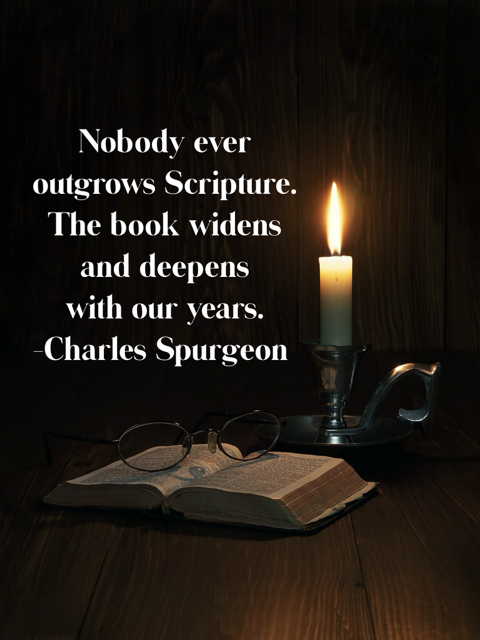
We never outgrow the Bible

Nobody ever outgrows Scripture. The book widens and deepens with our years.
–Charles Spurgeon.

Friday’s Fave Five

Friday's Fave Five

Though it’s not quite spring yet, and we still have some cold temperatures ahead, I’m ready to put aside the winter graphics and use spring-like ones. No matter what the season or weather, there are always blessings to be found along the way. Some of us share weekly with Susanne and friends at Living to Tell the Story. Feel free to join in!
1. Men’s prayer breakfasts have been one of Jim’s best ways to get to know other men in some former churches we’ve attended. Some men will come to something like that when they won’t come to other things. Plus there’s more time for conversation and getting to know each other in that setting. It’s hard to “go deep” in Bible study with people you hardly know. He suggested starting one here. They had their first get-together this last Saturday, and around 25 men came.

2. Dinner brought over by Jason and Mittu. They had found some pre-seasoned carne asada beef, I think at Costo, and served it over Spanish rice. It was very good! Plus it was nice to see them and not have to cook dinner.

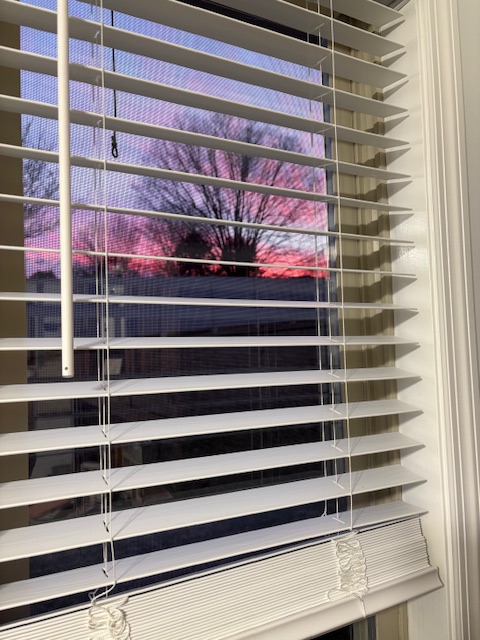
3. Sunrise. I don’t usually catch a glimpse of the sunrise, but I did one morning when heading to my desk. I didn’t want to go out in the cold, but wanted to get a photo. Even through the blinds and screen, it was lovely.

Sunrise

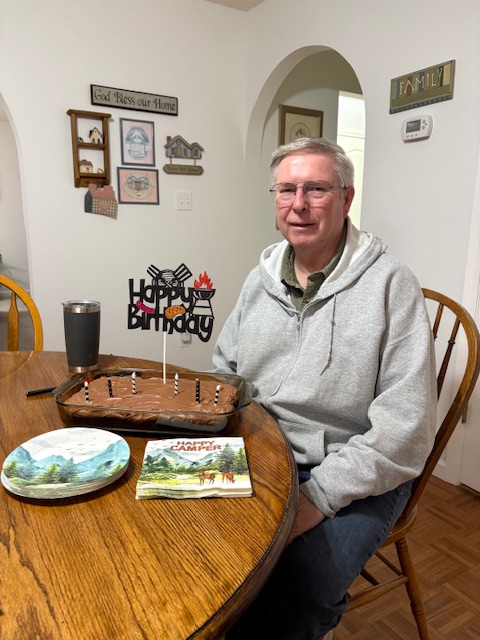
4. Jim’s birthday. It’s always a joy to celebrate my dear Husband. I am so thankful for him. We had lasagna, salad, and chocolate cake.

Jim's birthday

5. Encouragement. I’m battling another round of cellulitis this week. Some of you may remember I had an ordeal with that last year. I was discouraged that it happened again, especially after seeing early signs and praying it wouldn’t develop. And then I did something to my back one day. There are people dealing with much worse things, I know. One morning when I was particularly down, Daily Light on the Daily Path was particularly encouraging, as well as various things online and on the radio. God doesn’t always answer prayer just the way we would like, but He does care and walks with us.