Happy Independence Day!

free-indeed800

I discovered the following on the back of a church bulletin in a box I was cleaning out. It was written by a former pastor of our family’s, Jesse L. Boyd, for whom our son, Jesse, was named.

Are Your Free?

One of the frequent cries of our day is, “I want to be free.” Well, what is freedom? It is not the living of life without restraints of law.

It is not licentiousness or immorality, because their slimy arms can soon wrap us up in their dark and dismal prison-house of suffering.

It is not the lack of government, but rather the privilege of having the right of freely enjoying one’s own government.

It is true Americanism: founded on the Holy Bible, bequeathed to us by our forefathers, and symbolized in Old Glory — The Star-Spangled Banner — “Oh, long may it wave o’er the land of the free, and the home of the brave.”

It is the privilege of spending one’s treasure, of spilling one’s blood, and of being prompted by the spirit of liberty to stand against despotism and tyranny.

It is liberty and loyalty combined.

It is the enjoyment of civil and religious liberty.

It is the title to justice.

It is living as one should; no wicked man lives as he should, therefore, he is never free.

It is having full mastery over all matter.

Freedom ends where tyranny begins.

It comes by mastering one’s self.

It comes through knowing the truth. “Ye shall know the truth, and the truth shall make you free” (John 8:32).

It comes through receiving Jesus Christ as Lord and Saviour. “If the Son therefore shall make you free, ye shall be free indeed” (John 8:36). “It was for freedom that Christ set us free; therefore keep standing firm and do not be subject again to a yoke of slavery” (Galatians 5:1, NAS). “For the law of the Spirit of life in Christ Jesus hath made me free from the law of sin and death” (Romans 8:2). Hallelujah! What a Saviour!

Freedom is that which one receives from God in the new birth. Man cannot govern himself, because, when all restraints are taken away, then evil dethrones him. He can only find rest (soul rest; freedom) in the arms of Jesus Christ. Are you free?

Friday’s Fave Five

FFF spring2It’s Friday, time to look back over the blessings of the week with Susanne at Living to Tell the Story and other friends. Here are some favorite parts of the last week:

1. Lunch out at Cheddar’s. Most of you know we usually have to bring take-out in rather than going out because we can’t leave my mother-in-law home alone. But last Saturday morning Jim and I were out while her morning caregiver was here, and it was lunch time and we were near Cheddar’s, so he suggested we go there. Jason, Mittu, and Timothy were with us and Jesse joined us. That’s one of my favorite places, and we usually only go there once a year for my birthday, so it was a treat in many ways.

2. Cooler temperatures. It was overcast the first part of the week and rainy the latter part, providing a welcome break from the summer heat. The rain has been watering my plants for me as well.

3. Hershey’s miniatures. Chocolate sweetness in small portions. 🙂

4. Jim’s mom’s 87th birthday was Thursday, but we’re celebrating Friday when everyone’s off for the Fourth – Jason and Jesse work different shifts, making it hard to do things on week nights.

5. Friday off. With Independence Day falling on a Saturday this year, everyone has Friday off. Love 3-day weekends.

Happy Friday, and Happy 4th of July!

Book Review: Walking With God in the Season of Motherhood

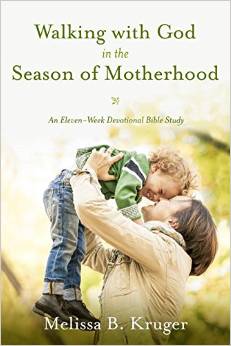
Walking With GodI first saw Walking With God in the Season of Motherhood by Melissa B. Kruger when someone linked to her blog, and I saw this story of how the book came to be written. I thought it might be a good book to pass along to young moms, but I found much for my own heart, though my children are all grown.

This study grew out of Melissa’s desire for “a Bible study that intersected who I was as a believer with the role I had been given as a mother.” It’s not necessarily a “how to be a better parent” study. It’s more of a “how to walk with God and then let that relationship impact your ministry to your children” study.

She begins with our purpose – to glorify God and enjoy Him forever – then reminds us of our responsibility to teach the same to our children and our inability to do so for ourselves or for them on our own. Succeeding chapters discuss walking in faith, wisdom, prayer, carefulness, and then each facet of the fruit of the Spirit, ending with a discussion of the Perfect Mom Syndrome.

The study is laid out over eleven weeks, with four days of study per week and a fifth wrap-up summary of the truths covered in that week. I really like that the Bible verses are included within the study, so a busy mom trying to feed a baby or grab a few minutes of study while waiting for piano lessons or ball practice to end has everything needed right there within the book. There is an additional study guide at the back that would be great for a group study but is also helpful for personal use.

I have several quotes marked but will try to pull out just a few:

It is important to assess regularly whether my family is suffering from an overly busy calendar. However, rather than simply removing activities, my greatest need is to add one particular meeting to my schedule. Every day I need time with Jesus. While it seems counterintuitive, the addition of this one meeting promises to positively affect every other part of my day (pp. 30-31).

When impatience, anger, or discontent well up in our hearts, these are signs that we are mothering in our own strength. Rather than dealing only with our outward behavior, we need the Lord to renew and recharge our hearts…our souls find renewed energy only by abiding in Jesus. Without this time we will find ourselves depleted, discouraged, and unable to bear fruit (p. 33).

[Re the Proverbs 31 woman], We can view her as an older woman to learn from rather than a standard against which to measure ourselves (p. 73).

An additional benefit of a home at peace is that it overflows into loving care and service for our community. The goal is not to create a place to escape or avoid the world but to carefully build our home so that it is a light to the world, shining the grace of Christ to those who are without hope. A peaceful home offers a place of respite and care in the midst of a weary world (p. 76).

When we receive the abundant love of Christ, we are free to pursue others with love, not to gain their affection but to give back what we have already received (p. 93).

True joy does not discount real suffering; it shines all the greater in the midst of it (p. 115).

The ability to extend kindness requires an other-awareness. We are apt to miss the needs of those around us if we remain self-focused. Helping children to see the needs of others will bless them with perspective on their own lives, as well as propel them toward good works that display the kindness of God (p. 157).

God uses these moments to grow our hearts in grace. We can only bear the fruit of patience when we have something to be patient about (p. 164).

In Jesus the performance pendulum stops — both the pride of success and the despair of failure are absorbed by grace (p. 208).

I cannot protect my children from my weaknesses. As hard as I may try, at some point my sin will affect their lives. However, the way I deal with my failure can provide an example for them to follow. I am a sinner raising sinners. Each of my children will face the weight and sorrow of his or her own sins. Just as we teach daily hygiene habits like brushing teeth, our children need instruction on how to find cleansing for their souls. By teaching our children about confession and repentance as well as grace and forgiveness, we bless their lives for years to come (p. 213).

At some points the study seemed a bit long, both in number of weeks and in how long it took to complete the day’s reading and answer the questions. But it’s not, really – eleven weeks is a good length of time for a study. I went through the book in less time than that because I used it six days a week and went on to the next chapter after finishing one rather than reading one chapter per week, but I think the latter would be the better course, to really soak in the truths for that week before going on. And each day’s lesson only took about fifteen minutes. One could spend longer – I tend to answer the basic questions in writing but answer some of the more thoughtful ones in my head. If one did more with the writing sections, one could spend more time with each lesson. And if a day’s reading and questions take more time than one has, there is no reason you can’t take a couple of days or whatever time is needed to complete it. It’s better to go at one’s own pace and really dig into it than barrel through just to get it done. Melissa’s summaries at the end of each week’s lessons really help to review the material and help tie it all together.

I really enjoyed going through this study, found it very beneficial, and am happy to recommend it to you in whatever season you are in.

(This review will also be linked to Semicolon‘s Saturday Review of Books.)

Book Review: The Captive Maiden

Captive MaidenThe Captive Maiden by Melanie Dickerson is a retelling of Cinderella set in Germany of the 1400s. Gisela’s father has died and her step-mother has taken over and treats Gisela like a servant. While Gisela submits when she has to, she is spirited and uncowed When a big tournament is held in town, Gisela sneaks away to see the games and unexpectedly runs into Valten, the duke’s son. They had met years ago when she was seven and he and his father had bought one of her father’s horses, and she has thought about him ever since.

Valten is the older brother of Gabe from The Fairest Beauty but quite different in personality. Where Gabe is glib-tongued, especially with the ladies, Valten never knows quite what to say and seems aloof. Valten excels at winning tournaments, particularly in jousting, but is beginning to think there has to be something else in life.

Valten also has an enemy in Ruexner, his main challenger in the tournaments. When Ruexner observes that Valten has an interest in Gisela, Ruexner sees her as a means of getting back at Valten. And of course Gisela’s step-mother hinders her attempts to pursue a relationship with Valten, so, to paraphrase Shakespeare, the course of their true love is not going to run smoothly. But I won’t spoil the details.

Along the way, Valten has to realize that he needs to rely on God’s strength rather that his own, and they both have to wrestle with the vengeance belonging to the Lord rather than being theirs to exact.

I didn’t think the writing in this story flowed quite as smoothly as in some of Melanie’s other books, and, although it is normal for couples to have some misunderstandings at first as they are getting to know each other and learning to read each other, the misunderstandings and misreadings here seemed excessive. But overall I did enjoy the story. I think anyone who likes fairy tale retellings and/or clean Christian romances would like this book.

(This review will also be linked to Semicolon‘s Saturday Review of Books.)

Laudable Linkage

It has been a while since I’ve shared interesting reads I’ve come across online. Here are some from the last few weeks:

Moms With Hands Full Need the Church.

I’m Grateful That Lady Forced a Bible On Me, HT to Challies. “We have this idea that doing something significant for God requires huge planning, red letters in the sky, a parting of the sea, signs and wonders. But the truth is, He’s working through us in ways we could never arrange on our own.”

No Disappointment in Jesus? HT to Story Warren. “It’s in life, in the real world, down here where things do and do not pan out, that the just are supposed to live by faith. When we are honestly disappointed in the way the God we trusted has handled things, when what has happened was not at all what we wanted—then statements like “Not my will but thine be done” have powerful meaning. What a sinewy kind of trust old John the Baptist had as he lay in chains—captive, doomed, lonely, blessed, and not offended.”

Are You Letting Your Kids Walk All Over You?

I Don’t Know What to Say. What’s helpful and not helpful when someone is grieving.

What I Learned From Elisabeth Elliot in Her Last Years.

Elisabeth Elliot’s Writings. Ann gives a good overview.

Staring at Dementia, Fighting For Joy.

Where’ve You Been? Story behind a touching and beautiful song about a man’s grandparents, one with Alzheimer’s.

How Can I Have a Successful Blog While Raising Little Kids?

Father’s Days: A Cartoonist’s Journey Into First Time Fatherhood of a baby with a severe illness.

7 Things You Need to Know About Medicare But Probably Don’t.

A boy’s stuffed tiger goes on a grand adventure at Tampa International Airport. Thought this was so cute and sweet!

Of course, yesterday’s Supreme Court ruling is on many minds and hearts. I’m still processing the news and don’t know whether I’ll say any more about it, but the best posts I’ve read so far are But What Does the Bible Say? by Kevin DeYoung and CBMW’s Official Response to the SCOTUS Ruling, and then Nancy Leigh DeMoss has a video response here.

Melanie shared this recently – a real-life illustration of the sheep knowing their shepherd’s voice:

I don’t know how many of you are familiar with Ron Hamilton, aka “Patch the Pirate.” He’s fairly well known in the Southeast. I love this arrangement of his song. Ben Everson is a master at these mutli-harmony things:

Happy Saturday!

Friday’s Fave Five

FFF spring2It’s Friday, time to look back over the blessings of the week with Susanne at Living to Tell the Story and other friends. Here are some favorite parts of the last week:

1. Surprise breakfast. Jason and Mittu had surprised us on Mother’s Day with breakfast and wanted to do the same for Father’s Day. Only this time they brought it on Saturday, for a number of reasons: so it would be even more unexpected; because they got Chick-Fil-A biscuits, and that restaurant is closed on Sundays; and so that the time would be more relaxed and open-ended. Besides the biscuits and some sausage links, Mittu also made these pineapple-upside-down muffins/cupcakes:

IMG_1228

2. Father’s Day: Unfortunately I wasn’t able to get to the computer on Father’s Day weekend to make a post for that day, but I do enjoy the time of celebrating and appreciating the fathers in my life, including my father and father-in-law in heaven, my stepfather, my husband, and my middle son. It was fun, too, to see the tributes and photos friends posted on Facebook that day.

3. Wednesdays. I mentioned that we had started hospice care for my m-i-l, and the first couple of weeks involved having a host of people coming by. I admit I was getting a little frustrated tending the (seemingly) revolving door and not being able to get anything else done or even think straight some days. But it looks like things are settling into a routine now, and it looks like Wednesday will be the day no one comes (besides weekends. They don’t come then unless something comes up). It felt so blissful this last Wednesday. I do appreciate their services, but it is nice to have a day with no visitors.

4. Different colored hydrangea blooms. I had mentioned before that my hydrangea bush is finally blossoming well this year, and I was delighted to find both blue and lavender flowers on it recently.

IMG_1247

5. Air conditioning. It’s that time of year when a trip to Wal-Mart or 15 minutes outside watering plants leaves me drenched in sweat. It’s so nice to come into coolness at those times – and to stay in it most days. 🙂

What are some favorite parts of your week? If you’d like to fellowship with some other bloggers counting their blessings, join us at Susanne‘s.

Adventures in Elder Care

Eldercare

Seven years ago my husband and I moved his mother 2,000 miles to be near us when she couldn’t live on her own any more. She lived in three separate assisted living facilities, a nursing home, and then came home to live with us about 2 years ago. In the posts below I detail some of that journey and pass along tips and truths that have helped us during this time. I hope you will find something to help you in your journey as well.

Helping Parents As They Age.

12 Things You Should Know About Caring for the Elderly.

Decisions.

Assisted Living and Nursing Homes.

The Introvert in Assisted Living (Ideas for one on one activities)

Caring For a Parent at Home.

Dealing With Caregiver Resentment.

A few more thoughts about caregiver resentment.

A Plea to Caregivers

Ministering To the Elderly and Their Caregivers.

It’s Not for Nothing.

Am I Doing Any Good?

But That’s Not My Spiritual Gift!

Remembering the Loved One Who Has Forgotten You

Bible Verses For Caregivers

Save

Save

Book Review: The Little Prince

the-little-prince.jpegThe Little Prince by Antoine de Saint-Exupéry was chosen by Amy for Carrie‘s Reading to Know Classics Book Club for June, and, at 85 pages, also happened to fit the novella or short classic category for my Back to the Classics Challenge. I read the 70th anniversary edition, which, thankfully, my library had, and which also includes a CD of the story read by Viggo Mortenson (Aragorn in the LOTR films). I listened a bit to one CD just to see what it was like, but this is a book you definitely want to read rather than listen to because of the illustrations.

On the surface, the story opens with the narrator reminiscing that as a child, when he drew a picture of a boa constrictor digesting an elephant, grown-ups could only see it as a hat and advised him to stop drawing and concentrate on school subjects. “That is why I abandoned, at the age of six, a magnificent career as an artist. I had been discouraged by the failure of my drawing…Grown-ups never understand anything by themselves, and it is exhausting for children to have to provide explanations over and over again” (p. 2). As an adult he still showed people his drawing, but if they said they only saw a hat, he “would put myself on his level and talk about bridge and golf and politics and neckties” (p. 3).

So he felt pretty lonely and misunderstood until he crash-landed his plane in the Sahara Desert and met, in the middle of the isolation, a little prince. He had a hard time at first learning anything about the prince because he didn’t answer direct questions. The narrator had to pick up clues from things he said in passing, and in that way he learned that the prince was from an extremely small planet (the size of a house). But best of all, the prince understood his drawings.

Over the next eight days – the length of time the narrator’s water supply lasted while he tried to fix his plane – he learned more about the prince’s planet, travels to different planets and the odd people he met there, and his first excursions on Earth.

One gets the definite sense while reading that this story means more than the adventures of a little prince on his travels, yet the meaning isn’t entirely plain. I didn’t feel too bad about not being to make it out when I saw on SparkNotes and Wikipedia that there are differences of opinion among those who have read and studied the book since it was published 70 years ago. Some see in it elements of WWII, since it was written during that time, the dangerous baobob trees of the prince’s planet, which can “overgrow the whole planet. It’s roots pierce right through. And if the planet is too small, and if there are too many baobobs, they make it burst into pieces” (p. 15) representing Naziism. But some dispute that. There is more agreement that the vain rose that the prince cared for on his planet represents Saint-Exupéry’s wife. Some see it as “an allegory of Saint-Exupéry’s own life—his search for childhood certainties and interior peace, his mysticism, his belief in human courage and brotherhood…. but also an allusion to the tortured nature of their relationship” (Wikipedia). Some see it as “metaphor of the process of introspection itself, wherein two halves of the same person meet and learn from each other,” the narrator and the prince both representing aspects of Saint-Exupéry (SparkNotes). It adds to the mystique of the story that Saint-Exupéry was a pilot and did indeed crash-land in the desert once, and went missing while on a mission in his plane.

Whatever it means or represents, there are a few themes that come to the forefront. One is that “One sees clearly only with the heart. Anything essential is invisible to the eyes,” as a fox tells the prince. Another major theme is the problem of limited viewpoints. First there are the adults not understanding the narrator’s drawings, then one planet the prince visits is inhabited only by a king who only sees others as subjects to be ruled and acts toward them accordingly, and on another planet there is only a vain man who only sees others as admirers of himself, and so on. When the prince comes to Earth and lands in the desert and sees no other people, he asks a flower where they are. In her life she had only seen a few pass by, so she thought that’s all there were and that “The wind blows them away. They have no roots, which hampers them a good deal” (p. 52).

But to me the crux of the book is in the concept of “taming.” When the fox tells the prince he isn’t tamed, and the prince asks what “tamed” means, the fox replies:

“It is an act too often neglected,” said the fox. “It means to establish ties.”

“To establish ties?”

“Just that,” said the fox. “To me, you are still nothing more than a little boy who is just like a hundred thousand other little boys. And I have no need of you. And you, on your part, have no need of me. To you I am nothing more than a fox like a hundred thousand other foxes. But if you tame me, then we shall need each other. To me, you will be unique in all the world. To you, I shall be unique in all the world….”(p. 59).

He goes on to say that, “If you tame me, my life will be filled with sunshine. I’ll know the sound of footsteps that will be different from all the rest…If you come at four in the afternoon, I’ll begin to be happy by three” (pp. 60-61), and that from now on a wheat field, which means nothing to a fox since he doesn’t eat wheat, will remind him of the prince since his hair is the same color, “And I’ll love the sound of the wind in the wheat…” (p. 60). The fox also says, “It’s the time that you spent on your rose that makes your rose so important. . . . People have forgotten this truth, but you mustn’t forget it. You become responsible for what you’ve tamed. You’re responsible for your rose” (p. 64). The prince had thought his only rose was special until he comes across thousands of them on Earth. But the time and care he spent on it was what made it unique and special. So I think probably the biggest takeaway is that relationships (“creating ties”) are worth both the investment of time and care and then the pain when those with ties are apart, as the narrator himself discovers at the end. When the prince has to leave the fox, and the fox is sad, the prince tells him it’s his own fault for wanting to be tamed. When the fox admits he will weep when the prince goes, the prince asserts the fox got nothing out of being tamed. The fox replies, “I get something because of the color of the wheat” (p. 61). That statement in context is so poignant it almost makes me teary.

What I first thought of as an odd little tale that I couldn’t quite make sense of, now, after a couple of days of pondering, seems a very sweet and touching story about love and relationships. I love books that do that – make you think and unfold themselves long after the last page is turned.

(This review will also be linked to Semicolon‘s Saturday Review of Books.)

What’s On Your Nightstand: June 2015

 What's On Your NightstandThe folks at 5 Minutes For Books host What’s On Your Nightstand? the fourth Tuesday of each month in which we can share about the books we have been reading and/or plan to read.

This being the fourth Tuesday of June, it’s time for another Nightstand post:

Since last time I have completed:

Christy by Catherine Marshall for Carrie‘s Reading to Know Classics Book Club for May, reviewed here. Nice reread.

Growing Up Amish: A Memoir by Ira Wagler, nonfiction, reviewed here. Very enlightening.

Strait of Hormuz by Davis Bunn, reviewed here. Very exciting!

The Little Prince by Antoine de Saint-Exupéry for Carrie‘s Reading to Know Classics Book Club for June. Just finished Monday, hope to have a review up in a day or two. Somewhat strange – I am still processing it.

The Incorrigible Children of Ashton Place, Book 5: The Unmapped Sea by Maryrose Wood, audiobook, reviewed here. Funny and clever as usual for this series, but a bit sad as well (which is, hopefully, a set-up for everything to come right again in the next book).

The Fairest Beauty by Melanie Dickerson, reviewed here. Nice retelling of Snow White.

I’m currently reading:

Walking With God in the Season of Motherhood by Melissa B. Kruger

Little Dorrit by Charles Dickens

Pioneer Girl: The Annotated Autobiography by Laura Ingalls Wilder, edited by Pamela Smith Hill.

The Captive Maiden by Melanie Dickerson, a retelling of Cinderella

Next Up:

The Narnian by Alan Jacobs for both the Reading to Know Classics Book Club for July and the Chronicles of Narnia Reading Challenge, both hosted by Carrie. Maybe Live Like a Narnian by Joe Rigney for these as well. Either one will finish up my TBR Challenge list.

After Little Dorrit, I have five more classics to chose from for my Back to the Classics Challenge. Thinking about One Day in the Life of Ivan Denisovich by Aleksandr Solzhenitsyn next.

Then I have some new books acquired since Christmas that I’d like to get to:

A Captain’s Duty: Somali Pirates, Navy Seals, and Dangerous Days at Sea by Richard Phillips

The River and Child of Mine by Beverly Lewis

Unlimited by David Bunn

Running Scared: Fear, Worry, and the God of Rest by Edward T. Welch

I think that will keep me busy for a while. 🙂 Sherry ay Semicolon wrote last weekend of a 48-hour reading challenge she was participating in. That made me think how nice it would be to have a reading vacation, whether at home, on the beach, or in a cabin somewhere. I don’t think anyone else in my family would go for it, though.

Happy reading!

Friday’s Fave Five

FFF spring2

It’s Friday, time to look back over the blessings of the week with Susanne at Living to Tell the Story and other friends. Here are some favorite parts of the last week:

1. Meeting with hospice. I mentioned earlier this week that we had met with a hospice provider for Jim’s mom just to see what services they provided. Previously we thought you didn’t call them in until death was imminent, and Jim’s mom is in good health except for losing her ability to move, so she might live years yet. But they offer nursing and a number of other services that will be helpful in her final years. We’re especially thankful that we have access to a nurse that will come to the house and that they’ll call in her prescriptions so we don’t have to bundle her up and take her to the doctor’s office or call his office multiple times to get refills taken care of. It’s been a whirlwind this week with all the people they have (nurse, bath aide, social worker, chaplain) coming to visit, but hopefully things will settle down into a routine soon. Plus Medicare pays for it and even pays for some things that we had been paying for out of pocket, so that should help her funds last a little longer.

2. Lettuce. Our neighbor brought by some lettuce and kale from his garden. I think the two varieties of lettuce were romaine and buttercrunch. So we’ve been having salads all week with dinner. I was impressed that Jesse said he actually liked these salads, where before he had just tolerated them. I don’t know if it is due to these different varieties or due to the freshness – probably both. I’ve never had kale before and have tried to make kale chips, but they haven’t turned out well so far (overcooked and overseasoned the first time, though I followed a recipe online). If you have any good kale recipes, let me know! I haven’t tried it in a salad – it seems a little strong for that.

3. Lactose-free ice cream. I’ve been lactose-intolerant for about 17 years. (I’ve never quite understood why you can eat or use something all your life and then suddenly develop problems, but around the same time I developed a lactose intolerance and allergies to penicillin and sulfa). I take Lactaid tablets with some dairy foods, but ice cream and straight milk always caused the worst reactions, so I have avoided them even with Lactaid. But a few days ago I discovered a lactose-free ice cream:

IMG_1227

It’s good, but I’ve found I don’t really crave it like I thought I might after so long. it’s nice to have the option now anyway.

4. Reminiscing about Elisabeth Elliot. After reading that Elisabeth Elliot passed away this week, a lot of posts have popped up about her life and influence. One of my favorites was Do the next thing, one of her sayings. Her influence on me was very similar to this author’s.

5. More reading time. We don’t follow all that many TV shows, but most of them are off for the summer, so I’ve had more time to read in the evenings.

And a bonus: I posted this Sunday but wanted to again here. This is actually one of my daughter-in-law’s photos from several weeks ago and is one of my favorites. Love his smile!

Tim Toys

Hope you’ve had a good week as well!