What’s On Your Nightstand: July 2013

What's On Your NightstandThe folks at 5 Minutes For Books host What’s On Your Nightstand? the fourth Tuesday of each month in which we can share about the books we have been reading and/or plan to read.

Wow, it’s been another super busy month. Here’s what I’ve been reading and plan to read next.

Since last time I’ve finished:

Through Gates of Splendor, by Elizabeth Elliot, a missionary classic about the lives and deaths of Jim Elliot, Nate Saint, and their three friends who tried to reach a savage tribe in Ecuador, for Carrie’s Reading to Know Book Club for June, reviewed here.

The Hidden Art of Homemaking by Edith Schaeffer along with Cindy at Ordo Amoris who is hosting a read-along book club where we discuss a chapter at a time. My discussions are here.

The Incorrigible Children of Ashton Place, Book II: The Hidden Gallery by Maryrose Wood, reviewed here, another fun one.

The Magician’s Nephew by C. S. Lewis for Carrie‘s Chronicles of Narnia Reading Challenge, reviewed here.

Light From Heaven by Jan Karon, last of the Mitford series, via audiobook. I summed up all the Mitford books here.

I’m currently reading:

The Last Battle by C. S. Lewis for Carrie‘s Chronicles of Narnia Reading Challenge

The Fruitful Wife by Hayley DiMarco.

The Wedding Dress by Rachel Hauck.

Next up:

Invisible by Ginny Yttrup.

On Distant Shores, hot off the press by Sarah Sundin.

Gulp: Adventures on the Alimentary Canal by Mary Roach.

Daniel Deronda, by George Eliot for Carrie’s Reading to Know Book Club for August.

If I should finish those, I have others lined up and just have to decide which to delve into. 🙂

What’s on your nightstand?

The Hidden Art of Homemaking Book Club: Chapter 14; Environment

tea_table(Graphics courtesy of Julia Bettencourt)

We’re discussing The Hidden Art of Homemaking by Edith Schaeffer a chapter at a time at  The Hidden Art of Homemaking Book Club hosted by Cindy at Ordo Amoris.

The last chapter of the book is “Environment,” and I wasn’t sure what to expect from it at first. Edith had promoted involvement in nature and decried the “plasticness” of her era earlier in the book, so I assumed this chapter would be along those lines. But I suppose that would have been a bit redundant since she had already discussed those things, and I was delighted to find she was referring instead to the environment each of us creates through our personalities, outlook, etc., as well as how we keep and decorate our homes. Perhaps some would understand this better as an aura, though not in the New Age sense of the word.

I marked many long paragraphs in the book that would be too much to reproduce here, so let me see if I can pick out a few of the key thoughts.

We produce an environment other people have to live in. We should be conscious of the fact that this environment which we produce by our very ‘being’ can affect the people who live with us or work with us. The effect on them is something they cannot avoid. We should have thoughtfulness concerning our responsibility in this area. We should be artists in doing something about the environment we are creating – artists before God, of course. We have His help because we are artists in this sense, in the hands of the Holy Spirit; for if we are Christians, He is dwelling in us, and we can ask for His power to help us.

Here in this life, a Christian should be an environment which is helpful to the people with whom he lives. This is not just a matter of dress and tidiness but also of character and spiritual life. It is worth considering what sort of an “art form” we are. What sort of an environment do we drag in with us? How do we affect other people in their attitudes toward that which we are supposed to represent? (p. 212).

“We are either being what the Holy Spirit would have us be, or we are hindering His work in us and through us. As God created the world, He was creating an environment for man which, we are told, was ‘good.’…It was a good environment before sin entered to spoil it. But Christians, who are restored to relationship and fellowship with God, should ask that they might be an environment that is conducive to others wanting to come to God (p. 212).

I am sure that there is no place in the world where your message would not be enhanced by your making the place (whether tiny or large, a hut or a palace) orderly, artistic and beautiful with some form of creativity, some form of ‘art’ (p. 213).

I was just thinking today, not for the first time, that I get frustrated at sentimental prose which seems to indicate that one can either have a clean house or spend quality time with kids, and of course the more godly person chooses time with kids. But does it have to be either/or? Sure, there are times we get too task-oriented and have to remind ourselves that people are more important than to-do lists. But I think one of the best ways to avoid this dichotomy to to integrate fun and family time into work. I appreciate that in the Little House on the Prairie series, and though I’m not a big proponent of Amish culture, I do like that both in the home and the community people pitch in together to work. In that way children learn the satisfaction of seeing a job well done, learning new skills as they grow up, and fellowshipping with others at the same time. My mother-in-law was a great example of this: until she started to decline, she always had a cheerful industriousness about her, and I appreciate that that rubbed off on her youngest son. I’m afraid I let my own negative attitude about work rub off on my children, but on the other hand I think they do have pleasant memories of working on projects with their dad in particular.

One of Edith’s examples in the book is that of roommates and how the slovenly habits of one affect first the mood and then the motivation of the other. As Edith said in some of the quotes above, our “environment” can either lift someone up or drag them down.

It goes without saying, too, that ‘The Environment’, which is you should be an environment which speaks of the wonder of the Creator who made you (p. 213).

I want to thank Cindy for hosting this book club. I gleaned much, much more out of the book by just reading a chapter a week, writing up thoughts about it, seeing what others had to say and pondering sometimes different perspectives or emphases, and then thinking about it all through the week before the next chapter, than I would have just plowing through on my own. I am thinking that this extended working through a non-fiction book is a much better way or retaining what I read.

This has been at least my second time through the book – I may have read it more times than that, but I can’t remember. I’ve enjoyed going back over it once again.

Book Review: The Incorrigible Children of Ashton Place, Book 2: The Hidden Gallery

Hidden GalleryAfter I listened to Book 1 in The Incorrigible Children series, The Mysterious Howling (linked to my thoughts), I had to get the audiobook for Book 2: The Hidden Gallery. The children are not called incorrigible because they are disobedient, but their benefactor, Lord Ashton, has given them that name after he found them in the woods, deduced they had been raised by wolves, and brought them home. His wife was less than pleased, but hired a star graduate from Swanburne Academy for Poor Bright Females, Penelope Lumley, age fifteen, to be their governess in the first book. Miss Lumley genuinely cares about the children and has brought them a long way, though they still have some howling inclinations and the tendency to drool at the sight of small birds.

The Hidden Gallery opens with workmen repairing the damage caused by the mayhem in Book 1. The noise and bother causes Lady Ashton to take the whole family to London while the work is being done. Penelope enjoys taking the children to see the sites, but they do have some mishaps, such as when the children mistake the furry hat of a stoic guard at Buckingham Palace for a bear.

The also have an odd encounter with a gypsy soothsayer with a mysterious prognostication and meet a new friend in young Mr. Simon Harley-Dickinson (he of the “perfectly nice young face, waves of brown hair, finely formed features, gleam of genius,” p. 154), and Penelope receives some strange warnings and instructions from her former teacher and mentor, Miss Mortimer.

Some mysteries just hinted at in the first book are expanded upon a bit here, such as the similarity in color between Penelope’s hair and the children’s, Lord Ashton’s somewhat wolfish behavior and absences during full moons, and the mural in the attic whose likeness appears in an art gallery, but we don’t seem to be close to finding answers for them nor the questions of what happened to the children’s parents nor Miss Lumley’s. I don’t know what the long term plans are for this series – I know Book 3 is out and Book 4 is due in December – but I’d rather have a short, really good series than have some of these questions dragged on for 8 or 10 books. But if the rest of the books are as fun as the first two, I don’t suppose people will complain too much, and it will be an enjoyable ride.

There are more pithy sayings from Swanburne Academy for Poor Bright Females’ founder, Agatha Swanburne, sprinkled throughout the book (such as “She who waits for the perfect moment to act will never make a turn at a busy intersection”) and apt descriptions (“If you have ever ridden on a tire swing after turning the rope ’round and ’round until it was twisted from top to bottom, you will have some idea of the wild, spinning, escalating whirl of Lady Contstance’s distress,” p. 5). Author Maryrose Wood also offers some amusing asides of instructions to her younger readers, such as the difference between high dudgeon and dungeon, or the meaning of some French phrases, and then refers back to these throughout the book.

Katherine Kellgren did another wonderful job narrating, and I enjoyed the book so much more by hearing her intonations. I did check the book out of the library as well to refer back to passages I heard in the audiobook.

The only real objectionable element was the soothsayer. She’s not a major character, but she appears three times in the book and speaks of a curse on the children. If I were reading this to children I’d feel the need to expound against soothsaying and fortune-telling.

With that caveat, I can recommend this as another fun, clever, witty, enjoyable book from Maryrose Wood.

(This will also be linked to Semicolon‘s Saturday Review of Books.)

Friday’s Fave Five

Another busy week has passed – I’m going to need a break from summer break. 🙂 But I appreciate having the opportunity each Friday to stop and think about the best parts of the week. Without Friday’s Fave Five I might let those blessings sail by without as much thought and thanks as they should generate, and I might forget to look for them in the weeks that are more problematic or heavy. Thanks once again, Susanne, for hosting this!

So here are some of the highlights from this week:

1. Mexican food. We hadn’t had any in a while – out, that is. There are a few dishes I make, but chimichangas aren’t one of my specialties, and that’s what I love to get when we eat at a Mexican food place.

2. My favorite All Meat pizza. There is a little local pizza place that Jesse and I love but my husband doesn’t care for. One night when Jim had an evening meeting, Jesse and I got a pizza from this place. Always nice to have a night “off” from cooking, especially unexpectedly on a week day, and this is one of my favorite things to have on that occasion.

3. Picking up my latest stitching project again. I had laid it aside….oh, I think maybe during Christmastime, and it has been such a busy year since that I just haven’t been inclined to get back into it. But for some reason I was inspired to this week, and once I get going I feel driven to keep at it. Here’s what I have so far:

photo(10)

4. A successful outreach cookout. Our church has been breaking up into small groups on Sunday nights to go through Tim Keller’s Gospel in Life series. Part of the emphasis is that the gospel isn’t just for salvation, but it is supposed to affect every area of life, and part of the emphasis is on community. The cookout was partly for members to get to know each other better but mainly for an opportunity to invite visitors. Rain was forecasted but thankfully did not appear, and the lake view next to the pavilion where we were was beautiful. There was a good ratio of visitors to church folks: if everyone had brought visitors, we each would likely have been taken up with our own visitors, without as much opportunity to interact with each other. As it turned out we sat across from a couple who were neighbors of one of our group and had a thoroughly enjoyable time chatting. I have to admit as an introvert that this kind of thing is intimidating to me, and I was feeling overwhelmed when I first came and saw a lot of people, in particular a lot of people I didn’t know (our “small” group is one of the biggest), but thankfully God gave grace and it went very well.

5. Your warm and thoughtful comments on my post about bringing Grandma home.

Stay tuned over the next couple of weeks for a giveaway to celebrate my 3,000th post and upcoming 7th blog anniversary. I’m not sure what I will do for it yet, but I’m pondering!

FFF daisies

Friday’s Fave Five is hosted by Susanne at Living to Tell the Story, who invites us to share five of our favorite things from the last week. It’s a wonderful exercise in looking for and appreciating the good things God blesses us with. Click on the button to learn more, then go to Susanne’s to read others’ faves and link up your own.

My 3,000th post!

946946_confetti

It seems that my 3,000th post should call forth something witty or wise or philosophical…unfortunately it is a busy day and nothing along those lines is coming to mind. 🙂

But I do plan on some kind of giveaway later this month to commemorate my 3,000th post as well as my 7th blogging anniversary coming up at the end of July. As soon as I decide what to do for that, I’ll let you know.

Meanwhile, thanks for being there. I write sometimes just to express myself or to work things out in my own mind or to pass along something the Lord’s taught me, and it’s a wonderful blessing when one of those things connects with some of you. I appreciate the blogging friends I’ve made!

Happy Birthday to Jason!

Image

Jason’s first birthday

CIMG4887

Jason’s birthday last year

Hope you have a wonderful day!

We love you!

Bringing Grandma Home

I mentioned briefly recently that we decided to bring Jim’s mom home to our house.

Years ago when it became clear that she could no longer live on her own, we evaluated the situation and chose an assisted living facility for her. She has been in three different assisted living facilities since then (we moved once and her declining health necessitated the other moves. I’ve been thinking of writing a post about assisted living experiences: my main conclusion is that they are ok if you don’t need that much assistance), and she has been in a nursing home since February.

A number of factors went into deciding to bring her home, but the main ones were that my husband would like to spend as much time as possible with her in the time she has left, he feels she’d rather spend her last days at home rather than in a facility, and we feel she’d receive better care with one caregiver focused on her rather than an assortment with many others to care for.

There have been some excellent aides in each facility she has been in, and some of the best have been in the nursing home, ironic since that is the one we were most reluctant about. But in a sense these facilities are only as good as their weakest employee. If we could request that only this and that person be her caregivers, that would be great, but that’s not possible.

The biggest issue has been in regard to eating. Ever since her hospitalization earlier this year, she has had trouble swallowing and has been on a pureed diet. That didn’t do much to increase her appetite at first, but once she got used to it she seemed to do fairly well. But as she has seemed to be continually losing strength over the last few years, even just eating requires more energy than she can muster sometimes. It has seemed to work best to give her a bite or two, give her something to drink, let her rest for a bit, then give her another bite or two, etc. We got a call a few weeks ago saying she had lost weight and they wanted to talk about feeding tubes. We had researched feeding tubes earlier in the year and felt that if she could not swallow, that was one thing, but we felt that this was more a matter of taking time with her meals (hard to do when there are others waiting to be fed), and interacting with her during feeding. My husband has walked in some times during meal time when the aide has been watching TV and not talking to or looking at his mom at all except to spoon food in. Jim asked that they turn the TV off during meal times, make sure her hearing aid is in, and interact with her during meals. Most of them have done that, and her weight has picked up again.

But we’ve felt that her eating and her general care will improve at home with more individual focus. When Jim was there a few nights ago, she was in pain, and he asked the nurse at the desk for pain medication for her. He waited in his mom’s doorway about ten minutes while the nurses chatted and laughed together, and when he saw the nursing supervisor and started to approach her, then the nurses scurried around and brought Mom’s medicine. We know they can’t drop everything and come running for every request, but when someone is in obvious pain and asking for medicine (and she has never been “the squeaky wheel” – she’s not one who rings her bell and asks for things all the time. In fact, I doubt that she has ever rung for anyone), it seems like one could forgo chatting and laughing with a friend for a few minutes to attend to that need.

We will have home health care aides come in about 8 hours a day at first, and then as we get adjusted to her needs and routine, we’ll probably cut back on the time we have them here. We will likely always call them for her bathing: just for her safety we want someone who knows what they’re doing, and neither of us feels confident about being able to bathe someone who is losing more and more muscular ability, can’t sit up on her own, etc. On the other hand, she sleeps most of the time, and we don’t want to pay someone to just sit with her while she sleeps, so we may get to a point of just having them come in to help her with her morning routine.

Honestly, I am a little uncomfortable about having non-family members in the house for long periods, so I think as soon as we can find the best balance for having aides here as long as needed but no longer, the better it will be. I’m also a little antsy about pureeing foods to the right level of consistency in a way that will be appetizing for her, but I’ve been researching it and plan to talk with the speech therapist at the nursing home, so I think that will be ok once we get started.

With the Medicare and nursing home regulations, if we find it is just impossible to care for her at home, we could have her readmitted within 30 days (normally you can’t be admitted unless you’ve had a stay of at least three days in the hospital), but we both don’t want to even try this if we don’t think it will work. It’s traumatic for her to be moved at this stage (and that’s something else we discussed about moving her here, but we feel she’ll settle in fine with us to be here with her more), so we certainly don’t want to move her here and then back within 30 days.

We’re planning to bring her home next week. The social worker at the nursing home has been great about lining up a hospital bed rental, a Hoyer lift, and getting us in touch with the home health care aides, etc.

I don’t know what this will mean for blogging, either my own or visiting others. Obviously that will have to take a back seat. It may not be impacted at all, as she does sleep a great deal, but if I’m scarce for a while, you’ll know where I am . 🙂 I so appreciate your interest in and concern for our family, and appreciate your prayers for this new stage of life.

The Hidden Art of Homemaking, Chapter 13: Integration

We’re discussing The Hidden Art of Homemaking by Edith Schaeffer a chapter at a time at  The Hidden Art of Homemaking Book Club hosted by Cindy at Ordo Amoris.

The subject of Chapter 13 is integration, and though it is a vital subject, I wondered at first how Edith thought it fit in with the overall concept of creative homemaking.

She begins by quoting Revelation 7:9-10: “After this I beheld, and, lo, a great multitude, which no man could number, of all nations, and kindreds, and people, and tongues, stood before the throne, and before the Lamb, clothed with white robes, and palms in their hands;And cried with a loud voice, saying, Salvation to our God which sitteth upon the throne, and unto the Lamb.” At that time, the barriers of differing language and class will have been removed, there will be no more war, hostility, anger, or sin. Everyone who has been born again by faith in Jesus Christ as Savior will be perfectly integrated into one family, so it behooves us to start living that way now.

She quotes as well Mark 10:13-14: “And they brought young children to him, that he should touch them: and his disciples rebuked those that brought them. But when Jesus saw it, he was much displeased, and said unto them, Suffer the little children to come unto me, and forbid them not: for of such is the kingdom of God.” “The disciples were displaying an attitude which regards adults as more important, while children needed to be brushed aside. Jesus was quite definite not only that children could come to Him but that the disciples had it all backwards. The adults needed to come as the children come. It is the trust of a child for its father that is needed, the whole-hearted belief” (p. 198). She points out that at that time when we stand before God’s throne, every age will be represented as well.

“What has all this to do with creative living, as a Christian?” (p. 199). She posits that laws do not solve the problem. They may open doorways, a good beginning, but they cannot make a people truly integrated in heart.

“True integration is a matter of people really feeling a oneness with others and attempting to understand them in personal communication of the sort that takes place around the fireplace, washing dishes together, having tea together, eating together, walking together, discovering things in common together. True integration is a matter of people having spiritual communication and fellowship together, discussing and discovering new thoughts and ideas by sharing trends of thought, or thinking out loud and having some kind of creative activities or recreation together – by choice, not law” (p. 200).

Integration of age, too, can best be accomplished at home. I grew up in the “children should be seen and not heard” era, and while children do need to learn not to interrupt and that the conversation should not center around them all the time, they should also be included in the conversations. “Family occasions can be planned to include each member of the family: meals together during which the viewpoints and interests of the children are given a place and during which the world events discussed are not discussed as if the subject matter were high above their heads, with the adults being careful to explain, even to the five year old, what is being talked about. Opinions and reactions should be encouraged” among all the different ages and sexes present (p. 201).

I’m not of the opinion that children should never do things with others their own age, but I think all too often in our communities and churches we are separated by age and life situation too much. At one church we were in, there were programs for children through the sixth grade at each and every service, so that, if a family participated in all of them, their children would never be in “big church” with the adults until they were in junior high. We have no objection to Sunday School and children’s church – it is helpful at times for children to receive instruction on their level in a way that can handle their wiggliness – but we thought having them “out” at every service was overdoing it, and voiced that to the pastor. He said he understood, but he had parents begging him for these programs (it wasn’t the other adults wishing the church would do something with “those kids” – it was the parents.) That was so sad to me. When our boys were small, the nursery only went up to age 2, so at a very young age they started coming into the worship services. The parents with younger kids tended to sit in a section off to the back so as not to be a distraction, and we brought small notepads and pencils and such for the kids to “doodle” while the service was going on (it’s too much to expect a two year old to sit completely still for an hour and a half and listen, but on the other hand, they can learn to be relatively still and quiet with something to occupy their attention). Ours did fine with that. They loved to wave their arms while the songleader led singing, they played “preacher” at home (my husband even build a kid-sized pulpit for them to play church at home). Once when my oldest was drawing on his notepad, the pastor was preaching and asked a rhetorical question, and my son answered it out loud. That caused a few giggles in the area, but I was gratified that he was listening and taking things in even at a young age.

And though we’ve been blessed with good youth pastors and my kids have benefited from youth group, that can be overdone as well. I’d like to see more projects where the teens interact with other members of the congregation.

In the first church we attended when we were married, the adult Sunday Schools were divided by topic, and though people might tend to stay with the same group through different topics and teachers, people were free to go to whichever one they wanted. We had a wonderful mix of single adults, young married couples, middle aged, and older adults, which added a lot of depth to discussions. In most of the churches we have been in since, the adults are divided by age, and the “singles” are sent to their own class. In one church, a young married woman came to the ladies’ group meeting, saw that all the women there were older than she was, and she never came back. That really pierced my heart, especially as ladies’ groups I had been in before had had a great mix of ages and experience.

We tend to seek out people just like ourselves to extend friendship. That’s natural and there is not anything necessarily wrong with that, but we shouldn’t stop there: we should reach out to and interact with people of varying nationalities, skin colors, ages, life situations, etc. If we have a group of friends who are all young married couples, and one couple has a baby, they shouldn’t feel they don’t “belong” any more, the others shouldn’t feel they can no longer relate. Yes, there are changes that will come in, but that’s not a bad thing. That’s life. We shouldn’t regard the “singles” (I wish we could come up with a different name) as incomplete and not able to join in with the rest of the adults until they have a mate. Yes, there is some advantage in breaking off into different groups in like stages of life – the young adults having a camp-out, the teens going on a mission trip or having a fellowship, young moms getting together to encourage each other, etc. But we shouldn’t be totally segregated from anyone different from ourselves. We have much to learn from each other. I’ve often said that the older women teaching the younger as instructed in Titus 2 was probably not originally in classes and seminars (though there is nothing wrong with those occasionally), but rather they probably occurred in everyday life as the women did chores together, had each other over for meals, etc.

Here are a few other quotes from this chapter that stood out to me:

When you really get to know people, their hopes and fears, aspirations and disappointments, viewpoints and misunderstandings, there is a sympathy and a desire to help, a true compassion and love which begins to grow (p. 202).

The tight little segregated life, always spent with people your own age, economic group, educational background, and culture tends to bring an ingrown, static sort of condition. Fresh ideas, reality of communication and shared experiences will be sparks to light up fires of creativity, especially if the people spending time together are a true cross-section of ages, nationalities, kindred, and tongues (p. 202).

You do not have to be a delegate to an international gathering on a large scale to do something. The most real ‘something’ you can do is within the family unit, as you open it up to others, to a cross-section of ages and peoples, or the gathering together of community life on a small scale (p. 203).

There is no real possibility of an integration that is true and meaningful in the total sense unless it is based on the inner integration which God made possible through the Second Person of the Trinity, Jesus Christ. He died so that man might move out of his ‘segregated’ position, segregated from God, from other men, and even from himself in so many aspects, into true integration. This true integration comes only when man is integrated with the Trinity. Jesus becomes one’s Saviour, as one accepts that which He has done for man on the Cross. His death is not for ‘mankind’ as an impersonal whole, but for each individual who accepts Him. God the Father becomes one’s own Father at that time, and the Third Person of the Trinity, the Holy Spirit, indwells one, so that one is truly integrated with the whole Trinity. When this has happened, a man can be helped by the Trinity to find at least the beginning of a true integration with other people. We can have help in understanding others, loving them and communicating with them (p. 204).

I don’t know how the Christian community missed this for so long. All those parables Jesus told involving Samaritans, the times He went out of His way to minister to Samaritans, should have been a wake-up call when we realize the Samaritans and Jews were enemies, due at least partly, if not primarily, because of race. The racism that has run rampant, not just through the American South, but through the world, is a blight and should have no place in those who belong to Christ:

11 Therefore remember that at one time you Gentiles in the flesh, called “the uncircumcision” by what is called the circumcision [the Jews], which is made in the flesh by hands— 12 remember that you were at that time separated from Christ, alienated from the commonwealth of Israel and strangers to the covenants of promise, having no hope and without God in the world. 13 But now in Christ Jesus you who once were far off have been brought near by the blood of Christ. 14 For he himself is our peace, who has made us both one and has broken down in his flesh the dividing wall of hostility 15 by abolishing the law of commandments expressed in ordinances, that he might create in himself one new man in place of the two, so making peace, 16 and might reconcile us both to God in one body through the cross, thereby killing the hostility. 17 And he came and preached peace to you who were far off and peace to those who were near. 18 For through him we both have access in one Spirit to the Father. 19 So then you are no longer strangers and aliens,but you are fellow citizens with the saints and members of the household of God, 20 built on the foundation of the apostles and prophets, Christ Jesus himself being the cornerstone, 21 in whom the whole structure, being joined together, grows into a holy temple in the Lord. 22 In him you also are being built together into a dwelling place for God by the Spirit. (Ephesians 2:11-22, ESV).

Laudable Linkage

Here are some interesting reads from the last couple of weeks:

8 Evangelism Lessons From an Unlikely Convert.

Gospel-Centered Counsel For Moms. “So often, in our sincere desire to be gospel-centered, we skip over a biblical diagnosis and assume we know what the problem is.” Excellent post.

When Your Friend Is Paralyzed With Fear.

How Cancer Changed Me For Good.

When You’ve Lost Your Joy in the Midst of Marriage and Motherhood.

Help for the Blindsided, when a past sin blindsides you with shame and sorrow.

Sanctification In the Season of Singleness.

Bosses Don’t Give Gold Stars — and Other Career Advice.

DOMA and the Rock.

Hope you have a great weekend!

Friday’s Fave Five

It’s hard to believe the summer is half over already. I wonder if the rest of it will be as busy as the first of it – probably so for us as we have three birthdays in July and August. But each week has its highlights, and here are some from this week:

1. Sunlight! We’ve had way more rain than usual this summer. I fact, this cartoon going around Facebook seemed apt:

Rain

But we’ve had some bright sunshine parts of this week as well, which has helped to dry things out about and was quite refreshing.

2. Cool evenings. One advantage to the rain has been that it has taken the edge off the normal summer heat wave. We’ve actually had to turn the AC down at night, and I’ve enjoyed some decaf coffee with something desserty in the evenings – I usually avoid coffee during the summer because it makes me hot.

3. New corner shelves for the closet in the craft/sewing room, and a son to put them together for me:

Corner shelves

I had been trying to figure out how to best utilize that corner, and this was the perfect solution, plus being open on two sides makes it more accessible.

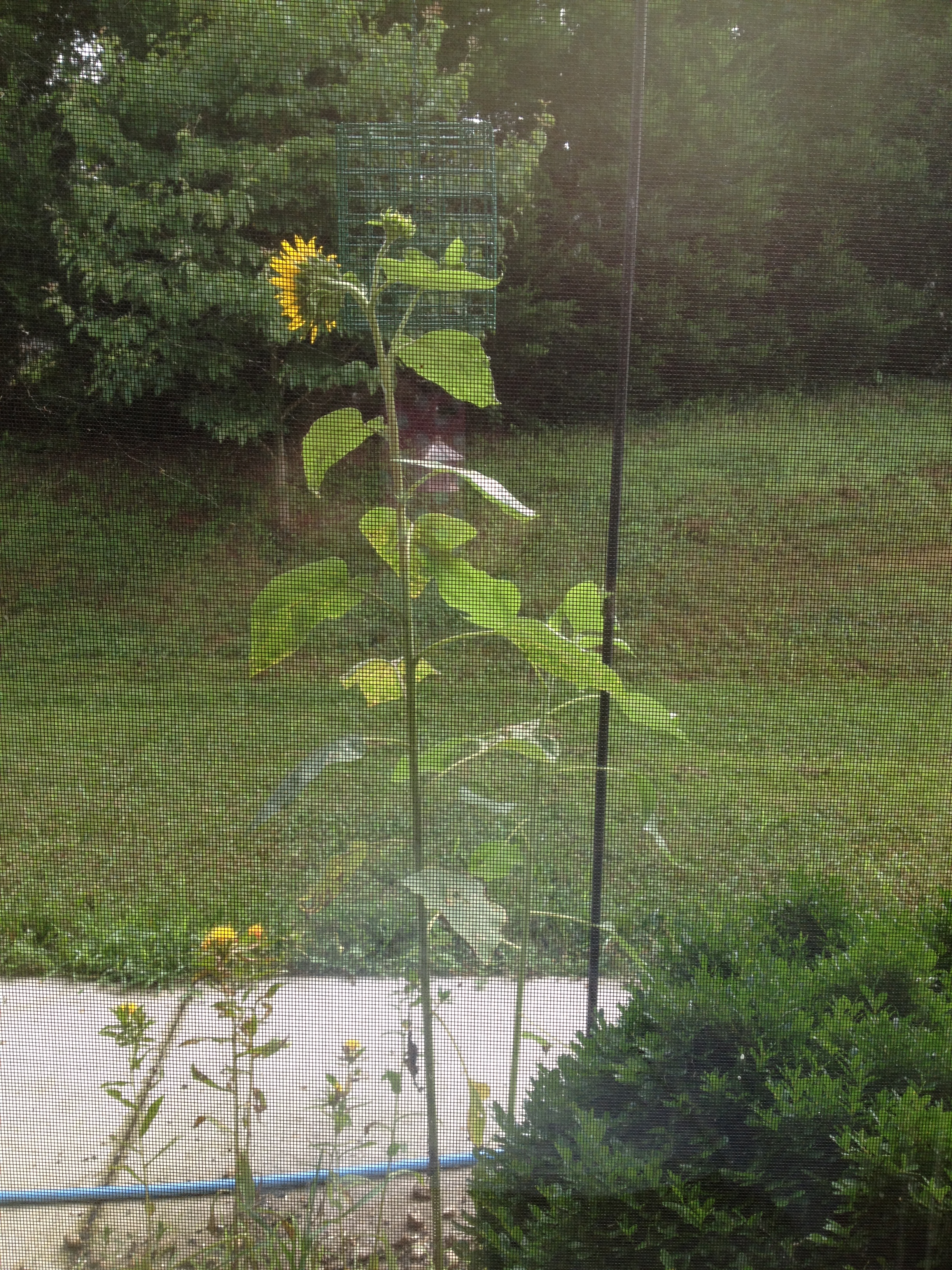
4. Sunflowers are not my favorite flower, but they are kind of neat – fun, happy flowers. When this one sprouted from dropped bird seed, we decided to let it grow. I think I am going to have to move the bird feeder, though!

photo(8)

5. Finally getting eye doctor appointments made and completed…after nearly three years here. 😳 Jesse’s eyes have not changed much, thankfully, so he does not need new glasses. I have a prescription for bifocals if I want them, or I can just keep on with my little readers if I prefer. I hate the constant off-and-on activity with the readers (as in church, for example, when I need them on to see my notes or Bible and off to see the preacher or screen), but I’m not sure that aggravation is worth the expense of bifocals. Still thinking about it.

I could also list books this week, always a fave, but I’ve been in some particularly good ones this week. Plus I have gotten some more organizing done in my craft/sewing room, which always feels good.

We have a busy week ahead with a church activity, a birthday, a ladies’ group activity, and preparations to bring my mother-in-law home – more on that later. Plus my 3,000th post and my 7th blogging anniversary are coming up: seems like I should do something special to commemorate those, but I am not sure what yet. Stay tuned! 🙂

FFF daisies

Friday’s Fave Five is hosted by Susanne at Living to Tell the Story, who invites us to share five of our favorite things from the last week. It’s a wonderful exercise in looking for and appreciating the good things God blesses us with. Click on the button to learn more, then go to Susanne’s to read others’ faves and link up your own.