Friday’s Fave Five

Friday's Fave Five

This has been a cold, blustery week. Thanksgiving is coming up quickly. I’m pausing with Susanne and friends at Living to Tell the Story to reflect on some of the blessings of the week. If you’d like to join in or visit others who do this exercise, Susanne has a place to share a link to your post.

1. Operation Christmas Child. I love this concept of sending useful and fun supplies to children in another country. We turned our OCC boxes in this week. I heard of some families filling a box with their children to help turn their focus on others.

2. A production of A Christmas Carol. The Christian school associated with our church is doing Dickens’ Christmas story this year. They invited the church and home school community to their dress rehearsal before the regular performances start. There were a few chuckles over missed cues or prop malfunctions, but overall, everyone did a great job. I appreciate the school giving these young people an opportunity to hone their talents.

3. A quick dinner with Jason, Mittu, and Timothy. The play rehearsal was on a Wednesday afternoon, and went overtime–and we have children’s ministries and adult Bible studies Wednesday evenings. So we dashed out for a quick dinner at McAlister’s Deli in-between.

4. An artificial Christmas tree. After 40+ years of choosing a live tree every Christmas, we finally caved in and bought an artificial one. The prices of live trees were so exorbitant last year, we figured an artificial one will pay for itself in a couple of years. I’ll miss the excursion to choose just the right tree and the fragrance it brings. But we’re already looking forward to not having to string lights and water it. We haven’t put it up yet but hope to do so soon.

5. A gift card solution. I receive a lot of gift cards from my family. They fit in a pocket in my purse, but when I need one, I have to pull out the whole stack of loose ones and shuffle through them at the cash register. Then it dawned on me to look for a small credit card-type wallet to keep them in, and I found one here–on sale and pink!

To those of you in the US, I wish you a joyous Thanksgiving with those you love.

Charles Spurgeon on thankfulness

Review: The Secret Keepers of Old Depot Grocery

The Secret Keepers of Old Depot Grocery by Amanda Cox

In The Secret Keepers of Old Depot Grocery, a novel by by Amanda Cox, Sarah Ashby’s husband has just died. She returns to Brighton, TN, where she grew up and where her mother and grandmother still run the Old Depot Grocery Store which her grandfather began. All she wants to do is settle back in Brighton and help run the store she loves so much.

But her mother, Rosemary, doesn’t want Sarah to feel stuck in Brighton like she did. She keeps pushing her to move on and see the world.

And even if Sarah stayed, the old grocery isn’t doing well since the big new chain store opened nearby. Rosemary is pushing her mother, Glory Ann, to sell while they have interested buyers. Besides, Rosemary has urgent reasons to sell, reasons Sarah and Glory Ann know nothing about.

But the Old Depot was Glory Ann’s husband’s legacy, his way of ministering to the community. He never gave up. How can she?

The novel is told with a dual timeline, the second one in 1965 detailing Glory Ann’s life from her teen years. She was engaged to her blue-eyed farmer boy, Jimmy. But he was called up to fight in Viet Nam and was killed not long after. She didn’t have a chance to tell him that she carried the baby conceived from their one night of indiscretion.

Glory Ann’s father was a preacher who arranged for Glory Ann to marry Clarence, the son of an old-time friend. Clarence has been told the situation and is willing to marry Glory Ann. She resists, but her father says her sin will destroy his reputation and ministry as well as hers if it becomes known.

Glory Ann, Rosemary, and Sarah each have secrets that they think are protecting the others. Instead, misunderstandings and assumptions strain their relationships.

I love the way Amanda wove the different threads of this novel. As with her first novel, which I loved, The Edge of Belonging, the story has multiple layers: unplanned pregnancies, the nature of true love, the nature of everyday ministry, the damage secrets can cause and the freedom truth brings, PTSD. (Her first novel had a character with PTSD, too, making me wonder f someone in her family did.)

I listened to the audiobook, which was free from Audible’s Plus Catalog and read by Stephanie Cozart. The narration was well-done except the fake Southern accents were a little overwrought and grating to me. I think I would have liked this better in print.

But I did love the story and highly recommend it.

Enjoy the 80 Percent

Enjoy the 80%

Many of you know that writer Elisabeth Elliot has been my “mentor from afar” for over forty years.

One of my favorites quotes comes from her book Love Has a Price Tag:

My second husband once said that a wife, if she is very generous, may allow that her husband lives up to eighty percent of her expectations. There is always the other twenty percent that she would like to change, and she may chip away at it for the whole of their married life without reducing it very much. She may, on the other hand, simply decide to enjoy the eighty percent, and both of them will be happy

That’s so true, isn’t it? We tend to fixate on the small things that bug us rather than the great majority of things we love.

I was thinking recently that this principle applies to more than marriage.

Take friendship, for instance. My best friend in high school had a lot of good qualities, but she was slow-moving, especially when we were to go somewhere together. Any attempts to hurry her led to even more slowness. Constant harping on this one issue would only have driven a wedge between us.

Or neighbors. A good neighbor is a treasure. A bad neighbor is a pain. We don’t want to offend the person who is going to live right next door to us for years, maybe decades. So we pick our battles. We can live with some irritants to keep peace.

We might love our work, but it’s not all sunshine. Even with the best job, there are always a couple of unpleasant aspects.

And what about churches? None is perfect. You’ve probably heard the old cliche: “If you find a perfect church, don’t join it, because then it won’t be perfect any more.” No one church will be and do everything we might like.

When I hear of people leaving church because of some disappointment, I often think of the Corinthians, the epitome of dysfunctional churches. If we had visited such a church in our searches, we would not have gone to this one twice.

Yet every time I read 1 and 2 Corinthians, I am amazed at how patient the apostle Paul is in dealing with them. They had much more than 20 percent that needed to be dealt with, but he never gave up on them.

Enjoying the 80 percent of any relationship doesn’t mean we can never address the aspects we don’t enjoy. But sometimes, as the KJV puts it, we need to forbear with one another. Other translations say bear with, make allowance for, tolerate, or even put up with each other.

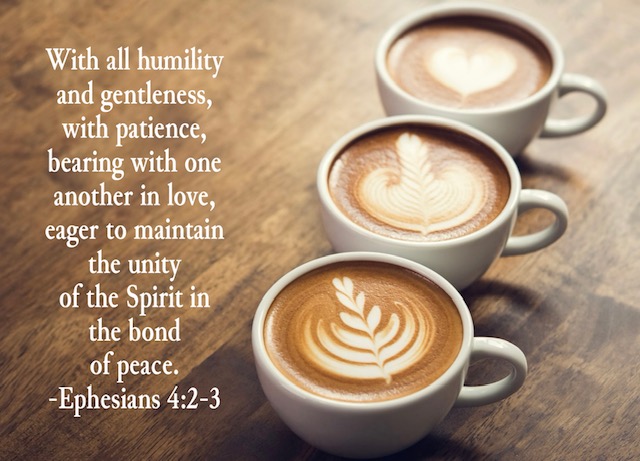
And the Bible goes beyond just bearing with each other. Ephesians 4:1-3 says: “I therefore, a prisoner for the Lord, urge you to walk in a manner worthy of the calling to which you have been called, with all humility and gentleness, with patience, bearing with one another in love, eager to maintain the unity of the Spirit in the bond of peace.”

Humility, gentleness, patience, love, unity, and peace: these are all more important than whatever irritates us about each other.

A couple of other thoughts that help me with this: there’s probably more than 20 percent about me that others have to “put up with,” yet they graciously do. My husband and friends don’t constantly find fault and criticize or insist I do things their way. I can extend that grace to them.

Also, even though God is in the business of correcting and sanctifying us, He does it with patience and grace. He doesn’t pile up everything we need to deal with all at once. We’d be crushed under the load.

One caveat to this 80 percent principle: it depends on what’s in the 20 percent. If a wife likes everything about her husband except the fact that he beats her, that behavior is not something that should be overlooked or ignored. If one friend learned that the other was embezzling his company, or cheating on his wife, he would be wise to step in. If we love the music, fellowship, people, and preaching of a church, yet the leadership denies that Jesus is God, or tells us we get to heaven by doing good works, then we need to find another church.

But in most cases, the 20 percent we don’t like is comprised of smaller issues. Can we not overlook them, for God’s glory and for the love and fellowship of His people?

Ephesians 4:2-3: bear with one another in love

(I often link up with some of these bloggers.)

Laudable Linkage

Laudable Linkage

I hope you’ll find something of interest in this collection of good reads.

Love the Church Like Jesus, HT to Challies. “Imagine you see a bride early on the morning of her wedding day — and she is a mess.” But she’ll look very different at the wedding, and it would be wrong and foolish to tell others how awful she looked that morning. The author provides an interesting comparison to the imperfections of the church and what it will be someday, and how we look at it as Jesus does.

Why Am I So Spiritually Dry? HT to Challies. “As I crunched my way through my neighborhood and watched the clouds for rain, I realized that dry seasons can be for our good. Sometimes spiritual dry spells come with a diagnosis and sometimes they don’t, but the only way through them is through them.”

Do You Feel Overwhelmed When You Pray? 3 Reasons not to Lose Heart. “Take heart, weary prayer warrior. When our feelings overwhelm us and the trials of life threaten to drown us, we can look to the unchanging truths of the Bible for strength and hope.”

Responding When Those We Respect Disappoint Us, HT to Challies. “While we understand intellectually that every person we meet is fallen and desperately needs God’s grace, that knowledge gets tested when someone we deeply respect disappoints us.”

The Spiritual Gift Inventory I Believe In. “In many churches, it is standard practice to have Christians take some kind of a spiritual gift inventory. Through a series of questions that probe an individual’s interests, passions, and successes, these tests claim to help people discover the ways the Holy Spirit has gifted them to better love and serve his people. Much has been written about such inventories and many people have expressed a degree of skepticism about their usefulness or accuracy.”

Marriage Happy, Marriage Holy. I really don’t like the saying that marriage is to make us holy, not happy. Scripture depicts marriage as happy. Yet when two sinners live together, they are bound to have differences and irritations. Tim Challies shares some of the surprising ways marriage can help sanctify us.

God’s Good Gift of Hobbies, HT to Redeeming Productivity. Steve Lindsey discusses many valuable benefits of hobbies. .

Why I’m Grateful to Live in 2024. Though there’s a lot wrong in the world, we’re also immeasurably blessed.

The Criticized Leader, HT to Challies. Good advice even for followers.

I mentioned a couple of weeks ago Ciara Dierking, who lost all four limbs after a near-fatal illness. Revive Our Hearts has two episodes of a podcast with her. You can listen to or read the transcript of Part 1: What Did I Do to Deserve This? here, and Part 2: More Grateful Than Before, here.

He makes us wait. He keeps us on purpose in the dark. He makes us walk when we want to run, sit still when we want to walk, for He has things to do in our souls that we are not interested in. Elisabeth Elliot, Secure in the Everlasting Arms

He makes us wait. He keeps us on purpose in the dark. He makes us walk when we want to run, sit still when we want to walk, for He has things to do in our souls that we are not interested in. –Elisabeth Elliot, Secure in the Everlasting Arms

Friday’s Fave Five

Friday's Fave Five

I am astonished that we’re halfway through November already. I wish there was a way to slow time down. The best alternative is to pause for a few moments and savor the blessings along the way. Some of us do so by joining in with Susanne and friends at Living to Tell the Story on Fridays. Feel free to join in!

1. Puttering is what I call doing a series of odd jobs around the house, the kind that are useful but not urgent. For me, puttering this week included cleaning out the catch-all basket on the counter, assembling items to take to the thrift store, removing things from an old frayed purse into a new one while cleaning out and sorting through them, etc.

2. Veteran’s Day. I am so thankful for those willing to serve our country in the most sacrificial ways.

3. Dinner with Jesse. We don’t see Jesse, my youngest, as often as we see Jason, Mittu, and Timothy. He lives a bit farther away. When we found out he had Veteran’s Day off, we invited him over for dinner. J&M couldn’t make it. While we missed them, and we enjoy time all together, it’s also nice to visit one-on-one. Jesse likes salmon, and we had some in the freezer from a half-price sale, so Jim grilled those while I made Red Lobster-style baked potatoes and mixed vegetables. I make Choco-Peanut Butter Dreams about once a year in the fall and decided to do that as well. I sent several home with Jesse and brought some to J&M Wednesday and still had several to munch on through the week. (The recipe is included with My Favorite Cookie Recipes.)

Choco-Peanut Butter Dream Cookies

4. Easy fixes for weird technological glitches. One day my Word grammar checker suddenly started making suggestions in French, including marking words as misspelled and giving me French alternatives. Of all the weird things! I poked around, trying to find the place to reset the language for it, then finally Googled it. Then my phone stopped receiving e-mail from either account. A quick search and reentering of my password had it working again. I am learning to search first before texting my children for help. 🙂

Then, right before leaving for an appointment Thursday, my computer started making weird tapping noises. Jim rebooted it, and that took care of whatever the problem was—or at least stopped the noise.

5. A good eye doctor appointment. Everything is about the same as last year, except I’ve had an odd shape in my vision for a few weeks. He didn’t see any problems when he dilated my eyes, so that was a relief.

Bonus: My youngest sister has been unemployed for ages after being laid off. After much prayer and searching, she got a job this week!

Review: Write a Must-Read

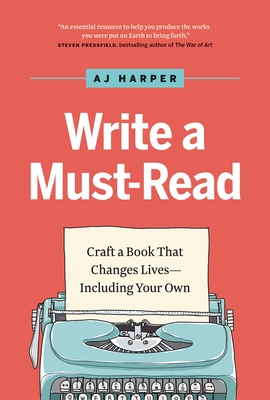
Write a Must-Read by A. J. Harper

A. J. Harper (no relation) has had a varied career as a ghostwriter on multiple books, publisher, editor, coach, co-writer, teacher, and more. Clients urged her to teach other writers how to write transformational nonfiction books. A nudge from a co-writer and an author retreat helping writers caused her to realize maybe she could write such a book. The result is Write a Must-Read: Craft a Book That Changes Lives—Including Your Own.

Harper’s main theme is “Reader first.” Often writers get started because they feel they have something to say. But writing to impact others isn’t just focused on imparting the writer’s story or information. Even a memoir or biography needs to have a take-away for the reader; otherwise, unless the author is famous, a reader won’t be interested in reading it.

First Harper helps writers identify their ideal reader and what their need is. I appreciated the distinction that the ideal reader is not an avatar, with multiple specific characteristics down to the cereal the reader eats (I’ve seen some writing advice that seems to lead this way). Rather, “Ideal Readers may come from different backgrounds and circumstances (demographics), but their problems, desires, and challenges in pursuit of their desire (psychographics) are the common denominator” (p. 46).

Then she helps writers craft their Core Message: what’s the “foundational truth that your entire book is built on” (p. 65). From there, writers craft the promise they make their readers.

Harper talks about teaching points,stories, anecdotes, case studies, outlines, sequencing, and much more, all under the umbrella of what would best serve the reader.

She includes a multitude of helpful questions to ask while editing and ends with a crash course in the process of publishing and need for marketing.

All her points are illustrated with stories and anecdotes from the authors she has worked with.

Many of the chapters end with exercises to work through and links to her web site for more information or to download worksheets or lists.

Some of the quotes that most stood out to me:

Writing a book is not about organizing content. It’s about creating an experience for the reader (p. 119).

The best outline for your book is the one that meets your reader where they are and takes them on a journey that leads to your Promise, delivered (p. 119).

You are not the hero of this book. They are. You are not the focus of this book. They are. And they need you to help them get where they want to go (p. 121).

Your book is not a collection of stories and knowledge. It is a journey—a quest (p. 130).

With nonfiction, specifically personal and professional development books, the aim is transformation. My singular goal is to help the reader change their life (p. 138).

A book is not about something. A book is for someone (p. 200).

I first read this in the evenings, a chapter or less at a time, before closing out the night with fiction before bedtime. That wasn’t the time I wanted to work through exercises and such. So I am going back through the book now at my desk, making notes, printing out worksheets and filling them out.

Some of my readers would want to know that there’s a smattering of profanity through the book, and the author comes from a completely different worldview than mine.

But the writing advice is excellent all throughout.

Achy Joints

Achy Joints

Can you imagine a body without joints? It wouldn’t even be able to move.

We don’t usually appreciate the joints in our body until they start to give us problems.

I’m at the age where various joints take turns stiffening, aching, tingling, creaking, or even going out on me. If they all ganged up on me at once, I’d be in real trouble.

What happens when a joint doesn’t work right? An achy joint limits mobility. If the joint is stiff or painful enough, it could stop movement altogether. The Bible likens an unreliable person to an unreliable joint: “Confidence in an unfaithful man in time of trouble is like a broken tooth, and a foot out of joint,” (Proverbs 25:19, KJV).

There are multiple passages comparing Christians to a body, with Christ as its head. And that body is held together and moves by way of its joints.

After telling about the gifts God has given to the church in teachers, shepherds, and evangelists to help the church mature and equip the saints for the work of the ministry, Paul says:

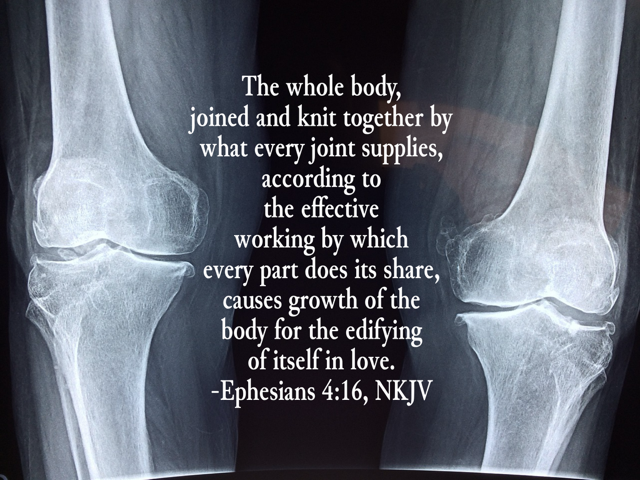
Speaking the truth in love, we are to grow up in every way into him who is the head, into Christ, from whom the whole body, joined and held together by every joint with which it is equipped, when each part is working properly, makes the body grow so that it builds itself up in love (Ephesians 4:15-16).

Colossians has similar imagery:

Holding fast to the Head, from whom the whole body, nourished and knit together through its joints and ligaments, grows with a growth that is from God (2:19).

In looking up the anatomy of joints, I was surprised to find just how complex they are. But one significant part of a joint is the synovium, which secretes synovial fluid, which in turn provides lubrication and nourishment for the joint, according to this article

Interestingly, that article also says, the synovium “not only has its own specific functions but also interacts with other tissues in the joint both structurally and functionally.” That’s just like the body of Christ, too, isn’t it? 1 Corinthians 12 says we each have our own gifts and areas of usefulness, but we also interact as different parts of the same body.

What’s the synovial fluid among God’s people?

Ephesians 4:15 says we should be “speaking the truth in love.”

Jesus said, “A new commandment I give to you, that you love one another: just as I have loved you, you also are to love one another. By this all people will know that you are my disciples, if you have love for one another” (John 15:34-35).

Peter said, “Above all, keep loving one another earnestly, since love covers a multitude of sins” (1 Peter 4:8).

Paul wrote, “Love is patient and kind; love does not envy or boast; it is not arrogant or rude. It does not insist on its own way; it is not irritable or resentful; it does not rejoice at wrongdoing, but rejoices with the truth. Love bears all things, believes all things, hopes all things, endures all things” (1 Corinthians 13:4-7).

Wouldn’t our interactions as a body go so much more smoothly if we expressed that kind of love?

The synovial fluid also nourishes joints. Colossians says we’re “nourished and knit together through its joints and ligaments.

How do we nourish each other? What’s our spiritual food? Job said God’s Word was more than his necessary food, and the author of Hebrews speaks of God’s Word as milk and meat.

As we take in God’s Word and grow in Him, we share it with each other, so that we help others grow as well.

Adrian Rogers* calls this activity within the body “flexible harmony.” “When each part is working properly, [it] makes the body grow so that it builds itself up in love” (Ephesians 4:16).

May we avoid spiritual achy joints by loving and nourishing each other in Christ.

Ephesians 4:16

*(This post was inspired by a couple of paragraphs near the end of Adrian Roger’s message, Faithful in Ministry, heard on BBN Radio 10/25/24. The link contains a summary, along with tabs to listen or download the transcript.)

(I often link up with some of these bloggers.)

Laudable Linkage

Laudable Linkage

Here are the latest good reads I’ve discovered:

If You Want to Be Like God. “At the root of every sin is some desire for godlikeness. . . . But. Satan didn’t invent this desire. Instead, he hijacked a desire that God had already wired into His creatures. God’s intention for us has always been for us to be like Him – just in a very different way.

The School of Faith: When God’s Ways Are a Mystery, HT to Challies. “But what about those seasons when God remains silent to prayers? What about that time when you prayed for protection and the very thing you feared and prayed against became a reality? What about that moment when you took a step of faith and followed God’s difficult leading, only to be met with more difficulty and nothing but confusion? Where is God’s love and goodness in those moments?”

A Call to Christian Unity in a Divided Country. “Today, and going forward, may people look at us and know more about the God we serve, than the man or woman we voted for. Shaming, blaming, gloating, laughing, wishing harm, or questioning people’s salvation over their voting choices is not reflective of the One who laid down his life for us.”

A Warning About Having Children. “The surgeon general recently issued a new public health advisory. Forget pandemics or toxic substances; this time the source of this warning is likely sleeping under the same roof as you. The culprit: your own kids. According to the surgeon general’s report, the mental toll of raising children is ‘an urgent public health issue.’ As the mother of a larger-than-average family—we have five children ages 18 months to 18 years—I’d like to think I have a little credibility on this topic.” I’d been mulling over posting about the benefits of children, since so much of society seems to view them as a bother and inconvenience. Jessica Burke does this well and shows the joy and positivity of being around little people.

On Parenting: Are You Bribing Your Way Through? “While our heavenly Father does use the promise of reward as a facet of the motivation He gives believers, it is only a part of the entire diamond that is the relationship we enjoy as His children. We too, can make use of measured, deserved, and appropriate rewards. However, the bribing system, which uses them perpetually to calm situations or direct behavior, deprives children of the biblical wisdom parents are commanded to impart.”

Design: Does Evolution Care About You? “It constantly amazes me to hear those committed to an evolutionary worldview talking about design. They can’t help themselves. Everything is so intricately designed.”

What Cheap Comfort Will Cost You. “What He has spent this year exposing is that I don’t have a shopping problem; I have a comfort problem. All my life, I have been seeking comfort in all the wrong places. The question God’s Word asks is: where do you turn for comfort?”

Toward. “Depending on your opinion and vote, you are either feeling elated or disappointed. And now we each have a choice to make – will we let the outcome continue to be divisive and cause arguments; or will we let it bring us toward one another to encourage one another?

10 Ways Your Pastor Wishes You Would Pray for Him. “I emailed the senior pastor at my church and asked him for his practical input. He responded by telling me that prayer is the most important way that church members can encourage their pastors. This prompted another email and another question: how do you want your congregation to pray for you?

The Church’s Unsung Hero: The Persevering Sunday School Teacher, HT to Challies. “The most significant contributions to the kingdom often come from those who never stand in the spotlight.”

Announcing Our 10th Annual Bible Reading Challenge. Knowable Word has a challenge to read the Bible in 90 days. I’ve never tried this, but I’ve heard from friends who have that they’ve seen overarching themes and connections that way that they never noticed before. KW is offering some nice prizes as incentive.

I’ve seen recommendations for Advent devotionals popping up this week from Michele Morin and Tim Challies. I’ve not read any on either list except Come, Thou Long Expected Jesus, compiled by Nancy Guthrie–and how fun that it was on both lists! It was on my list of recommendations last year, too.

Take heed that we hear, what we hear, and how we hear. Warren Wiersbe

Jesus admonishes us to take heed that we hear (Matt. 13: 9),
take heed what we hear (Mark 4: 24), and
take heed how we hear (Luke 8: 18).
–Warren Wiersbe

Friday’s Fave Five

Friday's Fave Five

We’re one week into November, and I’m pausing with Susanne and friends at Living to Tell the Story to cultivate gratefulness and share God’s blessings.

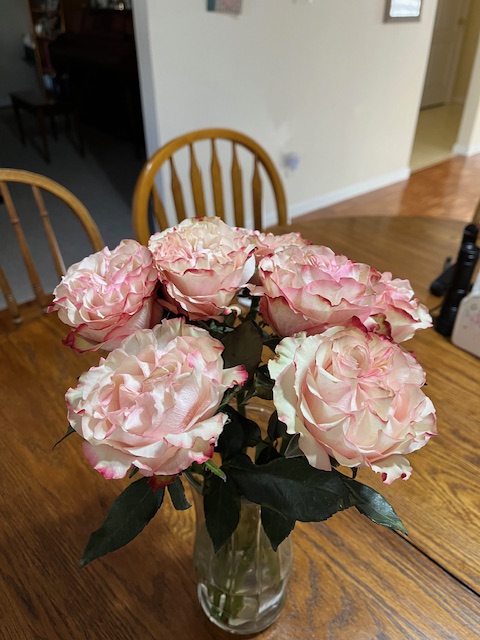
1. Pretty flowers. Jason and Mittu brought these over last week. I love the dark pink ruffled edges and the way they opened up so prettily.

pink roses

2. A fundraiser dinner. Our church supports a missionary from REAP India, and last Saturday night we attended a fundraiser dinner for the organization. We enjoyed learning more about the ministry. We hadn’t known that there was a long history with that organization and its founders and the former pastor of our church (now with the Lord–we had never met him). A lot of folks from church were there, too.

3. Libby is an app that allows you to borrow e-books from your local library. I had tried to use it a few times before, but could never get it to find my library, even though my library’s website says it’s connected. I tried it again this week and saw that somehow they had me in Fayetteville rather than Knoxville. I deleted and reinstalled the app and was able to get connected this time.

4. Biannual closet change-over. I like my spring and summer clothes better than my fall and winter ones. But it’s nice to have the warm and cozy clothes where I can get to them easily. And since my off-season clothes are in the guest room closet, I don’t have to dig them out of storage–just make a few trips back and forth down the hall between bedrooms.

5. Oven meals. There are some meals that I don’t make during the summer, because keeping the oven on for an hour makes it hard for the air conditioner to keep up. It’s been fun to resurrect some of the dishes we haven’t had since last winter. Plus, it’s nice to get dinner ready and then still have an hour to do other things.

Updated to add: How could I have forgotten the biggest event of the week? I am thankful for the election and the fact that, for the most part, it was peaceful and decisive, two things I was praying about in particular. I’m thankful we have an opportunity to choose our leaders.

And that wraps up another week! How was yours?

Review: Mrs. Tim Carries On

Mrs. Tim Carries On by D. E. Stevenson

Mrs. Tim Carries On is a sequel to Mrs. Tim of the Regiment. Like the first book, this is written in a diary format and based on author D. E. Stevenson’s own experiences.

Major Tim left for France during early 1940, leaving Mrs. Tim—Hester—home in a small English village with their daughter, Betty. Their son, Bryan, is away at preparatory school but comes home on holidays.

Hester writes that she decided to use her diary as an escape from war news and not mention it unless it affects her directly. So, at first she writes of old friends mentioned in the first book, amusing anecdotes of Betty, squabbles among servants, and such. She heads up the “Comfort Depot,” which involves collecting things for the soldiers and setting them out for the men to choose from.

The only mention of the war in the first part of the book has to do with shortages and an increasing number of Polish soldiers who have escaped from Hitler’s advances there. The community seems to receive them generously. Some of them can speak English or French, so they can usually find someone to communicate with.

The daughter of a friend, Pinkie, comes to stay with Hester indefinitely. Pinkie was a little girl the last time she was seen, but now is a beautiful seventeen-year-old, and several of the men fall in love with her. But she sees them only as friends.

Things turn a little somber in Part 3 when several more countries have fallen to Hitler and Hester has not heard from Tim for several months. Then in Part 4, she visits her brother in London and experiences bombs dropping in the streets and constant airplanes buzzing overhead.

There’s one odd new character, a Miss Brown Winters, who thinks she has lived several other lifetimes, mainly in ancient Egypt. Hester doesn’t believe her but finds her “interesting.”

Once again, there’s not much of an overall plot arc–the story is more just reflecting everyday life during that time.

Some of my favorite quotes:

[I] repair to the kitchen in a cheerful frame of mind. Cheerful feelings are soon dissipated. The kitchen is extremely warm, but the moral atmosphere is at zero. Mrs. Fraser, my large and terrifying cook, is waiting for me with a grim smile. I enquire in trembling tones whether anything has gone wrong. Mrs. Fraser replies that that depends. Having long and bitter experience of domestic catastrophes I am prepared for the worst (p. 5, Kindle version).

Her eyes are full of tears and I realise that she must be comforted, so I proceed to explain my own particular method of “carrying on”. None of us could bear the war if we allowed ourselves to brood upon the wickedness of it and the misery it has entailed, so the only thing to do is not to allow oneself to think about it seriously, but just to skitter about on the surface of life like a water beetle. In this way one can carry on and do one’s bit and remain moderately cheerful (p. 12).

“All war is awful,” says Guthrie. “It’s a wrong and horrible thing, war is, but we don’t need to worry about the rights and wrongs of war. We tried our best for peace. We tried for peace to the absolute limit of honour . . . but you can’t have peace when a pack of ravening wolves gets loose” (p. 37).

A day like this is a gift from God—or so it seems to me—and it seems all the more precious when it comes at the end of a long dark dreary winter (p. 52).

The daffodils have come in and are blowing like the bugles of Spring in the flower-shop window (p. 58).

I have the feeling that everyone in the world is asleep—but I know that it is not so. All over Europe there are people—men and women—keeping watch. There are aeroplanes, laden with death, speeding across the sky; there are sailors on the lookout; there are thousands of women like me who cannot sleep because their hearts are torn with anxiety . . . all over Europe the shadow of suffering lies. I sit and think about it, and in some strange way it is a relief to give way to misery. It does nobody any harm, for there is nobody to see. Just for a few moments I can take off the mask of cheerfulness. Just for a few moments I can allow myself to think (pp. 113-114).

I sit down on the window seat and prepare to listen, for if there is one thing I enjoy more than another it is a heart-to-heart talk with my son (p. 140).

[On visiting her childhood home] The dressing-table mirror is spotted with damp, and I am not sorry to see its degeneration, for it was never a kindly friend. It was like the friend who is in the habit of saying, “I feel it is my duty to tell you . . .” and it did its duty well. It was always candid about spots or blemishes or untidy hair. I glance into it as I pass to the window and find that its nature is not ameliorated by the passing years (pp. 215-216).

There’s a lovely poem called “Dunkirk 1940” which Stevenson shows as coming from one of the men. It’s too long to include (but I found a copy here). It tells of the Israelites’ miracle of the Red Sea parting, and the men at Dunkirk wishing for a similar miracle, to escape on dry land. But God provided a different miracle for them: “A double miracle to set us free –
Lion-hearted men, calm sea,” and hundreds of boats of all sizes.

I enjoyed this book much more than the first one. I can’t put my finger on why. Maybe because the characters were familiar to me, or maybe because the story had more touching moments mixed in with the lighter fare..