Laudable Linkage

It has been a while since I’ve shared links of interest. Here are some I’ve found profitable the last few weeks:

Rachel Weeping For Her Children — The Massacre in Connecticut.

The tension of “God is good” and “It shouldn’t be this way.” I saw this the day before the tragedy in CT, but it is certainly apropos.

Newsweek vs. the New Testament. “So, in the waning days of Newsweek as a print magazine, the editors decided to take on the New Testament. Readers should note carefully that it is Newsweek, and not the New Testament, that is going out of print.”

10 Holiday Survival Tips for 2012 if you holidays are much less than merry.

Five Habits for Holiday Happiness.

How to Help the Hurting.

Misused Reasons to Abandon Christmas: #3 God Didn’t Command It, HT to Diane. Deftly answers the charge that “if God didn’t command it we shouldn’t do it” in regards to Christmas but could well be applied to many areas. Others in the series have to do with the supposed pagan origins of Christmas and “It’s the wrong date.” He’s not saying anyone should or should not celebrate, just pointing out the flaws in these arguments.

Obedience and Gospel-centered Mothering. The two are not antithetical.

What Do Men Really Want in a Wife?

The Best Christmas DIYs and Crafts Ever.

And finally, this is just too cute: a kid’s gospel quartet. I couldn’t get the video to embed here and it doesn’t seem to be on YouTube, but hopefully you can see it on Facebook here.

Friday’s Fave Five

Welcome to Friday’s Fave Five, hosted by Susanne at Living to Tell the Story, in which we can share five of our favorite things from the last week, a wonderful exercise in looking for and appreciating the good things God blesses us with. Click on the button to learn more, then go to Susanne’s to read others’ faves and link up your own.

It’s been a busy but enjoyable week. Here are some favorite parts of it:

1. Jim is feeling much better. Still runs out of energy by evening and still has a cough but he is much better than he was last week.

2. Unexpected refunds. One company I ordered from online for the first time sent me an e-mail that they hadn’t gotten my order out when originally planned, so they refunded the shipping charges. Since I had ordered early for Christmas and it wasn’t “crunch time,” I hadn’t even really noticed that the order wasn’t in on time, but I appreciate the integrity of this company. Then we decided that something we ordered from another company wasn’t what we needed, and when I contacted them to send it back, they sent us a refund but said we didn’t need to return it.

3. Another bird feeder. I put a feeder containing suet up just outside the window by my desk, where hanging plants were in the spring and summer. It took a while for the birds to find it but now I see them there regularly and more close-up than the bird feeder by the tree. But I can’t seem to get a picture — I guess they’re close enough that they see or sense movement and fly off when I reach for the camera. Maybe they’ll get used to me after a while.

4. Caroling for “at-home” members. Last Sunday night our church broke up into smaller groups and took care baskets to some of our older members who can’t get out to church much and sang Christmas carols to them. My mother-in-law was one of those whom they went to. I wasn’t able to go but Jim said it went really well. Sometimes she’s too sleepy to interact much, but he said she sang along with some of the songs and enjoyed the visit.

5. Pumpkin Spice Swirl Bread. I passed by a display of this in the grocery store and then went back to pick one up. It’s more like regular sandwich bread with a bit of pumpkin and cinnamon flavor than regular pumpkin bread, but it makes good toast and is a nice seasonal change.

Pumpkin swirl

Hope you have a great week!

A Christmas memory

Susan at By Grace shared a Christmas memory last week, and that started my wheels turning, so I thought I’d do the same. I’ve shared this particular one before, but maybe some have not seen it or have forgotten it.

My husband and I were married Dec. 21. We didn’t have a honeymoon — we could not afford one and didn’t have time because we were both still college students. I had “crammed four years into five” as the saying goes and was in my second senior year, so I only had three classes left for my last semester.

We spent our first night in a hotel in Houston and planned to go back to my folks house the next day to pack up my things in a U-Haul and then start the drive back to SC. But something went wrong with our car and we ended up having to stay overnight. We couldn’t afford a second night in a hotel room, so we stayed with my folks…and let me tell you, it felt very awkward bringing my new husband into my old bedroom at the ol’ home place on just our second night together!

We started out the next day, I believe, and must’ve stayed overnight somewhere in-between because we got to SC about 11 p.m. Christmas Eve. We were renting a furnished mobile home from one of our college professors. We hadn’t seen it yet:  at the time we talked with him, the trailers he had were occupied but he was in the process of buying another one and said we could rent it. So this trailer and location were new to him as well. We called him when we got into town and he took us over to the trailer, showed us around, gave us the keys, and invited us to a Christmas banquet that the university was having the next day.

We unpacked just what we needed for the night and fell into bed. First thing the next morning, Christmas morning, we were startled awake by very loud and insistent pounding on our door. My husband scrambled himself together enough to open the door when what should his wondering eyes behold but a short grey-haired man — with no beard, no red suit, and a decidedly unjolly expression.

It turned out to be the man who owned the mobile home park. He had not been told that anyone new was moving in, and furthermore, he did not allow renters. He was very upset. I don’t know how the transaction had occurred between our landlord and the previous owners without taking into account the need to contact the landlord of the mobile home park — maybe they each understood the other was going to do that. I don’t remember exactly what Jim told him: something to the effect that we were sorry, we didn’t know, we’d have our landlord contact him.

When we went to the Christmas banquet we explained the situation, and the professor met with the trailer park owner and worked things out so that we were allowed to stay. So we had two landlords, one for the trailer and one for the space we were renting.

It was the nicest trailer park I had ever seen, with only fourteen trailers, a good amount of space between trailers, and a lot of trees. The owner was a shuffling little old man who wasn’t a physical threat to anyone, but he had an air of authority about him and drove through through the park several times a day to check on things. Looking at the situation from his point of view, his reaction was quite understandable, though it was disconcerting to us to find out that someone was very upset with us and we might be kicked out of our first place to live on Christmas day. But once that was settled we had a very amiable relationship for the six years we lived there.

I had a little two-foot-high aluminum tree that had belonged to my grandfather, and we hit the after-Christmas sales the next day for a few decorations and celebrated our first Christmas together a few days late. I don’t remember anything else about that first Christmas except for one pair of ornaments we bought.

Melted ornaments

The brown-haired boy represented Jim, and the blond girl represented me, and they were made of wax. But one year they got a little melted up in the attic. I couldn’t even get them out of the plastic bags because they were stuck. I don’t know why I haven’t thrown them away. Well, yes I do: I’m sentimental. I put all my Christmas candles in a box in a storage closest now so they don’t melt any more up in the attic, and I keep these in with them.

Despite that inauspicious beginning, we’re coming up on our 33rd Christmas together! Thankfully I think all the rest of them were relatively happy, as far as I can remember: the only one other one I remember having any problems was one when all five of us were sick as dogs. All the rest contained some combination of family, food, gifts, and most important, faith in the One whose birth we celebrate that day and who came to offer salvation to all who would believe.

Book Review: Unless It Moves the Human Heart

Unless it Moves the Human HeartI’ve hadn’t read anything of Roger Rosenblatt’s before, but somehow the name sounded a little familiar when I first saw the book Unless It Moves the Human Heart: The Craft and Art of Writing. The title grabbed me. Anyone who has any aspirations to write has, I think, the desire to touch someone else in some way; otherwise we’d just keep private journals.

Rosenblatt has written and won awards for columns, essays, books, and novels. He styled this book as one of his writing classes. These particular students and conversations are fictitious, but I am sure they are drawn from classes he has taught over the years. Neither the book nor the classes are very systematic: he says later in the book what I had already figured out, that he will come to class with a plan but a question from a student will carry the lesson into another direction. The interchanges do seem more like conversations than lessons, but that probably keeps them more interesting. “I may permanently forget whatever it was I originally planned to say. But it is much more exciting to allow oneself to be swung into a new and foreign path, just as in writing when you find yourself in the midst of the strangest sentence, and wonder how you got there” (p. 116).

He does work various principles into the conversations, the main one being restraint (“if you have the goods, there’s no need to dress them up,” p. 88) and “the preference of the noun to the adjective and the verb to the adverb” (p. 148), but even there he admits that “if I had foisted my preference on Keats, there would have been no Keats. And ‘rosy-fingered dawn’ is a …lot more beautiful than ‘dawn'” (p. 131).

The first part of the book had me thinking, “Wow, this is neat! I’d love to attend a class like this.” The second part had me disagreeing with him in spots.

Some of the parts I especially liked:

In a section on short stories, he says, “You know the character and his or her situation from the opening. You even know what’s likely to happen. The story is about why what you know matters” (p. 12). It struck me that in a sense that’s true of even longer stories and books. Something may be completely predictable and yet still be enjoyed because of what matters in the story.

“If we look like we’re trying to change the world, the writing will sink from the weight of its own piety. But in the best of our work, the idealism is there, like trout below the surface of the water. Of course you want to try to change the world. You just don’t want to show your cards. But look at the world. Who would not want to change it? Books count. They disturb people” (p. 59).

“There’s no purpose to writing unless you believe in significant things — right over wrong, good over evil. Your writing may deal with the gray areas between the absolutes, and all the relativities that life requires. But you still need to acknowledge that the absolutes exist, and that you are on the side of the angels” (p. 60).

“Writing is the cure for the disease of living. Doing it may sometimes feel like an escape from the world, but at its best moments it is an act of rescue. Each of you has his own way of seeing into suffering and error. But you share the desire to save the world from its blights by going deeper into them until they lie exposed. You show up the imperfections of living for what they are. You hope to write them out of existence” (p. 60).

Reading good writers “is like hanging around with a superior mind. You can never equal that mind, but you strive to do your best, and not to embarrass yourself in his presence” (p. 92).

Then there were things I wasn’t sure that I agreed with, like the following:

In contrasting writers to journalists, who have to clearly communicate, the author says “There’s a mystery to the art of writing. You write, yet you don’t always understand what you’ve written. And you’re not always understood. And you’re never fully understood. And this is a good thing– dwelling in and creating mysteries” (p. 74). I can see that to some extent, but I’d think even fiction writers want readers to understand what they’re trying to convey. Some of this kind of philosophizing got a little too metaphysical for me.

Likewise he says of a memoir, “A pure memoir meanders without achieving meaning. It avoids meaning — more like fiction that is real” (p. 88). If he means there’s no symbolism, ulterior motives or infused meaning of the writer, etc., I can agree with that. Yet I wouldn’t say there is no meaning, else no one would read it. There has to be some meaning to the life written about, the things the character did and learned. Personally I’ve drawn a lot of meaning — or maybe a better word would be inspiration — from reading biographies.

“A poet tries to identify a situation or an emotion as accurately as possible…At the same time, the poet knows that perfect identification is impossible, I think that’s where imperfection is the same thing as divine” (p. 129-130). Saying that imperfection is divine seems oxymoronic to me.

This a short book at 155 pages and reads easily. I liked the banter between Rosenblatt and his students and the fact that his representative students were a variety of ages, some even older than myself, rather than just college age. It is a secular book, so there are a few words and illustrations that I would personally find offensive but understand their being in a book like this. I enjoyed the variety of other writings that he referred to, some of which I want to explore further. Overall I found some good instruction and a lot of inspiration and food for thought in this book.

(This review will also be linked to Semicolon‘s Saturday Review of Books.)

What does it mean to magnify the Lord?

What does it mean to magnify the Lord?

During the brief four years we home-schooled, one of the biggest helps was a great support group. Qne of their activities was a monthly meeting where we sometimes had guest speakers (my favorite was Booker T. Washington’s granddaughter — she gave quite a fascinating talk). Sometimes the kids did activities, like an annual talent show; sometimes members of the group would speak about their work or hobbies.

One time my husband, whose job title for many years was Research Microscopist and who collects, buys, and sells microscopes, spoke about microscopes and brought a few for kids to look at whatever they wanted to under the microscope. He also spoke about Psalm 34:3: “O magnify the LORD with me, and let us exalt his name together.” He pointed out that we don’t make God bigger than He is: He’s already so big we can’t comprehend it. But we focus on Him, bringing out thoughts of His greatness.

I’m rereading Let Every Heart Prepare Him Room: Daily Family Devotions for Advent by Nancy Guthrie, and the selection for today comes from Mary’s song after learning that she will be the mother of the Messiah. “And Mary said, My soul doth magnify the Lord, And my spirit hath rejoiced in God my Saviour” (Luke 1:46-47). Guthrie explores the concept of what it means to magnify God and says:

The truth is, we can never fully take in or understand God’s greatness. But we can magnify Him. We magnify God not by making Him bigger than He truly is, but by making Him greater in our thoughts, in our affections, in our memories, and in our expectations. We magnify Him by having higher, larger, and truer thoughts of Him. We magnify Him by praising Him and telling others about His greatness so they can have bigger thoughts about Him, too.

I looked up the meaning of “magnify” in Dictionary.com, and part of the definition is: “to cause to seem greater or more important; attribute … importance to; to intensify; dramatize; heighten; to extol; praise.”

Mary magnified Him out of joy and gladness. The psalmist (Psalm 64 and 69) magnified Him out of deep need and affliction. They both speak of deliverance and answered prayer and expectation. The KJV speaks once of God magnifying Himself: “Thus will I magnify myself, and sanctify myself; and I will be known in the eyes of many nations, and they shall know that I am the Lord” (Ezekiel 38:23).

I don’t think God “needs” us to magnify Him: He doesn’t have an ego that needs stroking. Even when He magnified Himself, the purpose was that others would know who He was. But we need to magnify Him. It’s so easy to magnify the cares of this world, our needs, our weaknesses, our duties. That gets discouraging, distracting, defeating. But when we magnify Him, we see Him as He truly is, we remember how great and good He is, how He has strength He will provide us in our weakness, how He can easily take care of whatever need we have. The more we praise Him, the more rightly we relate to Him, then the more we praise Him and testify of Him to others, so they can focus on Him and see for themselves how great He is and how He can meet their needs as well. The more we magnify Him, the more we worship Him.

I will praise the name of God with a song, and will magnify him with thanksgiving.
This also shall please the Lord better than an ox or bullock that hath horns and hoofs.
The humble shall see this, and be glad: and your heart shall live that seek God.
Psalm 69:30-32.

Missing My Mom

It was 7 years ago today that my husband and I were at a Sunday School Christmas party and received a phone call from home to call my sister who had been trying to reach us. We glanced at our cell phones and saw we had missed multiple calls, hadn’t heard them over the conversations. We thought, “Oh, no, Mom must be in the hospital again.” My mom had been hospitalized with congestive heart failure several times. But, no, this time the stunning news was that my mom had passed away suddenly due to a massive heart attack.

You can imagine the awful time that followed — the sadness, the tears, the scrambling to get a flight to TX, and so on. In many ways that was one of the worst weeks of my life.

But even in the midst of tragedy, we saw God’s hand of blessing in many ways (I wrote in more detail about it here):

  • My mom had not wanted to die in the hospital or to die alone: she died in a car with my sister and nephew.
  • Many people extended themselves to show love and support in many ways.
  • We had treasured time with immediate and extended family.
  • My former pastor was asked to conduct the funeral and shared a wonderful and tender message of the gospel.
  • I had prayed for God to send Christian people  across my mom’s path and was warmed to hear people saying “Amen” and “That’s right” during the message at the funeral.
  • It was the first time we had left Jeremy home alone for several days. He was in the midst of college finals. He did fine even amidst the power going off in an ice storm.
  • When we got back in the midst of said ice storm we had to go pick up Jason from the college dorms (he stayed in the dorms that year while Jeremy commuted from home), about 20 minutes one way to get him and then about 30 or more to get back home, and made it safely.

Days like today, her birthday, Mother’s Day, and odd moments in-between will always have their pangs, their intense moments of missing her. Last year I reposted Christmas Grief, focusing on getting through the holiday “froth” when you’re not really feeling holiday cheer, and also last year I was able to do a newspaper column on Christmas Grief, Christmas Hope, focusing more on the hope we can cling to of seeing our loved ones again because Jesus died to redeem us. I wanted to mention those for anyone else having a hard time this season. Thankfully these losses don’t overshadow the season like they did at first, but they do provide some moments to pause and reflect and remember.


Friday’s Five Friday

Welcome to Friday’s Fave Five, hosted by Susanne at Living to Tell the Story, in which we can share five of our favorite things from the last week, a wonderful exercise in looking for and appreciating the good things God blesses us with. Click on the button to learn more, then go to Susanne’s to read others’ faves and link up your own.

It’s not been one of the very best weeks — poor hubby has been sick for a week now. Some weeks you have to look a little harder for some good points, but there are almost always some to be found.

1. Medicine. Jim had been holding off going to the doctor, figuring if he had just a cold or even the flu it would just need to run its course. But it had gone on a long time and the weekend was coming up, so we thought maybe he should try to get in in case of strep or an infection. He was given an antibiotic for bronchitis and prednisone for swelling and inflammation, so hopefully once those kick in he’ll start to mend.

2. The Children’s Christmas program at our church Sunday night. They do the exact same program with kids each year (except they may do different songs): a portrayal of Christ’s birth with Mary, Joseph, the inn keeper, shepherds, wise men, angels, etc. The cutest are the little ones in animal costumes made like footie pajamas. I wasn’t even sure I was going to go that night — Jim was home sick, I hadn’t been feeling all that great that morning, I thought, “It’s just going to be the same thing as last year…” But I am glad I did. It was enjoyable and those programs help set the tone for the season.

3. This sweet carol sung by some of the older girls in the children’s program.

4. Cozy books are always a fave, but I just finished an audiobook of At Home in Mitford and started Little Women. They make me want to curl up with a blanket and keep listening, but I try to keep them to when I am driving or curling my hair, etc.

5. Watching Little Women (the Winona Ryder version) with my daughter-in-law one evening when they were here to do laundry. My son was there, too, but I think he was working on something on the computer most of the time. I had been wanting to watch it in conjunction with reading the book (no worry about spoilers since I had read the book and seen the DVD many times before) and because, though it’s not specifically a Christmas story, it begins at Christmas and has another significant Christmas in it. It was fun to watch it with Mittu.

Hope you have a great weekend! I’m hoping to catch up on what I didn’t get done this week: Christmas cards!

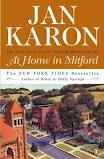
Book Review: At Home in Mitford

MitfordI first encountered Jan Karon in the pages of Victoria magazine some years ago. Victoria chooses a “Writer-in-residence” whose work they showcase in each issue throughout the year, and Jan was featured one year. I loved her warmth and hominess and clear faith depicted — in fact, I was surprised and pleased that a secular magazine would feature a writer whose faith was integral to her stories. I believe it was there I also first heard of and then sought out Mitford.

At Home in Mitford is the story of Father Tim Cavanaugh, a nearly 60 year old single Episcopal priest ministering in a fictional small town in NC which is replete with colorful and sometimes eccentric characters. He is so busy with his parish that he hasn’t been on a vacation in years and can’t seem to get away for more than a day or two, and the strain is starting to show.

Then unexpectedly a dog “as big as a Buick” comes bounding into his life, an untamed, neglected boy comes into his care, and a new enchanting neighbor “pops through the hedge” to visit. The discovery of stolen jewels weighs heavily on him, he’s asked to bear burdens and secrets of his people, and a condition of his own begins to manifest itself.

I strongly disagree with this assessment that Karon “satirizes Father Tim and the citizens of Mitford.” I see no satire here at all but rather realism, warmth, humor, and pathos. The characters are clearly and lovingly drawn with flaws, quirks, and endearing features intertwined realistically. As I mentioned earlier, there is a warmth, a hominess, a coziness in Karon’s stories. Here is one example when Father Tim goes to the home of good friends for dinner:

In the center of the kitchen was a large pine table, bleached by age, with benches on either side. A mason jar of early wildflowers sat in the center, along with a deep-dish apple pie, fresh from the oven. A dazzling beam of light fell through the windows that looked out to the stables.

Their guest stood transfixed. “A foretaste of heaven!” he said, feeling an instant freshness of spirit.

And then follows gently irony as he muses on the fact that everything is calm and peaceful and nothing dramatic or surprising happens there just before he’s blindsided by major news (good news this time.)

I enjoyed as well the beginnings of a “older” romance later in the book. It’s nice to see love stories aren’t just for the young. 🙂

Karon also weaves quotes from various authors, poets, and preachers throughout the book. She must be widely read but does not come across as pretentious at all.

I don’t know if her books would be classified as Christian fiction: I don’t think so. But faith is integral to the story. I had not know much about Episcopalianism before reading this book and I don’t know all the fine points of their beliefs, but the gospel is quite clearly and naturally presented.

Later books were a bit too ecumenical for me, but I could read them as a continuing part of the story, acknowledging but not agreeing with some of the happenings. The one thing that particularly bugged me was that many characters have a tendency to say “Good Lord!” or “Oh Lord,” which I perceive as taking the Lord’s name in vain, using something holy and glorious as an empty epithet. It was often said that Father Tim used such phrases as a prayer, though.

I was surprised to learn recently that this book started out as a weekly newspaper column and was begun when Jan was nearly 50 (that gives me hope that there may be a story in me yet!)

When I first read the books however many years ago, I borrowed them from the library. This time I listened to the audiobook read by stage actor John McDonough. It took me a while to get into his style. He seemed a little ponderous at first, but in some parts he reminded me of a beloved pastor from my teen and college years, and once I got into the story I enjoyed his rendition very much. Mitford is not a place to rush through, but to sit down, relax, and take your time.

I thoroughly enjoyed this revisit. the only problem now is that I want to sit down and devour the rest of the books in the series. But I’ll look forward to delving into a few more of them next year.

(This review will also be linked to Semicolon‘s Saturday Review of Books.)

Booking Through Thursday: Records

btt  button Booking Through Thursday is a weekly meme which poses a question or a thought for participants to discuss centering on the subject of books or reading.

I haven’t done one of these for ages, but I thought the question for this week was interesting:

Do you keep a list of the books you’ve read? How? In a journal? Through one of the online services? If so, WHY? To keep good records for future reference? To make sure you don’t accidentally reread? If not, why not? Too eager to move on to the next book? Too lazy? Never thought to bother?

I’ve only kept a list since starting my blog and I really enjoy it. Why keep a list? Well, I do get satisfaction from lists of things I’ve completed. It provides a sense of accomplishment. And it’s fun to look over and remember. At the end of the year I enjoy compiling a list of books I’ve read that year. It’s like catching up with old friends or looking through a photo album. I’ve been keeping a list for each year on my sidebar but after the first of the year I think I’ll try to compile those into one master list.

I don’t worry too much about accidentally rereading a book. I figure if I don’t remember having read it, it will probably do me good to go through it again.

I do wish I had lists from books I read from childhood. It would be interesting to see what my tastes were then, plus there are some stories that I can’t remember whether I’ve read or just seen the film of.

My most thorough lists are kept here on the blog. I do have an account at Goodreads but I’ve only recently begun to keep up with it regularly, so it only has a fraction of the books I’ve read.

Sometimes I enjoy looking through other people’s lists of books read as well, to compare notes and see if we liked the same books, to get an idea of their personality and preferences, to get ideas for my own ever-growing TBR list, etc.


Learning from the Savior’s learned obedience

One of the verses in my Daily Light reading for this morning was Hebrews 5:8: “Though he were a Son, yet learned he obedience by the things which he suffered.” The context for all the rest of the verses in today’s reading had to do with affliction, but that phrase about Jesus learning obedience arrested me, not for the first time. He had always obeyed the Father perfectly, but in Gethsemane  was the first time, as far as we know, that He prayed “not my will, but thine, be done” (Luke 22:42). So perhaps learning obedience had to do with obeying the Father’s will despite His own will? (There is more helpful commentary on this verse at the bottom of this page.)

One way in which this encourages me is to observe how the sinless Son of God obeyed and endured. Here are a few thoughts:

1. Our will and His will. It’s not necessarily wrong to struggle with God’s will. For us, more often that not, it usually is a problem of faith or obedience. People throughout Scripture have been called to do things that at first they didn’t want to do: Moses, Ananias, others.There are many times when God’s call to someone included encouragement that He would be with them and help them: Joshua, Jeremiah, Paul to name a few. These days people say you’ll know something is God’s will when you “have a peace” about it, but sometimes God’s will causes fear, trepidation, reluctance. Jesus asked, “Father, if thou be willing, remove this cup from me,” and then submitted His will to the Father’s: “nevertheless not my will, but thine, be done.” We can follow His example when we shrink from something He has called us to do. He was sinless, but we can pray and seek His Word to deal with any sinful issues we might have in regard to submitting to Him.

2. Remember our purpose. In John 12: 27, Jesus said, “Now is my soul troubled; and what shall I say? Father, save me from this hour: but for this cause came I unto this hour.” The plan of redemption had been decided upon from the foundation of the world. I’m sure many of the people mentioned above had to go back to their calling and remind themselves of God’s purposes and promises when they were later in the thick of things.

3. Seek His glory. After saying, “Now is my soul troubled; and what shall I say? Father, save me from this hour: but for this cause came I unto this hour, Jesus said, “Father, glorify thy name” (John 12:28). When we look at ourselves, our safety, our pain, our fears, our comfort, we shrink back: when we seek His glory we can find the purpose and strength we need.

4. Resist temptation with God’s Word. Satan tried to derail Jesus from His purpose, but Jesus resisted with God’s Word. We need to read and know His Word that we might do the same. Though He never sinned, we do fail, and thankfully God promises grace to forgive and help us. But he also wants us to be filled with His Word and grace and enabled to resist temptation thereby for His glory.

5. Remember the coming joy. “Looking unto Jesus the author and finisher of our faith; who for the joy that was set before him endured the cross, despising the shame, and is set down at the right hand of the throne of God” (Hebrew 12:2). I wonder what all was encompassed in that joy: perhaps having finished His course, pleasing His Father, being reunited with His Father and back home in heaven where all is right and no sin or sorrow dwells, providing the way for us to go there, too. And that leads us to…

6. Look beyond the momentary to the eternal. “For our light affliction, which is but for a moment, worketh for us a far more exceeding and eternal weight of glory; While we look not at the things which are seen, but at the things which are not seen: for the things which are seen are temporal; but the things which are not seen are eternal” (2 Corinthians 4:17-18). “If ye then be risen with Christ, seek those things which are above, where Christ sitteth on the right hand of God. Set your affection on things above, not on things on the earth” (Colossians 3:1-2).

Are there any other ways in which Jesus’ obedience encourages your own?

Seeing then that we have a great high priest, that is passed into the heavens, Jesus the Son of God, let us hold fast our profession. For we have not an high priest which cannot be touched with the feeling of our infirmities; but was in all points tempted like as we are, yet without sin. Let us therefore come boldly unto the throne of grace, that we may obtain mercy, and find grace to help in time of need. Hebrews 4:15-16