The Week In Words

”"

Welcome to The Week In Words, where we share quotes from the last week’s reading. If something you read this past week  inspired you, caused you to laugh, cry, think, dream, or just resonated with you in some way, please share it with us, attributing it to its source, which can be a book, newspaper, blog, Facebook — anything that you read. More information is here.

Here are a few that caught my attention this week:

Seen at Mama Bear‘s:

If you take two steps forward and one step back, you’re still getting someplace. Don’t give up the moment you slip up. Press on!

That’s so applicable and so encouraging in so many areas.

From a friend’s Facebook:

Two choices to make today (among many others): See the difficulty in every opportunity OR see the opportunity in every difficulty.

Seen at ivman:

“It is the easiest thing in the world for us to obey God when He commands us to do what we like, and to trust Him when the path is all sunshine. The real victory of faith is to trust God in the dark, and through the dark.” — Theodore L. Cuyler

If you’ve read anything that particularly spoke to you that you’d like to share, please either list it in the comments below or write a post on your blog and then put the link to that post (not your general blog link) in Mr. Linky below. I do ask that only family-friendly quotes be included.

I hope you’ll visit some of the other participants as well and glean some great thoughts to ponder. And don’t forget to leave a comment here, even if you don’t have any quotes to share! 🙂

Friday’s Fave Five

Welcome to Friday’s Fave Five, hosted by Susanne at Living to Tell the Story, in which we can share five of our favorite things from the last week. This has been a wonderful exercise in looking for and appreciating the good things God blesses us with. Click on the button to learn more, then go to Susanne’s to read others’ faves and link up your own.

It’s Friday! Again! What a blessing that it comes every week! 😀 Here are a few favorite particulars from the last week:

1. A night out with hubby. Last Friday I took Jesse up to the church for an overnight youth activity and then met Jim where he works for an annual antique festival in the area. The little town where he works has a short street that is mostly antique shops, and during this weekend they all host sales, have street vendors that sell food, and live music. I’m not so much into antiques — I don’t know enough about them to know what’s valuable — but I like a vintage-y look to things. And a lot of the wares weren’t truly antique, but there was some nice stuff at good prices. Then when we went back to his workplace to pick up his car, he took me on a tour of his area, which I had never seen before. It was nice to see where he spends his days. Then we ate at a restaurant near there which we frequented a lot on our house-hunting trips. It was altogether a very pleasant evening!

1a. Finding pink rosy fabrics. It’s hard to find fabric with truly pink roses these days: most of them are either too red or peachy. But one of the stores we went to had some older fabrics with just the right shade of pink roses. I have a project in mind…if it all works out, I’ll let you know!

2. Soup nights. Last night was cool and rainy, the perfect weather for a pot of vegetable beef soup (only I use ground turkey) and cornbread muffins.

3. Applesauce spice cake. A nice flavor — it tasted a little like zucchini bread to me — and only 90 calories. I added a little glaze, so that upped the calories a bit. And it only makes a 9 x 9 pan (or 8 or 9″ round, if preferred), so there wasn’t a whole 9 x 13 panful of it to tempt me. Unfortunately neither Jim nor Jesse liked it — Jesse wouldn’t even try it, and Jim, because of the name, thought it would taste like apples and was disappointed it didn’t. I should have just called it a spice cake.

4. Seeing a son display God’s wisdom. My youngest son had a classmate confide some serious issues to him, and I was blessed and a little amazed to hear how he handled it and what he told her. He did end up needing to share it with the principal for safety reasons, but the other person didn’t take offense. I can’t disclose the situation, but this girl needs a lot of prayer.

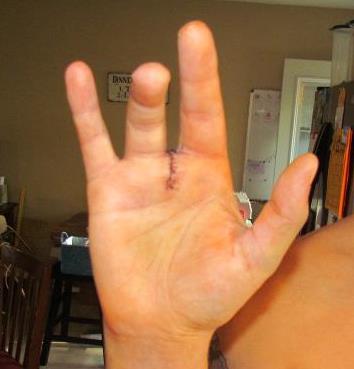
5. My nephew’s hand healing well. I mentioned last week my nephew having an accident resulting in the amputation of his middle finger. He posted a photo, and I thought it looked amazing for only a week after surgery. I hope this won’t make anyone squeamish:

He was joking about giving high fours instead of high fives, so he seems in pretty good spirits about it. The doctor said he should be able to use it normally — but I imagine some tasks might take a little getting used to. Thanks for praying!

When I first started thinking about the Fave Fives for this week, I only had a couple in mind. But then several others came to mind — that is the best part of this meme. There are all sorts of blessings we’d miss due to not taking the time to think about them. It’s a good thing to revisit the week and thank the Lord for the good things He has scattered through the days.

Rereading


Carrie posted a list of ten books she would like to reread, so the topic has been on my mind the last few days.

Why reread? Especially fiction, when the thrill of discovering what’s going to happen is gone? Well, why do we listen to the same music, rewatch a movie, tell the same stories at family gatherings? There is something comfortable and familiar about books we’ve read, like favorite old clothes or a cozy visit with a longtime friend. Each time we read them we either get something new, or we discover aspects we missed the first time. With some like the Little House books or Little Women, I find myself identifying with different characters at different stages in my life. Each time through is an enriching experience. With nonfiction, it can be hard to get all the good truths from the book in one reading, and each time through helps reinforce the old lessons learned and teaches us points we might have missed or glossed over before.

Here are a few books I have read multiple times:

1. The Bible
2. Some devotional books: Daily Light on the Daily Path, Spurgeon’s Morning by Morning and Evening by Evening
3. Les Miserables (the unabridged version only once, though!)
4. The Little House series by Laura Ingalls Wilder
5. David Copperfield by Charles Dickens
6. A Tale of Two Cities by Charles Dickens
7. Little Women, Little Men, Jo’s Boys
8. Changed Into His Image by Jim Berg
9. Spiritual Leadership by J. Oswald Sanders
10. How to Say No to a Stubborn Habit by Erwin Lutzer
11. Isobel Kuhn’s books: By Searching, In the Arena, Second Mile People, Green Leaf in Drought
12. Amy Carmichael of Dohnavur by Frank Houghton
13. Goforth of China and Climbing by Rosalind Goforth
14. Anne of Green Gables by Lucy Maud Montgomery
15. Rose From Brier by Amy Carmichael
16. Through Gates of Splendor by Elisabeth Elliot

Some of those I will probably revisit again in the future. Here are some that I don’t remember reading more than once but would like to read again some time:

1. C. S. Lewis’s Space Trilogy
2. Jane Austen’s books
3. Tolkien’s Lord of the Rings series
4. Jane Eyre
5. Gene Stratton Porter’s Freckles and A Girl of the Limberlost. I was quite captivated by them as a child, but when I have looked at descriptions of them as an adult, they don’t sound appealing. I don’t remember much about them, so it would be interesting to see what drew me to them in my youth.
6. When God Weeps by Joni Eareckson Tada and Steve Estes, one of the best books on suffering, born out of Joni’s questions and struggles after becoming paralyzed.
7. Uncle Tom’s Cabin by Harriet Beecher Stow. I was never interested in this until a former pastor described Uncle Tom as the kind of Christian you always wanted to be.
8. Spiritual Depression by David Martyn Lloyd Jones
9. Hudson Taylor: In Early Years – Growth of a Soul by Howard Taylor. There are shorter biographies of him — I may have read Hudson Taylor’s Spiritual Secret more than once — but this one covers so much more.
10. Jan Karon’s Mitford series
11. Keep a Quiet Heart by Elisabeth Elliot
12. A Path Through Suffering by Elisabeth Elliot
13. End of the Spear by Steve Saint
14. Michael Phillips’ Stonewyck trilogy
15. Janette Oke’s early books
16. Sarah Sundin’s Wings of Glory series

I’m sure there are even more I could add to that list. The main problem with rereading is that there are so many new good books being published, it’s hard to make time to go back to the old ones. But any of these is worth another read, and I like to work them in here and there amidst the new ones.

Can frugality go too far?

Frugality is a good thing. We’re supposed to be good stewards of the things God has entrusted us with. We’re supposed to exercise self-control, reduce, reuse, recycle, save, watch for bargains, etc. But is it ever possible to be too frugal? Are there any downsides to frugality?

I believe so. I want to share a few excesses or misapplications of frugality. Of course, not every frugal person manifests all of these traits, or any of them, necessarily. But these are things I have seen in real-life people and situations that we need to watch out for in our own hearts and lives.

1. Pride

There is nothing wrong with a sense of joy and satisfaction when we’ve found a great deal. There is nothing wrong with putting frugal practices into place as we feel led. But it can be easy to look with condescension or even scorn on others who don’t follow the same practices. One of the hardest things in the Christian life is to deal with the fact that not everyone feels led to the same place we feel the Lord has led us to in various aspects of life.

Once I was at a friend’s house when she invited me for lunch. She began making macaroni and cheese from scratch, and I was amazed that she would go to such trouble when the boxed varieties were less than a quarter back then. She responded that she usually had all the ingredients on hand and she didn’t consider it any trouble. Yet when we talked about spaghetti sauce, she admitted that she used the kind in a jar because she felt it was too much trouble to make from scratch, while I made spaghetti sauce from scratch all the time and didn’t consider it any trouble at all. I was relating this to a mutual friend and commented on how funny it was that different things were considered “trouble” by different people when this friend said, “Well, I wouldn’t use either of those!” It didn’t bother me that she didn’t use jars of spaghetti sauce or boxes of mac and cheese, but what bothered me was the condescending tone with which she said it.

Frugality does take time, either to make items from scratch or to search for deals or clip coupons or fill out rebate forms or whatever. Some people may choose to use mixes or jars occasionally as a time-saver, and if that’s okay with their families and within their budget, that’s fine. It’s not necessarily a sin to pay full retail price for items.

2. One-upmanship

This is somewhat related to the first point. Once I was showing a friend a new purse that I had found, that was the color and style I wanted with just the right little pockets, handle length, etc., and I happened upon it for $2 at a bargain table. Instead of saying anything along the lines of, “Hey what a great deal!” her response was, “I found one like that at a yard sale for fifty cents once.” It felt like a put-down. It’s normal to want to share our bargaining conquests, but when we try to outdo each other, something is wrong.

3. Lack of willingness to pay for quality

One friend who had a retail business had an interesting conversation with one her vendors one day. They both had dealings with a Christian university which had students, faculty and staff living in town. The vendor said, “Those folks recognize and want quality, but they don’t want to pay for it.” I don’t think that was necessarily a good testimony. Other people need to make money from their efforts. After all, if we were to make and sell goods or provide services, we would want, even need in most cases, to make enough money for it to be worth the materials and time involved. It’s not wrong to look for sales or deals or ask for a better offer, but, as I said above, it’s not wrong to pay full retail prices if it fits our budget and the Lord allows. There is a difference between being frugal and being cheap.

4. Obsession

Finding good bargains and saving money can bring joy and satisfaction, and once people get started on the lifestyle, frugality tends to grow. But if one’s life is so obsessed with bargain-hunting and implementing frugality that they become one-dimensional, can’t talk about anything else, or other interests or people are neglected, they may be going too far.

5. Hoarding

I know a dear older lady who grew up in the Depression and WWII era. She learned frugality and “doing without” as a lifestyle. She never put great stock in having a lot of things or having nice things, but she can rarely let go of what she does have for fear that she might need it some day. Her home is overflowing with things that are falling apart, outdated, or unneeded, but she can’t let them go. She can’t even be motivated by the thought that the things in good condition that she doesn’t use (and hasn’t in 40 years) could be sold or given away and become a blessing to someone else.

You know, you don’t have to be rich or have a lot to be materialistic. An over-preoccupation with the meager “things” you do have can be just as materialistic a mind-set.

6. Excess

Many coupons or specials require the user to buy multiple items in order to redeem the coupon, and some keep a few shelves for the “extras” or donate them to missions closets or rescue missions. But I’ve heard of people having whole rooms for such extras. Is that really necessary? Must we have 3 to 5 or more bottles of shampoo, deodorant, or whatever on hand? One lady I knew kept buying and then getting free an excess of hair care products and then had a hard time finding someone to give them to, and I thought, “You don’t have to buy them just because there is a deal on them.”

7. Shady practices

Sometimes this excessiveness can lead to less than noble practices, to put it mildly, or outright wrongdoing. Ann recently wrote about seeing a TV program where people with more coupons than the store allowed at a time went back to the store ten times for ten different transactions so they could use all the coupons, getting about a thousand dollars worth of groceries for about $20. That might sound great like a great deal, a super conquest, but how many stores could handle it if several customers did that? I can remember the days when stores had no restrictions on how many coupons could be doubled or the amount that could be doubled, but when articles started coming out about how shoppers could buy groceries for just a few dollars, or even get money back, then manufacturers and stores had to start adding restrictions lest they go out of business. So those few excessive couponers negatively impacted other shoppers, when these restrictions might not have been put in place if everyone had kept in moderation.

In another vein, this sentence jumped out at me in the biography Goforth of China by Rosalind Goforth: “”Graft, sweating of the poor (fed by women’s thirst for bargains) were horrors of cruelty to him that must be and were denounced” (p. 154).

8. Leaving some for others

Something else to think about when buying more than we need is the principle in the Old Testament of leaving something in the fields for poorer people to glean (Leviticus19:9-10). You might think with all that the Bible teaches about industry and diligence and hard work that God would want people to be careful to pick every possible piece of fruit off the vine. But He wanted people to leave some for others. We need to think about that before we buy an excess of items because they’re on sale: if the first twenty shoppers did that, would there be any left for anyone else? I don’t think this principle means that if the toy we want to buy our child for Christmas is the last one on the shelf, we should leave it for someone else. We have to keep all these things in balance. But perhaps we don’t need to buy twenty cans of pumpkin on sale if we’re just going to make a couple of pies and a few batches of bread or muffins with it over the winter.

I’ve also wrestled with this in regard to thrift stores. I feel I am supporting the charity that operates the thrift store when I buy something there, but I’ve wondered if I am taking something from someone else who couldn’t buy it anywhere else. I’m still pondering this one.

9. Time factors

As I mentioned before, most frugal practices do take time. There are some situations in life where there is really no choice: for various reasons there is a lack of income and time must be spent looking for ways to save money, even if those ways cost more time. But sometimes time itself can be put to better use than spending most of the day dragging children to five different stores, spending hours making something that would have been less of an investment to buy, spending time scouting online frugality sites when that time might be better spent in other pursuits, etc.

10. Impact on others

I was in a home once where I felt hampered by the hostess’s ultra-frugality, though she had the best of intentions. If I threw a paper plate in the trash, she got it out (sometimes seconds after it left my hand) to put it in the fireplace (where it burned in seconds, not really providing any long-lasting fuel). If I started to throw away a bit of food my child didn’t eat, she’d say, “No, don’t do that: save it for the dog.” I felt like I was constantly doing things “wrong.” Maybe your family (or guests!) would like you just to relax sometimes rather than feeling you’re constantly hounding them, or spend time with them rather than spending Saturdays scouting yard sales. Maybe they’d rather you didn’t buy three boxes of cereal they’re not crazy about (or like, but would also like some variety) because it was a good deal.

11. Neglect

If we neglect buying something we really need or avoid going to the doctor when sick because we don’t want to spend the money, we may be carrying frugality too far. There is a difference between not being able to do these things financially and not doing them just because we don’t want to. Good health is a good investment.

12. Health and sanitation

Even canned goods have an expiration date on them (another reason not to store an excess of them), and sometimes it’s best to throw away questionable leftovers than eat them. I’ve been sorely convicted by Proverbs 12:27 while throwing out food: “The slothful man roasteth not that which he took in hunting: but the substance of a diligent man is precious.” I need to do much better to be diligent to use my “substance,” but if it does spoil, I shouldn’t use it just because I don’t want to throw it out. Once a dear lady pulled out some leftover corn from the refrigerator, remarked that it didn’t look very good, and then, instead of throwing it out, added more fresh corn to it. I was less than excited to eat that meal!

I’m sharing the following not to disparage my mother-in-law, but to help others understand how older people’s thought processes can work. My mother-in-law grew up in an era where you rarely if ever threw anything away. Now in her old age when she doesn’t always think clearly, she wants to reuse straws. We use bendy straws to make it easier for her to handle, and she’ll take them out of her glass when she’s done and put them on her end table. The next time we get her something to drink, she’ll want us to reuse those straws rather than get a new one – even if that straw has been sitting there long enough to have dried milk globules in it. I don’t know if she could get sick from drinking through a used straw, but I don’t want to take the chance. She fusses at me for throwing them away, but I tell her teasingly she’s not so poor that she has to reuse straws (and I try to throw them away when she’s not looking so it doesn’t disturb her.)

13. Lack of faith.

Frugal practices can be a good investment in wise stewardship. But if it is causing any of the above problems, yet the one involved feels she can’t possibly scale back, it might be evidence of not trusting the Lord for His provision.

I know a dear younger lady who is trying very hard to be as frugal as possible because her husband is in a ministry that isn’t able to pay much, and she wants to stay home with her children rather than work outside the home. That is commendable and I applaud that. Yet she is so frantic about it that it seems a constant source of worry and consternation to her. She reads a number of frugality sites, always feeling like a failure because there is more she feels she should be doing. But there is so much information online about this kind of thing now, we can’t possibly do everything recommended, go to every store, find every deal, and then beat ourselves up if we paid for something and then found a better price elsewhere. It’s a miserable way to live. We really need to seek the Lord for what practices He would have us employ and remember that ultimately our provision is from Him.

One former pastor used to say that for every strength there is an off-setting weakness. Couponing, yard-saling, thrifting. repurposing and other frugal practices are good and effective, and most of us should probably work on being more frugal. But like anything else, if done to excess or in the wrong spirit it can lead to other problems. We need to remember to do unto others what we’d have them do for us if we had a business. We need to work hard yet trust God and keep all of these principles in balance. In an excellent post about frugality, Tim Challies sums up:

I guess the long and short is that money can be as big an idol when you seek not to spend it as it can when you do nothing but spend it. Frugality in and of itself must not be an end in itself but must be a means to a greater end of bringing glory to God and of serving others. Ever and always it is a matter of the heart.

(Graphic is courtesy of Microsoft Office clip art.)

This post will be also linked to “Works For Me Wednesday,” where you can find an abundance of helpful hints each week at We Are THAT family on Wednesdays, as well as  Women Living Well.

The Week In Words

”"

Welcome to The Week In Words, where we share quotes from the last week’s reading. If something you read this past week  inspired you, caused you to laugh, cry, think, dream, or just resonated with you in some way, please share it with us, attributing it to its source, which can be a book, newspaper, blog, Facebook — anything that you read. More information is here.

Here are a few that stood out to me, with little commentary:

Seen on Facebook, I think:

Let God have your life; he can do more with it than you can. ~ D.L. Moody

From a friend’s Facebook status:

Stop trying to fit in when you were born to stand out.

From Candy Troutman:

“What the Israelites feared (the sea) became their way to freedom.”

From another friend’s Facebook:

“The best training is to learn to accept everything as it comes, as from Him whom our soul loves. The tests are always unexpected things, not great things that can be written up, but the common little rubs of life, silly little nothings, things you are ashamed of minding one scrap” ~ Amy Carmichael

In a similar vein, from an Elisabeth Elliot devotional:

An angry retort from someone may be just the occasion we need in which to learn not only longsuffering and forgiveness, but meekness and gentleness; fruits not born in us but borne only by the Spirit. From “God’s Curriculum” in Keep a Quiet Heart.

From The Old Guys:

Shall we give entertainment unto that, or hearken unto its dalliances, which wounded, which pierced, which slew our dear Lord Jesus? ~ John Owen, Overcoming Sin and Temptation

If you’ve read anything that particularly spoke to you that you’d like to share, please either list it in the comments below or write a post on your blog and then put the link to that post (not your general blog link) in Mr. Linky below. I do ask that only family-friendly quotes be included.

I hope you’ll visit some of the other participants as well and glean some great thoughts to ponder. And don’t forget to leave a comment here, even if you don’t have any quotes to share! 🙂

Dear Lord and Father of Mankind

Dear Lord and Father of mankind,
Forgive our foolish ways;
Reclothe us in our rightful mind,
In purer lives Thy service find,
In deeper reverence, praise.

Drop Thy still dews of quietness,
Till all our strivings cease;
Take from our souls the strain and stress,
And let our ordered lives confess
The beauty of Thy peace.

Breathe through the heats of our desire
Thy coolness and Thy balm;
Let sense be dumb, let flesh retire;
Speak through the earthquake, wind, and fire,
O still, small voice of calm.

~ John Greenleaf Whittier

Longer text is here.

Laudable Linkage

This week seems like it was short somehow! Here are a few things that stood out to me along the way:

Distant or Engaged? Making Your Home a Haven.

The Foundation of Mortification. Very helpful thoughts on what the Bible means when it tells us to “mortify” the deeds of the flesh.

How S. O. A. P. Changed My Life. No, not bath soap or laundry detergent, but a method of Bible study.

The Manly Virtues: What do Noblesse Oblige and Condescension Have in Common?

Women’s Ministry Fall Ideas.

From More Funny and Maybe Not So Funny Signs, one of my favorites:

Craftiness:

Lovely Spaces: Craft Room. I love seeing how other people organize their craft stuff. The first two especially are really cute.

Laminating Love. Neat things to do with a laminator. I got one one sale months ago but haven’t used it yet — this has me itching to get it out.

Foodie stuff:

Pumpkin Cream Cheese Muffins. These look luscious!

Applesauce Spice Cake — only 90 calories a serving, and it sounds really good.

This is so cute. It was going around Facebook with the title “May You Always Sing Like No One is Listening.”

Using a plastic bottle as a light bulb. I wouldn’t want to convert my house to this, but it’s a neat idea.

Friday’s Fave Five

Welcome to Friday’s Fave Five, hosted by Susanne at Living to Tell the Story, in which we can share five of our favorite things from the last week. This has been a wonderful exercise in looking for and appreciating the good things God blesses us with. Click on the button to learn more, then go to Susanne’s to read others’ faves and link up your own.

It’s funny how the same set of hours seems to fly by faster at times. I don’t know what happened to this last week, but it is gone already! Here are a few favorites from it:

1. Eating fries out of the bag on the way home from a fast-food place. One of life’s simple pleasures. 🙂 I’m trying to cut down on fast-food fries, but I grabbed a quick lunch of a junior burger and small fries on the way home from errands this week, and I love to nibble on the fries while they’re at their prime on the way home. So good.

2. A Kindle app discovered on my TouchPad and…

3. Free Kindle books! I hadn’t known that you could download Kindle books with anything other than a Kindle. I was surprised at how effortless it was to download them. Then someone on Facebook posted a link to a list of free Kindle classic books (I would share the link, but they’re up to $1.79 now — but still a good deal, so here are some inexpensive Kindle classics if you’re interested). I tried reading one on the Touchpad while using the treadmill this week, and it all worked together just fine.

4. Clearance sale. I had to stop in the Christian book store this week and found they had marked a lot of books on clearance for $5 to 5.99. Like I need to add more books to my pile…but I did. 🙂

5. Being able to share prayer requests electronically. My 20-year-old nephew had a freak accident yesterday — a ring he was wearing caught on something as he was getting out of a truck and severely tore his middle finger, resulting in its amputation down past the knuckle. From the time he was in the ER and then throughout the afternoon, my sister was able to share updates and prayer requests, which we then passed on to our friends on Facebook and also to an e-mail prayer chain our ladies at church have. Knowing that you can have prayer support in just seconds is a tremendous blessing. The last I heard, he was to go home last night with pain medications. If you feel led, I’d appreciate your prayers for him and also for my sister as she is in another state — it is so hard to have your children go through these things, but especially when you can’t be there.

Except for my nephew’s accident, it has been a good week. I hope yours was the same. I am thankful for God’s grace every week, whether they seem “good” or “bad” at the time.

Every day is a gift

Yesterday could have been one of those no-good awful very bad days.

As I was waiting on my cream of wheat to gel in the microwave, I noticed anew the sad state of a burner on the stove that had been spattered with bubbling potato soup a few days ago, and thought, “I really need to clean that up.” As I took my half-formed cream of wheat out of the microwave above the stove in order to stir it, I bumped the microwave and the cream of wheat spilled onto the burner pan in question and its neighbor, looking, honestly, like someone had thrown up on them. So I took that as a sign to clean up that burner pan now.

The next several hours were fine except that I got out the door to go visit my mother-in-law later than planned. I have to pass through three school zones to get to her place, and at the wrong times of day that can be a nightmare. Plus I like to be home when Jesse gets home. He’s capable of being home alone, but I can remember the difference in my teens between coming home when Mom was there — warmth, interest, communication — and coming home an empty house when she was working to  — lonely and desolate. This is Jesse’s last year before college, and I want his memories to be of mom being there when he gets home from school.

So on my way to Mom’s, thinking I should make it past the one school zone that lets out earlier without too much delay, suddenly traffic came to a grinding halt in both directions. As several cars made three-point turns to go back the way they had come, I inched forward. It looked like one of those big construction vehicles had stalled (it looked like a truck in front but had a large long crane-type arm on the back), and from what I could tell, had been hooked to a tow truck. Hooked because evidently it was either too big or too heavy to be on the tow truck. But the tow truck, in making a wide turn onto my road with that unwieldy beast tethered to it, had swung too wide and almost went off the slope on the other side of the road. I was almost at the last turn to Mom’s place, so I hated to turn around and try to find another route when I didn’t know the area well (and the GPS wasn’t giving me any better ideas). I kept thinking about it, but every time I was just about to, I’d see some movement with the stalled vehicles and think we were just about to get going…and then realize we weren’t. I ended up there for about 45 minutes to an hour. Thankfully with all of this study about the sovereignty of God in Job, the Lord enabled me to take it all much more patiently than I might have otherwise, but I still stewed over the waste of time for all of us involved and prayed for the situation while listening to some nice classical music on NPR and occasionally flipping through the mail I’d picked up on my way out.

Finally the vehicles blocking the road got mobile and we were all on our way. I visited Mom a while and then, on the way back, felt my blood sugar slipping a bit and decided to pull into a fast-food drive-through for a little snack. But the line wasn’t moving. The guy parked where orders were placed looked like he was having a conversation rather than placing an order, and no matter how much he talked, he wasn’t going anywhere. I assume he was talking to someone in his truck while waiting for someone to take his order. Finally I decided to forget it and head home for a snack, saving money and calories and any more waiting time.

And then I got stopped in backed-up traffic again, this time for a passing train.

I finally got home, a little rattled, harried, and hungry, glad I had an hour or two to unwind before dinner and wouldn’t have to wait in line again for the rest of the day.

Elisabeth Elliot has a devotional I can’t find just now about how even little things that don’t seem to have a major purpose can be taken as the Lord’s will for the moment, and Amy Carmichael has written about God’s grace for disconcerting “little things.” I thought, “Well, Lord, I don’t know what purpose you had in all of that. But thank you for helping me not to get as frustrated as I could have.”

Later in the evening I was sorting through coupons, flyers, catalogs and such while watching The Biggest Loser. I decided to clean out the file folder of restaurant coupons and discovered in it an envelope my mom had sent some time before she died containing several pages from a desk calendar that she thought I’d find interesting. I had glanced at them before but I am sorry to say I had never gotten around to reading them, and I felt bad that she had taken the time and care to send them to me and I had neglected them.

I kept the envelope out and went through it this morning. The desk calendar was evidently a compilation of different Chicken Soup for the Soul books. One particular story was about a lady whose daughter was in the children’s ward of a hospital after surgery and who made friends with a bright cheerful six-year-old boy named Adam receiving chemotherapy for leukemia. One rainy, gloomy day, this woman remarked on what a depressing day it was, and Adam answered, “Every day is beautiful for me.”

Wow. Every day is a gift. For a middle-aged lady stuck in traffic as much as for a six-year-old leukemia patient.

Book Review: Worldliness: Resisting the Seduction of a Fallen World

Worldliness is a difficult topic to consider because people can have some weird ideas as to what is worldly. Yet it is a topic Christians must consider, because the Bible says ” friendship of the world is enmity with God” (James 4:4) and instructs us to “Love not the world, neither the things that are in the world. If any man love the world, the love of the Father is not in him” (I John 2:15). But what aspect of the world? Surely not the physical world, the flowers and sunsets and such that God created and called very good (Genesis 1 and 2), because “God…giveth us richly all things to enjoy” (I Timothy 5:17b). And surely not the people in the world, because “God so loved the world, that he gave his only begotten Son, that whosoever believeth in him should not perish, but have everlasting life” (John 3:16). John elaborates when he goes on to say, “For all that is in the world, the lust of the flesh, and the lust of the eyes, and the pride of life, is not of the Father, but is of the world. And the world passeth away, and the lust thereof: but he that doeth the will of God abideth for ever” (I John 2:16-17).

C. J. Mahaney and four other ministers help us think through some of these questions, considerations, and applications in Worldliness: Resisting the Seduction of a Fallen World. This book first came to my attention when I was listening to a former pastor’s sermon online and heard him quote from it. It intrigued me both because the quote in itself was very good, but mainly because I knew this pastor to be more conservative in his standards (not in a legalistic way) and thought if he found value in this book, it must definitely be worth reading.

And it definitely was. The authors successfully walk the narrow line between the extremes of making a list of legalistic external standards and eschewing all lists in favor of false understanding of Christian liberty. They seek to explain Biblically what it means to be “in the world yet not of it.” The first chapter discusses the concept, succeeding chapters apply the principles to media, music, possessions, and clothes, and the final chapter shares some right ways to love the world. There are two appendices in the back discussing modesty.

Here are just a few of the many quotes I marked:

The gospel makes all the difference between whether you are merely conservative or whether you are conquering worldliness in the power of the Spirit for the glory of Christ (p. 11, John Piper’s forward).

What does it look like when the blood of Christ governs the television and the Internet and the iPod and the checkbook and the neckline?…The only way most folks know how to draw lines is with rulers. The idea that lines might come into being freely and lovingly (and firmly) as the fruit of the gospel is rare (p. 11, Piper).

We will never be useful to the world if we are being deeply shaped by the world. And we will be shaped by the world without intentional efforts not to  be (p. 12, Piper).

In the end, the sum of all beauty is Christ, and the sin of all worldliness is to diminish our capacity to see him and be satisfied in him and show him compellingly to a perishing world (p. 13, Piper).

Before Demas deserted, he drifted (p. 20, Mahaney).

One reason why the church of God at this present moment has so little influence over the world is because the world has so much influence over the church (p. 23, Spurgeon).

Worldliness, then, is a love for this fallen world. It’s loving the values and pursuits of the world that stand opposed to God. More specifically, it is to gratify and exalt oneself to the exclusion of God. It rejects God’s rule and replaces it with our own…It exalts our opinions above God’s truth. It elevates our sinful desires for the things of this fallen world above God’s commands and promises (p. 27, Mahaney).

I’m not saying it’s wrong to watch television, rent a DVD, surf the Internet, or spend an evening at he cinema. The hazard is thoughtless watching. Glorifying God is an intentional pursuit. We don’t accidentally drift into holiness; rather, we mature gradually and purposefully, one choice at a time (p. 40, Cabaniss).

Filthiness, foolish talk, and crude joking are “out of place” — they’re forbidden not because they’re on some arbitrary “banned words” list, but because they reflect the heart and attitude of those who disregard God and His Word (p. 55, Cabaniss).

Christians should dislike and avoid vulgarity…not because we have a warped view of sex, and are either ashamed or afraid of it, but because we have a high and holy view of it as being in its right place God’s good gift, which we do not want to see cheapened (p. 56, Stott).

If we wouldn’t trust a non-Christian to give us counsel on how to live our lives, why would we regularly listen to their counsel set to music? (p. 82, Kauflin).

Materialism is what happens when coveting has cash to spend (p. 95, Harvey).

In my experience, 95 percent of the believers who face the test of persecution pass it, while 95 percent who face the test of prosperity fail it (p. 103, Alcorn quoting a Romanian pastor).

Covetous chains the heart to things that are passing away (p. 106, Harvey).

Your wardrobe is a public statement of your personal and private motivation. And if you profess godliness, you should be concerned with cultivating these twin virtues, modesty and self-control (p. 120, Mahaney).

The Bible doesn’t forbid a woman from enhancing her appearance. But here in I Timothy 2:9-10, Paul isn’t just advocating modesty in dress; he’s insisting that more time and energy be devoted to spiritual adornment in the form of good works. And he’s warning about excessive attention devoted to appearance to the neglect of good works (p. 135, Mahaney).

[The world] held no sway over Paul, nor was he dependent upon it for anything. He didn’t crave its approval, embrace its values, or covet its rewards (p. 169-170, Pursell).

Hope I didn’t overload you there. That’s only maybe a little over half of what I marked, and flipping through the pages again, I keep finding more thought-provoking statements.

There were maybe one or two statements in the book I’m not sure I agree with, but by and large I would consider it an invaluable resource for anyone who has grappled with what worldliness is and seeks grace-based ways of combatting it.

***I must say, as well, that though I enjoyed this book, this is not a blanket endorsement of the authors. I was only familiar with the names of two, knew little about them, and nothing about the rest.

A portion of the book is online here.

(This review will also be linked to Semicolon‘s Saturday Review of Books.)