Friday’s Fave Five

This is one of those weeks where I get to the end, sit down to write a Friday’s Fave Five post, and think, “Wait . . . what did happen this week?” 🙂 I try to keep a running list of things to mention on Friday, but failed to this week. I appreciate this weekly exercise in gratefulness with Susanne and friends at Living to Tell the Story. Sometimes I have to look and think a little harder, but there are always blessings to be found.

1. Internet issues fixed. We’d been having weird Internet issues for a while now. My husband replaced a part–a signal distributor, I think. But everything works fine now.

2. An updated bathroom. We’ve been in this house almost fourteen years, and the whole interior needed repainting. Jim did two bedrooms and our bathroom while he was still working, but decided to save the rest til retirement, when he could work without having to stop and start on weekends or evenings. This week he painted what we call the “guest bathroom” and replaced the flooring there. It looks so much brighter! The old walls were a yellowish kind of beige, and he’s covering them with a light grey.

I didn’t take a before picture, but here’s after:

bathroom redo

3. Hashtags. I don’t do a lot with my Instagram account besides post a link back to my Sunday posts and some books reviews. But it always took a long time to add the appropriate hashtags. I finally did something I’ve thought about for a while: I made groups of hashtags for different posts (blog post, quotes, book reviews, Bible verses memes) in the Notes app on my phone. Now I can just copy and paste them.

4. The Olympics. I’m not terribly interested in athletics most of the time, but I do like watching some of the Olympics. We just see the NBC coverage in the evenings. As I said in my end-of-month post, I only saw the last hour of the opening ceremonies, so I missed the controversial parts. But I heard about them the next day. Though I experienced several emotions, I didn’t feel I needed to boycott watching the coverage. It’s not the athletes’ fault that the program directors did what they did.

5. Avoiding rain. I was going to run errands Tuesday afternoon, but then we were hit with thunderstorms. More were in the forecast Wednesday, but I had to get things done, so I headed out, hoping for the best. Thankfully, I only caught a few raindrops between the car and a store.

That’s my week. How was yours?

July Reflections

July Reflections

Although July flew by too quickly, we enjoyed it while it lasted. It’s been hot, but not as much as it can be this time of year. A few showers the last week have cooled things off a bit and relieved my husband of daily watering plants.

The guys went on a camping trip right at the end of last month, and Jason, Mittu, and Timothy went to see Mittu’s family in OK. Jim helped someone from church move, but I’ve stayed pretty much indoors except for church, lunch with a friend, and dinner out with the family one night. The flowers we planted last May are blooming profusely, and we’ve harvested and even given away some of Jim’s squash and zucchini.

We enjoyed celebrating the fourth of July and Jason’s birthday this month.

Creating

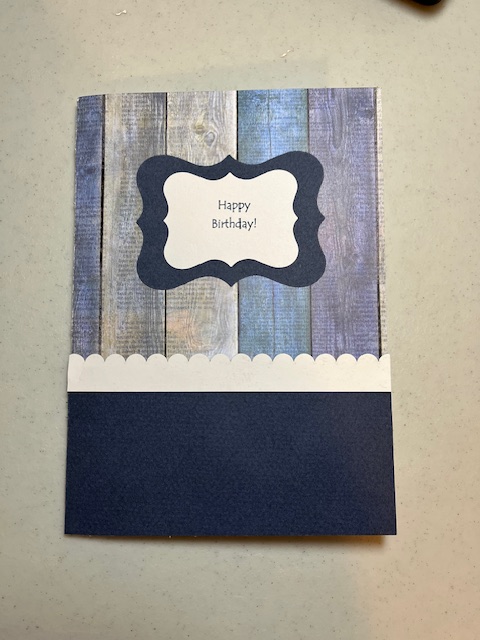
This was for Jason’s birthday:

Son's birthday card

Watching

I read Surprised by Oxford by Carolyn Weber a few years ago. It’s her story of going to Oxford to study and being surprised at running into people of faith there. She had no desire to become a Christian, but couldn’t escape being confronted with it. I had seen that a film was made of the book, but forgot about it til recently, when Jim and I watched it. Although the movie focuses more on the romance than her faith journey, the latter is still there.

We were surprised in may ways. I had thought of Oxford as a hotbed of leftist and “woke” thought, like many colleges. But that didn’t appear to be the case when this book was written (at least, if it was there, it hadn’t snuffed out conservative or religious thought completely).

There were a couple of bad words and “off” comments, but otherwise we enjoyed this movie quite a lot.

We also enjoyed Belle and Sebastian, a French film dubbed with English voices. It was based on a book, I think by the same name. A boy finds a stray dog which villagers thinks has attacked their sheep. But the boy, Sebastian, makes friend with the dog and names it Belle. They end up helping members of the French resistance fighters escape across the mountains.

I didn’t turn on the opening ceremony of the Olympics until about the last hour or so. I didn’t know until the next day about the controversial content. Part of me is shocked. Part of me feels like, “Well, yes, the world hates the truth of Christianity, and they are getting more blatant about it.” I’m still processing it, but I don’t know that I’ll say any more about it. I’m sure just about everything that could be said has been.

I’ve seen several Christians call for a boycott of the Olympics. Of course, each should follow their own conscience in the matter. Personally, I don’t know how much good that would do. But more than that, I feel the athletes are not at fault for what the program directors did. I may not watch the closing ceremony, in case it’s more of the same stuff as the opening ceremony—I haven’t decided yet.

Reading

Since last time I finished:

  • Dombey and Son by Charles Dickens (audiobook). A father pins all his hopes and dreams on his young son following him into business, but the son dies as a child. The father has little use for his daughter, who is the one person who truly loves him. The father’s pride brings him low, but the story is ultimately redemptive.
  • The Story of the Trapp Family Singers, the family of The Sound of Music fame. Not surprisingly, real life was different from the movie.
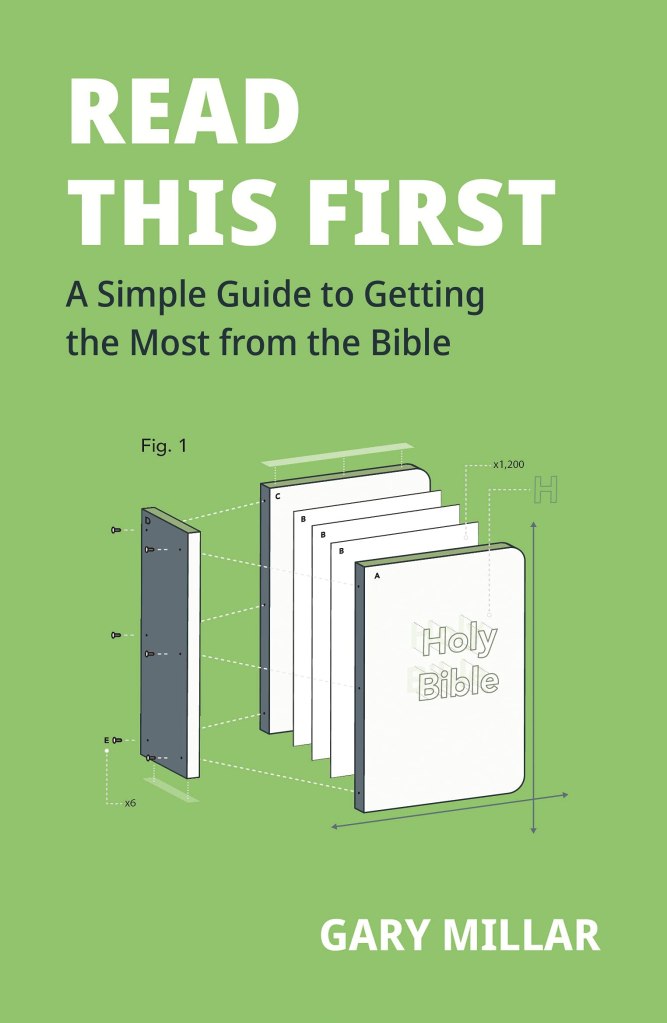
  • Read This First: A Simple Guide to Getting the Most from the Bible by Gary Millar. Good resource for those new to reading the Bible or those who have struggled with reading it.
  • A Month of Summer by Lisa Wingate (audio). Novel about a woman who has not seen her father for thirty years, but now needs to see to him, her developmentally-delayed step-brother, and her step-mother who has just had a stroke. Very good.
  • When We Were Young and Brave by Hazel Gaynor, a fictitious account of a true situation where a school for missionary children in China was taken over by the Japanese during WWII. As a story, it was good, but I struggled with how some facets were handled compared to what I had read in missionary biographies.

I’m currently reading:

  • Be Decisive (Jeremiah): Taking a Stand for the Truth by Warren W. Wiersbe
  • Help for the Hungry Soul by Kristen Wetherell
  • Write a Must-Read: Craft a Book That Changes Lives—Including Your Own by A. J. Harper
  • Shadowed Loyalty by Roseanna M. White, audiobook
  • Hillbilly Elegy by J. D. Vance
  • A Boy’s War by David Michell

Blogging

Besides the weekly Friday Fave Fives, Saturday Laudable Linkage, and book reviews, I’ve posted these since last time:

  • Are You Thirsty? Those who trust in the Lord have a continual source of refreshment and nourishment.
  • All Sunshine Makes a Desert.” As much as we would like all our days yo be sunny and bright, we’d dry up without rain. The same is true spiritually.
  • Assorted Stray Thoughts, some serious and some silly.
  • Be Careful of Your Strengths. We run to God for help in our weakness. But we can easily fall when trusting in our own strength as Uzziah did. He was “was marvelously helped, till he was strong. But when he was strong, he grew proud, to his destruction.”
  • Fading with Age. Hair color and some abilities fade out as we age. But as long as we’re breathing, God can use us.
  • One Book That Can Speak to Everyone. Writers are instructed that their books can’t be for “everyone.” Publishers want them to narrow their focus to a specific audience. But there is one book that truly can speak to everyone.

I didn’t remember my eighteenth blogging anniversary was this month until WordPress sent me a notice about it. Out or curiosity, I looked at my stats to see what my most- viewed post was: Coping When Husband is Away. The most-viewed in the last year was Mary’s Three Encounters with Jesus’ Feet.

I’ve been so blessed to get to know many of you virtually (and a few in person). Thank you for your kind and encouraging comments! And thank you for reading. I pray you’ve been blessed here.

Writing

I’m in the phase of revising my first draft, which is much slower work than initial writing. I got a big chunk done this month, which felt really good.

As we turn toward August, the calendar is pretty full. My oldest son will be coming to visit soon, and we’ll celebrate both his and my birthdays.

How was your July? Are you looking forward to anything in August?

Review: When We Were Young and Brave

When We Were Young and Brave

The day after Japan attacked Pearl Harbor, the Japanese invaded the Chefoo school for missionary children in what is now known as Yantai in northern China. They allowed the school to operate and keep to its schedule, though they rationed food and policed activities. Almost a year later, the Japanese took over the school buildings completely and sent the staff and students to an abandoned missionary outpost known as Temple Hill, keeping them under Japanese guard. In September 1943, the staff and student were transported to an interment camp known as Weihsien with 1,500 other people from various walks of life. They remained Weihsien until it was liberated by Americans in 1945.

Hudson Taylor, founder of the China Inland Mission, had founded the Chefoo school in 1881 for the children of CIM missionaries. A few children of other Europeans also attended the school.

I had read of the Chefoo school and its capture in various missionary biographies and in David Michell’s memoir of his time as a Chefoo student in A Boy’s War. So I was interested to learn that Hazel Gaynor wrote a fictional account of the school’s interment in When We Were Young and Brave.

Gaynor’s characters are fictional. She focuses mainly on a ten-year-old girl named Nancy, nicknamed Plum, and and two of her friends as well as one teacher, Elspeth Kent and her friend. The chapters switch back and forth between the point of view of Nancy and Elspeth, so we get both the adult’s and child’s view of events. One of Nancy’s friends, Joan, aka Mouse, gets one chapter late in the book.

The story begins with the everyday workings of the school with the Japanese occupying the surrounding area. The Chefoo school was fairly self-sufficient, so they didn’t fear the Japanese, though they disliked the tension of having them nearby.

Everything changed, however, when Japan declared war on Great Britain. Now everyone at Chefoo school was the enemy.

Thankfully, many students were away for Christmas break at the time of the Japanese occupation. Those at the school over the holidays were unable to be with their parents due to lack of safety to travel.

As the years wore on, the strain became harder to bear with lack of proper food and the increasing fear of the Japanese guards.

The school staff tried to keep everyone’s spirits up by maintaining classes and Girl Guides (similar to Girl Scouts in the USA). But they all faced various hardships.

The book opens and closes with the adult Nancy, thirty years after liberation, reflecting on her experiences.

The book is well-written. The characters are relatable and well-developed. As a reader, I felt the weight of what they were going through.

A few quotes stood out to me:

Our war wasn’t one of battles and bombs. Ours was a war of everyday struggles, of hope versus despair, of courage against fear, strength over frailty (p. 198).

In the most peculiar circumstances imaginable, their interment had insured that they were capable beyond their years (p. 243).

War and interment are part of their lives now, part of their story, part of who they are. . . . I actually think life is meant to have its share of difficultly and struggle. That’s when we find out who we really are, what we’re really made of, not when everything’s going along all jolly and straightforward and terribly nice. We come alive in the dramatic bits, don’t we; in moments that make us gasp and cry (p. 285).

But a few factors marred my enjoyment of the book.

First, Gaynor often refers to the children as “privileged.” Since most of them were missionary children, this was not a posh, expensive boarding school for the higher classes. There was probably some sense in which the children were more privileged than some of the Chinese nationals, who had been fighting Japan for a while already. But it wasn’t necessary to infuse the same sensibilities as one would have for a standard elite British boarding school.

Secondly, the school was established as a Christian school. According to David Michell, the school still provided “a truly Christian education for body, mind, and spirit” when he was there. But there is little mention of Christianity in Gaynor’s book. When Elspeth only took two books with her when they left Chefoo, she chose her Girl Guide Handbook and the Buddhist scriptures a Chinese servant had given her, not a Bible. She mentions struggling all her life to believe in God and says a budding sunflower gave her “more strength and hope that any prayer ever had” (p. 118). The teachers’ encouragement is the British stiff upper lip, “Keep calm and carry on” variety rather than anything of a spiritual nature.

Then, Elspeth feels that the children’s parents put their mission above their children by sending them away to school. That was not usually the case. Though teaching at home predates institutional learning, home schooling was not the industry then that it is now. Parents might have been able to teach their children at home on the mission field for their early years, but likely would not have had the material to do so as they got older. Plus, the children would not have had the credentials to go to college. Thankfully, these days, many mission boards work with parents to teach their children at home.

Additionally, some of the missionaries worked in remote areas with very few other Christians. Isobel Kuhn wrote that the tribe they worked with didn’t worship idols: they worshiped demons. When her son got old enough that she couldn’t keep him at her side all day, she feared what he would be exposed to as he interacted with people on the village. For many parents, sending their children away to school was for their protection.

Gaynor wrote that she drew from some of the internees’ own accounts at Weihsien Paintings and the Chefoo School Archives in London as well as other books. But all her characters were invented (except Olympic runner Eric Liddell, who was a missionary to China, and was interred at the camp. He died there of a brain tumor). Her characters and their interactions largely came from imagining what her own children might do in this situation, what she would have felt like as a parent at the time, and her grandmother’s war-time experiences. So I struggled a bit with not knowing was was real in the book and what came from the author’s imagination.

At some point, I set aside what I knew of the school and just read the book for what it was: a fictionalized account of people enduring and overcoming great, sustained hardships. I enjoyed it much more after that. But it spurred me to get David Michell’s book to reacquaint myself with the real story.

One Book That Can Speak to Everyone

One Book That Can Speak to Everyone

A few years ago, I attended my first writer’s conference. I hadn’t given any thought to attending one until I learned of a small one in a town where I used to live. I decided to try it out, and it spurred me to get serious about my desire to “write a book someday.”

I kept hearing at that conference that publishing was not what it used to be. Writers could no longer simply finish a manuscript and send it to a publisher, who would do the rest. Now publishers want potential authors to have an audience before their company will consider taking on a book.

Since shortly before that conference, I’ve been reading books, blog posts, magazine articles, and listening to podcasts about writing and publishing.

One piece of wisdom I’ve seen over and over is that telling a potential agent or publisher our manuscript is for “everyone” is a fast route to a closed door. Authors are advised to be as specific as possible in the audience they aim for.

I confess I struggle with this a little. For several years I wrote a newsletter for the ladies of the church we attended. I’m used to writing to women of all ages and stages. Occasionally we’d have an article focusing on one aspect of womanhood or another–single women, young wives and moms, older women—but most of what was written was applicable across the board. I’ve had the same approach with this blog.

Some of my favorite books seem the same way. The authors may have had a specific age group in mind, but it’s not obvious to me as I read their books. People of various ages and situations have bought certain books for years.

This trend towards specific audiences has led some books, like Gary Chapman’s Five Love Languages, to be transformed into versions for parents of children. parents of teens, singles, couples, men, and women. I wondered how he managed to write the same material for all these different groups. The illustrations would likely change in each, but it seems the basic principles would be the same.

Similarly, Stormie Omartian’s The Power of a Praying Wife led to the power of a praying husband, praying woman, praying mom, praying kid, praying teen, praying grandparent, and more.

In my more cynical moments, I wonder if this converting general books to several different audiences is a ploy of publishers and their marketers to sell more books.

But I can see that it would be helpful to take general principles and apply them to different specific situations.

These musings led me to this thought: there is one book that’s good for any age, gender, or life situation. The Bible is inspired and “for teaching, for reproof, for correction, and for training in righteousness” (2 Timothy 3:16).

There are study Bibles packaged in camouflage or sports paraphernalia for boys and pink or unicorns for girls. Bibles have been designed and illustrated for teens, women, men, even outdoorsmen.

The packaging would appeal to different specific groups, as would any devotional material or added notes. Those things can be useful. But I wouldn’t say they are truly necessary. The Holy Spirit can help us understand and apply the Bible at any age and stage of life.

Someone has said that the Bible is shallow enough for a child to wade in, but deep enough for an elephant to swim in. (1)

There are parts a child can understand. God told parents in the Old Testament to teach His Word to their children and grandchildren. Paul says Timothy has “from childhood . . . been acquainted with the sacred writings, which are able to make you wise for salvation through faith in Christ Jesus” (2 Timothy 3:15).

Of course, there are parts a child would not understand. There are parts the wisest theologian doesn’t understand completely. But I can testify, coming up on fifty years of reading the Bible with some degree of regularity, that it speaks to us and is applicable to us all through life. As we read it through different life stages, we continue to find applications to our situations.

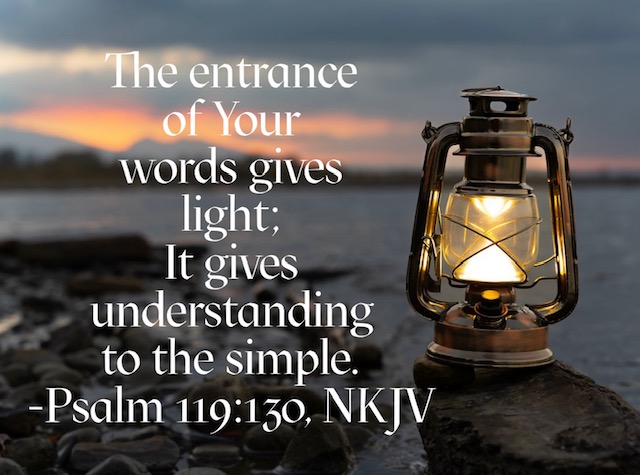
The Bible is even good for those who oppose it. Psalm 119:130 says, “The entrance of Your words gives light; It gives understanding to the simple.” Viggo Olsen tells in his book, Daktar, how he and his wife promised her Christian parents that they would look into the claims of Scripture. However, they secretly planned to disprove the Bible so they could get her parents off their backs about Christianity. Instead, they became convinced the Bible was true and God was real. They became Christians and later went as missionaries to Bangladesh.

The same thing happened to Lee Strobel. He and his wife were both atheists and planned to remain that way. When his wife became a Christian, he tried to disprove the Bible’s reliability and claims with the zeal of the investigative reporter he was. He says in his book, The Case for Christ, that the more he searched, the more convinced he became that the Bible was true after all. He became a Christian and went on to become a minister and wrote several more books about Christianity.

There are multitudes of reasons for reading the Bible: it provides light, joy, comfort, encouragement, builds our faith, helps us fight sin, tells us more about God. But the primary reasons for reading Scripture are that it is God’s message for us and our main means of getting to know Him.

If you’ve never read the Bible, I encourage you to. You might start with one of the gospels. John gives the most in-depth look at the Son of God and His ministry.

If you’ve had a stop-and-start pattern of Bible reading, don’t be discouraged. Many of us tried in fits and starts before getting into some kind of regular pattern of Bible reading. I shared tips for finding time to read the Bible here. I’d advise starting small and simple. Too often, we make grandiose plans but then can’t keep up with them.

If you’ve been reading the Bible regularly for years, wonderful! Keep at it! There’s always more to learn, but we need the reminders of old lessons, too. If you feel you’re in a devotional rut, these tips might help.

Whatever stage of life you are in, the Bible can speak to you.

Psalm 119:130

_____

(1) Variations of this statement have been attributed to Augustine, Gregory the Great, Jerome, and John Owen, among others. Andy Naselli tells why he thinks Gregory the Great is the original source here.

(I often link up with some of these bloggers.)

Laudable Linkage

Laudable Linkage

I found quite a few good reads this week:

Yes, God Really Does Desire Your Happiness, HT to Challies. “I have heard that exact line so many times (“God wants us holy, not happy”), and I agree that it contributes to untold, unnecessary suffering in the lives of Christians.

When Suffering Shakes Your Faith. “For the last decade, I’ve wanted to write to her: the woman overwhelmed by suffering, who feels herself crumbling under the weight of all that’s on her shoulders. But recently, I’ve been paying more and more attention to the woman watching from the other side of the television and the other side of the table. Her faith is also formed as she witnesses someone else’s suffering—her faith will either be forged by the reality of a sovereign and good God or be weakened one storm at a time.

Maybe We Make Meditation Too Difficult. “What is meditation? Meditation is pondering the words of the Bible with the goal of better understanding and sharper application. Ideally, meditation leads us to understand the words we have read and to know how God may call us to work them out in our lives. It is one of the ways that we output wisdom after inputting knowledge.” Tim points out that we usually think of meditation as something done in solitude and silence, but that may not always be the case.

Cultivating Christlike Compassion on Social Media. “As followers of Jesus, we should be known for our Christlike compassion, but the anonymity of social media can make it easy for us to forget that there’s a person created in the image of God on the other side of the screen. This sometimes leads us to forget our call to be different from the world and causes us to abandon the compassionate ways of our Lord.”

Confessions of a Chronic Yeller. “I didn’t set out to be a yeller. There were many aspects of my childhood I vowed not to repeat in my own family, but yelling somehow didn’t make the list. I was Portuguese Italian, after all. Portuguese Italians had dark hair, ate pasta, and yelled. Then I became a Christian. And strange things began to happen.”

A Mother to Me, Too, HT to Challies. “Mothering well does not depend on having Instagram-worthy kitchens or the laundry neatly folded and put away. Instead, it is about welcoming and nurturing the ones within our circle, caring for their hearts and their hurts through the tender love of Jesus. And then opening that circle to include those hungering outside the door.”

‘Never Look Your Age’: Shiny Lies We Often Buy, HT to Challies. “In Christ, the physical signs of aging are not marks to despise, but signs of how God has worked through your circumstances to turn you into the person you are today. Seen this way, they can encourage you to trust him with your future, whatever your fears.”

What Does It Mean to Die with Dignity? HT to Challies. Clue: it’s not what those who advocate euthanasia say it is.

Corrie ten Boom quote

If you look at the world, you’ll be distressed.
If you look within, you’ll be depressed.
If you look at God you’ll be at rest.

— Corrie ten Boom

Friday’s Fave Five

Friday's Fave Five

It’s hard to fathom we’re at the last Friday of July already. I like to intentionally pause with Susanne and friends at Living to Tell the Story to look back at the good things of the week and cultivate thankfulness.

1. Hot spots. Our Internet access was wonky one day this week, so I was glad I could set up a hot spot between my phone and iPad to do the things that needed to get done online that day.

2. A safe trip for Jason, Mittu, and Timothy. They drove to OK for Mittu’s cousin’s wedding reception and saw Mittu’s folks and several friends while they were there.

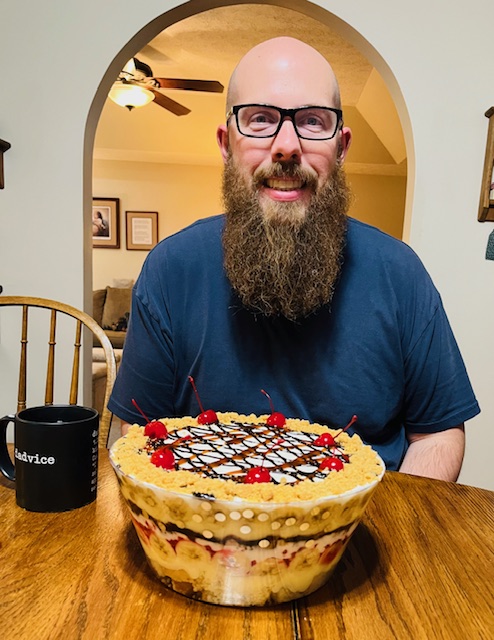
3. Jason’s birthday was actually last week, the day they left on their trip. So we celebrated last night. Mittu made a banana split trifle instead of a cake. Delicious and pretty!

4. Family group texts. Jason and Mittu shared things they saw on their trip in real time, making us feel a part of it. Pus we all share news or funny memes or reels or concerns that way.

5. Rain. Our area had a dry spell for quite a while there. We haven’t had as much rain as was forecast, but we’ve gotten a good bit.

Happy Friday!

Review: A Month of Summer

In Lisa Wingate’s novel, A Month of Summer, Rebecca Macklin lives in LA, has a legal practice with her husband, and runs her 9-year-old gymnast daughter to practices and meets.

Then Rebecca receives a devastating phone call. She has not seen her father in over thirty years. She was supposed to spend a month of every summer with him and his new family as part of the custody arrangement of her parents’ divorce when she was twelve. But she refused to go. Her father honored her wishes.

Her stepmother has written over the last couple of years that Rebecca’s father developed dementia and urged her to make peace before it was too late. But Rebecca ignored her. Why bother making contact with him now?

But a phone call from Dallas puts Rebecca in a tough spot. Her step-mother has had a stroke. Her developmentally disabled step-brother was roaming town alone, having gotten on a bus without being able to figure out how to find his way home. Her father was totally confused. The police found Rebecca’s name on a contact list. If she didn’t come to take care of her father and step-brother, Social Services was going to get involved.

Reluctantly, Rebecca makes plans to go. But on the day she leaves, she sees her husband at an outdoor cafe holding hands with one of his clients. Is this why he has been working late? Without time to confront him, she boards her flight, with all the problems of her life weighing her down.

But when she arrives in Dallas, things are worse than she imagined. A housekeeper who was supposed to keep things in order has disappeared. Dirty dishes and molded food are everywhere as is dirty laundry. Wet laundry has mildewed in the washer. And money is missing from her father’s accounts.

The point of view shifts back and forth from Rebecca and her step-mother, Hanna Beth. Hanna Beth is cognizant, but can’t express herself or control her movements. When she learns that Rebecca has come, now of all times, she wonders what will happen. Will Rebecca ship her father and step-brother off to institutions before Hanna Beth can recover enough to go back home?

As each woman painfully peels back layers of the last several years, they learn things aren’t always as they appear.

I saw one reviewer call this a light and easy read. I didn’t think so, myself. It was a good read, but felt very heavy sometimes, except for the knowledge (or at least the hope) that things would work out somehow in the end.

There’s a delightful cast of side characters in the book: a sweet older woman Rebecca meets on the flight who she runs into again later, a talkative older man in Hanna Beth’s nursing center, a stern German physical therapist, a sweet aide with two boys, a nurse from Ghana. I loved one teasing line from the nurse who was trying to get the older man back to his room: “Old rooster, he loud on the fence, quiet in the stew.”

This book is the first in Lisa’s Blue Sky Hill series about a neighborhood in Dallas. I had read the second book in the series, The Summer Kitchen, as well as the fourth, Dandelion Summer. But there were so many years between each read, I could not remember if any of these characters showed up in the later books. I probably would have caught more of the connections if I had read them in order and closer together, but each book does hold up well as a stand-alone.

Review: Read This First

Gary Millar wrote Read This First: A Simple Guide to Getting the Most from the Bible to “help people who would like to read the Bible but don’t really know where to start or how to go about it” (p. 2, Kindle version). Whether one is a new Christian or has never really gotten into regular reading, Millar hopes you will “read this first and go back to the Bible with the skills and confidence to truly enjoy it (p. 3).

First, Gary deals with the question, “Why bother with the Bible?” and lists reasons people don’t.

But he says, “I’ve written this book to help you meet a person—a living, loving, being like no other—through the pages of a book like no other. . . He made us, he loves us, he knows us inside out, and he speaks to us. And he does that through the Bible. That’s why reading the Bible matters so much—because when we read it, we meet the one and only God ” ( p. 10).

Millar assures that “the Bible was written to be understood by ordinary people like us. It doesn’t need insider knowledge or a special code to make sense of it. It’s not written for experts and professionals. It’s written for people like you and me (pp. 17-18).

Millar then gives tips on how to read, to pick up what he calls the “vibe” of a given passage, to understand different genres within the Bible, to discern meaning, and to apply what we’ve learned.

Every chapter ends with a couple of examples of Scripture to work through using the skills detailed in that chapter.

The appendix, titled “What Is the Bible?” gives a little background such as the difference between the two testaments, how we got the chapter and verse references that weren’t in the original manuscripts, and more.

Gary writes in a warm and simple style, so this book would be accessible to almost anyone.

This would be an excellent resource for someone new to reading the Bible or to anyone who feels they need a refresher course in how to do so.

Fading with Age

Fading with age

I remember sometime in my youth talking with an elderly person and noting that not only was his hair very white, but his skin was pale almost to the point of being white as well. Even his eyes seemed faded. I wondered, “Is that what happens when you get old? Do you just . . . fade away?”

Now that I’m nearer the category of “old,” I’ve learned that not everyone gets paler as they age. And no one ages in quite the same way: we’ve known people well into their eighties who traveled internationally as public speakers and even got married.

But it does seem we fade a bit in many ways. Win Couchman called it “The Grace to Be Diminished.”

First, energy decreases. We may not be able to do all we once did. We can’t push ourselves like we used to. Physical issues of various forms may creep up.

Then our influence can decrease. When we first visited a particular church in one state, a young woman was showing us where our Sunday School class would meet. As we passed one room, she said, “You don’t want to go there; that’s the old people’s class.” I suppose I should have felt gratified that she didn’t think I belonged in the old people’s class yet. But the attitude disturbed me. Later, in the same church, when facilitating a ladies’ group, a younger woman maybe in her mid-thirties told me she didn’t come to the ladies’ meetings because the attendees were all older women. Most of us were in our forties and fifties—we were by no means ancient. But I remember being shocked and hurt that someone would not want to be with us just because of our age.

We can lose our jobs and ministries as we retire.

We lose our independence as we have to give up our car keys and may not be able to live alone any more.

We lose our dignity as someone else has to feed and change us.

And eventually, we lose life itself.

That would all sound pretty dreary if that were the end of things.

But we were told that life would be fleeting.

“What is your life? For you are a mist that appears for a little time and then vanishes” (James 4:14).

“My days are swifter than a weaver’s shuttle” (Job 7:6).

The years of our life are seventy, or even by reason of strength eighty; yet their span is but toil and trouble; they are soon gone, and we fly away (Psalm 90:10).

“We all do fade as a leaf” (Isaiah 64:6, KJV).

A radio preacher said one reason our bodies start falling apart as we get older is to encourage us to let loose of them. We need the reminder that this life is not forever.

C. S. Lewis said in The Problem of Pain, “Our Father refreshes us on the journey with some pleasant inns, but will not encourage us to mistake them for home.” “For here we have no lasting city, but we seek the city that is to come” (Hebrews 13:14). This world, as the old song says, is not our ultimate home. Our transitions as we age help prepare us for our true home.

Does that mean when we reach a certain age, we just sit in our rocking chairs and wait to die? By no means.

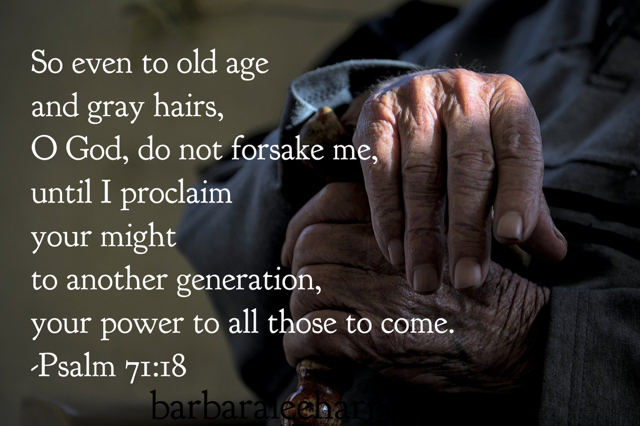
Elisabeth Elliot has said that our limitations don’t hinder our ministry; they define our ministry. We may not be able to coordinate VBS for 100 children any more (if you can, go for it!) But we can pray with the psalmist, “O God, from my youth you have taught me, and I still proclaim your wondrous deeds. So even to old age and gray hairs, O God, do not forsake me, until I proclaim your might to another generation, your power to all those to come” (Psalm 71:17-18).

How we proclaim His might and wondrous deeds may vary. We might be able to teach a class, write a book, or speak to groups. However, I’ve often thought that when Paul told older men and women to teach the younger, he probably didn’t have classes and retreats in mind. There’s nothing wrong with those; I have been blessed by many of them. But they probably weren’t done in Bible times. I think he probably had in mind interaction in the everyday course of life.

Godly women have influenced my life in just that way. One family had me over frequently as a teenager who came to church alone. I don’t think the wife of the family thought of me as a “project.” She was just being hospitable. Yet visiting their family and seeing her interact as a wife, mother, and homemaker was instructive for me.

Another woman passed along a vital piece of advice as we worked on a church bulletin board together that shaped my thinking in parenting teens. Another said something in passing while we worked in the church nursery that greatly encouraged me. Another was an invaluable and unwitting example to me as she was trying to prepare an event for a group, and her husband asked her for something in a critical moment. She didn’t snap; she closed her eyes briefly and then calmly directed him to what he needed.

Jesus said that we speak with our mouths out of the abundance of our hearts. As we fill our souls with God’s presence and Word and seek His guidance, then we will be able to share about Him in odd moments as we interact with others.

As another psalmist said, we can tell “things that we have heard and known, that our fathers have told us. We will not hide them from their children, but tell to the coming generation the glorious deeds of the Lord, and his might,and the wonders that he has done. . . that the next generation might know them, the children yet unborn, and arise and tell them to their children, so that they should set their hope in God and not forget the works of God, but keep his commandments” (Psalm 78:3-4, 6-7).

We don’t have to approach our old age with dread.

God has promised to take care of us: “Even to your old age I am he, and to gray hairs I will carry you. I have made, and I will bear; I will carry and will save” (Isaiah 46:4).

He has promised our fruitfulness: “They still bear fruit in old age; they are ever full of sap and green, to declare that the Lord is upright; he is my rock, and there is no unrighteousness in him” (Psalm 92:14-15).

He has promised a bright future to those who know Him. “So we do not lose heart. Though our outer self is wasting away, our inner self is being renewed day by day. For this light momentary affliction is preparing for us an eternal weight of glory beyond all comparison, as we look not to the things that are seen but to the things that are unseen. For the things that are seen are transient, but the things that are unseen are eternal” (2 Corinthians 4:16-18).

As we look back at His faithfulness all our lives, we can trust Him for the future. These stanzas from John Greenleaf Whittier’s poem, “My Birthday,” encourage me: I hope they’ll encourage you as well.

I grieve not with the moaning wind
As if a loss befell;
Before me, even as behind,
God is, and all is well!

His light shines on me from above,
His low voice speaks within,–
The patience of immortal love
Outwearying mortal sin.

Not mindless of the growing years
Of care and loss and pain,
My eyes are wet with thankful tears
For blessings which remain.

Let winds that blow from heaven refresh,
Dear Lord, the languid air;
And let the weakness of the flesh
Thy strength of spirit share.

And, if the eye must fail of light,
The ear forget to hear,
Make clearer still the spirit’s sight,
More fine the inward ear!

Be near me in mine hours of need
To soothe, or cheer, or warn,
And down these slopes of sunset lead
As up the hills of morn!

Psalm 71:18

(I often link up with some of these bloggers.)

Laudable Linkage

Laudable Linkage

Here are some of the good reads found this week:

Contentment Isn’t Only for Hard Times, HT to Challies. “I was about as happy as a person could be. I say ‘about’ because one unwelcome thought intruded: It’s not going to last. I was only visiting for a couple of weeks, and then I’d be back to the daily grind of work and responsibilities. In that moment, amid deep joy, the grace of contentment was just as essential as it is when my life is falling apart. I need contentment to receive God’s immense blessings gratefully, even knowing they’re temporary.”

It’s OK to Be OK, HT to Challies. “We need to fight two battles at once. We need to keep telling people that life is hard, the world is fallen, and we all fall short in sin. It’s OK to struggle, and when we do, we need to ask for help . . . However, we don’t need to equate authenticity with struggle. We need to leave room for people to be authentically happy—for life to go well sometimes.”

On Magic. “What is magic, in essence? It’s an attempt to get the gods to do what you want. And that is to turn the universe upside down and inside out. God is not our servant; he is not here to do what we want. We are here to do what he wants. If I do this or this or that, God will do what I want. That’s, ironically, godless thinking.”

Don’t Be Proud of What You Had No Say In, HT to Challies. “Many of the things that people tend to be proud of are things that we have no say in at all,” like height, natural beauty and abilities. “There is a difference between a gift and a talent. A gift is something you receive that you did not earn. A talent is something that you have developed over time, often based on a gift you have received.”

15 Resolves for Maintaining Spiritual Balance in Severe Interpersonal Conflicts, HT to Challies. I’d add one that has been a help to me: remembering the other person is beloved by God, and God wants the highest and best for that person, too.

Beware the Instagram Bible. I think I shared this a few years ago, but I needed to look it up again this week. “Beware the Instagram Bible, my daughters—those filtered frames festooned with feathered verses, adorned in all manner of loops and tails, bedecked with blossoms, saturated with sunsets, culled and curated just for you. Beware lest it become for you your source of daily bread. It’s telling a partial truth.”

When You Can’t Forgive Yourself After an Abortion, HT to Challies. Although the context is about abortion, the truths here are good for anyone who feels they can’t forgive themselves for something they have done.

Updated to add: I stay away from politics here on the blog, but I wanted to say I was saddened and shocked by the events of last weekend. Violence is not the answer no matter what party one is in.

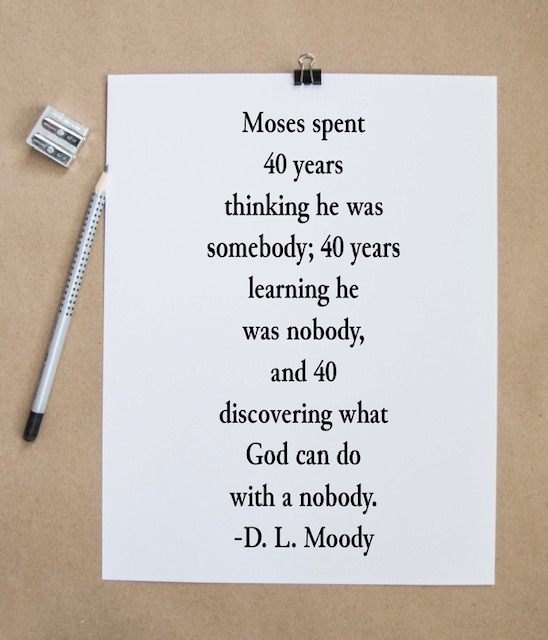
D. L. Moody quote about what God can do with a nobody

Moses spent 40 years thinking he was somebody; 40 years learning he was nobody,
and 40 discovering what God can do with a nobody. — D.L. Moody