When Do You Need to Look to Jesus?

Look away to Jesus

I don’t remember what I came to talk about with my elderly pastor’s wife that day four decades ago. Probably some besetting sin, some struggle of faith, some kind of burden. But I remember her shining, earnest face as she repeated, “Look away to Jesus.”

When do you need to look to Jesus?

Do you know where you’re going when you die? Do you have inner peace? Are you burdened with the weight of the world’s problems, and with your own as well? Do you have regrets, guilt, shame? Look to Jesus.

Look to Me, and be saved, All you ends of the earth! For I am God, and there is no other (Isaiah 45:22, NKJV).

Jesus said to him, “I am the way, and the truth, and the life. No one comes to the Father except through me” (John 14:6).

Do you need to change? Are you discouraged because of a lack of transformation and growth? Look to Jesus.

And we all, with unveiled face, beholding the glory of the Lord, are being transformed into the same image from one degree of glory to another. For this comes from the Lord who is the Spirit (2 Corinthians 3:18).

Do you need focus as you run the race of life? Do you stumble and fall spiritually? Look to Jesus.

Let us also lay aside every weight, and sin which clings so closely, and let us run with endurance the race that is set before us, looking to Jesus, the founder and perfecter of our faith, who for the joy that was set before him endured the cross, despising the shame, and is seated at the right hand of the throne of God (Hebrews 12:1b-2).

Do you long for something more than this life has to offer? Do you need hope to persevere? Look to Jesus.

For the grace of God that brings salvation has appeared to all men, teaching us that, denying ungodliness and worldly lusts, we should live soberly, righteously, and godly in the present age, looking for the blessed hope and glorious appearing of our great God and Savior Jesus Christ, who gave Himself for us, that He might redeem us from every lawless deed and purify for Himself His own special people, zealous for good works (Titus 2:11-14, NKJV).

Do you need grace and help and wisdom for every day life? Look to Jesus.

Seek the LORD and His strength; Seek His face continually (Psalm 105:4, NASB).

You have said, “Seek my face.” My heart says to you, “Your face, Lord, do I seek” (Psalm 27:8).

Looking to Jesus day after day,
Trusting His love each step of the way,
Knowing that He so willingly shares
All of my sorrows, troubles and cares.

Refrain:
Looking to Jesus—looking to Him,
Whether the path be sunny or dim;
Holding His hand by night and by day,
Trusting His love each step of the way.

Looking to Jesus when I am sad,
Looking to Jesus when I am glad,
Having no fear of tempest or foe,
Singing His praises, onward I go.

Looking to Jesus when I’m opprest,
Looking to Him for comfort and rest,
Shunning the world, its clamor and strife,
Looking to Him who crowneth my life.

Looking to Jesus me to defend,
Shield and encourage unto the end;
Knowing that He has buried my past,
Looking to Him for glory at last.

James Rowe, Public Domain
Seek the Lord

(I often link up with some of these bloggers.)

Laudable Linkage

Links to good blog posts

I have just a short list today, as I’ve been busy preparing for my oldest son’s visit.

Helping My Child Deal with Anxiety, HT to the Story Warren. “No mother wants to watch their kids suffer. We want them to have it better than we did, to skip the painful parts we suffered through. But we cannot control the world around them. We cannot control their brain chemistry or DNA. We cannot spare them the struggle of anxiety or depression.”

The Audacity of Disability, HT to Challies. “You might have gotten the diagnosis beforehand, when the beautiful process of growth in the womb turned fearful. Or maybe it happened like it did for us, entering the hospital with excitement, only to discover something terribly wrong in the delivery room. Or perhaps it was a few years later, when you began to notice that something wasn’t quite right. However it happened, however you learned of it, disability entered your world, unexpected and unwelcome.”

Songs Are Discipleship, HT to Challies. “How does this song build up the body of Christ? How does this song edify a seasoned saint? How does this jingle build up the newly-born believer? How does this worship leader understand his role and responsibility? We must take seriously the theological development of the individuals we call worship leaders because they are disciples too.”

Q&A with Tim Challies: Wisdom to Bolster Writers.

God's creation reflects His beauty.

Friday’s Fave Five

Friday's Fave Five

It’s been a busy week, and I welcome the opportunity to pause with Susanne and friends at Living to Tell the Story to remember the best parts.

1. Return of the hummingbirds. We’ve had more than the usual trouble this year with ants and teeny flying bugs getting into the hummingbird feeder. Then they decompose, and the hummingbirds don’t come around—or if they do, they hover a bit and fly away. As I once again emptied and scrubbed the feeder, I looked up how to make hummingbird food at home. Since I put the new stuff out, we’ve seen more hummingbirds this week than we have all summer. They must like it! My husband rigged something to keep ants out, so hopefully the feeder will stay usable for longer..

2. Kayaking. Jim, Jason, and Timothy went to a nearby lake to kayak for a bit. It was Timothy’s first time, and it didn’t take him long to get the gist of rowing.

Kayaking

3. Jason and Mittu’s 14th anniversary. We watched Timothy so they could have a date. They brought dinner when they dropped Timothy off and brought me a Crumbl cookie afterward. My FaceBook memories have been filled with posts about “wedding week,” so it’s been fun to reminiscence.

4. Safety and electricity. We had some strong thunderstorms here one night, with a tornado touching down about 11 miles from us. Limbs are down and trees uprooted all over town. Thankfully, our area was fine. Jason helped a neighbor cut up a fallen limb that was blocking the road–but first they had to deal with a bowling-ball-sized active hornets’ nest in the branches! Thankfully they were all safe.

Then we had a few more storms Wednesday night, though they weren’t as severe. We did lose power then, but not for long.

5. Four-way FaceTime. We’ll celebrate Jeremy’s birthday when he is here next week. We usually ship the presents he opens here to him when he goes home. We sent some of the heavy or large presents to him early, before his trip here–we get free shipping from Amazon, so it didn’t make sense to have them shipped free here and then have to pay a mint to ship them to him in RI. When he received our early presents, he set up a Face-Time call with all of us so we could see him open them. Thankfully, the connection worked for all of us. It was fun to have a little pre-visit visit. 🙂

We’re looking forward to Jeremy coming in this weekend. Jim will take most of the week off as well, so we’re anticipating a lot of good family time. Meanwhile, there’s much to do to prepare.

Have a good weekend!

Review: Yesterday’s Tides

Yesterday's Tides novel by Roseanna M. White

Roseanna M. White’s novel, Yesterday’s Tides, has two related story lines taking place in 1914 and 1942 on Ocracoke Island in North Carolina’s Outer Banks.

In 1914, Louisa Adair helps her mother and “Grann” run an inn. She’d like to go to teacher’s college, but there isn’t enough money. Plus, she’s needed at home.

Though Louisa has blue eyes, her skin coloring is darker than most people’s. Her mother will not tell her anything about her deceased father except that he was a good man. A few people are prejudiced against her, thinking she must be of mixed race.

When two college-age cousins, one from Maryland and one from England, come to the inn for the summer, Louisa has no idea how her life will change as a result. Louisa has no plans to fall in love: she keeps a polite reserve with the inn’s male guests. But she and Remington Culbreth, from England, find themselves in each other’s company often. Just after they do fall in love, WWI breaks out and Remington is called to service at home. Will their relationship survive not only the war, but the differences in their families and lifestyles?

In 1942, Evie Farrow now runs the inn with her grandmother. One day while taking some baked goods to the neighbors, a loud explosion is heard in the distant waters. While Evie’s Coast Guard friends prepare to investigate and help, Evie heads home to pray. When a badly burned Englishman washes up near the inn, somehow Evie knows not to report him. He says he is military, but he’s not in uniform. What mutterings she hears as he goes in and out of consciousness alert her to the fact that he is an intelligence officer. But what would an English spy be doing in Ocracoke?

When he wakes up, she learns his name is Sterling Bertrand and he is tracking a German operative. But it will take weeks for his wounds to heal. Meanwhile, he wonders just how far he can trust Evie, who seems to have secrets of her own.

I’ve read many dual timeline novels, and usually there are enough differences between the two timelines to keep from getting confused. I had a little harder time with this one, since both stories took place at an inn in Ocracoke and involved a visiting Englishman. I think I would have had an easier time with reading rather than listening. I didn’t catch some of the names that were the same in both timelines, so I kept getting surprised at the connections. I don’t think that would have happened if I were reading instead of listening.

As it happened, partway through the audiobook I discovered that I did have a Kindle copy! So I went back and forth between reading and listening.

One delight with this book was running into some characters from Roseanna’s previous books. I won’t say which ones, as that might give away parts of the plot. You don’t have to have read those books to understand this one, but it was a fun surprise to see those characters again. Evidently Remington was in an earlier book as well, but, though I remember the story and situation, I don’t remember him.

I’m sorry to say I was not thrilled with the audiobook narrator. Some of her accents seemed a little off to me. Plus she had an odd cadence, her inflection going up when it didn’t need to.

There are so many layers to this novel, and so much more to it than there appears to be at first. I loved the stories, and after finishing the book, I just wanted to sit with the characters a bit more before saying goodbye to them and starting another story.

Review: Be Worshipful

Be Worshipful by Wiersbe on Psalms

Psalms is the longest book of the Bible at 150 chapters, so Warren Wiersbe divided his commentaries on the Psalms into two books. The first is Be Worshipful (Psalms 1-89): Glorifying God for Who He Is.

“The book of Psalms has been and still is the irreplaceable devotional guide, prayer book, and hymnal of the people of God,” (p. 15). About one-third of the psalms don’t list an author, but King David wrote the majority of the others. The sons of Korah, Asaph, Solomon, Ethan, and Moses wrote others. All, however, wrote under the inspiration of the Holy Spirit.

Except for Moses’ psalm, the rest span the time of King David through the divided kingdom and Israel’s exile into Babylon.

“Some of the psalms are laments to the Lord, written by people in dire circumstances. There are also messianic psalms that point forward to the Lord Jesus Christ. There are also psalms of praise and thanksgiving, royal psalms, wisdom psalms, psalms of affirmation and trust, penitential psalms, and even imprecatory psalms calling down God’s wrath on the enemy” (p. 16).

The psalms’ poetry is not rhyming and rhythmic like English poetry. Hebrew poetry expresses itself in parallel lines. The second line of a pair might say the same as the first differently, or contrast with the first, or expand on the first. But the psalms uses similar literary devices as our poetry: simile, metaphor, imagery, symbolism, synecdoche (referring to one part to represent the whole, like keeping hands clean representing keeping one’s life clean), hyperbole, apostrophe (addressing a thing as if it were a person, like Wisdom), anthropomorphism, and others.

“There are over four hundred quotations or allusions to the psalms in the New Testament” (p. 16).

The psalms cover a lot of different subjects. “But primarily, the Psalms are about God and His relationship to His creation, the nations of the world, Israel, and His believing people” (p. 16).

“The psalms teach us to seek God with a whole heart, to tell Him the truth and tell Him everything, and to worship Him because of who He is, not just because of what He gives. They show us how to accept trials and turn them into triumphs, and when we’ve failed, they show us how to repent and receive God’s gracious forgiveness. The God described in the book of Psalms is both transcendent and immanent, far above us and yet personally with us in our pilgrim journey. He is ‘God Most High’ and ‘Immanuel—God with us'” (p. 18).

Wiersbe writes a few pages of comments on each psalm, explaining, drawing out truth, sharing insights. He includes discussion questions at the end of the book.

Many of the comments I have highlighted refer to specific contexts of psalms that would be impossible to explain without sharing all of Wiersbe’s comments on that particular section. But here are a few general comments I found helpful:

Those who have problems with the military aspects of some of David’s psalms should remember that David went to war only when the enemy attacked Israel. He did not invade other nations just to gain territory, and he was fighting the Lord’s battles (1 Sam. 17:47; 25: 28; 2 Chron. 20:15). The covenant God made with David (2 Sam. 7:11) assured him of victory over his enemies (p. 85).

Though David occasionally fell, as we all do, the habitual bent of his life was toward the Lord and His Word (p. 106).

The secret of David’s public confidence was his private obedience: He took time to fellowship with the Lord and get directions from Him. David knew that the most important part of his life was the part that only God could see, and this was one priority he would not negotiate” (p. 108).

David tried to “cover” his sins, but his schemes didn’t work. They never do (Prov. 28: 13), but when God covers the sins we confess to Him, they are hidden from sight and never seen again. (See Isa. 38:17; 43:25; 44:22; Jer. 31:34; 1 John 1:7–9.) (p. 121).

Chastening isn’t a judge punishing a criminal; it’s a loving Father dealing with His disobedient children to bring them willingly to the place of surrender. According to Hebrews 12:1–13, God’s chastening is proof that He loves us and that we are genuinely His children (p. 122).

[Re David praying against enemies} This was not a personal vendetta on David’s part, but a concern for the future of the nation of Israel and the dynasty of David. As ruler of the land, David wielded the sword of justice (Rom. 13:1–4), and nations today punish treason with death (p. 152).

The greatest danger a nation faces is not the invading enemy on the outside but the eroding enemy on the inside—a people gradually turning away from the faith of their fathers. Each generation must pass along to the next generation who the Lord is, what He has done, and what they must do in response to His goodness and faithfulness (71:18; 78:4, 6; 79:13; 109:13; 145:4; 2 Tim. 2:2) (p. 178).

It is our regular worship that prepares us for the crisis experiences of life (p. 207).

The psalms are not just emotional: they are full of truth and doctrine. Yet I love that the psalms show the writers’ hearts as they wrestle with problems, unanswered prayer, confusion, God’s seeming distance. Most of the psalms of lament end with the psalmist reminding himself the truth he knows about God and restoring his hope and confidence. And who can beat the praise psalms for lifting one’s heart in thanksgiving and worship.

The Bible tells us to study God’s Word, not just read it casually. Yet it’s possible to go too far the other way and examine a passage’s pieces, losing the main message or emphasis. I had to wrestle with this since I was using both the ESV Study Bible notes as well as Wiersbe’s commentary. Both were beneficial, but sometimes I left a passage with my head swimming. It helped to go back and read the passage again as a unit and as poetry after reading the comments and notes.

I appreciated the help Wiersbe’s commentary was to understanding and gaining more from the psalms.

When You’re at Your Lowest

When you're at you're lowest, God is there

Darlene Deibler Rose and her husband, Russell, were missionaries in New Guinea when the Japanese took possession of the area during WWII. When the Japanese separated the men from the women, Russell’s last words to Darlene were, “Remember one thing, dear: God said that he would never leave us nor forsake us.” She never saw him again.

The women were taken to a prison camp, where the bulk of Darlene’s book, Evidence Not Seen: A Woman’s Miraculous Faith in the Jungles of World War II, takes place.

Darlene received news that Russell died in 1944. Later, she was arrested by the secret police and taken to another prison for “questioning.” The conditions were horrible, to say the least. Darlene also suffered from dysentery, cerebral malaria, and beriberi. She was placed in solitary confinement.

Through all her troubles, Darlene relied on God’s presence with her. She wrote, “I knew that without God, without that consciousness of His Presence in every troubled hour, I could never have made it.”

Then suddenly one day, that presence seemed to leave her. She searched her heart to see if she was harboring any hidden sin. “My prayers, my expressions of worship, seemed to go no higher than the ceiling; there seemed to be no sounding board.” God didn’t seem to be answering any of her questions or prayers.

Heman the Ezrahite must have felt the same way. He wrote Psalm 88, the only psalm of lament that doesn’t end with hope and a renewed perspective

Heman writes that he cries out day and night to God. His soul is “full of troubles.” He has no strength. He feels forgotten, overwhelmed, helpless, and alone. He asks why God has cast him away and hidden His face. The last word of the psalm is “darkness.”

Why did God set such a depressing passage in Scripture, with seemingly no hope or help?

We don’t know all the reasons. But one would be that people feel like this sometimes. Troubles often seem to come in bunches. We’ve prayed for weeks or months, but nothing seems to change. We know God knows what is going on and He loves us—but why does He not alleviate the pain and change the situation? Why does He seem so far off and uncaring?

Even though Heman doesn’t share any outward hope or encouragement, he still expresses faith.

First of all, he comes to God, even though He feels far away.

Secondly, he knows God is the One who allowed the troubles to come. Whatever secondary sources lead to our trials, they could not come without God’s knowledge and permission.

Then Heman persists in prayer. He keeps coming, keeps calling out to God “day and night,” “every day.”

The ESV Study Bible commentary says, “The psalm instills a tough faith in its singers by reminding them to keep turning to God (the “God of my salvation,” v.1), even during these times when it seems that there is no answer being given. . . it helps its singers to see that faith can be real, even when it cannot arrive at strong hope after prayer” (p. 1048).

Job seemed to feel this way at times. He declared, “Though he slay me, I will hope in him” (Job 13:15). He didn’t trust only when he prospered or when prayer was answered the way and time he wanted. He still had questions. He cried out to God. He wished he could speak with the Lord face to face. But he maintained a gritty trust that God was the One who could help him, even though there was no sign of help yet.

Darlene had no Bible with her, but she had memorized Scripture in previous years. As she thought through Scripture she remembered, she prayed,  “Lord, I believe all that the Bible says. I do walk by faith and not by sight. I do not need to feel You near, because Your Word says You will never leave me nor forsake me. Lord, I confirm my faith; I believe.”

Then Hebrews 11;1 came to her mind: “Now faith is the substance of things hoped for, the evidence of things not seen.” She wrote:

Evidence not seen — that was what I put my trust in — not in feelings or moments of ecstasy, but in the unchanging Person of Jesus Christ. Suddenly I realized that I was singing:

When darkness veils His lovely face,
I rest on His unchanging grace.
In every high and stormy gale,
My anchor holds within the veil.

On Christ the solid Rock I stand;
All other ground is sinking sand.

I was assured that my faith rested not on feelings, not on moments of ecstasy, but on the Person of my matchless, changeless Savior, in Whom is no shadow caused by turning.

Heman, Job, and Darlene leave behind a testimony to trust God, cling to Him, even at our lowest low. He sees. He knows. He cares. In His time, He will minister His grace.

The LORD is near to the brokenhearted and saves the crushed in spirit.
Psalm 34:18

(I often link up with some of these bloggers.)

Laudable Linkage

Laudable Linkage

There is so much good reading online. Here are a few that stood out to me. It’s probably a good time for my occasional reminder that linking to any source does not imply 100% endorsement of everything on that site.

Why’d the Pigs Have to Die? HT to Challies. I’ve often wondered about this, from when Jesus cast a legion of demons out of one man, and the demons went into a herd of pigs and destroyed them. I appreciate the answer.

The Secret Meaning of YHWH, HT to Knowable Word. “I think God is not pleased by the herculean efforts some people go to look so hard for hidden meanings—whether linguistic or allegorical or what have you—that they miss the simple point of what he said.”

What Does It Look Like to Serve as Others as Jesus Served? “What does it look like to be a servant to my family, to say ‘My life for yours’? As a person of faith, I look to Jesus as my example of a servant’s heart.”

One of the Weirdest Articles I’ve Ever Written. Mike Leake uses and absurd example to illustrate the point that “Just because a word means something somewhere doesn’t mean it carries that same meaning elsewhere.” We can end up with this kind of extreme interpretation in Bible word studies when we “find all the uses of that word and then you shove each of those passages and all of their meaning into the Scripture you’re studying.”

Ambassadors for Marriage, HT to Challies. “It’s one thing for me, a 50-something, Christian mother of four, grandmother of two, to say, ‘Yes, get married! Don’t wait for the ‘perfect’ person or perfect timing! Don’t wait to get the whole rest of your life in order first! Marriage is great—it’s totally worth it!’ But it’s another thing entirely coming from someone who is under the age of 30.”

What It Feels Like, HT to Challies. A pastor’s experience with depression.

Shepherding Children Through Exposure to Pornography, HT to Challies. It’s sad that such an article is necessary, but these days, it’s too easy to come across pornography unexpectedly and then be drawn in.

God is Near: Certain Comforts for Moms, HT to Challies. “In my role as the Director of Children’s Ministries at my church, I’m privy to the thoughts of many mothers. As moms think about ‘back to school,’ one emotion keeps bubbling to the surface over and over. I hear it in their voices, in the questions they ask, and the conversations they have. It’s not a pretty emotion. It’s one that can sometimes paralyze us.  Fear.”

Your Rights as a Christian in a Public School in 2023, HT to Challies.

The most recent newsletter from the Elisabeth Elliot Foundation shared that the Museum of the Bible in Washington D.C is hosting an exhibit called Through Gates of Splendor: The Elisabeth Elliot Story through the end of 2023. I’d love to see it, but I doubt I’ll get to D.C. before the end of this year. Thankfully, this article says they’re working on a traveling exhibit. The newsletter shared this video of opening day:

John Newton quote about fear

Friday’s Fave Five

Friday's Fave Five

It’s the first Friday in August. Many of my favorites this week have appeared here previously—but it’s good to be continually thankful for continued blessings. I join Susanne and friends at Living to Tell the Story to share pour favorites from the week.

1. A lunch invitation. My son and daughter-in-law invited us over for a lunch chicken nachos last Sunday after church. Afterward, we played a children’s version of Charades with my grandson that was surprisingly fun.

2. My husband offers to go to the grocery store for me sometimes. Other times, when I go and come back hot and tired, he’s willing to get something out for dinner.

3. Timothy visit. We got a voice text from my grandson yesterday asking if they could come over. Of course!

4. Lighter temperatures. It’s been in the 80s this week rather than 90s—70s one day. With humidity in the 90s, it’s still been warm and muggy. But even that little drop helps take the edge of the heat.

5. Anticipation. My oldest son comes for a visit next weekend! My husband will take next week off, and the other kids will be here more than usual.

That’s my short but sweet list of highlights from this week. What’s one of yours?

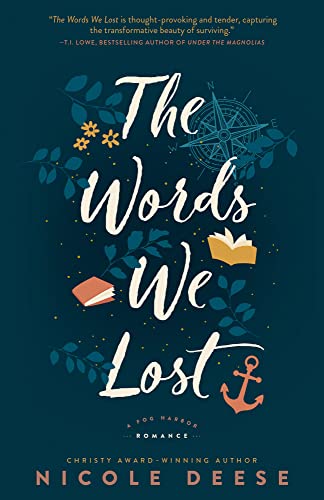
Review: The Words We Lost

The Word We Lost novel

In The Words We Lost by Nicole Deese, Ingrid Erikson moved to western Washington state with her father and became friends with cousins Cece and Joel Campbell when they were all teenagers.

Cece grew up to write a novel, which Ingrid, as an intern at a publishing house, sneaked to her editor. The editor loved the manuscript, bought it, and Cece’s series became runaway best-sellers.

But then Cece tragically died on the operating table during surgery to remove a brain tumor.

Besides losing Cece, Ingrid’s father died several years before. Ingrid blamed Joel and broke contact with him. So she lost all the people and the place she loved most and moved hundreds of miles away.

Ingrid is now a senior acquisitions editor, but she has a hard time functioning due to her grief. She relies heavily on her own intern, Chip. But her new boss can see she’s faltering.

Then Joel suddenly shows up unannounced. The family lawyer discovered a sealed letter addressed to him and Ingrid from Cece. She wanted them to come back home together to retrieve a package.

Ingrid’s boss gives her an ultimatum: find the rumored missing fourth manuscript to Cece’s series, or lose her job.

Ingrid isn’t sure she can go back to the area that she loves, but that brought her so much pain—and do so with Joel. But she doesn’t have a choice if she wants to keep her job.

I bought this book because I loved two of Nicole’s other books I had read. I got the audiobook at first, but the narrator just hit me wrong somehow. So I returned the book and got the Kindle version.

Then the first few pages held one of my pet peeves in writing. 🙂

But once we got past all that and I settled into the story, I loved it just as much as the others.

Some of the quotes I liked:

Success is a slow, long process of repetition (p. 90, Kindle version).

No heartache has ever gone unseen, and no darkness is ever too solid for light to overcome (p. 156).

God is often made visible by the hands and feet of the people He places in our lives (p. 177).

We can’t change the time we’ve spent, just how we choose to spend the time we have left (p. 228).

Even though there are still things to talk and sing and laugh about in this life, there are also things to miss and lament and grieve, too. Both are welcome and both are necessary (p. 367).

I enjoyed the depth of the characters and was pulled into their heartaches. The last few chapters unravel a bit of mystery. After the first few pages, I loved how the story developed and then concluded. I also loved the double meaning in the title. I’m happy to recommend this book to you.


Review: Dreams of Savannah

In Dreams of Savannah by Roseanna M. White, Cordelia Owens is a pampered Southern belle who loves to dream and write stories. She also loves Phineas Dunn, a lifelong friend newly recruited to the Confederate Navy, and promises to wait for him forever.

When she learns Phineas has been lost at sea, she weaves heroic tales for his mother and sister to help them keep up hope.

When Phineas was shot and fell overboard, he thought he was done for. But somehow he washes up on an island near Cuba. He’s rescued by a person he never imagined existed: an educated free black man from England. He has no way to let his family or his commanding officer know what has happened to him. All he can do is try to get well as fast as possible and get home. But his injuries are severe.

As the weeks drag by, a distant cousin of Cordelia’s comes to Savannah, assigned to the Confederate regiment there. Her parents are impressed by his manners, standing, and wealth. They like Phineas well enough, but his family’s credentials just don’t compare. They put pressure on Cordelia to turn her attention to her cousin. But even if she had not promised Phin she would wait forever, she would not have her cousin. There’s a predatory gleam in his eyes when her parents aren’t around.

When Phineas finally returns, he is still suffering from his injury. Worse, he has fallen in his own estimation. He wanted to be the hero of Cordelia’s stories. He doesn’t feel worthy of her, but he still vies for her hand. Her parents keep pushing her toward her cousin.

Both Cordelia and Phineas are from good families who are known to be kind to their slaves. Phineas’ father was, in fact, planning to free his slaves until doing so became illegal in Georgia.

But different experiences and people begin to change their perspectives. The question now is what to do. Is it enough just to be good to one’s slaves? Could they be mocked, scorned, or even arrested if their views on slavery changed? And how could their views change without changing their actions as well?

At the beginning of this book, Cordelia came across to me as young and somewhat silly (one of her fears for Phineas was that he might be attacked by a giant squid. . . ). I’m not sure how old she was, something hard to go back and find in an audiobook. Also, the Southern belle vibe came across a little too thick, replete with “fiddale-faddle” and “fiddel-dee-dee” (making me wonder for the first time why “fiddle’ was in so many expressions then).

But after I settled into the story, I began to enjoy it more. Cordelia is immature at the beginning. But the circumstances of the story cause her to grow. Even her story-telling matures over time.

It would be hard to write a book of changing viewpoints towards slavery and black people set in the 1861 South without attributing to the characters twenty-first century sensibilities. But Roseanna avoided that and had beliefs change and grow in the context of what was going on at the time.

A couple of my favorite quotes:

She certainly shouldn’t be refused happiness because of your convoluted ideas about your precious blood making her better than her mother . . . Because let me just tell you . . . your blood doesn’t have that power. There’s only one Man’s blood in all of history that can make us better than we are—and your are not Him.

She didn’t need to be a heroine in some fantastic tale of derring-do. That wasn’t what the Lord had given her. No, He’d given her words. Words to live by. Words to create with. Words that maybe, just maybe, could change the world beyond her house as surely as they had changed the one within.

I listened to the audiobook nicely narrated by Sarah Zimmerman.

So far, I have loved every book of Roseanna’s that I have read, including this one.