
The Corinthian church was one of the messiest ever known. Factions divided over favorite preachers. Their church dinners became feasts for the well-off members, while the poor ones were left out. Some were involved in such blatant sin as a man sleeping with his mother-in-law. Their culture honored eloquence in public speaking and scorned Paul because he didn’t speak or write that way. They rejected his authority as an apostle.
Most of us would avoid a church like that. But God hadn’t given up on them. He inspired Paul to lovingly rebuke, plead with, teach, and encourage them toward a right relationship with God, each other, and himself.
2 Corinthians is actually the fourth letter Paul wrote to the church. 1 Corinthians was the second. We don’t have the first and third, but Paul refers to them. Between the second and third letter, Paul made a “painful visit” to them to try to set things right and sent some of his coworkers to them as well. His care was evident: he didn’t just dash off a rebuke and leave it at that.
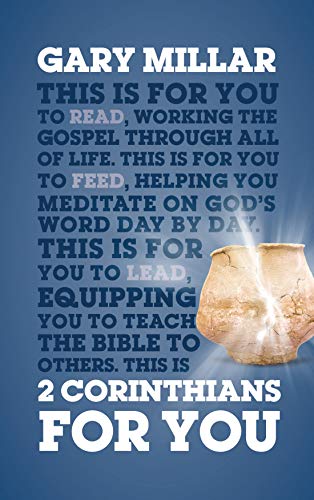
Gary Millar guides us through Paul’s letter in 2 Corinthians for You. He takes an expository approach, covering anywhere from a few verses to a chapter and a half from 2 Corinthians in each of his chapters. He explains the culture of Corinth at that time, a Grecian city with heavy Roman influence and a large number of Jewish exiles. He puts the pieces together from 1 Corinthians and Acts to help us understand this letter of Paul’s better.
Though he gives us a lot of helpful information, his style is easy to read and not academic. He does an excellent job pulling out application from the Corinthians and Paul to our lives hundreds of years after 2 Corinthians was written.
One of the themes throughout the book is weakness. The Corinthians thought Paul was weak, and he said, in effect, “That’s right.” He refers to his weakness thirteen times in this letter. One reference is the famous passage many of us lean on in 12:9-10, where, after praying three times for God to remove whatever his “thorn in the flesh” was, Paul writes, “But he said to me, ‘My grace is sufficient for you, for my power is made perfect in weakness.’ Therefore I will boast all the more gladly of my weaknesses, so that the power of Christ may rest upon me. For the sake of Christ, then, I am content with weaknesses, insults, hardships, persecutions, and calamities. For when I am weak, then I am strong.”
Paul repeatedly points out to the Corinthians that the church is God’s, to be conducted the way He wants. And ministry is done for Him and through His power.
Throughout both letters, Paul demonstrates Christian love, which mourns over sin, rebukes when needed, pursues even those who think we’re enemies, and gives of itself. One of many verses that stood out to me was “I will most gladly spend and be spent for your souls” (2 Corinthians 12:15). At times I have felt utterly spent after ministering in some way, and this verse reminds me, yes, it’s supposed to feel that way. As God pours into us, we give out to others.
I have mnay places underlined and noted in Millar’s book, but here are a few quotes that stood out to me.
When the gospel is our absolute priority, we will be predictably, reliably faithful to the gospel, even if it means that our plans may change when the progress of the gospel demands it. And how can we pull that off? Once again, it’s because God hasn’t simply told us to be like Christ, he has intervened in our lives powerfully and dramatically to enable us to be like Christ (p. 35).
When Christ is preached, God works by the Spirit to show people how stunningly, gloriously beautiful Christ is. We should keep going because the ministry which God has given us reveals the glory of God in the face of Christ, and there is no greater beauty, no greater privilege, no greater experience for human beings than this (p. 57).
A basic step in a lifetime of gospel ministry is to get over ourselves, to realise that ultimately whether people like us or not doesn’t really matter. Whether we’re perceived as successful or not doesn’t matter. Whether we’re recognised or not doesn’t matter. All that matters is preaching Christ as Lord. We keep going because it’s about him, not us (p. 67).
Ministry that isn’t borne out of love for people will be miserable for you and miserable for the people you are supposedly serving! (p. 114).
Investing in people is costly and time-consuming. The hardest this about ministry is always people. It doesn’t matter how extrovert or introvert you may be, it doesn’t matter how much you like the person or you struggle with them. Investing in people always drains energy and sucks up time. But remember—people don’t take you away from your ministry; they are your ministry (p. 115).
We must do everything in our power to remember that we never get past needing God to work in us (and through us) by his grace (p. 146).
Every time we look at another person and measure ourselves against them—we are throwing the door wide open to pride (if we can find a way to score ourselves higher than them) or its twin sister, self-pity (if we can’t). Every time we compare, we throw living by grace through faith out the window and start to run with a gospel of good works. Every time we compare, we swap living to please God with living to please ourselves, under the guise of impressing other people—and it stinks! (p. 151).
Let me challenge you right now to set yourself to hold onto the truth, and to ask God to give you a highly sensitive theological radar for the sake of the church in years to come. Be ready to think through the implications of every new idea, and be ready to fight for the truth . . . don’t swap the truth for lies (p. 160).
Real ministry is always accountable to God, saturated in and motivated by Christ himself, and has the clear aim of building up the church. Everything Paul did was done with the clear purpose of building up the Corinthians (p. 178).
There were a couple of minor points where I disagreed with Millar, but overall, I thought this book was a great companion and aid in getting the most out of 2 Corinthians.
(Sharing with Bookish Bliss Quarterly Link-Up)
 Stray Thoughts