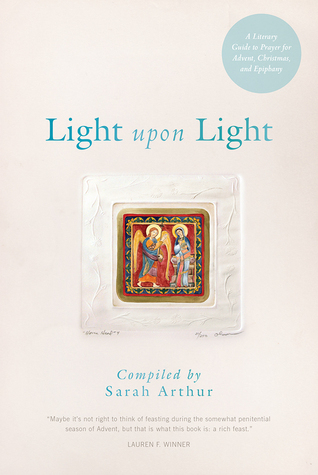
Many of us, when charting the timeline of our lives, can point to a moment when a story or poem happened. It happened the way an accident or a record-breaking snowfall happened: it was perhaps expected, perhaps not. One moment we were performing the usual routine–pouring cereal, say, or opening the mail–and the next moment we sat motionless with a book in our hands, eyes unfocused, a wave of words washing over us as relentlessly as a newsreel.
I’ve had that experience of being stopped in my tracks by a poem or piece of literature, staring out the window or up at the ceiling while the words reverberated in my mind. So I looked forward to such experiences in the pieces Sarah compiled.
There are eighteen sections, beginning the first week in Advent and continuing on until the ninth week of Epiphany. I don’t come from a church background that observes Epiphany, but I knew some churches celebrated it as the time the wise men found the Christ child. I didn’t realize it was observed for several weeks.
Each section has a theme, from Annunciations, to Sojourners, to Love’s Offices, etc. The section begins with an opening prayer, usually taken from a poem. A few Scripture passages are suggested, then several readings from different works are included. There are no assigned readings for specified days: the reader is allowed to meander at his or her own pace.
I loved the idea of this book. Unfortunately, I didn’t enjoy many of the selections. Some I didn’t “get” (my fault). Some were a little off theologically.
I tended to like the classical selections better than the contemporary ones. I don’t have anything against modern literature. I read modern writers all the time. But in this case, the modern pieces were most often the ones I questioned, or the ones that seemed more mystical than biblically accurate.
I did find a few nuggets that spoke to me. There were a couple of old familiar favorites, like an excerpt from Dickens’ The Christmas Carol and G. H. Chesterton’s “The House of Christmas.”
The introduction says, “Some of the works in this collection are obviously seasonal, some obviously Christian. Some are neither.” I know even secular work can express spiritual truth, so I don’t have a problem with it being included–as long as it’s not misleading. I have more trouble with spiritual works that are inaccurate.
I suppose if I had looked at the book as a collection of literary pieces on certain themes revolving around the holidays, my expectations would have been different. Looking at the introduction again after finishing the book, I see that’s how it was presented. My disappointment came from thinking the book was from a distinctly Christian viewpoint and finding it wasn’t. It seemed more in the “spiritual” rather than Christian vein.
Mercy Mild: A 25-Day Christmas Devotional Tracing Christ’s Love from Eden to Eternityby Josh Taylor is a 25-day Advent devotional book leading up to Christmas. Though the author discusses some of the usual Christmas passages and topics, he expands his focus to show that Christ is foretold and pictured in Scripture long before the gospels tell of His birth. And His coming shapes what is taught in the rest of the Bible.
Taylor starts in Genesis, moves to Abraham and the tower of Babel, David, Solomon, the kings, the gospels, the epistles, and Revelation.
Each chapter ends with a prayer, reflection questions, and possible conversation starters from the chapter to spark a spiritual conversation with unbelievers.
I have a multitude of quotes marked in this book. Here are a few:
Your worth isn’t earned. Scripture speaks honestly about our condition—sinners by nature, hostile to God. And yet God’s love reaches across the divide, not because we deserved it, but because love is who He is (p. 3).
How often do we miss God because He shows up differently than we expect? We look for raw power, and He gives us willing sacrifice. We seek a warrior-king, and He sends a servant. We expect a throne, and we get a manger (p. 24).
It’s fascinating how the word “worship” breaks down—“worth-ship.” It’s not about what we get; it’s about declaring what God is worth (p. 49).
God’s writing poetry with geography. The town where David started his search for a place to house God’s presence is exactly where God chose to show up in person (p. 51).
Sometimes the biggest act of courage isn’t doing more; it’s standing still and remembering who God is (p. 56).
This promise didn’t depend on Ahaz’s faith, didn’t need his permission. God was writing a story bigger than one king’s fears or failures (p. 58).
Peace isn’t just about ending wars; it’s about healing what starts them—pride, fear, broken relationships, sin. That’s why surface solutions never last; we need peace that goes soul-deep (p. 67).
He takes our deepest wounds, our darkest chapters, and writes redemption right through them (p. 92).
Sometimes the biggest moments in God’s plan don’t look big at all. Just one person, being faithful, speaking words that heaven whispered first (p. 98).
God didn’t send Jesus because He was lonely or incomplete. He came because that’s what love does—it gives itself away, draws near (p. 104).
A mother’s heart shatters as heaven’s plan unfolds through her Son’s broken body. Being chosen, being blessed—it didn’t spare Mary from this moment. It led her straight to it (p. 131).
The same God who spoke light into existence now arrives as a baby, bringing a different kind of brightness. Not the kind that hurts your eyes, but the kind that helps you see everything more clearly. The kind that shows you the way home (p. 169).
Yet here we are, still acting sometimes like we don’t have a home. Still trying to earn what’s already ours. Still carrying ourselves like orphans when we’re children of the King (p. 168).
I enjoyed this book quite a lot. A couple of passages sparked blog posts. I’m sure I’ll visit this book again in the future.
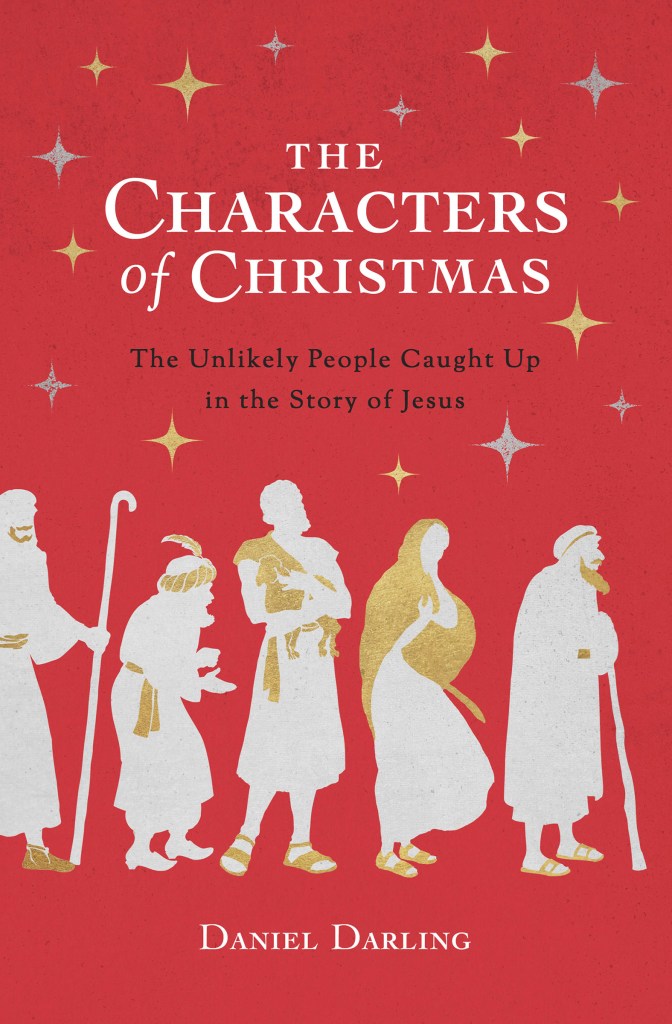
In The Characters of Christmas: The Unlikely People Caught Up in the Story of Jesus, Daniel Darling takes a fresh look at Joseph, Zechariah, Elizabeth, Herod, the innkeeper, and others involved in the first Christmas. He writes, “We should become familiar with them not because their lives are the point of the story, but because their lives, like our own, point ultimately to the one character whose birth changed the world: Jesus Christ” (p. 11). “Reading about this supporting cast allows us to get a closer look at the One who is worthy of our worship” (p. 169).
Most of them were “wonderfully ordinary” (p. 13), encouraging us that God often uses everyday folks.
The author weaves together what the Bible says about these people as well as what is known from the customs of the day and gives us a credible view of the first Christmas from their point of view.
Some of the quotes that stood out to me:
Zechariah was a common name in those days. There are even multiple Zechariahs in the Bible. But it is not a coincidence that the first words from God to His people in four hundred years would come to someone whose name means “the Lord has remembered” (p. 33).
A priest, who often spoke words of blessing on God’s people, would be silenced and would emerge with a renewed faith in the possibility of God’s promise. Sometimes God has to quiet us so we can hear Him. Sometimes we have to be still so we can see Him move. Sometimes our words and our busyness get in the way of our faith (p. 41).
The couple who suddenly showed up at his door was a disruption, an inconvenience, a problem he didn’t plan for. This is, by the way, how God often enters our lives (p. 86).
A temptation for us, this Christmas, is to simply get full of “the feels,” the warm sentimentality of this season, and miss the good news at the heart of the holiday: Christ has come into the world to save you and to save me (p. 100).
If Jesus is the true King, if He is indeed the fulfillment of the covenant promises to Israel, if He is the Light of the world who saves people from their sins, then isn’t He worthy of our whole selves, body and soul? (p. 114).
Each chapter ends with study reflections and a suggested Christmas song.
I appreciated the fact that the book was only eleven chapters rather than being a 25- or 31-day Advent schedule. Fewer chapters made it easier to work in amid Sunday School and Bible study reading throughout the month.
I enjoyed this book a lot. Even though I was familiar with most of what was written, it was done in a way that helped me look at the Christmas story anew. I’m sure I’ll use this book again for future Advent reading.
When I looked at the sample of the book at Amazon, however, I was disappointed that the book seemed to be less of Chesterton and more on Smith commenting on Chesterton. I eventually decided to get the book anyway, and I am glad I did.
Smith says that reading Chesterton is an “acquired taste,” and I agree. I would not have gotten nearly so much out of Chesterton’s quotes here without Smith drawing out the meaning.
If you’re not familiar with Chesterton, Wikipedia says he “wrote around 80 books, several hundred poems, some 200 short stories, 4,000 essays (mostly newspaper columns), and several plays. He was a literary and social critic, historian, playwright, novelist, and Catholic theologian and apologist, debater, and mystery writer.” He was a columnist for several newspapers and even wrote some Encyclopedia Britannica entries (including the one for Charles Dickens). He might be known best for his Father Brown stories about a priest who also does detective work.
He was baptized into the Church of England as a child, dabbled in the occult, then came back to the Anglican church as an adult, and later converted to Catholicism. I am curious how and why he embraced Catholicism but haven’t read enough to know his thinking. But “Christian themes and symbolism appear in much of his writing.”
Smith says Chesterton wrote prolifically about Christmas, much more than could be included in this book.
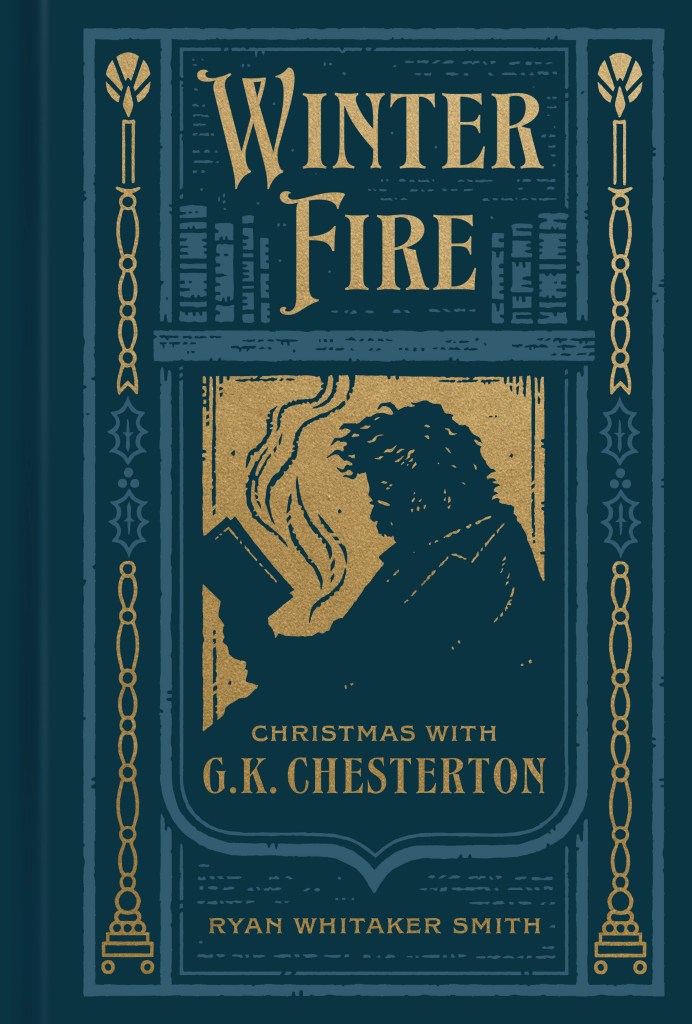
Winter Fire contains thirty days of readings, with Smith expanding on, explaining, and giving the cultural background to quotes about Christmas from some of Chesterton’s essays. After each reading is a Bible verse and questions for thought.
Then there are a variety of Chesterton’s other writings: several poems, a few essays, and a couple of short stories. Finally, Smith included recipes and games prevalent at the time Chesterton lived (1874-1936). The weirdest game, called Snapdragon, involved raisins doused in brandy, then set on fire. Then children tried to reach into the fire quickly and grab a raisin.
One of the readings here inspired a blog post, A Christmas Boomerang, and I have another post or two in mind based on thoughts read here.
Smith says the title of this book “is taken from a quote featured in the reading for Day 13: ‘Christ is not merely a summer sun of the prosperous but a winter fire for the unfortunate.’ The image of a fire burning amid the frosts of winter seemed a fitting image to draw from for a book that not only celebrates the comfort, joy, and revelry of Christmas, but the mercy of God who has called us to His everlasting feast” (p. 12). He writes that “The purpose of our journey is not so much to dwell in ‘the place from which Christmas came,’ but to allow that place to dwell in us, to return to our own country with christened eyes, to look upon our everyday surroundings with a baptized imagination” (p. 17).
I have scores of quotes marked, but I’ll try to share just a few:
In the majestic march of Progress, we have first vulgarised Christmas and then denounced it as vulgar. Christmas has become too commercial; so many of these thinkers would destroy the Christmas that has been spoiled, and preserve the commercialism that has spoiled it” (Chesterton, p. 32).
I have never understood what people mean by domesticity being tame; it seems to me one of the wildest of adventures (Chesterton, p. 45).
Omnipotence and impotence, or divinity and infancy, do definitely make a sort of epigram which a million repetitions cannot turn into a platitude. It is not unreasonable to call it unique. Bethlehem is emphatically a place where extremes meet. (Chesterton, p. 84).
Christmas did not merely borrow certain traditions from paganism; it survived paganism. It was a stronger thing than all the pagan world could offer. It was fiercer than its creeds, more potent than its rituals (Smith, p. 116).
The land endures the harshness of winter in order to be reborn in the vigor of spring. Everywhere we look, nature is rehearsing resurrection, preparing for the day when all things will be made new, when measurable time gives way to immeasurable eternity (Smith, p. 128).
These are a couple of stanzas from Chesterton’s poem “The House of Christmas”:
A Child in a foul stable, Where the beasts feed and foam; Only where He was homeless Are you and I at home; We have hands that fashion and heads that know But our hearts we lost—how long ago! In a place no chart nor ship can show Under the sky’s dome.
To an open house in the evening Home shall men come, To an older place than Eden And a taller town than Rome. To the end of the way of the wandering star, To the things that cannot be and that are, To the place where God was homeless And all men are at home.
The book cover, texture, and illustrations have a lovely old-fashioned feel to them.
Chesterton uses a lot of irony, and often. as Smith says, is “saying several things at once” (p. 11). I have question marks at a couple of places in the book. But I was inspired, taught, and encouraged by much that I read, and I am sure I’ll read this again in future Advent seasons.
One of the main things that helps me keep a good perspective through December is reading a Christmas or Advent devotional book.
Some years I’ve followed reading plans for Scripture that specifically deal with the coming of Christ, including the prophecies of His birth. I don’t have one on hand, but I’m sure there are plenty online.
Most years, though, I read an Advent devotional book usually in addition to, sometimes instead of, my usual devotional time. So I thought I’d share some of the ones I’ve enjoyed with you. I’ll link the titles back to my reviews.
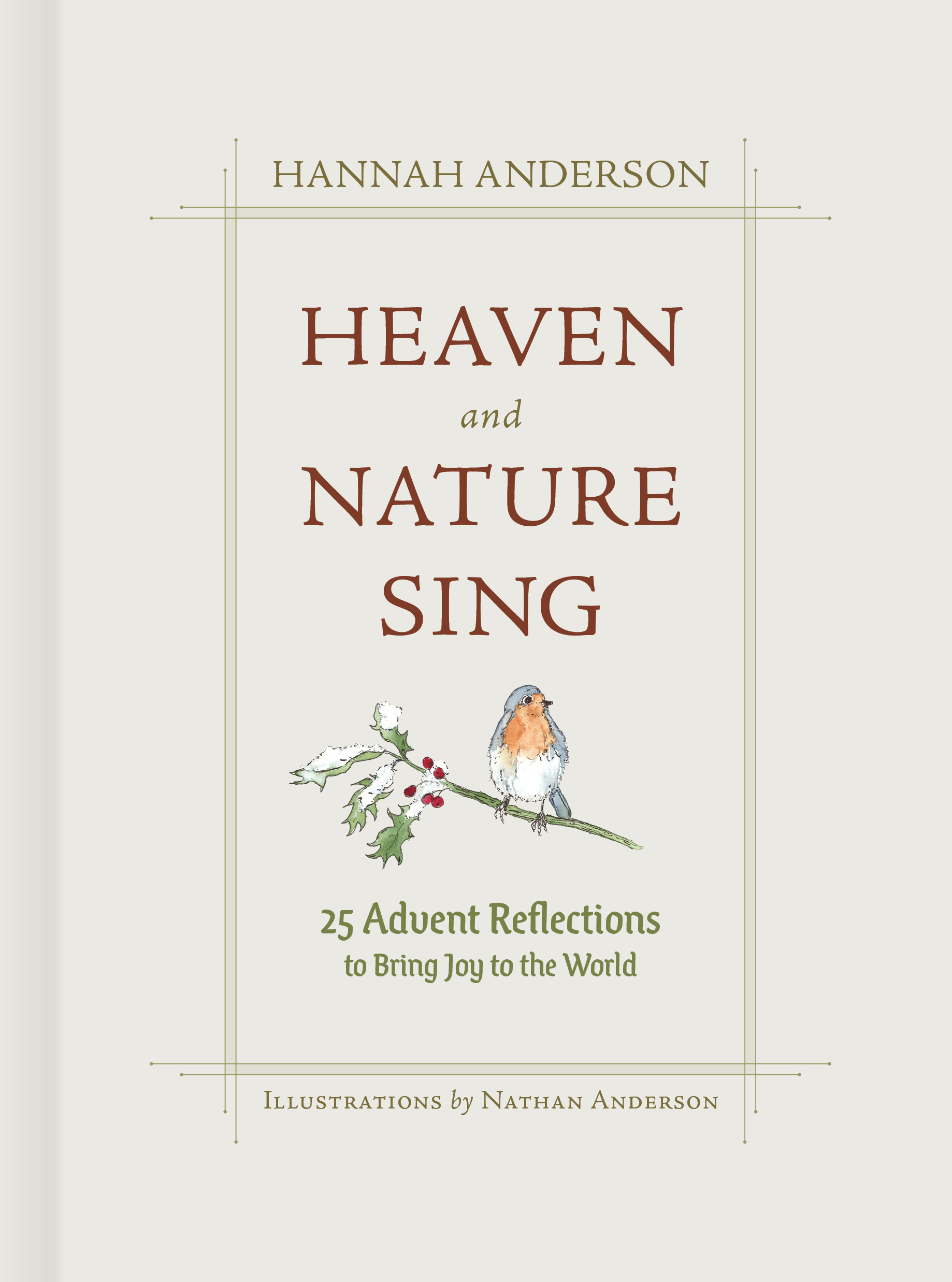
Heaven and Nature Sing: 25 Advent Reflections to Bring Joy to the World by Hannah Anderson is the newest I’ve read, just published last year. It’s also one of my favorites. Reading this book set me to reading many of Hannah’s other books this year. The title comes from a phrase in Isaac Watt’s “Joy to the World.” Hannah took inspiration from this phrase and wrote twenty-five Advent devotions based on various aspects of nature connected with the birth of Christ. Each devotion is about five pages long and written in an easily readable style.
Sample quote: “Yes, the manger signals something about this baby, but it is not simply his poverty. By being placed in the manger, he is revealed as both the rightful son of Adam charged with caring for his creation and also the eternal Son of God who created them and who provides for them. So instead of filling the manger with hay or corn, he fills it with himself.”
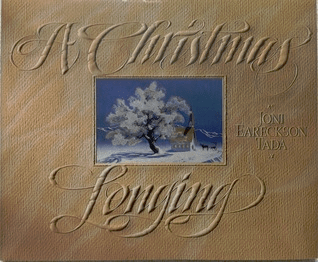
A Christmas Longing by Joni Eareckson Tada is a gorgeous book filled with her art work, drawn by mouth due to her paralysis. It’s made up of 31 readings for each day in December centered on the theme of joy.
Sample quote:”Lives hinge and eternal destinies hang in the balance when men and women come face to face with Jesus the Christ. It isn’t always peaceful. It isn’t always painless. It isn’t always easy. But bowing the knee to Jesus Christ is always right. No matter what.”
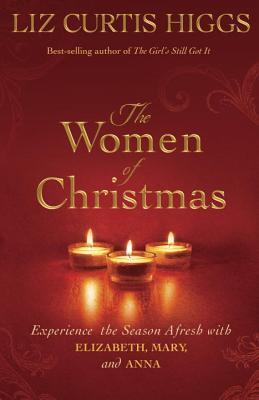
The Women of Christmas: Experience the Season Afresh with Elizabeth, Mary, and Anna by Liz Curtis Higgs. The eight chapters here are longer, around twenty pages or more. So it might not work as a devotional unless you divided the chapters up. But I thoroughly enjoyed this one. Liz did tons of research and study, but the book is warm rather than technical and stiff.
Sample quote: “When I hear women rail that the Bible is misogynistic, I wonder if we’re reading the same book. God loves women, redeems women, empowers women – then and now. On the day we call Christmas, he could simply have arrived on earth, yet he chose to enter through a virgin’s womb. On the day we call Easter, he could have appeared first to his beloved disciple John, yet he chose as his first witness a woman set free from seven demons.”
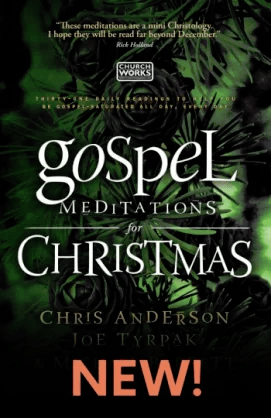
Gospel Meditations for Christmas by Chris Anderson, Joe Tyrpak, and Michael Barrett is divided into 31 pages, one a day through the month of December (or any time, really, since these truths are eternal). Each page lists a Bible passage to read and then delves into some facet of the passage for a handful of paragraphs. The primary focus of the book is various aspects of the Incarnation
Sample quote: “Matthew begins his account of the good news with a record of Jesus’ ancestry. This isn’t some boring list of personal details that Matthew came across in research and decided to include as space-filler. No, this genealogy is Matthew’s attention-grabbing introduction, and it’s jam-packed with significance.”
Expecting Christmas is a 40-day devotional by multiple authors. I wished this one was 25 or 31 days so it would fit neatly in December. I didn’t know any of the author names except one (Jennifer Dukes Lee). The selections are short, which is appreciated in a month like December. Each began with a verse or two of Scripture, a page and a half to two pages (at least in the Kindle version) of text, then three questions for refection.
The readings cover a variety of Christmas topics, though several deal with light.
Sample quote: “Mary’s response was one of quiet introspection as she treasured the good news of the gospel in her heart. The shepherds, on the other hand, left young Jesus, glorifying God and praising Him with outward enthusiasm and passion. People celebrate the gospel in different ways.”
Sample quote: “The tabernacle of old was not full of truth, but full of image, and shadow, and symbol, and picture; but Christ is full of substance. He is not the picture, but the reality; he is not the shadow, but the substance. O believer, rejoice with joy unspeakable for you come to Christ, the real tabernacle of God.”
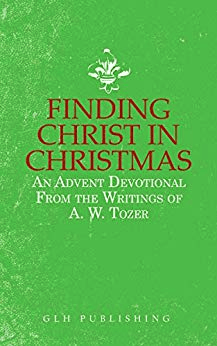
Finding Christ in Christmas: An Advent Devotional by From the Writings of A. W. Tozer has readings for December 1 – 25, ranging from just a paragraph to little more than a page. So the selections are easily readable. I felt the selections were a little haphazard, taken out of context, and some left the reader hanging a bit. But the book contained several great nuggets. Tozer’s writing is not warm and cozy, but it makes one think.
Sample quote: “The Law was given by Moses, but that was all that Moses could do. He could only ‘command’ righteousness. In contrast, only Jesus Christ produces righteousness. All that Moses could do was to forbid us to sin. In contrast, Jesus Christ came to save us from sin. Moses could not save anyone, but Jesus Christ is both Savior and Lord.”
Sample quote: “Even though you may still be unconverted and going your own way, you have received much out of the ocean of His fullness. You have received the pulsing life that beats in your bosom. You have received the brilliant mind and brain within the protective covering of your skull. You have received a memory that strings the events you cherish and love as a jeweler strings pearls into a necklace and keeps them for you as long as you live and beyond. All that you have is out of His grace. Jesus Christ, the eternal Word, who became flesh and dwelt among us, is the open channel through which God moves to provide.”
Come Thou Long Expected Jesus:Experiencing the Peace and Promise of Christmas, compiled by Nancy Guthrie, is one I have enjoyed several times. It contains 22 selections on various aspects of Advent, from Mary to conception by the Holy Ghost to Joseph to the shepherds to Jesus’s humility and others, from such teachers and preachers as Charles Spurgeon, Augustine, Martyn Lloyd-Jones to Tim Keller, John MacArthur, J. I. Packer, and Ray Ortland. I don’t know all of the authors, so I wouldn’t endorse everyone 100%, but I don’t think I read anything in this particular volume that I had a problem with.
Sample quote from J. I. Packer: “The Christmas message is that there is hope for a ruined humanity–hope of pardon, hope of peace with God, hope of glory–because at the Father’s will Jesus Christ became poor and was born in a stable so that thirty years later he might hang on a cross. It is the most wonderful message that the world has ever heard, or will hear.”
Let Every Heart Prepare Him Room: Daily Family Devotions for Adventby Nancy Guthrie is another I’ve read several times. It designed for families to read together, but works well read by individuals, too. There are 31 readings, each ending with a prayer, some discussion questions, and a few more Scriptures on the topic of the chapter.
Sample quote: “Sometimes we are given a gift that we think is not really useful to us, and therefore we never take it out of the box. We stash it away in a closet or on a shelf somewhere in case we need it someday. Sadly, that’s what some people do in regard to Jesus. They want to keep him handy for when something comes along that they can’t handle on their own, but for now they have no interest in making him part of their day-to-day lives, and so they put him on the shelf. They simply don’t believe he is as good as the Bible says he is, and so they have no real or lasting joy in having received this great gift.”
Those are all the ones I can remember reading or find mention of on the blog.
Do you have any favorite Christmas or Advent devotionals? I’d love to hear your recommendations.
“Heaven and nature sing” is a phrase from “Joy to the World,” written by Isaac Watts. Watts’ hymn looks forward to Jesus’ second coming more than His first, but it’s regularly used as a Christmas carol. Hannah took inspiration from this phrase and wrote 25 Advent devotions based on various aspects of nature connected with the birth of Christ. The Bible tells us creation groans from the effects of sin, waiting for redemption. We also groan or yearn for things to be set right. Hannah writes, “I want to offer you hope—not by ignoring the brokenness but by looking it squarely in the face, knowing your Redeemer has and will come” (p. 1).
One thing that struck me about these meditations was how much sheer thought must have been behind them, to weave so many threads together.
For instance, in the chapter “Family Tree,” Hannah writes of her husband’s discovering some old family genealogies which were written not in flow charts like we’re used to, but in concentric circles. Then she tells of a family visit to see the redwood trees in CA. One cross-section of a stump showed rings developed over the millennia the tree had been alive, and Hannah contemplates all the history the tree lived through. Then she brings up the records of Jesus’ human genealogy. His people were often faithless and disobedient, resulting in judgment by enemy armies taking over Israel and exiling its people. Isaiah compares this to God lopping boughs off a tree (Isaiah 10:33). But He promises “There shall come forth a shoot from the stump of Jesse, and a branch from his roots shall bear fruit. And the Spirit of the Lord shall rest upon him. . . In that day the root of Jesse, who shall stand as a signal for the peoples—of him shall the nations inquire, and his resting place shall be glorious” (Isaiah 11:1-2, 10).
“The story of Christmas is this: the tree is not dead” (p. 20). And eventually, others were grafted into the family (Romans 11:17-24), “strangers and foreigners and all those who thought they’d never know family again, those who never dared to hope that life would run through them” (p. 20).
You and I are links in the chain of generations, called to steward the fragile hope we’ve received. The seventy or eighty years given to us on this earth pale in light of those who have come before us and those who follow after. . .
So whether his work happens over the course of a thousand years or one day, whether it is given to us to play a prominent role in it or simply to stand as a faithful witness to the promise, we will wait on him. And we will wait in hope.
The tree is not dead. The quiet, steady work that came before us will continue on after us. The quiet, steady work we do today—even if it’s as simple as celebrating the Promised Son during this season—will echo through the years (pp. 20-21).
And thus Hannah writes about winter, stars, serpents, holly, evergreens, swaddling bands, shepherds, stars, and more.
One of my favorite quotes is in the chapter “Among the Beasts.”
Yes, the manger signals something about this baby, but it is not simply his poverty. By being placed in the manger, he is revealed as both the rightful son of Adam charged with caring for his creation and also the eternal Son of God who created them and who provides for them. So instead of filling the manger with hay or corn, he fills it with himself (p. 80).
I spent many mornings after my reading in this book in tears or joy, touched and awed by the contemplation of the “old, familiar” Christmas story.
Each devotion is about five pages long and written in an easily readable style. The illustrations on the cover and between chapters were drawn by Hannah’s husband, Nathan.
I can’t recommend this book highly enough. I’m sure I’ll use it again in future Advent seasons. But since these truths are timeless, you could read it any time of year.
I have some of Hannah’s other books in my Kindle app, and I am eager to read them. The only trouble is deciding which one to start with!






 Stray Thoughts