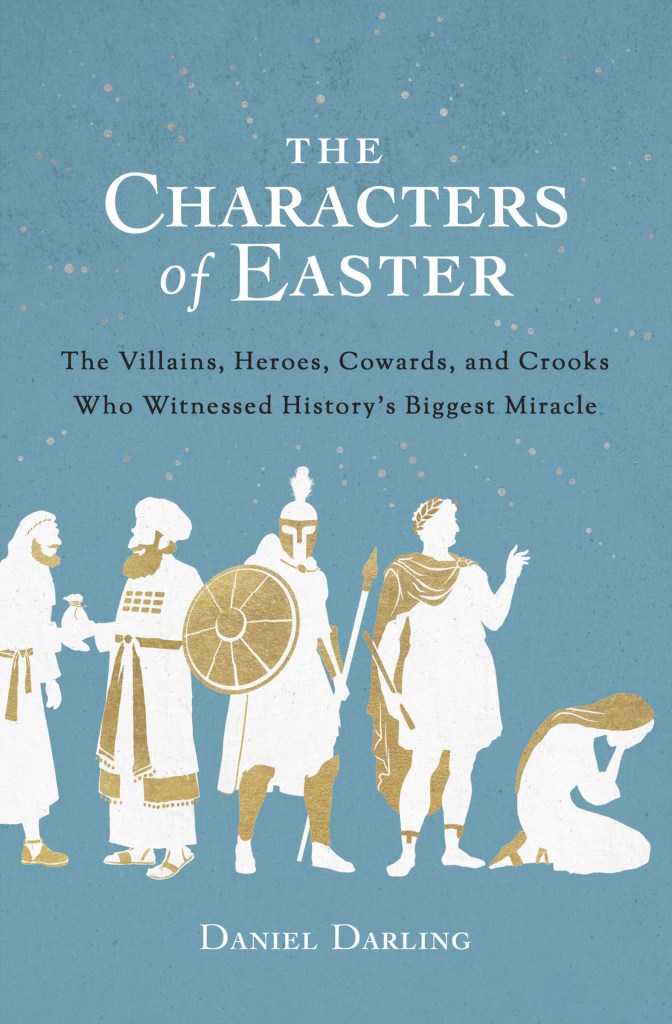
I enjoyed Daniel Darling’s The Characters of Christmas quite a lot. So when I saw he had also written The Characters of Easter: The Villains, Heroes, Cowards, and Crooks Who Witnessed History’s Biggest Miracle, I got it in time for Easter season this year.
Normally I like my seasonal reading in the form of shorter devotionals, because I don’t want them to replace my regular Bible reading. This book was not written in a short devotional style, but it only had ten chapters, so it was easy to work in.
The introduction discusses why Easter is so important and encourages us to look at it through fresh eyes.
Daniel devotes a chapter each to several individuals connected with Easter: Peter, John, Judas, Barabbas, Pilate and Thomas. The remaining four chapters discuss groups: the religious enemies of Christ (Pharisees, scribes, and Sadducees), the women who discovered the empty tomb, the secret disciples (Nicodemus and Joseph of Arimathea), and the Roman executioners.
Each chapter gives what background we know from the Bible of each person, as well as their actions and sayings connected to Jesus’ death and resurrection.
The chapter about John shows that the writer of a book and three letters bearing his name, as well as the book of Revelation, did not start out as the “Apostle of Love.” He and his brother were called “the sons of thunder.” They wanted to call down fire from heaven on a Samaritan village that did not receive Jesus. They wanted places next to Jesus when He established His kingdom. “When John became a disciple, he was far from ready for spiritual leadership. This is a reminder that Jesus didn’t choose His disciples because of their impressive résumés” (p. 47). It was good to follow John’s transformation and to be reminded we’re all in a state of growth. I’m thankful for God’s patience and kindness in dealing with us as we mature spiritually.
The chapter about Thomas was my favorite. We don’t know as much about him as some of the other disciples. Perhaps unfairly, many people only remember him for doubting that Jesus rose from the dead. Earlier, however, he was a brave follower of Jesus when others left because of His hard sayings. When Jesus wanted to go to Bethany after Lazarus died, to an area where His enemies had recently tried to kill Him, Thomas said, “Let us go also, that we may die with him” (John 11:1-16).
It’s kind of a macabre response, perhaps giving us insight into Thomas’s more pessimistic personality. It seems Thomas was the one always counting the cost, weighing the facts, looking for certainty when others like Peter were guided by the more emotional and subjective compass of the heart. And Thomas didn’t understand all that he even said. Thomas or any of the other disciples couldn’t really go with Jesus to die. To pay for the sins of the world, Jesus had to go alone to the garden, alone to the cross, alone to the grave.
And yet in a sense, Thomas understood the call Jesus gives every disciple to come and die with Him . . .
This is a bold statement. Thomas seems like the silent one, who carefully weighs and thinks before coming to a conclusion, and yet when he speaks, it is a profound statement of courage and loyalty. “Let’s go die with Jesus” could be a life verse, the call of everyone who sees and believes Jesus” (pp. 124-125, Kindle version.).
When Jesus began to tell His disciples that He had to go away, “Thomas, the seeker, the inquirer, the analyzer, asked, ‘Lord, we don’t know where you’re going. How can we know the way?’ (John 14: 5). This is a good question. Thomas, you remember, was the one willing to ‘go and die’ with Jesus. Thomas is willing to obey Jesus at all costs, but he just needs to know where to go” (p. 126).
But Jesus’ response to Thomas—the question-asker, the seeker, the one who hears things and rolls them around his mind until he can process them—is a stunning declaration, perhaps the most important and most controversial words ever uttered in human history:
“I am the way, the truth and the life. No one comes to the Father except through me.” (John 14: 6)
This is the meaning of Easter. There is not a path or a principle. There is only a Person. Jesus is the way. Jesus is the truth. Jesus is the life. He didn’t merely point to the truth. He didn’t merely show them the way. He didn’t merely tell them how to improve their lives. He’s the end of the journey, the object of our obsessions, what our hearts truly long for (pp. 127-128)
And, finally, Thomas wasn’t with the disciples when Jesus first appeared to them after His resurrection. He refused to believe it unless he saw Jesus in person with His scars. “Like a good shepherd, [Jesus] meets His struggling disciple where he is, carefully tending to his soul” (p. 130). Thomas responded, “My Lord and my God!”
Daniel writes of others like Lew Wallace (author of Ben-Hur), C. S. Lewis, and Lee Strobel, who didn’t believe until they looked up the facts for themselves. “Thomas’s story shows us the paradox of Christianity: it is both faith and facts, believing and seeing. Our faith is grounded in a mountain of historical facts . . . ” (p. 131).
“Jesus is not inhospitable to those who doubt, those who seek earnestly for the truth” (p. 132).
I enjoyed this book so much. I appreciated the author’s perspective and graciousness and his way of looking deeper into each of these people’s lives and hearts.
Looking at Jesus’ life, death, and resurrection through the eyes of people who were there at the time was an interesting and enlightening way to spend Lent and Easter. My heart was touched many times over. I can “amen” what the author said here: “You’ll notice that nobody in Scripture is ever casual after an encounter with the living God: Moses glowed, Isaiah was ‘undone,’ Ezekiel face-planted in fear, John fainted. Peter was overwhelmed—but he left his nets and followed” (p. 25).
(I often link up with some of these bloggers.)