
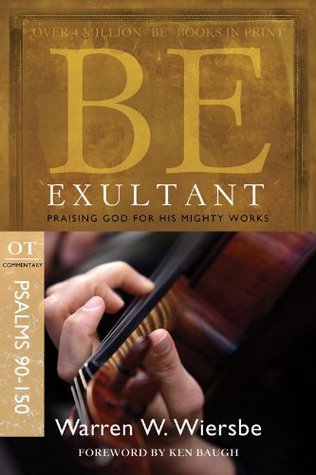
Review: Be Exultant

Be Exultant: Wiersbe commentary on Psalms

In my current trek through the Bible, I’ve just finished the book of Psalms. I had not planned to end the book right before Thanksgiving, but I was glad it worked out that way.

Once again, I used Warren Wiersbe’s short “Be” commentary as a companion, along with the ESV Study Bible notes.

Since Psalms is the longest book of the Bible at 150 chapters, Wiersbe divided his commentary on the book into two parts. I reviewed the first one here: Be Worshipful (Psalms 1-89): Glorifying God for Who He Is. The second is Be Exultant (Psalms 90-150): Praising God for His Mighty Works.

As I said in the earlier review, the book of Psalms is Israel’s songbook. The passages cover Israel’s history from creation to the latest happenings of the day, their return after being exiled in Babylon for seventy years.

Though David wrote a majority of the psalms, various other authors contributed as well.

The writers composed in caves, in hiding, in their rooms, under persecution, in celebration.

Many of the psalms are deeply personal, yet benefit the whole congregation.

The psalms are deeply doctrinal, some prophesying of the Messiah to come, many quoted in the New Testament.

But many people value the psalms most for their wide range of emotion, from the highest praise and exaltation to the lowest depths of misery. The psalms give us many examples of someone pouring out their heart to God in confusion, sorrow, pain, or guilt, then reminding themselves of what they know to be true about God.

Here are some of the quotes from Wiersbe’s book that most stood out to me:

Life is brief, so Moses prayed, “Teach us.” Life is difficult, and he prayed, “Satisfy us.” His work at times seemed futile, so he prayed, “Establish the work of our hands.” God answered those prayers for Moses, and He will answer them for us. The future is your friend when Jesus is your Savior and Lord (p. 25, Kindle version).

It is better to suffer in the will of God than to invite trouble by disobeying God’s will (1 Peter 2: 18–25) (p. 26).

This hidden life of worship and communion makes possible the public life of obedience and service (p. 26).

To rely on our faith is to put faith in faith, but to rely on God’s faithfulness is to put faith in the Lord. Our assurance is in the Word of God and the God of the Word (p. 102).

The Word of God performs many wonderful ministries in the life of the devoted believer. It keeps us clean (v. 9), gives us joy (vv. 14, 111, 162), guides us (vv. 24, 33–35, 105), and establishes our values (vv. 11, 37, 72, 103, 127, 148, 162). The Word helps us to pray effectively (v. 58) and gives us hope (v. 49) and peace (v. 165) and freedom (vv. 45, 133) (p. 110).

What a precious treasure is the Word of God (vv. 14, 72, 127, 162; 61: 5)! It is like a deep mine filled with gold, silver, and precious gems, and we must take time to “dig” for these treasures (Prov. 2: 1–9; 3: 13–15; 8: 10–11; 1 Cor. 3: 9–23). A mere surface reading of Scripture will not put spiritual treasure into our hearts. Mining treasure is hard work, but it is joyful work when we “mine” the Bible, as the Spirit guides us into truth. Then, the Spirit helps us to “mint” the treasure so we can invest it in our lives (obedience) and in the lives of others (witness) (p. 131).

Wrong ideas about God will ultimately lead to wrong ideas about who we are and what we should do, and this leads to a wrong life on the wrong path toward the wrong destiny
(p. 193).

I’m thankful once again for Dr. Wiersbe’s insights.

Review: Be Worshipful

Be Worshipful by Wiersbe on Psalms

Psalms is the longest book of the Bible at 150 chapters, so Warren Wiersbe divided his commentaries on the Psalms into two books. The first is Be Worshipful (Psalms 1-89): Glorifying God for Who He Is.

“The book of Psalms has been and still is the irreplaceable devotional guide, prayer book, and hymnal of the people of God,” (p. 15). About one-third of the psalms don’t list an author, but King David wrote the majority of the others. The sons of Korah, Asaph, Solomon, Ethan, and Moses wrote others. All, however, wrote under the inspiration of the Holy Spirit.

Except for Moses’ psalm, the rest span the time of King David through the divided kingdom and Israel’s exile into Babylon.

“Some of the psalms are laments to the Lord, written by people in dire circumstances. There are also messianic psalms that point forward to the Lord Jesus Christ. There are also psalms of praise and thanksgiving, royal psalms, wisdom psalms, psalms of affirmation and trust, penitential psalms, and even imprecatory psalms calling down God’s wrath on the enemy” (p. 16).

The psalms’ poetry is not rhyming and rhythmic like English poetry. Hebrew poetry expresses itself in parallel lines. The second line of a pair might say the same as the first differently, or contrast with the first, or expand on the first. But the psalms uses similar literary devices as our poetry: simile, metaphor, imagery, symbolism, synecdoche (referring to one part to represent the whole, like keeping hands clean representing keeping one’s life clean), hyperbole, apostrophe (addressing a thing as if it were a person, like Wisdom), anthropomorphism, and others.

“There are over four hundred quotations or allusions to the psalms in the New Testament” (p. 16).

The psalms cover a lot of different subjects. “But primarily, the Psalms are about God and His relationship to His creation, the nations of the world, Israel, and His believing people” (p. 16).

“The psalms teach us to seek God with a whole heart, to tell Him the truth and tell Him everything, and to worship Him because of who He is, not just because of what He gives. They show us how to accept trials and turn them into triumphs, and when we’ve failed, they show us how to repent and receive God’s gracious forgiveness. The God described in the book of Psalms is both transcendent and immanent, far above us and yet personally with us in our pilgrim journey. He is ‘God Most High’ and ‘Immanuel—God with us'” (p. 18).

Wiersbe writes a few pages of comments on each psalm, explaining, drawing out truth, sharing insights. He includes discussion questions at the end of the book.

Many of the comments I have highlighted refer to specific contexts of psalms that would be impossible to explain without sharing all of Wiersbe’s comments on that particular section. But here are a few general comments I found helpful:

Those who have problems with the military aspects of some of David’s psalms should remember that David went to war only when the enemy attacked Israel. He did not invade other nations just to gain territory, and he was fighting the Lord’s battles (1 Sam. 17:47; 25: 28; 2 Chron. 20:15). The covenant God made with David (2 Sam. 7:11) assured him of victory over his enemies (p. 85).

Though David occasionally fell, as we all do, the habitual bent of his life was toward the Lord and His Word (p. 106).

The secret of David’s public confidence was his private obedience: He took time to fellowship with the Lord and get directions from Him. David knew that the most important part of his life was the part that only God could see, and this was one priority he would not negotiate” (p. 108).

David tried to “cover” his sins, but his schemes didn’t work. They never do (Prov. 28: 13), but when God covers the sins we confess to Him, they are hidden from sight and never seen again. (See Isa. 38:17; 43:25; 44:22; Jer. 31:34; 1 John 1:7–9.) (p. 121).

Chastening isn’t a judge punishing a criminal; it’s a loving Father dealing with His disobedient children to bring them willingly to the place of surrender. According to Hebrews 12:1–13, God’s chastening is proof that He loves us and that we are genuinely His children (p. 122).

[Re David praying against enemies} This was not a personal vendetta on David’s part, but a concern for the future of the nation of Israel and the dynasty of David. As ruler of the land, David wielded the sword of justice (Rom. 13:1–4), and nations today punish treason with death (p. 152).

The greatest danger a nation faces is not the invading enemy on the outside but the eroding enemy on the inside—a people gradually turning away from the faith of their fathers. Each generation must pass along to the next generation who the Lord is, what He has done, and what they must do in response to His goodness and faithfulness (71:18; 78:4, 6; 79:13; 109:13; 145:4; 2 Tim. 2:2) (p. 178).

It is our regular worship that prepares us for the crisis experiences of life (p. 207).

The psalms are not just emotional: they are full of truth and doctrine. Yet I love that the psalms show the writers’ hearts as they wrestle with problems, unanswered prayer, confusion, God’s seeming distance. Most of the psalms of lament end with the psalmist reminding himself the truth he knows about God and restoring his hope and confidence. And who can beat the praise psalms for lifting one’s heart in thanksgiving and worship.

The Bible tells us to study God’s Word, not just read it casually. Yet it’s possible to go too far the other way and examine a passage’s pieces, losing the main message or emphasis. I had to wrestle with this since I was using both the ESV Study Bible notes as well as Wiersbe’s commentary. Both were beneficial, but sometimes I left a passage with my head swimming. It helped to go back and read the passage again as a unit and as poetry after reading the comments and notes.

I appreciated the help Wiersbe’s commentary was to understanding and gaining more from the psalms.