Laudable Linkage

Laudable Linkage

Some good reads found this week:

Just Not Feeling It”: How Routine Awakens Devotion. “To some, the word routine carries the stiffness of stale bread and the rot of dead plants, the stuffiness of library books never opened and attics dusty with age. The very thought of routine spirituality — planned, scheduled, disciplined — seems to undermine the ministry of the life-giving, freedom-bestowing Spirit. ‘Where the Spirit of the Lord is, there is freedom’ (2 Corinthians 3:17) — and where the spirit of routine is (we may think), there is bondage. The dichotomy, however, is self-imposed, self-imagined. If routine smells stale to us, the problem lies in our own sniffer.”

Delays Are as Much a Part of God’s Plan as Answered Prayers. “At times, we may find ourselves in situations where we are eagerly waiting for answers to our prayers, hoping for our dreams, goals, and aspirations to come to fruition. However, it’s during these moments of uncertainty and delay that we may become overwhelmed with frustration, anxiety, and even a sense of disillusionment.”

2 Ways Anxiety Affects Parents, HT to Story Warren. “In my thirty-plus years of counseling, I’ve never seen parents feel as much pressure or as much like failures as they do today. I’ve never had as many parents in tears in my office. And I’ve certainly never seen as many parents who live in a perpetual state of worry.”

5 Lies Teenagers Believe & Biblical Truth to Set Them Free. “I sometimes fear this generation of young people is stuck in a giant game of Where’s Waldo? They only see the things they are looking for. When you fear rejection, you see it on every face in the crowd. When you want to escape your responsibilities, you spot exits everywhere. When you crave affirmation, you will find it in all the wrong places. 1 Peter 5:8 HCSB says, ‘Be sober-minded, be alert. Your adversary the devil is prowling around like a roaring lion, looking for anyone he can devour.’ Sadly, teens are primary targets in the enemy’s strategy to dismantle the kingdom of God.”

Purposes of Predicative Prophecy. “Why has God given revelation in the form of prophecy? And why so much? What is the goal of prophecy? Or are there multiple intended effects? A number of passages answer these questions. The answers are surprisingly diverse.”

Lists are Menus, HT to Linda. I don’t have the negative feelings this writer has about working through a list. But there is something appealing about looking at a list like a menu. “These menus also help clarify a critical way a menu differs from a to-do list: picking just one or two items from a menu is something you get to do, not something you have to do. The myriad things you could order – so far in excess of your capacity to consume them – don’t constitute a problem.”

The Bible has to go through our head to affect our heart and life.

Laudable Linkage

Laudable Linkage

I have not been online much this week with all the family here. But I did come across a few good articles.

A Liturgy for When the House Feels Too Full of Children. Lovely poem for an overwhelmed parent.

A Home Is Not Our Hope: Resting in the Promise of a Place to Belong. “All of this moving has often left me longing for a home. Our home. A place we know and where we belong. A place with the perfect view from our many windows, with solid construction, a clean (mold-free) HVAC, and a beautiful piece of wooded land outside. Of course, we have no idea what settling down might look like, but all of these transitions stir in us a desire to have a home that is ours.”

Legalism, License, and the Tightrope of Bible Application. “Legalism, License, and the Tightrope of Bible Application. “Sometimes people warn of the danger of creating behavioral rules to either attain or maintain God’s favor. And at other times, people warn of cheap grace, where the gospel’s freedom is misunderstood to mean repentance is unnecessary. The tug-of-war between these perspectives may cause Bible application to feel like crossing a lava pit on a tightrope. Both sets of warnings are on to something; the dangers on either side are real. And both sets of dangers may have the same solution: holding fast to the main points of biblical texts.”

Erwin Lutzer quote

Review: Be Worshipful

Be Worshipful by Wiersbe on Psalms

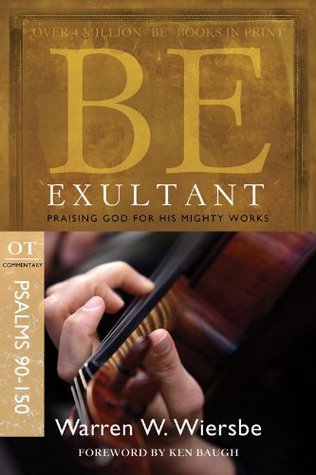
Psalms is the longest book of the Bible at 150 chapters, so Warren Wiersbe divided his commentaries on the Psalms into two books. The first is Be Worshipful (Psalms 1-89): Glorifying God for Who He Is.

“The book of Psalms has been and still is the irreplaceable devotional guide, prayer book, and hymnal of the people of God,” (p. 15). About one-third of the psalms don’t list an author, but King David wrote the majority of the others. The sons of Korah, Asaph, Solomon, Ethan, and Moses wrote others. All, however, wrote under the inspiration of the Holy Spirit.

Except for Moses’ psalm, the rest span the time of King David through the divided kingdom and Israel’s exile into Babylon.

“Some of the psalms are laments to the Lord, written by people in dire circumstances. There are also messianic psalms that point forward to the Lord Jesus Christ. There are also psalms of praise and thanksgiving, royal psalms, wisdom psalms, psalms of affirmation and trust, penitential psalms, and even imprecatory psalms calling down God’s wrath on the enemy” (p. 16).

The psalms’ poetry is not rhyming and rhythmic like English poetry. Hebrew poetry expresses itself in parallel lines. The second line of a pair might say the same as the first differently, or contrast with the first, or expand on the first. But the psalms uses similar literary devices as our poetry: simile, metaphor, imagery, symbolism, synecdoche (referring to one part to represent the whole, like keeping hands clean representing keeping one’s life clean), hyperbole, apostrophe (addressing a thing as if it were a person, like Wisdom), anthropomorphism, and others.

“There are over four hundred quotations or allusions to the psalms in the New Testament” (p. 16).

The psalms cover a lot of different subjects. “But primarily, the Psalms are about God and His relationship to His creation, the nations of the world, Israel, and His believing people” (p. 16).

“The psalms teach us to seek God with a whole heart, to tell Him the truth and tell Him everything, and to worship Him because of who He is, not just because of what He gives. They show us how to accept trials and turn them into triumphs, and when we’ve failed, they show us how to repent and receive God’s gracious forgiveness. The God described in the book of Psalms is both transcendent and immanent, far above us and yet personally with us in our pilgrim journey. He is ‘God Most High’ and ‘Immanuel—God with us'” (p. 18).

Wiersbe writes a few pages of comments on each psalm, explaining, drawing out truth, sharing insights. He includes discussion questions at the end of the book.

Many of the comments I have highlighted refer to specific contexts of psalms that would be impossible to explain without sharing all of Wiersbe’s comments on that particular section. But here are a few general comments I found helpful:

Those who have problems with the military aspects of some of David’s psalms should remember that David went to war only when the enemy attacked Israel. He did not invade other nations just to gain territory, and he was fighting the Lord’s battles (1 Sam. 17:47; 25: 28; 2 Chron. 20:15). The covenant God made with David (2 Sam. 7:11) assured him of victory over his enemies (p. 85).

Though David occasionally fell, as we all do, the habitual bent of his life was toward the Lord and His Word (p. 106).

The secret of David’s public confidence was his private obedience: He took time to fellowship with the Lord and get directions from Him. David knew that the most important part of his life was the part that only God could see, and this was one priority he would not negotiate” (p. 108).

David tried to “cover” his sins, but his schemes didn’t work. They never do (Prov. 28: 13), but when God covers the sins we confess to Him, they are hidden from sight and never seen again. (See Isa. 38:17; 43:25; 44:22; Jer. 31:34; 1 John 1:7–9.) (p. 121).

Chastening isn’t a judge punishing a criminal; it’s a loving Father dealing with His disobedient children to bring them willingly to the place of surrender. According to Hebrews 12:1–13, God’s chastening is proof that He loves us and that we are genuinely His children (p. 122).

[Re David praying against enemies} This was not a personal vendetta on David’s part, but a concern for the future of the nation of Israel and the dynasty of David. As ruler of the land, David wielded the sword of justice (Rom. 13:1–4), and nations today punish treason with death (p. 152).

The greatest danger a nation faces is not the invading enemy on the outside but the eroding enemy on the inside—a people gradually turning away from the faith of their fathers. Each generation must pass along to the next generation who the Lord is, what He has done, and what they must do in response to His goodness and faithfulness (71:18; 78:4, 6; 79:13; 109:13; 145:4; 2 Tim. 2:2) (p. 178).

It is our regular worship that prepares us for the crisis experiences of life (p. 207).

The psalms are not just emotional: they are full of truth and doctrine. Yet I love that the psalms show the writers’ hearts as they wrestle with problems, unanswered prayer, confusion, God’s seeming distance. Most of the psalms of lament end with the psalmist reminding himself the truth he knows about God and restoring his hope and confidence. And who can beat the praise psalms for lifting one’s heart in thanksgiving and worship.

The Bible tells us to study God’s Word, not just read it casually. Yet it’s possible to go too far the other way and examine a passage’s pieces, losing the main message or emphasis. I had to wrestle with this since I was using both the ESV Study Bible notes as well as Wiersbe’s commentary. Both were beneficial, but sometimes I left a passage with my head swimming. It helped to go back and read the passage again as a unit and as poetry after reading the comments and notes.

I appreciated the help Wiersbe’s commentary was to understanding and gaining more from the psalms.

Laudable Linkage

Laudable Linkage

There is so much good reading online. Here are a few that stood out to me. It’s probably a good time for my occasional reminder that linking to any source does not imply 100% endorsement of everything on that site.

Why’d the Pigs Have to Die? HT to Challies. I’ve often wondered about this, from when Jesus cast a legion of demons out of one man, and the demons went into a herd of pigs and destroyed them. I appreciate the answer.

The Secret Meaning of YHWH, HT to Knowable Word. “I think God is not pleased by the herculean efforts some people go to look so hard for hidden meanings—whether linguistic or allegorical or what have you—that they miss the simple point of what he said.”

What Does It Look Like to Serve as Others as Jesus Served? “What does it look like to be a servant to my family, to say ‘My life for yours’? As a person of faith, I look to Jesus as my example of a servant’s heart.”

One of the Weirdest Articles I’ve Ever Written. Mike Leake uses and absurd example to illustrate the point that “Just because a word means something somewhere doesn’t mean it carries that same meaning elsewhere.” We can end up with this kind of extreme interpretation in Bible word studies when we “find all the uses of that word and then you shove each of those passages and all of their meaning into the Scripture you’re studying.”

Ambassadors for Marriage, HT to Challies. “It’s one thing for me, a 50-something, Christian mother of four, grandmother of two, to say, ‘Yes, get married! Don’t wait for the ‘perfect’ person or perfect timing! Don’t wait to get the whole rest of your life in order first! Marriage is great—it’s totally worth it!’ But it’s another thing entirely coming from someone who is under the age of 30.”

What It Feels Like, HT to Challies. A pastor’s experience with depression.

Shepherding Children Through Exposure to Pornography, HT to Challies. It’s sad that such an article is necessary, but these days, it’s too easy to come across pornography unexpectedly and then be drawn in.

God is Near: Certain Comforts for Moms, HT to Challies. “In my role as the Director of Children’s Ministries at my church, I’m privy to the thoughts of many mothers. As moms think about ‘back to school,’ one emotion keeps bubbling to the surface over and over. I hear it in their voices, in the questions they ask, and the conversations they have. It’s not a pretty emotion. It’s one that can sometimes paralyze us.  Fear.”

Your Rights as a Christian in a Public School in 2023, HT to Challies.

The most recent newsletter from the Elisabeth Elliot Foundation shared that the Museum of the Bible in Washington D.C is hosting an exhibit called Through Gates of Splendor: The Elisabeth Elliot Story through the end of 2023. I’d love to see it, but I doubt I’ll get to D.C. before the end of this year. Thankfully, this article says they’re working on a traveling exhibit. The newsletter shared this video of opening day:

John Newton quote about fear

Laudable Linkage

Here are some of the thought-provoking blogs discovered this week:

If You Don’t Believe in Hell, HT to Challies. “Beliefs ripple. But we make a concerted effort to ignore that. Especially within the system of Christian faith, people can be tempted to pick and choose which doctrines they are “okay with” and which ones they leave behind. The problem lies in the ripples. Christians don’t always see how disbelief in one thing affects belief in another.”

Learning to Forgive Family, HT to Challies. First what forgiveness is and is not, and then why it is crucial.

The Glory of Godliness. “Frequently, I hear Christians talk about being more faithful, loving, or active in church. But I can’t remember the last time I heard someone say, ‘I want to be more godly.’ Why is there so little interest in godliness? Perhaps it’s because we don’t understand what it is.”

Don’t Fail to Capture the Train of Thought. “One of our greatest failures in Bible study is our tendency to treat the text atomistically. We look for inspirational words or sayings, while failing to grasp how the author used those words or sayings to persuade his audience of a message.”

I’ll Be More Faithful When I’m Older. “It’s folly to expect to wake up faithful twenty years from now if you’re not feeding your faithfulness today. If you desire to walk with Jesus more ten years from now, twenty years from now, or thirty years from now, you need to be feeding your faithfulness today.”

Slogging Blogging. This is an older post that Tim Challies recently linked back to, but it resonates with me. “I have little capacity to predict which articles will fall flat and which will make an impact on myself and others. I have trouble knowing in advance which are excellent and which are drab, which ones will somehow serve or challenge people and which will only irritate or confuse them. So all I can do is slog. All I can do is keep going and trust that the long effort will be rewarded with occasional success—the success of knowing that I’ve been able to bless or encourage or equip another person.”

Elisabeth Elliot quote

Laudable Linkage

Some of the good reads found this week:

Don’t Be Taken In by the Tolerance Trick, HT to Challies. “Real tolerance, I explained, is about how we treat people, not ideas. Classic tolerance requires that every person be free to express his ideas without fear of abuse or reprisal, not that all views have equal validity, merit, or truth.”

Quarantine Is Not a Good Option for parenting styles, HT to Challies. “As tempting as it might be, don’t move your family to a plot of land without internet, electricity, and running water. I’m suggesting that instead of being overwhelmed, we intentionally inoculate our children. Let me explain.”

The Lord Opened a Door for Me . . . So I Shut It, HT to Challies. I’ve included this mainly because it’s a great example of how to respond when a Bible passage doesn’t seem to make sense or seems to go against another passage. “When I find something odd like this in the Bible—when I’m apparently not on the same wavelength as God and his apostle Paul—the correct starting point is to assume I am the one who needs to adjust his thinking. So what can I learn here that might turn the ‘huh?’ moment into an ‘aha!’ moment?”

The Inefficient Church. HT to Challies. “I’m all for certain kinds of efficiency. I just placed an online order to save a trip to the store. But I’m for the right kind of inefficiency: the inefficiency of caring enough to slow down and treat people like people, to know their names, and to actually care.”

The Best Use of Your Short Life, HT to Redeeming Productivity. “Joni’s husband is gone. Her firstborn has passed. Her sister lived to 108 but left us last December. Her joints ache. She grieves over the dramatic moral collapse of our society. She’s ready to go home. So the question returns: ‘Why am I still here?'”

What Can You Do to Help Your Husband be the Best Dad? “In those first few months of parenting, the reality of our differences becomes more obvious than ever before. And with that, the temptation to nag is nearly unbearable. Trust me … even for those who thought we would never nag!”

10 Ways to Help a Musically-Challenged, Older Believer Worship Through Song. “I’m that person. I love to sing God’s praises, but I know nothing about music. I’m also old enough that I’m offered the senior discount at restaurants. Here’s how you might help people like me worship better.”

Laudable Linkage

Here are some of the latest good reads discovered this week:

God Is Eager to Forgive You. “God promises to show favor at the faintest whisper of a cry. He promises to answer ‘as soon as He hears.’ No probation. Just the ear of God, listening to the cry of a penitent sinner’s heart. He doesn’t see you as ‘damaged goods,’ a ‘second-class citizen,’ or a blight on His church. The sinner who has turned to Christ in forgiveness has the righteousness of the Savior credited to his account. It’s this righteousness, not the black mark of sin, that the forgiving Father sees.”

Emphasizing What The Bible Emphasizes. “When our issue of the moment begins to dominate our thoughts and conversations—to the exclusion of other healthy, worthy topics—what is missing is balance and proportion.”

Are You Casual with the Holiness of God? HT to Challies. “Imagine that, after suffering a loss on the battlefield, an American army general decided to galvanize his troops by taking the Declaration of Independence into battle. Sounds a little farfetched, I know. What kind of general would play so fast and loose with one of the most precious artifacts in the nation’s history? Though it may not seem likely to happen with American soldiers, this scenario actually did play out in Israel as the era of judges came to a close.”

To Rejoice with Those Who Rejoice, HT to the Story Warren. “As we pondered what we’d both seen, we concluded that often the people of God are better at mourning than rejoicing. Leaning into support, lifting up in prayer, and bringing a meal are actually easier than being a champion for, celebrating, and truly finding joy in someone else’s experience of blessing.”

The Ministry of the Pew: Sunday Morning for Normal Christians. “May I introduce you to what others have called the ministry of the pew? Ministry that you — normal Christian — perform every Lord’s day. Such is the ministry of the Not-Up-Fronts, the army sitting facing the pulpit.”

Anything Worth Doing, Is Worth Doing Badly, HT to Challies. “As Christians we should be those who work most excellently, because we are serving a better, more worthy, Master. And yet, I’m afraid this ideal of excellence often causes well meaning Christians to stop ‘doing’ altogether. They turn the adage into, ‘If it can’t be done well, don’t do it at all.’ And that is unbiblical.”

Willing Spirit, Weak Flesh: The Real Meaning of Matthew 26:41, HT to Knowable Word. “If willingness alone can’t overcome the weakness of our flesh, what will?”

Tagless, HT to Challies. A modern day parable with a good lesson.

Laudable Linkage

Here are several good online reads found this week:

7 Things Moms Will Always Need to Hear. “Throughout my mothering journey, I think I’ve learned more from fellow moms who are further down the parenting path than from any other source of wisdom besides the Bible.”

Counsel for Those Struggling with Assurance. “Christians wrestle with nagging doubts about their standing with God. In this article, I would like to define what assurance is, explain why Christians might lack assurance, and offer counsel for those who are struggling with worries about their salvation.” If you struggle with assurance of salvation, I invite you to read of my own battle with this in Blessed Assurance.

3 Powerful Ways the Holy Spirit Is Active In Our Bible Study. “Why do some Christians talk so much about Bible study? If we are truly led by the Spirit (Rom 8:13–17), some may ask, what need is there for something as dry and cognitive as study? Could we be in danger of quenching the Spirit and trusting our own efforts if we focus too much on rigorous, academically responsible study of the Scriptures? I cannot capture in a single blog post the sum total of the work of God’s almighty, infinite, and eternal Spirit. But perhaps I can highlight a few of the exceptionally clear and certain ways God has shown his Spirit to be at work in and through the Scriptures.”

Honour the King? HT to Challies. “‘I don’t understand how a Christian can agree to a proclamation declaring somebody other than Jesus to be our only king’. Well, it’s really not very hard. Jesus has the title ‘king of kings’ (Rev 17:14), not ‘the king who obliterates kings’! Jesus calls the kings of the earth to kiss him in Psalm 2, not to repent of their failure to introduce democracy. It’s very possible to be both in authority and under authority at the same time (e.g. the centurion in Matt 8:9). So, Jesus’ kingship isn’t an excuse to look at the British crown and say: ‘Not my king!'”

When Leaders Fall. “Then a few days later, I heard of allegations against another Christian leader – one I am less familiar with but whom I had respected from what I knew of him and his teaching. It brings up all kinds of questions: Why is this happening with so many Christian leaders? How many more? Who else? And how can we know who to trust? There is a lot I don’t know, and I’m still processing it all, but, here are a few things I do know.”

Please Don’t Weaponize Good-Faith Disagreement, HT to Challies. “In this new world, Christians seem increasingly unable to critique without canceling. We don’t see in our disagreements an opportunity to pursue truth together—to argue by appealing to Scripture, logic, reason, and tradition. Instead, disagreements devolve into quarreling. All heat, no light.”

A Plea for Fewer Metaphors in Children’s Talks, HT to Challies. Why teaching from metaphors isn’t effective for those under age nine and some alternative suggestions.

The Theology of Work, HT to Redeeming Productivity. “Many people today find themselves in opposite gutters along the highway of Biblical work; those gutters being laziness and idleness on the one side and workaholism on the other. Some people spend their lives chasing meeting after meeting or shift after shift and others spend their lives binging show after show, or scrolling reel after reel on their phones.”

Love Me, Love My Food. Very interesting article about how learning to love (or at least eat without a show of distaste) another culture’s food is a way of showing love to them.

When Mother’s Day Hurts. It can, for several reasons. But God sees, knows, loves, and helps.

Laudable Linkage

Links of interest to Christians

Here’s my latest list if laudable links to good, thought-provoking, beneficial reading.

Staying on Your Feet is Really All About Grace. “God is not asking you to single-handedly plan a VBS, execute elaborate parties for your children, or maintain a spotless house.  He is not impressed by heroic efforts or long days or endless lists. He wants you to bend your knees.  He wants you to relax into the rhythm of his keeping.”

A Few Thoughts about Daily Devotions. “Taking time every day to draw near to God through His Word and prayer might be one of the most life-changing disciplines we can cultivate. Below are a few thoughts that I pray will help you develop the discipline of daily devotions.”

Read the Bible in Bigger Chunks, Too, HT to Challies. “Reading the Bible exclusively, or primarily, in small chunks is like that. When we do this, we’re spending our time focusing on the trees. And not only the trees, but the branches, and individual leaves of the trees. And we’re right to do this, of course. Those ‘small’ details matter. But when that’s all we focus on, if we don’t zoom out once in a while, we can miss the forest.”

7 Biblical Truths Countering the False Gospel of “Emotional Health and Wealth,” HT to Challies. We hear a lot about what’s wrong with the “prosperity gospel,” the false idea that God blesses those who obey Him with health and wealth. But sometimes we falsely believe that if we do everything “right,” God will take away any emotional distress as well.

Ten Diagnostic Questions for the Potential Ideologue, HT to Challies. “While boiling political positions and strategies down to binary choices may make for effective political campaigns, biblical faithfulness may not be so easily reduced.” Though this is mainly about handling differing political viewpoints with fairness and grace, the principles hold true for differences of opinion in any category.

When Your Kids Make Poor Parenting Choices, Do You Feel Like a Failure? “We forget that fulfillment for our kids and grandkids will be found only in obedience to God and not elsewhere. This may require that we get out of God’s way and trust his perfect parenting of our adult children.”

Laudable Linkage

It’s been a super-busy week, so I have just a few links for you. But I think they’re good ones.

Why We Follow Some Old Testament Laws But Not Others, HT to Challies. “Critics accuse Christians of conveniently picking and choosing from Old Testament laws. We’re quick to ‘clobber’ gay people with verses from Leviticus, they say, yet we don’t keep kosher ourselves. The complaint, though, is based on a misunderstanding about the Mosaic Covenant that even Christians fall prey to.”

Where Is Your Faith?” HT to Challies. “How do you cling to belief amidst such turmoil of the heart? How do you survive the death of a child? I can tell you, it is not what happens in that moment of complete darkness or even in the months and years that follow. Survival is forged in the pew every Sunday. It is built on the truths of Scripture that you fill your mind with day by day. It comes through knowing Who God is.”

We’re Missing It. “He wants time to love us that way and it can’t happen if He is a ‘to do’ list item, or in sound bites only throughout our day, or only while we grab coffee on our way out the door.”

Well-Worn Boots. Lessons from a pair of faithful old work boots.