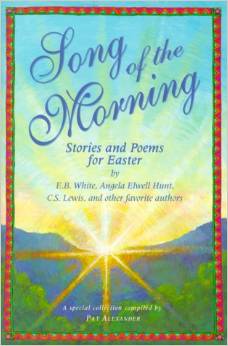
Book Review: Songs of the Morning: Stories and Poems for Easter

Song of the MonringSongs of the Morning: Stories and Poems for Easter was compiled by Pat Alexander and includes excerpts from the writings of C. S. Lewis, E. B. White, Dickens and others, some (mostly poems) written by children. I had bought it ages ago from a clearance section, put it on my shelf, noticed it it off and on through the years, and kept forgetting about it at Easter time. Finally this year I remembered to pull it out in the weeks preceding Easter. I like to read something devotional pertaining to Easter during that time, and while this wasn’t that exactly, it was both pleasant and beneficial.

I don’t think I realized, or I had forgotten, that it was geared primarily to children, probably the same age as those who would be able to read the Narnia series. But adults can gain from it, too.

I like that it couches the Easter story within historical context. The first section is “How It All Began” and begins with a short excerpt from a children’s Bible about God creating the world and sin entering in (Pat Alexander also wrote The Lion’s Children’s Bible, which I had not heard of before this, so I don’t know how well it expresses Biblical truth, but the excerpts I read here were fine). Then there are Narnia excerpts about the founding of Narnia and the White Witch and a couple of other sources to further illustrate those truths.

Other sections follow a similar pattern and focus on the birth of Christ, the triumphal entry on Palm Sunday, the crucifixion, and the resurrection. There’s also a section of “The Greatest Love,” with several historical and story illustrations of sacrificial love (like Sydney Carton’s in A Tale of Two Cities and a story about a boy’s dog risking its life to save the boy’s), one called “It’s All Right,” dealing with how new life in Christ should affect our lives in practical terms, like forgiveness of others, and a final one called “A New Beginning.”

The stories come from a variety of countries. Some are old, some are new. Some are from adults’ work, some from children’s books. Some are fun, some are serious. Pat did a fine job putting all these sources together. It doesn’t look like the book is in print any more, but there are copies that can be purchased online, or perhaps you can keep an eye out for it at library sales and such.

(This review will also be linked to Semicolon‘s Saturday Review of Books.)

Laudable Linkage

Here are some noteworthy reads from the last couple of weeks:

Shine Like Stars: Give and Rejoice {Philippians 2:17-18}. What it means for our lives to be poured like like a drink offering. Hit me right where and when I needed it.

10 Things We Don’t Want Our Kids to Learn From Church.

What these ladies did to turn a friend’s day around, and what they received in return. Loved this!

Why Can’t Christians Intelligently Discuss Current Events. “I suspect that by yelling so loudly about nearly everything, we’re obscuring the big thing (Matt. 12:36).”

Responding to the Increasingly Short Shelf-Life of Worship songs, HT to Challies. Songleaders/music pastors/worship leaders have an abundance of songs to choose from, and being able to project the words for all to see enables us to sing more than just what’s in the hymnbook. That’s good in many ways but complicates things in other ways. Though this was written to song leaders and such, it helped me to see what  big job it is to choose songs from the multitude we have available. I especially appreciated his caveat that some songs are for just a season. It used to bother me that we heard some songs often for a while and then not at all – kind of like a current “hit” – but then I realized that even the older hymn-writers wrote many songs that we know nothing about now, so that must have happened then, too.

This is a  neat overview of the Bible for kids, showing how it all points to Christ:

https://vimeo.com/123430346

Have a good weekend!

Laudable Linkage and a Jan Karon Video

I didn’t do one of these last week because I only had two or three – and now this week I have several. That’s how it goes sometimes. But here is some noteworthy reading found in the last couple of weeks:

Moms Need Theology Too. Excellent. Not just for moms.

Adding to Our Faith? Good study of what 2 Peter 1:5 means when it talks about things we need to add to our faith.

5 Things People Blame the Church For – But Shouldn’t.

A Good [Wo]man is Easy to Find. Excellent piece about finding a mentor.

From Lesbianism to Complementarianism – one woman’s testimony.

Dear Gay Community: Your Kids Are Hurting. From the daughter of a gay couple.

An 11-Year-Old Boy’s Open Letter to Sports Illustrated.

Nancy Leigh DeMoss’s Advice to Young Writers and Speakers.

Solid Food for Little Ones. A list of books for young children that teach about God. Keeping in mind for future reference when my little grandson gets older.

Remember Card Catalogs? As a former librarian and avid reader, I loved this piece about people who take the old cards from library card catalogs and illustrate them.

I thought this was really cool. With a nerdy family who loves the Marvel universe films, Iron Man being one on them, I loved this video of Robert Downey, Jr. (aka Iron Man) delivering a bionic arm to a boy who has only a partially developed right arm.

And for Jan Karon fans, I saw on her Facebook page this announcement about her newest book coming out this fall!

I loved hearing her talk and watching her expressiveness! I also saw this post on her Facebook page saying that there might be a movie about Mitford and asking for suggestions about who should play which part. I hope if this comes to pass that they let her have creative control. I have mixed feelings – I love the books and would definitely see any film made from them, but I’m not sure I’d want any images other than the ones in my head. 🙂 But we’ll see.

Happy Saturday!

Book Review: Becoming More Than a Good Bible Study Girl

LysaA few years ago I served a very brief stint as a book reviewer for a particular publisher. I love to read and love to talk about books, so what could be better than being given books for FREE to review, right? But the publisher sent me six books at a time every month. They didn’t expect me to read and review all six every month, but still – I didn’t want reviewing for a publisher to take over my reading time, so I dropped out. One of the books I received for review during that time was Becoming More Than a Good Bible Study Girl by Lysa TerKeurst. I don’t think I had heard of Lysa before that time (since then I have read two of her other books), but this title caught my eye. I determined to read it “sometime,” and it got put in a box of unread books all awaiting the opportunity to see the light of day. I did get it out at one point and put it on a bookshelf – but still didn’t get to it. That’s one reason the TBR Challenge is good for me. At any rate, the copy I have is an advanced reader copy from 2009 (ahem…blush!), and on the back it says it is an “uncorrected proof,”  so it may be  a bit different in places from the version you can buy today. But the bulk of it should be the same.

When I first saw this book, I thought it was going to be about getting more from one’s Bible study. Though Lysa does discuss that in a couple of chapters, the overall purpose of the book is to move Bible study from our to-do list and just acquiring knowledge, to living out what God is teaching us, to enjoy a deeper connection with God.

Lysa says in the first chapter:

I want my life with Jesus to be fulfilling. I want my beliefs to work no matter what life throws at me. I want to be so certain of God’s presence that I never feel like I have to face anything in my own strength or rely on my own perspectives. My strength will weaken during hard times. My perspectives get skewed by my emotions.

I want total security no matter what happens. In other words, I want my relationship with Jesus to be enough to keep me sane and together and still fully devoted. Is this possible? True fulfillment no matter what?

Fulfillment means to be completely satisfied. How might our lives look if we were so filled with God’s truths we could let go of the pain of our past, not get tripped up by the troubles of today, or consumed by worries about tomorrow?…Just going through the motions [of prayer, Bible study, etc.] will not in and of themselves fill our souls. They must be done with the great expectation and heart cry for God to lead us into a deeper and more life-changing connection with Him (p. 25).

The rest of the book fleshes out that purpose, discussing being “good enough” (and how we aren’t except through Christ), not feeling like we measure up, our relationships, our thoughts, our ministries, when our “ugly comes out,” when we’re hurt or offended by God.

A few more quotes I noted:

“Why doesn’t Jesus work for me?” is never the right question. Instead, when circumstances shift and we feel like we fall short, we should ask, “How can I see Jesus even in this?” (p. 41).

Don’t we get into God’s Word so it can get into us? So that it can interrupt us, change us, satisfy us? How sad to simply settle for learning facts about the Bible when it was meant for so much more (p. 74).

Just because you…achieve what you always thought would make you feel special does not fix that deep-down internal insecurity. External achievement never equals internal acceptance (pp. 86-87).

Too many of us live with an uncontrolled thought life. It is possible to learn to identify destructive thoughts and make wiser choices. Instead of letting those thoughts rumble freely about in my mind, I make the choice to harness them and direct them toward truth (pp. 99-100).

Grace doesn’t give me a free pass to act out how I feel, with no regard to His commands. Rather, His grace gives me consolation in the moment, with a challenge to learn from this situation and become more mature in the future (p. 123).

Satan would love for us to pick ourselves apart, to obsess on the negative. When we do, we become hyper self-focused and take our eyes off of Jesus and the mission set before us. Many of us spend years trying to hide or fix what we perceive as personal flaws. Jesus would love for us to see ourselves as a package deal of unique qualities that He – the author and perfecter of our faith – saw as necessary for the life He’s calling us to live (p. 164). (She’s not talking here about not confessing sin: she discusses that in other places, but here she is referring to accepting how God made us).

Ask Jesus to help you fully understand the joys of obedience. Also, ask Him how you can be a woman fully committed to obedience without slipping into a legalistic approach to life. We must always remember our goal is pursuing revelations of Him. Our focus can’t be just following rules but following Jesus Himself (pp. 174-175).

I realized that most times it’s not the big things along my spiritual journey that tempt me to get off track. It’s a culmination of small daily aggravations I know God could fix but doesn’t. But what if instead of seeing these aggravations as inconveniences, I saw them as reminders to draw near to God? (p. 197).

How I long never to diminish God by loving lesser things. Rather, I want to make much of God by diminishing lesser things. May I make less of me, less of this world, less of the temporary…so that I may be a vessel more full of God, more full of eternal perspectives, more full of His everlasting! (p. 200).

Having a set of goals is a good thing for many people. But when a goal takes your focus off God and His daily intentions for you, it can cause trouble. Being driven by my plans can shift the focus of my heart from following God and being open to His unfolding invitations, to following only that which leads me closer to my desires. For me, I started falling into a trap of making plans each day around what I wanted to see happen. Anything that wasn’t part of my plan became a distraction and an unwelcome interruption (p. 211).

I have many more marked but should probably stop there. I particularly liked the chapters “Beyond Sunday Morning,” where she talks about looking at a verse phrase by phrase to discern its meaning, and “Unlikely Lessons From a Pineapple,” a great chapter talking about drawing lessons from the lives of people in the Bible, even familiar ones that we might feel we’ve known all there is to know since we were children.

I was especially blessed by a chapter where she talks about waiting for God’s timing in our calling and serving Him in the mundane, everyday tasks He has placed before us until then, realizing that they are our ministry unto Him, not a hindrance or interruption of our ministry. I came to that chapter the day after posting The Back Burner, which is along a similar vein, and was touched at God’s timing and confirmation of the truths He had been teaching me.

I appreciated Lysa’s personal experiences, transparency, and sense of humor throughout the book, but most of all I appreciated her high view of Scripture that was not an end in itself but a means of knowing and experiencing God.

There were just 2-3 minor places where I disagreed with her interpretation or application just a smidgen, but they’re not big enough to go into. I would just mention one place where, in communion with God, things were flooding her mind that she felt were from the Lord, she says, “Bits and pieces of Scripture were woven throughout, and it made me smile. It confirmed that this was, in fact, God speaking” (p. 197-198). Satan uses Scripture, too (Matthew 4), and just because thoughts come to our minds that contain Scripture doesn’t mean they are automatically from the Lord. A lot of cults have been founded on bits of Scripture wrongly interpreted and taken out of context. I’m not trying to diminish the experience she was telling about, and I feel sure she’d agree with what I am saying, but just the way it was phrased could, I thought, be confusing to some readers who might think that if a thought contained Scripture, that meant it was confirmation from the Lord.

Overall I thought this was a wonderful book that fulfilled its purpose to encourage women to go beyond checking the boxes in their Christian lives to deepening their relationship with God.


(This will also be linked to Semicolon‘s Saturday Review of Books.)

Laudable Linkage

Its been another good week with some thought-provoking posts to ponder:

Open Roof Hospitality. Very convicting to me. If I had been the lady of the house whose roof was being torn up so people could bring their paralytic friend to Jesus, my first emotion would not have been gratitude and joy, I’m sure.

Pressing In To the Ungrateful.

Is It Possible For Christians to Idolize the Bible?

Seven Questions to Ask Before Having a Difficult Conversation.

The 3-Second Pause That Can Save a Morning and Spare Some Pain.

Six Observations About Speaking to Pastors Right Before They Preach. Although these are especially true for pastors for obvious reasons, many of them hold true for anyone. Once when my husband was the head usher in a very tightly packed church and was trying to find seats for people right before the service, someone who was also a neighbor chose that moment to tell him that he thought the lawn mower that we often let him borrow had been stolen. Hard to concentrate on anything in the service after that. 🙂

The Do Not Depart site has been focusing this month on what we can learn from the lives of Godly Women: Inspiring Stories of Faithful Daughters, mostly from the past. You know how much I love biographies, so I have enjoyed this series. So far they’ve shared from the lives of Corrie ten Boom, Susanna Wesley, Elisabeth Elliot, Helen Roseveare, Harriet Tubman, and Monica of Hippo (Augustine’s mother).

I saw this on Facebook and thought it rang very true. 🙂

Sports

The bad weather that was forecast for last night did not happen, yay! Have a wonderful Saturday!

Laudable Linkage

It’s been a while since I’ve been able to share interesting links with you. Here are some I’ve come across the last couple of weeks.

Often I write about Bible reading plans at the beginning of the year. I didn’t this year, but have found some good ones at What Is Your Bible Reading Plan for 2015? and A 2-Year Bible Reading Plan.

Similarly, you can find a plethora of posts about New Year’s Resolutions and/or goals. A couple of the best I’ve seen are Ten Truths That Will Change Your Life in 2015 and 5 Ways You Need to Be Honest With Yourself.

This is an older one, and I’ve linked to it before, but I just rediscovered my friend Susan’s post about making plans or goals for the New Year in a number of areas: spiritual, physical, marriage, children, homemaking, and creativity, along which some suggested questions and reasons planning aids us.

A Christmas Present from the Mainstream Media: Newsweek Takes a Desperate Swipe at the Integrity of the Bible (Part 1) and Predictable Christmas Fare: Newsweek’s Tirade against the Bible are a couple recommended by Tim Challies in response to Newsweek’s article slamming the Bible and those who believe it. In all honesty, I have not read all of the original article or these responses, but I’ve read parts of them and saved the links for when I had more time to concentrate on them.

How to Change Your Mind.

The Unbreakable Laura Hillenbrand. Very interesting story about the author of Unbroken and how she deals with chronic fatigue syndrome.

Hope you have a great first weekend of 2015!

Laudable Linkage

It’s been about a month since I shared interesting reading I’ve found around the Web. Here is what especially caught my eye lately:

Stop Waiting For a Zap. This was one that hit me right between the eyes.

How Salvation Brings Freedom. Excellent.

No Voice Like Yours.

The Tragic Prevalence of Sexual Assault. Best ways to handle the accusation for both parties.

Is It Biblical to Teach Our Kids About Sex?

A Response to “No, You’re Not Running Late. You Are Rude and Inconsiderate.” Good balance. People who are chronically late do need to realize the impact their lateness has on others and work on some time management skills, but we need to be careful not to sit in judgement whenever someone is late, for reasons the author delineates.

Are You Doing Too Much? Something we all need to evaluate periodically, especially if we’re feeling stressed or drained.

The Trail of Bible Documents. A good and clear explanation of them the different manuscripts Bible translators use.

Are You Ignoring Your Mommy Radar?

Finally, this is one of the most beautiful renditions of “Silent Night” I have ever heard. I wish they had done more than the first stanza, but the harmonies and expression are just beautiful.

Happy Saturday!


Book Review: Walking in the Spirit

Walking in the SpiritI’ve enjoyed listening to the music of the Steve Pettit Evangelistic Team for years, and have had the privilege of hearing Steve preach in my church a number of times. So when I saw he had written a book titled Walking in the Spirit: A Study Through Galatians 5, I wanted to read it not only because I felt I could trust it (as much as one can trust a human author), but also because this is a subject and a passage I have thought about and wrestled with for years.

Most Christians are familiar with the last few verses in Galatians 5 that talk about the works of the flesh and the fruit of the Spirit. But the context of the chapter, indeed of the whole book of Galatians, has to do with Christian liberty. Some were telling the Galatian believers that they had to keep the OT laws to be a Christian, which is legalism. But some who had gotten hold of the truth that they were no longer under that law went too far the other way: “For, brethren, ye have been called unto liberty; only use not liberty for an occasion to the flesh, but by love serve one another. For all the law is fulfilled in one word, even in this; Thou shalt love thy neighbour as thyself” (verses 13-14). Pettit says true Christian liberty is walking in the Spirit, as opposed to license on one hand (being a slave to one’s flesh) and legalism on the other (being a slave to the law).

Pettit takes us step by step through Galatians 5 and discusses what legalism and Christian liberty are, what it means to walk in the Spirit, the battle between our flesh and the Holy Spirit, the difference between what the Bible calls our “old man” which was crucified when we believed on Christ and the “flesh” that we still battle, and the evidences of the flesh and fruit of the Spirit. He discusses what our relationship to the law is and what use it is (conviction of sin, for one: “I would not have come to know sin except through the Law; for I would not have known about coveting if the Law had not said, “You shall not covet” [Romans 7:7 NASB]. But the law can only tell us it is sin. It can’t fix us or change us. It’s the diagnosis, not the cure).

It’s hard to summarize a book like this beyond that, so I’ll just share a few quotes that stood out to me:

“Seeking to add to the work of Jesus actually takes away from it” (p. 6).

“The flesh seeks to twist a true understanding of freedom into an opportunity to gratify the flesh’s desires. But Christian liberty is freedom from sin, not freedom to sin. When Christians begin to focus on their own personal rights and freedom from restraints, liberty is abused” (p. 14).

“Walking in the Spirit demands a constant pursuit of and response to God’s Spirit. To be complacent and indifferent about one’s walk is to put oneself in a place of spiritual peril. No one is impervious to the allurements of the flesh” (p. 26).

“We are not so strong that we do not need to be warned, and we are not so weak that we cannot be free. We experience this struggle until the day we die” (p. 15).

The Christian life is not about trying harder to obey the law; it is realizing that we are enabled to obey God by the power of the indwelling Spirit” (p. 47).

“The fruits of the Spirit are of such a nature that, when they are present, the law is no longer necessary” (p. 48).

“Sanctification is the process of submitting to the Holy Spirit as He works to produce this fruit in your life, so that your daily life matches up with who you really are now in Christ” (p. 81).

The book is written as a Bible study, with discussion questions and blanks to fill in answers. It would work well in a group study: in fact, some of the questions would have been more profitable with a group contributing their insights.

The book did clear up some things for me or reminded me of things that I know but need to go over again from time to time. There were a couple of places I wish he had gone into a little more detail. But overall I found this book to be not only thoroughly Biblical but also intensely practical.

(This will also be linked to Semicolon‘s Saturday Review of Books.)

 

Laudable Linkage

Here are some noteworthy reads from the last week or so:

“Make No Provision” For Your Yelling. The principles are good for anything you’re trying to overcome.

Which Promises Are For Me? There are many reasons it is not good to pick a promise out of context from Scripture and apply it to a situation it wasn’t meant for. Excellent thoughts from Jen about understanding and applying promises in the Word.

Handsome Lives at My House. Mine, too! 🙂

Imaginations Should Be Exercised.

7 Suggestions For Parenting Adult Children.

And, finally, I lived in Houston for 6 years, and when a fellow former Houstonian posted this on Facebook, it cracked me up. Houston isn’t really that bad when it snows.

Hope you’re having a good Saturday!

Book Review: Why We Are Not Emergent: By Two Guys Who Should Be

EmergentThose of you who read here regularly and have seen Why We Are Not Emergent: By Two Guys Who Should Be by Kevin DeYoung and Ted Kluck on about five different Nightstand posts are probably thinking, “Yes! She finally finished it!” When I was trying to read a bit here and there in 10-15 minutes offhand segments, it wasn’t working, but then I committed to trying to read a chapter, or at least a section, as many mornings as I could right after my devotional time. Once I really got into it, I loved it.

I would say this is a highly valuable book to read even if you don’t know (or aren’t interested in) what the emergent movement is all about, because there are tendrils of it popping up all over the place, and it is good to have Biblical thinking about these issues.

This book caught my eye because some years ago, when I first heard anything about the Emergent or Emerging church, I was active on a Christian message forum online and asked if someone could tell me in 2 or 3 sentences what it was all about. No one could, or at least, no one did. All I got were book recommendations. I wasn’t interested enough to read a whole book about it at the time. Fairly recently I saw this mentioned somewhere with the comment that it was a fair treatment, so when it came through on a Kindle sale, I got it. But then it sat there until the TBR challenge motivated me to add it to my books to be read this year, and then until just recently.

I don’t know much about either author except that DeYoung is a name in the “young, restless, Reformed” crowd. None of those adjectives fits me, but I do enjoy reading some of those folks and can work around those areas where I disagree with a Reformed view of things.

The Emergent movement or church is kind of hard to pin down, because it is not a denomination and there is no national spokesperson. But DeYoung and Gluck have done extensive research into the books and messages of those who identify themselves as  emergent and addressed some common themes (there is a distinction between those who would call themselves “emergent” and “emerging,” but for the purposes of this book the terms are used interchangeably). They discuss, from emergent writings, the good points, the valid concerns the emerging church has, and the problems they see with some of the emergent viewpoints and practices and why.

I have so many areas highlighted that it is going to be hard to share just a few things.

The authors begin by acknowledging that defining the emergent church or movement is like trying to “nail Jello to a wall,” but after reading some 5,000 pages of writing on the topic, they’ve identified some basic trends. They’re quick to acknowledge that not everyone who calls themselves  emergent will agree on every point and that they even share many of the same concerns as those in the movement, but while they “affirm a number of the emergent diagnoses, it’s their prescribed remedies that trouble us the most.” The emergent church is basically what postmodernism looks like applied to church, valuing questions more than answers, mystery more than authority, Christian living more than doctrine.

Here are some quotes that stood out to me:

For emerging Christians, the journey of the Christian life is less about our pilgrimage through this fallen world that is not our home, and more about the wild, uncensored adventure of mystery and paradox. We are not tour guides who know where we are going and stick to the course. We are more like travelers…the destination is a secondary matter, as is any concern about being on the right path…The journey is more wandering than directional, more action than belief, more ambiguous than defined. To explain and define the journey of faith would be to cheapen it.

[To the emergent] Christian life requires less doctrinal reflection and more personal introspection.

The emergent view of journey…undermines the knowability of God…emergent leaders are allowing the immensity of God to swallow up His knowability.

 Mystery as an expression of our finitude is one thing. Mystery as a way of jettisoning responsibility for our beliefs is another thing. Mystery as a radical unknowing of God and His revealed truth is not Christian, and it will not sustain the church.

One emergent leader writes, “Drop any affair you may have with certainty, proof, argument – and replace it with dialogue, conversation, intrigue, and search.”

There is a place for questions. There is a time for conversations. But there is also the possibility of certainty, not because we have dissected God…but because God has spoken to us clearly and intelligibly and has given us ears to hear His voice.

It is not a mark of humility when we refuse to speak about God and His will except in the most ambiguous terms. It is an assault on the Holy Spirit and disbelief in God’s ability to communicate rational, clear statements about Himself in human language.

The mantra “God is too big to understand and the truth too mysterious to know with certainty” is not just a confused humility. It has dangerous pastoral implications…Uncertainty in the light of our human limitations is a virtue. Uncertainty in light of God’s Word is not.

[Emergent leaders] confess to having “mixed feelings” about the Bible…They don’t want to use the traditional terms – authority, infallibility, inerrancy, revelation, objective, absolute, literal…They would rather use phrases like “deep love of” and “respect for.”…[To them] the Bible is not the voice of God from heaven and certainly not the foundation (foundationalism being a whipping boy among emerging Christians of a philosophical bent). Rather, the Bible “spurs us on to new ways of imagining and learning.”

[Emergents] pit information versus transformation, believing versus belonging, and propositions about Christ versus the person of Christ. The emerging church will be a helpful corrective against real, and sometimes perceived, abuses in evangelicalism when they discover the genius of the “and” and stop forcing us to accept half-truths….Our fullness of joy is dependent on believing, embracing, and treasuring the sentences that Jesus spoke. The sentences do not save us. The life, death, and resurrection of Jesus save us. But without truth-corresponding propositions like “this is eternal life, that they may know you the only true God, and Jesus Christ whom you have sent” (John 17:3) and “I have manifested your name to the people” (v. 6) and “I am praying for them” (v. 9) and “all mine are yours, and yours are mine, and I am glorified in them” (v. 10) – without these precious theological statements communicated and understood by verbal utterances, the joy of Jesus will not be fulfilled in us.

It simply isn’t true that orthodoxy as a right belief is nothing but a perverted Greek idea. John wrote his gospel..that people…might believe that Jesus was the Christ and by believing have life in His name (John 20:31)…There are certain truths that must be affirmed in order to be a Christian…There is no question that Paul believed in orthodoxy. “Follow the pattern of the sound words that you have heard from me, in the faith and love that are in Christ Jesus,” he told Timothy (II Timothy 1:13).

If the good news is an invitation to a Jesus way of life and not information about somebody who accomplished something on my behalf, I’m sunk. This is law and no gospel.

Yes, we do see through a glass darkly; we do not fully understand God…God is greater than we can conceive – but what about the 1,189 chapters in the Bible? Don’t they tell us lots of things about God that we are supposed to do more with than doubt and not understand? Aren’t the Scriptures written so that we might believe and be sure of what we hope for and certain of what we do not see and even proclaim this faith to others?

To the Emergent, Christianity is a story from which ethics are gleaned, rather than a life-saving proposition.

Christ was wounded for our transgressions and crushed for our iniquities. That is the heartbeat of the gospel. It is not the heartbeat of the emergent gospel.  Rather, the cross is a moral example.

Forgive me for not putting notations of where those quotes were: on the Kindle app is just says “Location 250” or whatever, and I started out putting that, but it was just too clunky.

One of the best parts of the book is the epilogue, where the writer sums up by discussing some of the seven churches in Revelation 2-3 and their application to us. The church at Ephesus was praised for being doctrinally correct and intolerant of those who brought false doctrine, but they were unloving. The churches at Pergamum and Thyatira were loving but tolerated false teaching.  “Their love was blindly affirming. The big problem at Thyatira was tolerance. They tolerated false teaching and immoral behavior, two things He who has eyes as piercing as fire and feet as pure as burnished bronze is fiercely intolerant of (Rev. 2:20). Jesus says, ‘You’re loving, which is great, but your tolerance is not love. It’s faithlessness.'” Each church was praised for its virtues but rebuked for its weaknesses. The need is not be be doctrinally correct or loving, but doctrinally correct and loving. We have to be careful in addressing the faults of one side or the other that we don’t magnify those and minimize the virtues and swing the pendulum too far the other way.

There is so much more I wish I could share. I’ll close with one last quote:

As a Christian man, specifically as a husband and father, I need truth. I need to worship a God who makes demands on my character, with consequences. I need to know that Christianity is about more than me just “reaching my untapped potential” or “finding the God inside me.” I need to know I worship a Christ who died, bodily, and rose from the dead. Literally. I need to know that decisions can (and should) be made on the basis of Scripture and not just experience. These are things that give me peace in a world of maybe.

An excellent review of this book is here.

(This will also be linked to Semicolon‘s Saturday Review of Books.)