31 Days of Inspirational Biography: William Tyndale

When William Tyndale began studying for the ministry at Oxford, he was horrified to discover that his official courses did not include study of the Scripture. He began to teach and discuss Scripture in private groups. He was fluent in seven languages besides English, and while studying Erasmus’ version of the Greek New testament he came to see the need and blessing of being justified by faith alone, and he realized many errors were perpetuated by his church.

Tyndale exhorted that it was in the language of Israel that the Psalms were sung in the temple of Jehovah; “and shall not the gospel speak the language of England among us?… Ought the church to have less light at noonday than at dawn?… Christians must read the New Testament in their mother tongue.” Tyndale determined to give the English people a translation of the Bible that even a plowboy could understand.

In 1523 he went to London to seek permission from the bishop to translate the Bible into English. He was denied. He worked on the translation of the New Testament on his own with help from Humphrey Monmouth until he went secretly to Germany and finally finished it in 1525 with the assistance of William Roy. It was “smuggled back into England. It was the first translation of the [New Testament] from the original Greek into English –indeed, it was the first translation of a Greek book into English. “ The translations were condemned by the bishop, who had copies burned in public, and Cardinal Wolsey declared Tyndale a heretic. Tyndale went into hiding and began translating the Old Testament and other papers and treatises. Due to the secrecy and danger of his work, much of his exact whereabouts and the identities of those who helped him are unknown.

At one point the authorities bought as many of his translations as possible in order to destroy them, but the money actually helped Tyndale by providing the means to work on new and better translations.

The King [Henry VIII], Wolsey, and [Thomas] More all had agents on the Continent hoping to find and arrest Tyndale. In 1534 Tyndale was betrayed by a false friend near Brussels, arrested by imperial forces, and thrown into prison. He was accused of maintaining that faith alone justifies. He was found guilty and in [October] 1536 was executed.

His last words at the stake were, “Lord! Open the King of England’s eyes.”  That prayer was answered three years later with the publication of Henry VIII’s “Great Bible.”

Much of the King James Version and other translations are based on Tyndale’s work.

We owe a great debt of gratitude to this man for having the burden and vision to give English-speaking people an understandable translation of the Bible, for doing right in the face of danger to himself, for the many hours of work involved, and for “loving not his life unto the death” (Revelation 12:11).

_________________________________________________________

Sources:

 http://en.wikipedia.org/wiki/William_Tyndale

 http://www.greatsite.com/timeline-english-bible-history/william-tyndale.html

 http://chi.gospelcom.net/GLIMPSEF/Glimpses/glmps059.shtml (Direct quotes are from this source.)


Quotes from William Tyndale:

I had perceived by experience, how that it was impossible to stablish the lay people in any truth, except the scripture were plainly laid before their eyes in their mother tongue, that they might see the process, order, and meaning of the text.

I defie the Pope and all his lawes. If God spare my life, ere many yeares I wyl cause a boy that driveth the plough to know more of the Scripture, than he doust.

I call God to record against the day we shall appear before our Lord Jesus, that I never altered one syllable of God’s Word against my conscience, nor would do this day, if all that is in earth, whether it be honor, pleasure, or riches, might be given me.

Christ is with us until the world’s end. Let his little flock be bold therefore. For if God be on our side, what matter maketh it who be against us…?

 The preaching of God’s word is hateful and contrary unto them. Why? For it is impossible to preach Christ, except thou preach against antichrist; that is to say, them which with their false doctrine and violence of sword enforce to quench the true doctrine of Christ.

Where no promise of God is, there can be no faith, nor justifying, nor forgiveness of sins: for it is more than madness to look for any thing of God, save that he hath promised. How far he hath promised, so far is he bound to them that believe; and further not. To have a faith, therefore, or a trust in any thing, where God hath not promised, is plain idolatry, and a worshipping of thine own imagination instead of God.

~ From http://en.wikiquote.org/wiki/William_Tyndale

photo 3(2)

For the 31 Days writing challenge, I am sharing 31 Days of Inspirational Biography. You can find others in the series here.


Laudable Linkage

I wasn’t sure whether to post my usual collection of interesting links while the 31 Days of Inspirational Biography was going on: in my experience, the more posts I publish in a week, the less they are read, especially if I post more than one a day. But if I save these all up until after October is over, I’ll have a massive list. 🙂 So I’ll go ahead and post them and hope that you’ll find something useful in them.

The Book of Books Is a Knowable Word.

Encouragement in the Word: Truth.

Bible Verses For When You Need Hope. I particularly liked the distinction “between hoping for something and hoping in Someone.”

Five Questions With a Former Muslim Who Converted to Christianity, an interview with Nabeel Qureshi, whose book I reviewed recently.

Lay Aside the Weight of Self-indulgence. Quote: “At the moment of indulging, it doesn’t feel like an enemy. It feels like a reward that makes us happy.” “…their beliefs finally changed. They went from believing one promise of happiness to believing another. That belief fueled their behavioral change and they went from self-indulgence to self-denial — but a denial for the sake of a better happiness.”

Lay Aside the Weight of Irritability. I forgot I had this in my files when I wrote about being easily irrtate-able – if I had remembered it, I probably would have just referred you to this. I need to refer to it often.

7 Conditions for Confrontation. I tend to avoid confrontation like the plague, but there is a time and place and even a Scriptural demand for it, and these are some principles to remember.

On Piles of Sand and Eating Babies on differences in cultures and judgmentalism, HT to Challies.

It’s Still a Bad Idea to Vent.

When Someone Reaches Out, Reach Back. Written particularly for those new to a church.

When Your Child’s Personality Annoys You. Quote: “Before you work to uproot them, consider whether behind that annoying trait is a strength waiting to be trained up. So often, the quality that manifests as a child’s greatest weakness holds the potential to be his greatest strength. ” Excellent post.

Boyhood, the Masculine Spirit, and the Formative Power of Work, HT to The Story Warren. Quote: We should be connecting the dots for young men between their lofty views of manhood and the small things they encounter everyday.”

Blogs Gone Cold and 7 Real-Life Reasons Why Women’s Blogs Go Cold. Some good and thoughtful reasons why women’s blogs seem less active.

Help for Aging Parents and Their Caregivers. I know these folks personally.

How to Make Driving Time Productive. Love this. Being in a car is one of my least favorite ways to pass time.

Save My Bleeding Quilt! How to Properly remove excess dye and a quilt and how to prewash fabrics to prevent the problem. Though I don’t quilt, I thought this would be useful for bleeding fabrics generally.

Happy Saturday!

Book Review: Seeking Allah, Finding Jesus

SeekingIn Seeking Allah, Finding Jesus: A Devout Muslim Encounters Christianity Nabeel Qureshi first gives a window into a loving and devout Muslim home, with all its practices, disciplines, and teachings, as well as a peek into the perspective of growing up Muslim in a non-Muslim culture.  Wanting to be a faithful representative of Islam, having been taught critical thinking in school and having a mind geared for it, he often turned the arguments of some of his Christian classmates on their heads, bringing up aspects they had not thought about before and were not ready to defend.

In college God brought to him “an intelligent, uncompromising, Non-Muslim friend who would be willing to challenge” him, someone who was “bold and stubborn enough” to deal with him but also someone he could trust “enough to dialogue…about the things that mattered to [him] the most.” Nabeel and his friend, David, were both on the forensics team and knew how to get to the heart of an argument and draw out and refute key points. For the most part they did this with each other’s worldviews good-naturedly, but when a given topic became too heated, they’d table it for a while. Muslims particularly have trouble with the reliability of the Bible, the deity of Christ, the Trinity, and the connection between Christ’s death on the cross and how it atoned for others’ sins. For three years Nabeel studied the Bible and its claims and others’ claims about it, fully confident that he’d be able to disprove those claims, and then to study the history of Mohamed and the claims of the Quran, fully confident that Islam would be justified. Though he was obviously biased toward the Quran, he really wanted to know the truth. He discovered the Bible’s claims were justified and Islam’s to be on shaky ground.

For some time he resisted acting on this knowledge. Being a Muslim was a matter of identity as well as religion: his whole life, everything he had always believed, his relationship with his family and community, everything would be turned upside down if he became a Christian. Yet he could not continue on, knowing what he now knew. In one of the most beautiful and touching passages in the book, he was seeking time to mourn before making the decision he knew he had to, and he opened the Bible for guidance this time, not simply to look for information to refute. He came to Matthew 5:4, 6:

Blessed are they that mourn: for they shall be comforted.

 Blessed are they which do hunger and thirst after righteousness: for they shall be filled.

Nabeel writes further:

There are costs Muslims must calculate when considering the gospel: losing the relationships they have built in this life, potentially losing this life, and if they are wrong, losing their afterlife. It is no understatement to say that Muslims often risk everything to embrace the cross.

But then again, it is the cross. There is a reason Jesus said, “Whoever wants to be my disciple must deny themselves and take up their cross and follow me. For whoever wants to save their life will lose it, but whoever loses their life for me and for the gospel will save it” (Mark 8:34-35).

Would it be worth it to pick up my cross and be crucified next to Jesus? If He is not God, then, no. Lose everything I love to worship a false God? A million times over, no!

But if He is God, then yes. Being forever bonded to my Lord by suffering alongside Him? A million times over, yes!

All suffering is worth it to follow Jesus. He is that amazing.

I feel I must comment on one aspect of the story that I questioned at first and I am sure other readers might as well: When Nabeel mentioned early on being “called to Jesus through visions and dreams,” I admit I inwardly winced and wondered what kind of story I’d be reading. For reasons too long to go into here, I am of those who believe that once God gave us His completed Word in writing, then dreams, visions, tongues, and the like fell away as unneeded.  The few modern instances I have ever heard or read of that seemed most in line with Bible truth were in cultures which didn’t have the Bible, often didn’t have a written language at all. Another problem with relying on dreams Nabeel discovered himself: one questions what it really means (his Muslim mother and Christian friend had completely opposite interpretations for what Nabeel’s dreams meant), wonders how much was due to wishful thinking, asks “Could I really hinge my life and eternal destiny on a dream?” etc. If that’s all he had to go on to become a believer, I would question what he was really trusting, but these dreams came after years of intense searching and study. In an appendix by Josh McDowell on this topic, he states, “Dreams and visions do not convert people; the gospel does,” but he explains, “In many Muslim cultures, dreams and visions play a strong role in people’s lives. Muslims rarely have access to the scriptures or interactions with Christian missionaries.” As in Nabeel’s case, “the dreams lead them to the scriptures and to believers who can share Jesus with them. It is the gospel through the Holy Spirit that converts people.”

One of many passages that stood out to me was in the chapter “Muslims in the West,” which described how Muslims view the West and Christians and, because they think both have corrupting influences and Westerners they are against Islam, they tend to keep to themselves. “On the rare occasion that someone does invite a Muslim to his or her home, differences in culture and hospitality may make the Muslim feel uncomfortable, and the host must be willing to ask, learn, and adapt to overcome this. There are simply too many  barriers for Muslim immigrants to understand Christians and the West by sheer circumstance. Only the exceptional blend of love, humility, hospitality, and persistence can overcome these barriers, and not enough people make the effort.”

I didn’t agree with everything Nabeel’s Christian friend said in the section about the Bible, in regard to believing some sections in the Bible were added later and not part of the original canon, but I do acknowledge that some do believe that.

There are multiple good aspects of this book: the window into another culture and mindset and the understanding of the difficulties a Muslim would have in coming to Christianity; the example of David and other friends who shared truth kindly and politely rather than belligerently or condescendingly, who genuinely cared about Nabeel as a friend rather than a “project”; the  wealth of information Nabeel found and shared from his studies which give a valuable apologetic (supplemented by several appendices>); and the touching yet agonizing conversion of a soul truly hungering and thirsting after the one true God.

This will also be linked to Semicolon‘s Saturday Review of Books.)

Laudable Linkage

Here are some links I found interesting in the last couple of weeks:

This quote is resonating with me from an article about preaching, though I am not a preacher: “That little voice inside your head saying ‘That’s just not who I am’ is not your friend. Sanctification is the process by which the Holy Spirit overcomes ‘who I am’ and shapes me into who He wants me to be.” The article is 5 Reasons Why Some Preachers Get Better and Others Don’t, HT to Challies.

15 Beautiful Benefits of the Word of God.

Five Specific Prayers for the Unsaved People in Your Life.

3 reasons you should not try to bind Satan.

Letting Parenting Struggles Make You Strong.

Ten Things My Parents Did Right.

Home Decor and Trendiness: Who Makes the Rules You Live By? Yes! I kept thinking that all through this post.

I am Ryland – The Story of a Male-Identifying Little Girl Who Didn’t Transition. In light of a recent case where parents started treating their daughter like a boy when she liked boy things, this blogger tells of growing up as what we used to call a tomboy or “late bloomer” who nevertheless did not identify herself as transgender. With the current climate, we’re going to run into these kinds of situations, and she makes some good points.

I’m not linking to 6 Reflections on Sleepovers so much for anything to do with sleepovers: it’s a response to a post on why this family doesn’t allow sleepovers, but I’m linking to it because the principles he discusses when Christians have different views cover many things. It is good to keep these things in mind when disagreeing on secondary issues.

Paralyzed? Or Medically Fragile?

Facts about the Hobby Lobby ruling that even some Christian seem to be missing.

Skip to the Loo, My Darling, HT to Lou Ann. An interesting look at bathroom facilities in other countries by missionary women. This reinforces the thought I’ve had that this aspect would be one of the things I’d have a hard time with if I ever traveled out of the country!

And lastly, I forget where I saw this, but it had me chuckling out loud. As my sister-in-law said when she saw it, “Baby: 1; Dad: 0.” (As an aside, for safety concerns it is probably not wise for an adult to climb into a baby’s crib.)

Happy Saturday!


Book Review: Women of the Word

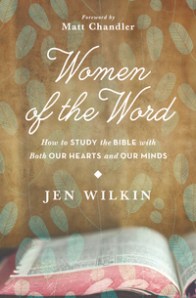
WOTWI have to confess that my first thought when I saw Women of the Word by Jen Wilkin mentioned favorably around the blogosphere was, “Hey! She took my title!” That’s not a very spiritual reaction, I know. 🙂 I’ve been blessed to have been able to compile a ladies’ newsletter for our current church for a couple of years and for a former church for about 9 years, and one column I’ve had in it  for a long time has gone by that same title, “Women of the Word.” It began after a discussion about devotions during one of our ladies’ meetings and the realization that no matter how long one has been a believer, there are always going to be struggles either maintaining a devotional time or making it what it ought to be. So I began the column to encourage ladies along that line and have begun to wonder lately if perhaps I might put them all together and see if they might possibly form a book.

My second thought, after reading a little bit about this book, was that I must get it. Everything I’d heard about it indicated that the author had the same passion as I do for getting women into the Word of God.

And the book definitely did not disappoint in any way.

Jen is not content to just get you into the Bible, however. She wants to equip women to dig for the true meaning of the Bible rather than using the Xanax approach (just seeking something to get through the day) or any number of other faulty approaches. She reminds us that God wants us to love Him not just with our hearts and souls, but also with our minds. She says that when she first began to read her Bible, she approached it with questions like, “Who am I?” and “What should I do?” Though the Bible did give her some insight for those questions, she eventually realized that “I held a subtle misunderstanding about the very nature of the Bible. I believed that the Bible was a book about me…I believed the purpose of the Bible was to help me” (p. 24). She learned that “We must read and study the Bible with our ears trained on hearing God’s declaration of Himself” (p. 26).

When I read that God is slow to anger, I realize that I am quick to anger. When I realize that God is just, I realize that I am unjust. Seeing who He is shows me who I am in a true light. A vision of God high and lifted up reveals to me my sin and increases my love for Him. Grief and love lead to genuine repentance, and I begin to be conformed to the image of the One I behold.

If I read the Bible looking for myself in the text before I look for God there, I may indeed learn that I should not be selfish. I may even try harder not to be selfish. But until I see my selfishness through the lens of the utter unselfishness of God, I have not properly understood its sinfulness (pp. 26-27).

“It’s possible to know Bible stories, yet miss the Bible story” (p. 11). In our quest for Biblical literacy, “we may develop habits of engaging the text that at best do nothing to increase literacy and at worst actually work against it” (p. 37). “We must be those who build on the rock-solid foundation of mind-engaging process, rather than on the shifting sands of ‘what this verse means to me’ subjectivity” (p. 87).

The author then shares ways to read the text within the context and to read it for comprehension, interpretation, and application. There is  an excellent chapter as well for teachers, one section of which makes an excellent case for women Bible teachers. She appears to believe, as I do, that women should teach women rather than men, but she gives some excellent reasons why women should teach other women.

I also appreciated how she dealt with an issue in the conclusion that I have seen some up in just the last couple of years. These days, when you try to encourage Bible reading and study or try to bring to bear what the Bible says on a conversation, you can sometimes be accused of “worshiping the Bible.” Jen answers:

I want to be conformed to the image of God. How can I become conformed to an image I never behold? I am not a Bible-worshiper, but I cannot truly be a God-worshiper without loving the Bible deeply and reverently. Otherwise, I worship an unknown God. A Bible-worshiper loves an object. A God-worshiper loves a person (p. 147).

In short, I love this book and highly recommend it. I do more than recommend it: I don’t often do this, but I encourage you to get it. I’m more than happy that the title I was considering using for a book has been attached to such a one as this.

I’ll close with one last quote:

We must make a study of our God: what He loves, what He hates, how He speaks and acts. We cannot imitate a God whose features and habits we have never learned. We must make a study of Him if we want to be like Him. We must seek His face…

We see Him for who He is, which is certainly a reward in itself, but it is a reward with the secondary benefit of being forever altered by the vision (p. 150).

(This will also be linked to Semicolon‘s Saturday Review of Books.)

Laudable Linkage

Here is my semi-weekly round-up of interesting reads – I hope you’ll find one or two of interest:

A Return to the Book. “The further I move from the written Word of God, the less confidence I can have that I’ve heard a word from God. ”

The Danger of Coasting. When we’re not living intentionally, we usually end up somewhere we didn’t mean to go.

Flip or Flop. People can say and do horrible things – like in an earlier post by this author where people commented, “Your poor husband – 6 kids and wife in a wheelchair” or tell her that her children will grow up to resent her disability. But in this post she discusses the good things people have said and done and the choice we can make in which to focus on.

5 Ways Moms Create Cranky Toddlers. Written by a mom and shared by a young mom friend.

Seven Ways to Love Your Pastor.

Why I Read Heartwrenching Stories. I haven’t read the book discussed here but I like what she said about why she reads books that deal with topics that are hard to read about.

Louis Zamperini, the subject of the book Unbroken by Lauren Hillenbrand (one of the best I’ve ever read) passed away this week at the age of 97. An Olympic athlete, WWII soldier, and POW, his greatest victory came through faith in Christ. Here are a couple of short news videos about his life and death, neither of which mentions his faith: let’s hope the upcoming film based on the book does:

Laudable Linkage

Here is a collection of some thought-provoking posts discovered in the last couple of weeks:

You Are What – And How – You Read from Rosaria Champagne Butterfield. About more than reading.

When Sin Looks Delicious.

The Inner Life — Four Reasons to Have a Quiet Time.

The ladies of Out of the Ordinary have been blogging about middle age this month, a topic you don’t often see on blogs. My two favorite posts so far have been Things to Guard Against in the Middle Years and The Middle Years: There’s Good News, Too!

On Daughters and Dating: How to Intimidate Suitors. Loved this: “Instead of intimidating all your daughter’s potential suitors, raise a daughter who intimidates them just fine on her own. Because, you know what’s intimidating? Strength and dignity. Deep faith. Self-assuredness. Wisdom. Kindness. Humility. Industriousness.”

What do those with disabilities owe those without?

An Outburst Is An Opportunity.

When It’s Time to Leave a Church.

Five Helps for Memorizing Bible Verses.

Three Reasons to Diversify Your Reading. Why Christians should read non-Christian books.

Hope you have a great weekend!

Laudable Linkage

Wow, I can’t believe it has been about a month since I’ve shared interesting links with you! Here’s some thought-provoking reading:

From my son’s blog: 4 things that have kept me sane in the NICU and Dealing with Disappointment in the NICU.

The Story. The importance of reading the Scriptures as a whole rather than isolated parts.

The Church Is a Body, Not a Body Part.

On parenting:

I’m Not Enough For My Kids.

Godly Feelings Flourish Behind Walls of Self-Control. The girltalk blog has been discussing teaching children self-control, and I especially appreciated this post about teaching a very emotional toddler to rein herself in.

Teaching Toddlers Emotional Self Control: A Few Practical Thoughts, another in the above series.

The Morning When My Mother Got Up Anyway.

I Want My Kids to Serve.

My Child….My Friend?

His Time, His Plan, His Way, a story of a premature birth.

Hospitality For Introverts.

What a child with food allergies would want you to know.

Why I Am Sick of Women’s Conferences. Though the title is maybe a little harsh, this is a good post about the wrong message being emphasized at some conferences.

Dear Inaccessible Church.

Do You Know Your Missionaries? Eight Ideas to get to know them better.

Could Quitting Facebook Be A Mistake? HT to Bobbi.

Web Sites For Writers.

This just made me smile – a friend saw at a shop in Williamsburg Jane Austen Action Figures.

jane-austen-action-figure

Happy Saturday!

Laudable Linkage

It has been a while since I’ve been able to share some of the interesting reading I have come across recently. Hope some of this is of interest to you!

A neat study on True Woman about the “I am” statements referring to God and those referring to us.

Smilingly Leading You to Hell. Sadly, some of the most appealing speakers don’t always have the best messages.

The Assumption We Cannot Afford on the need to teach the Bible and encourage others to study it for themselves. Excellent.

Missing the Forest for the Trees. “The Bible is not just a spiritual search engine.”

In the Heat of the Moment, dealing with rampant emotions.

Anger: Giving In to the Enemy.

Let’s Stop Forgiving Those Who Don’t Want Forgiveness. This has long been my stance on this.

Help! My Kids Are Looking at Porn! Advice for how to handle that.

Authentic worship, hands down. “Authentic worship means to me exactly what it means to you: the freedom to worship as the Lord leads. I have traveled the length of the denominational spectrum….It was a long trip through myriad worship styles, and participation was not always optional. My hands are at my sides for the same reason yours are thrown in the air: because I am free – free from the expectations of any of my fellow worshippers, free to worship in whatever posture the Spirit leads.  The truth is, I do occasionally raise my hands, but never when told to by a worship leader or a lyric. Because of my history, nothing could be more inauthentic, nothing less free.” This spoke to me on many levels. The churches I have attended are not usually physically demonstrative, but worship is sometimes “commanded” in other ways (“Turn to your neighbor and say…” or “Pray this right now” or any number of others things dictated from the pulpit). There is a difference between leading worship and manipulating worship.

How Mothers Can Worship In the Midst of Inconvenience.

 What Winter Trees Know About Singing. Lovely, lovely post about handling children’s questions without squashing their innocence and wonder.

Ten Lessons From a Hospital Bed.

Always Apologize First, HT to nikkipolani. “Apologizing first is the bucket of water which douses the flames threatening to burn bridges between wife and husband or father and children.”

100 Ways to Thank a Teacher. Neat ideas for end of the year teacher gifts – or any time you want to express appreciation to a teacher.

Happy Saturday!

Laudable Linkage

Here are a few interesting reads found this week:

Head Knowledge = Good. Heart Knowledge = Good. We need both.

Reading the Bible Like Jesus: Matt. 22:31 and Reading the Bible Like Jesus: Luke 24. I would just caution, with the first one, that though we do need to read the Bible as written directly to us, we need to remember that not every instruction or promise is for us to follow. Some things were given specifically to Israel or to an individual. But, yes, even that is written to us for a purpose.

Don’t Pray in Circles!

Coming Home: When Missionaries Come Off the Field. Ways to be helpful rather than hurtful.

Rescued. Beautiful.

How Do Birds Keep Warm in Winter? HT to FFF friend Kathie (who always has gorgeous photos!) I thought our resident cardinals were just getting fat, and though they do eat more to stay warm, they also fluff layers of air amidst their wings as insulation. Very interesting article.

Saw this at Bobbi‘s. Very sweet. I don’t know if falling makes you stronger, as it says at the end, but I do hope I’ve taught my kids that falling isn’t the end. This is a good reminder, too, that though Olympic athletes are talented, they also have years of hard word leading up to their feats.

Have a good weekend!