Review: A Noble Scheme

A Noble Scheme by Roseanna M. White

A Noble Scheme is the second novel in Roseanna M. White’s Imposters series. The first book, A Beautiful Disguise, established that The Imposters were a private investigation firm in the early 1900s. Siblings Yates and Marigold Fairfax learned that their father’s spendthrift ways had left no money. One of his whimsical purchases had been an entire circus which stayed at the estate when not traveling. The circus performers and animals became close friends of the Fairfaxes. Yates and Marigold had learned acrobatics, theatrics, and other performance tricks from them. They decided to use these skills to support themselves and their circus friends by maintaining their place in society and secretively, in disguise, investigating matters for high-end clientele.

However, in A Nobel Scheme, a waiter comes to them–someone who could not afford them. Yet when they hear that his son has been kidnapped, mistaken for his almost identical wealthy cousin, the team accepts the case pro bono.

Gemma Parks is also part of the Imposters. She writes a society column as G. M. Parker and fills in however she can. She keeps her ears open in society functions and sometimes masquerades as Marigold so Marigold can look for clues.

Graham Wharton is the Fairfaxe’s distant cousin who came to live with them when his parents died. He’s an architect who can help the Fairfaxes find tunnels or keeps or hiding places in old houses.

Graham and Gemma had grown up together and fallen in love. But in the last book, they were estranged. Several references were made to what had happened between them, but that situation wasn’t explained until this book. It’s a pretty big reveal, so I won’t spoil it.

Gemma avoids Graham as much as she can, but they try to put aside their differences for the cases they are working on. This particular case throws them together more than normal. Graham hopes to win Gemma back, but she can’t forgive him. He, in turn, blames God. He acknowledges his foolishness in what happened, but God could have prevented it.

I love that this series is different from the usual historical fiction fare. The themes of faith and forgiveness are woven in naturally. Roseanna is one of my favorite authors, and this book didn’t disappoint.

Some of my favorite quotes:

The more she wrote for herself, the more herself she became.

Words were wily things—but they were miraculous too. They created, they shaped, they breathed life. God had used them to form the universe, and Christ had come as a living Word to write Himself onto the hearts of humankind. Was it any wonder, then, that words had pulled her from the brink of darkness and delivered her, however slowly, back to the Light?

I enjoyed the audiobook nicely read by Susan Lyons. Sadly, the audiobook didn’t include any author’s notes. But I found this interview in which Roseanna shares how she came to write about nobility hosting a circus and investigating in disguise.

Review: Proverbs for Life for Women

Proverbs for Life for Women

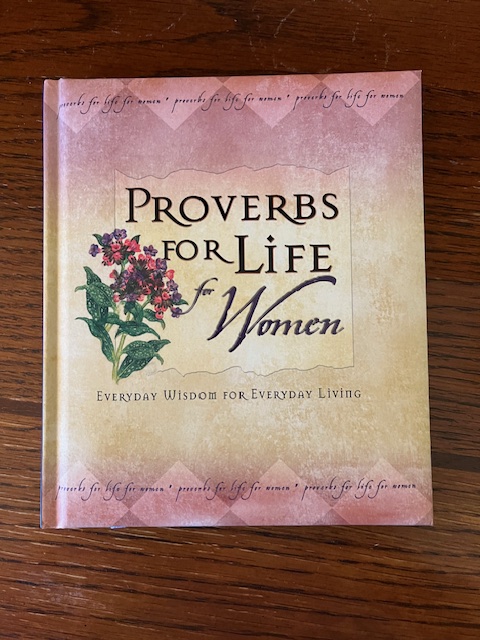
Proverbs for Life for Women is a gift book compiled by Lila Empson for Zondervan in 2003.

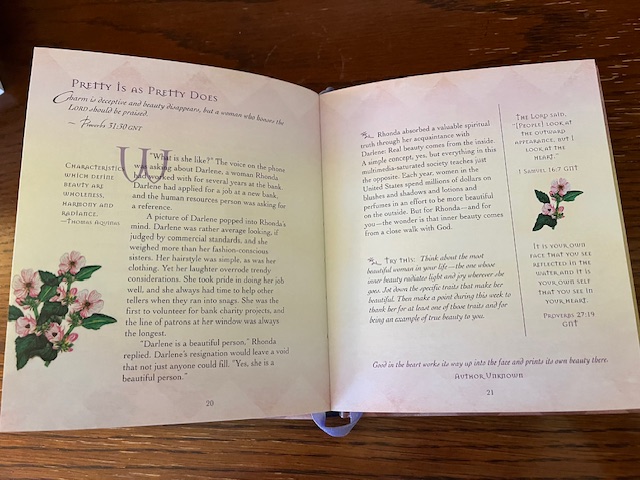
The book looks very much like a gift book. It has a puffy hardback cover, lovely pages, and a ribbon bookmark. The size is a little under 6×7″.

There are about 46 readings grouped into several categories: the Righteous Woman, Virtuous Woman, Faithful Woman, Confident Woman, etc.

Each reading contains a verse from the book of Proverbs in the Bible, a story illustrating the proverb, a conclusion, a “Try this” action suggestion, and a few other proverbs or quotes.

Proverbs for Life for Women

This book mostly uses the Good News Translation of the Bible (formerly Good News or Modern Man, now often called Today’s English Version). This is not my favorite version, for a number of reasons. It translates the thought of a passage rather than the words. It succeeds in its goal of having an easily readable text, but it sacrifices some accuracy. I think a different Bible translation would have made this book a lot stronger.

Also, I wouldn’t endorse all the people the book quotes from.

Just about the time I thought this book seemed a little lightweight in content, I’d read a section that was particularly helpful and meaningful.

So, this book has a lot of good points, more good than bad. But it could have been much better with a little tweaking.

(I often link up with some of these bloggers.)

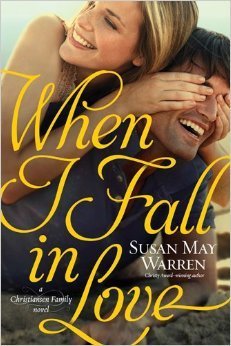
Review: When I Fall in Love

When I Fall in Love by Susan May Warren

Susan May Warren’s Christiansen family series centers on six fictional adult siblings and their parents and friends in the small town of Deep Haven, Minnesota. The family runs an old-fashioned resort (cabins but no Internet).

Though all the family plus several side characters appear in each book, each focuses mainly on the story of one sibling.

When I Fall in Love is the third in the series, about second-oldest sister Grace. Grace loves cooking and wants to go to culinary school. But she’s also a homebody who doesn’t like to venture out of her comfort zone.

When she caters her oldest brother’s wedding, the family thanks her by pitching in to surprise her with a three-week trip to a cooking school in Hawaii.

But Grace is not pleased. She’s terrified.

Her sister’s fiance, a hockey player on the professional team in Minneapolis, chose this particular school because his teammate, Max Sharp, is going there, too. He asks Max to keep an eye on Grace and help her out.

Max is less than thrilled. He goes on a cooking vacation each year somewhere where he’s not known. He gives the bulk of his year to hockey. For that one month, he just wants to get away by himself and do something different.

Grace is not happy, either. She doesn’t want Max to feel he has to baby-sit her.

But when they meet on the airplane, each not knowing who the other is at first—well, this is a romance novel, so you know they are going to be attracted.

The problem is, Max never planned to be attracted to anyone. He’s the carrier for a disease that killed his father early and will probably take his life as well. He can never ask a woman to be part of his life knowing what she will have to go through, only to end up alone.

Grace tests his resolve, though.

In the subplot, Grace’s friend and coworker, Raina, had helped cater Grace’s brother’s wedding. She’s fairly new to town and has had a hard background. Her only remaining family is her aunt Liza in Deep Haven. Raina is not religious, but she attends church because her aunt requires her to.

Grace’s brother, Owen, seeks Raina out after the wedding, making Raina feel special. But she doesn’t know that Owen is in a downward spiral. He was a rising hockey star, only to be sidelined by a devastating injury. The fame and money had gone to his head, and the injury and loss of his career has sent him further to the wild side. He only uses Raina for a one-night stand.

Raina is bitter against all the Christiansen men. But when she gets to know Casper, the college-aged brother home for a semester, she finds he is much different from Owen.

I liked the themes of getting out of one’s comfort zone and trusting God with the unknowns in life.

I didn’t like so much the family pushing Grace out of her comfort zone. Older sister Eden, in particular, comes across really pushy and bossy here. I hadn’t gotten that vibe from her in the book focusing on her (It Had to Be You). Not only does she propel Grace into the trip, she wants Grace to cater her wedding with Hawaiian food–as if cooking in Hawaii for three weeks makes Grace an expert. The fact that Eden didn’t listen to Grace and kept insisting really bothered me.

Plus, the author has God answering Grace directly several times when she prays about something.

Also, though we’re spared a bedroom scene with Owen’s indiscretion, we’re still shown more than I would have liked.

Even with those caveats, though, I found much to enjoy in this story. Just like in real life, we get ourselves in messes. But God offers healing and redemption.

I had listened to the audiobook, which unfortunately didn’t contain any of the author’s notes about what inspired this story. However, I did find a bit of background on Susan’s site here.

Review: Be Skillful (Proverbs)

Be Skillful: Wiersbe Commentary on Proverbs.

In Be Skillful (Proverbs): God’s Guidebook to Wise Living, pastor and Bible teacher Warren Wiersbe notes, “We are living in the information age, but we certainly are not living in the age of wisdom” (p. 11, Kindle version).

The book of Proverbs is one of the Bible’s wisdom books. Of course, we can gain wisdom all through the Bible, but Job, Psalms, Proverbs, Ecclesiastes, and the Song of Solomon, are grouped together as wisdom books.

Wiersbe goes on to say, “It isn’t enough simply to be educated and have knowledge, as important as education is. We also need wisdom, which is the ability to use knowledge. Wise men and women have the competence to grasp the meaning of a situation and understand what to do and how to do it in the right way at the right time” (p. 16).

“Biblical wisdom has little if any relationship to a person’s IQ or education, because it is a matter of moral and spiritual understanding. It has to do with character and values; it means looking at the world through the grid of God’s truth” (p. 17).

“Biblical wisdom begins with a right relationship with the Lord. The wise person believes that there is a God, that He is the Creator and Ruler of all things, and that He has put within His creation a divine order that, if obeyed, leads ultimately to success” (p. 17).

“The first essential for an effective study of Proverbs is faith in Jesus Christ so that you can honestly call God your Father. You can’t make a life until you first have life, and this life comes through faith in Jesus Christ (John 3: 16, 36)” (p. 26).

The bulk of Proverbs is made up of individual sayings. “Proverbs are pithy statements that summarize in a few choice words practical truths relating to some aspect of everyday life. The Spanish novelist Cervantes defined a proverb as ‘a short sentence based on long experience'” (p. 20). But these proverbs are not just clever sayings: they are God’s inspired Word and profitable for doctrine, correction, reproof, and instruction just like the rest of the Bible (2 Timothy 3:16-17).

Normally, Dr. Wiersbe’s comments follow the chapters of the book of the Bible he is discussing. In this commentary, however, he groups his remarks as to the categories in Proverbs: the contrast between wisdom and foolishness, diligence and laziness, the virtuous woman and the “strange” woman, etc., and characters like the drunkard, glutton, the simple, scoffer, fool, king, parents and children, and so on.

As to why God directed the writers of Proverbs to lay out the book this way, Wiersbe has a couple of suggestions. Most people didn’t have their own copies of the Scriptures. Short, pictorial statements would have been easier to remember that a lecture. Plus, “Just as the Bible itself isn’t arranged like a systematic theology, neither is Proverbs. What Solomon wrote is more like a kaleidoscope than a stained-glass window: We never know what the next pattern will be” (p. 22). Some make a practice of reading a chapter of Proverbs each day of the month. They receive wisdom on a variety of topics to carry with them throughout the day.

It had been a while since I had read Proverbs. I enjoyed thinking through it again along with Dr. Wiersbe’s insights.

(I often link up with some of these bloggers.)

Review: It Had to Be You

In It Had to Be You by Susan May Warren, Eden Christiansen feels like she’s forever on the sidelines. Her other siblings have stand-out talents. Eden always dreamed of being a reporter. She landed a job with the city newspaper, but she’s stuck as an obituary writer.

Since she lives in the same town as her younger hockey-player brother, Owen, and she’s the only family member there, she goes to his games and watches out for him. She sees that the fame, acclaim, and money has gone to his head. But he won’t listen to her admonitions. It doesn’t help that Owen idolizes his team captain, Jace, who has a bad-boy reputation on and off the ice.

When Jace and Eden meet, they clash immediately. She berates him for not being a better example to his team.

Jace, meanwhile, has his own problems. Several slams on the ice have resulted in too many concussions and regular migraines. He has nothing else but hockey, so he keeps going despite doctors’ warnings. When he tries to avoid fights during games, his value drops in the eyes of his team, agent, and the spectators.

And there is a side to Jace that others rarely see. He helps his best friend, Sam, run a restaurant and helps Sam take care of his daughter, a heart transplant patient.

Owen, in a moment of carelessness, sustains a devastating injury. While visiting him in the hospital, Jace and Eden accidentally discover a John Doe, an unidentified patient in a coma. They are thrown together to try to find John Doe’s family.

I don’t read romance novels very often. They can be somewhat silly and too focused on the physical. But Susan’s don’t seem to be that way so far.

I got a little irritated with both characters’ tendency to create a whole scenario of what they thought the other was thinking from a line or gesture or silence. It’s not usually good to assume motives no matter how well we know someone. But learning not to judge or assume is part of what they experienced here.

Another theme throughout the book is letting go of things we can’t and weren’t meant to control.

Overall, I enjoyed the story. A couple of my favorite quotes:

Minnesota grew hockey players like pine trees.

There’s always light . . . God’s love is too bright for the darkness to win.

This book is the second in the Christiansen family series. The first was Take a Chance on Me. Since the sequels were free in Audible’s Plus Catalog, I am listening to them before they are rotated out.

Review: Life Without Limits

When Nick Vujicic was born without arms and legs, his parents were shocked and grieved. They were concerned about how he could ever grow up to be independent. They were devout Christians yet wondered why God would allow such a thing to happen.

Nick wondered the same thing as he got older.

I have to confess, I wondered the same thing. Even with as much comfort and reassurance I’ve received studying God’s reasons for allowing suffering, and as much as I have come to trust His character and will, thinking of a person growing up in this condition was hard to come to grips with.

Maybe that’s why I had Nick’s book, Life Without Limits: Inspiration for a Ridiculously Good Life, on the shelf for so long without picking it up. It was one we had bought for my husband’s mother. I remember her saying her tears were streaming as she read this, and she felt she had nothing to complain about after reading this book.

Recently, I saw several Facebook posts from friends about a young wife and mother they knew who ended up in the hospital with several severe infections. The doctor said her condition was a 10 out of 10 on the scale of a serious illness. The treatment reduced blood flow to her limbs, which resulted in amputation of both arms and legs. She’s been in the hospital since December.

As my heart went out to this family and I’ve been praying for them, I decided to pick up Nick’s book to see how he dealt with his situation.

After his parents’ initial shock, they strove to give him as normal a life as possible. He was a determined little boy and found ways to do most things he wanted to do.

However, school was a different story. His family wanted him to attend regular classes rather than special-needs classes. He faced the cruel remarks of some of his classmates, which was depressing. He was even suicidal at one point until his father encouraged him.

Nick found that often he had to be the one to reach out to make people feel comfortable approaching him. That and a good sense of humor helped people to see he was just a regular guy on the inside.

Discussions with others about how he coped with no limbs led to speaking to student, church, and youth organizations. In the years since, speaking became Nick’s vocation and ministry, not only in his native Australia, but around the world.

This book is part memoir, part motivational encouragement. He does include Christian principles but also a lot of secular motivation (love yourself, etc.).

Some of the quotes that stood out to me:

Experiences like that helped me realize that being “different” just might help me contribute something special to the world. I found that people were willing to listen to me speak because they had only to look at me to know I’d faced and overcome my challenges. I did not lack credibility. Instinctively, people felt I might have something to say that could help them with their own problems (pp. 20-21).

As difficult as it might be to live without limbs, my life still had value to be shared. There was nothing I lacked that would prevent me from making a difference in the world. My joy would be to encourage and inspire others. Even if I didn’t change this planet as much as I would like, I’d still know with certainty that my life would not be wasted. I was and am still determined to make a contribution (p. 24).

Often the very challenges that we think are holding us back are, in fact, making us stronger. You should be open to the possibility that today’s handicap might be tomorrow’s advantage (pp. 43-44).

Nick was encouraged by the man who was born blind in John 2. The disciples asked Jesus, “Who sinned, this man or his parents, that he was born blind?” Jesus responded, “It was not that this man sinned, or his parents, but that the works of God might be displayed in him.”

This book was published in 2010. Since then, Nick has gotten married, had four children, written more books and traveled and spoken to even more people.

I appreciated Nick’s attitude and willingness to help and encourage others.

You might be interested in this piece about Nick on Australia’s 60 Minutes program:

(I often link up with some of these bloggers.)

Review: Dandelion Summer

Dandelion Summer by Lisa Wingate

In Dandelion Summer by Lisa Wingate, J. Norman Alvord is a retired widower with heart trouble. As he fades in and out of consciousness from an angina incident, he has a vivid memory of a house with seven chairs and a black maid. His mother never had a maid, and he was an only child. Norman wonders if this is truly a memory or a figment of his imagination. If it’s real, where was this house and who was the woman?

Norman’s daughter, Deborah, is at her wit’s end with her curmudgeonly father. They’ve never gotten along, but she promised her mother she’d take care of him. She tries to nudge him to think about moving to a facility. but he refuses. So for the short term, she hires a woman to come in once a week to clean her father’s house and the woman’s daughter to come in two days a week after school to make dinner, clean up the kitchen, and keep an eye out for her dad.

The daughter, Epiphany, has an Italian mother and black father, though her father is long gone. Epiphany, or Epie, as she is sometimes called, doesn’t feel like she fits in anywhere. She’s bullied at school until the school’s basketball star takes a liking to her. But he is bad news.

Epie and Norman don’t hit it off at first. They are opposites in almost every way. But when Epie agrees to keep some of his secrets, like Norman’s searching for clues about the house in his dreams upstairs, where his daughter has forbidden him to go, Norman grudgingly accepts Epie’s presence. Eventually he tells her what he s searching for and accepts her help bringing boxes from the attic.

Clues and more emerging memories lead Norman and Epie to a road trip for more information. But with Norman’s heart trouble and Epie’s inexperience, will they make it?

The point of view switched back and forth between Norman and Epie. I listened to the audiobook wonderfully read by Jason Culp and Bahni Turpin. Their voices and expressions added so much more to the reading/listening experience.

This book was the fourth in Wingate’s Blue Sky Hill series. I hadn’t read any except the second book, The Summer Kitchen, but I didn’t feel there were any gaps that didn’t make sense. This book stood well enough on its own.

Though I thought the road trip was unlikely in real life, the author made it plausible. I enjoyed the slowly developing relationship between Norman and Epie–first just tolerating each other, then learning to appreciate things about each other, and then coming to truly care for each other like a grandparent and grandchild.

The mystery of Norman’s background was unraveled quite nicely, keeping me curious and invested throughout the book.

I was struck by how both Norman and Epie were misunderstood from the outside. In the book, we’re privy to their thoughts and circumstances that no one else knows. Epie seems like an underachieving student to her teachers, but they have no idea what she has to deal with from the other students and a mom who has gone from man to man. And they don’t take the time to find out what underlying problems there might be. Yet Norman can see her innate intelligence and the need to be nurtured.

Some quotes that stood out to me:

Maybe not everyone got the mom who baked cupcakes and showed up at all the school parties. There weren’t enough of those to go around, so maybe God used other people, like Mrs. Lora and J. Norm, to make sure you learned how to shell a purple hull pea or find Saturn in the night sky.

I would have lived more fully in the moment, realize how easily a perfect day can slip by unnoticed. Any day is the glory day if you choose to see the glory in it.

It’s funny how mistakes are so much clearer after you’ve already made them.

Wingate has a penchant for sometimes halting the flow of dialogue by putting extra information between the speaker’s answers (one of my writing pet peeves). But overall, I really enjoyed this book.

Review: Take a Chance on Me

In Take a Chance on Me by Susan May Warren, Darek Christiansen is a single father working with his parents on the resort they’ve had for years: Evergreen Lake Resort in Minnesota. Darek had been a firefighter, but when his wife died, he worked at the resort to help take care of his son.

He and his wife, Felicity, and friends Jensen and Claire had grown up together in the area. But Jensen was responsible for Felicity’s death. Darek is angry at Jensen, at himself, at God.

Ivy Madison has just moved to the area as the new assistant county attorney. When she bids on Darek for a date at a charity auction, she doesn’t know what to make of his curmudgeonly behavior. But she sees a tender side of him when he’s with his son.

Ivy had grown up in the foster care system, and Darek’s family feels like the one she had always longed for.

But then she has a stunning realization. Before moving here, she had been asked to write a proposed plea deal for a man guilty of vehicular homicide. Since the incident was an accident, she suggested that the man do hours of community service rather than jail time.

After learning Derak’s story, Ivy realizes Jensen is the man whose plea deal she crafted. When Darek learns that Ivy was the one who kept Jensen out of jail, will he forgive her?

Meanwhile, a wildfire rages nearby. Firefighters are on it, but can they keep it from engulfing the town and resort?

Another plot line involves Claire, her unrequited love for Jensen, and her desire to stay in town while her missionary parents want her to go to college at age 25. There’s also a tussle when Claire’s grandfather has an accident. She wants to take care of him; her parents want to move him to a home.

I thought this was the first Susan May Warren book I had read, but I see I had read a few of her Christmas books in past years: Evergreen: A Christiansen Winter Novella (which I just realized involved the family from this book), The Great Christmas Bowl, and Baby, It’s Cold Outside.

The point of view switches back and forth between Darek, Ivy, Jensen, and Claire. One interesting thing about this story is that at first, Darek seems like the innocent wounded party and Jensen seems like the bad guy. But as we learn more of what happened and get to know them better, we see Darek (as well as Felicity) has done things he’s not proud of, and Jensen has good qualities no one appreciates at first.

I thought the faith element was woven in naturally.

Favorite quotes:

I knew your future would take you far from Evergreen Lake. I feared it would take you far, also, from your legacy of faith. Watching your son leave your arms has no comparison to watching him leave God’s. You never seemed to question the beliefs your father and I taught you. Perhaps that is what unsettled me the most. Because without questioning, I wondered how there could be true understanding.

“Small acts of justice can make great ripples in the community.” “Or tear it apart.”

We can’t hold onto something so hard that it destroys everything else we love.

I disagreed with one character saying that God acts almost entirely out of the emotion of love. Love isn’t just an emotion. And I wouldn’t say God acts primarily on emotion.

And I was disappointed Susan spelled out a metaphor that arose with the wildfire and something that was going on in the plot. It was kind of neat to make that connection, and I felt it would have been stronger if the reader had been allowed to make it for herself rather than being told.

But overall I liked getting to know the characters and their situations and where everyone ended up in their journeys. I enjoyed the audiobook narrated by Carol Monda. I didn’t realize that this book was the first of seven involving the Christiansen family. I was able to find several of them for free with Audible’s Plus Catalog,

Review: Organizing for the Rest of Us

Organizing for the Rest of Us

In my early married life, I read Sandra Felton’s The Messies Manual and received her newsletter for several years. Those helped me immensely. I don’t know if my husband realizes how much he’s indebted to Sandra. 🙂

But I realized that organization isn’t a destination. It’s a continual journey. You can’t just set up routines and places for things: you have to maintain them. And you continually get new things, get rid of old things, or get ideas of ways your organization could work better.

So I still read occasional books about organization. I don’t read books on decluttering because, though decluttering is a part of organization, it’s just one part. I don’t read books on minimalism because they go too far for my tastes.

Some of the more recent books I’ve read on time management and productivity focus on the larger principles. Those are needful and foundational. I need those reminders sometimes. But I’m more in need of practical everyday life hacks, those “Why didn’t I ever think of that?” ideas and solutions.

I just recently discovered Dana K. White’s Organizing for the Rest of Us: 100 Realistic Strategies for Keeping Your House Under Control when it was on sale for the Kindle. It’s full of great ideas, laced with humor, and written concisely. You could easily skim through chapter titles and just read about the areas you want help with. But I enjoyed the whole book.

Dana started sharing tips on an originally anonymous blog titled A Slob Comes Clean. It resonated with so many people that it grew into books, podcasts, and speaking engagements.

Dana was one of those people (like me) who wasn’t naturally organized. She discovered her tips one at a time while trying to “deslobify” her own house.

One of her principles I liked is that clutter is personal. Maybe that’s why I don’t like decluttering and minimalist books—I didn’t always agree with what they said I needed to get rid of. Dana defines clutter as “anything that gets out of control in your home” (p. 6, Kindle). “You can keep anything. You just can’t keep everything” (p. 58).

One of my favorite tips from this book was not to take everything out of a closet or cabinet when trying to organize it. Most of us do that, then we get tired or need to go tend to something else, and we have a massive mess on our hands. Instead, Dana urges taking one thing out at a time and deciding immediately what to do with it. Have a trash bag and donation box handy to put items that you want to get rid of. If you decide the item is something you want to keep, immediately put it where it goes. That may seem to take longer in the short run. But dealing with the item immediately saves having a pile of items to put away when you’re done and fatigued. Plus handling it just once cuts down on rethinking it. And if you’re interrupted or tired, you don’t have a mess to clean up (or shove back into the closet) before you can move on.

This was a fun and very helpful book. Highly recommended.

Review: Dear Henry, Love Edith

Dear Henry, Love Edith

In Becca Kinzer’s debut rom-com novel,. Dear Henry, Love Edith, Edith Sherman is ready to make a new start. Her marriage was difficult and about to end when her husband became ill and passed away. She stayed with him til the end, and they reconciled. But the problems there and in her relationship with her parents has soured her on marrying again. She had given up her hopes and dreams of traveling the world, and now is the time to pick them up again. She plans to go to South Africa to help in a mission there as soon as her passport arrives.

In the meantime, she heard from a friend that a crisis nursery in the small town of Westshire, IL could use her nursing skills for the summer. She had planned to stay in the house of a friend of a friend, Kat, who would be away during that time. But Kat sent her a note that a pipe had burst in her house. However, her uncle Henry had an upstairs he wasn’t using and would be glad to have her stay there until the damage was repaired.

Henry actually wasn’t glad. But since he was recovering from a knee injury and couldn’t use the upstairs, he reluctantly agreed that what he assumed was an older widowed missionary lady could stay there.

Edith, on her part, assumed that the uncle of someone her age would be an older bachelor. She didn’t realize that Kat and her uncle were just a few years apart.

For several weeks, living in different parts of the house and working different times, Edith and Henry didn’t meet and left notes for each other. Each assuming the other was older, their notes became more friendly and confidential.

Meanwhile, Henry can’t help but notice a beautiful brown-eyed blond in town. They run into each other several times without getting each other’s names. Then Henry realizes this is the Edith living upstairs in his house.

Edith notices Henry, too, and it’s only a matter of time before they find each other out and admit their attraction. But Edith remains firm about not marrying. And besides, she’s leaving the country soon.

I don’t usually read romantic comedies, but I saw good reviews for this one. When it was on sale for the Kindle and then free for Audible, I decided to try it. There were a lot of funny and cute moments, and the overall story was sweet. I enjoyed a lot of the banter. The “comedy of errors”—misunderstandings or things going wrong that escalate— is not my favorite type of humor. Nothing wrong with it, I just find it tiresome and not funny. I preferred the more serious parts. Even though this was meant to be a funny story, there was a lot of depth to it.

Though this was a Christian novel, at first I didn’t see much Christian about it besides an occasional mention of church or prayer. But later on, as the two main characters wrestle with their various issues, they pray and seek God more earnestly.

Unfortunately, there was one reference I was dismayed to see in a Christian novel. It wasn’t obvious, though, so I think some might overlook it.

If you like romantic comedies, you might like this book.