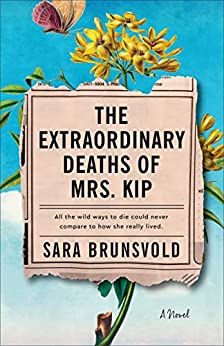
The Extraordinary Deaths of Mrs. Kip

In The Extraordinary Deaths of Mrs. Kip by Sara Brunsvold, Aidyn Kelley has been a cub reporter for the Kansas City Star for a year. But she feels more than ready for a real assignment, not the research she’s done for other reporters and the few light pieces she’s written. She was an award-winning student journalist at the University of Missouri, after all. So she sends a note to the managing editor, bypassing her supervising editor, laying out the reasons she is qualified and eager for meatier assignments.

Aidyn learns there is a reason not to bypass one’s supervisor. The managing editor wants to fire Aidyn, but her supervisor, Woods, advocates giving her a stern-talking to and low-level assignments until she learns humility and respect for the rules.

The first assignment is to interview and write an obituary for a dying septuagenarian, Mrs. Clara Kip. Aidyn dreads visiting the hospice center and talking to a dying woman. But if she wants to keep her job, she has no choice.

Aidyn finds more than she bargained for in Mrs. Kip. But Mrs. Kip isn’t going to unfold her story all at once. She wants Aidyn to make up some extraordinary deaths for her, and for every one, she’ll be allowed to ask Mrs. Kip three questions.

I don’t want to say too much more about the plot, because discovering Mrs. Kip’s personality and background along with Aidyn is half the pleasure of reading this book. I had thought, at first glance, that the story line would be pretty predictable. But the author throws in lots of surprises.

Alongside Aidyn’s journey, Mrs. Kip is dealing with the fact that she is dying, having to accept the weakening of her body and her confinement to the hospice center. Even so, she feels God has a couple more things He wants her to do before she runs out of steam.

Some of the quotes that stood out to me:

She could only trust that the Lord was up to something. Because he usually was (p. 2).

Clara gazed at the sliding glass doors of Sacred Promise. Such an odd feeling to know that once she walked in, she would not walk out. She clung to the belief the Lord had something for her here, so she shuffled forward. (p. 12.).

“I did nothing amazing, Miss Kelley,” she insisted. “Despite what you’ve been told. I simply tried to love people as best I could for as long as I was privileged to be with them. We don’t stay long in each other’s lives—that’s the crux of our humanness. You have to be the friend people need while they are there with you, because it’s the only chance you’ll get.” (p. 198).

The Lord will give you all the words you need. It’s not about whether they sound pretty. It’s about what he will do with them (p. 200).

This was a touching and encouraging story in many ways.I enjoyed both Aidyn’s and Mrs. Kip’s journeys.

Circle of Spies

Circle of Spies is the third of Roseanna M. White’s Culper Spy Ring, a real life spy ring active during the Revolutionary War (Ring of Secrets was the first and Whispers from the Shadows was second). Although we don’t know that the ring continued, Roseanna said in the last book that someone in the CIA said it was possible. So Roseanna imagined how the spy ring could have worked during the War of 1812 in the second book, and now in the Civil War.

Marietta Hughes is an unlikely heroine at first. She has lived mostly for her own will and pleasure, not walking with the God of her parents. She married Lucien Hughes, wealthy president of a railroad company. But Lucien had been killed. Marietta had an understanding with his brother, Devereaux, that they would marry as soon as was proper after her period of mourning.

But then Marietta’s grandfather, Thaddeus Lane, informs her that the Hughes family is not staunchly Unionist, as they proclaim. Not only are they Confederate, but Devereaux is the head of a secret fifth column bent on killing Lincoln and seizing power.

As if that wasn’t enough to turn Marietta’s world upside down, Lane tells her that their family has been involved as a ring of spies since the Revolutionary War. Then he tells her that a Pinkerton man, Slade Osborne, is on his way to infiltrate the secret society to try to find proof that will lead to their arrests. Marietta’s job is to distract Devereaux as much as possible to facilitate Osborne’s investigation.

Thus begins a game of cat-and-mouse. Osborne is not altogether certain he can trust Marietta at first. Marietta is revolted at what she has learned about the Hughes family, but must keep pretending she is in love with Devereaux.

I ached with Marietta as she came to face what she had become and wondered if God could forgive her. Sometimes the realization of the magnitude of one’s sin breaks open to them more fully after they believe. Osborne, too, has a broken background, as well as complications from a twin brother whose values were the opposite of his.

By the end of this book, I wanted to put everything else aside to keep reading what happened. There were some quite exciting twists and turns!

I did disagree with one point, though, when a character says that God doesn’t speak for or against slavery. He does: I wrote once about the Bible and Slavery. But I did like what the character had to say about trying to reconcile the views of different Christians on the issue: “At last we realized we didn’t have to, because God so very rarely tells us what society should do—rather, He tells us how we, as believers, should behave in whatever society to which we belong” (p. 226).

In-between this book and the previous one was a little novella titled A Hero’s Promise. Julienne Lane has been helping a friend, Freeda, hide runaway slaves and get them to safety. Julienne is unsure whether to let her fiance, Jack Arnaud, in on the situation.

Meanwhile, Jack has postponed their wedding twice already but might have to do so again. A mentally unbalanced man is being set up by enemies to assassinate President Jackson, and the Culpers must intervene.

The assassination attempt was based on a true event.

I enjoyed these forays in early American history and spycraft. But even more, I enjoyed the journeys of faith Roseanna takes her characters through.

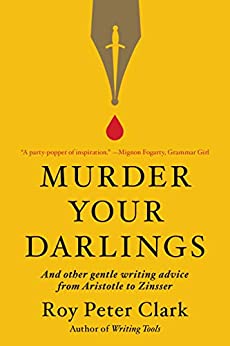
Murder Your Darlings

Murder Your Darlings is not a detective mystery or true crime drama.

Murder Your Darlings is writing advice. You see it a lot in writing circles these days, but it originally came from Sir Arthur Quiller-Couch, a British author and professor (known as Q, not to be confused with the WWII spy-gadget-maker). This phrase was first delivered in a lecture to his students in 1914 which was later published. In context, he said, “Whenever you feel an impulse to perpetrate a piece of exceptionally fine writing, obey it—whole-heartedly—and delete it before sending your manuscript to press. Murder your darlings” (p. 17).

Roy Peter Clark interprets Q’s advice thus: “Ask yourself, ‘Am I including this because it provides the reader with a memorable and delightful piece of evidence to prove the point of my text? Or is it beside the point even though it reveals what a good wordsmith I am?'” (p. 21).

In other words, the phrase, sentence, or paragraph that’s the most precious to you, but doesn’t really add anything to your thesis, must go. Clark opines that you don’t have to “commit verbicide on the words you love the most” (p. 17). You can save them in a file for another day.

Clark, known as “America’s writing coach,” shares advice from over 50 other writing sources in Murder Your Darlings: And Other Gentle Writing Advice from Aristotle to Zinsser. Clarks says, “I am not trying to steal their thunder. I am trying, instead, to amplify it, to pay back my debt to the authors who shaped my craft” (p. 8).

Some of these books are filled with writing advice, and Clark pulls out a lesson or two to discuss. “Most of what you will read here is why I appreciate them, what I or others have learned from them, and what I think you, the reader, can take away and apply to your own work” (p. 23).

Clark begins each chapter with a “toolbox,” a brief summary of the particular principle or writing instruction he’s going to discuss. Then he’ll give a little background about the work he is drawing from, the author, illustrations of the writing advice under consideration, whether he agrees or disagrees and to what extent. He ends each chapter with a short list of “Lessons” summarizing the main points of the chapter.

Clark’s book is quite readable. The Lessons at the end are particularly helpful to remind oneself of the salient tips from a chapter. Some of the writers he quotes from are well-known, others are not.

As you can imagine, I have multitudes of passages highlighted from the book. Here are a few:

It turns out that the internet is not an information superhighway. It is, instead, a polluted ocean with buried treasure sitting here and there on the bottom. Neutralize the poison of the propagandists, hackers, conspiracy theorists, trolls, and bullies by devoting your online efforts to the public good (p. 83).

Early writing is not sculpture, but clay, the stuff in which you will find the better work (p. 105).

An implied social contract exists between the reader and an author of nonfiction and that the contract reads, “Please believe me, my memory of events may be flawed, but none of this was intentionally made up.” If the author decides to veer from this standard, say, by using composite characters, the author must be transparent, revealing the strategies before the story begins, not in a footnote at the end (p. 222).

Donald Murray . . . advised writers to use “Shorter words, shorter sentences, shorter paragraphs at the points of greatest complexity” (p. 231).

Another Roman author, Horace, steps into the light with a sense of mission that is both public and aesthetic, arguing that the purpose of great literature is to delight and instruct or, on the good days, to do both! (p. 237).

This is a secular book, and there are words I wouldn’t use and situations and philosophies I wouldn’t agree with. But I found it fairly easy to sidestep those things just to glean the writing advice.

Clark’s book will help you hone your craft by sharing wisdom with you from sources that you might not have found yet. And the sources he quotes might inspire you to look up the authors’ original works.

Whispers from the Shadows

Whispers from the Shadows is the second novel in Roseanna M. White’s Culper Spy Ring series.

The story opens some 35 years after the Revolutionary War. England and the United States are once again battling each other, this time in the War of 1812.

So Gwyneth Fairchild can’t understand why her father is sending her away from England to America, to his old friends, the Lanes. How can crossing a sea filled with pirates and combatants be safer than England?

But her father is insistent. As they’ve said their good-byes, Gwyneth turns to the carriage and her guardians. But she runs back to ask her father one last thing—only to witness his murder. His last whisper as he sees her is, “Run.”

So Gwyneth runs. On the two-month long voyage, she can’t sleep more than two hours at a time. Seasickness, insomnia, and sorrow reduce her health and well-being to frightening levels. For some reason, she does not tell her guardians what happened.

When their vessel is overtaken by American privateers, they are delivered to Thaddeus Lane in Baltimore, the son of Winter and Bennet. Thankfully Thad’s parents are there when Gwyneth arrives.

Gwyneth slowly recovers from her ordeal, but still tells no one what happened to her father. Everyone suspects that her state is due to more than severe seasickness. Gwyneth takes refuge in drawing, and somehow Thad discerns that she has faced some kind of severe trauma.

On the surface, Thad is a merchant who knows almost everyone in Baltimore. Secretly, he’s a key member of the revived Culper Ring.

As Gwyneth and Thad discover each other’s secrets, the British invasion increases. In the midst of it all, Gwyneth can’t help but wonder if her father’s murderer will come after her, too.

I loved this book on so many levels. It was fun that Winter and Bennet from the first book were such a big part of this one as well. I enjoyed Gwyneth and Thad, their personalities and journey and especially Gwyneth’s growth. I loved Thad’s kind but non-nonsense cook, Rosie, who was a niece of Freeman from the first book.

There was also so much edge-of-your-seat intrigue.

I don’t know if I have ever read another book set during the War of 1812. So many write WWII novels, which is fine—I loved Roseanna’s books set then. But it’s nice to learn about other eras as well.

Wikipedia only details the Culper Ring activity through the Revolutionary War. Roseanna shared in her afterword of the first book that a CIA member said in an interview that “The Culper Ring may or may not still exist.” It’s fun it imagine that they continued on behind the scenes for so many years.

The next novel is set during the Civil War, and one more novella comes before. I am looking forward to them.

The Forgotten Life of Eva Gordon

The tag line for The Forgotten Life of Eva Gordon by Linda MacKillop is “Eva wants to run away from her life–if only she could remember how.”

Eva has been moved from her long-time cozy home in Cape Cod to the city of Boston to live with her granddaughter, Breezy. And Eva hates it. She hates the city, she misses the familiarity of her own home and town, she’s an introvert who has a hard time with the constant stream of students and friends in Breezy’s house. Breezy’s neighbor, Mabel, tries to keep an eye on Eva, but Eva feels Mabel is intrusive.

Then, on top of everything else, Breezy announces that she’s getting married to her boyfriend, Ian, and they’re all going to live in Ian’s old fixer-upper family farm with his elderly uncle.

It’s all overwhelming for Eva, but she’s stuck. She can’t count on her memory any more. Even when she works out what seems like a perfectly logical plan, she ends up getting into trouble.

I was first attracted to this book because I identified a lot with Eva. I’d probably feel the same way in her situation.

But as the story unfolds through flashes of Eva’s memories, there’s more to Eva than the desire for solitude and independence. She’s been pretty awful, driving her husband and children away, saying negative things without thinking (even before dementia). I wish we’d gotten a little better idea of why Eva was the way she was. The only clue I caught was that her dad tended to speak to her the same harsh way.

I think all of us would like to live independently, mentally and physically capable, til we’re 100. But reality doesn’t always work out that way. One poignant piece of advice Mabel offers is, “When the time come to release the last smidge of life, Eva, you want to have kissed the most important things good-bye already. Getting old like us involves lots of little deaths to prepare for the big one—like saying good-bye to loved ones, your home, your health” (p. 249). I’m tucking that away for later.

I can’t say I warmed up to Eva like I have other curmudgeonly characters. But I did come to appreciate her struggles, empathize with her, and understand her better. There’s no grand climax of eye-opening for her, but a gradual realization that she has treated people badly and needs to accept them and life circumstances more graciously.

I was curious about what inspired the author to write this book, so I searched a bit and found this interview, which helped me understand the story a little more. I especially liked this sentence: “The characters in the novel decide to move toward Eva without being put off by her abrasive personality, giving her the opportunity to decide whether she’ll receive their love and acceptance.”

I liked the theme of second chances. Even in old age, even in dementia, steps can be taken to heal relationships and accept love.

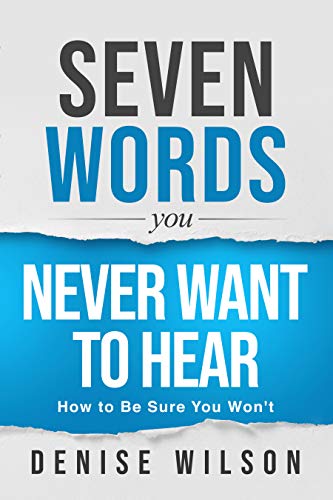
Seven Words You Never Want to Hear

The Seven Words You Never Want to Hear that Denise Wilson writes about are from Jesus: “I never knew you; depart from me” (Matthew 7:23). Those are frightening words indeed. I struggled with them when I was unsure of my salvation. Thankfully, as Denise’s subtitle indicates, she doesn’t stop there: she tell How to Be Sure You Won’t hear those words.

Those words of Jesus occurred in what we call the Sermon on the Mount in Matthew 5-7. The full paragraph is as follows:

Not everyone who says to me, ‘Lord, Lord,’ will enter the kingdom of heaven, but the one who does the will of my Father who is in heaven. On that day many will say to me, ‘Lord, Lord, did we not prophesy in your name, and cast out demons in your name, and do many mighty works in your name?’ And then will I declare to them, ‘I never knew you; depart from me, you workers of lawlessness.’ (7:21-23).

It’s possible to “do many mighty works in your name” and yet still miss salvation, miss knowing Jesus personally.

Denise discusses several ways that could happen. One is praying “the sinner’s prayer” without faith or repentance. Another is growing up in a Christian atmosphere without ever believing on Christ personally. Or one could be deceived by the prosperity gospel or a works-based religion. Perhaps we haven’t counted the cost of discipleship and only wanted passage to heaven rather than a life of denying ourselves, taking up our cross, and following Him.

People might need to examine their hearts if they say they have been saved yet their life has not changed. We won’t be perfect after salvation. We’re forgiven and cleansed, but we still have an old nature and still need to grow. We’ll still battle with sin—yet if we’re not battling it, but letting it have full sway on our lives, something is amiss.

Denise points out that Jesus did not use a cookie-cutter approach in dealing with people. Years ago I attended classes where we were trained in how to lead someone to the Lord using the “Romans Road,” a series of verses in Romans that explain salvation. That approach is fine as far as it goes. But leading someone to the Lord is not just a matter of getting them to allow you to read them a handful of verses and then you getting them to pray. We need to be open to the Lord’s leading as we speak to people. Only He knows what obstacles to salvation are in their hearts.

Denise includes several testimonies from the Bible, from history, and from modern times. Some of them, she points out, don’t look like what we think salvation looks like. Take the thief on the cross next to Jesus. He knew he was guilty and Jesus was innocent. He asked, “Jesus, remember me when you come into your kingdom” (Luke 23:39-42). Was anyone else ever saved using those words? I don’t know. But one thing I learned in my own struggle was that becoming a Christian was not a matter of saying the “right” words, like a magic formula or an initiation rite. It’s a matter of repentance and faith in Jesus.

2 Corinthians 13:5 tells us to, “Examine yourselves, to see whether you are in the faith.” Denise provides helps to do that in this book.

Ring of Secrets

Ring of Secrets by Roseanna M. White is the first in her Culper Ring series, fiction based on the real-life spy network set in motion during the Revolutionary War.

When Winter Reeves’ mother died while her father was fighting with the Patriots, her grandparents came to take her to their home in New York City. Her grandparents had never forgiven her mother for marrying outside their station and political affiliations, and they took their anger out on Winter. They instructed that she would say her father was dead, that she would not express any Patriot leanings, and she would marry the man of their choosing as soon as possible so they could get her out of their responsibilities and home.

Since Winter could not be who she really was, she played the part of a beautiful but witless society lady. Her persona gave her a great cover, though, for overhearing information from the Loyalist officers in their social circles. She passed along any useful information to her childhood friend, Robbie Townsend, a mercantile owner who was a vital link in the Culper Ring network.

Bennet Lane was a new arrival in the city. He would not have been considered a catch among the highest society there due to his professorship at Yale, teaching chemistry. But now he was set to inherit a large English estate, making all the tittering mamas in town set their sites on him as a potential son-in-law. Though Bennet usually got tongue-tied and awkward around women, he thought the apparent pursuit of a wife would be a good cover for his real mission: to discover information about a hidden Patriot spy ring.

When Bennet met Winter, he perceived that there was intelligence and spunk underneath the silly exterior she presented to the public. He wanted to know more.

Roseanna has become one of my favorite authors over the last few years, and this novel lived up to the others I read. There are so many layers to this story: the political intrigue and danger, the growing attraction between Winter and Bennet despite their differences, the pursuit of Winter by a Loyalist officer, Isaac Fairchild, Winter’s deep faith and Bennet’s lack of belief in anything he can’t see and test. As I read, I thought, “There is only one way I can see this working out.” The plot did go that direction, but with some surprises along the way.

I thought all the characters were well-drawn. I especially loved Freeman, a free Black man who had been one of Winter’s father’s closest friends and who pledged to protect Winter, and Viney, a poor but faith-filled woman Winter encounters.

Even though I love Roseanna’s writing and knew I’d get to this series eventually, I didn’t like the covers, which put me off the series a bit. It looks like this series was first published in 2019 and then the second edition in 2021. There are two covers for each book. I had this one in my Kindle library. But Audible currently has the books for free with an Audible subscription. I’m thankful they did and I finally got to them. I’ve already started the sequel.

I had not realized when I got the audiobooks that there were novellas in-between the books, not on audio. They are currently packaged together here. The first one, Fairchild’s Lady, takes place just before the French Revolution breaks out. General Fairchild from the first book is in France on two missions: to gather information and to locate a countess and her daughter and bring them to England before the Revolution makes travel impossible. He meets a beauitful woman, Julienne, at a masquerade ball, only to discover later that she is the young woman he is looking for. A dangerous French courtier has laid claim to Julienne, though.

This novella was just as good as the first book. Fairchild was a likeable, honorable character, even though he was on the other side, politically. It was fun to see his story continue.

Roseanna notes in her afterword of Ring of Secrets that the Culper Ring members were not professional spies. They were everyday people seeking to promote the cause of the fledgling United States of America. There were women in their ranks as well as men. The main characters in these books are fictional, but historical characters are mentioned as well.

I’m looking forward to see what else happens with the Culper Ring.

Be Joyful

Paul’s theme of joy in Philippians is remarkable when you consider that he wrote the letter from prison.

He wrote believers in the city of Philippi to thank them for a gift, let them know how he was, and encourage them in their walk with God.

Paul didn’t have much to correct among the Philippians. He mentioned dissension among a couple of members and encouraged unity. Otherwise, the Philippian church seemed a healthy one.

He let them know that “what has happened to me has really served to advance the gospel” (1:12). In addition, other believers increased in boldness and confidence. You’d think the opposite would happen, that Paul’s imprisonment would make them afraid lest the same thing happen to them. But perhaps seeing that Paul flourished and that God used even imprisonment to accomplish His will helped them go forward.

Most of us would chafe in imprisonment, eager to get out and back to business. But Paul knew that “to me, to live is Christ and to die is gain” (1: 21). He says later that he had learned contentment in good or bad circumstances, knowing that God would give him strength to face anything (4:10-13).

Paul encourages the Philippians to “let your manner of life be worthy of the gospel of Christ” (1:27), pointing to the example of Christ’s humility and selflessness (2:1-11).

Warren Wiersbe’s commentary, Be Joyful (Philippians): Even When Things Go Wrong, You Can Have Joy, helped as a companion to Philippians.

In some of Wiersbe’s other commentaries, he combines several shorter books together. Philippians has only four chapters, so I expected to find its commentary bundled with others. However, Wiersbe gave Philippians its own book.

Because Wiersbe wrote so much about this book of the Bible, and my ESV Study Bible had copious notes as well, I decided to slow down through this book and follow Wiersbe’s chapter divisions, which each covered only a paragraph or two of Philippians. It’s easy to zoom through this short book of the Bible and not retain much. So I was glad for this slower focus on it.

These are some of the quotes that stood out to me:

What was the secret of this joy? The secret is found in another word that is often repeated in Philippians: It is the word mind. Paul uses mind ten times, and also uses the word think five times. Add the time he uses remember and you have a total of sixteen references to the mind. In other words, the secret of Christian joy is found in the way the believer thinks—his attitudes. After all, outlook determines outcome (p. 18).

When you have the single mind, you look on your circumstances as God-given opportunities for the furtherance of the gospel, and you rejoice at what God is going to do instead of complaining about what God did not do (p. 42).

We Christians are the citizens of heaven, and while we are on earth we ought to behave like heaven’s citizens (p. 53).

It takes more than an example on the outside; it takes power on the inside (p. 73).

The Christian life is not a series of ups and downs. It is rather a process of “ins and outs.” God works in, and we work out (p. 73).

The verb “work out” carries the meaning of “work to full completion,” such as working out a problem in mathematics (p. 74).

Like most religious people today, Paul had enough morality to keep him out of trouble, but not enough righteousness to get him into heaven. It was not bad things that kept Paul away from Jesus—it was good things. He had to lose his religion to find salvation (p. 96).

Once again, I am thankful for Dr. Wiersbe’s insights.

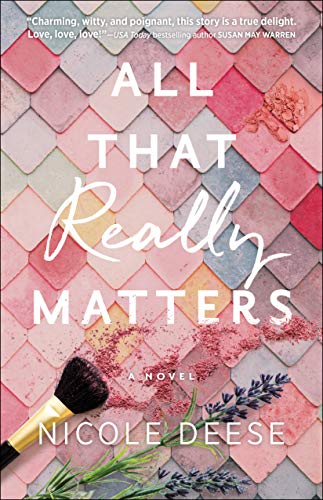
All That Really Matters

In Nicole Deese’s novel All That Really Matters, Molly McKenzie’s video channel about makeup and fashion has over half a million followers. She has corporate sponsors, a virtual assistant, and a manager who became her boyfriend.

Her manager shares an opportunity to host a makeover show. But first, she needs to increase her followers even more. And she needs a cause to show her compassionate, involved side.

Molly seeks advice from her pastor brother, and he directs her to a mentor program for kids transitioning out of the foster care program.

But the program director, Silas, is not impressed by Molly at their first interview. His kids are dealing with serious, real-life problems Molly knows nothing about. How could she help them?

When Molly comes back to him with a well-thought-out plan for classes, Silas decides to give her a chance. And his life and program are never the same.

At first, Molly is motivated to simply get this requirement out of the way. But as she gets involved with the kids, especially Wren, a quiet outsider of the group, Molly begins to really care about them.

Just as Silas begins to appreciate that there’s more to Molly than her sparkling online presence, a series of crises come that cause Molly to question her identity and purpose.

The first part of this book was just delightful. Molly is not the kind of character I’d normally connect with, but Nicole took care not to make Molly a caricature. She’s enthusiastic, but not overly bubbly. And, as Silas discovered, she’s not empty and vain.

Silas is a serious, caring, but by-the-book director. I like how Molly’s influence loosened him up a little. One reviewer thought they had something like the Maria/Captain Von Trapp vibe in The Sounds of Music.

When the crises came, my heart went out to Molly and the other people involved. Nicole drew all the characters so well and infused the plot with both humor and pathos.

Here are a few of the quotes I loved:

Of helping without overstepping. It’s difficult to see real needs and not want to rush the process to appease our own desire for restoration (p. 125, Kindle version).

But more often than not, the best rescue plan we can offer someone we care about is our support for each step they take forward (p. 209).

I think we first have to understand just how deeply we are already loved that way—by God. Then we can love each other out of the response to His love for us (p. 247).

You don’t honor God with your life by changing your personality and tossing out everything that is unique about who you are. You honor Him by offering those very gifts back to Him (p. 331).

This is the first book I’ve read by Nicole, but it won’t be the last. In fact, I loved this book so much, I already started the sequel, All That It Takes.

The Lady and the Lionheart

The Lady and the Lionheart by Joanne Bischof takes place in the Virginia of 1890. Ella Beckley has moved away from heartbreak in her mountain hometown to be a nurse in bigger city. The problem is that her knowledge is self-taught. The doctor with whom she applied won’t hire her for her homespun remedies. But he does let her work as a scullery maid, occasionally allowing her to assist in other ways.

One snowy evening, Ella is nearly bowled over by a tall, panicked stranger with a feverish baby. Busy, the doctor tells Ella to attend to the child. Ella learns that the man is a performer with the new circus in town. The doctor only lets the man and baby stay overnight since the man doesn’t have enough money to continue the baby’s care.

Risking her own job, Ella runs after the man, whom she learned was named Charlie Lionheart. She goes to his tent where she meets Regina, a widow who has become the baby’s godmother and who helps Charlie out. Ella tends the baby and checks back each day.

Circus life is a whole new world for Ella. Charlie has always kept his personal life private from “rubes”–circus outsiders who pay to laugh and gawk at performers but who think circus folks “beneath” fine society. But Ella’s kindness and persistent questions slowly break down his resolve, and he opens up to her.

They grow in appreciation and then attraction to each other, but the situation is impossible. Ella can’t run away and join the circus, after all. And Charlie is contracted for more than Ella knows. Plus they each have secrets from their pasts which have scarred them and affected their futures–secrets they’ve not yet shared.

I listened to the free audiobook version of this story, which did not contain any back matter. I’d love to know what inspired the author to write this story. I loved the subtle theme about not judging a book by its cover. The swarthy, heavily tattooed circus performer may have a heart of gold and a selfless reason for what he does. The pretty, kind nurse may hold a depth of pain behind her smile. But I especially loved when one character makes the point that when people are deeply damaged, and no amount of faith will make the circumstances or the past go away, they are still not to be discarded like a broken vase. They still have great value–and not only value, but beauty.

A few reviews I saw expressed dismay at how people perceived a man’s tattoos. They were offended the author would insinuate that anything was wrong with tattoos. But the author was portraying attitudes in the 1890s. The doctor says early on that tattoos were associated with ex-cons in that era.

I had gotten this audiobook not only because it was free, but especially because I had very much enjoyed the author’s Sons of Blackbird Mountain and Daughters of Northern Shores a few years ago. I felt that this story dragged just a bit (although another reviewer appreciated that it was “unrushed,” so maybe the pacing was a matter of perspective). It seemed the two main characters kept circling around the same issues over and over. There were a few editorial oddities that distracted me.

But despite those minor issues, I enjoyed the story, theme, and characters.