Be Compassionate (Luke 1-13)

In the gospel bearing his name, Luke, “having followed all things closely for some time past,” undertakes “to write an orderly account for you, most excellent Theophilus, that you may have certainty concerning the things you have been taught” (Luke 1:3-4).

Luke is a doctor and very detailed in his account. He is also a Gentile, and he emphasizes the availability of the gospel to everyone.

Luke begins before Jesus’ birth with the prediction of John the Baptist’s birth. Luke progresses the angel’s announcement to Mary that she would bear the long-awaited Messiah, the well-known Christmas story, Jesus’ ministry and teaching, death, burial, resurrection and ascension.

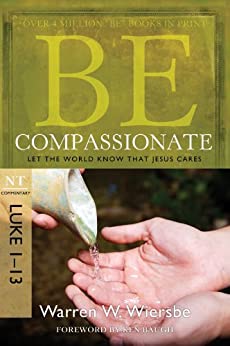
Because the book of Luke is so full, Warren Wiersbe divided up his commentary on Luke into two books. The first is Be Compassionate (Luke 1-13): Let the World Know Jesus Cares.

Wiersbe says Luke’s “key message is, ‘For the Son of man is come to seek and to save that which was lost’ (Luke 19: 10). He presents Jesus Christ as the compassionate Son of Man, who came to live among sinners, love them, help them, and die for them” (p. 16).

In the passage about Jesus’ temptation, Wiersbe says:

Satan questioned the Father’s love when he tempted Jesus to turn stones into bread. He questioned His hope when he offered Jesus the world’s kingdoms this side of the cross (see Heb. 12: 1–3). Satan questioned the Father’s faithfulness when he asked Jesus to jump from the temple and prove that the Father would keep His promise (Ps. 91: 11–12). Thus, the enemy attacked the three basic virtues of the Christian life—faith, hope, and love (p. 52).

I’ve often heard that this passage shows Satan tempting Jesus with “the lust of the flesh, and the lust of the eyes, and the pride of life” that 1 John 2:16 describes. I think that’s true as well as Wiersbe’s viewpoint.

In response to Jesus answering Satan’s temptation with Scripture, Wiersbe says:

Jesus balanced Scripture with Scripture to get the total expression of God’s will. If you isolate verses from their contexts, or passages from the total revelation of Scripture, you can prove almost anything from the Bible. Almost every false cult claims to be based on the teachings of the Bible (p. 53).

Some of the other quotes that stood out to me:

It was our Lord’s custom to attend public worship, a custom His followers should imitate today (Heb. 10: 24–25). He might have argued that the “religious system” was corrupt, or that He didn’t need the instruction, but instead, He made His way on the Sabbath to the place of prayer (p. 54).

Jesus was not teaching that poverty, hunger, persecution, and tears were blessings in themselves. If that were true, He would never have done all He did to alleviate the sufferings of others. Rather, Jesus was describing the inner attitudes we must have if we are to experience the blessedness of the Christian life (p. 80).

Life is built on character, and character is built on decisions. But decisions are based on values, and values must be accepted by faith (p. 81).

There is a difference between doubt and unbelief. Doubt is a matter of the mind: We cannot understand what God is doing or why He is doing it. Unbelief is a matter of the will: We refuse to believe God’s Word and obey what He tells us to do. “Doubt is not always a sign that a man is wrong,” said Oswald Chambers. “It may be a sign that he is thinking.” In John’s case, his inquiry was not born of willful unbelief, but of doubt nourished by physical and emotional strain (p. 93).

There are many people today who criticize the church for not “changing the world” and solving the economic, political, and social problems of society. What they forget is that God changes His world by changing individual people. History shows that the church has often led the way in humanitarian service and reform, but the church’s main job is to bring lost sinners to the Savior. Everything else is a by-product of that. Proclaiming the gospel must always be the church’s first priority (p. 94).

Power is the ability to accomplish a task, and authority is the right to do it, and Jesus gave both to His apostles (p. 117).

It is impossible to be wrong about Jesus and right with God (p. 121).

We must first say no to ourselves—not simply to pleasures or possessions, but to self—and then take up our cross and follow Christ daily. This means to be identified with Him in surrender, suffering, and sacrifice (p. 122).

[After the transfiguration] As wonderful as these experiences are, they are not the basis for a consistent Christian life. That can come only through the Word of God. Experiences come and go, but the Word remains. Our recollection of past experiences will fade, but God’s Word never changes. The farther we get from these events, the less impact they make on our lives. That was why the Father said, “Hear him!” and why Peter made this same emphasis on the Word in his report (2 Peter 1: 12–21). Our own personal “transfiguration” comes from inner renewal (Rom. 12: 1–2), and that comes from the Word (2 Cor. 3: 18) (pp. 125-126).

I appreciate Dr. Wiersbe’s insights and commentary on the Scriptures.

Objectionable Elements in Books and Film

Christians vary widely in what they consider objectionable material.

On one side are those who don’t restrict themselves from reading or watching just about anything. Any suggestion that some material might not be appropriate is met with accusations of legalism and censorship.

On the other side are those who, if they applied their preferences to everything they read, would not even be able to read their Bibles.

Most of us are somewhere in-between.

The difficulty is that the Bible doesn’t give us specifics such as: these words are okay, these words are not, these words are tolerable up to three times. Only this amount of skin is acceptable. These sins are okay to read about, but these are off limits.

So we have to draw from other truths and principles in the Bible. But we have to make sure we’re not pulling one thread and disregarding others.

Some would immediately go to Philippians 4:8: “Finally, brothers, whatever is true, whatever is honorable, whatever is just, whatever is pure, whatever is lovely, whatever is commendable, if there is any excellence, if there is anything worthy of praise, think about these things.” A great verse. Our mental health would be much better if we followed this verse.

But is this verse saying we can’t watch war movies? Or murder mysteries? Or any book that has sexual sin in it?

The Bible contains a great deal of violence. Here are just a few samples:

And Ehud reached with his left hand, took the sword from his right thigh, and thrust it into his belly. And the hilt also went in after the blade, and the fat closed over the blade, for he did not pull the sword out of his belly; and the dung came out (Judges 3:21-22).

At that time Menahem sacked Tiphsah and all who were in it and its territory from Tirzah on, because they did not open it to him. Therefore he sacked it, and he ripped open all the women in it who were pregnant (1 Kings 15:15).

So the angel swung his sickle across the earth and gathered the grape harvest of the earth and threw it into the great winepress of the wrath of God. And the winepress was trodden outside the city, and blood flowed from the winepress, as high as a horse’s bridle, for 1,600 stadia (Revelation 14:19-20).

The Bible tells us about sexual sin. Judah visited a prostitute, which was bad enough; but then he discovered she was his daughter-in-law. Amnon was guilty of both rape and incest when he assaulted his half-sister, Tamar. David called for the wife of Uriah, one of his mighty men, while Uriah was away in a battle. After committing adultery, impregnating Bathsheba, then trying to cover the whole affair up, David had Uriah put in the hottest part of the battle so he would be killed. Then David married Bathsheba. Solomon had 700 wives and 300 concubines.

And the Bible shows us an array of deception, injustice, and just about every kind of sin imaginable.

Some might say, there you go. All of this is in the Bible, so it’s okay to watch or read it in other venues.

Well, before we jump to that conclusion, we have a couple of things to consider.

The Bible is honest in reporting people’s sins because none of us is without sin. This honest acknowledgment of sin shows our need for a Savior.

But no sin in the Bible is there gratuitously, just for scintillation and excitement. Only the bare minimum of details is given to convey what happened. When sin is portrayed, it’s shown as wrong.

God often cites violence as one reason for His judgment. Have you ever noticed, for instance, that one reason for Noah’s flood was that “the earth was filled with violence”? (Genesis 6:9-14).

We don’t see details of David and Bathsheba or Amnon and Tamar in the bedroom. The warnings against the “strange woman” of Proverbs are enough to show her danger but not enough to cause one to lust just from hearing about her.

So just because a sin is cited in the Bible doesn’t mean it is okay. If you read the whole counsel of God, you see what He thinks about each one.

But because people do sin, the Bible tells us about it.

I heard someone say once that they didn’t read a certain book because two characters committed adultery.

Personally, I would not toss a book or movie just because there was adultery or murder in it. It would depend on how it was handled. Is the author presenting the sin as okay or wrong? Are there disturbing details that put negative images in my head? Is the need for forgiveness and redemption shown?

I don’t really care for books or shows where adultery is the main story arc. However, I have read books that show the devastating effects of adultery on the wife and children who were left behind in a broken marriage. I’ve read some that showed the hard work needed to come to a place of forgiveness. And I have seen redemptive stories where the broken couple worked through their issues and the marriage was restored. These things happen to real people in our world today. They can help us empathize with what people in such situations go through.

And the same could be said of most other sins in literature or shows. A murder mystery is more about figuring out the puzzle of “whodunnit” rather than glorifying murder. Most portray murder and violence as wrong: the whole purpose of the plot is finding the offender so he or she can be brought to justice. But there are shows and books that play up the violent part of such a story, seeming to delight in the gore or the perverted thinking of the perpetrator.

After the success of the 1985 film version of Anne of Green Gables, starring Megan Follows, a TV series called Road to Avonlea aired based on some other books of L. M. Montgomery. A friend was telling someone how much she enjoyed the series, when her companion said she didn’t watch it because of some characters’ tendency to gossip. I did not see the series. I know from reading many of L.M.M.’s books that gossip was a besetting sin of many characters in her stories. But gossip wasn’t presented as admirable or acceptable. In fact, innocent characters suffered due to gossip. So whether or not the author spelled out the wrongness of gossip, she showed it. On the other hand, if watching this program caused this woman to be tempted to gossip or to think lightly of it, then she was right in avoiding the show.

1 Corinthians 10:6 says, “Now these things took place as examples for us, that we might not desire evil as they did.” Paul then warns against the practices of some in the OT: idolatry, sexual immorality, putting God to the test, and grumbling (funny, but we don’t see people objecting to the latter in modern literature). Then he says in verse 11, “Now these things happened to them as an example, but they were written down for our instruction, on whom the end of the ages has come.” Just as the Bible teaches from both good and bad examples, so can stories in film or literature.

So how do we determine what’s acceptable or not in reading or viewing? How the wrong is handled is one factor. Is it written in a way to glorify the wrong, giving more details than necessary, showing no consequences? Does it cause me to sin in watching or reading? This is my objection to “steamy” scenes even in Christian fiction, not to mention secular works. Even if I can discern between right and wrong in the work, does the wrong lure me or put wrong words or images or desires in my head?

These principles guide me as well:

“All things are lawful,” but not all things are helpful. “All things are lawful,” but not all things build up (1 Corinthians 10:23).

“All things are lawful for me,” but not all things are helpful. “All things are lawful for me,” but I will not be dominated by anything (1 Corinthians 6:12).

If a show or book is tearing me down rather than building me up or bringing me under the power of wrong, I need to step away from it.

Another guideline is conscience. Conscience is not a perfect guide and needs to be trained by the Word of God. But we shouldn’t ignore conscience lest it become seared or numbed.

Of course, this topic could be expanded exponentially. We haven’t even touched on wrong philosophies. Reading the Bible and other books helps us develop discernment. But we don’t have to restrict our reading to what we agree with. We read everything with Christian eyes even if what we’re reading isn’t Christian. We evaluate as we go along. But if I sense a wrong philosophy is filtering into my thinking, it might be time to pull back.

Though I’ve been discussing secular books and shows, these same principles guide in Christian viewing and reading as well. Once I picked up a book aimed at helping teen guys battle lust. I scanned the first few pages to see whether I might bring the book home for my then-teen boys. But then I put the book back down. I felt if they didn’t have a problem with lust before they started, they would before they finished. The authors were way too explicit in describing the kinds of problems and situations they wanted to counsel guys to avoid.

These are some of the guidelines I use in evaluating what to watch or listen to. What are some of yours?

_______

I’m thankful to Dr. Ronald Horton, chair of the English department of my college when I was there and my Literary Criticism teacher, for a lecture on this topic when I was a student. What he taught formed the foundation of my thinking. Some years later, his lecture was turned into a booklet and sold in the university bookstore. When I was about 3/4 of the way through this post, I decided to see if he had posted his notes online anywhere. I found them here on A Biblical Approach to Objectionable Elements in a chapter from a larger volume titled Christian Education: Its Mandate and Mission. If you’re interested and have time, this is an excellent read. He goes into a lot more detail and nuance than I can here. 

(I often link up with some of these bloggers.)

Hospital Sketches

In 1862, at age 30, Louisa May Alcott intended to serve as a nurse in a Union hospital for three months. She only made it six weeks before she became ill with typhoid fever and had to go home.

During her time as a nurse, she had written letters home to her family about her experiences. Other people urged her to publish them. She fictionalized and changed them a bit, naming her heroine Tribulation Periwinkle. But the experiences were hers. The “sketches” were published in four parts in the Boston Commonwealth, an Abolitionist magazine edited by a friend of the family.

Louisa didn’t think much of the writings, and mainly hoped just to make a little money off them. But these sketches brought her writing to the public eye, though she had written for the Atlantic Monthly before. She was urged to compile the sketches in a book, so she added material to them and published them as her first book in 1863.

Though there are six chapters in the book, we don’t really get to see Nurse Periwinkle interact with the soldiers until the third. The first story, “Obtaining Supplies,” deals with her decision to go, saying good-bye to her family, and a lot of frustrating detours and obstacles before finding the right people to get her documentation, tickets, etc. She comments about halfway through her troubles on this day:

I’m a woman’s rights woman, and if any man had offered help in the morning, I should have condescendingly refused it, sure that I could do everything as well, if not better, myself. My strong-mindedness had rather abated since then, and I was now quite ready to be a “timid trembler,” if necessary.

“A Forward Movement” tells of her travels to Washington by train and boat, including the sites she saw, people she encountered, problems, fears, and funny things experienced along the way.

Chapter 3, “A Day,” tells of her first day in the hospital where she was put to work right away. Within three days they received a large influx of wounded from Fredericksburg, and she was warned, “Now you will begin to see hospital life in earnest, for you won’t probably find time to sit down all day, and may think yourself fortunate if you get to bed by midnight.”

The sight of several stretchers, each with its legless, armless, or desperately wounded occupant, entering my ward, admonished me that I was there to work, not to wonder or weep; so I corked up my feelings, and returned to the path of duty, which was rather “a hard road to travel” just then.

This chapter and the fourth, “A Night,” are the best in the book. “Nurse Periwinkle” tells of her experiences and the men she met and treated. Some of the encounters are touching, some are funny as she “entertained a belief that he who laughed most was surest of recovery.”

In the fifth chapter, “Off Duty,” she tells of becoming sick herself and isolated. They must not have realized she had typhoid fever yet, because she took walks in town, visited another hospital in much better shape than theirs, visited the Senate Chamber and other sites until bad weather and worsening symptoms forced her inside. Even then, she did mending while observing the goings-on outside from her window. Finally she was so ill that her father came to bring her home.

I never shall regret the going, though a sharp tussle with typhoid, ten dollars, and a wig, are all the visible results of the experiment; for one may live and learn much in a month. A good fit of illness proves the value of health; real danger tries one’s mettle; and self-sacrifice sweetens character. Let no one who sincerely desires to help the work on in this way, delay going through any fear; for the worth of life lies in the experiences that fill it, and this is one which cannot be forgotten. All that is best and bravest in the hearts of men and women, comes out in scenes like these; and, though a hospital is a rough school, its lessons are both stern and salutary; and the humblest of pupils there, in proportion to his faithfulness, learns a deeper faith in God and in himself.

I believe I read in her biography that she’d had to have her head shaved–I don’t know if that was treatment for typhus or due to something else. She doesn’t mention it here except for the brief mention of the wig above.

The last chapter, “Postscript,” includes answers to questions readers had asked but also more observations and stories. I especially liked one quote where she, “having known a sister’s sorrow,” sympathizes with a woman who lost her brother: “I just put my arms about her, and began to cry in a very helpless but hearty way; for, as I seldom indulge in this moist luxury, I like to enjoy it with all my might, when I do.”

Along with the tales of some of “our brave boys,” she writes of mismanagement at the hospital as well as poor treatment of Black people. She also tells of some of the doctors, some kind and thoughtful, some clinical and lacking in bedside manner.

I’d have to say I like her later writing better. But even here, her wit, keen observation, pathos, and humor shine through.

I listened to the free recording of the book at Librivox and read parts in the free Kindle version.

I’m counting this book for the Classic Short Stories category of the Back to the Classics Reading Challenge.

Victorian Short Stories of Successful Marriages

I got Victorian Short Stories: Stories of Successful Marriages both because the Kindle version was free and because I thought all the stories were by Elizabeth Gaskell (author of favorites North and South and Wives and Daughters).

As it turned out, each of the five stories in the book was written by a different author: only the first was from Gaskell. But I generally like stories from this era, and it was an opportunity to read some new-to-me authors.

The first story, “The Manchester Marriage,” is by Gaskell. It opens with a Mr. and Mrs. Openshaw moving from Manchester to London. Mrs. Openshaw had formerly been married to a cousin who was lost at sea. She was known as Mrs. Frank then, and she and her ill daughter and mother-in-law took a small house and took in lodgers, one of whom was Mr. Openshaw. Mr. O., over time, took a particular interest in Mrs. Frank’s ailing daughter, devising ways to amuse her and procuring things to help her. He was not a sentimental man, but he liked how Mrs. Frank did things. He offered an unromantic proposal, but Mrs. Frank accepted. They got along well, had a good life, and the little daughter thrived.

Then Mrs. Openshaw’s first husband showed up.

The second story is “A Mere Interlude” by Thomas Hardy. Baptista Trewthen was thought to be “a young woman with scarcely emotions or character.” “No crisis had come in the years of her early maidenhood to demonstrate what lay hidden within her, like metal in a mine.” She trained to become a teacher, but with her first job discovered she hated teaching. An old bachelor proposed. She didn’t love him, but thought life with him would be better than teaching. So she accepted.

After her term was over, she was going to head to her parents house to prepare for the wedding. But she missed her boat, and the next one wasn’t due for a couple of days. She took a room and then went for a walk—and ran into her former boyfriend from college.

This one had a couple of unexpected twists after this point.

In “A Faithful Heart” by George Moore, a Major Shepherd is secretly married because he doesn’t think his sisters will approve of his wife. He has only a small house and allowance for his wife because “He had so many expenses: his club, his clothes, and all the incidental expenses he was put to in the grand houses where he went to stay.” But she managed. She didn’t care about Appleton Place, her husband’s estate home. Her only wish was to take her daughter to see it one day.

The fourth story is “The Solid Gold Reef Company, Limited” by Walter Besant. Reg loves Rosie, but he has no money, and she has no intention of marrying anyone without money. He leaves, she gets engaged a couple of times without ever marrying, he makes his fortune. Her father gives permission for Reg to call upon Rosie again. But though they both get what they want, it’s not exactly happily ever after.

The final story, “The Tree of Knowledge,” is by Henry James. Honestly, I had a hard time with this one. The author had a penchant for very long sentences made up of three or more clauses. I had sort of followed the thread, but I had to look up some other sources to understand the story.

Peter Brent is a writer who is close friends with a sculptor, Morgan Mallow. He doesn’t think Morgan is talented, however. He loves Mrs. Mallow from afar, but he has never acted on his feelings or indicated them to her in any way. He’s also godfather to the Mallows’ son, Lance.

When Lance wants to go to Paris to become a painter, Peter tries to discourage him. Peter is afraid either Lance will have the same level of talent as his father, or his eyes will be opened to good art and then he’ll know his father is a fraud. They both end up being surprised.

There is nothing at the beginning or end of the book to say when these stories were compiled together. Since most of them originally appeared in other publications, I am assuming that this compilation is recent. The publication date for this edition is 2012.

I don’t know what the compiler thought a successful Victorian marriage was. Not all of these marriages were what I would call happy. But if “successful” meant they made a go of it and stayed married, they were all successful.

I thought Gaskell’s story was very sweet. I didn’t like Major Shepherd in the third story or Rosie in the fourth. But each story had something to offer and enjoy and think about. It’s surprising how many twists and surprises came up in such short works. Short stories are not normally my favorite reading material, but I did enjoy these.

I originally chose this book because a book of short stories was one category in the Back to the Classics Reading Challenge. However, when I was nearly finished, I looked again at the rules, and there had to be six short stories in the book to count for the challenge. This one had only five. So I can’t count it for the challenge, but I am still glad I read it.

As I said above, I was familiar with Gaskell. I’d heard of Hardy and James but never read them. I had not heard of Moore or Besant. Have you read any of these stories or authors?

Audiobook Challenge Check-In

The Audiobook Challenge, hosted by Caffeinated Reader and That’s What I’m Talking About, is having its mid-year checkpoint today. Here are the audiobooks I have listened to so far this year (titles link to my reviews):

  1. The Other Bennet Sister by Janice Hadlow. The events of Jane Austen’s Pride and Prejudice and beyond from the viewpoint of Mary, the quiet, bookish middle sister. Excellent.
  2. Framley Parsonage by Anthony Trollope, the fourth of his Barsetshire Chronicles. A young vicar trying to get in with society’s elite gets into trouble. The village matron’s son falls in love with the vicar’s sister rather than the beautiful but cold society maiden his mother had picked out for him.
  3. The Path Through the Trees by the “real” Christopher Robin of the Winnie-the-Pooh books, Christopher Milne. This book is the sequel to his first, The Enchanted Places (both are reviewed at the ink.
  4. The Small House at Allington by Anthony Trollope, the fifth in his Barsetshire Chronicles, had numerous threads, but the main plot focuses on a widow and her two daughters who live in a small house on the property of her brother-in-law, who owns the manor house and never liked his sister-in-law.
  5. The Last Chronicle of Barset by Anthony Trollope, the final book in his Chronicles of Barsetshire series. A stern vicar is accused of stealing and resistant to the community’s attempts to help him. All the threads from the previous books in the series are satisfyingly tied up.
  6. To Sir, With Love, an autobiographical novel by E. R. Braithwaite about a Black teacher in a London school of rowdy students in the 60s.
  7. The Winnie the Pooh books by A. A. Milne (When We Were Very Young, Winnie-the-Pooh, The House at Pooh Corner, and Now We Are Six). All four reviewed together. I’ll just count them as one entry since they are so short.
  8. Mary Barton by Elizabeth Gaskell. Part helping rich and poor understand each other, part coming-of-age, part unraveling a crime.
  9. Eugene Onegin by Alexander Pushkin. Russian classic about a bored young rich man who turns away the naive girl who loves him only to find he does lover her when it’s too late.
  10. The Confessions of St. Augustine. Challenging to listen to, but I am glad I did.
  11. Once Upon a Wardrobe by Patti Callahan. Novel about a college girl asking C. S. Lewis about Narnia for her dying younger brother.
  12. Hospital Sketches by Louisa May Alcott. Stories about her brief time as a Civil War nurse.

I had chosen to aim for the Binge Listener level at 20-30 audiobooks this year, and I am well on my way to that goal.

Once Upon a Wardrobe

In Once Upon a Wardrobe by Patti Callahan, Megs Devonshire is a college student at Oxford in the 1950s. Her 8-year-old brother, George, has a heart condition and is not expected to live long.

George has become enamored with The Lion, the Witch, and the Wardrobe by C. S. Lewis. George wonders often if Narnia is a real place. If not, where did it come from? When he learns that the author of the book is a professor at Megs’ school, George begs her to ask Lewis about Narnia for him.

Megs demurs. First, she explains to George, Oxford is made up of different colleges, and Lewis doesn’t teach at the one she attends. Plus, Megs studies math and physics and is not much for stories. She prefers logic and black and white answers. Of course Narnia is just a figment of the author’s imagination, she insists.

But George keeps asking, and Megs loves him. So she finds a way to meet Mr. Lewis.

Lewis is very hospitable. But he doesn’t answer Megs’ question directly. Instead, he tells her a series of stories about his life over several visits.

George enjoys the stories. But Megs is frustrated that she can’t get a straight answer. And their mother wonders if George is spending too much time thinking about an imaginary world.

There are three levels, or threads, to this story. One is Megs and George and their family. One is Lewis’ biography. And another is Megs’ learning the value of stories. Having read On Stories by Lewis, I recognized a lot of his points in this novel. He’s not saying that the world doesn’t need logic and math and facts. Rather, “Reason is how we get to the truth, but imagination is how we find meaning” (p. 52).

The middle section of the book seemed a little formulaic. Megs’ point of view is written in the first person. She’d visit Lewis and come back with a story for George. As she begins to tell it, the point of view switches to George’s, but in the third person. Then, as if the scene is unfolding in George’s imagination, a section of Lewis’ story is told in the third person.

In the final third or so of the book, the action picked up and there were no more switches, so it was easier to get caught up in the story.

The scenes with C. S. and his brother, Warnie, made me feel like I was there in their room with the fireplace going, listening in. Callahan had studied Lewis’ life for her first book, Becoming Mrs. Lewis, and I am not surprised another book about him grew from all that research. The details shared showed a familiarity with Lewis’ home and school without overpowering the story.

Callahan writes in her note after the story that she wasn’t interested in “ascribing logic, facts, and theory to the world of Narnia,” as that has been done by so many others. But she wanted to explore how Narnia changes readers and how, as Lewis said, “Sometimes fairy stories may say best what needs to be said.”

I’ve read many biographies of Lewis, so most of his story was familiar to me. There were parts that surprised me, though. For instance, I knew he took some children from London into his home during the Blitz, but I had never heard anything about them until this book. It also occurred to me that, though I had read much about Lewis, I had never read his book about himself: Surprised by Joy. I’d seen that book quoted in anything else I’d read about him, so I thought I knew it. But I should read it some time.

There were a couple of places the theology was a little wonky. I wasn’t sure whether these were from the author’s beliefs or a character’s.

But overall, this was a sweet and touching story.

I listened to most of the book via audiobook, read nicely by Fiona Hardingham. But I had also gotten the Kindle version on sale and looked up many sections there.

The Four Loves

In The Four Loves by C. S. Lewis, he says that when he contemplated writing about love, he thought there were two types: Need-Love and Gift-Love. Need-love is that of a child for its parents, who meet its needs and comfort when frightened. Gift-love is that of a man who works hard for the well-being of his family. Lewis was going to propose that the latter is more like God because He gives and needs nothing. Need-love, however, seemed totally selfish and not deserving of the name “love.”

But, he reasoned, no one thinks a child is selfish for looking to its parents for comfort or an adult selfish for wanting the companionship of friends. And man’s love to God is almost totally Need-love.

It would be a bold and silly creature that came before its Creator with the boast ‘I’m no beggar. I love you disinterestedly.’ Those who come nearest to a Gift-love for God will next moment, even at the very same moment, be beating their breasts with the publican and laying their indigence before the only real Giver. And God will have it so. He addresses our Need-love: ‘Come unto me all ye that travail and are heavy-laden,’ or, in the Old Testament, ‘Open your mouth wide and I will fill it’ (pp. 3-4).

Lewis also differentiates between Need-pleasures and Appreciation-pleasures. One quote stood out to me here because I see this in online discussions all the time.

We must be careful never to adopt prematurely a moral or evaluating attitude. The human mind is generally far more eager to praise and dispraise than to describe and define. It wants to make every distinction a distinction of value; hence those fatal critics who can never point out the differing quality of two poets without putting them in an order of preference as if they were candidates for a prize (pp. 14-15).

Next he writes a chapter titled “Likings and Loves for the Sub-Human”—about love of nature, home, family, country. There’s much to contemplate here, but I’ll just share this one quote from this chapter: “All natural affections, including this, can become rivals to spiritual love: but they can also be preparatory imitations of it, training (so to speak) of the spiritual muscles which Grace may later put to a higher service” (p. 30).

Then Lewis determined that there were four loves and dedicated a chapter each to each one.

First is Affection, or storge in the Greek (“two syllables and the g is ‘hard,'” p. 41). He describes Affection as “a warm comfortableness . . . satisfaction in being together . . . the least discriminating of loves” (p. 41). Affection is “the humblest love. It gives itself no airs” (p. 43). Affection can be in combination with the other loves or not.

Next comes friendship. You’d think that would be part of Affection. But Affection can be felt for pets and even people we don’t like very much. If I understand it rightly, it’s not as deep as friendship.

This chapter contains Lewis’ famous quote, “The typical expression of opening Friendship would be something like, ‘What? You too? I thought I was the only one'” (p. 82).

“To the Ancients, Friendship seemed the happiest and most fully human of all loves; the crown of life and the school of virtue. The modern world, in comparison, ignores it” (pp. 72-73). This book was published in 1960 and its elements were first shared in a series of radio talks. I don’t know if Lewis would say the same today. However, I am sure he would emphasize even more in our day that “It has actually become necessary in our time to rebut the theory that every firm and serious friendship is really homosexual” (p. 76).

Those who cannot conceive Friendship as a substantive love but only as a disguise or elaboration of Eros betray the fact that they have never had a Friend. The rest of us know that though we can have erotic love and friendship for the same person yet in some ways nothing is less like a Friendship than a love-affair. Lovers are always talking to one another about their love; Friends hardly ever about their Friendship. Lovers are normally face to face, absorbed in each other; Friends, side by side, absorbed in some common interest (p. 77).

Friendship is also not just between two people, though it can be. A group of friends enhances the friendship of each with the other. “In each of my friends there is something that only some other friend can fully bring out. By myself I am not large enough to call the whole man into activity; I want other lights than my own to show all his facets” (p. 77).

Friendship also has its good and bad sides. There is a certain exclusiveness to friendship–we can’t be as close to everyone as we are with our closest friends. But that can turn to snobbishness or cliqueishness. It can also form an “us against the world” attitude where we close off criticisms or efforts to point out problems or disagreements. Friendship must “invoke the divine protection if it is to remain sweet” (p. 111).

The third love, Eros, is what Lewis calls romantic love. I’ve always heard the Greek word eros meant sexual, physical love, but Lewis call that Venus. People can experience Eros and Venus together or just one or the other.

Sexual desire, without Eros, wants it, the thing in itself; Eros wants the Beloved. The thing is a sensory pleasure; that is, an event occurring within one’s own body. . .

Now Eros makes a man really want, not a woman, but one particular woman. In some mysterious but quite indisputable fashion the lover desires the Beloved herself, not the pleasure she can give (p. 120).

Eros, like Friendship, can have good and bad sides. Our fallen nature can corrupt any good thing.

The last of the four loves, according to Lewis, is Charity or agape in Biblical Greek. Lewis warns many times that our natural loves can act as rivals to the love of God. But he also warns that love of God does not erase or demean our naturals loves. Rather, His love infuses them to be what He created them to be.

Lewis gives an example from Augustine (which, in the providence of God, I just finished reading). Augustine had a dear friend, Nebridius, whose death plunged him into despair and desolation. “This is what comes, [Augustine] says, of giving one’s heart to anything but God” (p. 153). Therefore, he concludes we shouldn’t love other people so much. “If love is to be a blessing, not a misery, it must be for the only Beloved who will never pass away” (p. 153). Lewis responds:

Of course, this is excellent sense. . . I am a safety-first creature. Of all arguments against love none makes so strong an appeal to my nature as ‘Careful! This might lead you to suffering.’ To my nature, my temperament, yes. Not to my conscience. When I respond to that appeal I seem to myself to be a thousand miles away from Christ. If I am sure of anything I am sure that His teaching was never meant to confirm my congenital preference for safe investments and limited liabilities. I doubt whether there is anything in me that pleases Him less (p. 153-154).

To love at all is to be vulnerable. Love anything, and your heart will certainly be wrung and possibly be broken (p. 155).

The only place outside Heaven where you can be perfectly safe from all the dangers and perturbations of love is Hell. I believe that the most lawless and inordinate loves are less contrary to God’s will than a self-invited and self-protective lovelessness. It is like hiding the talent in a napkin and for much the same reason. . . Christ did not teach and suffer that we might become, even in the natural loves, more careful of our own happiness (p. 155).

We shall draw nearer to God, not by trying to avoid the sufferings inherent in all loves, but by accepting them and offering them to Him; throwing away all defensive armour. If our hearts need to be broken, and if He chooses this as the way in which they should break, so be it (pp. 155-156).

Lewis then goes on to a good discussion of what it means when God says He loved Jacob but hated Esau, or what God meant when He tells us we can’t be His disciples without hating mother, father, etc., which He tells us in other places to love. One helpful quote from this section:

To hate is to reject, to set one’s face against, to make no concession to, the Beloved when the Beloved utters, however sweetly and however pitiably, the suggestions of the Devil. A man, said Jesus, who tries to serve two masters, will ‘hate’ the one and ‘love’ the other. It is not, surely, mere feelings of aversion and liking that are here in question. He will adhere to, consent to, work for, the one and not for the other (p. 157).

But then we’re called to show this agape kind of love to others. And when we try, we quickly see it’s not in us naturally.

The invitation to turn our natural loves into Charity is never lacking. It is provided by those frictions and frustrations that meet us in all of them; unmistakable evidence that (natural) love is not going to be ‘enough’— . . . But in everyone, and of course in ourselves, there is that which requires forbearance, tolerance, forgiveness. The necessity of practising these virtues first sets us, forces us, upon the attempt to turn—more strictly, to let God turn—our love into Charity. These frets and rubs are beneficial (p. 173).

These can be raised with Him only if they have, in some degree and fashion, shared His death; if the natural element in them has submitted—year after year, or in some sudden agony—to transmutation (p. 174).

Even though this is an overly long review, I still feel I’ve only scratched the surface of the book. And even though I gleaned much from the book, I can already tell I’ll need to read it again some time.

I like to read whole chapters of this kind of fiction at a time so I can follow and hopefully retain the author’s thoughts all the way through. But with only six chapters in a 192-page book, the chapters are long. It wasn’t until the last chapter that I hit on the idea of taking it in much shorter bits and chewing on that for a while before moving on. I’ll have to try that through the whole book next time.

As always, Lewis has a way of stating and illustrating some things in a way to make them startlingly clear and convicting.

I’ll close with one last quote sharing the need for surrendering to God:

This pretence that we have anything of our own or could for one hour retain by our own strength any goodness that God may pour into us, has kept us from being happy. We have been like bathers who want to keep their feet—or one foot—or one toe—on the bottom, when to lose that foothold would be to surrender themselves to a glorious tumble in the surf. The consequences of parting with our last claim to intrinsic freedom, power, or worth, are real freedom, power, and worth, really ours just because God gives them and because we know them to be (in another sense) not ‘ours’ (pp. 167-168).

I’m counting this book for the Nonfiction Classic in the Back to the Classics Challenge.

Be Distinct (2 Kings and 2 Chronicles)

Be Distinct (2 Kings and 2 Chronicles): Standing Firmly Against the World’s Tides is Warren Wiesrbe’s short commentary on those two books of the Bible.

I read this book while reading 2 Kings 2, so it was nice to have the parallel material from 2 Chronicles, Isaiah, and Jeremiah to fill in the rest of the details.

2 Kings covers a sad time in Israel’s history. The northern kingdom was conquered by the Assyrians, and the southern kingdom of Judah continued its descent from what it had been during the reigns of David and Solomon. A few of Judah’s kings were godly and enacted various reforms away from idolatry and back to the worship of the one true God as He had laid out in His Word. But the next generation would fall away even further than they had before. Finally, Babylon conquered Judah, destroyed the temple, burned Jerusalem, and took most of the Israelites back to Babylon. Different prophets were sent with God’s warnings, but were largely ignored.

It’s not hard to see history repeating itself in our day. America is not Israel, of course. But any people who have had God’s light and turn away from it are going on a similar collision course. As Dr. Wiersbe says:

When society around us is in moral and spiritual darkness, God’s people need to be lights; and when society is decaying because of sin, we need to be salt. We must be distinctive! Paul calls us to be “children of God without fault in the midst of a crooked and perverse generation” (Phil. 2: 15 NKJV). . . .The hour has come for God’s people to be alert to the voice of God and obedient to the will of God—to be distinctive. God is seeking transformers, not conformers (p. 11, Kindle version).

Throughout the book, we also see the grace of God in keeping His promises to David and offering help multiple times.

Some quotes that stood out to me:

The gospel isn’t only a message to believe; it’s also a mandate to obey (p. 19).

During the years that I was privileged to instruct seminary students, I occasionally heard some of them say, ‘Why should we attend school? Charles Spurgeon never went to seminary, and neither did Campbell Morgan or D. L. Moody!’ I would usually reply, ‘If any of you are Spurgeons, Morgans, or Moodys, we’ll no doubt discover it and give you permission to stop your education. But let me remind you that both Spurgeon and Moody founded schools for training preachers, and Campbell Morgan was once president of a training college and also taught at a number of schools. Meanwhile, back to our studies.’ God has different ways of training His servants, but He still expects the older generation to pass along to the younger generation the treasures of truth that were given to them by those who went before, ‘the faith … once for all delivered to the saints’” (Jude 3 NKJV) (p. 21).

Never underestimate the power of a simple witness, for God can take words from the lips of a child and carry them to the ears of a king (p. 53).

To the humble heart that’s open to God, the Word generates faith, but to the proud, self-centered heart, the Word makes the heart even harder. The same sun that melts the ice will harden the clay (p. 74).

[Uzziah] had a wonderful beginning but a tragic ending, and this is a warning to us that we be on guard and pray that the Lord will help us to end well. A good beginning is no guarantee of a successful ending, and the sin of unholy ambition has ruined more than one servant of the Lord (p. 140).

Even though 2 Kings ends on a bleak note, God has not entirely forsaken His people. After 70 years in captivity, they would be allowed to return. And several hundred years later, the rightful ruler of the throne of David would come to earth. He would not to establish His physical kingdom at that time. But He would provide for their salvation.

The Confessions of St. Augustine

Augustine of Hippo wrote his Confessions partly as an autobiography, partly to express his views on doctrine.

Augustine was born in 354 and grew up in northern Africa. His mother, Monica, was a Christian, but his father was a pagan until close to his death. Augustine was sent to school to study rhetoric and eventually taught grammar and later rhetoric in Carthage, Milan, and Rome.

In the school he was sent to, boys bragged about their sexual exploits, even making up encounters so as to have something to tell. He began a relationship with a mistress that produced one son. He later agreed to forsake his mistress and marry, but the girl he was engaged to was too young. In the meantime, he took another mistress.

He was involved for many years in Manichaeism and astrology.

When Augustine first began to study the claims of Christianity, he was plagued by what the nature of God was, the origin of evil, and the seeming unconquerable hold his lust had on him.

Through reading, study, and conversations with others, he eventually he turned away from Manichaeism, disproved astrology, and came a satisfactory understanding of the nature of God and evil. It took a very long time, however, for him to be willing to give up his lust. He once famously prayed, “Grant me chastity and continence, but not yet.” He tells how this last stronghold was broken and how he came to believe in Christ for salvation and was baptized.

Confessions is written in thirteen books, the first nine autobiographical and the last four philosophical. He was only in his forties when he wrote it and lived until 76, so the book only covers the first half of his life. Wikipedia says Confessions is the “first Western Christian autobiography.” It’s written somewhat like the psalms, with Augustine’s history or thoughts on a subject followed by bursts of penitence or praise. In his introduction, the translator of this edition says:

One does not read far in the Confessions before he recognizes that the term “confess” has a double range of meaning. On the one hand, it obviously refers to the free acknowledgment, before God, of the truth one knows about oneself—and this obviously meant, for Augustine, the “confession of sins.” But, at the same time, and more importantly, confiteri means to acknowledge, to God, the truth one knows about God. To confess, then, is to praise and glorify God; it is an exercise in self-knowledge and true humility in the atmosphere of grace and reconciliation.

Augustine is considered one of the early church fathers. Though a Catholic, he is also claimed by many Protestants as well. Of course, the Reformation wouldn’t happen until the 1500s. But some of the seeds of Protestant thought are in Augustine’s writings, one being the doctrine of original sin.

Confessions was one of those “I probably ought to read that sometime” books. I put it off several times, thinking it would be hard to understand.

The words themselves weren’t hard to understand. The copy I read and listened to was originally translated by Albert C. Outler in 1955 and then included in this version in 2002, so perhaps the archaic language was modernized. But as Outler said in his introduction, “A succinct characterization of Augustine is impossible, not only because his thought is so extraordinarily complex and his expository method so incurably digressive, but also because throughout his entire career there were lively tensions and massive prejudices in his heart and head.” “Incurably digressive” was a good way to put it.

The dialogue and narrative testimony wasn’t hard to understand, either.

But what I found hard to follow were Augustine’s lengthy trains of thought: for example, over 16 Kindle pages pondering what was meant by “The earth was without form and void” in Genesis 1:2, 20 pages on what time is and how it is measured, similar long discourses on memory and many other subjects.

Also, I am not familiar with many of the schools of thought or warring doctrines and philosophies of the times. In fact, I am sorry to say that I know very little about the first millennium AD after the first century or so.

Augustine’s famous quote, “Thou hast made us for thyself and restless is our heart until it comes to rest in thee,” comes from the first page of his confessions. Some of my other favorite quotes:

Thou wast always by me, mercifully angry and flavoring all my unlawful pleasures with bitter discontent, in order that I might seek pleasures free from discontent. But where could I find such pleasure save in thee, O Lord—save in thee, who dost teach us by sorrow, who woundest us to heal us, and dost kill us that we may not die apart from thee.

I especially liked “mercifully angry” and “woundst us to heal us.”

I got a lot from his discussion of the will and struggles with food, especially that “What is sufficient for health is not enough for pleasure.”

He had a section on people with differing interpretations and Scripture and said, “In this discord of true opinions let Truth itself bring concord, and may our God have mercy on us all, that we may use the law rightly to the end of the commandment which is pure love.”

I enjoyed finding an incident I had heard, but did not know came from this book. Augustine’s mother, Monica, had prayed for him for years. She talked to a bishop who had had some of the same struggles as Augustine with the Manicheans. She wanted the bishop to speak to Augustine, but he felt Augustine was unteachable at the moment, and they should just pray for him for now. She cried and begged him, until he said, “It cannot be that the son of these tears should perish.”

There was another illustration I had heard but didn’t realize came from Augustine until I read it here. He tells of a friend, Alypius, who had “a passion for the gladiatorial shows,” but determined they were bad for him and he wouldn’t attend any more. One night he ran into some friends who, with “friendly violence . . . drew him, resisting and objecting vehemently, into the amphitheater” to watch. He determined to keep his eyes closed. But a cry from the audience caused him to open his eyes, and, “as soon as he saw the blood, he drank it in with a savage temper.” He became enamored once again with the violence of the games, receiving “a deeper wound in his soul than the victim.”

There was one famous illustration that I was looking forward to reading that was not in the book. The story is told that, after Augustine’s conversion, he ran into one of his mistresses on the street. He tried to avoid her, but she kept following and calling to him, “Augustine, it is I.” He was said to have answered, “Yes, but it is no longer I.” This article indicates this incident may not have ever happened. On the other hand, it may have come from some of Augustine’s writings that are not searchable online. At any rate, it’s not in his Confessions.

I am not Catholic and therefore couldn’t agree with his distinctly Catholic views. Probably my biggest disagreement is that, though he expressed faith and his life changed before his baptism, he equated salvation with baptism several times in the book. Also, he spends a lot of time near the end of the book interpreting creation allegorically–the firmament is supposed to mean the Bible, the spiritual gifts are supposedly meant by the sun, moon, and stars. etc. He goes into a great deal of explanation as to how he came to these conclusions. But personally, I think we have to be careful not to make something in the Bible symbolic that the Bible doesn’t convey as symbolic. He and his mother also put a lot of stock in visions and dreams, which I don’t.

So, I have mixed views about Augustine. But I am glad to finally have read this book.

I started out listening to the audiobook read by one of my favorite narrators, Simon Vance. I read parts in this 99-cent Kindle version, but didn’t find Augustine’s arguments any easier to follow. The last few pages, I read along while listening to the audiobook. That seemed to be the clearest way for me to gain the most from the book. If I ever read it again—which won’t be for a very long time to come—I’ll have to try it that way from the beginning.

I am counting this book for the Pre-1800 Classic for the Back to the Classics Challenge hosted by Karen at Books and Chocolate.

Have you ever read Augustine’s Confessions? What did you think?

Eugene Onegin

Eugene Onegin is a classic Russian story by Alexander Pushkin, first published serially in the early 1800s before being published as a book. The most unique feature of the story is that it is all written in verse. In fact, Wikipedia says the form of poetry used in the book has come to be known as the “Onegin stanza” or the “Pushkin sonnet.”

Eugene is only 26, but he is rich and bored with his world, tired of balls, parties, etc. He’s self-centered: when the uncle who was to provide his inheritance was sick, Eugene complained of how boring it was to sit by his uncle’s sickbed. Euegen is described a couple of times as a misanthrope.

Eugene meets and befriends a young poet named Vladimir Lensky. Lensky is engaged to Olga Larina and invited Eugene to dine at the Larina’s house.

Olga is fun-loving and carefree. Her sister, Tatyana (or Tattiana, depending on the translation) is introverted and bookish. Tatyana is particularly fond of romance novels. For some reason, she falls hard for Eugene. After he leaves, she pours out her heart to him in a letter.

When Eugene comes again, he tells her he is flattered but not interested in marriage. She would be his pick if he did marry, but even though they might love each other intensely, he would eventually grow bored with her. He also warns her about naively being so open and vulnerable—some men might take advantage of her.

Tatyana is, of course, embarrassed and heartbroken. They don’t see each other for a while, until Lensky invites Eugene to Tatyana’s name day celebration. Lensky leads Eugene to understand that the celebration will be with just a few people. But instead he finds it’s a country version of the type of balls he is so bored with. He’s so irritated with the situation, he flirts and dances a lot with Olga. Lensky gets mad and challenges Eugene to a duel.

In duel having killed his friend
And reached, with nought his mind to engage,
The twenty-sixth year of his age,
Wearied of leisure in the end,
Without profession, business, wife,
He knew not how to spend his life

Some years later, Eugene attends a ball in St. Petersburg. He sees a beautiful woman and realizes it’s Tatyana. She is married to an older man now, called a prince in one place and a general in another. Eugene finally feels alive and determines to declare his love. Tatyana still loves him but refuses him. She’s determined to remain faithful to her husband.

That’s pretty much the whole plot, though there are a few side scenes, including a nightmare of Tatyana and a visit from her to Eugene’s house when he is not there.

I listened to the audiobook available free at Librovox. Even though it was nicely read, it was very hard to follow. The parts that contained action or dialogue were understandable, but suddenly the narrator would be off in some kind of musing where I wasn’t sure what he was talking about. At one point, he even says, “Haste, haste thy lagging pace, my story!” I read parts of it, but I think it would have been better to read the whole thing (this Kindle version was 99 cents but Project Gutenberg also has it online here). This version was translated by Henry Spalding, who gives some helpful comments on footnotes. One example: “It is perhaps worthy of remark, as one amongst numerous circumstances proving how extensively the poet interwove his own life-experiences with the plot of this poem, that it was by this road that he himself must have been in the habit of approaching Moscow from his favourite country residence of Mikhailovskoe, in the province of Pskoff.” It’s amazing that he could translate from Russian to English and still have it come out rhyming.

Wikipedia’s article helped me get more from the story than I would have on my own. I especially liked this line: “Another major element is Pushkin’s creation of a woman of intelligence and depth in Tatyana, whose vulnerable sincerity and openness on the subject of love has made her the heroine of countless Russian women.” There’s also an interesting section on how the duel didn’t conform to the usual rules.

Probably most people are familiar with the story through the opera by the same name written by Tchaikovsky. I watched it last night on YouTube (which thankfully had subtitles) while Jim was out of town. The music was wonderful (only the music at the opening of Act III was familiar to me, but it all sounded very Tchaikovsky-ish). The opera left out the boring parts and added in a few things, but it kept the greater part of the story elements. In fact, I picked up on points that I missed in the book. I have to say I much preferred the opera to the book in this instance. While looking for more information on some of the singers, I found this nice review of the DVD version of this performance.

I’ve not watched opera in a long time. I’m always amazed by the power of operatic voices. Opera writers and singers know how to milk a dramatic moment for all it’s worth. 🙂 I thought the first ball, the country one, looked a little clunky and mused that the smoother ones in movies are probably heavily edited: we usually just see various steps and moments rather than zooming out to see the whole thing. But then the later ball in St. Petersburg was very synchronized. So perhaps the first one was clunky on purpose to show it was a “country” one.

One side note I found interesting. I had wondered how Onegin was supposed to be pronounced. The narrator of the audiobook pronounced it with a long O and E and soft G, accent on the second syllable. But in the opera it sounded like O-nya-gin–long O and A and soft G, which I am sure is more accurate.

I read/listened to this book for the “Classics in translation” category of the Back to the Classics Challenge hosted by Karen at Books and Chocolate. One advantage this book has as opposed to others in its category is that it’s a lot shorter. Other Russian books I’ve read are some of the longest novels. But I am glad to be familiar with the story now in both the book and the opera.

Are you familiar with Eugene Onegin?