Review: Between the Sound and Sea

Between the Sound and Sea

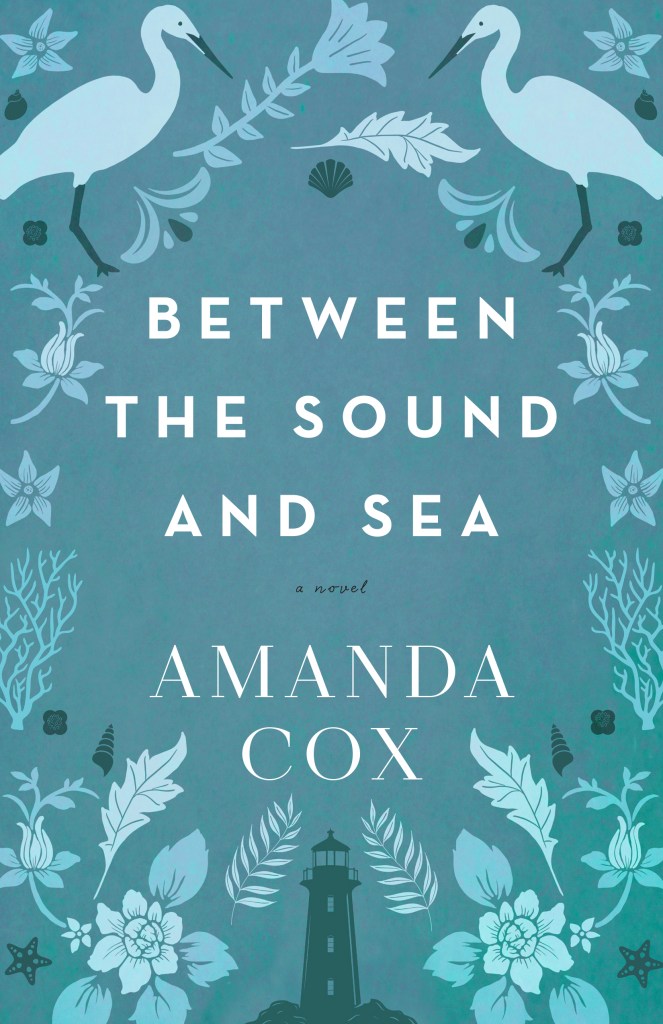
Between the Sound and Sea is “Inspirational Contemporary Fiction with History and Mystery at a North Carolina Lighthouse.” The Sound in the title is Pamlico Sound in the Outer Banks of NC, but the title has several layers of meaning.

Josephina Harris–Joey–owns a fledgling event-planning business in Copper Creek, TN, where she grew up. She had helped her father and brother in their restoration business until her father retired and sold the business. But the new owner cheated people, who, for some reason, blamed Joey’s father. Her parents decided to make a new start in Florida. Joey’s customers have cancelled events one by one

When Joey’s friend sends her an ad about help wanted to restore a lighthouse and cottage on a North Carolina island, Joey decides to apply. If she gets the job, it will give her an income to tide her over and give her time to think about what she should do next.

Joey travels to NC and meets the owner of the lighthouse, 81-year-old Walt O’Hare, and his grandson, Finn. Walt had grown up in the area but left after WWII. His best friend, Cay, short for Cathy, had been the lighthouse keeper’s daughter. During the war, her father’s body had mysteriously washed up on shore, but Cay was never found and presumed dead. Walt wants to restore the lighthouse in their memory. Finn is not so sure this idea of his grandfather’s is a good one and is even less sure Joey is the person for the job. But he acquiesces.

It soon becomes clear that Walt has other reasons for wanting to restore, reasons which he is not sharing.

The people in town tell of strange things happening on the island over the years. Some say ghosts inhabit the island. Others say Cay’s father was working for the Nazis.

As Joey begins restoration, she finds patched-up places in the lighthouse’s inner walls. When one area begins chipping, she discovers what appears to be a lighthouse keeper’s log inside–but the events described don’t match the official logs.

Local lore describes a “Saint Mae” who rescued people lost at sea. Could these logs belong to Mae? But who is she and why is she not listed among the lighthouse keepers?

When accidents and unexplained things start happening around the lighthouse and cottage, Joey wonders what’s at the bottom of it all.

Besides the lighthouse mystery, Joey, Walt, and Finn all deal with regrets from their past and indecision about how to handle the future. There’s a secondary story line involving a teenage boy with a troubled past.

I enjoyed how the story unfolded, sharing what really happened with Cay, who Mae was, how everything connected, and how each character found peace. The restoration of the lighthouse seemed a subtle metaphor for the needed restoration available to each character.

I also loved that the author had Christian characters doing Christian things without being heavy-handed about it. Some Christian fiction is so subtle, there’s almost nothing Christian about it. It’s refreshing to find truly Christian fiction.

A couple of favorite quotes:

God meets us right where we’re at. And maybe things in our lives get broken down and beat up along the way. The good news is restoration work is kind of His specialty.

I’m grateful to have played a role, but I wasn’t the planner orchestrating this event.
This one was in the hands of One far more skilled than I, gently guiding even when we were all half certain we’d lost our way.

A couple of well-worded descriptions caught my ear, too: “the comfort of an oversized sweater worn on a crisp fall morning” and “Her voice was wispy like fog over water.”

I listened to the audiobook read by Rebecca Quinn Robertson, who did an okay job. She spoke too softly sometimes.

As I sat down to write this review, I looked up the book on Amazon and reread the first few pages in their free sample. I had forgotten how it began, with an older woman telling a young boy about Saint Mae. I was delighted to realize who those characters were later in the story.

Overall, this was a great read that I am happy to recommend.

Review: The Librarian of Saint-Malo

The Librarian of Saint-Malo

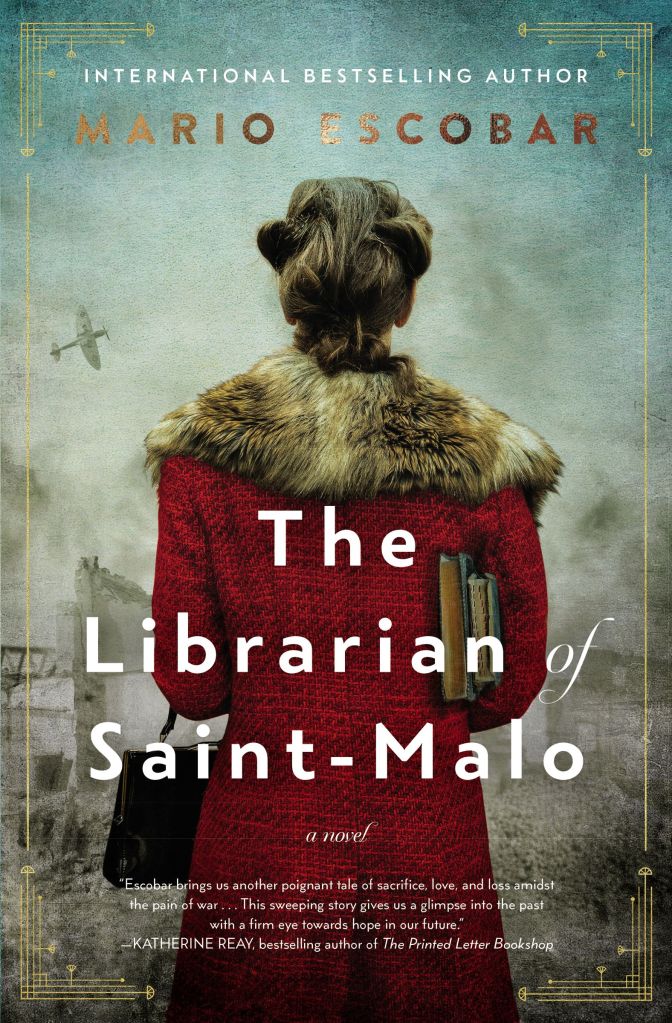
In the novel, The Librarian of Saint-Malo, by Mario Escobar, World War II broke out on the day Jocelyn and Antoine married. She developed tuberculosis on their honeymoon and struggled with her health for a long time.

Jocelyn worked as a librarian’s assistant in Saint-Milo, France, a port city that was once a haven for privateers. Antoine was eventually called for military service. When the Nazis invaded France, Jocelyn and her friend, bookstore owner Denis, hid some of the most valuable and important books away before the Nazis could either destroy or steal them.

A Nazi officer took over one of the bedrooms in Jocelyn’s apartment. The officer in charge of going through the books at the library was kinder and did not search as thoroughly as he could have for forbidden or valuable books.

The longer the Nazis occupied the area, the worse things got: food shortages, restrictions, people being herded and sent to concentrations camps–including Denis.

When the tide turned and the Nazis saw they were beginning to lose the war, they refused to surrender or retreat from Saint-Malo in an effort hold off Allied forces from getting further inland. So the city was besieged by American bombs to try to drive out the Nazis, leaving it nearly totally destroyed.

The book is written as a series of letters from Jocelyn to an author she admires so that he might tell her story. But most of the chapters weren’t really written as letters. When Jocelyn addresses the author at intervals, it seems she does so almost as a reminder to the reader that she’s writing letters.

Escobar writes in his author notes that this book was inspired by a visit he took to Saint-Malo as well as an account of a love story someone shared with him. He shares what circumstances and characters were based on real people.He writes that he “wanted to show the suffering of the common people during the German occupation of France and home in on the terrible persecution that the occupation unleashed on culture and books in particular” (p. ix).

I’ve read a number of WWII novels, mainly because that seems to be the most popular era for historical fiction. Usually this genre details some of the awful things people went through during that time but also highlights the bravery and humanity of the characters and leaves one feeling inspired and hopeful.

But this book fell flat for me, especially the ending. I never really connected with Jocelyn. The fact that this book was translated from another language and written by someone from another culture may have contributed to some of the thinking and conversations seeming a little unnatural to me.

Plus the author had characters, mainly Jocelyn, making sweeping generalizations. At one point she comes to see the wife of the marshal’s daughter because she’s been told letters from her husband have been sent there. She remarks, “I thought about how the rich and powerful never lose a war; they can adapt to any circumstance, as if pain and suffering were never meant for them (p. 46)–as if no one rich or powerful ever suffers. In another place, she says, “Heroism is just selfishness” (p. 46). She writes to her author-correspondent, “Being a writer means feeling things at a deeper level than everyone else and knowing how to communicate those depths, helping readers to see reality in a way they never have before” (p. 112). I agree with the second half of the sentence, but not the first. She tells an officer, “You fail to understand women, Lt. Bauman. We are not moved by ideals—that is a banal game ever played by men. We’re driven by something much deeper that really makes the world turn: affections” (p. 116). That doesn’t make sense to me at all.

And then there’s a vulgar expression that I thought was more modern uttered by the Marshall.

I had thought this was a Christian fiction novel, but it doesn’t seem to be. “Fate” is mentioned several times.

One good thing from the book was learning about Saint-Malo, which I had never heard of before. Somehow it was rebuilt after all the destruction and is now a resort town.

Plus there were a few quotes I loved. A couple of my favorites:

My hope is that someday, when humanity regains its sanity, people will know that the only way to be saved from barbarianism is by love: loving books, loving people, and, though you may call me crazy, loving our enemies. There’s no doubt that love is the most revolutionary choice and, therefore, the most persecuted and reviled (p. 2).

Literature is a weapon against evil (p. 124).

Since Escobar is a new author to me, I looked up several reviews of this book when I saw it on sale. Opinions were mixed. Some, like me, felt the book fell short in some ways; others loved it.

(Sharing with Bookish Bliss Quarterly Link-Up)

Ezekiel: The God of Glory

Ezekiel: The God of Glory

Ezekiel can seem like an intimating book of the Bible at first, with his many visions, odd heavenly creatures, acted-out sermons, and prophecies.

There’s much going on in Ezekiel’s 48 chapters. The basic idea of the book is that Israel has sinned, worshiping other gods and not living the way God told them to. They thought they were okay because they had the temple. After repeated warnings from various prophets, Israel is conquered and exiled by Babylon. Eventually Babylon destroys the temple in Jerusalem. Ezekiel was taken in the first wave of exiles and given the task of preaching to hard-hearted people who don’t listen to him. Some form of the phrase “You will know that I am the LORD” is used around seventy times in the book.

Eventually, God promises “I will give you a new heart, and a new spirit I will put within you. And I will remove the heart of stone from your flesh and give you a heart of flesh. And I will put my Spirit within you, and cause you to walk in my statutes and be careful to obey my rules. You shall dwell in the land that I gave to your fathers, and you shall be my people, and I will be your God. And I will deliver you from all your uncleannesses (Ezekiel 36:26-29). The famous vision in chapter 37 of the valley of dry bones that comes to life is a dramatic picture of what God is going to do in their hearts.

God also promises a coming shepherd-king, the Messiah, and a new temple (with much debate over the years whether this temple is literal or symbolic).

During my last reading of Ezekiel, I used Warren Wiersbe’s Be Reverent (Ezekiel): Bowing Before Our Awesome God as an aide while reading the book in my ESV Study Bible with its notes. Last year, I finished the last of Warren Wiersbe’s 50 “Be” commentaries on different books of the Bible. So I wanted to use a different source this time.

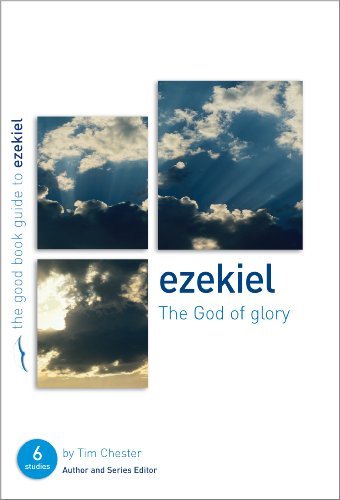
I had enjoyed our ladies’ Bible study’s use of the Good Book Company’s Isaiah for You by Tim Chester and 2 Corinthians for You by Gary Millar so I checked to see if there was a “For You” book for Ezekiel. There wasn’t, but while looking I found Ezekiel: The God of Glory by Tim Chester. It’s a six-week, 63-page study guide providing what the publisher called a “whistle-stop tour” through Ezekiel’s 48 chapters.

Unfortunately, I don’t think this format worked for Ezekiel. Perhaps it’s just too big a book to be covered in six chapters. I’m sure Chester had good reasons or highlighting the chapters he did, but they seemed random. There were several key passages I was surprised weren’t covered in the study.

In Isaiah for You, even though Chester only spent thirteen chapters on Isaiah’s 66 books, he summarized the chapters that came between the ones he covered. That helped orient the passages we did study into the book as a whole. Of course, in a smaller study like the one on Ezekiel, there was not space to do that, but it would have helped.

Each chapter’s study seemed fragmented to me. In fact, I was not getting much out of the study at all and thought perhaps I should get the leader’s guide it referred to, only to discover the guide was included in the back of the book. That helped some.

There were individual nuggets throughout the study that ministered to me and brought out truths from Ezekiel, but I was disappointed in the study as a whole. I don’t think the problem is with Chester’s writing since he did such a good job with Isaiah. I just don’t think this format worked well for Ezekiel. It might do better for some of the Bible’s smaller books.

On a side note, I’d heard about The Bible Project’s videos giving animated summaries of different books of the Bible, but had not seen one until it was used in our ladies’ Bible study as an introduction to Hebrews. I looked up their videos on Ezekiel and found them both fascinating and helpful. Part 1 is here and part 2 is here.

(Sharing with Bookish Bliss Quarterly Link-Up)

Review: Firefly Cove

Firefly Cove is the second in Davis Bunn’s Miramar Bay series.

Lucius Quarterfield lived in the 1960s and developed pleurisy when he was seven. The illness damaged his heart to the point that doctors did not give him long to live.

Though often weak and in pain, when Lucius was grown, he bought a small automobile dealership, which eventually turned into a chain.

He fell in love with a woman named Jessica, who was opposite from him in almost every way. However, since he knew he would die young, he felt it was best to pull away, to spare Jessica the pain of losing him.

After eleven months, he wants to see her and drives back to Miramar. His worst fears are realized when he has a heart attack and dies in her arms.

But then he wakes up in a cold room with a sheet over his face. People call him Luke, not Lucius. His hands and face are not his own. He discovers the date is almost fifty years ahead of his own time.

Nothing in the book’s descriptions said anything about this, and the other books in the series that I have read so far don’t have any kind of supernatural or science fiction elements. So it was jarring. Maybe the author wanted it to be as disorienting to the reader as it would have been to the character.

I don’t believe in reincarnation because Hebrews 9:27 says, “It is appointed for man to die once, and after that comes judgment.” There’s also nothing in Scripture about any human inhabiting any other human’s body. From what I have read of the author, I think he believes the same way. So I am not sure why he would have this occur in his story.

I decided to view the situation as a plot device, just like other impossibilities such as time travel.

In Lucius’s situation, the young man whose body he woke up in had just attempted his third try at suicide. His therapist’s supervisor is ready to have him locked up. He would be even more ready if Lucius told him he had actually lived fifty years before. All Lucius wants to do is find out what happened to Jessica.

Luke’s therapist, a Persian young woman named Asha, notices several differences about him right away. He looks the same but carries himself differently, speaks differently, and has even lost his French-Canadian accent. She and her supervisor think Luke’s “near death experience” led to Dissociative Identity Disorder, or a split personality. Yet he doesn’t manifest certain hallmarks of that illness.

At it’s heart, this book is a love story, though an unconventional one. The story was well-written. We’re drawn in as Lucius’s situation slowly unfolds, figuring out modern gadgets and ways, what kind of man Luke was, how he should proceed, what his future should look like. The characters were well-developed–besides Lucius, I particularly liked Asha and her grandmother. The intrigue of what’s going to happen to Luke–will he ever find Jessica, what will he do when he does, will he be able to avoid being committed to an institution, will anyone else ever believe his story–keeps us engaged, as does Asha’s story. I’m still processing what I think about the book. Even though I normally wouldn’t care for this kind of story, I found it engaging.

I’m inclined to think this might have worked better as a stand-alone novel, except that the theme of the Miramar Bay books has to do with second chances.

(Sharing with Bookish Bliss Quarterly Link-Up)

Review: Miramar Bay

Miramar Bay by Davis Bunn

When I started listening to The Christmas Hummingbird by Davis Bunn, I didn’t realize that it was the eighth novel in a series. The first few books in the series were free for Audible subscribers, so I decided to try them out.

In the first novel, Miramar Bay, Connor Larkin is an actor known for his “bad boy” good looks and for dying onscreen (97 times so far). His current gig is a fake “reality” show featuring his relationship with a Hollywood starlet. But now the studio has written an on-air wedding into the script, and Connor bolts. He had visited Miramar, on California’s central coastline, some years before, and it seemed a quiet place to hide out and think.

Connor steps into a Miramar restaurant playing Sinatra music and is drawn in. He had originally wanted to be a musician playing this type of music, but his early acting roles led him another direction. He finds himself applying for a waiter’s job at the restaurant.

Sylvie Cassick had put all her money and hopes into the restaurant and named it Castaways. Her father had been an artist, a kind man but an impractical dreamer. When her mother left them, Sylvie took on the role of trying to keep things in order and the bills paid. She had not heard from her mother in years, and her father passed away, so she’s on her own. Her staff has become dear friends. But everything hangs by a thread: one major problem or repair could cost her everything.

And then the unthinkable happens when illegal drugs are found in her fish order.

As Conner and Sylvie get to know each other, they bond over music. But when Sylvie learns who Connor really is, she can’t get over the fact that he lied to her.

Miramar is known as a place of second chances. Will Connor and Sylvie find theirs as they each face their separate crises?

Some of the characters in the later book were here, too: the sheriff, the head waitress, and a few others.

I looked online to see if Miramar is a real place, and it is: you can read more here.

I loved the small-town, close-knit community Bunn created. The characters seemed real and relatable. The plot kept me invested and interested.

As with the Christmas book, there’s not much mention of anything of a spiritual nature in this book, though everything else I’ve read from Bunn has been Christian fiction. One character visits a chapel a couple of times and prays for help. Perhaps Bunn meant this as a crossover into the general market, which would then draw readers back to his many other books. This is a good, clean read, but it was a little sad to me that the author, who knows real peace can only be found in Christ, had Connor find his peace in a community.

The only other thing some readers might find objectionable is a fair amount of alcohol consumption. One example: Sylvie’s friends “make” her drink brandy to brace herself before sharing bad news. I know this is an area where good people can differ, but to me alcohol seemed to be mentioned a lot.

I listened to the audiobook nicely read by Graham Winton. If you’re familiar with the Adventures in Odyssey radio program by Focus on the Family, Graham’s voice sounds a lot like the actor who portrays character Jason Whitaker there–so much so, that I had to look up that actor. But that actor’s name is Townsend Coleman.

(Sharing with Bookish Bliss Quarterly Link-Up)

Review: Set the Stars Alight

Set the Stars Alight

In Amanda Dykes’ novel, Set the Stars Alight, Lucy Claremont is the daughter of an English watchmaker whose family invites a young “lost boy” into their circle. Dash grew up in America until both parents died. He lived with a distant aunt who wasn’t home much and seemed not very interested in him.

Lucy’s father loved to tell stories and riddles to the children. Many of his stories centered on a legend about a man who lived 200 years before, Frederick Handford. Handford was a seaman who, accused of treason, stole a boat called the Jubilee and was never heard from again. Many had searched for any sign of Handford or the Jubilee, to no avail. Many stories had been told about what might have happened.

Lucy grew up with a love for the ocean and a desire to research and find the Jubilee. Dash grew up loving the stars, after hearing about them from Lucy’s father and using his homemade telescope. Their interests and circumstances seemed to take them in opposite directions until their paths crossed again while researching the Jubilee.

The story shifts back and forth from 2020 to the 1800s and what really happened with Frederick Handford. He was the son of a respected admiral who, since his own glory days, fell to drink. Frederick grew up with his father on one end of the house, drinking and raging, and his mother at the other end, playing parts of Handel’s Messiah. When his mother died, he ran away to escape his father’s rage and neglect. He was taken in by a kind local shepherd, but inadvertently brought tragedy to the man and his family. Frederick spent the rest of his life trying to make it up to them, especially the man’s daughter, Juliette.

Amanda writes in her author’s notes that this story felt like a set of nesting dolls, with many layers and stories within stories. That’s an apt description.

Amanda’s stories have a way of deeply touching hearts. Her characters are real and flawed, yet their stories are redemptive.

One of my favorite quotes comes from the book comes from a poem titled “The Old Astronomer to His Pupil” by Sarah Williams:

Though my soul may set in darkness, it will rise in perfect light;
I have loved the stars too fondly to be fearful of the night.

A few more quotes that stood out to me:

He is coming, and coming, and coming, and coming after you. In every sunset, in every snatch of birdsong In everything that stirs deep into you and makes you hungry for bigger things, eternal things. That is Him, pursuing you with tenderest grace. In the places so hard they wring your soul. In the places so beautiful they steal your breath. He is there, filling your soul, giving you breath.

Made-up tales that stand through time . . . they are echoes . . . of truth.

I think it’s our duty to keep the stories, to pass them on. It is our duty—and our honor. In a world as dark as ours, we—that is, people—forget how to see the light. So we remind them by telling the truth, fighting the dark, paying attention . . . setting the stars alight. There are things shining brightly all along, if we will notice.

Such freedom, to know our limits. And to know the God who has none.

God had a way of redeeming wounds with the strength of others.

Surprise gave way to curiosity, And curiosity–as it was meant to from the time God breathed life into the great wide world–made way for wonder.”

I listened to the audiobook, which was mostly good except the narrator’s diction wasn’t clear in places. I checked out the e-book from Libby to get the author’s notes and look up some passages.

I thought the modern-day part of the book moved a little slowly at times. But overall, this was a lovely, touching story.

(Sharing with Bookish Bliss Quarterly Link-Up)

Winter Fire: Christmas with G. K. Chesterton

Winter Fire: Christmas with G. K. Chesterton

I’ve not read G. K. Chesterton except for one novel, The Man Who Was Thursday, and a few pithy quotes. The quotes were enough to entice me to read more. So I was excited to see Winter Fire: Christmas with G. K. Chesterton by Ryan Whitaker Smith.

When I looked at the sample of the book at Amazon, however, I was disappointed that the book seemed to be less of Chesterton and more on Smith commenting on Chesterton. I eventually decided to get the book anyway, and I am glad I did.

Smith says that reading Chesterton is an “acquired taste,” and I agree. I would not have gotten nearly so much out of Chesterton’s quotes here without Smith drawing out the meaning.

If you’re not familiar with Chesterton, Wikipedia says he “wrote around 80 books, several hundred poems, some 200 short stories, 4,000 essays (mostly newspaper columns), and several plays. He was a literary and social critic, historian, playwright, novelist, and Catholic theologian and apologist, debater, and mystery writer.” He was a columnist for several newspapers and even wrote some Encyclopedia Britannica entries (including the one for Charles Dickens). He might be known best for his Father Brown stories about a priest who also does detective work.

He was baptized into the Church of England as a child, dabbled in the occult, then came back to the Anglican church as an adult, and later converted to Catholicism. I am curious how and why he embraced Catholicism but haven’t read enough to know his thinking. But “Christian themes and symbolism appear in much of his writing.”

Smith says Chesterton wrote prolifically about Christmas, much more than could be included in this book.

Winter Fire contains thirty days of readings, with Smith expanding on, explaining, and giving the cultural background to quotes about Christmas from some of Chesterton’s essays. After each reading is a Bible verse and questions for thought.

Then there are a variety of Chesterton’s other writings: several poems, a few essays, and a couple of short stories. Finally, Smith included recipes and games prevalent at the time Chesterton lived (1874-1936). The weirdest game, called Snapdragon, involved raisins doused in brandy, then set on fire. Then children tried to reach into the fire quickly and grab a raisin.

One of the readings here inspired a blog post, A Christmas Boomerang, and I have another post or two in mind based on thoughts read here.

Smith says the title of this book “is taken from a quote featured in the reading for Day 13: ‘Christ is not merely a summer sun of the prosperous but a winter fire for the unfortunate.’ The image of a fire burning amid the frosts of winter seemed a fitting image to draw from for a book that not only celebrates the comfort, joy, and revelry of Christmas, but the mercy of God who has called us to His everlasting feast” (p. 12). He writes that “The purpose of our journey is not so much to dwell in ‘the place from which Christmas came,’ but to allow that place to dwell in us, to return to our own country with christened eyes, to look upon our everyday surroundings with a baptized imagination” (p. 17).

I have scores of quotes marked, but I’ll try to share just a few:

In the majestic march of Progress, we have first vulgarised Christmas and then denounced it as vulgar. Christmas has become too commercial; so many of these thinkers would destroy the Christmas that has been spoiled, and preserve the commercialism that has spoiled it” (Chesterton, p. 32).

I have never understood what people mean by domesticity being tame; it seems to me one of the wildest of adventures (Chesterton, p. 45).

Omnipotence and impotence, or divinity and infancy, do definitely make a sort of epigram which a million repetitions cannot turn into a platitude. It is not unreasonable to call it unique. Bethlehem is emphatically a place where extremes meet. (Chesterton, p. 84).

Christmas did not merely borrow certain traditions from paganism; it survived paganism. It was a stronger thing than all the pagan world could offer. It was fiercer than its creeds, more potent than its rituals (Smith, p. 116).

The land endures the harshness of winter in order to be reborn in the vigor of spring. Everywhere we look, nature is rehearsing resurrection, preparing for the day when all things will be made new, when measurable time gives way to immeasurable eternity (Smith, p. 128).

These are a couple of stanzas from Chesterton’s poem “The House of Christmas”:

A Child in a foul stable,
Where the beasts feed and foam;
Only where He was homeless
Are you and I at home;
We have hands that fashion and heads that know
But our hearts we lost—how long ago!
In a place no chart nor ship can show
Under the sky’s dome.

To an open house in the evening
Home shall men come,
To an older place than Eden
And a taller town than Rome.
To the end of the way of the wandering star,
To the things that cannot be and that are,
To the place where God was homeless
And all men are at home.

The book cover, texture, and illustrations have a lovely old-fashioned feel to them.

Chesterton uses a lot of irony, and often. as Smith says, is “saying several things at once” (p. 11). I have question marks at a couple of places in the book. But I was inspired, taught, and encouraged by much that I read, and I am sure I’ll read this again in future Advent seasons.

(Sharing with Bookish Bliss Quarterly Link-Up)

Reading Plans for 2025

Reading Plans for 2025

I like to set some goals for my reading year. If I mean to read more of a certain author, or get to particular titles, those things don’t happen unless I plan for them.

But I also like having flexibility to read a new find or pick up something I am in the mood for or feel the need to read about.

Some of my reading goals this year:

  • One Dickens book I’ve not read yet.
  • A couple of classic books.
  • One C. S. Lewis book I’ve not read yet.
  • A book about writing.
  • A book about productivity, time management, or organization.
  • At least one biography, autobiography, or memoir.
  • A Bible study book.
  • A Christian living book.
  • A book related to midlife or aging.
  • Some of the unread books on my shelves or in my Kindle.

I like reading challenges that help me reach my goals and expand my horizons. Plus, reading challenges are a fun way to share about books we love. But I don’t like being involved in too many because of the record-keeping involved.

These challenges best intersect with my goals:

Mount TBR challenge

Bev at My Reader’s Block hosts the Mount TBR Reading Challenge, where we set a goal to read a certain number of books we already own. Details and rules are here. Bev has set the challenge up in increments of twelve, each set represented by a particular mountain. Last year I read 31 books from my shelves and Kindle app. This year I’m aiming for Mt. Blanc again, which is 24 books.

TBR 25 in '25

The TBR 25 in ’25 Challenge hosted by Rose City Reader dovetails nicely with the Mount TBR challenge. It’s the same idea—to read books you own but haven’t read it (though rereads count, too). The difference is, we aim for 25 and list them some time during the challenge. I don’t have my whole list figured out yet, but I know I want to read Ron Hamilton: The Man Behind the Patch by Shelly Hamilton, Bloom In Your Winter Season by Deborah Malone, Writing for Busy Readers: Communicate More Effectively in the Real World by Todd Rogers and Jessica Lasky-Fink, The Testament by John Grisham (have not read anything by him. I got this at a library sale a few years ago), The Wingfeather series by Andrew Peterson, and Rembrandt Is in the Wind: Learning to Love Art through the Eyes of Faith by Russ Ramsey, to name a few.

I listed this challenge last year but then forgot about it since it was new to me.

2025 Nonfiction Reader Challenge

Shelly Rae at Book’d Out hosts the Nonfiction Reader Challenge. This can be done one of two ways. Shelly has twelve books in different categories that we can aim for. Or we can be a “Nonfiction Grazer” and make our own goals. Although I might hit a few of her categories, I’ll go the grazer route and incorporate the nonfiction goals mentioned above.

Historical Fiction Reading Challenge

Finally, The Intrepid Reader. hosts the Historical Fiction Reading Challenge. A lot of my fictional reads fit this category. I’m going to aim for the Medieval level at 15 books.

Do you have any reading goals or participate in any book challenges?

(Sharing with Bookish Bliss Quarterly Link-Up)

Two Christmas Books

The Everyday Gospel Christmas Devotional was taken from Paul David Tripp’s larger book, Everyday Gospel: A Daily Devotional Connecting Christmas to All of Life. The 25 selections are only two pages, easy to incorporate in one’s devotional time. Each day’s reading begins with Scripture,and they cover a wide variety of topics related to Christmas. Excellent resource.

Some of my favorite quotes from the book:

The beginning of Matthew presents us with a majestic one-time moment in history that you shouldn’t run past in your desire to complete your daily Bible reading. God has recorded and preserved it for you because he wants it to leave you in gratitude and awe. And that awe is meant to capture your heart with such force that it changes the way you think about who you are and how you live your life.

The one who designed us to sing recorded and preserved songs for us. These songs are meant to focus our hearts, instruct us in the ways of the Lord, motivate our joy, and put words to our worship.

The entire biblical story is about a God who gives his creatures what they do not know they need, what they often do not want, and what they could never earn or do for themselves—but which they cannot live without.

The end of the reign of evil on earth began with the birth of Jesus. Later Satan would be defeated at Christ’s temptation, he would be defeated on the cross, and he would be defeated by the empty tomb. Jesus was victorious on our behalf and now reigns in glory. His reign guarantees the end of sin and death and an eternity of peace and righteousness for all who believe. The dragon is defeated. The Son reigns. Hallelujah!

The Christmas Hummingbird by Davis Bunn is perhaps the most unusual Christmas novella I have ever read (or listened to).

Ethan Lange lives in Miramar Bay, CA, and is awakened by banging on his front door. He finds a female police officer telling him an out-of-control fire is heading their way and he must vacate immediately.

A few weeks later, Ethan is in a rental property, having lost everything in the fire. When he runs into the police officer who saved his life, Ryan Eames, she asks if he would be willing to be deputized to help with a problem: people are robbing some of the vacation houses belonging to out-of-towners just before fire reaches them. In fact, police suspect the fires were started on purpose as a cover for the robberies.

As Ethan helps Ryan, he rescues a number of homeless animals, including a hummingbird overcome by smoke. Later we learn why hummingbirds mean so much to Ethan. Ryan’s mostly silent son takes an interest in helping the hummingbird, which he names Trevor.

Ethan contacts homeowners in the affected area offering to transfer their valuables to a vault in his bank.

Ethan has a side interest in art and often makes miniatures used in films to depict cities or neighborhoods. His contact in Hollywood calls to say a company is making a film series of his favorite childhood fantasy series, and does Ethan want in? Yes, of course.

Both Ethan and Ryan have been hurt before, so they are slow to consider another relationship. As Ethan gets to know Ryan and her son, Liam, he forges a special relationship with Liam. He finds that Liam is a gifted artist, though he rarely lets anyone see his work.

I love that there are so many layers to this book: the mystery of the fires and robberies, Ethan’s relationship with both Ryan and Liam individually and together, the hummingbird, the fantasy story Ethan’s latest project is based on.

Most of what I have read from Bunn has been Christian fiction. I don’t recall anything of a spiritual nature mentioned in this book, but I listened to the audiobook read by Graham Winton, and it’s impossible to flip back through pages. Nevertheless, this is a lovely story. I just discovered it’s also part of a Mirarmar Bay series by Bunn.

(Sharing with Bookish Bliss Quarterly Link-Up)

Favorite Books of 2024

I posted all 74 books I read this year here, doubling up on my posts today since they overlap. I felt I had a good variety and enjoyed probably 98% of what I read.

But there are always a few standouts, and this year is no different. Most of these were not published this year, but I am glad I read them in 2024.

My top ten books read in 2024 are:

Adorning the Dark: Thoughts on Community, Calling, and the Mystery of Making by Andrew Peterson. Immediately upon finishing this book, I read it again. I wanted to soak up as much of I as I could. I’m sure I’ll read it again. From my review: “He writes about battling self-doubt, creating as an act of worship, the fact that creating is work, not magic, that writing what we know doesn’t mean the polished end, but the struggle. He writes about humility, self-consciousness, and the fact that we don’t create to draw attention to ourselves even though ‘art is necessarily created by a Self’ (p. 28). He references Lewis and Tolkien and others and talks about imagination, serving the work, and serving the audience.”

Stop Asking Jesus Into Your Heart: How to Know For Sure You Are Saved by J. D. Greear. As one who wrestled with assurance of salvation for decades, and knowing several others in the same boat, I found this book very helpful. From my review: “Satan can trip people up over assurance because if we’re insecure about our salvation, we come to a standstill in our Christian growth. We don’t have the confidence to serve the Lord in any way. Instead of going forward in our Christian lives, we’re spinning our wheels over the same issues. On the other hand, there is such a thing as false assurance. Jesus said there would be people who stand before Him some day, fully assured that they are all right spiritually. They’ll be shocked to hear Him say, ‘I never knew you; depart from me, you workers of lawlessness.'”

Help for the Hungry Soul: Eight Encouragements to Grow Your Appetite for God’s Word by Kristen Wetherell “is not about how to read or study the Bible. She goes further back than that to our appetite for God’s Word. We’re made to hunger for God. Satan tempted Adam and Eve to hunger for the wrong thing for the wrong reasons. Our spiritual appetites have been skewed ever since.”

Life Without Limits: Inspiration for a Ridiculously Good Life by Nick Vujicic. It would be hard to function without limbs. But Nick shares how his parents and others along the way helped him to thrive. I didn’t agree with every little point of theology, but I was inspired by Nick’s story.

Isaiah for You: Enlarging Your Vision of Who God Is by Tim Chester. Our ladies’ Bible study went through this, along with reading Isaiah, last spring. Isaiah has some beautiful, familiar, relatable passages, but others that are a little harder to work through. Chester did a great job explaining the passages with the overarching purpose of the book in mind.

Whose Waves These Are by Amanda Dykes, my favorite fiction book this year. I had never read Amanda before, but I loved this book and am seeking out others of hers. Set in a coastal Maine village, the story goes back and forth between two brothers during WWII and the granddaughter of one in modern times. I loved the story, the writing, the strong sense of place.

Hope Between the Pages by Pepper Basham. Pepper is another new-to-me author. This book is set in the Asheville, NC, area and also goes back and forth between current times and 1915. Modern-day Clara Blackwell owns a bookstore in Biltmore village but is about to lose the store unless she can find the lease. In searching, she discovers her grandmother was the librarian at the Biltmore House in the early 1900s. Books, Biltmore, Asheville–what’s not to love? 🙂 I enjoyed the story in both timelines.

The Edge of Belonging by Amanda Cox. Amanda is yet another new favorite author to me. In this story, a homeless man discovers an abandoned baby. He plans to find a home for her, but grows too attached. But he can’t raise her alone. In the current day, Ivy receives a mysterious letter from her grandmother after her death, sending her on a search for how her family, all unrelated to each other, came together.

The British Booksellers by Kristy Cambron goes back and forth between WWI and the forgotten “Coventry Blitz” of WWII. Amos is the son of a tenant farmer and good friends with the daughter of the manor house. He goes off to fight in WWII and comes back scarred and morose. Charlotte is widowed, and now they own competing bookstores on the same street. But to survive WWII, they’ll all have to learn to work together.

Everything Sad Is Untrue: (A True Story) by Daniel Nayeri has the distinction of being the most “different” book I have ever read in its style. Daniel’s mother became a Christian in Iran and then had to flee the country with her two children. The family deals with many losses and new adjustments. It took a while to get into this book, but I was glad I persevered. I loved it.

Honorable Mention:

What were some of your favorite books read this year?

(I often link up with some of these bloggers.)