Book Review: Mere Christianity

Mere ChristianityI first read Mere Christianity by C. S. Lewis some seven or so years ago and tried to write a review, but ended up mainly just listing quotes, which is not a review. It wasn’t hard to read or to follow — for the most part Lewis’s thinking was actually pretty easy to track, and he writes in a logical, almost conversational style rather than like a theology textbook. It was more a matter of there being too much to take in and process and too many goods things to share to reduce it to anything like a review. I read a quote by Elisabeth Elliot (which I neglected to keep track of) something to the effect that she could understand Lewis by reading him through the first time, but needed to read him again to be able reconstruct his arguments. I feel the same way. I’m thankful The Cloud of Witnesses Challenge sponsored by Becky at Operation Actually Read Bible spurred me to pick this up again. I feel I got much more from it this time, maybe just because of a second reading, maybe because of several years of (hopefully) maturing in the meantime, maybe because our church has been talking about “Coffee Shop Apologetics” on Wednesday nights using some of Lewis’s material here and there.

It is interesting to read how Lewis came from an atheistic background and what the Lord used to convince him that Christianity was the truth. Although this book is not his “testimony” per se, he does touch on his own personal journey to faith.

The book is divided into four sections: “Right and Wrong as a Clue to Meaning in the Universe,” in which he argues for Christianity and why it is the best solution to universal moral and logical dilemmas, then “What Christians Believe,” “Christian Behavior,” and “Beyond Personality: Or First Steps in the Doctrine of the Trinity.” Originally the various segments were radio talks in the 1940s which were then tweaked to better fit written form.

I have many more places marked than I can possibly share here. Goodreads has a list of several quotes from the book, some you’ll recognize as classic Lewis. One of my favorite quotes about love comes from this book. Here are a few others hat stood out to me:

From the chapter “We Have Cause to Be Uneasy”:

For the trouble is that one part of you is on His side and really agrees with his disapproval of human greed and trickery and exploitation. You may want Him to make an exception in your own case, to let you off this one time; but you know at bottom that unless the power behind the world really and unalterably detests that sort of behaviour, then He cannot be good. On the other hand, we know that if there does exist an absolute goodness it must hate most of what we do. This is the terrible fix we are in. If the universe is not governed by an absolute goodness, then all our efforts are in the long run hopeless. But if it is, then we are making ourselves enemies to that goodness every day, and are not in the least likely to do any better tomorrow, and so our case is hopeless again. We cannot do without it, and we cannot do with it. God is the only comfort, He is also the supreme terror: the thing we must need and the thing we most want to hide from. He is our only possible ally, and we have made ourselves His enemies. Some people talk as if meeting the gaze of absolute goodness would be fun. They need to think again. They are still only playing with religion. Goodness is either the great safety or the great danger -according to the way you react to it. And we have reacted the wrong way.

From the chapter “The Practical Conclusion”:

[The Christian] does not think God will love us because we are good, but that God will make us good because he loves us.

From the chapter “Social Morality”:

I may repeat “Do as you would be done by” till I am black in the face, but I cannot really carry it out till I love my neighbor as myself: and I cannot learn to love my neighbor as myself until I learn to love God.

From the chapter “Sexual Morality”:

We may, indeed, be sure that perfect chastity-like perfect charity-will not be attained by any merely human efforts. You must ask for God’s help. Even when you have done so, it may seem to you for a long time that no help, or less help than you need, is being given. Never mind. After each failure, ask forgiveness, pick yourself up and try again. Very often what God first helps us towards is not the virtue itself but just this power of always trying again. For however important chastity (or courage, or truthfulness, or any other virtue) may be, this process trains us in habits of the soul which are more important still. It cures our illusions about ourselves and teaches us to depend on God. We learn, on the one hand, that we cannot trust ourselves even in our best moments, and, on the other, that we need not despair even in our worst, for our failures are forgiven. The only fatal thing is to sit down content with anything less than perfection.

From the chapter “The Great Sin”:

Pleasure in being praised is not Pride. The child who is patted on the back for doing a lesson well, the woman whose beauty is praised by her lover, the saved soul to whom Christ says, “Well done,” are all pleased and ought to be. For here the pleasure lies not in what you are but in the fact that you have pleased someone you wanted (and rightly wanted) to please. The trouble begins when you pass from thinking, “I have pleased him; all is well,” to thinking, “What a fine person I must be to have done it.”

That was immensely helpful to me. I don’t know if anyone else experiences this, but sometimes when you receive a compliment, then you feel a rush of pleasure, that feel guilty for that pleasure and feel you need to redirect the attention to the Lord, and in trying to do so sound awkward and overly pious. For that reason, when someone, say, sings a solo in church that I enjoyed, I try to tell them it blessed my heart rather than just “I enjoyed your song this morning.” Though I mean the same thing by both sentences, the second one makes people feel awkward and self-conscious. This thought did help me to understand it’s not wrong to feel pleasure in pleasing someone else or accepting a compliment.

From the same chapter:

Do not imagine that if you meet a really humble man he will be what most people call “humble” nowadays: he will not be a sort of greasy smarmy person, who is always telling you that, of course, he is a nobody. Probably all you will think about him is that he seemed a cheerful, intelligent chap who tool a real interest in what you said to him….He will not be thinking about humility: he will not be thinking about himself at all.

From the chapter “Charity”:

Good and evil both increase at compound interest. That is why the little decisions you and I make every day are of such infinite importance. The smallest good act to-day is the capture of a strategic point from which, a few months later, you may be able to go on to victories you never dreamed of. An apparently trivial indulgence in lust or, anger to-day is the loss of a ridge or railway line or bridgehead from which the enemy may launch an attack otherwise impossible.

From the same chapter:

Nobody can always have devout feelings: and even if we could, feelings are not what God principally cares about. Christian Love, either towards God or towards man, is an affair of the will. If we are trying to do His will we are obeying the commandment, ‘Thou shalt love the Lord thy God.’ He will give us feelings of love if He pleases. We cannot create them for ourselves, and we must not demand them as a right. But the great thing to remember is that, though our feelings come and go, His love for us does not. It is not wearied by our sins, or our indifference; and, therefore, it is quite relentless in its determination that we shall be cured of those sins, at whatever cost to us, at whatever cost to Him.

From the chapter “Hope”:

If I find in myself a desire which no experience in this world can satisfy, the most probable explanation is that I was made for another world. If none of my earthly pleasures satisfy it, that does not prove that the universe is a fraud. Probably earthly pleasures were never meant to satisfy it, but only to arouse it, to suggest the real thing. If that is so, I must take care, on the one hand, never to despise, or be unthankful for, these earthly blessings, and on the other, never to mistake them for the something else of which they are only a kind of copy, or echo, or mirage. I must keep alive in myself the desire for my true country, which I shall not find till after death; I must never let it get snowed under or turned aside; I must make it the main object of life to press on to that other country and to help others to do the same.

From the chapter “Faith”:

But supposing a man’s reason once decides that the weight of the evidence is for [Christianity]. I can tell that man what is going to happen to him in the next few weeks. There will come a moment when there is bad news, or he is in trouble, or is living among a lot of other people who do not believe it, and all at once his emotions will rise up and carry out a sort of blitz on his belief. Or else there will come a moment when he wants a woman, or wants to tell a lie, or feels very pleased with himself, or sees a chance of making a little money in some way that is not perfectly fair: some moment, in fact, at which it would be very convenient if Christianity were not true. And once again his wishes and desires will carry out a blitz. I am not talking of moments at which any real new reasons against Christianity turn up. Those have to be faced and that is a different matter. I am talking about moments when a mere mood rises up against it.

Now Faith, in the sense in which I am here using the word, is the art of holding on to things your reason has once accepted in spite of your changing moods. For moods will change, whatever view your reason takes. I know that by experience. Now that I am a Christian I do have moods in which the whole thing looks very improbable: but when I was an atheist I had moods in which Christianity looked terribly probable. This rebellion of your moods against your real self is going to come anyway. That is why Faith is such a necessary virtue unless you teach your moods ‘where they get off,’ you can never be either a sound Christian or even a sound atheist, but just a creature dithering to and fro, with its beliefs really dependent on the weather and the state of its digestion. Consequently one must train the habit of Faith.

From a second chapter titles “Faith”:

And, in yet another sense, handing everything over to Christ does not, of course, mean that you stop trying. To trust Him means, of course, trying to do all that He says. There would be no sense in saying you trusted a person if you would not take his advice. Thus if you have really handed yourself over to Him, it must follow that you are trying to obey Him. But trying in a new way, a less worried way. Not doing these things in order to be saved, but because He has begun to save you already. Not hoping to get to Heaven as a reward for your actions, but inevitably wanting to act in a certain way because a first faint gleam of Heaven is already inside you (emphasis mine).

From the chapter “Nice People or New Men”:

But we must not suppose that even if we succeeded in making everyone nice we should have saved their souls. A world of nice people, content in their own niceness, looking no further, turned away from God, would be just as desperately in need of salvation as a miserable world – and might even be more difficult to save.

For mere improvement is not redemption, though redemption always improves people even here and now and will, in the end, improve them to a degree we cannot yet imagine. God became man to turn creatures into sons: not simply to produce better men of the old kind but to produce a new kind of man…

If what you want is an argument against Christianity (and I well remember how eagerly I looked for such arguments when I began to be afraid it was true) you can easily find some stupid and unsatisfactory Christian and say, ‘So there’s your boasted new man I Give me the old kind.’ But if once you have begun to see that Christianity is on other grounds probable, you will know in your heart that this is only evading the issue. What can you ever really know of other people’s souls-of their temptations, their opportunities, their struggles? One soul in the whole creation you do know: and it is the only one whose fate is placed in your hands. If there is a God, you are, in a sense, alone with Him. You cannot put Him off with speculations about your next door neighbours or memories of what you have read in books. What will all that chatter and hearsay count (will you even be able to remember it?) when the anaesthetic fog which we call ‘nature’ or `the real world’ fades away and the Presence in which you have always stood becomes palpable, immediate, and unavoidable?

There were a very few places I disagreed with him. In “The Perfect Penitent” he thinks the theory “about our being let off because Christ had volunteered to bear a punishment instead of us” is a silly one and says he doesn’t understand the point of punishing an innocent person for a guilty one, though he says he can understand it better in terms of paying a debt. I’m not sure how he could have missed the teaching that God’s just letting us off the hook would be a violation of His justice and righteousness, and Christ’s innocent death satisfied that justice (Romans 3:24-26). In “The Practical Conclusion” he says “a Christian can lose the Christ-life which has been put into him, and he has to make efforts to keep it,” which I would disagree with very much. When we’re saved we are born again: we don’t get unborn. Our spiritual life may get weak and sickly with neglect, and we do need to nurture that life and mature in it, but we don’t lose it. Then in “Counting the Cost” he says that God said in the Bible that we are “gods” and “He will make the feeblest and filthiest of us into a god or goddess, dazzling, radiant, immortal creature…which reflects back to God perfectly (though, of course, on a smaller scale) His own boundless power and delight and goodness)”. I’m not quite sure how to take him there. Both Psalm 82:6-7 and John 10:34-36 have the term “You are gods,” and, frankly, I am not quite sure what is meant in those cases, either. The Bible talks about us becoming one with the Father and Son and becoming partakers of the divine nature, but we don’t become Deity like Christ is. I don’t think Lewis is saying that we do – I am just not sure what he is saying. If you’ve read his Space Trilogy, you know he portrays the mythical gods and goddesses as some kind of created being more powerful than humans but not like angels, either. Perhaps all he is talking about it what we’ll be like in glory: perfected yet still less than God the Father and Jesus Christ. And in “The Practical Conclusion,” he says that three things that spread the “Christ-life” to us are baptism, belief, and communion (the Lord’s Supper). I would say only faith does: the others are matters of obedience and blessing, but they are symbolic and not life-giving in themselves (see the outline for “Why We Know Baptism Does Not Save.”)

Much more could be discussed, on these points or others in the book. Despite those few caveats mentioned, I feel this is a valuable book and one of those Christian classics that everyone should read at least once, probably several times over.

(This will also be linked to Semicolon‘s Saturday Review of Books.)

Book Review: The Great Divorce

the-great-divorceI first picked up The Great Divorce by C. S. Lewis some years ago when I found it on sale in a bookstore. I wasn’t sure what kind of divorce the title was talking about, and the description on the front about a bus ride from hell to heaven seemed really weird, but it was Lewis and it was on sale, so I got it. But it sat around for all these years unopened. The TBR challenge of reading things that have been unread on our shelves spurred me to work this book in this year.

Lewis explains in the preface that the title and concept came in response to William Blake’s book The Marriage of Heaven and Hell. Lewis explains that there can be no such marriage.

“We are not living in a world where all roads are radii of a circle and where all, if followed long enough, will therefore draw gradually nearer and finally meet at the centre: rather in a world where every road, after a few miles, forks in two, and each of those into two again, and at each road you must make a decision. Even on a biological level life is not like a river but like a tree. It does not move towards unity but away from it and the creatures grow further apart as they increase in perfection. Good, as it ripens, becomes continually more different not only from evil but also from other good.”

“Evil can be undone, but it cannot ‘develop’ into good. Time does not heal it.”

To illustrate some of those fork-in-the-road choices as well as the opposite directions of heaven and hell, Lewis developed this fantasy of a group of people on a bus ride from hell to visit heaven. When they arrive, they are surprised to find that they are transparent and that contact with solid objects is painful (“It will hurt at first, until your feet are hardened. Reality is harsh to the feet of shadows.”) They are called ghosts, whereas the inhabitants who come to meet them are called Solid People or Spirits. Most of the people decide not to stay for various reasons, despite the Spirits encouraging them to put away whatever is holding them back and enter into joy.

The cleric who does not believe in absolutes refuses to believe in them still: “For me there is no such thing as a final answer. The free wind of inquiry must always continue to blow through the mind, must it not? ‘Prove all things’…to travel hopefully is better than to arrive.” The Spirit speaking with him, a friend he knew in life, responds, “If that were true…how could anyone travel hopefully? There would be nothing to hope for.” The artist prefers his painting to reality. “Every poet and musician and artist, but for Grace, is drawn away from the love of the thing he tells, to the love of the telling till, down in Deep Hell, they cannot be interested in God at all but only in what they say about Him.” The overbearing wife wants to continue “managing” her husband. The mother who has developed motherly love into idolatry would rather take her son from heaven back to hell with her than lessen her focus from him to love God. “Mother love…is the highest and holiest feeling in human nature,” she says, and is told, “No natural feelings are high or low, holy or unholy, in themselves. They are all holy when God’s hand is on the rein. They all go bad when they set up on their own and make themselves into false gods.” The man who lives for manipulating people with his self-pity is told, “Did you think joy was created to live always under that threat? Always defenseless against those who would rather be miserable than have their self-will crossed?”

But a few are willing to have their besetting sins taken and killed, and they grow more “solid.”

“There are only two kinds of people in the end: those who say to God, “Thy will be done,” and those to whom God says, in the end, “Thy will be done.” All that are in Hell, choose it. Without that self-choice there could be no Hell. No soul that seriously and constantly desires joy will ever miss it. Those who seek find. To those who knock it is opened. ”

“Good beats upon the damned incessantly as sound waves beat on the ears of the deaf, but they cannot receive it. Their fists are clenched, their teeth are clenched, their eyes fast shut. First they will not, in the end they cannot, open their hands for gifts, or their mouth for food, or their eyes to see.”

Lewis, or the narrator, finds George MacDonald, someone he has greatly looked up to and learned from, who then becomes a guide and teacher for him, similar to Dante and Virgil in The Divine Comedy.

Lewis assures in the preface that he is not writing to propose anything about what heaven might be like: he is simply using this scenario as a vehicle to discuss truths.

There are a few similar themes as are found in The Last Battle, the last book in the Narnia series written about 10-11 years later: the idea of moving “further up and further in” and the effusive joy of heaven.

I don’t know if Lewis believed in a purgatory or if he was just using the idea of the dead getting “second chances” to illustrate that many of them would not take it. The Bible says in Hebrews 9:27 that “it is appointed for man to die once, and after that comes judgment,” so I would have a problem with this book promoting the idea of purgatory, but I think the whole second chance scenario is just part of the plot device.

One character in the book says, “Hell is a state of mind – ye never said a truer word. And every state of mind, left to itself, every shutting up of the creature within the dungeon of its own mind – is, in the end, Hell. But Heaven is not a state of mind. Heaven is reality itself. All that is fully real is Heavenly. For all that can be shaken will be shaken and only the unshakeable remains.”  Again, I don’t know if the idea of hell being just a state of mind was part of Lewis’s own philosophy or if it was just the nature of it in this as a fantasy, but the Bible does speak of hell with literal terminology.

Overall this was quite a fascinating and thought-provoking read.

(This will also be linked to Semicolon‘s Saturday Review of Books.)
Laudable Linkage

Here are some noteworthy reads from the last week:

How Not to View Your Devotions, HT to Kim. Excellent.

The Value of a Long-Term Struggle.

A Slave in My Own Kingdom, something learned from a C. S. Lewis’s The Silver Chair.

5 Things to Do Before Leaving Your Church.

Gospel-Centered Sex?

Half a Century Since C. S. Lewis. I mentioned this yesterday but wanted to note it here as well.

Narnia Through the Ages, a photo essay of covers of C. S. Lewis’s The Lion, the Witch, and the Wardrobe over the years, HT to Janet.

Blessing Mix, a neat idea to give out at Thanksgiving along with a little printable tag, HT to Julia.

Hope you have a great weekend!

Book Review: A Severe Mercy

Severe MercyThere are several tracks of interest in A Severe Mercy by Sheldon Vanauken. The first is his love story with his wife, nicknamed Davy, her death, and how he dealt with it (no spoiler there: it’s mentioned up front and the whole book is colored by her death). The second is their journey from condescending atheism to Christianity, and the third is their friendship with C. S. Lewis.

The book begins, of course, with their meeting and falling quickly in love. They had a penchant for naming everything: cars, houses, events, periods in their history. They constructed what they called the Shining Barrier around their love:

The Shining Barrier – the shield of our love. A walled garden. A fence around a young tree to keep the deer from nibbling it. An fortified place with the walls and watchtowers gleaming white like the cliffs of England. The Shining Barrier – we called it so from the first – protecting the green tree of our love. And yet in another sense, it was our love itself, made strong within, that was the Shining Barrier (p. 36).

They promised to share everything in life, even to the point of deciding not to have children (because they couldn’t share in that experience equally and a child might divert their love for each other) and declaring that one would not die without the other.

They called this their pagan love, this era their pagan days, either because they were not believers at this time, or they made idols out of each other and their love, or both.

They had the opportunity to go to Oxford for a time and there met some fellow students who were Christians. They had been rather scornful of Christianity to this point, but these friends were kind, intellectual, wonderful to talk to, and they decided perhaps they should study Christianity out just to find out for themselves what they believed about it and to be fair. They read Pilgrim’s Progress, Augustine’s Confessions, and a multitude of other books, but the ones that impacted them the most were C. S. Lewis’s, who “could…swiftly cut through anything that even approached fuzzy thinking” (pp. 108-109). Vanauken wrote to Lewis a couple of times with questions which Lewis graciously answered. The book details their thought processes during this time, with Davy coming to believe first and Sheldon a couple of months later.

They thrived and grew for months, but eventually realized that Christianity itself was a breach to their “Shining Barrier.” After a while Sheldon “wanted life itself, the colour and fire and loveliness of life. And Christ now and then, like a loved poem I could read when I wanted to. I didn’t want us to be swallowed up in God….But for Davy, to live was Christ…His service was her freedom, her joy” (p. 136). He was jealous of her relationship with God and resented the intrusion of love for Christ for a time but, admitting one “cannot be only ‘incidentally a Christian.’ The fact of Christianity must be overwhelmingly first or nothing,” he eventually came to the point of realizing and being willing for full surrender himself.

Then vague symptoms Davy was having became a serious illness and then a terminal one, and the author shares the details and struggles of that time. He felt the “severe mercy” was God’s taking Davy from him in light of the fact that he still had a tendency to idolize her and their love. Perhaps. We don’t see the whole picture as God does, nor can we know all of His purposes for what He does. Davy was willing to go, even offered up her life to God for Sheldon, and God’s answer to that prayer was evidently what was best for both of them. “[Her death] saved our love from perishing in one of the other ways that love could perish. Would I not rather our love go through death than hate?”

They had visited with C. S. Lewis several times while in Oxford and their correspondence with him continued. It was interesting viewing him as someone’s friend and the impressions he made when he came to their apartment. Some 18 of his letters are included in the book. I enjoyed seeing a dashed-off note sprinkled with abbreviations yet still full of razor-sharp wit and clarity. His encouragement in Sheldon’s grief came full circle when he married Joy Davidson, came to love her, and then saw her through illness and death. Though grieving, Sheldon and Lewis both saw death as “an act which consummates, not…merely stops, the earthly life” (p. 183).

It took me a while to get into the book. My more left-brained practicality couldn’t quite fathom some of the more right-brained conversations they had at first. But after a while much in the book resonated and inspired me, especially their journey to faith and its implications on their lives. I wouldn’t agree with every little point in their theology and doctrine but I don’t feel the need to dissect that here: most of my quibbles were minor. I did enjoy each of the tracks of interest.

(This will also be linked to Semicolon‘s Saturday Review of Books.)

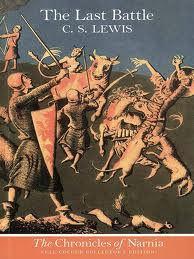
Book Review: The Last Battle

Last BattleThe Last Battle is the last book in the Narnia series by C. S. Lewis. It opens with a false Aslan: a confused donkey coerced to wear a lion skin by a conniving ape, who in turn is being controlled by others. In Aslan’s name, talking beasts are turned into slaves, dryads are dying because their trees are being cut down, Calormenes are overseers. Strange things are afoot, everything seems not quite right to everyone, but Aslan is not a tame lion, after all, so his ways will of course be a little different, and they think they must obey.

King Tirian sees at once that something is wrong, but he sets off rashly without thinking and winds up in trouble, He calls out for help, and Eustace and Jill show up. Together with the few Narnians who don’t believe in the false Aslan, they wage a last battle to save Narnia.

Even though the Narnia series is not an allegory per se, it’s still not hard to see the Biblical allusions to the end times and the antichrist. In Narnia as on Earth, things will get much, much worse before the end comes. And “Aslan’s country” has always typified heaven. All the beasts and creatures and people going “further up and further in” to Aslan’s country, the joyful reunions with those who have gone before, the sense that “this is what I have been seeking and waiting for my whole life” are the best parts of the books to me.

I think this time through the series, that is most what I have carried away with me: that longing, as in the song “Beulah Land”: “I’m kind of homesick for a country where I’ve never been before.” I have to admit that too often I am caught up with the joys and cares of this life. I look forward to having no more sin, sorrow, suffering, and tears some day, but I don’t always carry that personal longing just to be with Christ there, and this series as a whole stirs up that longing for Narnia and Aslan that all who visit experience while they’re away. It calls to mind Biblical texts like Hebrews 11:16: “But now they desire a better country, that is, an heavenly: wherefore God is not ashamed to be called their God: for he hath prepared for them a city,” and Colossians 3:1-2: “If ye then be risen with Christ, seek those things which are above, where Christ sitteth on the right hand of God. Set your affection on things above, not on things on the earth,” as well as Lewis’s own words from Mere Christianity: , “If I find in myself a desire which no experience in this world can satisfy, the most probable explanation is that I was made for another world…I must [therefore] keep alive in myself the desire for my true country, which I shall not find til after death.”

There is sadness for those who choose not to believe, such as the dwarves who are only for the dwarves and refuse to be “taken in.” As Aslan says, “They will not let us help them. They have chosen cunning instead of belief. Their prison is only in their own minds, yet they are in that prison, and so afraid of being taken in that they cannot be taken out.” Unfortunately there will be people like that as well.

There is a point of confusion with the Calormene Emeth, who served the Calormene god Tash, yet is admitted to Aslan’s country, not because Tash and Aslan are one, as some tried to proclaim (Aslan shook the earth with his growl at the very thought), but because Aslan took to himself everything Emeth had done for Tash. For, he says, “he and I are of such different kinds that no service which is vile can be done to me, and none which is not vile can be done to him. Therefore if any man swear by Tash and keep his oath for the oath’s sake, it is by me that he has truly sworn, though he knew it not, and it is I who reward him. And if any man do a cruelty in my name, then, though he says the name Aslan, it is Tash whom he serves and by Tash his deed is accepted…unless thy desire had been for me thou wouldst not have sought so long and so truly. For all find what they truly seek.” I don’t know how much of this reflects Lewis’s personal belief system, but I can’t endorse the idea that someone sincerely serving and seeking a false God is really serving the one true God unaware.

A couple of my favorite quotes:

“I have come home at last! This is my real country! I belong here. This is the land I have been looking for all my life, though I never knew it til now. The reason why we loved the old Narnia is that it sometimes looked a little like this.”

“Your father and mother and all of you are – as you used to call it in the Shadowlands – dead. The term is over: the holidays have begin. The dream is ended: this is the morning.”

It was only the beginning of the real story. All their life in this world and all their adventures in Narnia had only been the cover and title page: now, at last they were beginning Chapter One of the Great Story which no one on earth has read, which goes on forever.”

I have to thank Carrie for sponsoring the Chronicles of Narnia Reading Challenge, which spurred me on to revisit the series. I’ve so enjoyed being in Narnia again! I also marvel at how someone with an intellect as large and complex as Lewis’s can write something simple enough for children to understand yet engaging to adults, too, with such nobility and depth and beauty.

Here are my posts from the whole series:

The Lion, the Witch, and the Wardrobe
Prince Caspian
Voyage of the Dawn-Treader
The Silver Chair
The Horse and His Boy
The Magician’s Nephew
The Lion, the Witch, and the Wardrobe Graphic Novel.
The Way Into Narnia
Narnian Magic.

Chronicles of Narnia Reading Challenge

(This will also be linked to Semicolon‘s Saturday Review of Books.)
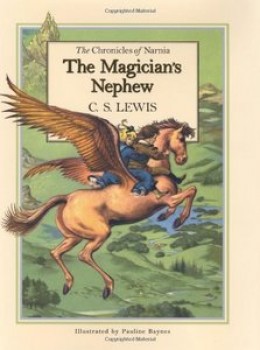
Book Review: The Magician’s Nephew

Magicians NephewI read The Magician’s Nephew by C. S. Lewis for Carrie‘s Chronicles of Narnia Reading Challenge. It’s the fifth book in order of publication but the first book in the Narnian time line. I liked reading it as the fifth book very much, and I’ll tell you why in a moment.

The story opens with two children, Digory and Polly, meeting. Polly lives in London, and Digory has just come there to stay with an aunt and uncle because his mother is very ill and his father is in India. Digory is not happy about leaving his pony and nice home in the country to come to London, and he is concerned about his mother, but after his meeting with Polly gets off to a shaky start, they become friends.

Digory’s uncle is thought by some to be mad, but if he’s not exactly mad, he’s at least strange. One day Digory and Polly go exploring in an attic corridor that seems to run along the length of the row of houses (the description of stepping on the rafters reminds me of a description of Lewis doing the same thing when he has a boy in a biography I read years ago – I don’t remember which one). They’re trying to get to an empty house to explore, but they miscalculate and find themselves in Uncle Andrew’s attic room. He dabbles in magic and has made some rings which he thinks sends people to other worlds – at least that seems to be what’s happened to the guinea pigs he has sent through. He suddenly sends Polly through and then manipulates Digory into going after her.

The children find themselves in what looks like a land of ancient ruins, where Digory inadvertently awakens an ancient evil, which follows them to London and causes a ruckus. In trying to get everyone back where they belong, they end up in an uninhabited world, and witness the creation of Narnia, beautifully and wonderfully described.

But they’ve brought the evil with them into the brand new world on its first day, which Aslan predicts will cause further evil later, but he promises to “see to it that the worst falls upon myself,” an echo of Christ’s taking the punishment for our evil on Himself.

More of those echoes to Biblical truth are found when Aslan breathes life into his creatures, when Aslan questions Digory as to how the evil came to be in Narnia, and Digory finds that Aslan won’t let him fudge the truth at all, when Digory concludes “the Lion was not at all the sort of person one could try to make bargains with,” with the freedom of choice that might lead to evil and its consequences, when Digory is sent to retrieve a particular apple from a particular tree enclosed by a particular gate and reads a sign that one must come through the gate, that stealing or climbing over the wall will lead one to despair, when Digory is tempted by forbeidden fruit, when Aslan welcomes him back from his quest with “Well done,” and probably in other ways as well which I am not remembering. With this book as well as the others, as Aslan told the children in Voyage of the Dawn-Treader, “You were brought to Narnia, that by knowing me here for a little, you may know me better there.”

I’m leaving our great chunks of the story on purpose so as not to spoil it for those who haven’t read it yet. But this book as well as the others leaves me with an appreciation of its underlying truths and a wistfulness for Narnia.

And personally, I think I got so much more out of this book reading it at this stage rather than the beginning because of the thrill and anticipation when I recognized certain connections – realizing just who the children were waking up, recognizing the lamppost in the woods as that lamppost, finding out who Digory turns out to be, etc.. If I had read this book first I think I would have had a hard time caring much about what was going on with Digory and Polly at the beginning: I even had to almost fight to care this time, even knowing, from having read the book before, where their adventures were going to lead. But I suppose people who read this book first might experience the same thrill of recognition when they get to The Lion, the Witch, and the Wardrobe. It’s just hard for me to fathom experiencing these stories without starting there.

I ended up loving this book much more than I thought I would at the beginning, and I’m very much looking forward to The Last Battle next.

(This will also be linked to Semicolon‘s Saturday Review of Books.)

C. S. Lewis on love

From Mere Christianity by C. S. Lewis:

Being in love is a good thing, but it is not the best thing. There are many things below it, but there are also many things above it. You cannot make it the basis of a whole life. It is a noble feeling, but it is still a feeling. Now no feeling can be relied on to last in its full intensity, or even to last at all. Knowledge can last, principles can last, habits can last; but feelings come and go. And in fact, whatever people say, the state called “being in love” usually does not last. If the old fairy-tale ending “They lived happily ever after” is taken to mean “They felt for the next fifty years exactly as they felt the day before they were married,” then it says what probably was never was or ever could be true, and would be highly undesirable if it were. Who could bear to live in that excitement for even five years? What would become of your work, your appetite, your sleep, your friendships? But, of course, ceasing to be “in love” need not mean ceasing to love. Love in this second sense — love as distinct from “being in love” is not merely a feeling. It is a deep unity, maintained by the will and deliberately strengthened by habit; reinforced by (in Christian marriages) the grace which both partners ask, and receive, from God. They can have this love for each other even at those moments when they do not like each other; as you love yourself even when you do not like yourself. They can retain this love even when each would easily, if they allowed themselves, be “in love” with someone else. “Being in love” first moved them to promise fidelity: this quieter love enables them to keep the promise. It is on this love that the engine of marriage is run: being in love was the explosion that started it.