Review: North! Or Be Eaten

North! Or Be Eaten

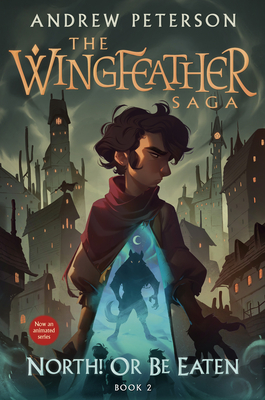
North! Or Be Eaten is the second of Andrew Peterson’s Wingfeather Saga for children.

In the first book, On the Edge of the Dark Sea of Darkness (linked to my review), we met the Igiby family: grandfather Podo, mother Nia, sons Janner and Tink, and daughter Leeli. They lived in Skree, which is under the domination of the Fangs of Dang, headed by Gnag the Nameless.

At the end of the first book (spoiler alert if you haven’t read it), the children are stunned to learn that they are the lost Jewels of fabled Anniera. Their father was the High King.

Unfortunately, the Fangs figure this out as well. They raze the town, burn the Igiby’s home, and pursue them. Podo’s plan is to make it to the Ice Prairies, which the lizard-like Fangs can’t tolerate. Once there, they can decide what to do next.

Thus the family sets out on an epic quest “through many dangers, toils, and snares.”

They are accosted by the Stranders, rough, fierce people who live in Glipwood Forest and have no conscience about stealing and kidnapping. Yet they find a couple of people of character even there.

They get separated at Dugtown, which, oddly, lacks children–and soon find out why.

While searching for the lost Tink, Janner gets whisked away to the deceptively named Fork Factory, where there is no escape.

They are betrayed by those they thought were friends. But they find aid in unexpected sources.

Along the way, they battle not only the enemies pursuing them, but themselves. When the journey is quiet, the children are told more about the kingdom and their established roles in it. Leeli is fine with hers and seems to have been fulfilling it already. But the boys take longer to absorb the news and aren’t so sure they want the responsibility.

However, their trials and hardships bring home to their hearts what is most important. And when things seem at their lowest, “darkness is seldom complete, and even when it is, the pinprick of light is not long in coming–and finer for the great shroud that surrounds it” (p. 312).

One whose hidden past caught up with him “moved through the days in peace and wonder, for his whole story had been told for the first time, and he found that he was still loved” (p. 323).

The first book took a while to set up the characters and situation. This book dove right into the action. There’s a lot less humor in this book than the first, but I felt the first went a little overboard in that department. There aren’t many occasions for full-blown humor in this book, but it’s tucked in here and there.

Besides trusting “the Maker,” family, bravery, and overcoming, it seemed to me that identity was a key theme. Though Janner struggled with his role in the kingdom, remembering who he really was helped him in the Fork Factory, where all the workers were only called “Tools” and treated as such.

The book is wonderfully illustrated by Joe Sutphin. I think the boy on the front cover is supposed to be Tink, who looks a lot like former Monkee Michael Nesmith. 🙂 I don’t think that’s purposeful, as neither author nor illustrator are old enough to have been Monkee’s fans. But it was a fun connection.

I enjoyed the book a lot, especially the latter third of it. There are two more books in the series. I look forward to what happens to the Igiby family next.
Review: Little Lord Fauntleroy

Little Lord Fauntleroy has never been on my to-read lists. But I was looking through Audible‘s Plus Catalog of free books they rotate in and out, and this title caught my eye. I saw that the novel was written by Frances Hodgson Burnett, who also wrote The Little Princess, which I loved, and The Secret Garden, which I had mixed emotions about. I decided to give it a try.

Cedric Errol is a little boy living with his mother in “genteel poverty.” His father had been the third son of an earl in England. When he came to America, he fell in love and married. His father hated Americans and felt this one was just after his son’s money. So he cut his son off from his inheritance and position.

Cedric’s parents lived happily together for several years until his father became sick and died. Cedric calls his mother “Dearest” because that’s what his father had always called her, and it seems to make her happy.

Cedric is seven years old at the story’s beginning. “He had never heard an unkind or uncourteous word spoken at home; he had always been loved and caressed and treated tenderly, and so his childish soul was full of kindness and innocent warm feeling.” He’s special friends with the grocer, Mr. Hobbs, a young bootblack named Dick, and the “apple woman.” Even when winning a race with another boy, he encourages him by saying he only won because he’s three days older and his legs are a little longer.

Then one day a stranger from England, a lawyer named Mr. Havisham, arrives at Cedric’s home. Cedric’s father’s brothers have all died, and Cedric is the heir to his grandfather’s estate. His grandfather wants Cedric to come to England, live with him, and learn how to become an earl. He would become Lord Fauntleroy. His mother is invited, too, but the earl doesn’t want to see her. She’s be provided another home nearby so she and Cedric can visit every day.

Cedric’s mother believes his father, who loved his home in England, would have wanted Cedric to accept this invitation. She doesn’t want Cedric to start out with bad feelings against his grandfather, so she doesn’t tell him why his grandfather won’t see her.

The earl is described as “sitting in his great, splendid, gloomy library at the castle, gouty and lonely, surrounded by grandeur and luxury, but not really loved by any one, because in all his long life he had never really loved any one but himself; he had been selfish and self-indulgent and arrogant and passionate.” Everyone is intimidated by him. But Cedric’s mother said he was kind and generous. So Cedric approaches him without fear, which impresses the earl.

He wants Cedric to realize the riches at his disposal, so he gives instructions that Cedric can have anything he likes (perhaps not realizing that this was what ruined his two older sons). Instead of indulging himself, Cedric wants to use the money to help others.

Just when I thought the book was going to be fairly predictable, an unforeseen crisis arises.

Cedric is almost too good to be true. I haven’t found anything to explain why Burnett wrote the book: this was her first children’s book, though she had written for adults before. Perhaps she wanted to give children an example to follow. It’s interesting to trace the development of characters in her children’s books (at least the three I have read). Sarah in A The Little Princess is ideal as well, but not so perfect. Mary in The Secret Garden is spoiled and nasty.

Wikipedia says this book was as popular as Harry Potter in its day, and it started a fad of boys wearing the long curls and white frilly shirt that Cedric was known for.

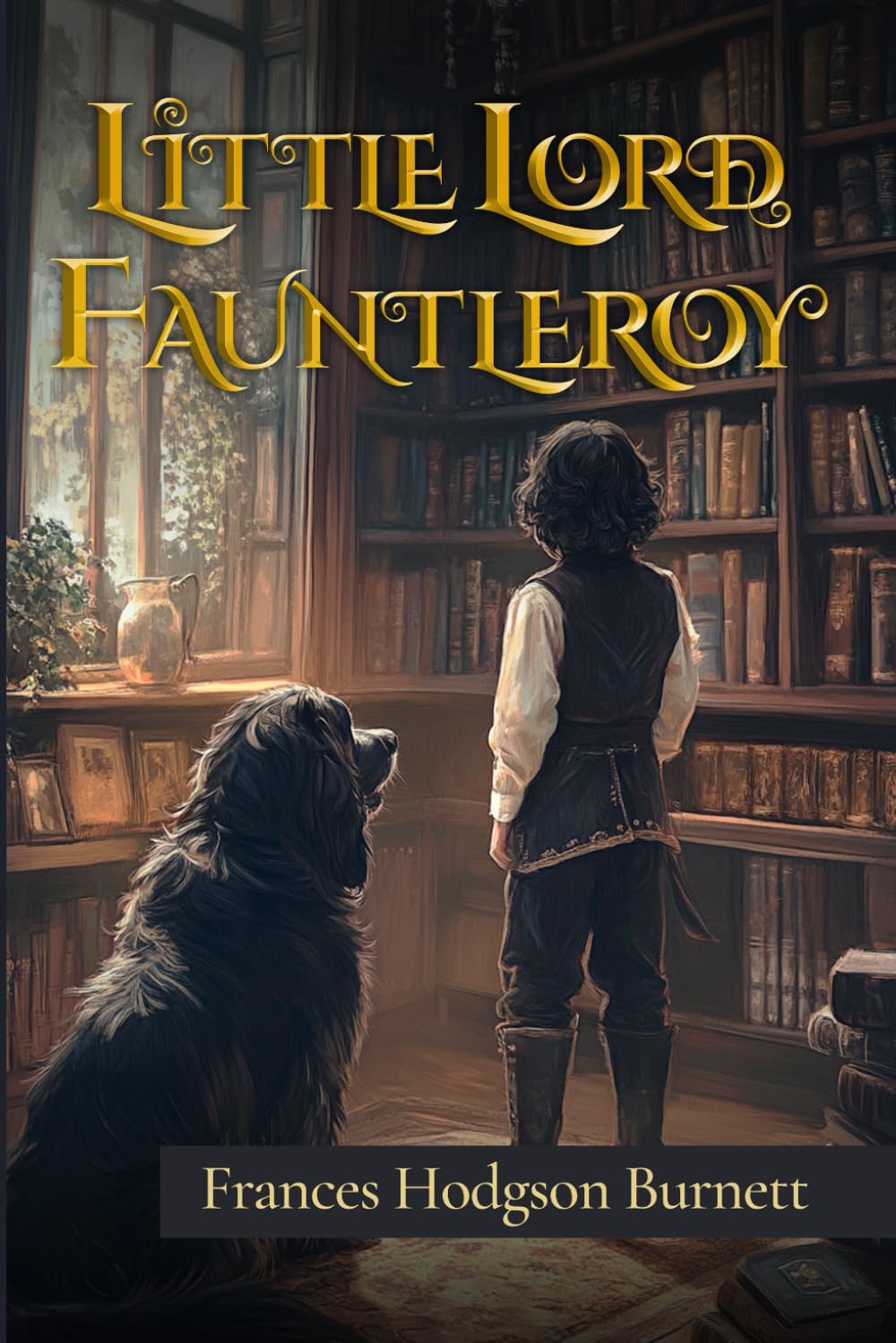
Virginia Leishman did a nice job narrating the audiobook. It’s free through September to Audible subscribers, and only about six and a half hours long. I also got the Kindle version for 99 cents, which includes some of the original illustrations, which were fun to see. I don’t know why the newer cover shows Cedric with dark hair when the book repeatedly mentions his golden curls.

Even though Cedric and his mother are somewhat idealized, this was a sweet story that I enjoyed very much.

Review: On the Edge of the Dark Sea of Darkness

Dark Sea of Darkness

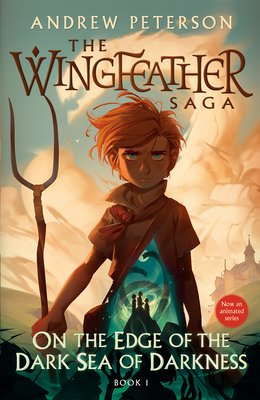
On the Edge of the Dark Sea of Darkness is the first in the four-part Wingfeather Series by Andrew Peterson. Amazon recommends it for children in third through seventh grades

The story takes place in the mythical land of Skree, which has been taken over by life-size lizard-like people called Fangs, whose leader is Gnag the Nameless.

The book’s main focus is the Igiby family: mother Nia, grandfather Podo, and children Janner, Tink, and Leeli. Podo is an old pirate with a pegleg, but he’s amazingly agile. Leeli’s leg is crooked, and she walks with a crutch. The children’s father died some time ago, and Janner is disturbed that his grandfather and mother won’t allow questions about him.

Despite the oppressive Fangs, life is fairly peaceful in Skree.

Oh, yes, the people of Skree were quite free, as long as they were in their homes by midnight. And as long as they bore no weapons, and they didn’t complain when their fellow Skreeans were occasionally taken away across the sea, never to be seen again. But other than the cruel Fangs and the constant threat of death and torture, there wasn’t much to fear in Skree (p. 3).

But then the children have an altercation with one of the Fangs, Slarb. The children are put in jail but released when their mother gives the commander some of her jewels.

But now they are on Slarb’s radar.

And Janner didn’t even know his mother had jewels. Between that and the secrets surrounding his father, Janner wonders what else his mother is hiding.

The tension escalates into a classic battle of good-vs.evil with a surprise revelation at the end.

Alongside this plot, the children have normal fusses with each other and learn to face fears.

There seems to be some symbolism or allusions to Christian themes like in the Chronicles of Narnia. The family prays to “the Maker.”

One GoodReads reviewer said “Peterson intended this to be the ‘vastness of Lord of the Rings’ with the ‘whimsey of the Princess Bride.'” I don’t know if she read that in an interview: if so, I’d love to find it. It does help understand the tone of the story.

Some of the animals that live in Skree and the nearby forest are skonks, toothy cows (like our cows except they have long fangs and are omnivores), thwaps–like squirrels, a menace to gardens, and flabbits–like rabbits bur hairless with exceptionally long ears..

The danger is real and scary, but humor is sprinkled throughout. In fact, there seemed too much humor in the first part of the book.

I had a hard time getting into the book at first. But once the action picked up and some of the things hinted at came to light, I thought it was very good.

Some of my favorite quotes:

Blood was shed that you three might breathe the good air of life, and if that means you have to miss out on a Zibzy game, then so be it. Part of being a man is putting others’ needs before your own (pp. 23-24),.

There’s just something about the way he sings. It makes me think of when it snows outside, and the fire is warm, and Podo is telling us a story while you’re cooking, and there’s no place I’d rather be–but for some reason I still feel… homesick (p. 70).

Even if hope is just a low ember at night, in the morning you can still start a fire.

An animated series has been made of the books–at least the first two, I think. I have not seen it but want to with my son’s family. It appears to be very well done.

(Sharing with Bookish Bliss)

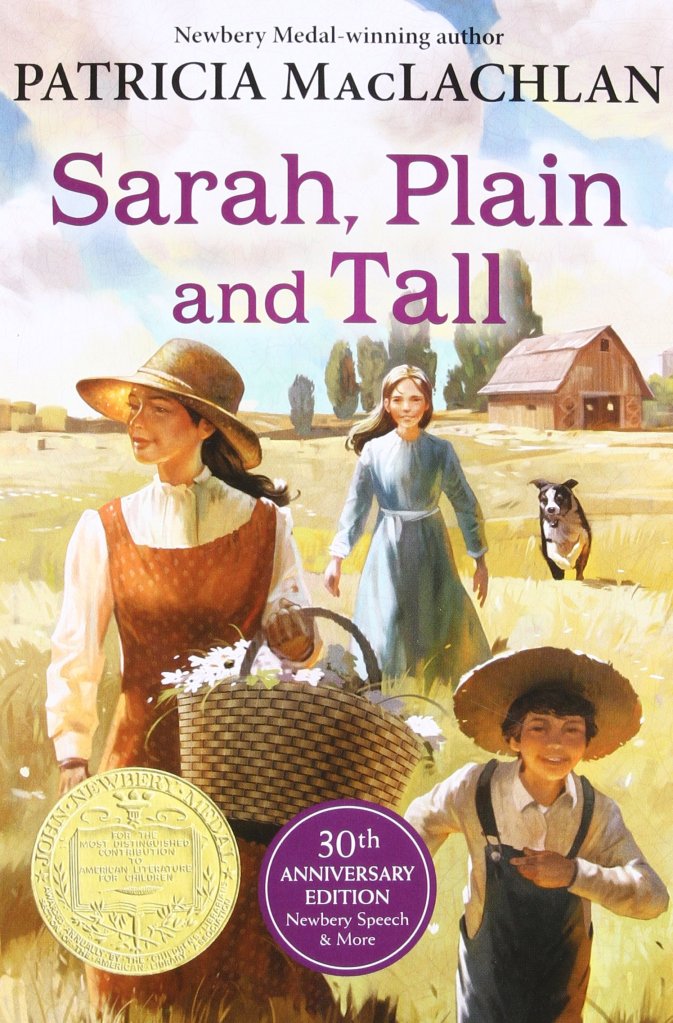
Sarah, Plain and Tall

I saw the film version of Sarah, Plain and Tall with Glenn Close several years ago and loved it. I hadn’t known then that it was based on a children’s book by Patricia MacLachlan. I just recently read the Kindle version.

The story opens with Anna, her younger brother Caleb, and their widowed father living on the prairie in the late 19th century. Written from Anna’s point of view, she notes that her parents used to sing all the time, but her Papa never does any more.

Papa tells the children he has placed an advertisement for a wife and received a reply from Sarah, a woman in Maine. She lives with her brother, but he is getting married. She’s concerned she will miss the sea, but she’s willing to come out by train to the prairie and meet the family.

Sarah exchanges letters with papa, Anna, and Caleb until she arrives. Sarah is different and does unusual things. They all like each other, but the children are afraid Sarah misses the sea too much to stay.

This was a lovely story written in a simple yet beautiful style.

A few of my favorite quotes:

Outside, the prairie reached out and touched the places where the sky came down.

My brother William is a fisherman, and he tells me that when he is in the middle of a fog-bound sea the water is a color for which there is no name.

There is no sea here. But the land rolls a little like the sea.

I shook my head, turning the white stone over and over in my hand. I wished everything was as perfect as the stone. I wished that Papa and Caleb and I were perfect for Sarah. I wished we had a sea of our own.

This book won a Newberry Medal, and the Kindle version I read included the author’s speech upon receiving it. She said the story was based on a real Sarah from Maine who had traveled to the prairie to become the wife and mother of a friend of the author’s mother. This speech contained a couple more favorite quotes:

Every writer should have a loving reader who has the courage to write both “I love this” and “Ugh” on the same page.

When Julius Lester praises children’s literature as the “literature that gives full attention to the ordinary,” he echoes my parents’ belief that it is the daily grace and dignity with which we survive that children most need and wish to know about in books.

My parents believed in the truths of literature, and it was my mother who urged me to “read a book and find out who you are,” for there are those of us who read or write to slip happily into the characters of those we’d like to be. It is, I believe, our way of getting to know the good and bad of us, rehearsing to be more humane, “revising our lives in our books,” as John Gardner wrote, “so that we won’t have to make the same mistakes again.”

I knew there was one sequel to the book, Skylark. But I hadn’t known there were three more. The Kindle version contains the first chapter of each of the books. Someday I hope to read the rest.

I wanted to rewatch the videos of both Sarah, Plain and Tall and Skylark, but they don’t appear to be available to stream from anywhere. I might see if the library has the DVDs.

Have you read or watched Sarah, Plain and Tall? What did you think?

The Winnie-the-Pooh Books

Winnie-the-Pooh is a creation of A. A. Milne based on the teddy bear of his son, Christopher Robin. Milne had written many other genres: plays, magazine articles, books for adults. But these days he is best known for Pooh and Christopher Robin and their friends.

My kids grew up with the Disney version of Winnie the Pooh and company. There were four individual videos at the time: Winnie the Pooh and the Honey Tree, Winnie the Pooh and the Blustery Day, Winnie the Pooh and Tigger Too, and Winnie the Pooh and a Day for Eeyore. The first three videos have since been combined into The Many Adventures of Winnie the Pooh. Then there was a Saturday morning cartoon called The New Adventures of Winnie the Pooh which we watched regularly for many years. We had stuffed Poohs (and Tiggers and Piglets) and Pooh picture books. If there were Pooh sheets or jammies, we would have had them.

But somehow, I never read the original Pooh books by A. A. Milne to my kids, and I have always regretted that. I’m not sure why I never read them. I had not read them in my own growing-up years: perhaps if I had, I would have made it a point to read them to my children just as I searched out some of the Little Golden Book titles that I’d had as a child. I dipped into one of the volumes at some point, but I don’t remember which one or if I completed it.

When I read Christopher Robin Milne’s autobiographies recently, I was reminded that I had never read the original Pooh books. So I set out to correct that lack.

There are four books that specially deal with Pooh.

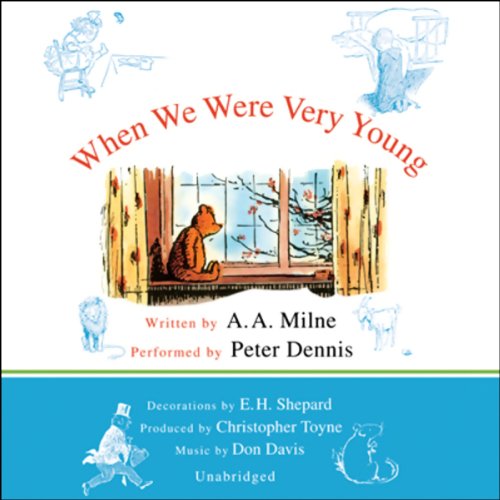
When We Were Very Young is a book of children’s poems. Christopher Robin’s bear there is named Edward. Some time after that, he renamed his toy bear Winnie-the-Pooh (with hyphens when his whole name is written, though he is often called just Pooh or Pooh Bear. The Disney version dropped the hyphens). “Pooh” was after a swan that Christopher had previously given that name to, and Winnie after a bear by that name in a zoo. Some of the poems feature Christopher, but all of them were probably inspired by him. One of the most famous is “Vespers” about Christopher saying his prayers.

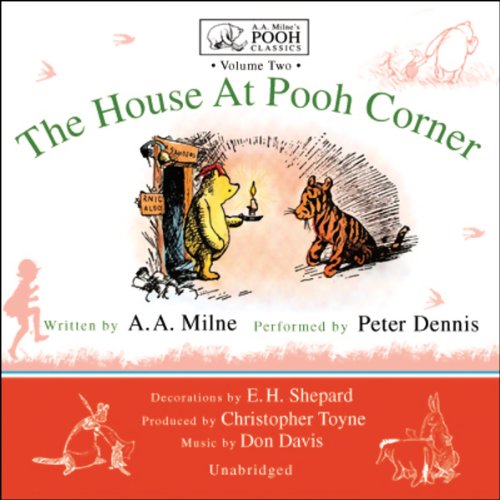
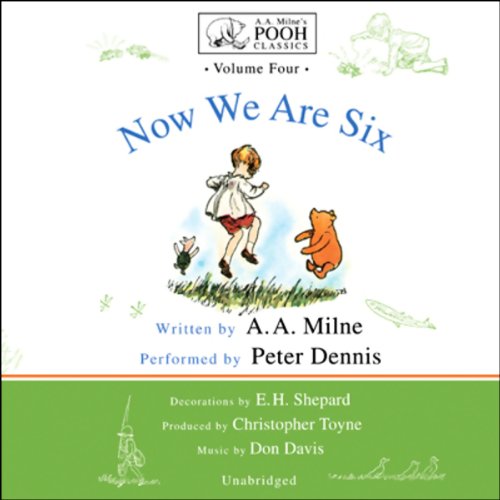
Winnie-the-Pooh is a collection of short stories about Christopher Robin and Pooh and the other animals/toys. The House at Pooh Corner, another collection of stories, was published next, and finally there was another collection of poems, Now We Are Six. “Forgiven” is one of my favorite poems from this volume.

One of the things I had liked about the videos and TV series was that they were quiet. There were conflicts and predicaments and misunderstandings, yes. But the shows weren’t full of noise and razzle-dazzle like other kid’s shows were (that was something I liked about Mister Rogers as well).

The books are the same way. The characters are endearing. Pooh is “a bear of very little brain,” but he is kind, thoughtful, and a faithful friend. He likes to make up rhymes and take time for “smackerel” of “a little something—usually “hunny.” Christopher Robin is the one everyone looks up to and the one who rescues the others when they get in trouble over their heads. Piglet is small and timid, but also kind and thoughtful. Rabbit is bossy, but has everyone’s best interests at heart. Eeyore is gloomy (actually, he’s a little harsher in the books). Owl is wise (he can even spell Tuesday!), Kanga is motherly, Roo is spunky.

One of my favorite quotes is from Pooh in The House at Pooh Corner about how poems come to him: “But it isn’t easy,’ said Pooh. ‘Because Poetry and Hums aren’t things which you get, they’re things which get you. And all you can do is to go where they can find you.” Another is this: “Sometimes,’ said Pooh, ‘the smallest things take up the most room in your heart.” And these:

Some people care too much. I think it’s called love.

People say nothing is impossible, but I do nothing every day.

It is more fun to talk with someone who doesn’t use long, difficult words but rather short, easy words like “What about lunch?”

“What day is it?” asked Pooh.
“It’s today,” squeaked Piglet.
“My favorite day,” said Pooh.
 
Piglet noticed that even though he had a Very Small Heart, it could hold a rather large amount of Gratitude.

I love how Kanga is described as carrying her family in her pocket (something Rabbit thinks strange at first).

And I dearly love this exchange between Eeyore and Pooh, read in Eeyore’s deadpan voice, when Eeyore thinks everyone has forgotten his birthday:

“Good morning, Pooh Bear, if it is a good morning. Which I doubt.”

“Why, what is the matter”

“Nothing, Pooh Bear, nothing. We can’t all, and some of us don’t, and that’s all there is to it.”

“Can’t all what?” said Pooh, rubbing his nose.

“Gaiety. Song and dance. Here we go round the mulberry bush.”

I was very glad to see that the films and videos, for the most part, told the stories almost completely as the books did. The series went on to develop their own stories based on the characters, but kept the same tone.

Milne captures childhood innocence and ways of thinking well with playfulness and gentleness. I was very sad to learn that Christopher came to resent the books about him as he became an adult, perhaps due to teasing from others when he went to boarding school. Christopher said in his own books that his father wasn’t very expressive in person: his inner thoughts came out in his writing. But his father’s obvious delight in his son and how he thought shines through in these stories and poems. I think Christopher must have come to terms with that at some point since he provided a favorable introduction to the audiobook of When We Were Very Young, saying family friend Peter Dennis’ narration presents Pooh “as he [Christopher] knew him.”

All four volumes of the books were available as part of my Audible subscription. I listened to the stories via audiobook, but read the poetry collections via Kindle (which included, thankfully, E. H. Shephard’s original illustrations).

One thing I didn’t like about the audiobooks was the long musical interludes between chapters.

But otherwise it was a sweet experience to visit these characters their original settings.

The Back to the Classics Challenge allows us three children’s classics. So I am going to count Winnie-the-Pooh as one for the “Classic that’s been on your TBR list the longest.”

The Story of Doctor Dolittle

Hugh Lofting first created the character of Doctor Dolittle in letters home to his children while he was in WWI. The first book in the series is The Story of Doctor Dolittle: Being the History of His Peculiar Life at Home and Astonishing Adventures in Foreign Parts Never Before Printed.

Dr. Dolittle is a medical doctor, but he has a lot of pets. He begins to lose patients when they are scared by the number and kinds of pets he keeps. Someone suggests he become an animal doctor. His talking parrot tells him all animals have languages and teaches the doctor several of them. The doctor’s fame spreads far and wide since he can now diagnose and treat animals for the exact ailments they tell him about.

There’s only one problem. Animals aren’t paying customers. As much as the doctor dislikes money and wishes he didn’t have to bother with it, a certain amount is necessary to live.

So he and the animals devise ways to economize plus make some money.

Then birds bring word that monkeys in Africa are very sick, with many of them dying. They’ve heard of Doctor Doolittle and wonder if he can help them.

So after making arrangements for his house and the animals who will stay home, and finding a boat and supplies, the good doctor sets off along with several of his animal companions. They experience several misadventures during their travels and their time in Africa.

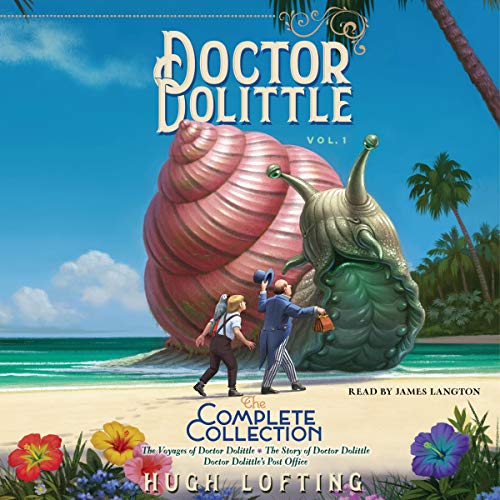
I had not realized that there were a number of books with Doctor Doliitle as the main character until I set out to read about him. I had thought that there was one main chapter book. This book is the first written, but others tell of time periods before this book. So some sets of the Doolittle books are arranged in the chronology of the settings rather than publication order. I prefer publication order of any series because that’s how the story would have originally unfolded. Sometimes we don’t care much about the back story until we come to know and care about the characters and their world. I listed to the audiobook very nicely read by James Langton. But it was put together in setting order, so I had to search through several beginnings of chapters in The Voyages of Doctor Dolittle, which had been placed first, before finding this story (the beginning of the different books wasn’t marked).

Also, I didn’t realize the set I listened to was “fully updated for the modern listener.” I would much rather read and listen to books in their original words. One new illustrated edition has taken the liberty of adding an “updated magical twist.” So if you prefer original classics, check for these things before choosing a volume.

Some editions say they have removed “ethnically insensitive” parts of the story. I assume this one did since it’s “revised for modern readers.” Generally, I’d rather leave stories as they were and explain why certain things are no longer done or said. I don’t know what things were removed from these books. Perhaps, especially in the versions designed for children to read themselves, it is better to adapt them without those offensive elements.

I hadn’t intended to read Doctor Dolittle until this set came up in a “2 books for one credit” sale on Audible. I’m glad to be more familiar with it now, but I don’t think I liked it well enough to read the other two books in this set.

I have not seen any of the film versions.

I’m counting this book for 20th century classic for the Back to the Classics Reading Challenge.

Three Children’s Books About Race

Recently, my daughter-in-law and I were discussing the lack of diversity in children’s books. Bible story books, in particular, seemed to draw Biblical people lily white, when in reality they would have been Middle Eastern in appearance.

Not long afterward, I came across What God’s Family Looks Like, a post from The Story Warren about children’s books that deal with race. I looked up the main book mentioned, then followed a rabbit trail of recommended reading. I ended up getting these three books.

Why be colorblind when we can be colorFULL insteadThe first is Colorfull: Celebrating the Colors God Gave Us by Dorena Williamson, illustrated by Cornelius Van Wright and Ying-Hwa Hu. I love the tagline: “Why be colorblind when we can be colorFULL instead?”

The back of the book says this:

Imani and Kayla are the best of friends who are learning to celebrate their different skin colors. As they look around them at the amazing colors in nature, they can see that their skin is another example of God’s creativity! This joyful story takes a new approach to discussing race: instead of being colorblind, we can choose to celebrate each color God gave us and be colorFULL instead.

Imani’s Granny Mac helps gives the kids some perspective. My daughter-in-law said she wished adults would read this book, too.

When God Made You by Matthew Paul Turner, illustrated by David Catrow, doesn’t explain or emphasize race: the story just incorporates it naturally as part of who God made you to be. God planned each person with their particular gifts, appearances, personalities, etc. to reflect His image.

One line in this gave me pause: “Have faith but love more.” At first it seemed to downplay faith. But you could also read it as saying, “Have faith, but don’t stop there: love others.”

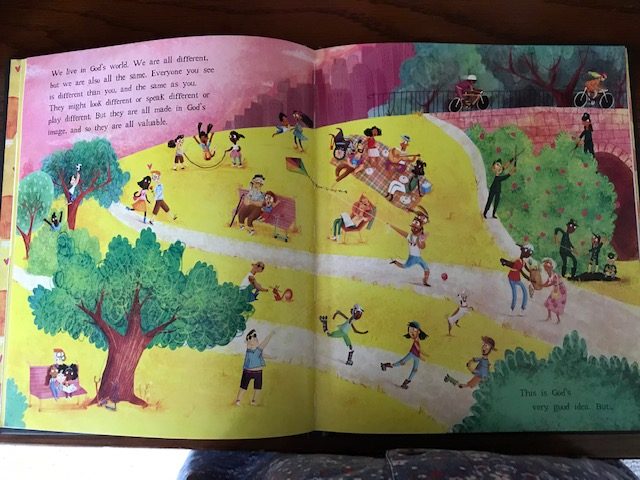
An inside page:

Trillia Newbell’s God’s Very Good Idea (illustrated by Catalina Echeverri) took several weeks to get here. I hope that means lots of people are buying it!

Trillia begins at the beginning: with creation. Making people, and making them in all different colors and varieties, was God’s idea. They would “all enjoy loving him and all enjoy loving each other . . . reflecting what God is like.”

But the first people chose to disobey God. That plunged all of us into sin. We don’t love God or each other as we ought. “Sometimes we treat others badly because they are different than us.”

But part of God’s very good plan was sending Jesus to come and live on earth, to show us how to love, to die on the cross so we could be forgiven, and to rise from the dead, and to give us the Holy Spirit to help us live for Him.

He also gave us the church as a foretaste of what it will be like in heaven some day, “lots of different people enjoying loving him and loving each other.”

I love that Trillia’s story is couched firmly in the Bible and the gospel. She gives an overview of creation, sin, and redemption in words a child could understand.

I didn’t get a chance to read these with my grandson. I sent him home with them. But I hope he enjoys them!

I believe children need to be taught early that God created all people in His image.

Now that I look again at the post I first mentioned, I see a whole list that I must have forgotten to look up when I got distracted earlier. So I will probably explore some of those. Now that we have some books with a good, Biblical worldview about race, I’d love to find some that just show kids of all different colors naturally as characters in a story.

Do you know of any good books for kids along these lines?

(Sharing with InstaEncouragement, Worth Beyond Rubies, Grace and Truth,
Hearth and Soul, Senior Salon, Booknificent Thursday, Carole’s Books You Loved)

Laura Ingalls Wilder Reading Challenge Wrap-up for 2020

The end of February closes the Laura Ingalls Wilder Reading Challenge. I hope you had fun with it, and I look forward to hearing about what you read!

A week from today I’ll use random.org to draw a name from the comments on this post to win either The Little House Cookbook compiled by Barbara M. Walker, Laura’s Album: A Remembrance Scrapbook of Laura Ingalls Wilder by William Anderson, The Little House Coloring Book, or a similarly-priced book related to Laura. A week should give some who are still reading time to finish up and post. You don’t have to have a blog to participate: you can tell us what you read in the comments here. If you have a blog, you can either let us know what you read in the comments or share the links back to any reviews or challenge-related posts from your blog or even from Goodreads if you review books there. Due to shipping costs, I’m afraid I can only ship to those in the US.

I only read one book this year: Old Town in the Green Groves by Cynthia Rylant about the two years Laura left out of the Little House Books.

Old Town in the Green Groves about Laura Lingalls Wilder's lost years
The book I had originally planned to read was actually about Little Women rather than Little House, so I’ll save it for Tarissa’s Louisa May Alcott Reading Challenge in June.

As I mentioned earlier this year, this will be the last Laura Ingalls Wilder Reading Challenge hosted here, for a number of reasons. Thanks so much to those who have participated at any point during the last nine years. I’ve thoroughly enjoyed delving into books by and about Laura, discussing them with you, and hearing what you’ve read.

Remember, leave a comment on this post about what you read or did for the challenge before Saturday of next week to be eligible for the drawing.

Update: The winner is Tarissa! Congratulations!

Book Review: Old Town in the Green Groves

Laura Ingalls Wilder originally wrote out the story of her life in Pioneer Girl. When that manuscript was rejected several times, acting upon suggestions from editors, Laura reframed her narrative into a story for children about a pioneer family traveling west (p. 31). She left out a year that the family traveled back east due to the grasshopper infestations that twice ruined their crops and hopes in Plum Creek, although she had told of it in Pioneer Girl. Pamela Smith’s Hill’s notes on this section in Pioneer Girl: The Annotated Autobiography says:

She deliberately chose not to depict this part of her family’s experiences in her fiction. “It is a story in itself,” Wilder explained to Lane in 1937, “but does not belong in the picture I am making of the [fictional Ingalls] family (LIW tp RWL, [Dec. 1937 or Jan. 1938], Box 13, file 193, Lane Papers). Moving the fictional family east and not west would have undermined Wilder’s optimistic portrait of their resilient pioneer spirit. Furthermore, her experiences in Burr Oak were more urban, gritty, even edgy. Although Wilder introduced some adult ideas and themes into her later novels, she waited until the fictional family had moved west once more into Dakota Territory, where her main character was a more mature adolescent. Wilder herself was just nine years old when the family moved to Burr Oak (p. 95, note 99).

I’ve seen some criticism of Laura for leaving out the events that take place in Burr Oak. But I would defend her decision for several reasons. Everything I have read about memoirs and autobiographies says you can’t share everything. She did include this era in her original autobiography. The Little House books were fictionalized, focusing on the life and progress of a pioneer family. The time in Burr Oak might have seemed a stop or even a setback to the action. Plus the family’s proximity to a saloon and the unsavory behavior they saw and heard might not have seemed suitable to an audience of children at the rime she was writing.

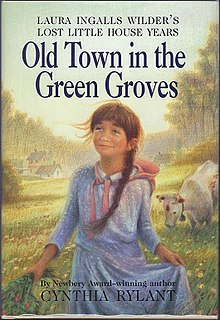
Old Town in the Green Groves about Laura Lingalls Wilder's lost yearsBut readers are curious about the “lost years” in the LH narrative. So Cynthia Rylant was asked to write what was known about the family’s story during this period in the style of the LH books. Her book is Old Town in the Green Groves.

The story begins back in Plum Creek, where the family contentedly moved from their winter rental house back to their farm. Baby brother Freddie was born. Ma was severely ill for a while, but recovered. Then the second wave of grasshoppers returned and destroyed everything growing. Pa declared he’d had enough of the “blasted country.” He had debts to pay, and the crop that would have paid them was ruined. Pa sold the farm to pay off the debts and lined up a job at a hotel in Burr Oak in Iowa.

On the way, the family stayed with their aunt and uncle and cousins, Peter and Eliza Ingalls and their children. They helped in various ways around the farm until ready to move on. Sadly, brother Freddie died there.

One chapter describes meeting with a kind beekeeper who was also planning to move since the bees couldn’t thrive without flowers. (Hill’s note on p. 96 of her book says Charles and this beekeeper kept in touch with each other for years).

When they arrived in Burr Oak, they lived above the hotel. Life was hectic: Ma helped with cooking and cleaning, and the girls all had to help, too. The saloon next door was loud, people were constantly coming in and out. Laura missed the quiet of her home and the prairie.

The book goes on to describe the various people they encountered and things that happened in Burr Oak before they decided to head west again.

I think Rylant did a good job. Just glancing over this section again in Pioneer Girl, I can see how Rylant took the narrative and fleshed it out. It’s more or less in the style of the LH books, but it’s not Laura: it couldn’t be.

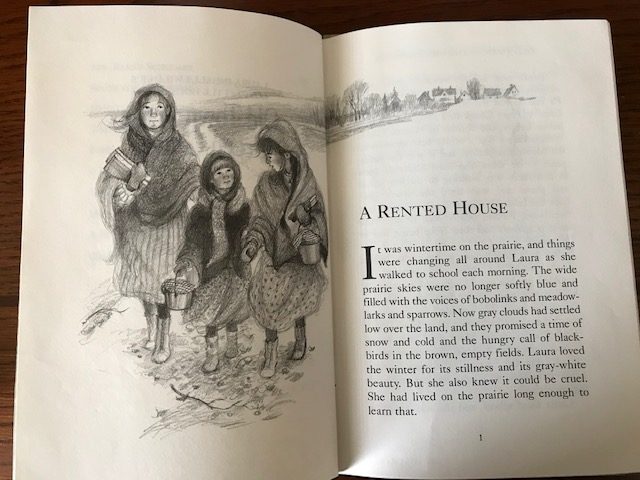
I was glad to see the illustrations by Jim LaMarche in my library copy were also similar to the Garth William’s illustrations of the Little House.books. Like the words, they were not quite the same, but they seemed a similar style and spirit.

The book cover shown above is the one on my library copy. I’ve seen another illustrated cover here that makes Laura seem a little older and a photographed cover here that I didn’t care for at all.

I share my friend Ann‘s concern over the placement of the book on the back cover. The top says “Read all the Little House books.” The covers of all the books are shown, with this book set in-between On the Banks of Plum Creek and By the Shores of Silver Lake. I’m assuming this was done to show that the action in this book takes place between those two. But, as fine as this book is, I would regard it as supplemental and wouldn’t include it as part of the set or as one of the LH books.

Though this book describes some of the hard times the family went through, it also shares their resilience and hope. It’s a good story in its own right, but especially for fans of the Little House books.

(Sharing with Carole’s Books You Loved, Booknificent)

Laura Ingalls Wilder Reading Challenge Wrap-up for 2019

The end of February closes the Laura Ingalls Wilder Reading Challenge for this year. I hope you had fun with it, and I look forward to hearing about what you read!

A week from today I’ll use random.org to draw a name from the comments on this post to win either The Little House Cookbook compiled by Barbara M. Walker, Laura’s Album: A Remembrance Scrapbook of Laura Ingalls Wilder by William Anderson, The Little House Coloring Book, or a similarly-priced book related to Laura. A week should give some of us who are still reading time to finish up and post about our reading. You don’t have to have a blog to participate: you can tell us what you read in the comments here. If you have a blog, you can either let us know what you read in the comments or share the links back to any reviews or challenge-related posts from your blog or even from Goodreads if you review books there. Due to shipping costs, I’m afraid I can only ship to those in the US, unless you’d like a Kindle version.

For my part, I read:

Fairies

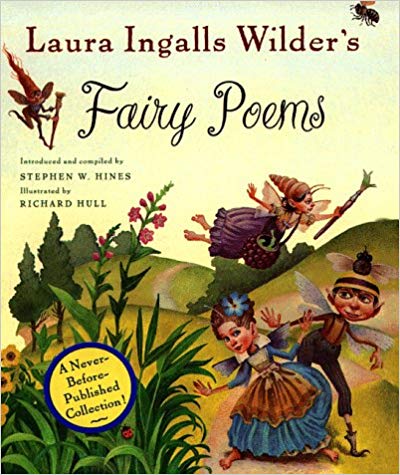
Laura Ingalls Wilder’s Fairy Poems, compiled by Stephen W. Hines, illustrated by Richard Hull. I had forgotten that Laura wrote such poems until Rebekah mentioned them. Laura is usually more matter-of-fact than fanciful, though some of her descriptions are lovely. So I was interested to see how she did with fairy poems. Hines provides a brief introduction, telling how Laura came to write the poems for the San Francisco Bulletin. Then he shares an adaptation of an essay Laura wrote called “Fairies Still Appear to Those With Seeing Eyes.”

There are only five poems in the book, spread out over several pages with a number of illustrations. The poems are very old-fashioned, naturally, as they describe the various activities fairies are involved in. I’m not normally into fairy poems, so I don’t know how they would measure up for young readers today.

Honestly, I didn’t care for the illustrations much. I think I would have preferred lighter colors, maybe a watercolor effect. I liked the detail of the plants and animals, but not the fairies and people.

Have you or your children read this book? What did you think?

LIW song book

The Laura Ingalls Wilder Songbook compiled and edited by Eugenia Garson.

The copy I checked out from the library looks like the one above, but I saw other copies on Amazon with a Garth Williams illustration of Pa with his fiddle on the front.

What I appreciated most about this one was Garson’s research. She looked up every song mentioned in the Little House books, provided a few sentences of background for it (when it could be found), and a quote from the LH book where it was mentioned. Sheet music is provided for all the songs, making me wish I could play the piano enough to pick out the tunes. I was familiar with just a few of them. This would be a nice resource for anyone wanting to learn more about music from this era.

Traveler

I also read On the Way Home and The Road Back by Laura Ingalls Wilder. These two books have been packaged together with West From Home, Laura’s letters to Almanzo while visiting Rose in San Francisco for the World’s Fair, into one volume called A Little House Traveler. Since I had read West From Home a few years ago, I did not read that one at this time. The first is Laura’s record of moving with her husband and daughter by covered wagon from South Dakota to Mansfield, Missouri; the second is her journal of traveling back to South Dakota to visit her two remaining sisters 40 years later in an un-air-conditioned Buick. I reviewed them here.

I also wrote Why Laura Ingalls Wilder Is Still Worth Reading because some question whether she is any more. No, she and her family were not perfect. But we can still learn from them.

That’s it for me. How about you? Remember, leave a comment on this post about what you read or did for the challenge before Thursday of next week to be eligible for the drawing.

Update: The giveaway is closed. The winner is Rebekah! Congratulations!

(Sharing with Carole’s Books You Loved)