Book Review: My Hands Came Away Red

HandsIn the novel My Hands Came Away Red by Lisa McKay, eighteen-year-old Cori decides to spend her summer on a backpacking mission trip in Indonesia. Though she has a vague desire to do good, to help people, to “spread the love of Jesus,” her main purpose for going is to get some time away from Scott, her boyfriend. Cori is a Christian, but her relationship with God isn’t as close as it once was. Scott is not a believer, but he wants to marry Cori. So Cori needs time away to think, to sort things out.

After meeting the mission leader and the five other teens who will be going on the trip, they spend several days in a grueling boot camp. Then they travel on to Indonesia where they will help build a church as well as performing puppet shows and such. They meet Mani, the son of the local pastor, whose English is best and who acts as an unofficial liaison between the mission group and the church folks.

The group learns there is a tenuous peace between the Christian and Muslim villages. The Muslims view those who convert from Islam to Christianity as traitors, and Mani’s father is such a convert. But, though they are advised to be careful, no serious trouble is expected.

After several weeks of work and getting to know each other in the process, when the thatched-roof church is nearly finished, the mission group leader’s wife falls suddenly and dangerously ill. As the leader, Gary, makes hasty plans to get the group ready to leave, the kids protest. They can finish the church in the next couple of days and catch the next boat to meet up with Gary. Reluctantly, Gary agrees.

When the church is finished, the teens decide it needs a cross on top, so they go into the woods to find a suitable log. Nearing the village on their return, they hear angry voices. Mani stops the group close enough to listen, but far away enough not to be seen. Men from a neighboring Muslim village are angry that Christians have attacked their village, and, grouping all Christians together, they call on this village to answer for it. Mani’s father tries to explain and calm, but tempers flare and fighting breaks out. Mani’s parents are killed before the group’s eyes. One of the teen guys rescues Mani’s younger sister, Tina, while Cori tries to help Mani’s father. But it’s too late. The horrified and shaken teens head back into the woods. Mani says it would be no use to try to go back to the village. Their best bet would be to hike through the mountains to a neighboring village and then to the airport.

Thus begins a harrowing three-week journey in which the teens are tested in almost every imaginable way.

My thoughts:

Though teens are the main characters, and this book would be good for teens to read, it’s not just teen or young-adult fare. I found the story riveting. First, from my own standpoint, I don’t think I could have survived what the teens went through. And secondly, as a parent of young people, I can imagine what the parents went through with news of fighting in the area and no word from their kids.

On top of the physical hardships and mental and emotional strain they all face, some of them, especially Cori, wrestle with their faith. Reading Bible passages about God’s protection seem hollow after what they witnessed. Yet, to whom else can they turn?

Before this summer those words [Romans 8:28] were part of whole set of trusty beliefs that defined my life. I knew they were true the same way I knew it really was good for me to eat my green vegetables. God is good, and everything works out for the best . . . and we all live happily ever after. I was so naïve. It’s not that I don’t want to trust those promises I’ve always believed in, but I just don’t understand

_____

If God didn’t see fit to save them, who’s to say that we weren’t all going to end up dead in this whole mess? And I hardly saw how that might produce a rich crop of faith, hope, and peace in my life. Unless it was in my heavenly life. Which, as much as I believed in heaven, was hardly a comforting thought.

In some ways I wish Cori’s faith struggles were more resolved by the end, but then I think part of the author’s point is that there are some things we can never resolve. One of the other teens tells Cori, after everything is over physically, but not mentally, emotionally, and spiritually, that sometimes you “just have to make a choice based on what you know about God. And relax and trust for the rest of what you don’t know” and “You know, life’s a journey…Some questions get answered later. You can’t stop traveling just because that’s not now.”

Besides the story itself, I loved the clearly-drawn characters. And I love the Jip and Kiki story game that started back in boot camp and helped distract the kids on their trek. One of the teens would start with, “Once there was a boy named Jip,” who loved chocolate and had a pet monkey named Kiki, and each one would add a few sentences, often based on what the kids themselves were going through.

In the author’s afterword, she shares that though the people in the story are fictitious, the circumstances, the fighting in the villages she named, were very real. The author’s own international and even inter-continental upbringing informs her writing, making it even more realistic.

I had heard this book highly recommended years ago and have had it on my TBR list since then. Somewhere recently I read that someone bought the rights to the book for a movie, and the book was being re-released. That brought it to the forefront of my attention again, so I decided now was a good time to read it. I am glad I did. I hope the film does it justice.

(Sharing with Semicolon‘s Saturday Review of Books, Literary Musing Monday, Carole’s Book’s You Loved)

Book Review: The Lost Castle

Lost CastleIn The Lost Castle by Kristy Cambron, Ellie Carver’s Grandma Vi had raised her since her parents’ deaths when she was a child. Now her grandmother was in a care facility suffering the ravages of Alzheimer’s, often not even knowing who Ellie was.  But one particular day, her grandmother seemed especially agitated and could hardly keep herself from the window. While Ellie gently attempted distraction, her grandmother pulled out a book of The Sleeping Beauty in French. While wondering  why her grandmother had such a book in French and flipping through the pages, an old photo fell out. The picture was WWII-era vintage of a young woman sitting on a stone wall smilingly staring up at a young man who was definitely not Ellie’ grandfather. Ellie learned that there was a castle called The Sleeping Beauty in France, and Vi was supposed to have met this man at the castle to tell him whether or not she would marry him.

These revelations sent Ellie to the Loire Valley in France, uncovering a story that spanned hundreds of years.

In 1789, Aveline Sainte-Moreau was much more interested in the politics and current events of the day than a lady of her station should have been. Though she did not condone all the actions of the disenfranchised poor, she had compassion on them and helped as she could. To keep her in her place and divert her attention, her father arranged her marriage with a man she had never met. On the night of her debut and the official announcement of her engagement at her fiance’s home, the castle was attacked. While the castle crumbled and burned, Aveline was rescued, but not before being scarred by the flames. Her rescuers had to keep her hidden while she recovered: unrest had been fomenting into revolution, and the nobility in general was in danger.

In 1944, Viola Hart was a linguist caught in France, having escaped the Nazis. Taking refuge in a chapel, she was discovered by a neighboring vigneron, Julien, who secreted her to his family’s home. Eventually she learned he was part of the French Resistance, and her skills would be valuable. Having no way to safely get home, she stayed to help. In their preparations, they painted a large red V on the walls of a deserted castle.

When Ellie came to the Loire Valley, she wanted to search for the castle wall where her grandmother’s picture had been taken. She was distressed to learn that the castle grounds were closed to the public. Her host and tour guide, Quinn, was reluctant to push any further into the mystery, wanting to respect the castle owner’s wishes. But at Ellie’s  and his own grandfather Titus’s insistence, Quinn took Ellie where she needed to go and helped her unravel the clues. She learned that the castle’s nickname, The Sleeping Beauty, came from a legend of a member of the nobility hundreds of years before who seemed to disappear in the area. As Ellie uncovered more of her grandmother’s past, she unlocked more of her own story as well.

My thoughts:

I loved the three women’s stories and how Kristy wove them together. I loved the strength of each character in her circumstances. I enjoyed some of the touches in each timeline: the castle itself, a brooch passed down to each woman, a fox that lives in the woods and visits the castle grounds, the various shades of lavender and purple, from Aveline’s shawl and love of violets to Grandma Vi’s cardigan. The faith element is subtle but steady.

And isn’t that cover gorgeous?

One quote that encapsulates the book’s theme:

Titus says the land is a witness of the generations who have come before. That it stands resolute. It’s the same yesterday. Today. And who knows what tomorrow will look like. He likens it to God’s influence over creation. That He’s immovable. Steady. Watching from a distance, yet ever involved. A bit like your lost castle, hmm? (p. 244).

I’ve read many books with two timelines: this is the second in recent months that had three. It wasn’t confusing to keep up with them, as each setting with its characters was distinct. The only confusion within a timeline came when a new chapter opened at a time earlier than where we had last left those particular characters – a flashback within a given timeline. But it only took a few moments to get oriented.

With elements of mystery, the fairy-tale quality of Aveline’s story in particular, historical elements, and above all a lovely story and testimony of God’s faithfulness, Kristy has another winner here. So far I have never been disappointed with any of her books, and I hope she writes many more!

(Sharing with Semicolon‘s Saturday Review of Books, Literary Musing Monday, Carole’s Book’s You Loved)

Book Review: Borders of the Heart

Borders of the HeartIn the novel Borders of the Heart by Chris Fabry, J. D. Jessup has moved from Nashville to Tuscon and works on an organic farm. Tuscon is close enough to the border of Mexico that a lot of illegal aliens come through the area. J. D. has been instructed to call Border Patrol if he sees any illegals.

While on his rounds one morning, J. D. Comes across a beautiful Mexican woman in the desert. She is dehydrated and injured, with a handcuff on one wrist. Instead of calling border patrol, however, he takes her back to his place and then to a doctor. Before long he learns that a killer is after the girl, a killer who has no qualms about killing anyone who has had contact with her.

Several times J. D. thinks perhaps he should leave well enough alone, and the girl, Maria, urges him to for his own safety. But he just can’t let go. For various reasons he feels compelled to help her, and in doing so, the walls around his own heart begin to come down.

Both J. D. and Maria are close-mouthed about their pasts at first, and their stories come out piecemeal as they get to know each other. Maybe for this reason, it was a little hard for me to connect with the characters at first. And, though I know the lead characters in a story have to go through all kinds of trials and setbacks before they reach the end, they usually face both ups and downs. In this story, however, there seemed to be unrelenting and worsening downs for most of the book before things finally turned around.

But things did turn around near the end, and by that time the characters had grown on me. Along the way, the book tackles some tough issues, like racism, false assumptions, and wondering where God is during tragedies. The only quote I marked touches on the latter:

But think of it this way. A lot of people don’t believe in God because bad things happen. A follower of Jesus can hope in spite of the bad things. Look at the crucifixion. That didn’t look like a good outcome for his followers. But God gained his most glorious victory on that cross.

While this is not my favorite of Fabry’s books, it’s still a very good read.

(Sharing with Semicolon‘s Saturday Review of Books,
Carole’s Book’s You Loved)

Book Review: Emma’s Gift

Emma's gift Emma’s Gift is the sequel to Julia’s Hope by Leisha Kelly. I think you could read and understand the second book without the first one, but you’d get much more out of the story with both of them. Plus, since Julia’s Hope will probably be one of my favorite books read this year, I encourage you to read it, too.

In Julia’s Hope, Julia and her husband, Samuel Wortham, and their two children lost everything during the Depression. They were hitchhiking east to get a job with Samuel’s cousin when they got word that the job fell through. Totally alone and with no hopes, they find shelter in an abandoned farmhouse. Then Julia gets the idea that perhaps the owner would let them stay in return for fixing up the place. They find the owner, Emma, who is an elderly amputee who can no longer live alone. She agrees to the arrangement, much to the consternation of some of her friends who think the Worthams are taking advantage of her. Before long the Worthams suggest that Emma come back to the farmhouse and stay with them, which she agrees to do, and they become something of an adopted family for each other.

Emma’s Gift picks up the story several months later. Emma was not in good health in the last book and knew her time was soon coming to an end. She passes away near the beginning of this story. It’s not unexpected, yet it’s still a blow to the family. But then their neighbor, a mother of ten children, passes away the same night, totally unexpectedly. The Worthams take in the children while the woman’s husband, George, deals with his grief. While glad to help, and, really, having no choice, an addition of ten children, one a newborn, weighs heavily. Helping the children through their grief while dealing with their own is a challenge.

Uncertainty also weighs on both families as their houses and land were owned by Emma. Emma had tried to give the Worthams the deed to the house they were in, but Samuel refused at the time. George has been unable to make any payments for months, if not years, and Emma wanted to forgive the debt. But now her affairs are in the hands of her nephew, so everyone has to wait to see whether he’ll abide by Emma’s wishes or take the property as his own.

Some of the townspeople bring food out and stay to help with the children, which helps Julia to feel that they are finally accepted. Some of the men help Samuel deal with George, who is on the verge of doing something stupid.

Even though the first part of the book is heavy with grief, please don’t let that deter you. The light does break through in the end, and it’s heartwarming to see the progression.

The point of view switches back and forth between Julia and Samuel. Two themes emerged for me: that everyone has something to give to help others no matter how much or little they have, and when you’re weighed down almost to the breaking point, God’s grace sufficient.

A few favorite quotes:

It made me feel good inside to love her right over top all the rough edges.

Kissing cheeks, passing plates, even listening to George pour out his woes one more time over a late cup of root coffee—it was all the work of God. Because people need each other. And sometimes we don’t realize how much we have to give until we’ve started giving it.

It doesn’t take away the pain of this world. But just knowing the outcome can stop the ache that comes in the middle of some lonely night, or can give you words to make a crying child smile again. God is faithful. Our shelter in the time of trouble. Our refuge in the time of storm. We don’t always know what he’s given us. When we’re deep in the hurt of some awful moment, we don’t always know what good things God has prepared for the days ahead. But we do know so much of himself has been given to our hands. To cherish. To rest in. And especially to share.

These two books are all I have, but there is another sequel, and then another three-book series with some of the same characters as well as a Christmas story. I’d like to get to the rest of them some day. In looking up Leisha Kelly after reading the last book, I was sad to discover that she and her teenage son had died in a car accident some years ago. But I am glad she left this legacy behind.

(Sharing with Carole’s Books You Loved, Semicolon‘s Saturday Review of Books, Literary Musing Monday)

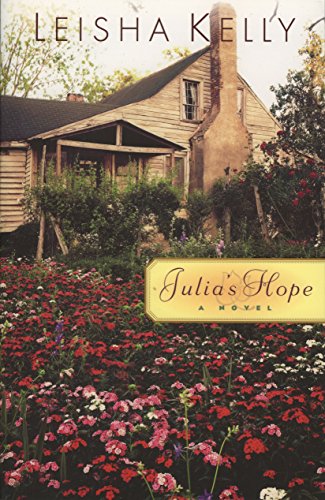
Book Review: Julia’s Hope

JuliaIn Julia’s Hope by Leisha Kelly,  Samuel Wortham is out of a job, like so many others in the early 1930s. Not only did his business close, but the investment he financed with money from his wife’s inheritance failed. The family has just a few dollars. Sam’s cousin says there’s work for Sam in Illinois, so the family is going to hitchhike from Pennsylvania.

Julia, Sam’s wife, is understandably angry with Sam over the lost investment, but she tries to keep a brave face for the children and make the trip an adventure.

It occurred to me then that I ought to pray for help in getting over the anger I felt towards Sam. But I didn’t do it. I guess it was easier to think that I’d forgiven him already and was just entitled to my feelings beyond that.

A few days into the trip, with money gone and the family eating in soup kitchens and sleeping wherever they can, Sam calls his cousin to tell him where they are. He’s told the job fell through and the cousin himself is looking for work.

But when Samuel stepped out of that office, looking like a stormy wind had dashed him against a wall of stone, the clouds descended over me and I turned away. I knew by his face. Dewey wouldn’t be coming. Dewey couldn’t carry all the hopes we’d pinned on him. We were alone.

One day, caught by a sudden downpour, the family takes refuge in an abandoned farm house. Something about it appeals to Julia and the children, so she proposes they find the owner and see if they might be allowed to stay in return for working on the place. Sam thinks the idea is crazy, but Julia is so set, he humors her.

They discover the homeowner is an elderly lady named Emma. She loves the house, but due to a heart condition and the loss of  leg, she can’t live there alone any more, so she has been living in a boarding house in town. Though what the Worthams propose is unconventional, she agrees to let them stay at her house so that it doesn’t deteriorate further.

The Worthams feel like they are taking unfair advantage, though. So within a few days they propose a new situation: that Emma come out and live with them at the house. She agrees.

Emma and Julia both know how to live off the land – what greens are good for food or tea, how to plant seeds and cultivate vegetables etc. But Sam is totally out of his element. He has never farmed and he’s worried about Emma’s care. But there doesn’t seem to be anything else he can do, so he puts forth his best effort.

Emma is a town treasure, so many of her friends check on her and the Worthams. Some of her friends, however, suspect the Worthams have “sweet-talked” her and are out to milk her out of her property, and they make no end of trouble despite Emma’s assurances. One in particular “was a difficult sort, one who was pleased to be displeased.”

My thoughts:

I loved this story. Its main appeal to me is how clearly Leisha communicates the character’s feelings. I ached along with Sam in his financial predicament, his guilty feelings, and his loss of self-respect. I understood Julia’s struggle to put aside her anger,  forgive, and attend to her children in a way that kept them hopeful, rather than afraid. I felt Emma’s joy at being home again.

But I also enjoyed reading about this time era, not one that I can remember seeing much in fiction. I enjoyed the gelling of a new family group. And I appreciate the way the people in the community helped each other though most of them didn’t have a lot themselves.

We all need each other, and that’s how the good Lord intended things to be.

“You think when that boy come bringin’ the Lord bread and fish, that the Lord shoulda just sat an’ ate it all his own self?”

“Well, no, he couldn’t. He fed the five thousand.”

“That’s right,” she said with a smile. “Didn’t look like it, but God’s got plenty for ever’body. So it don’t hurt me none to share.”

The point of view switches between Sam, Julia, and Emma, so we see their different perspectives. The faith element is woven in naturally.

This is the first book in a long time that I stayed up too late to read and had a hard time putting down. I immediately started reading the sequel, and I am looking forward to more with the Wortham family.

(Sharing With Literary Musing Monday, Carole’s Books You Loved, Semicolon‘s Saturday Review of Books)

Book Review: Tea With Emma

 Tea With Emma by Diane Moody is a story within a story.

The outer story has writer Lucy Alexander with writer’s block ever since her beloved aunt died. When Lucy’s father sends her the teacup collection that her aunt had willed to her, Lucy is reminded of their special times together and of the Jane Austen book her aunt had bought for her.

Then Lucy is inspired: she can write a series of stories based on each of the cups. The first one is loosely based on Jane Austen’s Emma.

Next comes the first story, Tea With Emma.

Two lifelong friends, Maddie and Lanie, are just returning from a trip to England. Maddie is inspired to open an English tea shop, and Lanie has agreed to help her. Their giggling and carrying on in the plane annoys the seatmate in front of them, an English professor. In a comedy or errors, the girls and the professor keep running into each other, with near-disastrous results.

When Maddie goes home to her grandmother in Texas, whom she has taken care of since the latter had a stroke, she lays out her plans for the tea room and gets her grandmother’s blessing. She soon discovers that the grumpy professor lives across the street. She tries to befriend him, but he rejects her efforts.

Inspired by Jane Austen’s Emma, but evidently missing what Emma had learned by the end, Maddie feels God’s mission for her life is to be a matchmaker. She encourages Lanie towards the contractor and away from an online computer geek. It does not go well.

Meanwhile the professor has to come to grips with the issues in his life which have made him so cranky.

My thoughts:

I thought the premise would make for a fun, touching story, but I just didn’t connect any of the characters, except maybe the grandmother and the computer guy. Maddie and Lanie seemed juvenile, Maddie seemed pushy, and the professor was just a grouch, at least until he got his heart right. And the transformation from irritation with Maddie to falling in love with her just seemed too quick and unrealistic. Of course, this is a novella, so things had to happen a little faster than they would have in a longer novel.

I enjoyed the theme of letting God have control and following His direction. Both Maddie and the professor became more likeable by the end of the story. I know Jane Austen’s Emma goes through a similar learning curve, but I always found Emma sophisticated and likeable even while I disliked her actions and motivations at the beginning.

Reviews on Amazon were mixed, with some people loving the story and others not, so it may just be a matter of personalities not appealing to everyone. It’s a sweet, clean story. So don’t let me discourage you from trying the book, especially as it’s free for the Kindle at the moment.  I’d love to hear what you thought of it.

(Sharing with Semicolon‘s Saturday Review of Books, Literary Musing Monday)


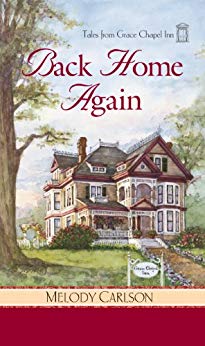
Book Review: Back Home Again

Back HomeIn Back Home Again: Tales from the Grace Chapel Inn by Melody Carlson, Alice Howard is a middle-aged single woman who has lived with her father in the old family home for years. Now her father has passed away, and her sisters have come home for the funeral. The house has been left to the three of them equally, and as they discuss what to do with it, they hit upon the idea of converting it to a bed-and-breakfast.

Their first obstacle is a meddling aunt and small-town resistance to anything new. Then, the three sisters are so different, and two of them in particular disagree over every little aspect. Alice tries to be a peacemaker between her two sisters and her family and the town.

The sisters, their aunt, and the town learn to come together, forgive, and give each other the benefit of the doubt.

This is the first book in a series of over thirty, authored by various writers. A light, pleasant read.

(Sharing with Semicolon‘s Saturday Review of Books, Literary Musing Monday, Carole’s Books You Loved)

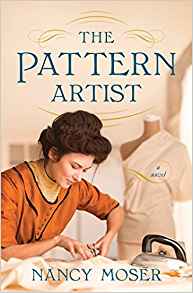
Book Review: The Pattern Artist

Pattern ArtistIn The Pattern Artist by Nancy Moser, Annie Wood left her dysfunctional family to go into service as a housemaid in England in 1911. She had a knack for sewing and alteration and hoped those skills would pave her way towards becoming a lady’s maid. She accompanied the family on a visit to America, and a number of factors worked together to compel her to run away with a couple of friends to see what life had to offer in this country.

Their first few days are rough, but then Annie lands a job at Macy’s Department Store in the sewing department. Her suggestions for her customers are noticed favorably by her managers, but negatively by a jealous coworker. A Butterick pattern salesman sees her potential and recruits her to join his company as a pattern designer.

Annie’s path is not always smooth, though. A number of obstacles, dangers, and a tragedy block her way. But she hopes, with hard work, determination, and a faith just beginning to bud, that she might find her own American dream. She learns “Humble beginnings are a badge of honor. It’s not where you begin, but where you end up” (p. 187).

This book caught my eye because I have enjoyed many of Nancy’s books, plus I used to do a lot of sewing and worked in a fabric shop for years. It was fun to read of how all of that worked in the early 1900s.I had not heard before of the Reform Dress Movement, an effort “started in the 1840s, rejecting the unhealthy confinement of the female form, and promoting practical clothing” (p. 189), but I am glad it helped get rid of corsets and ridiculous fashions like the hobble skirt.The movement plays a part in Annie’s career.

I enjoyed the author’s explanations in the afterword about how she came to include some of the various historic details. And somehow I totally missed the double meaning of the title until I read it in that afterward, but it should have been plain to me. Realizing that made me enjoy the story all the more.

It dawned on me at some point that the family Annie first worked for was in Nancy’s Summerfield (Manor House) series. I have only read the first book in that series so far, but it was fun to make that connection.

Overall quite an enjoyable read!

(Sharing with Semicolon‘s Saturday Review of Books, Literary Musing Monday, Carole’s Books You Loved)

Book Review: When the Morning Glory Blooms

Morning Glory When the Morning Glory Blooms by Cynthia Ruchti explores three different, but related, timelines.

The first one, in modern times, involves Becky, whose teenage daughter had a baby out of wedlock. Becky takes care of her grandson so her daughter can finish high school, but she struggles with how much she’s helping and how much she’s enabling her daughter’s lack of sense of responsibility.

In 1951, Ivy just saw her boyfriend off to the Korean War. Then she found out she was pregnant. Now she’s afraid to tell him. She doesn’t want to put him in danger by distracting him, but she’s also afraid he’ll reject her. Ivy works in a nursing home, and one of her patients is Anna. Anna wants Ivy to help write down her story, and at first Ivy acquiesces just to please Anna. But she realizes that Anna is perfectly clear and not at all the dementia patient Ivy had thought. And Anna’s story is not only remarkable in itself, but it touches her own in many ways.

In the 1890s, Anna inherited some property. Her dream: to turn the old home into a haven for unwed mothers. She had little resource except faith. Her plan was not well-received by the community – except for her pastor and his wife, who helped to bring others on board.

As you can see, each of the stories involves unplanned pregnancies. Even though they were handled in different ways in different eras, they still brought complicated and painful consequences. Yet in each story line, those involved found some measure of grace and some maturity and growth through their circumstances.

The three are also connected by morning glories – but I’ll let you discover what that means.

A few quotes:

Your baby’s name is not Regret.

Wouldn’t one think that the forgiven would be quickest to forgive others? That the redeemed would fall over one another in their rush to carry the song of deliverance to those who had yet to hear its calming melody? That those who had found refuge would do everything in their power to light the way for others?

When young women lived with me, they worked beside me both because their help was needed and because work is both healing and character building.

I thought I’d have trouble keeping up with three different threads of story, but Cynthia wove them together well while keeping each distinctive enough to avoid confusion. I enjoyed the humor especially in Becky’s narrative. There were a few surprises: some of the connections between the women turn out to be different from what I had thought they would be. I enjoyed the unfolding of each woman’s story, and the need to extend and receive grace displayed in each one.

(Sharing with Semicolon‘s Saturday Review of Books, Literary Musing Monday, Carole’s Books You Loved)

Book Review: My Father’s House

My Father's House My Father’s House by Rose Chandler Johnson begins with the idyllic childhood of Lily Rose Cates in Georgia. Then her father died when she was sixteen, turning her world upside down. Her mother had been not entirely mentally present for some time, a situation made worse by the death of Lily’s father. A lady who took care of their home, Annie Ruth, became a second mother and the main stabilizing influence in Lily’s life.

Milestones pass – high school graduation, friendships, college. Lily has a couple of part-time jobs she likes, but life is pretty tame. She is invited to visit a cousin’s place in New York City and is absolutely mesmerized by all there is to see and do. One highlight is an encounter with a handsome and charming waiter who asks for her number.

To her joy and surprise, the waiter, Manny, does call – only he’s not a waiter. The restaurant was his family’s, and he was just helping out for a while. He’s actually a driven, high-powered lawyer in Detroit. A telephone romance leads to a proposal and a move for Lily Rose. Some incidents and reactions from Manny make Lily uncomfortable, but she’s in love and her courtship is such a whirlwind, she lets them go.

Their first few days are bliss until Manny has to go back to work, leaving Lily lonely trying to get accustomed not only to a new city, but a new situation, style of home and life, everything. Before long, Manny’s dark side comes out bit by bit. Lily realizes that she can no longer brush off or overlook his actions. Manny has become unpredictable and dangerous, and Lily decides to leave with the help of a friend.

Lily goes back to Georgia to a home of her father’s that she had inherited but had not told Manny about.  She knows Manny will come looking for her, but for a while she has time to heal, stabilize, and rediscover her roots and her faith.

This was a wonderfully told story with a strong sense of place. The description of the Southern setting makes one want to settle in a rocking chair on the porch with a glass of sweet iced tea. I was drawn right in and looked forward to each new chapter, sorrowing with Lily over the loss of her father and her marriage, rejoicing as she grew.

There were a few too many references to Lily and Manny’s intimacy for my tastes, but none of that was explicit, and what was said did make sense in context. Then in the second half of the book, there are a number of instances of an unmarried man and woman staying overnight in a cabin and home. None of the other characters seems to have a problem with that: I would have loved for at least one of them to object. The author prevents anything from happening between them. And there’s an odd incident where Lilly almost seems to be saying she visited her father in heaven in a dream.

But other than those caveats, I thought this was a lovely story.

(Sharing with Semicolon‘s Saturday Review of Books, Carole’s Books You Loved)