Book Review: Leaving Oxford

Leaving OxfordThe setting for Leaving Oxford by Janet W. Ferguson is not in England, but in a small town in Mississippi. There advertising expert Sarah Beth LeClair works remotely for her company in CA and teaches a few classes at the University of Mississippi. A trauma has left her suffering from severe panic attacks, and she only feels safe in Oxford, where she grew up. Because of the limitations of her anxieties, she avoids getting into a dating relationship. But a new coach from FL enters her world as a friend and eventually becomes something more. When he has an opportunity to advance in his career by taking a college coaching position in another state, that puts him in a dilemma with the woman he has come to love who can’t leave town.

I thought the first chapter, especially about seven paragraphs in, was just kind of silly, but knowing the subject matter, I knew it would have to get deeper before long. And it did. Overall it was a good story, though I felt the writing fell a little flat in some places. I loved the cover.

The thing I appreciated most about the book will require me to back up to explain. I am a fan of Christian fiction, but some plot lines have everything being resolved in one act of repentance or in the character getting right whatever it is he or she needs to get right in their hearts, and they live happily ever after, when in real life, that act of repentance is just the starting point, not the end. For instance, in one book I read years ago, a couple had a troubled marriage and were even planning to divorce after an event in their daughter’s life. They were just marking time until they could get to that point. The author ended the book in a climatic and dramatic surrender of each to the Lord and to acceptance of each other. In real life, that would be a beginning, but it would still take a lot of work for the marriage to recover from everything it had gone through.

That said, I was happy to see that this author didn’t go that route. Though there is drama that advances the characters to where they need to be, there is also acknowledgment that change and recovery are journeys.

My favorite quote from the book: “Put God first. Don’t confuse passion for love. Love includes the work that happens after the passion. Love becomes a choice.”

Oddest incident in the book: the folk song “The Water Is Wide” is used in an engagement and played at a wedding. It’s one of my favorites and has a gorgeous melody, and the first stanza sounds very romantic – but in most versions, it’s about a love that “proved false” and “grows old and waxes cold And fades away like the morning dew.”

Some readers would want to know that a few of the characters discuss past indiscretions in their relationships, but not in an explicit way.

So, overall it was a good story, though I probably wouldn’t place it on my top ten favorites of the year. But there is a sequel I am considering reading to see what happens to one of the other characters.

(Sharing at Semicolon‘s Saturday Review of Books)

Save

Save

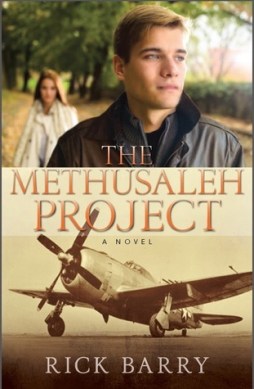
Book Review: The Methusaleh Project

MethusalehLately I seem to be catching up with books that were popular a year or two ago. Maybe that’s how long it takes for them to go on good sales for the Kindle. 🙂 At any rate, when The Methusaleh Project by Rick Barry came up as  Kindle sale last year, I remembered seeing a number of favorable reviews about it, so I got it.

The first part of the book switches between two different story lines. In one, Captain Roger Greene is a US pilot flying on a mission in Nazi Germany in 1943. His plane is shot down and he is captured, but instead of being taken to a POW camp, he is taken to an underground bunker set up like a lab. He and six other captives are subjected to experiments by a Nazi doctor designed to accelerate the body’s healing and prolong life. If successful, the doctor will be able to to pass along this technology to the Nazi powers that be. When an Allied bomb destroys the building, the doctor, and all his research, as well as the six other captives, only Roger and the doctor’s assistant survive. The Nazi regime keeps Roger captive and sets up the doctor’s assistant in a new building to try to figure out what the doctor did to Roger so they can duplicate it.

The alternate story involves Katherine Mueller in Atlanta in 2015. Her parents died long ago and she was raised by her uncle. The major consideration in his life is the Heritage Organization, a secret society “aimed at challenging individuals to higher levels of achievement, improving the world with inventions and positive influences, then passing on a stronger heritage to the next generation.” He wants Katherine to move up the ranks in the organization, which involves excelling in marksmanship and field exercises involving tracking. She doesn’t know exactly what the organization does – only the higher-ups do – and it seems almost cultish to her sometimes. But her Uncle Kurt and both her parents were involved in it, and she trusts her uncle completely, so she wants to carry on the family tradition. Though she loves her uncle, she’s frustrated by his matchmaking involving only men from the organization, none of whom attracts her in any way.

I assumed these story lines would intersect at some point, though they were 70 years apart. And wow, did they ever! I won’t reveal how, but let’s just say this is the fastest I have read any book lately because I kept looking for opportunities to open it.

There were just a few speed bumps in the writing in the first part of the story, but I didn’t even note what they were except that Roger at first seemed beyond the stereotypical brash and breezy WWII American flyboy into something of a cliche in the first chapter or so. But that feeling dissolved pretty quickly, and it wasn’t long before I was totally wrapped up in the story, racing to see how the author would bring various elements together and whether some of my suspicions about some of the characters and the “organization” were accurate.

I’m not sure exactly how you’d classify this book. It’s part sci-fi, part historical fiction, part contemporary fiction, part action and suspense. It is Christian fiction: neither Roger nor Katherine are Christians at the beginning of the book. Roger has faint memories of a former Sunday School teacher encouraging him to pray, and he is given a Bible in captivity that long hours of inaction and desperation drive him to. I thought the author wove the faith element in quite naturally.

Overall – I thoroughly enjoyed this book!

(Sharing at Semicolon‘s Saturday Review of Books)
Save

Save

Book Review: They Almost Always Come Home

RuchtiI picked up They Almost Always Come Home by Cynthia Ruchti when it came up on a Kindle sale because I had seen some favorable reviews for some of her books. I couldn’t remember if this was one I had seen reviewed, but I did remember Ruchti’s name being mentioned favorably.

Libby’s husband, Greg, has been on a solo two-week wilderness trek. He does these often, roughing it in the Canadian wilderness, canoeing, camping, fishing. But this is the first time he has gone completely alone. And now he’s late.

As Libby takes the initial steps to call Greg’s dad and notify the authorities, she also wrestles with her own heart. She had actually planned to leave Greg. Their marriage had been fairly empty since their young daughter died some time before, with Libby holding Greg responsible for what happened  to her. In fact, she wonders if perhaps he took this opportunity to leave her.

As Libby, her best friend Jen, and Greg’s father, Frank, embark on a trip of their own to look for Greg, Libby faces her own assumptions and realizes she might just be wrong in a few areas.

A little over half-way through, the point of view shifted from Libby’s first person to Greg’s third person. I was a little jarred at first, but after I finished the book, I agreed that was probably the best way to unfold the story of what happened to him.

There were a few too many…I don’t know whether to call them object lessons or simile moments or what:

[After wiping crumbs off the counter] How long will it take me to figure out what to do with the crumbs of my life?

I pick up my wide-toothed comb and tackle the tangles in my hair. Working at them little by little, from the bottom up, the knots soon turn to wet but smooth silk. Where can I find a wide-toothed comb for marital tangles?

[After putting her backpack on] How clumsy I am with all those pounds on my back. Like the weight of grief, it makes me stumble on simple motions.

[When biting ants attacked her father-in-law] A tiny intruder can create a great deal of turmoil. Under the microscope, the small choices in my marriage might have seemed insignificant, too.

I just encountered a lot of this in another recent book: Please, please tell me this is not a new trend!

The Kindle formatting is worse than I have seen in other books – first words in sentences not capitalized, words smushed together or unrecognizable.

But overall I really enjoyed the book. There were a number of humorous moments as well as heart-grabbing ones. I was touched by the faith journey each character took.I read that this is the author’s first faith-based novel. I was just a touch disappointed in the ending: I don’t require that every little thing be wrapped up in a tidy bow to be satisfied, but I felt a couple of areas were unresolved. I almost wondered if a sequel was planned, but it doesn’t appear so. Maybe the idea was that once the characters got their hearts right, the circumstances didn’t matter as much because then they could get through anything.

 (Sharing at Semicolon‘s Saturday Review of Books)


Save

Book Review: Chateau of Secrets

ChateauMelanie Dobson first came to my attention through Carrie. If you read Carrie much at all, you know that she does not like Christian fiction, yet she likes Melanie. Since I do like Christian fiction, I figured I would probably enjoy Melanie all the more. So when I saw her Chateau of Secrets come through on a Kindle sale last year, I snapped it up.

And indeed, I enjoyed it very much. Normally I read Kindle books on my iPad mini as I am getting ready to fall asleep and then when I have any waiting time away from home. But this one had me pulling my phone out several times during the day to read a few more paragraphs.

Gisèle Duchant lives with her father in their ancient chateau on Normandy before the onset of WWII. As Hitler’s forces come ever closer, they decide to leave. But Gisèle’s father is killed, and she then decides to stay. Her brother, Michel, is a leader in the underground resistance, and she has been helping him by secretly bringing food and supplies where he is hiding in the tunnels beneath their property.

Eventually the Nazis come to their area and take over the chateau for their local headquarters. They commandeer Gisèle to cook and keep house for them, so she’s walking a tightrope between doing what is required of her there yet still helping her brother and trying to keep the tunnels a secret.

The chapters alternate between her story in the 1940s and her granddaughter Chloe’s story in modern times. Chloe is a teacher engaged to Virginia gubernatorial candidate Austin Vale. Being the fiancee of a high-profile politician has its drawbacks, but their times alone convinces her that it’s worth it. Just a few weeks before her wedding, her parents ask her to go to France. A filmmaker is doing a documentary on the chateau and its role in the war, and Chloe seems to be the best person to go and be interviewed by him. Chloe doesn’t know much about the chateau, and her grandmother Gisèle’s dementia confuses or hides much of her memory, so she’s not able to give her much information. But when she tells her grandmother that she’s going to the chateau in Normandy, Gisèle urgently insists that she must find Adeline. Chloe has never heard of Adeline before. As she travels to France, stays in the chateau, and delves into her grandmother’s history, she uncovers a multitude of secrets, some of which will have an impact on her family now.

I enjoyed both Gisèle’s and Chloe’s story lines. I liked the way the author wove in much detail about France in that era without making it too heavy or encyclopedic. I had not known that Jews served in the German Wehrmacht. Some probably did so to hide their Jewishness, but some did so out of coercion to protect loved ones. I loved the mystery of the story and thought the author did an expert job at unfolding it.

The story is loosely based on the life of Genevieve Marie Josephe de Saint Pern Menke. She lived in a chateau in France during WWII which was taken over by the Germans, and “risked her life to hide downed Allied airmen and members of the French resistance in this tunnel underneath the chateau,” among many other things.

Gisèle is Catholic, and, not being Catholic myself, there were a few points here and there that I would disagree with, namely praying to Mary, St. Michel, and ever her dead mother (that’s not the biggest problem I have with Catholicism, but it’s the biggest one in this book, because nowhere in Scripture are we instructed or encouraged to pray to anyone but God Himself. Jesus said, “When ye pray, say, Our Father which art in heaven….” After all He did to create access for us to God, why would we try to go to Him through anyone else?) I don’t share what I disagree with in books just to be critical or contentious, but sometimes people tell me they read things I recommend, so I want to be careful that I don’t promote error. I would assume that Gisèle’s Catholicism is accurate to the time, place, and person her character is based on. And I did find much good spiritual truth in the book otherwise.

Overall I loved the book and will keep my eyes peeled for more of Melanie’s books in the future.

(Sharing at Semicolon‘s Saturday Review of Books)

Save

Save

Laudable Linkage

Here are some noteworthy reads discovered recently:

Antidote to False Teaching: Stability and Growth in The Knowledge of Christ. Quote: “The single most effective method for studying any book of the Bible is accessible to every believer.”

3 Truths to Speak to Your Temptation

Imagination and Evil. Quote: “Children’s books that scrub any evil from the story are burgeoning. The conflicts are based on misunderstandings or due to a different perspective. They are easily solved with a pleasant discussion. It’s very sanitary! But are we telling our children the truth by painting an evil-free, pain-free world? Stories are not innocuous; they convey a worldview just as powerfully, if not more so, than direct statements.”

Me Before You: Dear Hollywood, Why Do You Want Me Dead? “11-year-old wheelchair athlete tells the culture to get over itself”

Check Your Words at the Door

My Husband Doesn’t Put the Kids to Bed, and It’s Really Okay

I’m not sure why I keep reading Jess Connell. I enjoy her posts but she mainly writes about raising children, and I am past that stage. Maybe to recommend her to others? Anyway, here are three that struck a chord with me lately:

Motherhood 101: The Class We Never Got. Learning “on-the-job” while feeling overwhelmed.

How To Set Your Kids Up For Obedience.

Is Homeschooling a Safeguard Against Rebellion?

Praise Him in the Hallway.

More Weird Things Writers Say.

Imagine If Ebooks Came First.

And to end with a smile…

Cover squirrel

Husky
Happy Saturday!


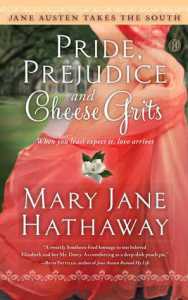
Book Review: Pride, Prejudice, and Cheese Grits

PP&CGPride, Prejudice, and Cheese Grits by Mary Jane Hathaway might sound like a Southern version of Jane Austen’s novel, and indeed it is. Set in the present-day South, it is not a point for point retelling – there are a few differences in characters and plot. But if you’re thinking of P&P while reading it, you’ll recognize a number of plot points and people. This book is the first in Hathaway’s “Jane Austen Takes the South” series. I had read the second book, Emma, Mr. Knightly, and Chili Slaw Dogs, first and then backtracked to read this one.

In this story, Shelby Roswell appreciates history, from old houses to old diaries. In fact, she is a professor of history specializing in the Civil War era working to become tenured. She had written a book with hopes of it propelling her toward her goal, but eminent Civil War expert and writer Ransom Fielding wrote a scathing review of it for a national magazine. And now he’s a visiting guest professor at her college for an entire year. She hopes to avoid him, but at their first meeting, they clash big time, and publicly at that. They each push all the wrong buttons in the other, yet find qualities attractive in each other.

Ransom is, of course, devastatingly handsome, sure of himself, and seemingly a little stuffy at first. He lost both a wife and child, leaving him bitter against God and determined to guard his heart from ever loving another woman.

Of course, following P&P, you know where this is going to go, but it is fun to see how it gets there. Jane from P&P is replaced by Shelby’s roommate, Rebecca, English professor and Jane Austen expert. Ransom’s aunt Margaret Greathouse represents the formidable Lady Catherine de Bourgh. Shelby’s family represents Elizabeth’s in a laid-back father, marriage-minded mother, and silly sisters. Mr. Collins and Wickham are combined in a David Bishop.

I’ve seen a couple of reviewers refer to this volume as more preachy than the second book, but I’d have to ask what they mean by “preachy.” To me, a preachy Christian fiction book is more a “lesson” thinly veiled as a story and may entail finger-wagging and implied “You ought…” advice to the reader. I saw none of that here. As I wrote in Why Read Christian Fiction?, you’d expect in this genre to see professing Christian characters doing Christian things like reading their Bibles and trying to figure out how to apply their faith to everyday life. I do find that here in a natural, uncontrived way, such as when Shelby, after a heated encounter with Ransom, wonders why she has a hard time with putting into practice the verse she had read that morning about being swift to hear, slow to speak, and slow to wrath when she is around him (though actually it’s not just around him – she tends to blurt things out before speaking to nearly everyone) and, when they finally talk about his wife and child, and she advises him in ways to deal with it. That’s perfectly normal. The author seemed to go the other way in the second book – I remember wondering why it was called Christian fiction when there wasn’t really anything distinctly Christian in it that I could recall. Perhaps she did so in response to criticism in this book, but I’d rather have Christianity displayed as it is here rather than being so subtle it is unobservable.

There were a couple of plot points that didn’t quite make sense to me, but overall the writing was fine. There were a couple of sections I felt didn’t need to be there: for instance, when Shelby is holding her cousin’s baby while talking to Ransom, the baby keeps putting its fist in her cleavage. Sure, babies do things like that, but in a book there was really no reason to draw attention (ours or Ransom’s) to her cleavage. And one character is framed with a fake video of a fake sexual encounter. Sure, there is scandal in P&P when Lizzie’s sister runs off with Wickham, but we are told very little about it. This book doesn’t go into all the specifics of the tape but mentions more than necessary – and I felt the conflict and tension this incident was supposed to create could have been handled in a different way. I’ve seen a couple of reviewers mention a swear word in the book, but I don’t remember any, and I am usually sensitive to that.

But I thought the theme that “love changes us” was nicely brought out, and I enjoyed the ways it changed Ransom and Shelby. And the Austen connections were fun, too.

(Sharing at Semicolon‘s Saturday Review of Books)

Book Review: One Perfect Spring

One Perfect SpringI’ve seen many blog posts recommending Irene Hannon, so when One Perfect Spring came through on a Kindle sale, I got it. Hannon is most known for mysteries, but has written a few contemporary romance novels, this being one of them.

The story opens with workaholic Keith Watson sifting through requests for his boss’s McMillan Charitable Foundation to find the best two or three he could recommend. Among them he finds a handwritten note from an eleven year old girl named Haley asking for the firm’s help for her neighbor. Haley had seen Mr. McMillan’s picture in the newspaper and was told by her mom that he “did nice things for people.” Her neighbor was seeking for a son she had given up for adoption, and Haley wanted Mr. Macmillan to help her. Keith places the note on the reject pile to be sent a standard letter. But his boss finds the note and wants Keith to follow up on it. He sees in Keith a younger version of himself and wants to help him avoid the mistakes he made in putting his work first place for too much of his life. Keith is less than thrilled, but follows through.

The neighbor in question is Maureen Chandler, a college professor. She had just been through cancer treatments that seemed to be successful so far, but the bout caused her to reflect. She had given up her son twenty-two years ago and kept him a secret. Now she wants to make a connection and try to find some closure.

Keith’s pursuit leads him not only to Maureen, but her neighbor, Haley’s mother, Claire Summers. Claire is a single mom who bought a fixer-upper house and is trying to take one project at a time as the budget allows, doing much of the work herself to save money. Keith and Claire don’t hit it off at first, but Maureen and David MacMillan do.

While Keith works on Maureen’s case, some of each character’s past and issues are revealed. They have to learn that dealing with the past and forgiveness are necessary parts of preparing for a future, that learning to trust again is possible but takes time, and that giving a person another chance is necessary.

I enjoyed the story very much. But one aspect of Hannon’s writing grated on me after a bit.

“Mmm. Cream cheese…sweet, smooth, and yummy. Kind of like the man who’d brought it.”

“The effort to eradicate [the paint] chafed her skin, leaving an angry red blemish. Kind of like the lingering blemish left on her heart…”

“[The chair] must be stronger than it looked. Kind of like the owner of this house.”

“She transferred the [hot] dish to the table as fast as she could, touching it as briefly as possible. Kind of like the way she’d handled the events that had gotten her into a mess…Like the hot casserole, her story had the power to burn.”

“[The race] was neck and neck, making the outcome hard to predict. Kind of like the outcome of her relationship with Keith.”

There are half a dozen or so of these “kind of like” comparisons, and many more that don’t use that exact phrasing (“She picked up his glass, swirling the ice that was quickly melting in the heat of the house. Warmth could melt so many things. Including hearts.” “She swiped up a stray drip of mustard left from their dinner, the cheerful hue reminding her of Haley’s comment about Keith brightening up their house.” “It was only a room. But could it symbolize more?”) The first time, I thought, “She didn’t just do that, did she?” Symbolism is a great literary device, but it’s usually much more subtle than that. I don’t think many people see that many connections or object lessons throughout life.

But I am hoping that this isn’t characteristic of Hannon’s writing, and I liked the story well enough to seek out another of her books. In fact, the preview of one of her mysteries at the end of this book hooked me in enough to want to find out what happened.

If you like clean (except for one inexplicit yet to me kind of tacky reference) Christian fiction where characters are realistically flawed, yet learn and grow through the story, you would probably like this book.

(Sharing at Semicolon‘s Saturday Review of Books)

Book Review: What Follows After

What Follows AfterIn What Follows After by Dan Walsh, Scott and Gina Harrison are separated, but no one knows it. They attend functions together and ask their boys, Colt, age 11, and Timmy, age 6, to pretend as if everything is all right. But everyone is miserable, and Colt has finally had enough. He decides to take the money he has saved and buy bus tickets for himself and Timmy to go to their favorite aunt and uncle’s house. They feel sure their aunt and uncle will take them in, listen to their side of the situation, and talk some sense into their parents.

Everything goes as planned until the bus stops for a short break. Colt and Timmy get something to eat at a nearby diner. When all sorts of Army vehicles begin to pass by, Timmy is enthralled and won’t come when Colt needs to use the restroom. Colt decides it won’t hurt to leave Timmy there for a few minutes. But when he comes back, Timmy is gone. The waitress said he went out with a man she thought was their dad. They had gotten on a different bus heading the opposite direction from their aunt and uncle’s house.

The story is set in 1962 Florida on the eve of the Cuban missile crisis, which, though it doesn’t affect the story directly (except in taking attention and manpower away from the kidnapping case), does add a layer of tension. I was born in the 50s and thought Walsh did a good job recreating that era.

There are a lot of threads to the story: Scott and Gina’s relationship, what led to its current standing, the kidnapping, the motive and the man who did it, race relations in the South at the time, and people’s reactions to the current crisis with Cuba. I thought the overall story was good, and Walsh brought out a lot of good points about the Harrison’s marriage and what needed to be done to mend it.

Walsh is known for writing that tugs at the heartstrings, for books that could easily be made in Hallmark movies. But though all the elements were there to make this another winner, somehow it just fell flat to me. The characters did not seem fully developed and some of the conversation seemed cliche. Whatever it is that draws me in and really makes me feel for the characters just seemed to be missing this time. But, skimming through reviews on Amazon and Goodreads, none of them seemed to have any objections except just a very few people who didn’t like the religious element. So maybe it was just me.

But even though I didn’t feel it was up to Walsh’s usual standards, it’s still a fine book and I’d still recommend it. Maybe you’ll like it better than I did. I especially like the paragraph from which the title comes, that “what follows after” a crisis or terrible situation can be good, that God can bring beauty and blessing out of misery and work all things together for good for those who love Him.

(Sharing at Semicolon‘s Saturday Review of Books)
Winner of The Tenth Plague giveaway

The-Tenth-Plague

The winner of the giveaway of the paperback version of The Tenth Plague by Adam Blumer is Faith. Congratulations, Faith!

For those who didn’t win, check out Adam Blumer’s Facebook page, where he’ll be posting about various other giveaways over the next few months.

Thanks for entering, and thanks to Adam for sponsoring the giveaway and writing such great books!

Book Review: The Reunion

The ReunionI’ve had The Reunion by Dan Walsh in my Kindle app for months now (or years…yikes!), but Lou Ann’s review caused me to move it up to my next Kindle read.

Aaron Miller is a Viet Nam vet who works as a maintenance man in a trailer park. Serious injuries sustained in the war sent him home and caused him to become addicted to painkillers. He lost his family, his job, his home, and lived on the streets for a time. But he found the Lord and began the slow road to recovery.

Even though his job might not look prestigious to most, he does it well. And in the course of it, he seems often to be put in the way of people who need help. A teen-age girl with an abusive boyfriend. A legless veteran who is on the verge of ending it all. An elderly woman whose home is crushed by a tree.

Unbeknownst to Aaron, three men he knew back in Nam are looking for him. And when one of them hires journalist Dave Russo, who is writing a book about Viet Nam vets in honor of his later veteran father, they just might find him.

All of Dan’s books that I have read are heartwarming, but this one is probably the most so. I kept thinking it would make a great Hallmark Movie. 🙂 I loved the Amazon introduction to this book: “There are people in this world we pass right by without giving a second thought. They are almost invisible. Yet some of them have amazing stories to tell, if we’d only take the time to listen…” I loved Aaron’s character and could just picture him as one of those kinds of people most would tend to overlook but who faithfully does his work well and who has a great story behind him. I enjoyed Dave’s story as well. Dan did a wonderful job weaving all the different elements of the story together and pulling at the heartstrings.

Here are just a couple of quotes that stood out to me:

Of course, it was clear the thing Billy needed most was a friend. It didn’t help that Billy talked so much once he got going. One thing after another, like he’d been sitting on a mountain of words and Aaron had come in and set off a volcano.

Most of the people who blame God for everything never even try things his way, so how can they blame Him when it all goes wrong? But they do. I did. For years, til eating that meal. That day, the lights came on. And I saw that all I ever did was do things my way, my whole life. And all it ever did was get me in trouble and more trouble.

I also enjoyed the Author’s Note at the end where Dan says two stories about two different WWII Congressional Medal of Honor winners (Bobbie E. Brown and Bill Crawford) who came home, eventually became janitors, and had very different endings inspired him and caused him to think about people we overlook who might have amazing life stories or might have accomplished great things no one would ever guess. Plus he was inspired by Jesus’ example of speaking to out-of-the-way, overlooked people. And I join him in expressing gratitude for “the unsung warriors whose actions have made it possible for the rest of us to live free.”

(Sharing at Semicolon‘s Saturday Review of Books)