Book Review: All Things New

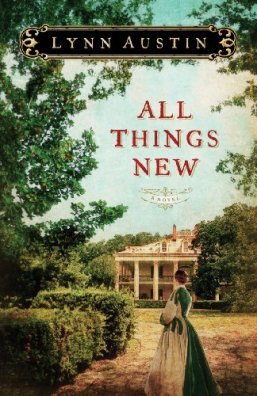
All Things New by Lynn Austin takes place at the end of the Civil War and the beginning of Reconstruction, one of the most difficult periods in American history.

Virginians Josephine Weatherly and her mother, Eugenia, and sister Mary have lost their father, oldest brother, and many of their possessions to the war. Their other brother, Daniel, finally comes home but is a broken man. Living for so long with famine, fear, and unanswered prayers, Josephine has lost her faith as well.

As the South tries to recover from the war, various attitudes clash. Some, like Eugenia, want to restore everything to the way it once was and have difficulty treating the former slaves as employees. Some, like Daniel, become bitter and want revenge and control through violence. Josephine is in a fog for a long time, but eventually she sees that things must change. Bored with her listless life and empty time, she begins helping one of their two remaining servants in the garden, much to her mother’s shock and dismay. But Josephine finds that she enjoys doing something useful. She also begins to see the servant, Lizzie, as a real person and learns more about the family she hadn’t even known Lizzie had.

A federal agent is sent to help the freed slaves find positions, start a school for their children, and help negotiate contracts between the former slaves and masters as employee and employer. The former slaves are grateful for his aid, but he is not trusted by the white people because he is a Yankee and still regarded as an enemy. When Josephine runs into him accidentally, at first she is appalled, but as she gets to know him, she finds him and his views thought-provoking and reasonable.

Among the views that need changing are not only those involving slaves and masters, but those involving what it means to be privileged. As Josephine shocks and angers her mother by further activities outside the bounds of what privileged young ladies are supposed to do, Josephine finds new purpose and meaning. And gradually her heart begins to open to the idea that it needs freedom as well.

Here are some of the quotes that stood out to me:

Eugenia hated seeing her daughter stray so far from her aristocratic upbringing to labor like a common woman, even though her hard work was saving all of them.

Jo fought to control her temper, to be the dutiful daughter. She was walking the same narrow path that Dr. Hunter was, her conscience telling her one thing, her sense of duty and her ingrained respect for her mother telling her something else.

“Even after the war, Eugenia, do you still put people into categories the way you were taught to do—rich and poor, socially acceptable and not, black and white?”

“I haven’t placed them there. Life has.”

“But people are all the same in God’s eyes, don’t you think? Or do you believe there will be segregated divisions in heaven like the ones we’ve created here on earth?”

I think you’ll find our children’s values will be different from ours. They’ll see that slavery was wrong and that it had to end. They’ve seen the futility of war. They’re learning to live without wealth and privilege. I would hope our sons and daughters would also learn to look for other qualities in each other besides money and social position.

We have to lead by example. Our generation has to make peace with the Negroes and with the Yankees. We have to show our sons and daughters that the old South was destroyed because it was flawed and that we’re willing to embrace the changes. It will only lead to more suffering if we don’t. We can show our children that many of the changes are good. . . . It begins with us—you and me.

Pride. We began to believe that we were little gods, expanding our empires, living well at the expense of an entire race of people. The Almighty finally had enough and showed us we were only human after all, that we would bleed and die from cannonballs and bullets. He reduced us to the same poverty and helplessness that we inflicted on the Negroes—but some of us just haven’t learned that lesson yet.

The war has exposed our false beliefs and the moral rot that accompanied slavery. All of our prideful decisions and the shameful way we treated the Negroes have been exposed. We were flawed, Eugenia. God said so. It’s time to let go of our old attitudes and rebuild the South with compassion for others and with the belief that’s at the core of our Constitution—that all men are created equal. And it’s up to us to lead by example.

I grew up in southern TX, where we considered ourselves Southerners, but it didn’t really come up much unless someone with a Northern accent was around. It wasn’t until I moved to SC that I met people passionate about being Southern and speaking haughtily about “The War of Northern Aggression.” Students of the Civil War are quick to point out that it wasn’t just about slavery, that there were other issues involved as well. But as John Newton said to Hannah More in a letter concerning their fight against slavery in England:

I think this infamous traffic cannot last long; at least that is my hope…should it still be persevered in, I think it will constitute a national sin, and of a very deep die…I should tremble for the consequences; for, whatever politicians may think, I assuredly know there is a righteous judge who governs the earth. He calls upon us to redress the injured, and should we perversely refuse, I cannot doubt but he will plead his cause himself (as quoted in Fierce Convictions: The Extraordinary Life of Hannah More by Karen Swallow Prior).

I don’t know why it took so long for people to recognize the wrongs of slavery. Ruffled feathers against “Yankees” and “The War of Northern Aggression” aren’t cute any more. Change of heart has been slow in coming, and it’s much better than it was in this era, but there is still a long, long way to go to repent of deep-seated prejudices in this country. I’ve lived in the South all my adult life, in SC, GA, and now TN, and I love it dearly, but we still need to grow.

I thought this book was very well done showing the difficulties of this era on all sides without simplistic platitudes pasted on like band-aids. And beyond the overarching themes and settings, the stories of the individual characters were well-drawn. Highly recommended.

(Sharing with Semicolon‘s Saturday Review of Books, Literary Musing Monday, Carole’s Books You Loved)

Save

Save

Book Review: All She Ever Wanted

All She Ever WantedAll She Ever Wanted by Lynn Austin opens with a stressed-out Kathleen Seymour. She’s just lost her job, and her daughter, who has always been given everything she ever wanted, has been caught shoplifting. Advised by a counselor to try to connect better with her daughter, Kathleen decides they should go on a road trip back to where she grew up, where she has not been for thirty-five years.

On the way, Kathleen opens up about her own dysfunctional, poverty-stricken childhood that she had kept carefully hidden, with a thief for a father, a mother with little energy and interest, and a Communist uncle.

Conversations with friends and relatives along the way also reveal to Kathleen much she didn’t know about her own mother and grandmother’s lives. Each woman had left home trying to escape her family or situation, each faced stumblingblocks and sorrows, and each made mistakes with her own children. Will they ever find “all they ever wanted,” or are their sins past forgiveness?

My thoughts:

Truly each person has hidden sorrows and struggles, and we need to be “quick to hear, slow to speak, slow to anger” (James 1:19). And, truly, God’s forgiveness is available to all who will accept it and believe in His Son, Jesus. And, truly, we all have enough of our own sins and foibles to deal with that should keep us from judging each other. And we all need to seek God’s will for our lives rather than navigating them on our own and making a mess of things. I was thankful for those emphases throughout the book.

Some readers would want to know that one of the women fell into extramarital sex, but nothing is explicit, and that does happen. It’s a believable part of the story, not there just for titillation.

Though it’s a good story, it’s not my favorite from Lynn. I’m having a hard time putting my finger on exactly why. It was a little disjointed with the back-and-forth timelines between the women. The next to last chapter, while good, and resolved in the ways I would have hoped, yet containing some surprises, seemed just a little too…pat, maybe. There were a couple of places I disagreed with the theology a bit. But none of these were big enough that I wouldn’t recommend the book, and I especially liked the last chapter.

(Sharing with Semicolon‘s Saturday Review of Books, Carole’s Books You Loved)

Save

Book Review: Though Waters Roar

Though Waters RoarIn Though Waters Roar by Lynn Austin, Harriet Sherwood is a young woman in the early 1900s who has just landed in jail for defying the Prohibition’s liquor laws – but not for the reasons you might think. As she spends the night in jail, she contemplates how ironic it is that she’s there, given that her grandmother spend much of her adult life fighting for Prohibition. Trying to trace how she got to where she is, she reminiscences about the women in her heritage.

Her great-grandmother, Hannah, helped hide slaves and smuggle them to the Underground Railroad. Her grandmother, Bebe, stepped out of the conventional role of her new marriage in upper-class society to help those less fortunate, participate in the Women’s Christian Temperance Union, and fight against “Demon Rum,” landing in jail herself for taking an axe to whiskey barrels. Her mother, Lucy, though having a very different personality and upbringing, eventually stepped out of her shallow lifestyle to try to help others as well. Finding that the means to appeal to civic authorities for needed changes was blocked by those authorities because she was a woman, she fought for women’s right to vote.

Harriet “didn’t want to be like my fiery grandmother and end up in jail, any more than I wanted to be a dutiful wife like Mother or a virtuous siren like Alice [her sister]. But how was I supposed to live as a modern woman, born just before the dawn of the twentieth century? What other choices did I have? That’s the question I was endeavoring to answer when I ended up in jail.”

The story of Harriet’s ancestors takes up most of the book and is told in flashback. With each mother-daughter pair, the mother tries to teach eternal truths to a daughter not always willing to listen, at least at first. But eventually each finds her own way, and Harriet is reassured that “Someday…God is going to give you a task to do in your own time and place. Then you’ll have to put your faith in Him as you follow your conscience.”

A few favorite quotes:

Thank goodness you’re such a plain child. You’ll have to rely on your wits.

Grip the rudder and steer, Harriet. Don’t just drift gently down the stream. If you don’t have a map, you might run aground somewhere or end up crushed against the rocks. Always know where you’re headed.

Bitterness is like a weed. Remember how hard it always was to pull out thistles once they take root? Remember how deep those roots grow, and how if you just snapped off the end of it, the plant would grow right back? You have to dig down deep inside. Let God search your heart. Let Him show you what’s there and help you root out all that bitterness.

There’s no shame in changing direction, Harriet. In fact, once you’ve seen the warning signs, it’s always wise to turn around.

Our daughters aren’t the same people we are, nor are they extensions of ourselves. They are unique individuals in God’s eyes, responsible to Him for the choices they make, not to their mothers.

As much as our communities might need it, and as bad as things are, imposing our morality on others isn’t the answer. It doesn’t work. People may be forced to give up alcohol, but they are still going to hell. That’s our calling—to bring people to Christ—not to force them to behave the way we want them to or to solve all their external problems.

I had not known until fairly recently that there were different waves of feminism and that when it first started, it fought for good and necessary ways to help others. It was later on that other agendas and prejudices crept in. So it was interesting to read how this first wave came about. Even in fighting for good causes, though, there were problems with balance in being away from home so much, leaving children to others to raise, and occasionally defying husbands. I don’t think the author is saying those things are necessary or right, but that it’s always a struggle to maintain the right balance. Even Grandma Bebe (speaker of the last quote listed) comes to realize in the end that her life would have been better spent in eternal pursuits.

I actually didn’t like Harriet very much, but I think her personality was indicative of both having been left to herself too much and trying to find her way. When she does seem to be finding it and some pieces start to fall together for her, some of the rough edges smooth over.

I did enjoy the story and the look into the lives and journeys of the women. I was about to say which one I identified most with, but then found I couldn’t really name one – there was much to glean from and identify with in each woman’s life.

(Sharing with Semicolon‘s Saturday Review of Books, Literary Musing Monday, Carole‘s Books You Loved)

Save

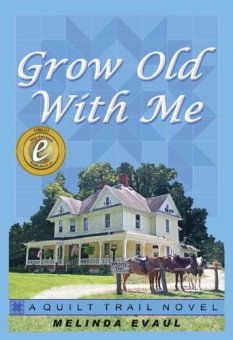
Book Review: Grow Old With Me

Grow Old With MeIn the novel Grow Old With Me by Melinda Evaul, Sarah Campbell runs a bed and breakfast in the small NC town of Love Valley. She spent all of her adult life caring for her mother, who had an accident leaving her with the mind of an eight-year-old. Sarah gave up a chance at marriage and a family of her own to care for her parents. Now her parents have passed on, and she is in her 50s, barely making ends meet, and trying to ignore symptoms that indicate something worse than just the aches and pains of getting older because she doesn’t have the money to see a doctor. She has a good church and set of friends, but she doesn’t let anyone know the depth of her problems.

One day a client, Benjamin Pruitt, comes to her establishment to do some carpentry work in the town. He is horribly disfigured from a fire years ago that killed his best friend. He keeps to himself to avoid people’s stares and carries a lot of bitterness, especially toward God for allowing such a thing to happen. He plans to mostly stay in his room after work, but the first night, when Sarah has dinner set out for him and another client, he doesn’t feel he can back out without being terrible rude. She extends friendship and grace towards him, and eventually he responds.

Friendship turns to something more, but there are so many issues in the way. Both had expected to spend the rest of their lives single. Sarah is a believer and Benjamin is not. As Sarah’s symptoms escalate, so do her fears of becoming dependent on someone and being a burden to them, and her physical and financial situation seem like too much to ask someone to take on. Benjamin is still in the process of opening himself up to others and trusting.

My thoughts:

It was nice to see a romance between ordinary older people rather than the main characters being young/beautiful/handsome/muscular/at the top of their profession. I thought the fears of aging were handled realistically. Both characters were realistically flawed: Sarah admits to having a bad temper and is fiercely independent; Benjamin struggles the way many people would who had undergone what he had. I liked what both characters learned along the way about themselves, God, and each other.

I did find the writing a bit choppy in places and awkward in others. There were some sentences that seemed a bit overly…sentimental, maybe, almost silly (“Dust motes danced to the Christmas music playing on the CD”; “Fervent pleas leapt from his dark eyes.”) I thought Sarah went way too far in the relationship without knowing that Benjamin was a Christian and knowing that would be an obstacle for her.

But overall it was a good story. It’s supposed to be the first in a Quilt Trail series, but it was written in 2010, and apparently there are no sequels yet. The author’s web site tells how she and her husband like to travel the back roads of TN and NC seeking out Quilt Barn Squares on buildings, so evidently she originally planned a series of books along those lines. I don’t know if she still plans to write more. This one has pretty consistently been 99 cents for the Kindle, making it easy to give it a try.

(Sharing with Semicolon‘s Saturday Review of Books and Carole‘s Books You Loved)

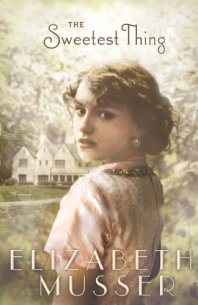
Book Review: The Sweetest Thing

Sweetest ThingIn The Sweetest Thing by Elizabeth Musser, Perri Singleton belongs to a well-to-do family in Atlanta in 1933. She attends a private girls’ high school, goes to parties and dances, has tons of friends and dates, and doesn’t have to worry about much in the world.

Her mother’s best friend, Mrs. Chandler, had invited her niece to live with her and get an education at Perri’s school. The niece, Mary Dobbs Dillard, is about Perri’s age, but her family lives in Chicago and doesn’t have much money. Her father is an evangelist, not a well-paying profession in itself, but the family tends to give much of their resources away to help the poor. Mrs. Chandler thought Mary Dobbs intelligent and wanted to help with her education. So she asks Perri and her mother to accompany her to pick Dobbs (as she prefers to be called) up at the train station. They agree, and Perri is expecting a ragged waif. But Mary Dobbs is gorgeous, yet in an “unorthodox” way that doesn’t fit in with the current styles. She’s also a bit overenthusiastic, talkative, and religious.

Perri’s not particularly impressed, but on that very same day, her world falls apart, and Dobbs ends up becoming her closest friend.

There are so many layers to this book. Friendship, obviously. Differences between rich and poor. Dobbs realizes that she has misjudged wealthy people, and they’re not all selfish – some of them are quite generous, with an eye to helping the poor. And she starts to get used to having enough to eat, beautiful clothes, and little luxuries. Crises of faith for both Perri and Dobbs, in different ways. Life in the South in those times. Figuring out how to live out your faith in a foreign situation. Finding your gifts and your place in life. Family secrets. And even a mystery about stolen items, misplaced blame, threats, and deceit.

I feel like I am not telling you enough about the book, but there is so much I don’t want to give away. Here are just a couple of quotes:

Faith doesn’t work that way. You don’t just believe when you get everything you want. That’s not our choice. We share in the sufferings of others….We bear the burdens together. We take what comes, and we believe. It’s not down here that it will all be equal and okay. It’s later. Here, well, the Lord promised us sometimes we will have hardship and suffering. He also promised He’d never leave us. His presence, His holy presence is with us here. And later, there, that’s when the tears will be wiped away. Later.

I always thought of God like that—providing in the nick of time—believing in Him got me something: a miracle, or at least help. God owed me something. But…it wasn’t working….And finally it hit me. Selfishly, I wanted a formula to fit God into, something that could be explained….It had almost seemed easy – the way He’d provided for us so many times before. But Mother was right. God was past understanding, and He was asking me to trust Him as a good God and Father before I knew there would be [an answer.]

I loved this book and felt right along with the girls and all they were going through. Elizabeth Musser is one of my favorite authors. She says her books are “entertainment with a soul.” They are indeed.

(Sharing with Semicolon‘s Saturday Review of Books, Literary Musing Monday and Carole’s Books You Loved)

Save

Save

Book Review: Love of the Summerfields

Summerfields

Love of the Summerfields by Nancy Moser takes place in England in the 1880s and touches on lives in the manor house, both family and servants, and in the village as well. Some of the characters and their situations are:

Adelaide Weston, the dowager countess of the manor. A strong-willed, take-charge woman, her life turns upside down when an old love comes back into her life.

Frederick and Ruth Weston are the current earl and countess. Frederick is a decent man, but the manor is coming into hard times with more outgo than income. Ruth has become a recluse, both because of feeling intimidated by her mother-in-law and guilt over some of her actions in the past.

Clarissa Weston is their spoiled daughter who has not made a “match” yet, so her father and grandmother make one for her, partly to relieve the financial affairs of the manor.

Jack and Fidelia Hayward are shopkeepers. Jack is a fine, decent, patient man, but Fidelia is a bitter, controlling, unkind gossip. Lila is their daughter, a sweet girl in love with a man out of her reach. To make matters worse, she is pressed into acting as the go-between with this man and his fiancee. The Hayward’s son, Morgan, is in love with Ruth’s maid, Molly, but they have to keep it quiet because a lady’s maid is not supposed to have suitors. When Jack’s father dies, the family takes in his mother.

When a secret threatens to upend the lives of several in both village and manor, good for some but seemingly bad for others, the first instinct of those who uncover it is to keep it concealed. Will they let truth prevail even though it will cost them, or will hiding it bring greater repercussions?

This book is marketed as “If you like Downton Abbey, you’ll enjoy” this book. I don’t know if that’s the best way to present it. It is from the same era with the same strict class rules, and it even has a feisty dowager countess. But all the other characters and storylines are vastly different. So those who don’t want it to be too much like DA might avoid it, and those who want it to be just like DA will be disappointed. But if you like stories like from this time and place and type of people (which is what I think the slogan is actually going for), then you’d probably like this book. From the author’s notes after the book, the story was inspired by her own reading interests and her family history, not DA.

This book is the first in a series of three, and although I enjoyed it, I wasn’t planning on reading the sequels – until I got to the end and then read an except from the next book. Now I want to find out what happens!

(Sharing with Semicolon‘s Saturday Review of Books, Literary Musing Monday and Carole’s Books You Loved)

Save

Save

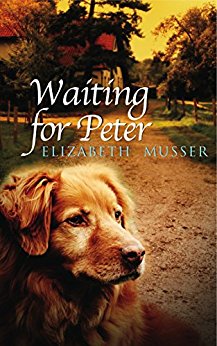
Book Review: Waiting For Peter

I’m sorry I’ve written about nothing but books so far this week. I’ve been working on another post for some time now but just haven’t had the time and mindset to pull it together this week. I guess book reviews are easier posts, in a way, because I am dealing with definite subject matter, and while I’m sharing my thoughts, it’s different from wrestling through a subject and the Biblical implications and coming to a conclusion. And I just happened to finish several books lately. 🙂

I’m not normally drawn to animal stories. They’re often designed to be heartwarming – and my heart needs warming as much as anyone else’s – but I find myself perversely resistant to stories that I know upfront are going for that effect. Or they’re sad, sometimes while simultaneously being heartwarming. One son shared a quote with me something to the effect that getting a dog is an investment in a small tragedy. Because they live a much shorter time than humans, generally, we’re going to have to deal with their deaths.

Waiting For PeterSo I don’t think I would normally have picked up the novella Waiting for Peter except that I really like Elizabeth Musser. This is a short book: only 90 pages. And it’s heartwarming and sad. But it’s good.

The story is about a boy named Peter who was in an accident that took the life of his friend and left Peter with severe injuries. He survives with nothing worse than a limp physically, but his confidence is shattered. His whole world has been shaken up and nothing is the same. His parents decide to let him choose a dog to try to help him, and Peter finds one who seems a little sickly and neurotic, but responds to him.

Dog and boy grow up together. They have adventures and Peter learns to extend himself (talking to strangers when not naturally prone to, etc.). Mom has to deal with the messes, chewed up household items, etc., but likes how dog and boy are both developing. When she deals with her own midlife issues – physical changes, aloof daughter, emptying nest – the dog becomes her companion, too.

The back of the book says, in addition to the book being about “the healing power of love between a boy and his dog,” it is also an “allegory of how we should view our relationship with God, our Master.” Those parts were a little more…not didactic, exactly, but more direct, more like one would see in a devotional than in fiction. That’s not characteristic of Musser, but maybe because the book was so short, there wasn’t space to develop it like one would in a novel. Or maybe she meant it exactly like she wrote in order to make the points she made. I’m not criticizing it or saying it’s bad – it’s just different from how she usually writes.

The story is told alternately from the points of view of the mom, Lanie, and the dog…the latter of which could be a little tricky, but it was kind of fun reading Sunny’s “thoughts.”

There is not a forward or afterward, so I don’t know if the story is based on one from the author’s life (although on her author’s page she does mention having a neurotic dog).

Overall, though not my usual cup of tea, I enjoyed it.

(Sharing with Semicolon‘s Saturday Review of Books and Carole’s Books You Loved)

Save

Save

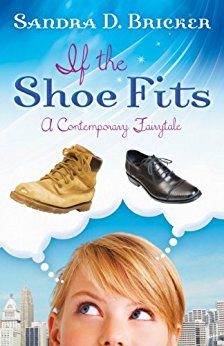
Book Review: If the Shoe Fits

If the shoe fitsI scrolled through the unread books on my Kindle app, looking for something light, and spied If the Shoe Fits: A Contemporary Fairy Tale by Sandra D. Bricker. Perfect! I’ve read a few of Sandra’s books before, and so far they’ve all been lighthearted and funny, yet not purely fluff due to a spiritual undertone.

In this book, Julianne Bartlett just opened a law firm with her lifelong best friend, Will Hanes. But for all her expertise in law, she’s a bit…quirky? scatterbrained? the embodiment of Murphy’s Law? in everyday life. After narrowly missing being part of a multi-car pile-up, she witnesses a devastatingly handsome man rescuing a hurt dog from the road. When she discovers a boot and toolbox fell from his truck before he drove away, she rescues them and takes them as a sign that she’s supposed to find him again. She places an ad and they do meet, but he’s not quite the Prince Charming type. But she’s so focused on her fairy tale ideal that she’s in danger of completely missing the opportunity for a real, true relationship right in front of her.

There are some subplots with an ideal receptionist with a shady past, Julianne’s archenemy rival, Julianne’s mom and Will’s dad, and various cases as well as several bumps along the course of true love not running smooth. But it ends up in a satisfying way. I enjoyed the way Sandra wove in spiritual truth in a natural and not heavy-handed way.

Just a sample of Sandra’s writing:

She couldn’t hold a tune if it were packed up for her in a handy little box, but he sure did love to hear her try.

He waved a mug close enough to Will’s nose to bring him around, like caffeinated smelling salts.

“Apologizing.” Rand spoke the word as if it had been dipped in spoiled milk before crossing his lips.

Romantic comedy is not usually my first choice of genre for reading, but every now and then something light hits the spot. I could easily envision this as a Hallmark movie.

(Sharing with Semicolon‘s Saturday Review of Books and Carole’s Books You Loved)


Save

Save

Save

Book Review: The Ringmaster’s Wife

Ringmaster's WifeKristy Cambron’s The Ringmaster’s Wife is set in the 1920s Jazz Age. Mable Burton came from humble beginnings on a farm in Ohio. She wanted more out of life, so she went to work at the Chicago World’s Fair, carrying with her a cigar box of clippings she had collected to inspire her dreams. She met John Ringling of the Ringling Brothers circus, and eventually they married.

Lady Rosamund Easling was an earl’s daughter whose life was more or less arranged for her without consultation as to her desires. Her parents were arranging and preparing for her engagement and marriage to a man she didn’t love, and worst of all, her father was selling her beloved horse, Ingenue, a gift from her deceased brother. When offered a chance to travel to America, Rosamund took it, eventually becoming the star bareback rider for the circus.

It’s interesting that the two women came from opposite ends of the economic and social spectrum, so to speak, but both were motivated to break out of the life that was expected of them. Mable and John were real people; Rosamund and Colin, the man in charge of everything under John, were fictional. Mable didn’t set out to become rich, but she adapted well to her new lifestyle without letting it go to her head. She and John loved Venice, so when they built their home, Ca’ d’ Zan (House of John), in Florida, Mable oversaw every aspect of it and included a lot of Venetian inspiration. They had grand parties with guests like the mayor and the Ziegfelds. After I read the book, I went back to reread Susanne’s review, and saw a comment there that Kristy had a video of a tour of the house, so I looked and found this. (That’s just the first floor: there is another for the second floor and one for the circus train cars I haven’t watched yet) It was fascinating to see, having just read the book.

In the book, though, Mable was known more for her quiet wisdom. She didn’t “dip her oar” in John’s business, but she extended her influence when she thought it appropriate, like accosting the boy who pickpocketed her husband and, seeing the potential in him, encouraging him to work for the circus (I don’t know if the pickpocket incident was real). Likewise when Rosamund was “just” a beginning performer, Mabel took time to encourage her.

I wondered what inspired Kristy to write about Mable and this era (both her previous books were set in WWII, but this and the next one are set in the Jazz Age). I didn’t find anything on that exactly, but in trying to find that out I did find this interview with her about the book.

There were a lot of behind-the-scenes looks at how a circus works, and a lot of mention of the circus workers as a family. Every family will have its squabbles, though, and there is some dissension among some on a couple of issues. But I think the main thrust of the book is the sacrifice and joy involved in chasing one’s dreams.

My only criticism was that the back-and-forth timelines got a little confusing at times, even though the date is at the beginning of every chapter.

My favorite line: “Home can move. As long as your heart goes with it.”

Genre: Historical inspirational fiction
Potential objectionable elements: None
My rating: 8 out of 10

(Sharing with Semicolon‘s Saturday Review of Books, Literary Musing Monday) and Carole’s Books You Loved)

lmml-button-2-6

Books you loved

Save

Save

Save

Save

Book Review: Traces of Guilt

Traces of GuiltIn Traces of Guilt by Dee Henderson, Evie Blackwell is an Illinois State Police detective helping test out the possibility of a new task force dedicated to reexamining cold cases. To that end she comes to small town Carin. The disappearance of a policeman and his family  as well as the disappearance of a small girl have been unsolved for years. A fresh pair of eyes and an objective point of view should aid in coming up with new angles and questions and hopefully new trails of evidence to solve the case.

Evie’s primary contact is Gabriel Thane, Carin’s sheriff. He makes sure she has everything she needs, from case files to work space to food, answers questions, and considers possibilities of the cases with her. He loves his job, the town, and his close-knit family.

Meanwhile Gabriel’s brother, Josh, receives news that an old friend – in fact, the only girl he ever had feelings for – is coming back to town and will need his help. Learning what she needs and the reason for it is gut-wrenching, but he and his whole family are willing to help, and he hopes he can begin to reestablish a relationship with her.

Ann and Paul Falcon of Dee’s earlier book Full Disclosure make appearances here: Ann is something of the connector for various people in the story. I don’t remember if Gabriel was in any of Dee’s earlier books or not, but here they have a full-fledged working relationship and history. A few other characters from Dee’s most recent books are referenced as well.

The suspense in this story is not that of mile-a-minute action or edge-of-your-seat expectation: it’s more the suspense of puzzle-solving as Evie tugs on different threads to see which one unravels the case.

An attraction is growing between Evie and Gabriel, but they wonder if any kind of romance can thrive between a self-professed “woman of no small ambitions” and a small town sheriff committed to the area.

I always enjoy Dee, and this book is no exception. The cases themselves were intriguing, and I imagine a real-life cold case investigator would have to do much of what Evie did, examining evidence, coming up with and running down leads  that don’t end up anywhere but that tip off other details or questions, before something leads to the right outcome.

I appreciate that the Christianity in the book is neither subtle or blatant. Characters do normal Christian things like pray and talk about spiritual issues, but they don’t preach at each other or the reader.

Evie receives a tantalizing offer near the end of the book, one that contributes to fulfilling her ambitions but does nothing to resolve her personal life. But this book is evidently the first in a series, with a sequel due out in May, so we’ll see where her next steps take her.

(Sharing with Semicolon‘s Saturday Review of Books, Literary Musing Monday, and and Carole’s Books You Loved)

lmml-button-2-6

Books you loved

Save

Save