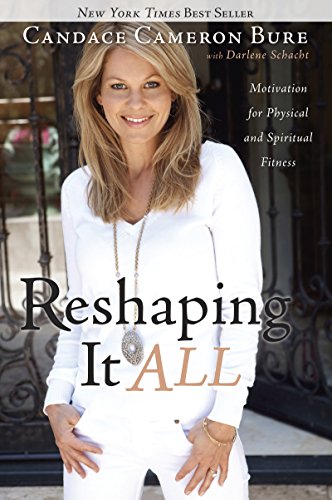
Book Review: Reshaping It All

ReshapingSome of you may remember Candace Cameron Bure as oldest daughter D. J. Tanner in the TV series Full House several years ago. I have not really kept up with her career since then, but somehow I was aware that she’d had some eating issues, had lost weight, and was an outspoken Christian like her brother Kirk Cameron. So when her book, Reshaping It All: Motivation for Physical and Spiritual Fitness came up on a Kindle sale, I got it.

Although the book is not a full-fledged memoir, Candace gives glimpses of her growing-up years, family, time on Full House, marriage, and motherhood.

Her family seems remarkably grounded: even though Cameron and her brother were making all kinds of money, their father still made them work (at other jobs: he didn’t consider acting “work”) when they wanted something.

He could see that hard work was not only a prerequisite for success but that it was also a prerequisite for strong character. Struggling for the things we get teaches us the all-important lesson of self-disciple while it strengthens our body and spirit. It wasn’t enough for us to achieve a certain level of success in this world: our parents wanted us to reach our full potential as people who are strong in spirit and mind.

But Candace received mixed signals about food. He father provided “cardboard-tasting ‘health’ food” while her mother brought in doughnuts and such. Various other factors came into play, resulting in Cameron’s being about 25 pounds overweight and suffering from bulimia in her early twenties.

What I didn’t realize at the time is that my heart was longing for the things of this world. I ran to comfort food instead of running to God. I discovered my sin, but I hadn’t discovered that my heart was in the wrong place. I sought moral reformation instead of spiritual transformation. I had known who He was, but I still hadn’t grasped who I was in His sight.

She tells how she changed her approach to food and fitness. She didn’t follow a specific diet plan, and she believed everything was allowable in moderation, but she had a few principles she went by.

Transforming our bodies must begin by the renewing of our minds. Our bodies aren’t making these detrimental choices for us; they are simply animated by a mind that needs a mental makeover.

One such principle was HALT. “When you feel like reaching for food, ask yourself first if you are hungry, angry, lonely, or tired. If you’re hungry, then proceed, but it you are reaching for food in response to emotion, then halt your behavior immediately.”

And even though the book is primarily about her journey towards fitness, she applies some of the same principle to style, clutter, marriage, and other facets of life.

Candace became a Christian at age 12, and the life principles she espouses are based squarely on Scripture. She writes in a conversational, level-headed, encouraging, easy to read style.

Standing face-to-face with a mountain can be overwhelming, especially when your perspective is that of looking up from the bottom. But if we decide to take one step and then another, looking only at the ground set before us, we realize the potential we have.

The only negative for me was the fan letters. At the end of every chapter, Cameron includes a fan letter asking her a question related to the chapter before. That was fine, but each letter also contains a certain amount of fannish praise that I felt awkward reading.

This book was written back in 2011, before her co-hosting stint on The View and other pursuits. She has written a few more books since that time, too.

I enjoyed the book very much and took away a few nuggets to help me in my own journey.

(Sharing with Semicolon‘s Saturday Review of Books, Literary Musing Monday, Carole’s Books You Loved)

“A Heart at Leisure From Itself”

We all need encouragement some times. We all occasionally feel down in the dumps, or inadequate, even ugly. We have an enemy of our souls who specializes in tripping us up and bringing us down.

The KJV rendering of Proverbs 12:25 says, “Heaviness in the heart of man maketh it stoop: but a good word maketh it glad.” We know the blessing of that “good word” that meets us just at the right time in our moment of need. I am thankful for the encouragers among us who, sensitive to the Holy Spirit’s leading, specialize in thoughtful observation and uplifting words.

However, I have seen women Bible teachers express concern over the plethora of material for Christian women which is based on emotion and self-esteem: “You are beautiful.” “You are wonderful.” “You are enough.” There are a handful of blogs I only read occasionally because every single post seems to espouse these messages.

I share that concern, for a few reasons. As I said, we all need a boost every now and then. But this kind of encouragement focuses on self, and the sheer volume of these messages makes me wonder whether we are altogether too preoccupied with self. And if Christian leaders and teachers are constantly feeding us esteem-building maxims, we’re lacking the teaching we most need: that which turns our attention to God and His truth. And, just occasionally, these kinds of message are wrong: for instance, as we discussed last week, we are not enough in ourselves.

Please understand: I am not trying to heap guilt on top of other negative feelings. I’m just turning our attention to a better focus and message. When we’re bombarded by self-defeating thoughts, we need to take them captive and apply God’s truth to them.

I am ugly. “I praise you, for I am fearfully and wonderfully made. Wonderful are your works; my soul knows it very well.” Psalm 139:14, ESV.  “And your renown went forth among the nations because of your beauty, for it was perfect through the splendor that I had bestowed on you, declares the Lord GOD.” Ezekiel 16:14

I am worthless. “Knowing that you were ransomed from the futile ways inherited from your forefathers, not with perishable things such as silver or gold, but with the precious blood of Christ, like that of a lamb without blemish or spot.” 1 Peter 1:18-19

I am inadequate. “Not that we are sufficient in ourselves to claim anything as coming from us, but our sufficiency is from God. 2 Corinthians 3:5

I am not enough. “Abide in me, and I in you. As the branch cannot bear fruit by itself, unless it abides in the vine, neither can you, unless you abide in me. I am the vine; you are the branches. Whoever abides in me and I in him, he it is that bears much fruit, for apart from me you can do nothing.” John 15:4-5

I am not lovable. God shows his love for us in that while we were still sinners, Christ died for us.” Romans 5:8

Personally, a lot of my self-esteem issues were solved once I truly got hold of the KJV translations of Ephesians 1:6: “He hath made us accepted in the beloved.

Some years ago at a leaders meeting for a church ladies’ group, the pastor’s wife was encouraging us to speak up when we each did our various parts during the meeting. She mentioned almost offhandedly that “Self-consciousness is consciousness of self, and we are supposed to forget self.” That was another concept that helped me turn from my preoccupations with self (which increased anxiety about messing up in some way) to forgetting self in doing what God wanted me to do in the moment, trusting Him for the grace and ability.

Last week I caught a couple of Elisabeth Elliot’s radio broadcasts, replayed now on BBN Radio, in which she was talking about these very ideas. When I stopped the car, I jotted down some notes from her broadcast before I got out to run my errands. I was so hoping I could find a transcript of the program online, but I have had no luck so far.  In searching, however, I did find the September/October 1999 copy of her newsletter in which she discussed related issues. She quotes C. S. Lewis as saying:

The very first step is to try to forget about the self altogether. Your real, new
self (which is Christ’s and also yours, and yours just because it is His) will not come as long as you are looking for it. It will come when you are looking for Him…The principle runs through all life from top to bottom. Give up your self, and you will find your real self. Lose your life and you will save it.
Submit to death, death of your ambitions and favourite wishes every day and death of your whole body in the end: submit with every fibre of your being, and you will find eternal life. Keep back nothing. Nothing that you have not given away will ever be really yours. Nothing in you that has not died will ever be raised from the dead. Look for yourself, and you will find in the long run only hatred, loneliness, despair, rage, ruin, and decay. But look for Christ and you will find Him, and with Him everything else thrown in. (She quotes from Beyond Personality, but a similar quote is in Mere Christianity as well).

She also includes a few stanzas of this poem/prayer by Anna Laetitia Waring. Two lines which most stood out to me are the author’s request for “a heart at leisure from itself, To soothe and sympathise” and “And a life of self-renouncing love Is a life of liberty.”

I also have in my files a quote from one of Elisbaeth’s old email devotionals that were sent out by Back to the Bible years ago. This one is also from her book Keep a Quiet Heart:

“His purpose in dying for all was that men, while still in life, should cease to live for themselves and should live for him who for their sakes died and was raised to life. With us therefore worldly standards have ceased to count in our estimate of any man…. When anyone is united to Christ, there is a new world (or a new act of creation); the old order has gone, and a new order has already begun” (2 Corinthians 5:15-17, NEB).

That new order is a far cry from the notion of self-acceptance which has taken hold of the minds of many Christians. Any message which makes the Cross redundant is anti-Christian. The original sin, pride, is behind my “poor self-image,” for I felt that I deserved better than I got, which is exactly what Eve felt! So it was pride, not poor self-image, that had to go. If I’m so beautiful and lovable, what was Jesus doing up there, nailed to the cross and crowned with thorns? Why all that hideous suffering for the pure Son of God? Here’s why: There was no other way to deliver us from the hell of our own proud self-loving selves, no other way out of the bondage of self-pity and self-congratulation. How shall we take our stand beneath the cross of Jesus and continue to love the selves that put Him there? How can we survey the wondrous cross and at the same time feed our pride? No. It won’t work. Jesus put it simply: If you want to be My disciple, you must leave self behind, take up the cross, and follow Me.

I also remember Elisbaeth commenting on the radio program that what we sometimes think of as self-hate is actually self-love, because so much of our thought and time is still caught up with self.

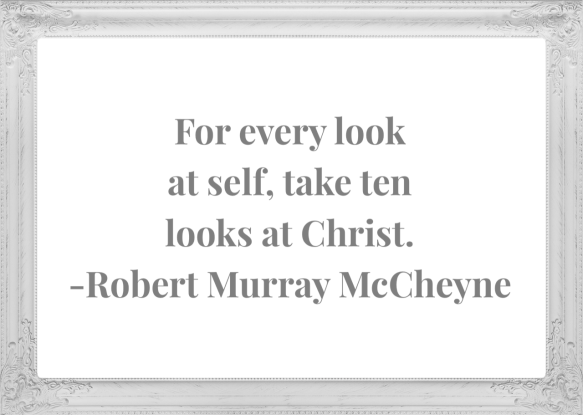
Please understand, again, all this talk about forgetting self and dying to self doesn’t mean we neglect self-care. Our bodies are temples of the Holy Spirit, and we take care of them in thankfulness to Him and for His usefulness. He wants us to glorify Him in our body and spirit. Sometimes we need help with twisted or negative self-talk or self-concepts due to abuse, or a lifetime of put-downs, or other reasons. But the best way to heal from these things is to see what God’s Word says about how He made us and how much He loves us and how He longs to work in and through us. As Robert Murray McCheyne said, “For every look at self, take ten looks at Christ.”

IMG_1106

(Sharing with Literary Musing Monday, Inspire Me Monday, Let’s Have Coffee, Porch Stories)

Book Review: Full Assurance

For several years I struggled with whether or not I was really a Christian. During that time we visited my mother-in-law’s home, and I discovered on her book shelves Full Assurance by H. A. Ironside. I borrowed it, and it helped me with one key point in particular.

Recently while looking for something else on my bookshelf, I came across this volume again (I guess that means I never gave it back – sorry, Mom!) I couldn’t remember much about it except for the one point that had helped me so much some 30 or so years before, so I decided to read through it again.

Ironside says in his introduction that he wrestled with assurance for a while himself, and he wanted to “make as plain as I possibly can just how any troubled soul may find settled peace with God” (p. 7). He said that “so many people who profess to want help along these lines are too indifferent to investigate,” but he wanted to appeal to “earnest seekers after truth” (p. 7). He assures that God cares about us and wants us to rest in His salvation.

In subsequent chapters he unpacks several verses that speak specifically of assurance, like Isaiah 32:17 (“And the work of righteousness shall be peace; and the effect of righteousness quietness and assurance for ever”) and Colossians 2:1-3 (especially verse 2: “That their hearts might be comforted, being knit together in love, and unto all riches of the full assurance of understanding“).

Then his longest chapter deals with “Difficulties Which Hinder Full Assurance” in the form of questions and answers, like “How can I be sure I have repented enough?” and “I do not feel fit to come to God” and “I don’t know if I can hold out.”

Ironside had been a preacher for almost 50 years at the time of this writing, and he deftly handles every issue from the Scriptures and shares several anecdotes to illustrate his points.

The point I mentioned having trouble with was whether I had repented “right” or “enough.” Forgive the long quote, but I wanted to share his whole answer here:

Very often the real difficulty arises from a misapprehension of the meaning of repentance. There is no salvation without repentance, but it is important to see exactly what is meant by this term. It should not be confused with penitence, which is sorrow for sin; nor with penance, which is an effort to make some satisfaction for sin; nor yet with reformation, which is turning from sin. Repentance is a change of attitude toward sin, toward self, and toward God. The original word (in the Greek Testament) literally means “a change of mind.” This is not a mere intellectual change of viewpoint, however. but a complete reversal of attitude.

Now test yourself in this way. You once lived in sin and loved it. Do you now desire deliverance from it? You were once self-confident and trusting in your own fancied goodness. Do you now judge yourself as a sinner before God? You once sought to hide from God and rebelled against His authority. Do you now look up to Him, desiring to know Him, and to yield yourself to Him? If you can honestly answer yes to these questions, you have repented. Your attitude is altogether different to what it once was.

You confess you are a sinner, unable to cleanse your own soul, and you are willing to be saved in God’s way. This is repentance. And remember, it is not the amount of repentance that counts: it is the fact that you turn from self to God that puts you in the place where His grace avails through Jesus Christ.

Strictly speaking, not one of us has ever repented enough. None of us has realized the enormity of our guilt as God sees it. But when we judge ourselves and trust the Saviour whom He has provided, we are saved through His merits. As recipients of His lovingkindness, repentance will be deepened and will continue day by day, as we learn more of His infinite worth and our own unworthiness (pp. 89-90).

One other point that I remember being struck with, though I can’t find now the specific place he discusses it, is from Hebrews 6:11-12: “And we desire that every one of you do shew the same diligence to the full assurance of hope unto the end: That ye be not slothful, but followers of them who through faith and patience inherit the promises.” Showing “diligence to full assurance” helped me understand that when we’re having problems along this line, we need to “be not slothful” but diligently seek God’s Word for the answers rather letting doubts and questions fester in the background for years.

I have many places marked in the book. Here are a few of the helpful, standout quotes:

It is well to remember that some vivid emotional experience is not a safe ground of assurance. It is the blood of Christ that makes us safe and the Word of God that makes us sure” (p. 29).

Faith is not the savior. Faith is the hand that lays hold of Him who does save. Therefore the folly of talking of weak faith as opposed to strong faith. The feeblest faith in Christ is saving faith. The strongest faith in self, or something other than Christ, is but a delusion and a snare, and will leave the soul at last unsaved and forever forlorn (p. 39).

Assurance is not based upon any emotional change, but whatever emotional experience there may be, it will be the result of accepting the testimony of the Lord given in the Scriptures. Faith rests on the naked Word of God. That Word believed gives full assurance (p. 45).

So long as a man considers himself worthy there is no salvation for him; but when, in repentance, he owns his unworthiness, there is immediate deliverance for him through faith in the Lord Jesus Christ. Without repentance the sinner is unable to believe unto salvation (pp. 91-92).

Many times Ironside counsels readers to study the Bible:

As soon as one knows he is saved, he should begin, in dependence upon the Holy Spirit, a careful regular, systematic study of the Word of God. The Bible is our Father’s letter to us, His redeemed children. We should value it as that which reveals His mind and indicates the way in which He would have us walk. ‘All Scripture is given by inspiration of God, and is profitable for doctrine, for reproof, for correction, for instruction in righteousness: that the man of God may be perfect, throughly furnished unto all good works” (II Tim. 3:16-17). The study of the Word will instruct me in the truth, it will show me what needs to be rectified in my life and walk, it will make clear how I may get right with God, and it will guide me in paths of uprightness. No Christian can afford to neglect his Bible. If he does, he will be stunted and dwarfed in his spiritual life, and he will be a prey to doubts and fears, and may be carried away by every wind of doctrine (p. 48).

Nothing will make up for lack of this diligent study of the Bible for yourself. You cannot get the full assurance of understanding without it. But as you search the Scriptures, you will find truth after truth unfolding in a wonderful way, so that doubts and questions will be banished and divinely given certainty will take their place (p. 50).

How necessary then for His redeemed ones to study His Word in dependence upon His Holy Spirit, that they may be delivered both from the fears that are a result of ignorance of His truth and pride that is a result of self-confidence. The liberating Word alone will give to the honest, yielded soul who searches it prayerfully, in order that it shall have sway over his life, the full assurance of understanding, for it is written: ‘The entrance of thy words giveth light; it giveth understanding unto the simple'” (p. 54).

There’s a very helpful section for those fearing they might not be “elect” or “predestined,” but it’s about three pages long, too long to share here. But one excerpt: “But what does the Word say? ‘Christ died for the ungodly.’ Are you ungodly? Then He died for you. Put in your claim and enter into peace” (p. 92).

I have seen this book listed by various titles just Full Assurance, or Full Assurance: How to Know You’re Saved; Full Assurance, or A Series of Messages for the Anxious Soul, and the author’s name sometimes listed as Harry A., most times as H. A. Ironside. I assume they are all basically the same book, but I don’t know whether there might have been some revisions between reprintings. The copy I have is from 1968, but it says it is a revised edition. If you look at Kindle versions, check the reviews first: one I came across said that several chapters were left out.

This book is an excellent resource especially for those who have wrestled with assurance of salvation or those who counsel such people, but it is also a good resource for those who want to learn more about what salvation is or for those who are already saved to understand and appreciate more what their salvation involves.

(Sharing with Semicolon‘s Saturday Review of Books, Literary Musing Monday, Inspire Me Monday ,Let’s Have Coffee, Carole’s Books You Loved)

Laudable Linkage

I have just a short list today, but I thought it best to go ahead and share it rather than have an overly lengthy one next time.

The Greatest Thing You Can Do With Your Life.

Know the Neighborhood, HT to True Woman. “Because many Christians have not ‘walked the streets’ of our Bibles, we are overly susceptible to the views of others, right or wrong. Like would-be travelers or gullible sightseers we take as fact the opinions of the ‘experts’ about the 66 cities we have rarely or never been to visit.”

Why Women Should Be Readers of Good Books, HT to Out of the Ordinary.

The “At Least” Among Us, HT to True Woman. “The thing about saying ‘At least’ to someone—particularly someone who’s confessing their own anger, fear, grief, or sadness at the circumstances of their life, is it negates their wrestle and it naturally elevates our own.”

Five Dangers of Reading Christian Biographies, HT to True Woman. You know I love Christian biographies, but there are some potential stumbling blocks in reading them.

And finally, HT to Laura, this fun real estate listing showed a guest using the various facilities on the property.

Happy Friday!

Toward a Quiet Soul

Why art thou cast down, O my soul? and why art thou disquieted in me?

Have you ever felt disquieted?

Three times the psalmist asked himself why he is cast down and disquieted (Psalm 42:5, 11 and 43:5). The ESV says “in turmoil”; the NASB uses “disturbed.” Other translations say “sad,” “restless,” “upset.” But “disquieted” aptly includes all kinds of disturbances.

The Hebrew word translated “disquieted” in those two psalms includes these definitions:

“To murmur, growl, roar, cry aloud, mourn, rage, sound, make noise, tumult, be clamorous, be disquieted, be loud, be moved, be troubled, be in an uproar, to roar, to be in a stir, be in a commotion, to be boisterous, be turbulent.”

Ever felt any of those?

Each of those times the psalmists asks himself why he is disquieted, he answers himself, “hope thou in God: for I shall yet praise him for the help of his countenance.

That’s the course of many of the psalms. The writer has no peace of mind for various reasons: enemies are after him; sin weighs on his conscious; wicked people are prospering at the expense of the righteous. I love the honesty of the psalmists’ emotions as they lay out their dilemmas and questions before God. And gradually, as they remind themselves of what they know about their God and put their situation in the proper perspective, their souls return to peace, to rest.

Psalm 107 speaks of a physical storm, but there are parallels to a spiritual, emotional, or mental storm as well.:

Then they cry unto the Lord in their trouble, and he bringeth them out of their distresses. He maketh the storm a calm, so that the waves thereof are still. Then are they glad because they be quiet; so he bringeth them unto their desired haven. Psalm 107:28-30, KJV

We’re always glad when peace and quietness reign after any storm.

A quiet soul is not a result of Zen-like tranquility or an emptying of the mind. It’s not a mystical state. It comes from deliberately, consciously reminding ourselves of God’s love, wisdom, promises, and power and resting in Him. Whatever we’re going through, God has a reason for it and will give us grace to deal with it.

But I have calmed and quieted my soul, like a weaned child with its mother; like a weaned child is my soul within me. Psalm 131:2, ESV

It’s fine to pray for calm circumstances.

I urge that supplications, prayers, intercessions, and thanksgivings be made for all people, for kings and all who are in high positions, that we may lead a peaceful and quiet life, godly and dignified in every way. 1 Timothy 2:1-2, ESV

God doesn’t always remove the problems, but He gives His peace. I once saw a saying on a plaque that said, “Sometimes God calms the storm: sometimes He lets the storm rage and calms His child.”

But whoso hearkeneth unto me shall dwell safely, and shall be quiet from fear of evil. Proverbs 1:33, KJV

A quiet soul is not passive, but actively resting in God.

For thus said the Lord God, the Holy One of Israel, “In returning and rest you shall be saved; in quietness and in trust shall be your strength.” But you were unwilling…Isaiah 30:15, ESV

A quiet soul can go from God’s Word and prayer into everyday life, still trusting and resting.

But we urge you, brothers, to do this more and more, and to aspire to live quietly, and to mind your own affairs, and to work with your hands, as we instructed you, so that you may walk properly before outsiders and be dependent on no one. 1 Thessalonians 4:10b-13, ESV

For we hear that some among you walk in idleness, not busy at work, but busybodies. Now such persons we command and encourage in the Lord Jesus Christ to do their work quietly and to earn their own living. 2 Thessalonians 3:11-12, ESV

But let your adorning be the hidden person of the heart with the imperishable beauty of a gentle and quiet spirit, which in God’s sight is very precious, 1 Peter 3:4, ESV

Having a quiet spirit does not mean one is silent or mousy: it doesn’t quell exuberance. It’s a quietness of rest and peace. It’s not stirred up in a wrong way over the wrong things.

It is good that a man should both hope and quietly wait for the salvation of the Lord. Lamentations 3:26, KJV

And the effect of righteousness will be peace, and the result of righteousness, quietness and trust forever. . Isaiah 32:17, ESV

Sometimes God has to disquiet us before He can quiet us. Sometimes we need to be shaken out of our complacency or chastened. Jonah was disturbed at God’s calling for him and tried to run away. God dealt with him rather severely. In Jonah’s prayer in the fish’s belly, he laments:

For you cast me into the deep, into the heart of the seas, and the flood surrounded me; all your waves and your billows passed over me (verse 3, ESV).

The waters closed in over me to take my life; the deep surrounded me; weeds were wrapped about my head at the roots of the mountains (verses 5-6, ESV).

But when his “life was fainting away,” he “remembered the Lord” (verse 7), prayed, thanked God, and promised to fulfill his vows. God delivered him, and Jonah went on to obey God. Unfortunately, Jonah continued to have attitude problems and never did seem to come to truly rest in the Lord, at least in this book. The end result of chastening rightly received is “the peaceful fruit of righteousness” (Hebrews 12:5-13).

I originally wanted to publish this post last week, but felt strongly impressed to go with a different one instead. I think one of the reasons for waiting was that God knew I would come across two quotes in my reading this week that tied in with this topic.

H. A. Ironside said in his book Full Assurance:

As one walks with God, and learns to suffer and endure as seeing Him who is invisible, eternal things become more real than the things of time and sense, which are everything to the merely natural man. Thus there comes to the heart a trustful calm, a full assurance, based not alone on the revealed Word but upon a personal knowledge of communion with God, which gives implicit confidence as to this present life and all that lies ahead. (pp. 59-60, emphasis mine).

Then the ESV Study Bible says of Psalm 62:1-2:

The description of a trusting soul is there to set an ideal for God’s people: each one should aspire to this kind of quiet faith (p. 1011).

And the introduction to Psalm 63 in the ESV Study Bible says:

This psalm opens as if it were a lament, seeking God in a time of trouble; and yet the overall flow of the song is one of confident expectation. Hence it is best to see the psalm as enabling each of God’s people to develop confidence during their times of trouble (p. 1012).

Whatever the source of our trouble – God’s chastening or growing us, outward circumstances or inward turmoil – we can rest in His presence, wisdom, love, care, and provision.

The Lord your God is in your midst, a mighty one who will save; he will rejoice over you with gladness;  he will quiet you by his love; he will exult over you with loud singing. Zephaniah 3:17, ESV

He Will Quiet You

In this life, there are times of tribulation;
Hearts are filled with deep despair.
Heartache and pain and troubles abound;
Is there comfort anyway?
In your times of trial,
Lift your eyes to the Father above
He alone is the Answer,
The Source of please and love.

He will quiet you,
He will quiet you.
He will take delight in you,
And quiet you with his love.
His plans for you are perfect
And all His ways are best.
He will give you rest
As He quiets you with his love

He longs to take you into his arms,
And gently shelter you.
Only He can calm the storms in your life,
And give you peace anew.
And He will rejoice,
He will rejoice over you with singing.
He will rejoice,
He will rejoice over you with singing.
The Creator of all will lift up His voice;
And over your life
He will sing and rejoice!
He will rejoice!
He will rejoice!

He will quiet you,
He will quiet you.
He will take delight in you
And quiet you with his love.

His plans for you are perfect
And all His ways are best.
He will give you rest
As He quiets you with his love.
Come to Him for rest
Let Him quiet you with his love.

~ Words and music by Cindy Berry

(Sharing with Inspire Me Monday, Literary Musing Monday, Tell His Story, Let’s Have Coffee, Porch Stories, Wise Woman, Faith on Fire)

Laudable Linkage

Here’s my latest round-up of thought-provoking online reads:

Danger: Doing “Jesusy” Stuff Without Knowing Jesus, HT to True Woman.

7 Things You Should Know About the Formation of the New Testament, HT to Out of the Ordinary.

Russian Spies, Post-millennialism, and the National Prayer Breakfast.

The Morning Before a Sexual Fall: How the Battle for Purity Is Lost. Though the context is sexual sin, the principles apply to any temptation.

Smells Like Teen Spirit, HT to Challies. “For many, ‘going to church’ is less about worshiping the infinitely holy God who was redeemed a people for Himself by giving up His Son to the bloody death on the cross, as it is about getting a shot of motivational vitamin-B for existential significance. Rather than being called by God into His presence by the mediating work of His Son, “Here we are now; entertain us” becomes the liturgical responsive call to worship. After all, the success of the church is dependent on your excitement, isn’t it?”

6 Warning Signs Of A Bad Pastor And Spiritual Abuse, HT to Challies.

Learn to Embrace Mess, HT to Challies. I didn’t think I was going to agree with this, based on the title, but it does make sense in context.

Confusing Christ-likeness with Christ: Seeking the soft-hearted in the search for a spouse, HT to True Woman.

No, Kids, You Can’t Be Anything You Want to Be.

9 Things Adult Daughters Want Their Moms to Know.

Shouldn’t We Share Our Concerns About a Book Directly with the Author Instead of in the Public Forum? HT to Challies.

How Many Cups in a Quart? A free printable chart.

Fake Views: The Good, the Bad, and the Ugly of Soviet Photoshopping – before Photoshop was invented. HT to Challies.

And finally, a couple of thoughts for the day found on Pinterest:

Happy Saturday!

Bedrock Truth

Society today is trending away from absolute truth – truth that always has been and always will be real for everyone. Instead everyone has his or her own truth. This mindset is one of the tenets of postmodernism; another is valuing questions more than answers.

Unfortunately, this way of thinking has filtered into the church.

Sure, it’s irritating when someone gives a trite, pat response to a complicated question, especially without even hearing out the question first. Or when someone expresses obnoxious assurance about an area where there’s room for nuance and speculation. There are mysteries about life and even Christianity that we’ll never understand completely this side of heaven.

But Jesus said we can know the truth, and it will set us free. He said we can discern His teaching if we’re willing to do God’s will.

Here are a few solid, bedrock, foundational truths we can rest on:

God’s Word is reliable (2 Peter 1:16-21). Peter was one of only three people to experience one of the most awe-inspiring experiences ever. He, James, and John saw Jesus transfigured before their eyes talking with Moses and Elijah, though the two prophets had been in heaven for centuries. Yet Peter called Scripture a “more sure word of prophecy” than even this experience. (See also Romans 16:25-26).

Jesus is the Son of God. “And we know that the Son of God has come and has given us understanding, so that we may know him who is true; and we are in him who is true, in his Son Jesus Christ. He is the true God and eternal life” (1 John 5:20, ESV). “ So Jesus said to the twelve, “Do you want to go away as well?” Simon Peter answered him, “Lord, to whom shall we go? You have the words of eternal life, and we have believed, and have come to know, that you are the Holy One of God” (John 6:67-69, ESV). He is in the Father, and the Father is in Him.

We’re not good in ourselves. “For I know that nothing good dwells in me, that is, in my flesh. For I have the desire to do what is right, but not the ability to carry it out” (Romans 7:18, ESV).

We can know God: “And this is eternal life, that they know you, the only true God, and Jesus Christ whom you have sent” (John 17:3, ESV).

We can know His love.

Jesus has authority to forgive sins.

Jesus redeemed us to himself by His blood.

We can be justified by faith in Christ. “we know that a person is not justified by works of the law but through faith in Jesus Christ, so we also have believed in Christ Jesus, in order to be justified by faith in Christ and not by works of the law, because by works of the law no one will be justified” (Galatians 2:16, ESV).

We can know we have eternal life. “I write these things to you who believe in the name of the Son of God, that you may know that you have eternal life” (1 John 5:13, ESV).

We can live a godly life: “His divine power has granted to us all things that pertain to life and godliness, through the knowledge of him who called us to his own glory and excellence” (2 Peter 1:3, ESV).

Jesus was raised from the dead, and we will be raised, too.

His sheep hear His voice.

Suffering has a purpose. “We rejoice in our sufferings, knowing that suffering produces endurance, and endurance produces character, and character produces hope” (Romans 5:3-4, ESV). (See also James 1:2-4).

We can learn something about God from His creation. “For his invisible attributes, namely, his eternal power and divine nature, have been clearly perceived, ever since the creation of the world, in the things that have been made” (Romans 1:20, ESV).

It’s worth everything to know Him.

We don’t know everything. Someday we’ll know more clearly. But what we do know, we can have full confidence in.

“I know whom I have believed, and I am convinced that he is able to guard until that day what has been entrusted to me” (2 Timothy 2:12, ESV).

True, some people will deny and undermine these truths. But I’d rather stake my soul on the truth that God made us and communicated His will to us than try to build a foundation on forever shifting sands of self-invented realities.

(Sharing with Literary Musing Monday, Tell His Story, Wise Woman, Woman to Woman Word-filled Wednesday, Let’s Have Coffee, Porch Stories, Faith on Fire)

Laudable Linkage

IMG_0195

Here are several thought-provoking reads found in the last week or so.

Every Testimony Is Dramatic and Miraculous. “There is nothing basic or boring about the life-transforming power of our Lord Jesus Christ. The angels throw a party every time someone comes to Christ, and the parties aren’t less enthusiastic for the freckle-faced eight year olds. Salvation is never small. It is big and dramatic and miraculous, every single time.”

Is Prayer Enough?

What Jesus Said About White Privilege.

7 Stabilizing Principles in a Chaotic World, Part 3: Everyone Is Made in the Image of God. Even the people on the other side of the political fence or the ones who drive us crazy. And we “need to treat everybody—everybody—with that kind of respect.”

How You Might Break the Third Commandment in Church, HT to Challies.

What to Do When a Friend Loses a Baby, HT to True Woman. Much of this is good for other types of loss as well.

Give Children All of Your Attention. Some of the Time. HT to True Woman. I remember  as a young mom struggling with guilt when I did not give my children my full attention, yet feeling it was good for them to learn to entertain themselves sometimes. I thought of women in Bible times or even a couple of hundred years ago who had to do so much from scratch and could not have possibly sat on the floor playing with their children eight hours a day. But it is good to set everything aside for one-on-one time together sometimes. This post has some good thoughts along these lines.

How to Leave Porn Behind, HT to True Woman. Good thoughts on “radical repentance” for any sin.

3 Reasons Contemporary Worship Is Declining, and What We Can Do to Help the Church Move On. I don’t agree with every point here, but I especially like this: “We’ve done ourselves and the church a disservice by insisting that there are two kinds of worshipers, traditional and contemporary…Our musical tastes don’t dictate how we worship, our theology does. Both of these extremes are toxic. All worship is historic because it recalls the creative and redemptive acts of God. All worship is contemporary, because we’re doing it now. All worship is future, because it foretells the coming resurrection.”

And, finally, a smile found on Pinterest. This is close to how I really think now, except I say 20. 🙂

Happy Saturday!

Psalms for the Sleepless

Most of us occasionally wake up in the middle of the night and then have a hard time getting back to sleep, but it seems to happen more as we get older. Sometimes I can get right back to sleep after a brief nocturnal trip to the bathroom, but other times I’m awake for a couple of hours. I don’t know what makes the difference. Generally I try keep things quiet, turn the lamp back off as soon as possible, avoid checking my phone, and do whatever else I can to make the atmosphere conducive to sleep. But still I find myself staring into the darkness.

I know some who read if they wake up during the night. Reading on the couch makes me doze off: reading in bed keeps me awake.

I’ve learned that stressing about it only makes it worse. Elisabeth Elliot once said that when she woke up in the night, she could luxuriate: she didn’t have to be up and doing anything else, so she could relax and rest, even if she didn’t get back to sleep. I’ve tried to take that tack, and it helps some.

But sometimes I find myself distressed, even in tears, over my sleeplessness. As it is I struggle with finding the best way to arrange my schedule and get everything done that I want to during the day. A nap sometimes gets me over feeling draggy, but it takes a chunk of time out of my prime work hours. I’d rather sleep when it’s time to sleep, not when I want to be busy doing other things.

Once I dealt with sleeplessness for several Saturday nights in a row…and had trouble staying awake in church the next day. I would plead with God in prayer: “Lord, You know I need sleep. You made me to need sleep. You know the things I need to do tomorrow. I’d really like to stay away in church, and I think You want me to as well. You’ve said you give to your beloved sleep. Why won’t You help me get back to sleep?” I try, instead, to rest in the fact that He does know when I need sleep. I ask Him in the morning to multiply the few hours of sleep like He did the loaves and fishes and make them sufficient for the day ahead. And He does.

Recently I looked up a couple of verses that refer to thinking or praying during the night, and that turned into a Bible study with much more than I bargained for! I primarily searched through Psalms but checked in Job and Proverbs a little, too.

Apparently many Bible people were up in the night. Job said, “When I lie down I say, ‘When shall I arise?’ But the night is long, and I am full of tossing till the dawn” (Job 7:4). Here’s what some Biblical writers did during their sleepless hours (some of the verses could be used in multiple categories):

Attend to needs

Some got up or stayed awake to attend to urgent tasks.

David vowed, “I will not enter my house or get into my bed, I will not give sleep to my eyes or slumber to my eyelids, until I find a place for the Lord, a dwelling place for the Mighty One of Jacob” (Psalm 132:3-5).

One who had gotten himself involved in an unwise pledge was urged to “Give your eyes no sleep and your eyelids no slumber; save yourself like a gazelle from the hand of the hunter, like a bird from the hand of the fowler” (Proverbs 6:1-5).

“He who gathers in summer is a prudent son, but he who sleeps in harvest is a son who brings shame” (Proverbs 10:5).

The Proverbs 31 woman got up “while it was yet night” to prepare food and worked late into the night (Proverbs 31:15, 18).

I just finished a book in which the author told of using late night hours to write because she had trouble falling asleep. My husband has said that he can often get much more work done when he wakes up in the night than when he is in a busy office.

Mourn and seek comfort

Painful or sad thoughts can be kept at bay while we’re busy through the day. But at night, there is nothing else to distract us. Asaph said: “In the day of my trouble I seek the Lord; in the night my hand is stretched out without wearying; my soul refuses to be comforted. When I remember God, I moan; when I meditate, my spirit faints. Selah. You hold my eyelids open; I am so troubled that I cannot speak” (Psalm 77:2-4). David mourned over sin until he found forgiveness (Psalm 6, especially verse 6: “I am weary with my moaning; every night I flood my bed with tears” and 32, especially verses 4-5: “For day and night your hand was heavy upon me; my strength was dried up as by the heat of summer. Selah. I acknowledged my sin to you, and I did not cover my iniquity; I said, ‘I will confess my transgressions to the Lord,” and you forgave the iniquity of my sin.'”) It’s good to confess sin as soon as we’re aware of it, but it’s not a bad practice at the end of the day to ask God to search us and show us anything we overlooked.

The psalmist of Psalm 42 mourns because of an enemy (verse 9): “My tears have been my food day and night, while they say to me all the day long, ‘Where is your God?'” (verse 3). He remembers past times of praising God in the house of God and admonishes himself, “Why are you cast down, O my soul, and why are you in turmoil within me? Hope in God; for I shall again praise him, my salvation and my God” (verses 5 and 11).

Sing praises to the Lord, O you his saints, and give thanks to his holy name. For his anger is but for a moment, and his favor is for a lifetime. Weeping may tarry for the night, but joy comes with the morning” (Psalm 30:4-5).

Meditate

Biblical meditation is not an emptying of the mind but turning something over in your mind.

Psalm 1 says of the blessed man “his delight is in the law of the Lord, and on his law he meditates day and night.”

“My soul will be satisfied as with fat and rich food, and my mouth will praise you with joyful lips, when I remember you upon my bed, and meditate on you in the watches of the night; for you have been my help, and in the shadow of your wings I will sing for joy. My soul clings to you; your right hand upholds me” (Psalm 63:5-8).

“My eyes are awake before the watches of the night, that I may meditate on your promise” (Psalm 119:148).

“I bless the Lord who gives me counsel; in the night also my heart instructs me“(Psalm 16:7).

“Be angry, and do not sin; ponder in your own hearts on your beds, and be silent” (Psalm 4:4).

One good example of the process of meditation is Psalm 77. There Asaph was so troubled he could not sleep. But then he reminded himself of God’s character, grace, faithfulness, love, past works and deeds.

Pray

Sometimes when I lament nighttime wakefulness, someone glibly advises me to “just pray.” That makes me feel they don’t understand or aren’t taking into account the problems with wakefulness I mentioned above. On the other hand, though the advice comes across as a little unsympathetic, those hours are a good time for undistracted, heartfelt prayer.

“O Lord, God of my salvation, I cry out day and night before you. Let my prayer come before you; incline your ear to my cry! For my soul is full of troubles, and my life draws near to Sheol” (Psalm 88:1-3).

“I rise before dawn and cry for help; I hope in your words” (Psalm 119:147).

Of course, the mourning and seeking comfort above and singing and praising below are also parts of prayer.

Sing

“By day the Lord commands his steadfast love, and at night his song is with me, a prayer to the God of my life” (Psalm 42:8).

“I said, ‘Let me remember my song in the night; let me meditate in my heart.’ Then my spirit made a diligent search” (Psalm 77:6).

One of my favorite posts discussed songs in the night.

Praise

“For the Lord takes pleasure in his people; he adorns the humble with salvation. Let the godly exult in glory; let them sing for joy on their beds” (Psalm 149:4-5).

“It is good to give thanks to the Lord, to sing praises to your name, O Most High; to declare your steadfast love in the morning, and your faithfulness by night” (Psalm 92:1-2).

“Come, bless the Lord, all you servants of the Lord, who stand by night in the house of the Lord!” (Psalm 134:1).

Rest from fear

Like mourning, fear can plague at night. When we’re still and quiet, our thoughts can run rampant. But we can take our thoughts captive and turn them to God’s protection.

“In peace I will both lie down and sleep; for you alone, O Lord, make me dwell in safety” (Psalm 4:8).

“He will cover you with his pinions, and under his wings you will find refuge; his faithfulness is a shield and buckler. You will not fear the terror of the night, nor the arrow that flies by day” (Psalm 91:4-5).

“He will not let your foot be moved; he who keeps you will not slumber. Behold, he who keeps Israel will neither slumber nor sleep.The Lord is your keeper; the Lord is your shade on your right hand. The sun shall not strike you by day, nor the moon by night” (Psalm 121:3-6).

In the context of rejoicing in God’s presence with him everywhere (“Where shall I go from your presence?” verse 7), David says, “If I say, ‘Surely the darkness shall cover me, and the light about me be night,'” even the darkness is not dark to you; the night is bright as the day, for darkness is as light with you” (Psalm 139:11-12).

Among the benefits of keeping “sound wisdom and discretion” is this: “If you lie down, you will not be afraid; when you lie down, your sleep will be sweet. Do not be afraid of sudden terror or of the ruin of the wicked, when it comes, for the Lord will be your confidence and will keep your foot from being caught” (Proverbs 3:21-26).

Then there are people whose nighttime activities we don’t want to emulate. The adulteress of Proverbs 7 was active at night. “The wicked…plots trouble while on his bed; he sets himself in a way that is not good; he does not reject evil” (Psalm 36:3-4) and “they cannot sleep unless they have done wrong; they are robbed of sleep unless they have made someone stumble” (Proverbs 4:16).

Some people dread night, but God “made the moon to mark the seasons; the sun knows its time for setting. You make darkness, and it is night, when all the beasts of the forest creep about. The young lions roar for their prey, seeking their food from God” (Psalm 104:19-21). “Yours is the day, yours also the night; you have established the heavenly lights and the sun” (Psalm 74:16).

It would be a profitable exercise to read some of these psalms in their entirety, maybe one a day, and see in context what the psalmist was troubled about and how he turned his thinking around. I love how so many of the psalmists begin with trouble and anguish, remind themselves and the reader of God’s truth and love, and end up in hope and peace.

Losing sleep in the middle of the night can be frustrating. But if we turn our thoughts to the Lord, those moments can become precious times of fellowship with Him.

(Sharing with Inspire Me Monday, Literary Musing Monday, Tell His Story, Wise Woman, Woman to Woman Word-filled Wednesday, Let’s Have Coffee, Faith on Fire)

Laudable Linkage

img_0021

Here’s my latest list of thought-provoking reads:

Women, Don’t Be Weak-minded, HT to True Woman. “I’m grieved every time I see another woman I care about succumb to the latest ‘Christian’ bestseller which, more often that not, is feel-good psychology scantily clad in a few decontextualized Bible verses.” “Critical reading in one thing. But, trying to glean ‘something good’ from an author who denies Christ’s supremacy, man’s depravity, or Scriptural inerrancy is entirely another thing all together and should be avoided.”

How (Not) to Discover Your Spiritual Gifts, HT to Challies.

Five Things I’d Tell My Newlywed Self.

A Slanderous Charge. Far from promoting racial prejudices and stereotypes, the Little House series shows a different side.

I’d Like to Have an Argument, Please, HT to Out of the Ordinary. “In fact, all this opining just makes things worse. You don’t like what someone wrote and it upset you? Shouting your reaction is infantile (mere stimulus-and-response) and, worse, destructive….What we need instead is argument: inference from evidence to clear conclusions. Or, in a more right-brained approach, the setting-out of a compelling alternative.”

And finally, this cracked me up:

Happy Saturday!