A Stirred-up Woman

I keep a section in my “notes” app on my phone for jotting down things that strike me that I want to look into further, either for my own study or perhaps to develop into a blog post. In deleting some old notes recently, I came across a notation that said “The danger of a stirred-up woman: Acts 13:50.” In the KJV this passage says: “But the Jews stirred up the devout and honourable women, and the chief men of the city, and raised persecution against Paul and Barnabas, and expelled them out of their coasts.” Some other translations use the word “stirred”; some say “incited.” In this chapter, Paul and Barnabas had come to Antioch and shared the gospel, and many believed. “But when the Jews saw the crowds, they were filled with jealousy and began to contradict what was spoken by Paul, reviling him,” verse 45 (ESV), and then by verse 50 they stirred up others to expel the preachers.

I know the passage refers to men as well, but it struck me both as a woman reader and as someone who has seen the results of a stirred-up woman both in others and in myself.

I looked up the Greek word translated as “stirred” or “Incited” in this verse and found it is only used here. So I looked up other verses using the English word “stir.” An interesting study! One can be stirred up in a bad way (all ESV unless otherwise noted):

All day long they injure my cause; all their thoughts are against me for evil. They stir up strife, they lurk; they watch my steps, as they have waited for my life. (Psalm 56:5-6).

Deliver me from those who work evil, and save me from bloodthirsty men. For behold, they lie in wait for my life; fierce men stir up strife against me. For no transgression or sin of mine, O Lord, for no fault of mine, they run and make ready. (Psalm 59:2-3)

Deliver me, O Lord, from evil men; preserve me from violent men, who plan evil things in their heart and stir up wars continually. (Psalm 140:1-2).

Hatred stirs up strife, but love covers all offenses. (Proverbs 10:12).

A soft answer turns away wrath, but a harsh word stirs up anger. (Proverbs 15:1).

A hot-tempered man stirs up strife, but he who is slow to anger quiets contention. (Proverbs 17:18).

A greedy man stirs up strife, but the one who trusts in the Lord will be enriched. (Proverbs 28:25).

A man of wrath stirs up strife, and one given to anger causes much transgression. (Proverbs 29:22).

And they stirred up the people and the elders and the scribes, and they came upon him [Jesus] and seized him and brought him before the council (Acts 6:12).

 Then all the city was stirred up, and the people ran together. They seized Paul and dragged him out of the temple, and at once the gates were shut. And as they were seeking to kill him, word came to the tribune of the cohort that all Jerusalem was in confusion. (Acts 21:30-31). (There are several passages in Acts about people being stirred up after the apostles preached.)

As for a person who stirs up division, after warning him once and then twice, have nothing more to do with him, knowing that such a person is warped and sinful; he is self-condemned. (Titus 3:10-11).

…Or in a good way:

And they came, everyone whose heart stirred him, and everyone whose spirit moved him, and brought the Lord‘s contribution to be used for the tent of meeting, and for all its service, and for the holy garments. (Exodus 35:21).

And every skillful woman spun with her hands, and they all brought what they had spun in blue and purple and scarlet yarns and fine twined linen.  All the women whose hearts stirred them to use their skill spun the goats’ hair [for the tabernacle] (Exodus 35:25-26).

And Moses called Bezalel and Oholiab and every craftsman in whose mind the Lord had put skill, everyone whose heart stirred him up to come to do the work. (Exodus 36:2).

Then rose up the heads of the fathers’ houses of Judah and Benjamin, and the priests and the Levites, everyone whose spirit God had stirred to go up to rebuild the house of the Lord that is in Jerusalem. (Ezra 1:5).

 Let us hold fast the confession of our hope without wavering, for he who promised is faithful. And let us consider how to stir up one another to love and good works, not neglecting to meet together, as is the habit of some, but encouraging one another, and all the more as you see the Day drawing near. (Hebrews 10:23-25).

Wherefore I put thee in remembrance that thou stir up the gift of God, which is in thee by the putting on of my hands. (2 Timothy 1:6, KJV).

Therefore I intend always to remind you of these qualities [in verses 3-11], though you know them and are established in the truth that you have. I think it right, as long as I am in this body, to stir you up by way of reminder…(2 Peter 1:13).

This is now the second letter that I am writing to you, beloved. In both of them I am stirring up your sincere mind by way of reminder,  that you should remember the predictions of the holy prophets and the commandment of the Lord and Savior through your apostles. (2 Peter 3:1-2).

Furthermore, “stirring” can be done by God, by ourselves, by other people, and by situations.

Sometimes we need stirring. Hosea speaks of sinful people “like a heated oven
whose baker ceases to stir the fire” (7:4b). But sometimes we’re stirred up to the point of getting out of hand, and sadly, it’s usually the negative kind of stirring that does this the quickest.

So when i feel “stirred up,” I need to ask myself:

  • What is stirring me up? Is this from God, from myself, from others?
  • What emotions are stirred up? Anger, spite, selfishness, jealousy? Or love and compassion?
  • Am I being stirred up to a mindless, destructive frenzy or to purposeful usefuless?
  • What am I stirred up to do? Lash out? Exact vengeance? Harm? Put someone in their place? Use my gifts to help others? Serve? Love?

My initial thought of “the danger of a stirred-up woman” is only partially accurate. After this study, I’d instead refer to “the power of a stirred-up woman,” for evil or for good. Self examination in the light of God’s Word will help me understand whether that stirring is something I need to yield to or to confess and repent of.

(Sharing with Inspire Me Monday, Literary Musing Monday, Glimpses, Soul Survival, Wise Woman, Tell His Story, Porch Stories, Coffee For Your Heart, Faith on Fire)

Book Review: Me, Myself, and Bob

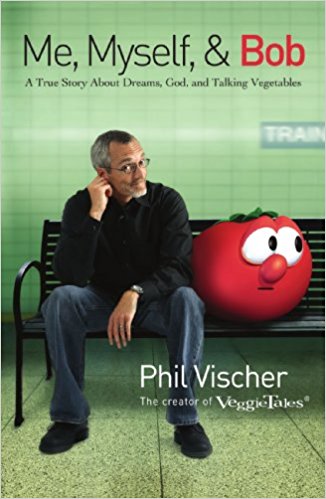
Our family was never hugely into Veggie Tales, but we saw and enjoyed enough of them to be able to sing along with the theme song, “Where Is My Hairbrush,” “Barbara Manatee,” and others. I wasn’t too crazy about their adaptations of Bible stories: I didn’t think building a silly plot around them served them well. But I enjoyed the stories that dealt with life issues that kids face, like being afraid of the dark. I was sad to see the decline of the company, Big Idea. Some years ago I read an interview with Veggie Tales creator, Phil Vischer, about what had happened, which motivated me to get his book, Me, Myself, and Bob: A True Story About Dreams, God, and Talking Vegetables,when I saw it on sale for the Kindle.

Me Myself and BobPhil goes into his background as a shy, nerdy kid with a quirky sense of humor and interests in filming and computers which dovetailed when computer animation began to be possible. Watching MTV videos, he was enthralled with the filming but appalled at the morals (or lack of them) in many of the videos. Years later in a media conference he heard a Viacom chairman share “how he intended to hook kids with Blue’s Clues, then lead them through Nickelodeon straight to MTV.” Phil wanted to make films that God could use. “I knew God wanted me to tell stories that promoted biblical values, and I wanted to do that through any available means.”

He dropped out of college, married, worked for a computer animation company, and experimented in his spare time. I didn’t always quite follow some of the few technical parts, but I got enough to know that, with the animation equipment and software at the time, he needed characters without arms, legs, or hair. He started with a candy bar until his wife commented that moms probably wouldn’t appreciate a candy bar being the hero of the stories, so he switched to vegetables. His wife (the voice of Junior Asparagus!) and a few friends joined him in working on the idea, and eventually Veggie Tales was born. The whole process of how it came to be and then grew is pretty fascinating. Fun fact: they were aiming for moms who bought videos for their kids, but the only marketing that was done was a cardboard cutout in bookstores, which didn’t seem to draw much interest. Veggie Tales was launched into the public eye by young adults and college students working in Christian bookstores who got bored with the same videos playing on display, popped Veggie Tales in, loved it, and recommended it.

Once Veggie Tales caught on, they experienced a meteoric rise in popularity and the company grew exponentially (becoming at one point “the best-selling Christian videos series in history, and the number two kids’ videos series in the world at that time, trailing only Pokemon”), but that turned out to be its downfall. Enthusiastic hiring, too much and too quickly, drove expenses up far beyond income. A lack of vetting allowed new employees who weren’t on the same page, even among the upper management, creating dissension within. Some of the experts they brought in specialized in packaged goods, which seemed plausible since Veggie Tales was sold as videos, but no one had experience in the entertainment industry. The company landed in bankruptcy, the final nail in the coffin being a lawsuit involving an unsigned contract (unsigned yet precisely because they had not yet come to mutually agreeable terms), which, inexplicably, was ruled in favor of the other company. The ruling was eventually overturned, but by that time the company had been sold. I had been dismayed to see Veggie Tales on network TV without its Biblical underpinning, but Phil explains that by that time, the company was in other hands. He was asked to stay on to provide voices and some help with animation, and was led to believe that the program would be the same, minus a specific Bible verse, but eventually learned that no religious content would be allowed.

As Bob the tomato so often wrapped up a Veggie Tales video discussing what we’ve learned today, Phil’s last few chapters discuss handling the crushing death of a dream, a dream that seemed to have been given by God and was being used by Him. Why didn’t He “rescue” Veggie Tales? While we don’t know the exact answer to that, one thing Phil learned was the difference between driving oneself for God and being led by Him. Though the whole book is fascinating, this is where the gold is.

Rather than asking God directly, I spent a lot of time thinking about what my work for Christ might be. Missionary conferences pitched mission fields at us kids like travel agents pitching vacation packages. Watch the slides—make a commitment. But overseas missions didn’t seem right for me, so I kept looking. Eventually, I found a place where my storytelling gifts seemed to line up with a need that was tugging at my heart–a need to express God’s Word through popular media. And that would be my work for Christ!

“If God gives you a dream, and the dream comes to life and God shows up in it, and then the dream dies, it may be that God wants to see what is more important to you–the dream or him.”

Rather than finding my identity in my relationship with God, I was finding it in my drive to do “good work.” The more I dove into Scripture, the more I realized that I had been deluded. I had grown up drinking a dangerous cocktail–a mix of the gospel, the Protestant work ethic, and the American dream.

I started to get it. The Christian life wasn’t about running like a maniac; it was about walking with God. It wasn’t about impact; it was about obedience.

What is “walking with God?” Simple. Doing what he asks you to do each and every day. Living in active relationship with him. Filling your mind with his Word, and letting that Word penetrate every waking moment.

The God who created the universe is enough for us–even without our dreams…God was enough for the martyrs facing lions and fire–even when the lions and the fire won. And God is enough for you.

The impact God has planned for us doesn’t occur when we’re pursuing impact. It occurs when we’re pursuing God.

I very much enjoyed Phil’s story, the behind-the-scenes look into how Veggie Tales came to be, learning what happened to it and to Phil, and what God taught him through the whole process.

(Sharing with Semicolon‘s Saturday Review of Books, Literary Musing Monday, Carole’s Books You Loved)

Save

Laudable Linkage

IMG_0195

Here are more good reads discovered in the last week or so:

The Transgender Matrix: It’s Time to Choose the Red Pill, HT to Challies. From a man who had transgender surgery on why it didn’t solve his problems and facing reality. He had other issues, but those weren’t even dealt with before his psychologist approved him for surgery.

A Three-step Strategy for Fighting Sin, HT to Challies. Probably one of the most helpful articles I have seen on the subject. On the same topic from the same blog: 20 Practical Ways to Kill Sin.

5 Ways to Pray for Persecuted Saints, HT to Challies.

You Were Created for More Than Motherhood.

The Neglected Stepchild of the Bible, Ecclesiastes. There are some weird approaches to this book, and this article helps rightly divide it.

Do Christians Have to Care About Everything? HT to Challies. “You’re not Christ. You’re part of His body. And there is a difference.”

Happy Saturday!

Balance

(Photo courtesy of https://morguefile.com/)

22 years ago a virus attacked my spine, and my body, in an auto-immune response, attacked the myelin sheath around the nerves as well as the virus. This is called transverse myelitis, which I wrote about more extensively here. The main symptom, from a whole laundry list of them, was that I couldn’t walk on my own. With physical therapy and a lot of prayer, I progressed from a wheelchair to a walker to a cane to wobbly and then more firmly walking on my own.

Among the symptoms still remaining are lack of full feeling in my left hand and lower legs, weird nerve signals, and balance problems that are worse when I am standing still. One of the early exercises my physical therapist had me do was to stand on a pillow, close my eyes, and lean as far as I could in different directions. We did this in front of my bed so that I’d have a safe place if I fell backwards, and she promised to catch me if I fell forward. But she was a tiny little thing and I was afraid of crushing her! Thankfully that never happened.

Though the balance issues are much better than they were 20-22 years ago, they are still a problem. I’m not sure what makes them worse some days than others. But the one thing that helps most is touching something stationary, if I am standing, or firm if I am walking. Just touching something firm keeps me steady. Sometimes that means taking someone’s arm, or leaning against a wall or chair. When I was in choir, it used to be that the back of my calves touching the chair behind me was sufficient, but I had to quit when that no longer was enough to keep me steady. Even while standing and singing in the congregation, I’m usually touching or leaning against the pew in front of me. If my eyes are closed in the shower, I often have to touch the wall or the caddy holding the soap and shampoo. Stairs are almost an impossibility if they don’t have a handrail. Uneven or rocky ground requires an assistant.

Feeling unbalanced is disorienting, even scary sometimes, occasionally paralyzing. Balance is an essential part of walking. It’s hard to move forward if you’re constantly fearing a fall, but even aside from fear, without stability your mind and body can’t process moving forward.

~~~

It’s easy to feel disoriented, unstable, and even fearful in this world today. So many problems, so many issues, so many arguments without simple resolutions. The hymn echoes what Paul said, “fightings and fears within, without.”

Where can we find balance, safety, and stability? Where is something firm to lean on to hold us steady and help us move forward?

 Uphold me according unto thy word, that I may live: and let me not be ashamed of my hope. Hold thou me up, and I shall be safe: and I will have respect unto thy statutes continually. Psalm 119:116-117.

For you have delivered my soul from death, yes, my feet from falling, that I may walk before God in the light of life.  Psalm 56:13, ESV.

For thou hast delivered my soul from death, mine eyes from tears, and my feet from falling. I will walk before the Lord in the land of the living. Psalm 116:8-9.

But as for me, my feet were almost gone; my steps had well nigh slipped…Until I went into the sanctuary of God

Nevertheless I am continually with thee: thou hast holden me by my right hand. Thou shalt guide me with thy counsel, and afterward receive me to glory. Whom have I in heaven but thee? and there is none upon earth that I desire beside thee. My flesh and my heart faileth: but God is the strength of my heart, and my portion for ever. Psalm 73:2, 17a, 23-26.

“Believe God’s love and power more than you believe your own feelings and experiences. Your rock is Christ, and it is not the rock that ebbs and flows but the sea.” ~  Samuel Rutherford

(Sharing with Inspire Me Mondays, Literary Musing Monday, Glimpses, Soul Survival, Tell His Story, Wise Woman, Faith on Fire)

Save

Save

Laudable Linkage

img_0021

I have kind of a longish list today, but found all of these noteworthy or thought-provoking in some way. Hope you find something you like!

Where Is God in a Mass Shooting? HT to True Woman.

Letter to a Church Member (Or a Letter to Myself). “Your church is here, not to give you a good self-image, but to give you a true self-image.”

Exegesis Without Embarrassment, HT to Challies. The first of a series dealing with why God would command the destruction of the Canaanites.

Ten Things You Should Know About Temptation, HT to Challies.

God Is With You in Your Panic Attack.

Let’s Get Real About Women’s Discipleship, HT toChallies. “If Instagram is any clue, most Christian women think discipleship is limited to hosting thoughtfully curated Bible studies in tasteful homes where shrieking children and dirty dishes don’t exist. This glossy ideal sits like a yoke on many women’s shoulders rather than spurring them onward in Christ’s Great Commission.”

The Holiness of Small Things.

Worship Isn’t About Feelings, HT to Challies. “Sometimes I serve my neighbor out of obedience to Christ, and love for Christ follows. Sometimes I am filled with love for Christ, such that I look for an opportunity serve my neighbor.

When You Don’t Need God’s Guidance, HT to True Woman. “We don’t need to seek guidance where guidance has already been revealed in Scripture. How easy it is to convince ourselves we’re “confused” about what we should do when we’re reluctant to do what we know is right. It helps us feel better to label questions of morality “complicated” when they require us to pick up a cross or suffer rejection. The serpent’s ancient whisper—Did God really say?—trips off the tongue when God’s commands are costly.”

Heroes, Hagiography, and Villainy. I’ve been thinking for some time now about writing a post concerning flawed heroes. This says some of the things I have been thinking.

Four Reasons to Read Slowly. “The Information Age isn’t slowing us down, but subtly and constantly pressuring us to speed up. As we browse, surf, and scroll, we’re training ourselves to quickly see new facts and then look for the next figures, rather than feel the weight of what we read.”

Advice for Reading the Bible when a learning disability makes it hard.

Benny Hinn Is My Uncle, But Prosperity Preaching Isn’t For Me.

Theological imagination.

I Stopped Praising My Kids for a Week: This Is What I Learned, HT to Story Warren.

Some years ago I was wandering around the local library’s video collection looking for something to watch and saw the 10th anniversary production of Les Miserables. I decided to get it and see what all the fuss was about – and that started a love affair with the musical and then the book. Since the particular singers there were the first I heard, and though I have seen some wonderful clips of a variety of singers singing some of the songs, this cast will always embody the characters for me. Recently I stumbled across this video of Philip Quast, who played Inspector Javert, telling how he approached one of the solos. I had no idea such thought and intention was involved behind every word. In the song he’s discussing, Javert has just had an encounter with ValJean, the man he has been trailing all his adult life. ValJean has just carried a wounded Marius through the sewer system when he runs into Javert and begs Javert to let him see Marius to safety. Previously ValJean had held Javert’s life in his hands, and let him go. Javert can’t compute this: he upholds righteousness and The Law, and in his mind, once you’ve fallen, there is no mercy or grace. “Once a con, always a con” is his mindset. So how can it be that this man no longer acts like a con and even shows mercy and compassion?  I’ll post the video of this song from the musical after this interview:

A couple of other things I love about this: Javert’s previous solo was about the comfort he found in the stars as “sentinels” of God’s order in the world. But here, “the stars are black and cold.” Also, there is so much parallelism between this song and Valjeans’s soliloquy when when the bishop shows him an undeserved kindness: the same tune there and here, similar phrasing about “allowing this man” to have an influence, an offer of freedom, “I am reaching, but I fall…,” escaping the world of Jean ValJean, but in two different ways. Although ValJean had to wrestle with it, he accepted the bishop’s grace. Javert either thought he didn’t need it, since he was always in the right in his own eyes, or he couldn’t accept it from this man. When his entire worldview was turned on its ear, instead of adjusting, he could only escape. Grace accepted saves and changes a person. Grace rejected leaves one out in the cold darkness.


Save

For His Name’s Sake

It happened Thursday morning that my reading from Daily Light on the Daily Path intersected with my Bible reading. The Daily Light passage for September 28 is as follows:

They shall put my name upon the children of Israel; and I will bless them. Numbers 6:27.

O LORD our God, other lords beside thee have had dominion over us: but by thee only will we make mention of thy name. Isaiah 26:13. We are thine: thou never barest rule over them; they were not called by thy name. Isa. 63:19.

All people of the earth shall see that thou art called by the name of the LORD; and they shall be afraid of thee. Deut. 28:10. The LORD will not forsake his people for his great name’s sake: because it hath pleased the LORD to make you his people. I Sam. 12:22

O Lord, hear; O Lord, forgive; O Lord, hearken and do; defer not, for thine own sake, O my God: for thy city and thy people are called by thy name. Dan. 9:19. Help us, O God of our salvation, for the glory of thy name: and deliver us, and purge away our sins, for thy name’s sake. Wherefore should the heathen say, Where is their God? Psalm 79:9,10. The name of the LORD is a strong tower; the righteous runneth into it, and is safe. Prov. 18:10.

Obviously, what those verses all have in common is God’s name, and there are multitudes more in the Bible. We may be somewhat familiar with the last one, but have we ever prayed for forgiveness, as Daniel did, or help, as Asaph did in Psalm 79, for God’s sake, for the sake of His name, for His glory? I have to admit, most often my focus is on my own need and wanting it resolved as soon as possible.

Part of my Bible reading was in Psalm 79 on this same day, which is quoted in this day’s Daily Light. According to my MacArthur Study Bible, this psalm was probably written after Nebuchadnezzar’s destruction of the temple in Jerusalem. He comments that in that time and culture, defeat of a nation was taken to mean the defeat of its god as well. Maybe that’s one reason God manifested Himself to Nebuchadnezzar later on – to show him that He had not been defeated, as well as to show him his need of Him.

Knowing those things magnifies the poignancy of OT saints being concerned for God’s name and, in sense, His reputation. God associated His name with Israel in a particular way. But what of NT saints, especially NT Gentile saints? What is our relationship to His name?

Are we called by His name?

Simeon hath declared how God at the first did visit the Gentiles, to take out of them a people for his name…That the residue of men might seek after the Lord, and all the Gentiles, upon whom my name is called, saith the Lord, who doeth all these things. Acts 15:14, 17.

 For this cause I bow my knees unto the Father of our Lord Jesus Christ, Of whom the whole family in heaven and earth is named… Ephesians 3:14-15.

Nevertheless the foundation of God standeth sure, having this seal, The Lord knoweth them that are his. And, let every one that nameth the name of Christ depart from iniquity. 2 Timothy 2:19.

What benefits do we receive through His name?

But as many as received him, to them gave he power to become the sons of God, even to them that believe on his name. John 1:12.

And such were some of you: but ye are washed, but ye are sanctified, but ye are justified in the name of the Lord Jesus, and by the Spirit of our God. 1 Corinthians 6:11.

I write unto you, little children, because your sins are forgiven you for his name’s sake. 1 John 2:12.

For where two or three are gathered together in my name, there am I in the midst of them. Matthew 8:20.

And in that day ye shall ask me nothing. Verily, verily, I say unto you, Whatsoever ye shall ask the Father in my name, he will give it you. Hitherto have ye asked nothing in my name: ask, and ye shall receive, that your joy may be full. John 16:23-24.

Do our actions reflect on His name?

And this was known to all the Jews and Greeks also dwelling at Ephesus; and fear fell on them all, and the name of the Lord Jesus was magnified. Acts 19:17.

For the name of God is blasphemed among the Gentiles through you. Romans 2:24.

For God is not unrighteous to forget your work and labour of love, which ye have shewed toward his name, in that ye have ministered to the saints, and do minister. Hebrew 6:10.

Do not they blaspheme that worthy name by the which ye are called? James 2:7.

Does His name influence our actions?

 And Jesus came and spake unto them, saying, All power is given unto me in heaven and in earth. Go ye therefore, and teach all nations, baptizing them in the name of the Father, and of the Son, and of the Holy Ghost: Teaching them to observe all things whatsoever I have commanded you: and, lo, I am with you always, even unto the end of the world. Amen. Matthew 28:18-20.

Whosoever shall receive one of such children in my name, receiveth me: and whosoever shall receive me, receiveth not me, but him that sent me. Mark 9:37.

But the Lord said unto him, Go thy way: for he is a chosen vessel unto me, to bear my name before the Gentiles, and kings, and the children of Israel. Acts 9:15.

By whom we have received grace and apostleship, for obedience to the faith among all nations, for his name: Among whom are ye also the called of Jesus Christ. Romans 1:5-6.

Because that for his name’s sake they went forth…3 John 7.

I know thy works, and thy labour, and thy patience, and how thou canst not bear them which are evil: and thou hast tried them which say they are apostles, and are not, and hast found them liars: And hast borne, and hast patience, and for my name’s sake hast laboured, and hast not fainted. Revelation 2:2-3.

I know thy works, and where thou dwellest, even where Satan’s seat is: and thou holdest fast my name, and hast not denied my faith…Revelation 2:13a.

I know thy works: behold, I have set before thee an open door, and no man can shut it: for thou hast a little strength, and hast kept my word, and hast not denied my name. Revelation 3:8.

What might it cost us to bear His name?

Then shall they deliver you up to be afflicted, and shall kill you: and ye shall be hated of all nations for my name’s sake. Matthew 24:9.

If ye be reproached for the name of Christ, happy are ye; for the spirit of glory and of God resteth upon you: on their part he is evil spoken of, but on your part he is glorified. 1 Peter 4:14.

I hope these verses encourage you, as they do me, to enlarge my vision in my prayers, my life, and my actions to concern for His name.

And in his name shall the Gentiles trust. Matthew 12:21.

Wherefore also we pray always for you, that our God would count you worthy of this calling, and fulfil all the good pleasure of his goodness, and the work of faith with power: That the name of our Lord Jesus Christ may be glorified in you, and ye in him, according to the grace of our God and the Lord Jesus Christ. 2 Thessalonians 1:11-12.

(Sharing with and Literary Musing Monday, Inspire Me Monday, Glimpses, Soul Survival, Wise Woman, Tell His Story, Woman to Woman Word-filled Wednesday, Faith on Fire)

Save

Save

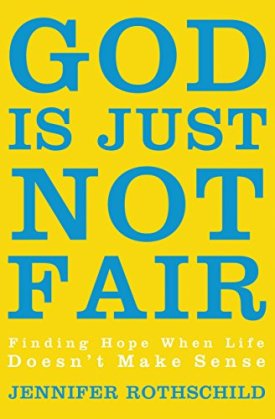
Book Review: God Is Just Not Fair

Not FairWhen Jennifer Rothschild was 15 years old, she was blinded by Retinitis Pigmentosa, effectively killing her dreams of becoming an artist and cartoonist. Then, several years later, she experienced a time of deep depression which, as she put it, tore holes in her blanket of faith.

In God Is Just Not Fair: Finding Hope When Life Doesn’t Make Sense, Jennifer Rothschild explores from her Bible study and personal experiences the questions that often come up when experiencing some sort of trial or trauma: Does God care? Why did He allow this? Why did this person experience healing but I didn’t?

That last question, not only of unanswered prayer on my part, but of the very same prayer being answered in someone’s else’s life, can bring up questions of God’s fairness. Fairness doesn’t mean He does the exact same thing in every person’s life. We’re not robots or cookie cutter Christians: God works in our lives individually according to what He wants to do in us and how He wants to grow us and show Him forth in our own circumstances and sphere of influence. And Jennifer turns this around to ask if it’s fair that we receive mercy and blessings instead of wrath for our sin. If we got what we truly deserved, we’d all be in trouble.

But Jennifer doesn’t tell us to therefore stifle our questions. She encourages us to bring them to light. We might not find answers to all of them, but we will for a few, and for the rest we can trust Him. Where He doesn’t give answers, He gives Himself.

There is so much good teaching here, it’s hard to sum it up. But I’ll give you a few examples:

If God allows you to wrestle with him, it is not so there will be a winner and a loser. He doesn’t need to prove he is stronger and you are weaker. No. The point of wrestling with God is to give you an opportunity to cling to him. God wants you to hang on to him no matter what — and the result will be blessing. You are blessed when you bring your hurts and questions to God and struggle with them in his presence. In that divine wrestling match, you may feel wounded, but you will also receive a blessing you couldn’t have received any other way.

He sometimes allows something bad in our lives to prevent something far worse in our lives. That is a wondrous work of God I cannot even see, because sometimes I have no idea how God is working on my behalf.

Being willing to thank God doesn’t mean you ignore what bothers you. It just means you are willing to look beyond what bothers you and see the good in a situation also.

Paul positioned gratitude as a choice, not a feeling. My friend, even when we don’t feel grateful, we can still be grateful.

Your difficulty can be hard enough, but the resentment or anger you drag along with it can be even more debilitating than the difficulty itself.

When we are enduring hardship, perhaps the better questions to focus on are not about the whom of suffering but about the how: • How will God use this redemptively in my life? • How will he use this loss for my gain? • How can I cooperate with my loving God’s master plan through this current suffering? • How can this possibly help me grow or change? The why of suffering is sometimes never answered. But to ask the how of suffering allows us to begin to see the beautiful redemption of what God can do in and through our suffering.

God’s ways may seem strange to us, but his ways do not have to live up to our standards or our analysis. He is who he is, and we are who we are. He is beyond error, perfect in all his ways. If his ways confuse or disappoint you, guard against the temptation to re-create him into a god you like better. You and I are to humble ourselves before him and seek to conform to his standard, not the other way around. He is sovereign and good, compassionate and merciful. If we do not accept God in his wholeness, we will never experience our own.

Ultimately, I trust God’s will to be best. He knows more, sees more, and loves more than I do.

Faith is the evidence of things unseen; instant response is not the evidence.

Unanswered prayers and prayers with disappointing answers can be greater gifts that getting what we thought we wanted.

He may allow your suffering to remain because he is using that hard thing to protect you from something far worse, preserve you for something far better, or provide for you what you don’t even realize you need. His apparent inactivity is not a sign that he is forgetful or lacks compassion, but rather an indication of his deep compassion and higher purpose for you.

God allows you to struggle, even though his power could prevent it, because his wise and compassionate authority knows that the benefit of your struggle far outweighs the comfort you may experience from his rescue.

God delivers us in different ways. Sometimes he protects us from awful things so we never have to endure them. Other times God delivers us by rescuing us or healing us. Sometimes God brings us through hard things —that’s also a form of God’s deliverance. But then there are the times that God, out of his great care for his children, delivers us out of the horror and into glory.

Thomas’s questions and doubts could have led him away from the Christ he loved and away from his friends who followed the Christ. But what a loss that would have been. Your questions and doubt can take you many places if you let them. They can take you down a road of cynicism, despair, or loneliness. But, my friend, what a waste of your doubts and questions! When you are full of questions and doubt, might you respond like Thomas? Might you stay connected with your friends who follow Christ? Will you take whatever faith or curiosity you have and channel it toward Christ himself? He welcomes questions, and he welcomes the questioner. He already knows your questions, but ask him anyway. Jesus won’t just give you the lesser gift of an answer; Jesus will give you himself because he is the answer…It was in the midst of Thomas’s honest struggles that Jesus revealed himself to Thomas. He will do that for you, too.

Being too self-focused makes every sorrow deeper, every problem bigger, and every slight more personal. It harms us and makes us forget God and others.

Never stop seeking; never stop walking with and toward him. Jesus invites us to keep taking steps toward him, even if every stepping-stone is in the shape of a question mark. As you continue to seek, don’t let theological information become a substitute for faith. Don’t let knowledge become a substitute for wisdom. And don’t seek God only for the answers he gives —seek God himself. Pursue an encounter with the God who loves you. Don’t settle for mere answers, my friend. Be satisfied with nothing less than God himself.

Every difficult, confusing season in life offers a choice. You can either surrender your questions and sorrow to God so he can use them, or you can surrender to bitterness and the enemy of your soul, who will use them against you. Don’t give him the weapons to hurt you.

The only quibble I noted or can remember is one phrase near the end of the book about “forgiving God if you need to.” God does no wrong, so He has no need of our forgiveness, and whenever I see that thought, it strikes me as a little pretentious. But what I think Jennifer is getting at is, don’t hold whatever God has permitted in our lives against Him. She speaks in the rest of this paragraph of trusting Him, being patient, and humbling ourselves before Him. As Jesus said, “And blessed is he, whosoever shall not be offended in me” (Matthew 11:6).

Because Jennifer has gone to the mat with these questions and wrestlings in her own life, her words are authentic rather than empty platitudes. And because she has sought the Scriptures and bases what she shares there, she can offer the only real hope we have: that God loves us, has a reason for everything He allows, will use it to develop us, and will give us the grace to go through it.

(Sharing with Semicolon‘s Saturday Review of Books, Faith on Fire, Literary Musing Monday, Carole’s Books You Loved), Wise Woman, Tell His Story, Woman to Woman Word-filled Wednesday)

Laudable Linkage

IMG_0195

It’s been a little longer than usual since I’ve had the opportunity to share some noteworthy reads discovered online the last few weeks, so here goes:

What Does It Mean to Abide in Christ?

3 Tests God Ordains for His Children, HT to Challies.

Self-examination Speaks a Thousand Lies. “God calls us to examine ourselves (2 Corinthians 13:5; Lamentations 3:40), but healthy self-examination is a difficult and dangerous duty….when that introspection makes us self-absorbed instead of Christ-absorbed, we undermine our faith.” “God knows the worst about you and loves you still.”

Don’t Speak Up: On the Spiritual Discipline of Silence, HT to Challies. “As evangelicals, we often feel guilty for not evangelizing more, or not speaking a word of correction to a friend in sin. And sometimes that sense of guilt is correct! But here, Jesus identifies another way we can err: speaking up wrongly, at the wrong times, and to the wrong person.”

Remembering My Friend, Nabeel Qureshi, HT to Challies. I was heartbroken to hear of Nabeel’s passing, though happy that he is no longer in pain and with the Lord. I loved his book Seeking Allah, Finding Jesus and respected his integrity and determination to go where the truth led him, no matter the cost. I have to admit I wondered why God would take someone so young who was doing so much to bring people to Himself. But after a while I thought the better way of thinking would be that we all have a given number of days, not guaranteed to be 80+: are we making the most of them like he did?

Embodying Masculinity in a World That Rejects It. “If I thoroughly study the ‘man’ passages and never work through the ‘all believers’ passages (the rest of the NT), I will completely fail in both.”

Have We Christians Made Marriage Too Complicated? HT to Challies.

God Didn’t Write a Book. “It took the printing press to make the Bible a book, but it didn’t take the printing press to make the Bible the Bible…the Bible is not essentially a book. It is essentially God’s recorded words to humanity, and those words transcend any single medium.”

Modern Media Is a DoS Attack on Your Free Will, HT to Challies. Lots to ponder in this one, but one statement stood out to me: “Democracy assumes a set of capacities: the capacity for deliberation, understanding different ideas, reasoned discourse. This grounds government authority, the will of the people.” And these are largely absent from most social media exchanges.

The Wrong Donations: Some Tough Words on Disaster Relief.

Ten Unfair Expectations of Pastor’s Wives, HT to Challies.

Why I signed the Nashville Statement, HT to Challies. Particularly poignant since Rosaria was once a lesbian feminist.

A Real Life Fall Home Tour. I loved this! Laura Ingalls Gunn (yes, related to that Laura Ingalls!) writes about home decor and posts Pinterest-worthy photos, but this time she showed “real life” scenarios – shoes and “stuff” out, etc. I am tempted to do a similar post, even though I don’t usually write about home decor. I think as homemakers we often strive for that balance between wanting things to look aesthetically pleasing and yet wanting the people who live there to feel comfortable and at home.

Happy Saturday!

Save

Nice, but still a rebel

You can hardly read Facebook, especially during election season or any kind of controversy, or just about any comments on anything online, without wishing people would be nicer to each other. We’re all so prone to forget the admonition to treat others with the same respect and grace with which we would want to be treated, especially when we deem them wrong in some way.

But is it possible to be thoroughly nice and still not right with God? Some years ago while reading Mere Christianity by C. S. Lewis, I came across a passage where he discusses that. It’s from the chapter “Beyond Personality” in a section concerning the truth that you can sometimes have an unsaved person who is actually nicer than some Christians. Lewis goes into many reasons for that which I won’t reproduce here, but one reason has to do with general disposition. Person A may be a quieter, calmer person and generally nice and personable, yet unsaved. Person B may have a more excitable personality and a fiery temper which the Lord has been giving him grace to overcome, and he may be a lot better than he was, yet compared with Person A he doesn’t seem as nice. Lewis then goes on to say (emphasis mine):

If you have sound nerves and intelligence and health and popularity and a good upbringing, you are likely to be quite satisfied with your character as it is. “Why drag God into it?” you may ask. A certain level of good conduct comes fairly easily to you. You are not one of those wretched creatures who are always being tripped up by sex, or dipsomania, or nervousness, or bad temper. Everyone says you are a nice chap and (between ourselves) you agree with them. You are quite likely to believe that all this niceness is your own doing: and you may easily not feel the need for any better kind of goodness. Often people who have all these natural kinds of goodness cannot be brought to recognize their need for Christ at all until, one day, the natural goodness lets them down and their self-satisfaction is shattered….

If you are a nice person — if virtue comes easily to you — beware! Much is expected from those to whom much is given. If you mistake for your own merits what are really God’s gifts to you through nature, and if you are contented with simply being nice, you are still a rebel: and all those gifts will only make your fall more terrible, your corruption more complicated, your bad example more disastrous. The Devil was an archangel once; his natural gifts were as far above yours as yours are above those of a chimpanzee.

….We must not suppose that even if we succeeded in making everyone nice we should have saved their souls. A world of nice people, content in their own niceness, looking no further, turned away from God, would be just as desperately in need of salvation as a miserable world — and might even be more difficult to save.

For mere improvement is no redemption, though redemption always improves people even here and now and will, in the end, improve them to a degree we cannot yet imagine. God became man to turn creatures into sons: not simply to produce better men of the old kind but to produce a new kind of man

If what you want is an argument against Christianity (and I well remember how eagerly I looked for such arguments when I began to be afraid it was true) you can easily find some stupid and unsatisfactory Christian and say, “So there’s your boasted new man! Give me the old kind.” But if you once have begun to see that Christianity is on other grounds probable, you will know in your heart that this is only evading the issue. What can you ever really know of other people’s souls — of their temptations, their opportunities, their struggles? One soul in the whole creation you do know: and it is the only one whose fate is placed in your hands. If there is a God, you are, in a sense, alone with Him. You cannot put Him off with speculations about your next door neighbors or memories of what you have read in books. What will all that chatter and hearsay count (will you even be able to remember it?) when the anesthetic fog which we call “nature” or “the real world” fades away and the Presence in which you have always stood becomes palpable, immediate, and unavoidable?

Jim Berg quotes Lewis in Changed Into His Image and then goes on to say:

Surprising as it may seem, there are many of us who really try to be good, not because we are allowing God to work in our lives to produce His fruit, but because it seems that life has fewer snags when we stay out of trouble. We often achieve the accolades and image we want. We can become smug around others who aren’t doing right and can become easily embittered during the times when we are being good and don’t get what we want.

We sometimes think we are pretty good people who “mess up” once in a while. The biblical picture is just the opposite: we are pretty bad people who do right only by the grace of God.

The true strength of my sinful heart…was not fully known to me until I resisted it.

“Being good” can be just our own way of making life work without God.

One of my friends had a hard time coming to the Lord for that very reason — she felt she was every bit as good as the people witnessing to her and therefore didn’t “need” to be saved. Thankfully the light finally broke through.

 The Bible tells us that “we are all as an unclean thing, and all our righteousnesses are as filthy rags; and we all do fade as a leaf; and our iniquities, like the wind, have taken us away” (Isaiah 64:6, KJV). Next to God’s blazing holiness, our righteousness is like filthy rags.

But how can that be, you might ask. You’re not promiscuous or hateful, you return the money when the cashier gives you too much back, you give to good causes, you drive the speed limit.

Think of it this way. Jesus said the greatest command is to love God with all our heart, soul, mind, and strength. So it follows that the greatest sin is breaking this commandment…and we all fail in that way several times a day. Plus the Bible tells our our heart is deceitful, so there are likely ways we sin that we don’t realize.

This is a paltry comparison, but imagine you have a favorite white shirt that still looks pretty good to you. But one day in the store you find another white shirt and decide to get it. When you bring it home and hang the new shirt next to your old one, you’re horrified. Your old shirt, which looked perfectly fine to you the day before, now looks grey and worn next to the bright new one.

The only righteousness that meets all the qualifications for heaven are His.

For I bear them witness that they have a zeal for God, but not according to knowledge. For, being ignorant of the righteousness of God, and seeking to establish their own, they did not submit to God’s righteousness. For Christ is the end of the law for righteousness to everyone who believes (Romans 10:2-4, ESV).

And be found in him, not having a righteousness of my own that comes from the law, but that which comes through faith in Christ, the righteousness from God that depends on faith (Philippians 3:9, ESV).

Christ took our unrighteousness on Himself on the cross, and when we repent of our own way and believe on Him, He credits His righteousness to our account. As Chris Anderson’s hymn, “His Robes For Mine,” says:

His robes for mine: O wonderful exchange!
Clothed in my sin, Christ suffered ‘neath God’s rage.
Draped in His righteousness, I’m justified.
In Christ I live, for in my place He died.

So, I am all for being nice and wish the world contained more niceness. But before God, being nice is not enough. Instead of trying to make our own righteousness come up to Him, an impossible task, we need the righteousness that comes from Him. If, like me, you’ve made that exchange, rejoice with me in His grace. If not, I invite you to come to Him today.

(Revised from the archives. Sharing with Inspire Me Monday, Literary Musing Monday, Glimpses, Soul Survival, Tell His Story, Woman to Woman Word-filled Wednesday, Wise Woman)

Laudable Linkage

IMG_0195

It’s later in the day than I usually post these, but here are a few good reads discovered in the last week:

Today, More Than Ever, Read Beyond the Headlines. Yes! And the Twitter feeds.

Hard Evidence for a Supernatural Book.

Those Spiritual Gift Tests? Maybe You Ought to Ignore Them.

Please Stop Saying “Christianity Isn’t a Religion, It’s a Relationship” HT to Challies.

10 Suggestions for new Bible College Students, HT to Challies.

White Christian conservatives should oppose protests by white supremacists.

On Waiting and the Lord of the Rings.

Redeeming Princess Culture, HT to Story Warren.

And something from Pinterest that resonated with me:

The Rock higher than I