Spots and Wrinkles

Spots of spilled food or splashed mud and wrinkled clothes can usually be repaired, thankfully, but other spots are more of a problem.

In regular exchanges between Father Tim and his wife, Cynthia, in Jan Karon’s Mitford books, she joyously exclaims that she loves  something, then he will ask, “What don’t you love?” She usually replies with three items, one of which is often “age spots.”

I share her dislike and dismay over those pesky blotches. They’re popping up all too frequently, and there doesn’t seem to be much one can do about them.

Another dismaying sign of aging is wrinkles. Hopefully most of one’s wrinkles will mark laugh lines rather than frown creases, but neither is really a welcome sight. I have dry skin, which was responsible for my not having many pimples in my teens, for which I was glad. But I didn’t learn until later that same dry skin would betray me by wrinkling earlier than my oilier counterparts. In the hormonal changes of middle age, I once experienced the ultimate injustice of a big fat pimple right in the middle of a wrinkled forehead. It didn’t seem like those two should go together!

Spots and wrinkles in one’s character, though, are worse than the biggest age spot and the most wrinkle-prone linen and harder to deal with. Too often my good deeds are splotched with wrong motives. Fissures of selfishness seem to grow deeper and longer every day. My efforts to clean up those spots or iron out those wrinkles only seem to add more.

In the 1720s, Benjamin Franklin “conceiv’d the bold and arduous project of arriving at moral perfection. I wish’d to live without committing any fault at any time; I would conquer all that either natural inclination, custom, or company might lead me into.” He made a chart listing thirteen virtues, and placed a dot beside each one he violated every day, with the goal that eventually he’d be able to live with a completely clean chart. But it was never spotless. He had to admit that “I never arrived at the perfection I had been so ambitious of obtaining, but fell far short of it, yet I was, by the endeavour, a better and a happier man than I otherwise should have been if I had not attempted it.”

Even though we might become “better and happier” by trying to develop virtue, we can never become perfect, and perfection is what is required to be right with God and to get into heaven. Revelation 21:27 says of heaven, “But nothing unclean will ever enter it, nor anyone who does what is detestable or false, but only those who are written in the Lamb’s book of life” (ESV). Jesus said, “Be ye therefore perfect, even as your Father which is in heaven is perfect.” Even if we could be completely perfect and sin-free from this moment forward, we have all the sins of our past still spotting our souls.

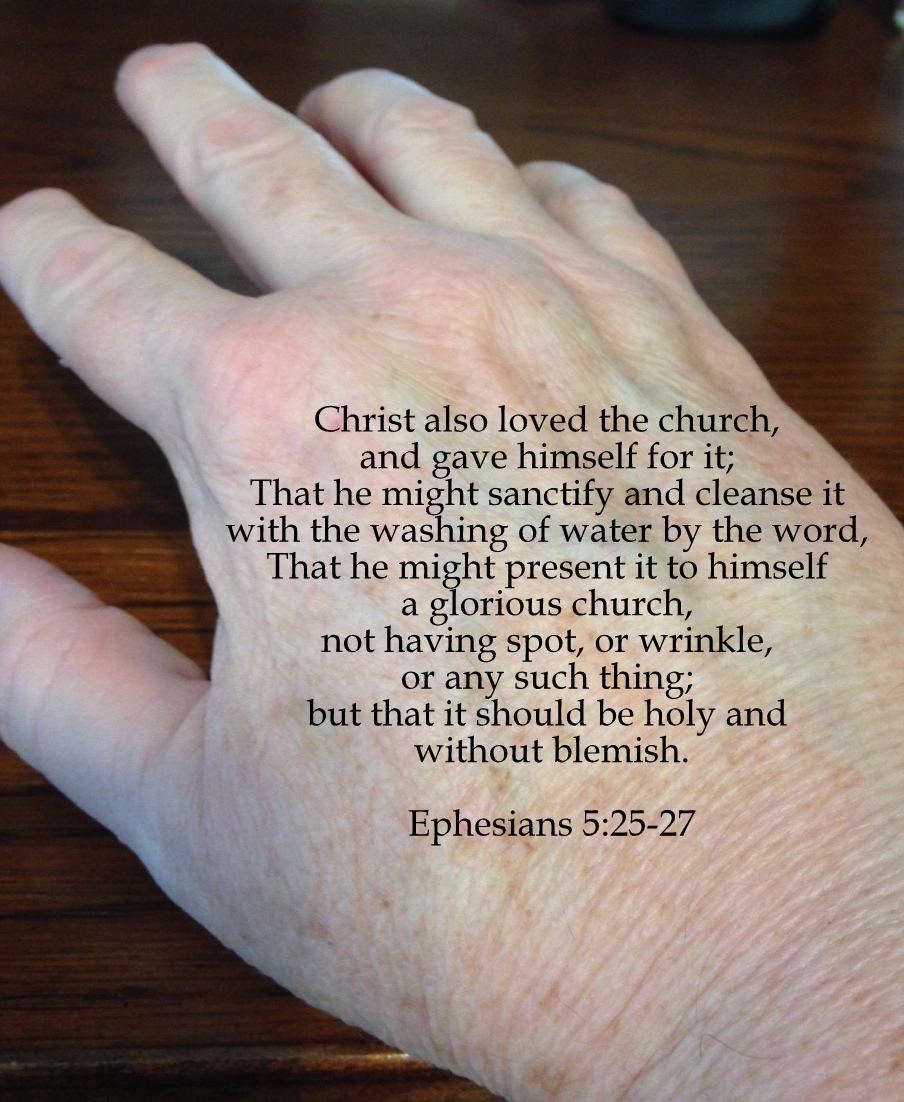
It would be hopeless except that “Christ also loved the church, and gave himself for it; That he might sanctify and cleanse it with the washing of water by the word, That he might present it to himself a glorious church, not having spot, or wrinkle, or any such thing; but that it should be holy and without blemish” (Ephesians 5:25-27).

Only Jesus is free of spots or wrinkles of wrong thinking and wrongdoing.

How much more shall the blood of Christ, who through the eternal Spirit offered himself without spot to God, purge your conscience from dead works to serve the living God? Hebrews 9:14.

 Forasmuch as ye know that ye were not redeemed with corruptible things, as silver and gold, from your vain conversation received by tradition from your fathers; But with the precious blood of Christ, as of a lamb without blemish and without spot. (1 Peter 1:18-19).

Only Jesus can cleanse us and remove the wrinkles in the depths of our souls:

And from Jesus Christ, who is the faithful witness, and the first begotten of the dead, and the prince of the kings of the earth. Unto him that loved us, and washed us from our sins in his own blood. (Revelation 1:5)

This then is the message which we have heard of him, and declare unto you, that God is light, and in him is no darkness at all. If we say that we have fellowship with him, and walk in darkness, we lie, and do not the truth: But if we walk in the light, as he is in the light, we have fellowship one with another, and the blood of Jesus Christ his Son cleanseth us from all sin. If we say that we have no sin, we deceive ourselves, and the truth is not in us. If we confess our sins, he is faithful and just to forgive us our sins, and to cleanse us from all unrighteousness. (1 John 1:5-9)

I don’t know whether our bodies in heaven with retain the spots and wrinkles they had on earth, but I am sure we won’t care then. However, I am intensely, eternally thankful that when we believe on Jesus Christ as our own Lord and Savior, our souls are thoroughly cleansed now and through all eternity from any hint of a blemish or wrinkle.

Be diligent that ye may be found of him in peace, without spot, and blameless. (2 Peter 3:14b).
IMG_1210

I lay my sins on Jesus,
The spotless Lamb of God;
He bears them all, and frees us
From the accursed load.
I bring my guilt to Jesus,
To wash my crimson stains
White in His blood most precious,
Till not a spot remains.

I lay my wants on Jesus:
All fullness dwells in Him;
He heals all my diseases,
He doth my soul redeem.
I lay my griefs on Jesus,
My burdens and my cares;
He from them all releases;
He all my sorrows shares.

I rest my soul on Jesus,
This weary soul of mine;
His right hand me embraces,
I on His breast recline.
I love the Name of Jesus,
Emmanuel, Christ, the Lord;
Like fragrance on the breezes
His Name abroad is poured.

I long to be like Jesus,
Meek, loving, lowly, mild;
I long to be like Jesus,
The Father’s holy Child;
I long to be with Jesus,
Amid the heavenly throng;
To sing with saints His praises,
To learn the angels’ song.

~ Horatius Bonar

Just as I am, and waiting not
to rid my soul of one dark blot,
to thee, whose blood can cleanse each spot,
O Lamb of God, I come, I come.

~ Charlotte Elliott

Sharing at Thought-Provoking Thursday.

Laudable Linkage

It’s been a few weeks since I’ve been able to share links I found interesting recently. But I don’t have as many as you might expect for a longer time period. Here they are:

What Does It Mean to “Accept Jesus”? “Accepting Jesus’ is not just adding Jesus. It is also subtracting the idols.”

No, Hanging Out With Your Friends Is Not the Church. Love this blog name, too: The Wardrobe Door.

Freedom From Parenting Guilt.

10 Amazingly Enjoyable Things About Having Kids. We hear so much negativity in the world about the frustrations of having children, but there are many fun things, too. This is from a secular source and therefore has a couple of philosophical bits I wouldn’t agree with, but overall some great observations.

Love Theologically. HT to Challies. Love and theology should feed each other, not oppose each other.

Sweet video about Moms.

If you’re a fan of Pixar movies (we are!), you might enjoy this video of “Easter eggs” in the films – little surprises from one film in another:

Happy Saturday!

Laudable Linkage

Here are just a few commendable links from the last week:

Borrowed Lights: Inspiration for Christian Living. Benefits of reading about the lives of other Christians who follow the Lord closely. Loved this that Robert Murray McCheyne said of Jonathan Edwards: “How feeble does my spark of Christianity appear beside such a sun! But even his was a borrowed light, and the same source is still open to enlighten me.” I liked it so much I added it to my previous post Why Read Biographies.

Are You a Mentoring Momma? “Most likely if you asked them, not one [of these women] would say she mentored me. Yet her life influenced mine in profound ways. The common thread among each of these unique women is that she was further along in the journey, loved me, loved Christ more, and modeled how to treasure Him above all else.” To me that’s the best mentoring – not an official program, not a formal set-up mentor-mentee relationship, but just this.

When Motherhood Drains Your Happiness. The truths here of what to do when you feel drained ministered to me even though I wasn’t feeling that way with regard to motherhood at this point.

My Mother Practiced the Piano. “There’s nothing selfish about working toward your artistic interests as God allows the time. In fact, your children can benefit from watching you model discipline and discovery.”

And, for a smile – I’ve watched this several times and love the look on this cat’s face – although it wouldn’t really be funny to live with a cat who does this:

Happy Saturday!

Book Review: He Is There and He Is Not Silent

SchaefferWhen I first saw the title of He Is There and He Is Not Silent by Francis Schaeffer, I thought it sounded like something from the Psalms, a response to a deep heart-cry of someone who needed God and found Him.

It’s not that, at least not like the Psalmist’s expressions. It’s a book of philosophy and apologetics. It’s actually the third book in a trilogy, The God Who Is There and Escape From Reason being the first two.

Elisabeth Elliot once said of some of C. S. Lewis’s writing that she could follow it, but it took several careful rereadings to grasp it well enough to be able to express what he said to someone else. That’s how I feel about this book. I could follow the thread of his arguments, but I couldn’t possibly reproduce any of them for you. You can get a brief overview of one chapter at Wikipedia and probably other places. Wikipedia’s overview sums it up nicely: “He Is There and He Is Not Silent is divided into four chapters, followed by two appendices. The first of these chapters deals with metaphysics; the second, morals; and the third and fourth, epistemology. The first appendix concerns revelation and the second the concept of faith.”

Honestly, reading sentences like, “The reason for the modern dilemma is that men have moved from uniformity of natural causes in an open system — open to reordering by God and man — into the uniformity of natural causes in a closed system” makes my head feels like it is about to explode (and some of the comments on Goodreads reassure me that others felt the same way). But it is good to stretch one’s brain sometimes, and I am glad for such masterfully written books because I do know people who think like this about these things, and it is good to know that Christianity not only stands up to scrutiny, but, as Schaeffer shows, it is the only reasonable answer to the many issues that he brings up. He and his wife hosted a lot of people, many of them students, in the 60s and 70s, and I am sure these kinds of things came up in their discussions.

I admit I am an intensely practical person, so when someone asks, “How do we know we are really here?” I am liable to think, “Maybe look in the mirror? Or pinch yourself. Hard.” This was written in 1972, well before The Matrix, but I guess some people really do wonder if reality is close to that kind of scenario.

It wasn’t until the fourth chapter, “The Epistemological Necessity: The Answer,” that the clouds began to clear. It’s the only chapter where I marked any quotes. Here are a couple:

The Bible teaches in two different ways: first, it teaches things in didactic statements, in verbalizations, in propositions…Second, the Bible teaches by showing how God works in the world that He Himself made. We should read the Bible for various reasons. It should be read for facts, and it should also be read devotionally. But reading the Bible every day of one’s life does something else — it gives one a different mentality…Do not minimize the fact that in reading the Bible we are living in a mentality which is the right one, opposed to the great wall of this other mentality which is forced upon us on every side — in education, in literature, in the arts, and in the mass media.

When I read the Bible, I find that when the infinite-personal God Himself works in history and in the cosmos, He works in a way which confirms what He has said about the external world (p. 78).

The strength of the Christian system — the acid test of it —  is that everything fits under the apex of the existent, infinite-personal God, and it is the only system in the world where this is true. No other system has an apex under which everything fits.That is why I am a Christian and no longer an agnostic. In all the other systems, something “sticks out,” something cannot be included; and it has to be mutilated or ignored. But without losing his own integrity, the Christian can see everything fitting into place beneath the Christian apex of the existence of the infinite-personal God who is there (p. 81).

The Christian should be the man with the flaming imagination and the beauty of creation (p. 87).

I’ve had this book on my shelf for something like 30 years. I am thankful for the TBR Challenge, which encouraged me to scour my shelves for unread books and finally get to them. If you like philosophizing, this book is for you.

(This review will also be linked to Semicolon‘s Saturday Review of Books.)

Laudable Linkage

Here are some posts I found worth reading and sharing over the last couple of weeks:

The Dead End of Sexual Sin along with some advice from John Owen about overcoming sin of any kind.

Providential Dullness: An Easter Meditation. We give the disciples a hard time for missing that Jesus said He would rise again, but Luke 18:34 says, “this saying was hid from them.” Why would that be? Some good answers in this piece.

The Ones in the Front Row.“I cannot control the reception my children’s God-given callings receive out there in the wide world. But I can raise them to be appreciators of beauty, loveliness, and skill. Then, maybe they will be the ones in the front row, clapping their hearts out, whistling, standing and cheering at all the beauty the world holds for them.”

Thanks For Raising the Man of My Dreams! I hate mother-in-law jokes and did long before I became a m-i-l. I did have  relatively good relationship with mine. Here are some good thoughts to enhance that relationship.

10 Ways to Create a Home of Warmth and Grace.

How to Get Published.

For those who like Christian fiction, especially free Christian fiction, there’s a Christian Fiction Scavenger Hunt going on this weekend with a possibility of winning 17-34 books from 30+ authors. Some of the individual authors are hosting their own giveaways as well.

Happy Saturday!

Praying for the Lost Scripturally

Photo courtesy of pixgood.com

Photo courtesy of pixgood.com

My late pastor used to frequently emphasize that we not let our praying fall into “Christian cliches,” but that we pray Scripturally. That doesn’t mean we used prayers or phrases in the Bible as magic words or a magical formula, but by seeing examples in the Bible of how and what to pray, we can know we’re praying in line with God’s will.

One night at the beginning of a prayer meeting, he mentioned noticing that there didn’t seem to be many instances in the Bible of Christians praying for unbelievers to become believers, though there were examples of their praying for a number of other things. This wasn’t his message for the night or anything he studied out: if he were preparing a sermon he would have developed the thought more fully before mentioning it. It was more just a thought that had occurred that day that he was throwing out there. Of course it’s certainly not wrong to pray for unbelievers. Paul said in Romans 10:1, “Brethren, my heart’s desire and prayer to God for Israel is, that they might be saved.” But my pastor encouraged us to think of Scriptural ways to pray for them. This is something I am going to be watching for the next time I read through the New Testament, but here are a few thoughts along this line.

1. We can pray for God to send someone to tell them of Jesus. In Matthew 9:37-38, Jesus said, “The harvest is plentiful, but the workers are few. Therefore beseech the Lord of the harvest to send out workers into His harvest.” That was something I prayed for my mother often. She was not open to talking to me about her spiritual condition, we lived 1,000 miles apart, and she was not inclined to go to church, so I prayed God would send someone across her path, perhaps a coworker, who would be a good testimony to her. At her funeral, where my former pastor presented the gospel clearly, I heard a number of “Amens” behind me and was astonished at the number of people who evidently knew the Lord there. I don’t know exactly how they were able to share with my mom, but I was touched at how God had answered that frequent prayer.

2. We can pray for their hearts to be “good ground.” In what we call the parable of the sower in Matthew 13, Jesus talks about various people’s hearts as ground that the seed of the Word is dropped into. It doesn’t take root and grow in some because it’s snatched away, in others because their heart is stony, in others because thorns choke it out. But the one with “good ground is he that heareth the word, and understandeth it; which also beareth fruit.” Though we’re not specifically instructed to pray this way, I’ve prayed at times for hearts of lost loved ones to become good ground, for the stones to be removed, the bedrock underneath to be broken up, the thorns to be kept back, so that the seed of the Word can take root and bring forth fruit. I think God does that in some by bringing circumstances into their lives to soften them and by bringing them under the sound of the Word that they reject at first, but which gradually breaks down the stoniness. I think apologetics ministries are most helpful here: I’ve seen these types of ministries as well as creation-based ministries scorned a bit because they’re not the gospel.  Most, however, include the gospel and I think they help make way for the gospel.

3. We can pray for God to draw them to Himself. John 6:44 says, “No one can come to me unless the Father who sent me draws him. And I will raise him up on the last day.”

4. We can pray for the Word of God to have free course in their lives. 2 Thessalonians 3:1 says, “Finally, brethren, pray for us, that the word of the Lord may have free course, and be glorified, even as it is with you.” I love the term “free course” there – to me it conveys the idea of being unhindered.

I’ve also prayed that God would “open their eyes, so that they may turn from darkness to light and from the power of Satan to God, that they may receive forgiveness of sins and a place among those who are sanctified by faith in me” (Acts 26:18). Though in that passage that’s not part of a prayer, it’s what God says He will do through Paul, I don’t think it is too much of a stretch to ask God to do the same through others. I’ve also prayed that people would realize that whatever they’re trusting in is not dependable and will not satisfy in the long run, or that whatever is keeping them from salvation is not worth it: though I can’t think of an instance in the Bible where that kind of thing is recorded as a prayer, I don’t think those are unbiblical prayers: I think they’re in keeping with the tenor of Scripture.

What do you think? Are these valid ways of praying for unbelievers? Do you have Biblical ways you pray for them?

For this reason I bow my knees before the Father, from whom every family in heaven and on earth is named, that according to the riches of his glory he may grant you to be strengthened with power through his Spirit in your inner being, so that Christ may dwell in your hearts through faith—that you, being rooted and grounded in love, may have strength to comprehend with all the saints what is the breadth and length and height and depth, and to know the love of Christ that surpasses knowledge, that you may be filled with all the fullness of God.

Now to him who is able to do far more abundantly than all that we ask or think, according to the power at work within us, to him be glory in the church and in Christ Jesus throughout all generations, forever and ever. Amen.

Ephesians 3:14-21

Camouflaging Dirt

Photo courtesy of morguefile.com

Photo courtesy of morguefile.com

Years ago when my youngest was still a baby and we were moving to another state, a house we looked at had all white cabinets, flooring, and appliances in the kitchen. I thought to myself, “This will never work with three boys.” But that is the house we ended up buying, and a funny thing happened. Because everything was white. I noticed streaks and smudges right away and cleaned them up as I noticed them. That kitchen was probably cleaner than any of my kitchens with darker floors and wooden cabinets mainly because I don’t notice dirt and smears against the wood as easily as against white. I was shocked recently to open a wooden cabinet door and notice when the light hit it just right that it was covered in dust that I had been totally unaware of. Sometimes I think I have dusted the wooden end tables or swept the parquet floor thoroughly — until the sunlight comes through the windows at just the right angle, and then I see spots I missed.

We used to have stovetops that had metal (aluminum, I think) removable burner pans that would catch all the gunk and spills, which would then get encrusted and hardened with the heat from cooking. I tried to keep on top of the spills, but eventually I had to do something with the burner pans. When I could find cheap replacements, I’d just buy those and toss the old ones. When the replacements got too expensive, I came across a tip to put the burner pans in a big pan of water with some baking soda, bring it to a boil, and then just let them sit in the hot water for a while. Somehow that did make them easier to clean even the caked-on stuff. But it was tedious. My stovetop now is totally while and doesn’t have removable burner pans, so, because the spills are more obvious, I clean them as I go and rarely have to do a major cleaning there.

Sometimes when we’re looking for furniture, appliances, or flooring, we want something that doesn’t show dirt. I still think that way in some areas. I wouldn’t want a totally black or white car: the black shows up pollen and dust, the white shows up everything else.

But I’ve come to prefer white in a kitchen, partially because it makes the room lighter, brighter, and more open and airy, but also because I like to be able to see and keep on top of the dirty stuff rather than wonder what I am going to discover with a closer look.

One church we were in had flooring in the kitchen/fellowship area that looked dirty all the time. It wasn’t unclean: it was just that the color and pattern made it look grimy. Recently we went looking for flooring for our bathroom, which came with carpeting, which is gross in a bathroom. A lot of the vinyl flooring we looked at had the same feature: a swirly pattern looked to me like smudges, and dots looked like something had spilled that needed to be cleaned up. I guess the designers figured that’s one way to hide dirtiness: camouflage it so it always looks dirty anyway.

And then sometimes we can’t see dirt when our eyesight fails. I was cleaning a windowsill recently and thought I was done until I put on my reading glasses, and then the windowsill didn’t look very clean at all. One of the signs of my mother-in-law’s aging was that she didn’t see things that weren’t clean. She had always been very industrious, but the older she got, the more we found areas that were sticky or covered in dog hair that she would have clean if she had realized, but she just didn’t see it.

I’ve often thought, when I see sunlight showing up the dust I missed, that I should probably dust or sweep at that time of day so I can see better and do a better job in that light. I’ve also thought that it was a good analogy of the need to shine the light of God’s Word on my life. Everything may look okay to me, but my spiritual sight may need adjustment. My human dimness may have camouflaged an unkind thought as justifiable or missed a selfish motive. And I need to compare myself not to my fellow creatures with their own smudges, but to the blazing holiness of the Son of God. Why would we do that when none of us can come close at all, when we look so shabby and dingy in that light? Because that’s the best way to see what needs to be taken care of. And instead of fearing to come to that light, we can have confidence that “If we confess our sins, he is faithful and just to forgive us our sins, and to cleanse us from all unrighteousness” (1 John 1:9) and we can have assurance that we can “come boldly unto the throne of grace, that we may obtain mercy, and find grace to help in time of need” (Hebrews 4:16).

One of our sons, when he was very little, used to have a hard time admitting he had done anything wrong. Often we took him to Proverbs 28:13: “Whoever conceals his transgressions will not prosper, but he who confesses and forsakes them will obtain mercy.” “If we say that we have no sin, we deceive ourselves” (I John 1:8a). As long as we cover, camouflage, excuse, or miss seeing our sins, faults, and flaws, we’re stuck with them. But if we see, acknowledge, confess our sins to the Lord and forsake them, He will cleanse us.

Sometimes when we discover a mess we had missed, we can be discouraged at the work needed to clean it up. Sometimes when I start to clean one area, I notice five others that need work, and it can be discouraging. But spiritually, Jesus has done all the work. He took all of our sin and all of God’s wrath towards it on Himself on the cross. When we believe on Him, our sinfulness is exchanged for His righteousness. Though we still have to battle sin in this life, we can be cleansed, and in heaven we’re given white robes, the Bible says. I sometimes joke that I can’t wear white til I get to heaven because of my propensity to spill or brush against something messy and end up with a spotted garment. What a joy it will be in that day to have sin totally removed so it can’t touch us any more. But what a joy in our day that though our “sins be as scarlet, they shall be as white as snow” (Isaiah 1:18).

Search me, O God, and know my heart: try me, and know my thoughts: And see if there be any wicked way in me, and lead me in the way everlasting. Psalm 139: 23-24

Create in me a clean heart, O God; and renew a right spirit within me. Psalm 51:10

Laudable Linkage

Here are some noteworthy reads from the last couple of weeks:

Shine Like Stars: Give and Rejoice {Philippians 2:17-18}. What it means for our lives to be poured like like a drink offering. Hit me right where and when I needed it.

10 Things We Don’t Want Our Kids to Learn From Church.

What these ladies did to turn a friend’s day around, and what they received in return. Loved this!

Why Can’t Christians Intelligently Discuss Current Events. “I suspect that by yelling so loudly about nearly everything, we’re obscuring the big thing (Matt. 12:36).”

Responding to the Increasingly Short Shelf-Life of Worship songs, HT to Challies. Songleaders/music pastors/worship leaders have an abundance of songs to choose from, and being able to project the words for all to see enables us to sing more than just what’s in the hymnbook. That’s good in many ways but complicates things in other ways. Though this was written to song leaders and such, it helped me to see what  big job it is to choose songs from the multitude we have available. I especially appreciated his caveat that some songs are for just a season. It used to bother me that we heard some songs often for a while and then not at all – kind of like a current “hit” – but then I realized that even the older hymn-writers wrote many songs that we know nothing about now, so that must have happened then, too.

This is a  neat overview of the Bible for kids, showing how it all points to Christ:

https://vimeo.com/123430346

Have a good weekend!

When the message isn’t for me

Courtesy offreedigitalphotos.net

Courtesy of freedigitalphotos.net

A week or two ago I came across a blog post that got me to thinking about how we respond when a meeting, church service, or even a Bible passage seems to apply to someone other than myself. When there is an ordination service or a Mother’s or Father’s Day message or children’s program, do I skip them because I am not a part of any of that?

I don’t think so. Here’s why:

1. “All scripture is given by inspiration of God, and is profitable for doctrine, for reproof, for correction, for instruction in righteousness: That the man of God may be perfect, thoroughly furnished unto all good works.” II Timothy 3:16-17. It is all profitable for me in some way even if the particular passage doesn’t seem to apply to me.

Some years ago the pastor of the church where we were at the time read a few verses from Exodus with instruction about oxen. He asked, “Do any of you own an ox?” No one raised their hands.

He then asked, “How many of you have even seen an ox?” One or two raised their hands.

“So,” he said, “We should just turn the page and skip this passage, right?” No, we didn’t think so, but what do we do with that passage?

He then brought out several applications from the passage. For instance, someone who owned an ox that was known for trying to push people with its horn was more liable if it injured someone. So if we have, say, a dog with a tendency to bite, we are even more responsible to keep it from people it could hurt. Or, to apply it further, if our tail lights are out on our car, we’re liable if someone crashes into us because they didn’t know we were stopped or slowing down to turn, so it behooves us to keep up with those things.

2. It helps us understand our brothers and sisters in the Lord. I may not be a pastor or a husband or a mother, but the passages that talk about them help me understand their roles, not so I can form a checklist and note when they’re not getting it right, but so that I can pray for them, understand their problems, needs, and temptations, and encourage them. The Bible says the church is the body or Christ, and “If one member suffers, all suffer together; if one member is honored, all rejoice together.” (I Corinthians 12:26).

3. Their position is under attack. Satan is not omnipresent, but he does get around, and he seeks to undermine everything God calls good. Any role or function within the church, home, or family as designed by God is under attack in some way or another. The blog post I mentioned at the beginning was complaining, in part, that the focus on married women and mothers in some women’s ministries left single ladies out. I do think that is a valid point: not all women are called to be married, not all mothers are able to stay home, and we need to find ways to minister to the whole scope of womanhood. However, there are particular ways marriage and motherhood are being particularly attacked and undermined in the world today, so we need to help support those roles.

4. I can learn something that applies to me even though the particular focus of the passage or sermon is for someone else. Loving one another as Christ loved the church is something that applies to us all, not just husbands, so I can take an illustration that may be particularly about husbands and learn something I need in loving others. Years ago in college we were encouraged to read a particular book about leadership which I gleaned a lot from even though I was not a leader at the time (and still don’t naturally feel inclined to be now).

This is not to say that I should attend every focus group within the church since we’re all part of the body of Christ. Some of those were created to handle specific concerns in a smaller group setting. But when a Bible passage or sermon or ladies’ meeting seems to apply to someone else, there is still much I can learn and benefit from if I have ears to hear and a heart to receive.

Laudable Linkage and a Jan Karon Video

I didn’t do one of these last week because I only had two or three – and now this week I have several. That’s how it goes sometimes. But here is some noteworthy reading found in the last couple of weeks:

Moms Need Theology Too. Excellent. Not just for moms.

Adding to Our Faith? Good study of what 2 Peter 1:5 means when it talks about things we need to add to our faith.

5 Things People Blame the Church For – But Shouldn’t.

A Good [Wo]man is Easy to Find. Excellent piece about finding a mentor.

From Lesbianism to Complementarianism – one woman’s testimony.

Dear Gay Community: Your Kids Are Hurting. From the daughter of a gay couple.

An 11-Year-Old Boy’s Open Letter to Sports Illustrated.

Nancy Leigh DeMoss’s Advice to Young Writers and Speakers.

Solid Food for Little Ones. A list of books for young children that teach about God. Keeping in mind for future reference when my little grandson gets older.

Remember Card Catalogs? As a former librarian and avid reader, I loved this piece about people who take the old cards from library card catalogs and illustrate them.

I thought this was really cool. With a nerdy family who loves the Marvel universe films, Iron Man being one on them, I loved this video of Robert Downey, Jr. (aka Iron Man) delivering a bionic arm to a boy who has only a partially developed right arm.

And for Jan Karon fans, I saw on her Facebook page this announcement about her newest book coming out this fall!

I loved hearing her talk and watching her expressiveness! I also saw this post on her Facebook page saying that there might be a movie about Mitford and asking for suggestions about who should play which part. I hope if this comes to pass that they let her have creative control. I have mixed feelings – I love the books and would definitely see any film made from them, but I’m not sure I’d want any images other than the ones in my head. 🙂 But we’ll see.

Happy Saturday!