Book Review: The Pursuit of God

Pursuit-of-GodI had not originally planned to reread The Pursuit of God by A. W. Tozer for Carrieβ€˜s Reading to Know Classics Book Club, this month because I thought I had read it just last year. When I actually checked, however, what I had read last year was Tozer’s The Knowledge of the Holy. (Good thing I don’t rely much on my memory. πŸ™‚ ) It had been years since I had read The Pursuit of God and I couldn’t remember much about it, so I decided to delve into it again. And I am glad I did.

In his preface, Tozer expresses concern that though there are good Bible teachers teaching vital right doctrine and the fundamentals of the faith, they seem “strangely unaware that in their ministry there is no manifest Presence,” that “God’s children [are] starving while actually seated at the Father’s table,” that “there may be a right opinion of God without either love or…right temper toward Him (pp. 8-9). “The Bible is not an end in itself, but a means to bring men to an intimate and satisfying knowledge of God, that they may enter into Him, that they may delight in His Presence, may taste and know the inner sweetness of the very God Himself in the core and center of their hearts” (p. 10). This book is his “modest attempt to aid God’s hungry children so to find Him” (p. 10).

The ten chapters explore different aspects or pursuing God. I had thought about jotting a few notes about each chapter as I finished and wish I had now.

The first chapter, “Following Hard After God,” reminds us that our pursuit of God is preceded by His pursuit of us. Jesus said, “No man can come to me, except the Father which hath sent me draw him” (John 6:44a).Β  “The impulse to pursue God originates with God, but the outworking of that impulse is our following hard after Him” (p. 12). “We Christians are in real danger of losing God amid the wonders of His Word. We have almost forgotten that God is a person and, as such, can be cultivated as any person can” (p. 13). We still pursue Him even after we first find Him, as Moses and David and others did. “Complacency is a deadly foe of all spiritual growth. Acute desire must be present” (p. 17). One of my all-time favorite quotes closes this chapter:

O God, I have tasted Thy goodness, and it has both satisfied me and made me thirsty for more. I am painfully conscious of my need for further grace. I am ashamed of my lack of desire. O God, the Triune God, I want to want Thee; I long to be filled with longing; I thirst to be made more thirsty still. Show me Thy glory, I pray Thee, so that I may know Thee indeed. Begin in mercy a new work of love within me. Say to my soul, β€˜Rise up my love, my fair one, and come away.’ Then give me grace to rise and follow Thee up from this misty lowland where I have wandered so long (p. 20).

The second chapter. “The Blessedness of Possessing Nothing,” according to the introduction “reflected his desperate struggle to turn his only daughter over to God” (p. 7). He begins by acknowledging that all good gifts come from God, but we have a tendency to grasp them for ourselves and even elevate them in our hearts rather than Him. Jesus said, “If any man will come after me, let him deny himself, and take up his cross, and follow me. For whosoever will save his life shall lose it: and whosoever shall lose his life for my sake shall find it.” In our pursuit of God, we need to come to a place of “having nothing, and yet possessing all things” (II Corinthians 6:10b), holding all things, as some have said, with an open hand, remembering that they are His to do with as He will.

We are often hindered from giving up our treasures to the Lord out of fear for their safety; this is especially true when those treasures are loved relatives and friends. But we need have no such fears. Our Lord came not to destroy but to save. Everything is safe which we commit to Him, and nothing is really safe which is not so committed.

Our gifts and talents should also be turned over to Him. They should be recognized for what they are, God’s loan to us, and should never be considered in any sense our own. We have no more right to claim credit for special abilities than for blue eyes or strong muscles. “For who maketh thee to differ from another? and what hast thou that thou didst not receive?”

Since these truths must be learned by experience and not just as facts, sooner or later God will bring every one of His children through such a test as Abraham underwent with Isaac. Though the struggle is immense, when all is yielded to God, blessedness follows.

Chapter 3 speaks of removing the veil of self-life (“self-righteousness, self-pity, self-confidence, self-sufficiency, self-admiration, self-love and a host of others like them”) which hinders our following God and our need of renunciating it. Chapter 4 talks about the reality of the invisible world and our need to set our hearts on unseen and eternal realities. Chapter 5 excellently explains the difference between pantheism (the mistaken thought that God is in everything) and God’s immanence, which means that God is everywhere. Since God is everywhere and wants to manifest Himself to people, “Why do some persons ‘find’ God in a way that others do not? Why does God manifest His Presence to some and let multitudes of others struggle along in the half-light of imperfect Christian experience?” (p. 67).

I venture to suggest that the one vital quality which they had in common was spiritual receptivity. Something in them was open to heaven, something which urged them Godward. Without attempting anything like a profound analysis I shall say simply that they had spiritual awareness and that they went on to cultivate it until it became the biggest thing in their lives. They differed from the average person in that when they felt the inward longing they did something about it. They acquired the lifelong habit of spiritual response. They were not disobedient to the heavenly vision. As David put it neatly, “When thou saidst, Seek ye my face; my heart said unto thee, Thy face, Lord, will I seek” (p. 67).

Receptivity is not a single thing; it is a compound rather, a blending of several elements within the soul. It is an affinity for, a bent toward, a sympathetic response to, a desire to have. From this it may be gathered that it can be present in degrees, that we may have little or more or less, depending upon the individual. It may be increased by exercise or destroyed by neglect. It is not a sovereign and irresistible force which comes upon us as a seizure from above. It is a gift of God, indeed, but one which must be recognized and cultivated as any other gift if it is to realize the purpose for which it was given (pp. 68-69).

He then reminds that this takes time, something our instant and push-button generation needs to reminds ourselves of. “And always He is trying to get our attention, to reveal Himself to us, to communicate with us. We have within us the ability to know Him if we will but respond to His overtures. (And this we call pursuing God!) We will know Him in increasing degree as our receptivity becomes more perfect by faith and love and practice” (p. 71).

Chapter 6 explores the ways God speaks to us. Chapter 7, “The Gaze of the Soul,” perhaps my favorite, is about faith: not so much a definition as a study of how it works, what it looks like.

In the New Testament this important bit of history [Numbers 21:4-9] is interpreted for us by no less an authority than our Lord Jesus Christ Himself. He is explaining to His hearers how they may be saved. He tells them that it is by believing. Then to make it clear He refers to this incident in the Book of Numbers. “As Moses lifted up the serpent in the wilderness, even so must the Son of man be lifted up: that whosoever believeth in him should not perish, but have eternal life” (John 3:14-15).

Our plain man in reading this would make an important discovery. He would notice that “look” and “believe” were synonymous terms. “Looking” on the Old Testament serpent is identical with “believing” on the New Testament Christ. That is, the looking and the believing are the same thing. And he would understand that while Israel looked with their external eyes, believing is done with the heart. I think he would conclude that faith is the gaze of a soul upon a saving God. (pp. 88-89).

I made a note in my book that that is perhaps one reason why God often puts us in situations where we must look to Him, not just for salvation but for our everyday lives as well. “The man who has struggled to purify himself and has had nothing but repeated failures will experience real relief when he stops tinkering with his soul and looks away to the perfect One. While he looks at Christ the very things he has so long been trying to do will be getting done within him. It will be God working in him to will and to do” (p. 91).

“Neither does place matter in this blessed work of believing God. Lift your heart and let it rest upon Jesus and you are instantly in a sanctuary though it be a Pullman berth or a factory or a kitchen. You can see God from anywhere if your mind is set to love and obey Him” (pp. 94-95).

Another of my all-time favorite quotes is from this chapter:

Someone may fear that we are magnifying private religion out of all proportion, that the “us” of the New Testament is being displaced by a selfish “I.” Has it ever occurred to you that one hundred pianos all tuned to the same fork are automatically tuned to each other? They are of one accord by being tuned, not to each other, but to another standard to which each one must individually bow. So one hundred worshippers met together, each one looking away to Christ, are in heart nearer to each other than they could possibly be were they to become “unity” conscious and turn their eyes away from God to strive for closer fellowship. Social religion is perfected when private religion is purified. The body becomes stronger as its members become healthier. The whole Church of God gains when the members that compose it begin to seek a better and a higher life (p. 96).

This is refreshing to me because there is such an emphasis on community today – a needed emphasis, but we can always get unbalanced one way or another. I don’t hear as much these days about being individually “tuned” to the Lord as I used to, yet without that, we’re not going to be of much use to each other when we do come together in community. But if each individual member is growing closer to the Lord and more like Christ, then we’ll become closer to and more unified with each other.

In chapter 8, “Restoring the Creator-Creature Relation, I have far too many places marked to reproduce here, and chapter 9, “Meekness and Rest,” contains another favorite and piercing quote:

The labor of self-love is a heavy one indeed. Think for yourself whether much of your sorrow has not arisen from someone speaking slightingly of you. As long as you set yourself up as a little god to which you must be loyal there will be those who will delight to offer affront to your idol. How then can you hope to have inward peace? The heart’s fierce effort to protect itself from every slight, to shield its touchy honor from the bad opinion of friend and enemy, will never let the mind have rest. Continue this fight through the years and the burden will become intolerable. Yet the sons of earth are carrying this burden continually, challenging every word spoken against them, cringing under every criticism, smarting under each fancied slight, tossing sleepless if another is preferred before them.

Such a burden as this is not necessary to bear. Jesus calls us to His rest, and meekness is His method (p. 112).

Chapter 10, “The Sacrament of Living,” talks about what it means to truly “do all to the glory of God” – not just spiritual exercises, but everyday life.

The “layman” need never think of his humbler task as being inferior to that of his minister. Let every man abide in the calling wherein he is called and his work will be as sacred as the work of the ministry. It is not what a man does that determines whether his work is sacred or secular, it is why he does it. The motive is everything. Let a man sanctify the Lord God in his heart and he can thereafter do no common act. All he does is good and acceptable to God through Jesus Christ. For such a man, living itself will be sacramental and the whole world a sanctuary. His entire life will be a priestly ministration. As he performs his never so simple task he will hear the voice of the seraphim saying, “Holy, Holy, Holy, is the Lord of hosts: the whole earth is full of his glory” (p. 127).

I echo Tozer’s closing prayer in the book” “I beseech Thee so for to cleanse the intent of mine heart with the unspeakable gift of Thy grace, that I may perfectly love Thee and worthily praise Thee” (p. 128).

I hope you’ll forgive the lengthiness of this review. I was just thinking recently, in wondering how to cultivate time for other writing, whether to make shorter work of the book reviews I write, especially since they don’t seem to be viewed as much as other blog posts. But I write them not just for blog readers, but also as a reminder to myself not only as I go through a book but also as I look back on it in the future.

There is good reason this book is a Christian classic, and I heartily recommend it to you. I am sure I will revisit it again a number of times in the future. At the moment it is 99 cents for the Kindle and free online at Project Gutenberg, and of course it is available as a paper and ink or audiobook as well.

(This review will also be linked toΒ Semicolonβ€˜s Saturday Review of Books.)

Is it nice to call someone a false prophet or a false teacher?

Caution

I don’t know whether it’s nice. But sometimes it is necessary, and oftentimes it is the most loving thing one can do.

The Bible has some pretty serious things to say about false prophets and false teachers:

Jesus said, “Beware of false prophets, which come to you in sheep’s clothing, but inwardly they are ravening wolves.” Matthew 7:15

But there were false prophets also among the people, even as there shall be false teachers among you, who privily shall bring in damnable heresies, even denying the Lord that bought them, and bring upon themselves swift destruction.Β And many shall follow their pernicious ways; by reason of whom the way of truth shall be evil spoken of. II Peter 2:1-3

Beloved, believe not every spirit, but try the spirits whether they are of God: because many false prophets are gone out into the world. I John 4:1

I marvel that ye are so soon removed from him that called you into the grace of Christ unto another gospel:Β Which is not another; but there be some that trouble you, and would pervert the gospel of Christ.Β But though we, or an angel from heaven, preach any other gospel unto you than that which we have preached unto you, let him be accursed.Β As we said before, so say I now again, if any man preach any other gospel unto you than that ye have received, let him be accursed. Galatians 1:6-9

If there arise among you a prophet, or a dreamer of dreams, and giveth thee a sign or a wonder,Β And the sign or the wonder come to pass, whereof he spake unto thee, saying, Let us go after other gods, which thou hast not known, and let us serve them;Β Thou shalt not hearken unto the words of that prophet, or that dreamer of dreams: for the Lord your God proveth you, to know whether ye love the Lord your God with all your heart and with all your soul.Β Ye shall walk after the Lord your God, and fear him, and keep his commandments, and obey his voice, and ye shall serve him, and cleave unto him. Deuteronomy 13:1-4

I don’t recall seeing in Scripture anything along the lines of “He doesn’t speak the truth, but he is very kind…or gives food to the poor…or has such a nice family…” or whatever. For one thing, those “good works” don’t give anyone points with God. For another, the falsehood is such an important issue that it trumps whatever else the person might be doing.

And what I am doing I will continue to do, in order to undermine the claim of those who would like to claim that in their boasted mission they work on the same terms as we do.Β For such men are false apostles, deceitful workmen, disguising themselves as apostles of Christ.Β And no wonder, for even Satan disguises himself as an angel of light.Β So it is no surprise if his servants, also, disguise themselves as servants of righteousness. Their end will correspond to their deeds. II Corinthians 11:12-15, ESV.

I’m not talking about every little thing people can disagree about in the Bible. People can have different views of baptism, church government, election and free will, the best Bible versions, standards of modesty, etc., and still each love God and teach the major truths of the Bible. While all of these are important and we should study the Scripture to be fully persuaded in our own minds, the Bible also teaches that people can have different convictions and should be able to still get along. I think as modern day Christians we have spent way too much time fighting amongst brethren on these things and have gotten sidetracked from the bigger picture of sharing God’s Word and making disciples (for Him, not for our views).

But there are majors issues – the fundamentals, if you will – truths that to deny would be to deny Christ and mislead people into tragedy: who God is, how a person can be rightly related to Him, the Deity of Christ, the inspiration and verity of the Bible, the death, burial, and resurrection of Christ, among others. When a person is wrong on these, I believe it is harmful to dwell only on the “good” he seems to be doing without warning people of his falsehoods. We don’t want to do anything to give credence to his message. That’s why I said earlier that calling a false prophet or teacher what he is can be the most loving thing you can do if it keeps someone from blindly following him into error.

I don’t think that means we have to set up web sites as false teacher watchdogs. I have come across a few like that, and though I am sure the owners meant well, the sites I have seen come across as harsh and unbalanced.

I also don’t think it means that if someone said they read a book or listened to a message from someone we would consider to be a false teacher, that we have to “pounce” on them and rip the teacher to shreds. We should be kind and compassionate with the person we’re speaking to, and part of that may be acknowledging that the person they are listening to might have some good points. We can prayerfully continue and bring biblical truth to bear in the conversation. If a person is really entrenched, we may need to just deal with one aspect at a time.

Jude 1:3 says, “Beloved, when I gave all diligence to write unto you of the common salvation, it was needful for me to write unto you, and exhort you that ye should earnestly contend for the faith which was once delivered unto the saints.” We are called to contend for the faith. Many of the epistles do just that in dealing with falsehoods making the rounds, even to the point of naming names. Interestingly, I had this started this post last week and saved it, and then last Sunday our Sunday School teacher started teaching from Jude. He said the Greek word for “contend” is used only one time in the Bible, and that is in this passage, and it has the idea of an athlete pouring everything into competing and winning with total commitment. Ephesians 5:11 goes on to say, “And have no fellowship with the unfruitful works of darkness, but rather reprove them.”

Besides contending for the faith, we need to clearly separate from false teaching.Β  Romans 16:17-18 says, “Now I beseech you, brethren, mark them which cause divisions and offences contrary to the doctrine which ye have learned ; and avoid them. For they that are such serve not our Lord Jesus Christ, but their own belly; and by good words and fair speeches deceive the hearts of the simple.” 2 John 1:9-11 says, “Whosoever transgresseth , and abideth not in the doctrine of Christ, hath not God. He that abideth in the doctrine of Christ, he hath both the Father and the Son. If there come any * unto you, and bring not this doctrine, receive him not into your house, neither bid him God speed: For he that biddeth him God speed is partaker of his evil deeds.”

Considering the above, when I quote someone or review a book, if I have some minor issues I might say something like, “I don’t agree with everything he said but I think there are good things to be gleaned from the book.” But if the author is wrong on the major issues, I can’t leave at “I disagree with some things he says”: I feel I must warn my own readers about this person’s falsehoods. Then if they want to go on and read the book, that is up to them, but at least they’ll know to compare what was written with what the Bible teaches (something we should be doing anyway.)

Warning of false teaching is one way we can we can contend for truth; we also need to be sharing truth proactively, as the Biblical writers did as well. Some years ago when David Koresh was in the news, I was astonished to hear an interview with one of his disciples commenting on his knowledge of the Bible. That person had to have had an amazing lack of previous Bible teaching or reading to think a thing like that. That’s one reason, among many others, that I have a passion to get people into the Word of God for themselves: it teaches us to know Him and His truth, helps us grow in Him, and keeps us from being deceived by false teachers who would lead us astray.

While we don’t need to set ourselves up as the False Teaching Police and become consumed with ferreting out falsehoods, we should be in the Word of God enough to recognize when we come across false teaching of it and be able to articulate the truth. It may be one thing that makes a difference in the hearts of those who hear us.


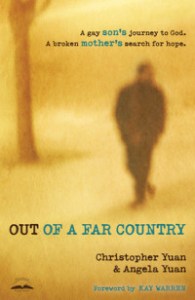
Book Review: Out of a Far Country: A Gay Son’s Journey to God. A Broken Mother’s Search for Hope

Far CountryI’ve been wanting to read Out of a Far Country: A Gay Son’s Journey to God. A Broken Mother’s Search for Hope by Christopher and Angela Yuan ever since seeing it recommended by Tim Challies, and I am glad to have finally done so. I’m predicting it will be one of my top ten books of the year.

Christopher and Angela take turns with the chapters, describing events from their different points of view. They open the book with Chris’s coming out to his parents that he was gay. Angela did not object on Biblical grounds: she was an atheist who hated Christians. I don’t think the book ever explains just why she was against his homosexuality, except that they had hoped he would follow in his father’s footsteps and become a dentist, and patients would probably avoid a dentist who had the potential to be HIV positive. Maybe it just didn’t fit in with her idea of a perfect family, but it was devastating to her.

Angela had come from an unhappy home and had put great stock into having a good family. But over the years her husband grew cold and distant, her oldest son rebelled, and now Christopher was going in a direction completely unacceptable to her.Β  She gave him an ultimatum between his family and his homosexuality, and, believing he had no choice in his orientation, he left home to be with friends who would accept him as he was. Angela crumpled to the ground in despair, feeling she had nothing left to live for. She made plans to end her own life, but wanted to talk to a minister first. Though he was kind, nothing really changed in her heart. He gave her a booklet which she later read, and her eyes were opened to the truth that her lifelong desire for belonging could be fulfilled in belonging to God. It was even a relief to know and admit that she was a sinner, that though she was far from perfect, God still loved her. “I had not been seeking God, but I was found by him” (p. 19).

Chris, for his part, was glad to get away from the “Chinese-mother guilt-trip drama” (p. 8). Coming out to one’s parents and the inevitable negative reaction was a rite of passage among his friends. He finally felt free to live as he wanted to. He “started going to gay clubs and began tending bar” (p. 23) at night while attending dental school during the day. Eventually the party scene took over his life. While feeling low after a broken relationship, he accepted someone’s offer of the drug Ecstasy, and within a very short time started selling drugs to support his own habit, then became a popular and leading seller in his area and even across the country. His schooling suffered to the point that he was eventually expelled, but it no longer mattered since he was making money hand over fist and enjoying life and popularity.

Until he was arrested.

During this time Angela had been growing in her own faith and her husband Leon had come to the Lord as well. At first she tried various things to get through to Chris but finally realized that she could not “fix” him. She could only fast, pray, show him love, and not shield him from the consequences of his actions. She and her husband did not intervene when Chris was threatened with expulsion from school and after he was arrested asked the judge to give him a sentence just long enough to bring him to God. Once after reading Psalm 46:1, “Be still, and know that I am God,” she knew “as hard as it was, I knew I had to quit striving and trying to make things work my way. But rather, I had to let God do things his way and in his timing” (p. 73). “It may have just been easier for us to give up on our son, but God said, Wait! He gave us faith to hope against all the evidence we saw and to trust he had a plan, Leon and I committed to focus not on hopelessness but on the promises of God” (p. 109). She “prayed specifically that God would do whatever it took to bring our son to him — not to us, not out of drugs, not out of homosexuality…but to the Father” (p. 159).

With Christopher’s arrest, his popularity vanished. None of his “friends” wanted any more to do with him. One day in prison, he saw a Gideon’s New Testament on top of some trash, and he took it back to his cell and began to read mainly just as a way to pass the time. Over time, both with reading the Bible on his own and studying it with others, Chris came to believe on Christ.

Being in prison had taken care of getting Chris off drugs and out of the party scene, and he came to admit they were both wrong and he needed to stay away from them once he got out. When he talked with a chaplain about his homosexuality, he was told that the Bible did not condemn homosexuality and gave Chris a book explaining that view. That sounded wonderful to Chris, but as he read the book and then studied the Bible, he felt the book did not line up with what the Bible taught. He did discover that in “Leviticus 18:22 and 20:13 — passages normally used to condemns gays and lesbians…God didn’t call lesbians and gay men abominations. He called it an abomination. What God condemned was the act, not the person. For so long, I had gotten the message from the Christian protestors at gay-pride parades that the God of the Bible hated people like me, because we were abominations. But after reading these passages, I saw that God didn’t hate me; nor was he condemning me to an inescapable destiny of torment. But rather, it was the sex he condemned, and yet he still wanted an intimate relationship with me” (p. 186). Being gay had been a major part of his identity, but as he continued to study the Scriptures, he “began to ask myself a different question: Who am I apart from my sexuality?” (p. 187). He details his thought processes and conclusions in a chapter called “Holy Sexuality.” One conclusion was:

God’s faithfulness is proved not by the elimination of hardships but by carrying us through them. Change is not the absence of struggles; change is the freedom to choose holiness in the midst of our struggles. I realized that the ultimate issue has to be that I yearn after God in total surrender and complete obedience (pp. 168-169).

This book touched me on so many levels. What a joy to see the journey of how God brought both Christopher and his parents to Himself.

Christopher’s testimony from a documentary is here:

You can read more of Christopher’s life and ministry at his web site, www.christopheryuan.com.

(This review will also be linked toΒ Semicolonβ€˜s Saturday Review of Books.)


Laudable Linkage

Forgive me for blogging about mostly books the last couple of weeks. I just happened to have finished several at once (a couple were really short), plus it has been a busy time, and somehow book reviews are easier for me to do than other posts where I am thinking through something. I do have a couple of the latter percolating on the back burner and hope to be able to finish them soon. Meanwhile, here is some interesting reading I’ve come across the last couple of weeks:

The Danger of Pet Sins.

Busy Bible Reading.

The Way Pinterest Makes Us Feel.

Two Ways to Ruin Your Relationship With the Giver. We hear a lot about the first one, but the second one is a problem, too.

11 Ways Mothers Change the World.

Why You Should Think Twice Before Badmouthing Obama. I am not a fan of the man but I cringe to see Christians calling him names when we are called to honor our authorities, even when we disagree with them.

Spurgeon on Christians Who Rail Against the Times.

Some of you might echo this sentiment:

praying for snow

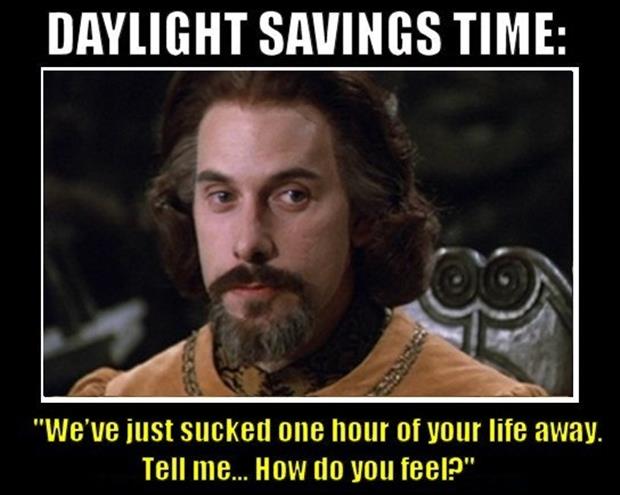
And finally, it is that time of year again…

Princess Bide daylight-savings-time

Some of you might recognize the character and the take-off from a quote in The Princess Bride. πŸ™‚ I do feel that way about Daylight Savings Time, though! And it seems earlier this year. Don’t forget to turn your clocks ahead tonight.

Two Books: I Deserve a Donut and Taste For Truth

DonutI first became aware of I Deserve a Donut (And Other Lies That Make You Eat) by Barb Raveling through my friend Kim. It originally started out as a list of questions and Bible verses Barb put together for her own use. When she shared some of it with a group of teenagers she was teaching, one suggested it should be an iPhone app. Since she had a son who created iPhone apps for a living, he helped her to do that. Then, realizing that not everyone has an iPhone, she put these truths into book form, both paperback and digital.

The study is based on Romans 12:2: “And be not conformed to this world: but be ye transformed by the renewing of your mind, that ye may prove what is that good, and acceptable, and perfect, will of God.” The book is divided up into reasons – or lies – that cause us to eat and different emotions that can lead us to eat. For example, under the first section are categories like Entitlement eating (“I deserve this”), Garbage Disposal Eating (“I don’t want this to go to waste”), Good Food Eating (“That looks good. I should eat it.”), and Social Eating (“She’s eating. I should eat.”) The next section lists just about every emotion that could lead you to eating, with the understanding that the problem there is not just eating for the wrong reasons, but dealing with the underlying emotions as well.

Then, after you look up whatever situation or emotion is causing you to want to eat, you’ll find a series of questions concerning that situation or emotion, a list of Bible verses, and some tips. For example, a couple of questions under Entitlement Eating are “What do you feel like eating? Why do you feel like you have a right to eat in this particular situation? Do you think God would agree with your outlook?” plus six more. There are about six Bible verses listed, among them Philippians 4:11: “Not that I speak in respect of want: for I have learned, in whatsoever state I am, therewith to be content.” There are about five short paragraphs of tips, including:

The best way to break free from entitlement eating is to adopt a biblical perspective of life. God never said, “You deserve the good life, and of course you have a right to eat.” Instead, He said, “If you want to follow me, you have to be willing to give up everything.”

TasteOfTruthTaste For Truth: A 30 Day Weight Loss Bible Study by Barb Raveling was one I saw recently again at my friend Kim‘s blog, and it works hand-in-glove with I Deserve a Donut (which is why I wanted to review them together.) They overlap a bit, but that is not a problem because renewing one’s mind takes place daily, reminding ourselves over and over of God’s truth, especially in response to the wrong thinking we’re prone to.

The first chapter talks about our part in making changes. I have the tendency to just ask God to change my thinking, which is necessary, but that’s just the starting place, not the stopping place. He has given us specific instructions, such as in II Corinthians 10:3-5 about casting down imaginations and bringing our thoughts into obedience to Christ, in John 8:31-32 about continuing in His Word, and of course Romans 12:2. One of my favorite quotes from the book comes from this section:

β€œThe Greek word for abide used in John 8: 31-32 and John 15: 4-5 is the same word that’s used for living in a house. The idea is that we don’t just visit the Word for 10 minutes a day. We live in the Word. Meditate on it. Chew on it as we walk through the day. Let it fill us and change the way we think about life. Let it fill us and change the way we think about our habits. AndΒ even let it fill us and change the way we think about ourselves” (pg. 11).

The rest of the chapters are Bible studies with a place to answer questions about various topics related to breaking control of the hold eating has on us, such as “I Hate Boundaries,” “The Anatomy of a Habit,” Is Overeating a Sin?,” “When You’re Not Losing Weight,” and “I. Need. Chocolate.”

Here are a few more quotes that stood out to me:

God is not all about “do what you want when you want.” On the contrary, God is all about “love me with all your heart, soul, mind, and strength.” One of the ways we love Him well is to hold His gifts with open hands, willing to give them up if they get in the way of loving Him (pp. 12-13).

(After discussing how a fence keeps children safe in a yard even though it limits them) That doesn’t mean the fence is bad. On the contrary, the fence makes their lives better because it protects them from harm. The same is true for us. Lifelong boundaries in the area of food make our lives better because they keep us safe. Yes, they cramp our style, but you know what? Our style needs to be cramped because there are consequences to eating what we want when we want (p. 13).

In many ways it’s like a home improvement project: You don’t know what you’re getting into. You uncover problems you didn’t know you had. You have to make multiple calls to your friend, the Carpenter, for help. And it usually takes longer than you think it will take (p. 61).

The renewing of the mind, like a home improvement project, is a taking off and putting on. You take off the old self. You put on the new self. You takes off the lies. You put on the truth. You take off a cultural perspective. You put on a Biblical perspective. You take off what you learned growing up. You put on what you learned in the Bible (p. 61).

Unfortunately, it will take more than one conversation to unlearn the lies we learned growing up. We learned those lies situation by situation, and I am afraid we’ll have to unlearn them the same way (p. 62).

I found both of these books very helpful and very convicting. I appreciate Barb’s matter-of-fact style. She assures that our thinking can and will change over time as we renew our minds, though the same temptations can come up again any time and we need to keep bringing our thoughts captive to God’s truth.

My friend Kim is taking the study very slowly, taking more than one day for each lesson so as to savor and steep in the truths there. That is probably the better way to go. I tended to get to the end of one lesson, see the title of the next one, and think, “Oh! I need that, too,” and I’d sometimes do two in a day – maybe even three on a few days. But I knew that no matter how slowly or quickly I went through the lessons, I was still going to have to go over and over them once I finished. Sometimes I tend to get to the end of a book, or even a word study like some I have done on anger and fear, and think, “There! Done!” But going through those truths once doesn’t renew our minds: we need to bring them to bear on our thinking often.

Barb has applied this same process of questions and Bible verses to other areas of her life, particularly procrastination. I am thinking of doing the same – just this morning I was struggling with a particular area of thinking and reminding myself of God’s truth pertaining to the matter, and thought I should probably write these out both for my own instruction and to have them as a ready reference next time it comes up.

(This review will also be linked toΒ Semicolonβ€˜s Saturday Review of Books.)

Book Review: Better To Be Broken

Better_to_Be_BrokenBetter to Be Broken is the testimony of Rick Huntress. The book opens with a horrific accident: while on a training mission on an Air Reserve base in GA, the locking system for the two-ton cargo bay door of an airplane where Rick was supervising a cargo load failed, and the door came crashing onto his head, shattering three vertebrae which severed his spinal cord, leaving him a paraplegic.

The next chapter goes back to Rick’s previous life. He had accepted Christ as his Savior at a young age, but early on he loved “praise and accolades.” “Because I had no understanding at that age where my gifts came from, the deadly sin of pride thrived in fertile soil…It made me think I was something special, and that attitude only served later to alienate me from my peers.” He developed a drive to be on top, out front, well thought of, and so he hid his personal weaknesses and his real self. He served in the Air Force, married, attended college, and started a good job all with the same mentality. After a while things began to deteriorate, especially in his marriage.

The next chapter picks back up to the time right after the accident and the ensuing weeks in a hospital. Between pain, drugs, confusion, and fear, finally his walls started breaking down. He tells not only of the progress in his condition but also the progress in his soul as he began to face reality.

I wouldn’t say that God caused my accident to happen, but He did allow it to happen. During the weeks after my surgery, as my body was physically healing, God knew that what I needed most was spiritual healing. That could only be accomplished by His direct hand. He brought me to a place in which rescue was possible only by complete trust in Him. It had been so long since I had trusted in Him that I had forgotten how. But from the moment of the accident, the journey had begun.

Verse 17 of Psalm 51 says, “The sacrifices of God are a broken spirit: a broken and a contrite heart, O God, thou with not despise.” I, too, was broken, and it was the best thing that ever happened to me. My broken back is a blessing from God. He used it to bring me back to Himself. I have heard it said, “God sometimes puts us flat on our back, so we can learn to look up at Him.” That certainly was true for me.

Rick continues to tell of physical and mental adjustments once he was well enough to go home, adjustments to the house, to life in a wheelchair, to not being able to do what he always did. It was hard to navigate the “new normal.” But eventually he came to peace with the differences and found new ways to serve, especially ministering to others in similar circumstances. He once even organized a memorable trip to Israel for several disabled people.

Rick concludes, “If it took a wheelchair for me to have a close relationship with my heavenly Father, then I would choose it all again” and “This is not a sob story about my broken body, it is my sincere attempt to give God the glory for breaking my stubborn will. It is the best thing that ever happened to me.”

Though I winced at several of the things Rick had to go through, I was greatly blessed and challenged by his story, and I highly recommend it to you.

(This review will also be linked toΒ Semicolonβ€˜s Saturday Review of Books.)

Laudable Linkage

It has been almost a month since I’ve shared links that I have found interesting for one reason for another, so I hope you’ll forgive a longer list this time, and I hope you find something of interest among them:

Twenty-One Grains of Wheat. A must-read about the 21 people killed by ISIS.

An Extraordinary Skill for Ordinary Christians. Ways any of us can minister to others.

How to Make the Most of Your Bible Study.

Intimacy or Familiarity. Sometimes it is good to read large portions of the Bible to get the overall view, sometimes it is good to hone in on a smaller passage for a longer time. Love the truth that Bible study doesn’t have to be either/or, but that we need both.

23 Things That Love Is.

What My 9-Year-Old Taught Me About Being Willing to Follow God Into Uncomfortable Places.

How to Spot Mean Girls at Church, and How Not To Be One.

When To Overlook a Fault. This is something I’ve struggled with – when to confront and when to overlook.

When Pain Enters, HT to Lisa. Setting aside the Calvinist/non-Calvinist arguments over which so many disagree, there are some good thoughts from one in pain about how God uses it.

Praying For Adult Children.

Spurgeon on Christians Who Rail Against the Times. HT to Challies. Of course we observe the times and interpret them in light of what the Bible has to say, but I do get frustrated with those Christians whose constant theme is harping about how bad the times are. Evidently there were those even in Spurgeon’s day. I love what he had to say: “What have you and I to do with the times, except to serve God in them?” “We must not be β€œWoe! Woe!” Christians. We must be β€œGrace! Grace!” Christians.”

Gentle Fiction: What It Is and Why I Write It. I had never heard the term “gentle fiction” before, but it perfectly describes the kinds of books I most like to read.

Forty Portraits in Forty Years, HT to Challies. One photographer took a photo of four sisters once a year over 40 years. Fascinating to see the progression.

Adding Beauty. Love this philosophy of decorating and making home “homey.”

Why Missionaries Hate Airports from my real-life friend and missionary, Lou Ann. I always love glimpses into aspects of missionary life that we might not have thought of or realized.

Dear Moms: It’s OK to Be Unremarkable. Nothing wrong with gleaning neat ideas from Pinterest, posting pictures on Facebook, or making 3-layer cakes, but the point is well-made that we don’t need to “compete” in all these areas.

Are You Too Sensitive?

Six Reasons Your Husband May Not Like Your Women’s Group.

Dear Mom…Worried About Your Daughter’s Reading Material?

Emotional Vertigo.

7 Principles of Sabbath Rest.

God Makes One Baby Boy “Different” To Save Hundreds of Others.

And in the “You think YOU’VE got snow” category, Kathie, one of my FFF friends in Prince Edward Isle, showed 16-foot snow banks in her area and shared this funny clip:

Too much snow for me!

Hope you have a great day!


How Not to Become an Old Biddy

Crabby-Old-Lady

After I was married but before I had children, I worked for some years at a fabric shop. We had a variety of customers of all ages, but some of the ones that stood out to me were the older ladies. Some were very sweet. I remember one, after I had spent a great deal of time helping her (to choose some buttons, if I remember correctly), saying, “You’ve been so kind – here, let me buy you a cocoa” while she put some change on the counter. I don’t remember what I did in response: I remember thinking I probably shouldn’t take her money, but I didn’t want to offend her, either.

On the other hand, other older ladies were…cantankerous, to put it nicely. Really, all customers could fit into either of these categories, but somehow they seemed sharper and more focused in old age.

I remember thinking that I hoped when I became an old lady, I’d be one of the nicer ones. Then, of course, it dawned on me that I was in the process of becoming the kind of older lady I would be, and I needed to start working on that now.

Now I am in my “middle years,” but with “old age” looming some time in the future (when exactly it starts keeps getting pushed back further and further πŸ™‚ ), I’ve started to think in a more concentrated manner about becoming the right kind of older lady. So I thought I’d preach to myself a little bit in preparation. You’re welcome to read along. Keep in mind I am preaching to myself, not older ladies – that’s not my place.

Avoiding the wrong kind of old age:

Having a know-it-all attitude. Years and experience can provide more wisdom, but we should never get to the place where we can’t humbly receive what someone else has to say.

“The way we always did it” syndrome. Every new generation brings with it new vocabulary, new technology, new methods. Older people can help younger ones discern between new methods and old truth and try to keep the latter from sliding into oblivion, but we shouldn’t insist that everything be done the way we always did it (or gripe when it isn’t).

Being busybodies. Many years ago, an older lady in our church at the time told one young mom of seven that she was having too many children too close together, and another young married lady, who with her husband wanted to wait until he was out of school before starting a family, that she needed to get busy and start having children. You can imagine that both women were hurt and offended. I am sure that was not the older woman’s intent and that she thought she was helping others with the benefit of her accumulated wisdom, but she overstepped. Before sharing advice, we really need to seek the Lord about whether it is really needed and how and when it should be shared.

Being quick to judge.

Gossiping.

Impatience. You would think a person would increase in patience over the years, but I have not found that to be the case for myself. This is one area I know I especially need to work on.

Forgetting what it is like to be young, to have small children. etc.

Sharp words.

Being caught up in our physical issues. I have mixed emotions about this one. One does start having more physical issues the older one gets, and we shouldn’t expect older people to try to cover that up: we need to listen and empathize. We know how we feel now when we’re ill or hurting for a few days or weeks: imagine if that was the norm and not the occasional occurrence. On the other hand, if I expand my horizons a little bit, it will probably help my own outlook as well as give me something else to talk about.

Developing into the right kind of old age.

Keep in the Word of God. If you’ve read it through several times during your life, you may feel like you’ve got it all down. But we always have room to learn and grow spiritually: we always need fresh communion with our heavenly Father.

Take an interest in others. One serious problem for older people in our churches, as they wane in energy or start having physical problems and can’t attend as often, is that we tend to forget them. Or we hope they’re doing ok but neglect taking the time to make contact, especially if they don’t have e-mail or aren’t on Facebook where we can do so easily. As we age we may get to a place where we can’t contact others, but until then, as much as possible we can take the initiative to make a phone call or send a note.

Look for ways to serve others. You may not be able to head VBS or organize a banquet or serve in the ways you used to, but you can look for ways you can serve in your present capacity.

Don’t stop learning and growing.

Come to terms with a failing body. I don’t mean that we stop taking care of ourselves, but we realize that our physical bodies come with a limited shelf life. Years ago I heard a radio preacher say that one reason God lets our bodies start failing us as we get older is to make us more willing to give them up when the time comes. Each aging problem is a reminder that I won’t live on this earth forever, and I need to be prepared for eternity.

Don’t be bitter. People have failed us and will continue to. “Let all bitterness, and wrath, and anger, and clamour, and evil speaking, be put away from you, with all malice:Β And be ye kind one to another, tenderhearted, forgiving one another, even as God for Christ’s sake hath forgiven you.” (Ephesians 4:31-32).

Seek God’s will and wisdom in sharing advice. The Bible does say one thing older women are supposed to do is teach the younger (Titus 2:3-5), but it’s not always easy to know how to go about it. Dispensing unwanted advice right and left is not usually received well, especially, when it is done with harshness and impatience and a superior attitude. We need to pray much and be sensitive to the Holy Spirit’s leading in speaking to others.

Remember God has a purpose for your being here. I’ve heard older women wonder why they are still here when many of their loved ones have passed on and they can’t do much any more. Perhaps God wants you to minister in prayer for others or to be a godly example in your circumstances: perhaps He want to bless and grow others as they care for you.

Throughout my life, from my teens until now, God has placed older women at the stage just ahead of where I am whose example I can learn from. From single college girls to young wives to young parents to parents of older kids and then teens, and now facing the almost empty nest years and “middle age,” I’ve had godly examples to look to. I was inspired by one older lady where we used to live who was put into a frustrating situation of having to retire earlier than expected from a job she loved. She could have become bitter at the situation, but she came to terms with it and went on to find other ways to serve. I watched her make a point to welcome new people at church and invite them to sit with her, have other women two or three at a time over to her house for lunch, and visit with a couple of ladies in assisted living a few times a month. A couple of older ladies in our church now are consistently cheerful and take an active interest in others. One writes notes to my mother-in-law and gets together regularly with another older lady (neither of them drives, but the daughter of one takes them to a restaurant and then picks them up when they’re done).

My own mother-in-law has been a great example to me. I used to say I wanted to live until I was 100: after seeing what she has gone through in the last several years, I’ve amended that to “I want to live until I’m 100 if I can live in my own home, go to the bathroom by myself, and take care of myself.” I hope that will be the case, but God may allow something different in my life as He has in hers. So often when we’re changing her or positioning her or giving her a shower, I think, “You know, I would hate this – I would hate having other people have to handle me and take care of my most intimate needs and not be able to do anything for myself.” She probably would have felt the same way: everyone wants to be able to take care of themselves. But now that she is in this situation, she doesn’t complain (except maybe when our hands are too cold or when we have to wash a contracted hand that hurts) and is usually upbeat and cheerful. She thanks us for the least little thing we do for her. I remind myself that God gives grace for what we need when we need it: I don’t have the grace for old age now, but whatever situation God puts me in at that time, He will provide the grace then for it.

The Bible does have specific instruction for older women:

The aged women likewise, that they be in behaviour as becometh holiness, not false accusers, not given to much wine, teachers of good things;Β That they may teach the young women to be sober, to love their husbands, to love their children,Β To be discreet, chaste, keepers at home, good, obedient to their own husbands, that the word of God be not blasphemed. Titus 2:3-5

A godly example of an older lady is found in I Timothy 3:9b-10:

…having been the wife of one man.Β Well reported of for good works; if she have brought up children, if she have lodged strangers, if she have washed the saints’ feet, if she have relieved the afflicted, if she have diligently followed every good work.

Some of the older women in the Bible that stand out to me are Elisabeth, Mary’s cousin; Anna, who served God in the temple and told others about the coming Messiah; Lois, Timothy’s grandmother, whose “unfeigned faith,” along with that of his mother Eunice, surely influenced him.

And there is specific encouragement for that time of life:

Cast me not off in the time of old age; forsake me not when my strength faileth. Psalm 71:9

Those that be planted in the house of the Lord shall flourish in the courts of our God.Β They shall still bring forth fruit in old age; they shall be fat and flourishing;Β To shew that the Lord is upright: he is my rock, and there is no unrighteousness in him. Psalm 92:13-15

And even to your old age I am he; and even to hoar hairs will I carry you: I have made, and I will bear; even I will carry, and will deliver you.Β  Isaiah 46:4

Can you think of any other truths we need to keep in mind for our old age? Have you had any godly examples of older ladies in your life?

Book Review: Becoming More Than a Good Bible Study Girl

LysaA few years ago I served a very brief stint as a book reviewer for a particular publisher. I love to read and love to talk about books, so what could be better than being given books for FREE to review, right? But the publisher sent me six books at a time every month. They didn’t expect me to read and review all six every month, but still – I didn’t want reviewing for a publisher to take over my reading time, so I dropped out. One of the books I received for review during that time was Becoming More Than a Good Bible Study Girl by Lysa TerKeurst. I don’t think I had heard of Lysa before that time (since then I have read two of her other books), but this title caught my eye. I determined to read it “sometime,” and it got put in a box of unread books all awaiting the opportunity to see the light of day. I did get it out at one point and put it on a bookshelf – but still didn’t get to it. That’s one reason the TBR Challenge is good for me. At any rate, the copy I have is an advanced reader copy from 2009 (ahem…blush!), and on the back it says it is an “uncorrected proof,”Β  so it may beΒ  a bit different in places from the version you can buy today. But the bulk of it should be the same.

When I first saw this book, I thought it was going to be about getting more from one’s Bible study. Though Lysa does discuss that in a couple of chapters, the overall purpose of the book is to move Bible study from our to-do list and just acquiring knowledge, to living out what God is teaching us, to enjoy a deeper connection with God.

Lysa says in the first chapter:

I want my life with Jesus to be fulfilling. I want my beliefs to work no matter what life throws at me. I want to be so certain of God’s presence that I never feel like I have to face anything in my own strength or rely on my own perspectives. My strength will weaken during hard times. My perspectives get skewed by my emotions.

I want total security no matter what happens. In other words, I want my relationship with Jesus to be enough to keep me sane and together and still fully devoted. Is this possible? True fulfillment no matter what?

Fulfillment means to be completely satisfied. How might our lives look if we were so filled with God’s truths we could let go of the pain of our past, not get tripped up by the troubles of today, or consumed by worries about tomorrow?…Just going through the motions [of prayer, Bible study, etc.] will not in and of themselves fill our souls. They must be done with the great expectation and heart cry for God to lead us into a deeper and more life-changing connection with Him (p. 25).

The rest of the book fleshes out that purpose, discussing being “good enough” (and how we aren’t except through Christ), not feeling like we measure up, our relationships, our thoughts, our ministries, when our “ugly comes out,” when we’re hurt or offended by God.

A few more quotes I noted:

“Why doesn’t Jesus work for me?” is never the right question. Instead, when circumstances shift and we feel like we fall short, we should ask, “How can I see Jesus even in this?” (p. 41).

Don’t we get into God’s Word so it can get into us? So that it can interrupt us, change us, satisfy us? How sad to simply settle for learning facts about the Bible when it was meant for so much more (p. 74).

Just because you…achieve what you always thought would make you feel special does not fix that deep-down internal insecurity. External achievement never equals internal acceptance (pp. 86-87).

Too many of us live with an uncontrolled thought life. It is possible to learn to identify destructive thoughts and make wiser choices. Instead of letting those thoughts rumble freely about in my mind, I make the choice to harness them and direct them toward truth (pp. 99-100).

Grace doesn’t give me a free pass to act out how I feel, with no regard to His commands. Rather, His grace gives me consolation in the moment, with a challenge to learn from this situation and become more mature in the future (p. 123).

Satan would love for us to pick ourselves apart, to obsess on the negative. When we do, we become hyper self-focused and take our eyes off of Jesus and the mission set before us. Many of us spend years trying to hide or fix what we perceive as personal flaws. Jesus would love for us to see ourselves as a package deal of unique qualities that He – the author and perfecter of our faith – saw as necessary for the life He’s calling us to live (p. 164). (She’s not talking here about not confessing sin: she discusses that in other places, but here she is referring to accepting how God made us).

Ask Jesus to help you fully understand the joys of obedience. Also, ask Him how you can be a woman fully committed to obedience without slipping into a legalistic approach to life. We must always remember our goal is pursuing revelations of Him. Our focus can’t be just following rules but following Jesus Himself (pp. 174-175).

I realized that most times it’s not the big things along my spiritual journey that tempt me to get off track. It’s a culmination of small daily aggravations I know God could fix but doesn’t. But what if instead of seeing these aggravations as inconveniences, I saw them as reminders to draw near to God? (p. 197).

How I long never to diminish God by loving lesser things. Rather, I want to make much of God by diminishing lesser things. May I make less of me, less of this world, less of the temporary…so that I may be a vessel more full of God, more full of eternal perspectives, more full of His everlasting! (p. 200).

Having a set of goals is a good thing for many people. But when a goal takes your focus off God and His daily intentions for you, it can cause trouble. Being driven by my plans can shift the focus of my heart from following God and being open to His unfolding invitations, to following only that which leads me closer to my desires. For me, I started falling into a trap of making plans each day around what I wanted to see happen. Anything that wasn’t part of my plan became a distraction and an unwelcome interruption (p. 211).

I have many more marked but should probably stop there. I particularly liked the chapters “Beyond Sunday Morning,” where she talks about looking at a verse phrase by phrase to discern its meaning, and “Unlikely Lessons From a Pineapple,” a great chapter talking about drawing lessons from the lives of people in the Bible, even familiar ones that we might feel we’ve known all there is to know since we were children.

I was especially blessed by a chapter where she talks about waiting for God’s timing in our calling and serving Him in the mundane, everyday tasks He has placed before us until then, realizing that they are our ministry unto Him, not a hindrance or interruption of our ministry. I came to that chapter the day after posting The Back Burner, which is along a similar vein, and was touched at God’s timing and confirmation of the truths He had been teaching me.

I appreciated Lysa’s personal experiences, transparency, and sense of humor throughout the book, but most of all I appreciated her high view of Scripture that was not an end in itself but a means of knowing and experiencing God.

There were just 2-3 minor places where I disagreed with her interpretation or application just a smidgen, but they’re not big enough to go into. I would just mention one place where, in communion with God, things were flooding her mind that she felt were from the Lord, she says, “Bits and pieces of Scripture were woven throughout, and it made me smile. It confirmed that this was, in fact, God speaking” (p. 197-198). Satan uses Scripture, too (Matthew 4), and just because thoughts come to our minds that contain Scripture doesn’t mean they are automatically from the Lord. A lot of cults have been founded on bits of Scripture wrongly interpreted and taken out of context. I’m not trying to diminish the experience she was telling about, and I feel sure she’d agree with what I am saying, but just the way it was phrased could, I thought, be confusing to some readers who might think that if a thought contained Scripture, that meant it was confirmation from the Lord.

Overall I thought this was a wonderful book that fulfilled its purpose to encourage women to go beyond checking the boxes in their Christian lives to deepening their relationship with God.


(This will also be linked toΒ Semicolonβ€˜s Saturday Review of Books.)

Repost: The Back Burner

I’ve had some other obligations this week that have taken much of my computer time: I’ve been thinking about and working on some other posts, but they need to incubate a while longer. Meanwhile, this morning this post came back to mind, and I thought I’d share it again. Sometimes I chafe that there are still things on the back burner that I thought I’d be able to get to when my children got older. I have to accept that the circumstances God has me in are His will for me now, and if those other desires are truly from Him, He’ll make a way for them in His time. So even though the major thrust of this article has to do with parenting, it applies in any area where God wants us to wait on His timing.

This is one of the few articles I’ve had published. It appeared in Frontline magazine’s July-August 2005 issue. I wrote to Frontline asking permission to reprint the article here in January of 2008, which they granted: I am going to assume that permission extends to this repost as well.

IMG_1031

The Back Burner

Every mother, particularly one who has very small children, can get discouraged sometimes. Even though a woman has looked forward to being a mother all her life and delights in her child, there are those days when she feels she is accomplishing nothing beyond wiping noses and changing diapers, when she feels her mind is turning to mush after reading Dr. Seuss and Curious George all day, when she longs to do something β€œimportant.” Certain intellectual and creative pursuits have to be put on the back burner because there are only so many hours in the day. Even some ministry opportunities have to wait until the children are a bit older. It is easy to lament what we can’t do.

Of course, young mothers are not the only ones who have to put things on the back burner. Newlyweds, new teachers, students, young singles getting started in a career, middle-aged children taking care of an elderly parent, and any number of other life situations will cause us to have to focus on the business at hand and delay other pursuits. But motherhood is the area through which the Lord taught me about the back burner.

Some 15-20 years ago I read something in a secular women’s magazine that greatly encouraged me and has stayed with me ever since. Unfortunately, I can’t remember even what magazine it was, much less what author. The writer was talking those things that have to be put on the back burner. But, she wrote, what is usually on the back burner when we are cooking? Isn’t it something that has to simmer awhile, that is all the richer in flavor for the time it spent there on the back burner? The meat gets tender, the flavors blend, the smell wafts though the house, and we can hardly wait until dinnertime.

Oh, dear mother….what you are doing is vitally important. Your little one may not remember the specific things you did together or all your loving care in their early childhood, but those loving ministrations laid the foundation for your future relationship. The time you spend together reading, playing, rocking, feeding, nurturing a new little life that God has given to you to care for is precious.

As the children get older, their need of your care is still vital, though it is different from when they were small. Instead of feeling isolated at home, you may feel you are nearly living out of your car with all the places you have to take your children to. We have to keep a balance between giving them opportunities and spreading everyone too thin, but some of those times in the car can be precious as well. One of my sons does not open up to me if I sit across the table from him and ask him how things are going in his life, but a casual conversation or observation made while we are out and about can give me glimpses into his heart. Sometimes children feel a little freer to open up while we’re driving.

Someone once said, β€œWith children, the days are long, but the years are short.” That is all too true. You have heard it before, but they do grow up so fast. You always have a ministry with them and an influence on them, but your main years of training them are when they are little. Redeem the time and enjoy it to the hilt.

Don’t worry about those things on the back burner. Give them a stir every now and then. Perhaps you can skim over the newspaper headlines or watch some of the evening news with your husband, or spend 15 minutes or so a day reading a good book to stimulate your mind. Buy a craft kit, take a class, jot down story ideas, or somehow β€œstir the pot” of whatever your areas of interest are. Take advantage of opportunities to get together with other ladies for fellowship. Explore what ministry opportunities you can within the constraints of your situation, but remember that ministry doesn’t only take place within the four walls of the church: getting to know your neighbor, inviting another mother from the baseball league to church, baby-sitting for another mother for a doctor’s appointment, giving a tract to the repairman are all outlets through which the Lord can use you as well as being an example to your children.

Then, as you stir those things on the back burner from time to time, perhaps you can take a small taste to test the readiness of it. After all, if you start to write the next great novel, and find the timing still isn’t right, you can let it simmer a little longer.

Don’t get discouraged if other women seem to have all their burners going at once, accomplishing things right and left. I used to lament that I couldn’t do as much as some other ladies til I finally had to come to grips with the fact that God made us with different capacities, abilities, and personalities.

Ultimately we have to entrust those back burner issues to our loving Lord and ask His guidance as to when and how to proceed with them. There may be some things He wants us to relinquish completely, and here our back burner analogy breaks down: there are some things He never intended for us to pursue, and we have to set aside what was a personal desire that was not His will. We have to remind ourselves that, no matter how strong and even good a desire was, if it is not God’s will, it would not have been good for us and may actually have been harmful and taken away from what He did have for us to do. On the other hand, we can’t let the back burner become a place of excuses and, due to laziness or fear, place things there that the Lord does want us to pursue now. How can we know the difference? By walking with him day by day, seeking His guidance, asking Him to open doors He wants open and close doors He wants closed. When it is His timing to finally serve one of those β€œback burner” dishes, it will indeed be β€œjust right.”