Laudable Linkage

Here are some reads that piqued my interest this week: you might find some of them beneficial as well.

We Must Believe. A good explanation of what exactly it means to believe on Christ for salvation.

6 Reasons Women Should Study Theology.

Mentoring 101, HT to Challies.

Emotional Control.

What a Pastor Wants From the Music Ministry.

The Books Boomers Will Never Read.

Read Slowly to Benefit Your Brain and Cut Stress.

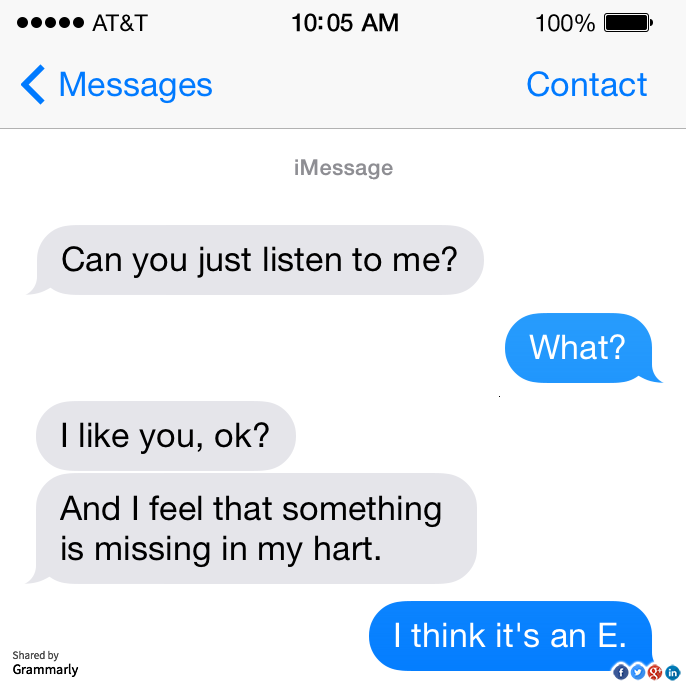
And this from a Facebook friend brought a smile:

The E

Hope you have a great day!

Laudable Linkage

It’s been a couple of weeks since I have been able to share some interesting reads with you. Here are some standouts from my recent web reading:

The Memorial Service of Tom Craig, Our Pastor. Brad is a member of our church who has been chronicling the journey of our pastor and church every week since our pastor’s cancer diagnosis, and here he describes the events on the day of his memorial service as well as the service itself. Our church originally had a fundraiser that had been scheduled that morning weeks before, and there was much discussion about whether to postpone it since the funeral was scheduled for the same day. Thankfully they decided to go ahead with it, but that’s what the description of the run and bike rides are about. A recording of the memorial service is here.

Losing the Language. Apt analogy about getting away from church and the things of the Lord.

10 Ways to Exercise Christlike Headship, HT to Challies.

What People Who Are New to Your Church Want to Know.

To the Girls in the Pew Ahead of Me.

That Day I Wore Yoga Pants: 5 Myths About Modesty. Most posts/articles/books about modesty tend to lean either toward the woman’s responsibility to watch how she dresses so as not to cause others to stumble or the man’s responsibility to guard his eyes and heart. I thought this one was nicely balanced.

A list of things you may not have known about paralysis from a fellow TMer.

5 Things You Must Do To Protect Yourself Online.

10 Things I’ve Learned After 30+ Years and 70+ Books.

Dear Pinterest, We Need to Have a Talk About Bookshelves. Loved this fun, incredulous look at how people decorate their bookshelves with something other than the best thing: books.

I Quit Liking Things on Facebook For Two Weeks, HT to Kim, shows how what we click that we “like” affects what we see there. I’m not going to quit using the like button, but I am conscious that whatever I “like” feeds into algorithms to give me more of the same.

My friend Lou Ann sent out a survey to readers about decluttering and has posted a series about the results. My favorites are Finding Balance in Decluttering (it’s so easy to get off-balance even in good things) and Disadvantages of Decluttering (did you know there were some? There are! Or at least can be), probably because I rarely see anyone discussing those aspects. Other posts in the series are Advantages of Decluttering and Systems for Decluttering.

I think I have shared this before, but if you haven’t seen it, it’s the story of the pilot who was originally scheduled to fly one of the planes that was highjacked on 9/11:

Absent From the Body, Present With the Lord

My pastor, who has been battling pancreatic cancer the last few months, passed away last night.

It’s been hard to know how to pray the last few weeks as we’ve seen the effects of cancer continually decimate his body. We wanted him to have as many days with his family as possible, but we didn’t want him to have to suffer any more than necessary. My youngest son has frequently prayed that Pastor “would have as many good days as possible,” which I thought was probably the best way to pray in addition to asking for God’s will and grace for him and his family and all those who loved him.

As people arrived for prayer meeting last night, a few men were stationed at the church doors and would go out to greet people individually as they approached the building to let them know Pastor had passed away just a short time before. That was probably the best way to handle it rather than waiting for everyone to come in and then starting the evening with a shock moment, or having someone who didn’t know accidentally overhear it mentioned in the conversation of someone who did. This way everyone had a moment to react, absorb the news, and collect their thoughts for a moment before going in, and we could start the service more or less on the same page. One of our assistant pastors led us in singing a song Pastor Tom had requested often lately, “O The Deep, Deep Love.” Another of our men shared some Scripture, someone prayed, people in the congregation were given opportunity to  share Scripture that was comforting to them, we broke up into smaller groups to pray, and we sang “O The Deep, Deep Love” one more time.

O the deep, deep love of Jesus, vast, unmeasured, boundless, free!
Rolling as a mighty ocean in its fullness over me!
Underneath me, all around me, is the current of Thy love
Leading onward, leading homeward to Thy glorious rest above!

The comforting and sharing have continued through the night and into this morning on Facebook. It has been a great blessing to me, and I am sure to many others, as we’ve shared with each other through this journey, particularly in the last several hours. This extension of community has been both comforting and edifying as I’ve seen photos and read various thoughts, memories, Scriptures, and bits of song that people have shared.

I’ve only known Pastor Tom for four years. Two main things stand out to me about himself as a person and his ministry. One, he continually led (even gently pushed) us to be deeply grounded in the Bible and in our relationship to God: to see Him in the Scriptures, not to “surface” read the Bible or pray in cliches. He constantly encouraged us to make it real and make it deep. Secondly, he had a true pastor’s heart. He deeply cared for his people, would be with them through any trial as much as he could. When we came forward at the end of a service to join the church, my mother-in-law was with us in her wheelchair. He got down on one knee to speak to her face to face and tell her how he wanted to be her pastor. When my husband was facing his kidney surgery (they joked about being in the “one kidney club” – Pastor also had a kidney removed when he was younger), we had told him that I’d probably be more comfortable getting lost in a book while waiting than having someone outside the family with me – then I’d feel pressured to keep a conversation going. He understood. But he showed up at the hospital in the early hours just as we arrived and signed in, and we had a few minutes to chat and pray before we were called back. That meant a lot to both of us.

Two verses came to mind as we shared during prayer meeting last night. One was shared with me when my mother passed away and it ministered to me greatly then: Psalm 119:76: “Let, I pray thee, thy merciful kindness be for my comfort, according to thy word unto thy servant.” This, among other things, is what I pray for Pastor Tom’s family. I am so thankful he was able to walk his two older daughters down the aisle at their weddings this summer and that they were all able to be there when he passed. Though we “sorrow not, even as others which have no hope” (I Thessalonians 4:13), we do sorrow, “Sorrowing most of all …that they should see his face no more” (Acts 20:38) until we join him there. I know I felt it was much too soon when my mother passed away in her 60s: I can imagine that feeling is even more magnified when a father and husband passes away in his early 50s. Even trusting that this is God’s will and plan and rejoicing that he is with his Savior and out of pain, it still hurts in a way that only God can heal. Death is called an enemy (I Corinthians 15:26), and though its sting is removed and it’s “swallowed up in victory” (I Corinthians 15:54-57), grief is wrenching, and I pray for His special kindness and comfort for them and our church in the days and months to come.

The second was the verse I did share last night: not long before His own death, Jesus prayed, “Father, I will that they also, whom thou hast given me, be with me where I am; that they may behold my glory, which thou hast given me: for thou lovedst me before the foundation of the world” (John 17:24). That’s where Pastor Tom is now – with Him who loved him since before he was even born, where he is, beholding His glory. Though we miss him, we rejoice and look forward to joining him there.

Craigs

I once scorned ev’ry fearful thought of death,
When it was but the end of pulse and breath,
But now my eyes have seen that past the pain
There is a world that’s waiting to be claimed.
Earthmaker, Holy, let me now depart,
For living’s such a temporary art.
And dying is but getting dressed for God,
Our graves are merely doorways cut in sod.

 Calvin Miller

When you sailors see the haven before you, though you were mightily troubled before you could see any land, yet when you come near the shore and can see a certain land-mark, that contents you greatly. A godly man in the midst of the waves and storms that he meets with can see the glory of heaven before him and so contents himself. One drop of the sweetness of heaven is enough to take away all the sourness and bitterness of all the afflictions in the world. ~ Jeremiah Burroughs

Book Review: Seeking Allah, Finding Jesus

SeekingIn Seeking Allah, Finding Jesus: A Devout Muslim Encounters Christianity Nabeel Qureshi first gives a window into a loving and devout Muslim home, with all its practices, disciplines, and teachings, as well as a peek into the perspective of growing up Muslim in a non-Muslim culture.  Wanting to be a faithful representative of Islam, having been taught critical thinking in school and having a mind geared for it, he often turned the arguments of some of his Christian classmates on their heads, bringing up aspects they had not thought about before and were not ready to defend.

In college God brought to him “an intelligent, uncompromising, Non-Muslim friend who would be willing to challenge” him, someone who was “bold and stubborn enough” to deal with him but also someone he could trust “enough to dialogue…about the things that mattered to [him] the most.” Nabeel and his friend, David, were both on the forensics team and knew how to get to the heart of an argument and draw out and refute key points. For the most part they did this with each other’s worldviews good-naturedly, but when a given topic became too heated, they’d table it for a while. Muslims particularly have trouble with the reliability of the Bible, the deity of Christ, the Trinity, and the connection between Christ’s death on the cross and how it atoned for others’ sins. For three years Nabeel studied the Bible and its claims and others’ claims about it, fully confident that he’d be able to disprove those claims, and then to study the history of Mohamed and the claims of the Quran, fully confident that Islam would be justified. Though he was obviously biased toward the Quran, he really wanted to know the truth. He discovered the Bible’s claims were justified and Islam’s to be on shaky ground.

For some time he resisted acting on this knowledge. Being a Muslim was a matter of identity as well as religion: his whole life, everything he had always believed, his relationship with his family and community, everything would be turned upside down if he became a Christian. Yet he could not continue on, knowing what he now knew. In one of the most beautiful and touching passages in the book, he was seeking time to mourn before making the decision he knew he had to, and he opened the Bible for guidance this time, not simply to look for information to refute. He came to Matthew 5:4, 6:

Blessed are they that mourn: for they shall be comforted.

 Blessed are they which do hunger and thirst after righteousness: for they shall be filled.

Nabeel writes further:

There are costs Muslims must calculate when considering the gospel: losing the relationships they have built in this life, potentially losing this life, and if they are wrong, losing their afterlife. It is no understatement to say that Muslims often risk everything to embrace the cross.

But then again, it is the cross. There is a reason Jesus said, “Whoever wants to be my disciple must deny themselves and take up their cross and follow me. For whoever wants to save their life will lose it, but whoever loses their life for me and for the gospel will save it” (Mark 8:34-35).

Would it be worth it to pick up my cross and be crucified next to Jesus? If He is not God, then, no. Lose everything I love to worship a false God? A million times over, no!

But if He is God, then yes. Being forever bonded to my Lord by suffering alongside Him? A million times over, yes!

All suffering is worth it to follow Jesus. He is that amazing.

I feel I must comment on one aspect of the story that I questioned at first and I am sure other readers might as well: When Nabeel mentioned early on being “called to Jesus through visions and dreams,” I admit I inwardly winced and wondered what kind of story I’d be reading. For reasons too long to go into here, I am of those who believe that once God gave us His completed Word in writing, then dreams, visions, tongues, and the like fell away as unneeded.  The few modern instances I have ever heard or read of that seemed most in line with Bible truth were in cultures which didn’t have the Bible, often didn’t have a written language at all. Another problem with relying on dreams Nabeel discovered himself: one questions what it really means (his Muslim mother and Christian friend had completely opposite interpretations for what Nabeel’s dreams meant), wonders how much was due to wishful thinking, asks “Could I really hinge my life and eternal destiny on a dream?” etc. If that’s all he had to go on to become a believer, I would question what he was really trusting, but these dreams came after years of intense searching and study. In an appendix by Josh McDowell on this topic, he states, “Dreams and visions do not convert people; the gospel does,” but he explains, “In many Muslim cultures, dreams and visions play a strong role in people’s lives. Muslims rarely have access to the scriptures or interactions with Christian missionaries.” As in Nabeel’s case, “the dreams lead them to the scriptures and to believers who can share Jesus with them. It is the gospel through the Holy Spirit that converts people.”

One of many passages that stood out to me was in the chapter “Muslims in the West,” which described how Muslims view the West and Christians and, because they think both have corrupting influences and Westerners they are against Islam, they tend to keep to themselves. “On the rare occasion that someone does invite a Muslim to his or her home, differences in culture and hospitality may make the Muslim feel uncomfortable, and the host must be willing to ask, learn, and adapt to overcome this. There are simply too many  barriers for Muslim immigrants to understand Christians and the West by sheer circumstance. Only the exceptional blend of love, humility, hospitality, and persistence can overcome these barriers, and not enough people make the effort.”

I didn’t agree with everything Nabeel’s Christian friend said in the section about the Bible, in regard to believing some sections in the Bible were added later and not part of the original canon, but I do acknowledge that some do believe that.

There are multiple good aspects of this book: the window into another culture and mindset and the understanding of the difficulties a Muslim would have in coming to Christianity; the example of David and other friends who shared truth kindly and politely rather than belligerently or condescendingly, who genuinely cared about Nabeel as a friend rather than a “project”; the  wealth of information Nabeel found and shared from his studies which give a valuable apologetic (supplemented by several appendices>); and the touching yet agonizing conversion of a soul truly hungering and thirsting after the one true God.

This will also be linked to Semicolon‘s Saturday Review of Books.)

Laudable Linkage

It’s been a while since I’ve had time to share links to posts I found interesting, so this will be a bit longer than usual, but I hope you find something here of interest:

Wonderful Hope by Bobbi’s dad, who is facing a terminal diagnosis at the same time his wife is undergoing cancer treatments.

Advice On Seeking Answers to Spiritual Issues.

Becoming Christ-Like: The Goal of the Christian’s Life? There is a subtle but important point here that resonated with me.

God Does Not View Your Labors as Filthy Rags. We have this tendency to take one verse and run away with it.

Are Christian Missionaries Narcissistic Idiots? No. Here’s why.

The Risk of Practical Love.

The girltalk blog has had a series on training your children in dealing with their emotions. 7 Reminders When Talking to Your Teen About Emotions and Helping Children Handle Their Emotions were two that stood out to me.

Give Me Gratitude or Give Me Debt.

12 Strategies for Singles and Hospitality. The tips are good whether you’re single or married.

Why Courtship Is Fundamentally Flawed. Courtship vs. dating is a hot button debate and I am a bit hesitant to just post the link without discussing it further. I may come back and do so at some point. I may not agree with every little thing but overall he made some excellent points. I did read the book in question before my kids got to that age and pulled some principles from it but did not follow it exactly. We did feel dating – at a certain age and under certain guidelines – was a good way to get to know someone before taking the relationship further but we did want to avoid continued serious relationships and breakups one after another: we didn’t feel the latter was good emotionally nor good training for marriage.

Why Prison Isn’t Restful. We need to be careful about throwaway quips on topics we really know nothing about.

For the Quiet Child (And For Their Parents)…You Can Stop Apologizing For Who You Are.

Ten Things Your Husband Hates.

5 Myths You Might Still Believe About the Puritans.

On Writing Negative Reviews. Good reasons to do so when necessary.

Have a good weekend!


Laudable Linkage

Here are some noteworthy reads discovered this week:

Testing Your Faith in Divine Intervention. On blaming God instead of people when tragedies happen and on why God does not always intervene, among other things.

The Kind of Complaint That’s Pleasing to God. HT to Challies. “If the Father appeared and spoke with us face to face, his words would have no more weight in our hearts than the ones he has already spoken. If we find his words in Scripture to fall short, we would also find his personal visitation unsatisfactory.”

The Myth of God’s Silence.

How to (and How Not to) Minister to Families Battling Cancer.

22 Facts About Sleeping That Will Surprise You.

This had me smiling:

Happy Saturday!

Laudable Linkage

Here are some links I found interesting in the last couple of weeks:

This quote is resonating with me from an article about preaching, though I am not a preacher: “That little voice inside your head saying ‘That’s just not who I am’ is not your friend. Sanctification is the process by which the Holy Spirit overcomes ‘who I am’ and shapes me into who He wants me to be.” The article is 5 Reasons Why Some Preachers Get Better and Others Don’t, HT to Challies.

15 Beautiful Benefits of the Word of God.

Five Specific Prayers for the Unsaved People in Your Life.

3 reasons you should not try to bind Satan.

Letting Parenting Struggles Make You Strong.

Ten Things My Parents Did Right.

Home Decor and Trendiness: Who Makes the Rules You Live By? Yes! I kept thinking that all through this post.

I am Ryland – The Story of a Male-Identifying Little Girl Who Didn’t Transition. In light of a recent case where parents started treating their daughter like a boy when she liked boy things, this blogger tells of growing up as what we used to call a tomboy or “late bloomer” who nevertheless did not identify herself as transgender. With the current climate, we’re going to run into these kinds of situations, and she makes some good points.

I’m not linking to 6 Reflections on Sleepovers so much for anything to do with sleepovers: it’s a response to a post on why this family doesn’t allow sleepovers, but I’m linking to it because the principles he discusses when Christians have different views cover many things. It is good to keep these things in mind when disagreeing on secondary issues.

Paralyzed? Or Medically Fragile?

Facts about the Hobby Lobby ruling that even some Christian seem to be missing.

Skip to the Loo, My Darling, HT to Lou Ann. An interesting look at bathroom facilities in other countries by missionary women. This reinforces the thought I’ve had that this aspect would be one of the things I’d have a hard time with if I ever traveled out of the country!

And lastly, I forget where I saw this, but it had me chuckling out loud. As my sister-in-law said when she saw it, “Baby: 1; Dad: 0.” (As an aside, for safety concerns it is probably not wise for an adult to climb into a baby’s crib.)

Happy Saturday!


When People Say the Wrong Thing

In the last couple of years I have seen an abundance of articles about “What not to say to…” single people, a pregnant person, a childless couple, adoptive parents, a depressed person, the chronically ill etc. Some are actually quite helpful and enlightening. For the record, never ask a single person why they’re not married yet (they may be wondering the same thing themselves), or a couple when they’re going to start a family (it’s not our business, and if they’ve been trying without success such questions are extremely painful), or any lady when she’s due (unless you know she’s pregnant!) I remember when my husband and I were dating during college, whenever we’d come back from any kind of break, I”d hear remarks like, “Let me see that left hand!” or “Are you engaged yet?” I wanted to whimper, “We’re trying to figure it out. When we have news to share, you can be sure we’ll tell everyone we know.” We can easily make people feel hurt or pressured or frustrated by such questions. A friend shared on Facebook a chart of some of these common statements (or thoughts) to parents, and a lively discussion ensued of those on the receiving end of some of these comments:

how many kids

Sometimes it’s not so much hurtful speech as thoughtless speech.Years ago friends with the last name of Fox had their first child, and when I saw them at church I smilingly quipped the verse about “little foxes spoiling the vine.” The husband looked at me and said wearily, “Everyone says that.” I instantly realized what a thoughtless, inane statement that was, and later was convicted that it was a horrible misuse of Scripture.

Sometimes people can rival Job’s “miserable comforters,” who meant well, sympathized (at least at first), and said many true things, but misapplied much of the truth they shared. We need to be especially careful about telling people why we think God allowed something to happen in their lives. We don’t really know, but we can comfort and encourage them in many others ways.

Ephesians 4:29b reminds us make our speech “that which is good to the use of edifying, that it may minister grace unto the hearers,” and Colossians 4:6 says, “Let your speech be alway with grace, seasoned with salt, that ye may know how ye ought to answer every man.” We need to be careful, thoughtful, prayerful, and edifying in what we say.

Yet not everyone is going to get the memo or read these kinds of articles. Eventually we’re all going to have someone say or ask something that hits us wrong. What’s the best way to react?

Avoid sarcastic retorts. Most times they don’t realize they’ve said something hurtful. Sending back a zinger will only escalate the incident.

Educate if needed. If they’ve never been in our situation, of course they are not going to understand. A friend with a child with severe life-threatening allergies has often had to shed light on common misconceptions, as have many others in different situations.

Appreciate their interest. At least they are interested in your life and they’re not ignoring you.

Give the benefit of the doubt. Most people truly do mean well. If they are trying to say hurtful things on purpose – then we need to have a different kind of conversation with them.

Realize sometimes we’re the problem. Sometimes something is meant well but we take it the wrong way.

View the opposite end of the spectrum. Sometimes, particularly when a person is in a very difficult situation like marital problems or illness or a death in the family, people are so afraid of saying the wrong thing that they say nothing and avoid them. We can foster that by too much complaining about the wrong things that have been said.

Give them grace, the same grace we would want people to extend to us if we said the wrong thing…because we likely will at some point. In fact, we probably have at some time without realizing it.

You may need to talk to them about why their comment hurt and try to resolve the issue. (Matthew 18:15: “If your brother sins against you, go and tell him his fault, between you and him alone. If he listens to you, you have gained your brother.”)

Or you may decide just to overlook it (I Peter 4:8: “Above all, keep loving one another earnestly, since love covers a multitude of sins,” Proverbs 10:12: “Above all, keep loving one another earnestly, since love covers a multitude of sins.”)

But we need to deal with it one way or the other and let it go. Don’t hold it against them, don’t carry a grudge, don’t let it fester, don’t avoid them afterward.

We need to forgive:

Matthew 6:14-15: “For if you forgive others their trespasses, your heavenly Father will also forgive you, but if you do not forgive others their trespasses, neither will your Father forgive your trespasses.”

We need to forgive on the basis of the great wrongs we have been forgiven, not on the basis of whether or not they “deserve” it (See Matthew 18:20-35). We didn’t deserve God’s forgiveness, and He has forgiven us so much more than anything anyone has done or said to us.

We need to exercise patience and forbearance:

Colossians 3:12-13: “Put on then, as God’s chosen ones, holy and beloved, compassionate hearts, kindness, humility, meekness, and patience, bearing with one another and, if one has a complaint against another, forgiving each other; as the Lord has forgiven you, so you also must forgive.”

Ephesians 4:1-3: “I therefore, a prisoner for the Lord, urge you to walk in a manner worthy of the calling to which you have been called, with all humility and gentleness, with patience, bearing with one another in love, eager to maintain the unity of the Spirit in the bond of peace.”

We need to be filled with and manifest the fruit of the Holy Spirit:

Galatians 5:22-23: “But the fruit of the Spirit is love, joy, peace, patience, kindness, goodness, faithfulness, gentleness, self-control; against such things there is no law.

Whether we’re the speakers or the receivers, we need to walk closely with the Lord, seek His guidance, and manifest His grace.

(Update: I’m not saying there is anything at all wrong with those “What not to say” type posts. Sometimes they are very informative and enlightening and usually help dispel our notions of stereotypes. There is nothing wrong with telling someone that something they’ve said is off-base or hurtful. But I’ve known people to carry around a personal bitterness because of something another person has said in ignorance about their situation, and that’s not healthy.)

Is This the Right Road Home?

dark_forest_path_shadows_m44453

Is this the right road home, O Lord?
The clouds are dark and still,
The stony path is hard to tread,
Each step brings some fresh ill.
I thought the way would brighter grow,
And that the sun with warmth would glow,
And joyous songs from free hearts flow.
Is this the right road home?

Yes, child, this very path I trod,
The clouds were dark for Me,
The stony path was sharp and hard.
Not sight but faith, could see
That at the end the sun shines bright,
Forever where there is no night,
And glad hearts rest from earth’s fierce fight,
It IS the Right Road Home!

I don’t know the author to this little poem. I rediscovered it in a devotional book yesterday, and when I looked it up online today, found this neat story of God’s using it in the life of Rosalind Goforth. That’s probably where I had seen it before, in one of her books.  That link goes on to tell about its inspiring a song, which I’ve not heard.

But we have this treasure in earthen vessels, that the excellency of the power may be of God, and not of us. We are troubled on every side, yet not distressed; we are perplexed, but not in despair; Persecuted, but not forsaken; cast down, but not destroyed; Always bearing about in the body the dying of the Lord Jesus, that the life also of Jesus might be made manifest in our body. For we which live are always delivered unto death for Jesus’ sake, that the life also of Jesus might be made manifest in our mortal flesh…

For which cause we faint not; but though our outward man perish, yet the inward man is renewed day by day. For our light affliction, which is but for a moment, worketh for us a far more exceeding and eternal weight of glory; While we look not at the things which are seen, but at the things which are not seen: for the things which are seen are temporal; but the things which are not seen are eternal. II Corinthians 4:7-11, 16-18.

Laudable Linkage

Here is my semi-weekly round-up of interesting reads – I hope you’ll find one or two of interest:

A Return to the Book. “The further I move from the written Word of God, the less confidence I can have that I’ve heard a word from God. ”

The Danger of Coasting. When we’re not living intentionally, we usually end up somewhere we didn’t mean to go.

Flip or Flop. People can say and do horrible things – like in an earlier post by this author where people commented, “Your poor husband – 6 kids and wife in a wheelchair” or tell her that her children will grow up to resent her disability. But in this post she discusses the good things people have said and done and the choice we can make in which to focus on.

5 Ways Moms Create Cranky Toddlers. Written by a mom and shared by a young mom friend.

Seven Ways to Love Your Pastor.

Why I Read Heartwrenching Stories. I haven’t read the book discussed here but I like what she said about why she reads books that deal with topics that are hard to read about.

Louis Zamperini, the subject of the book Unbroken by Lauren Hillenbrand (one of the best I’ve ever read) passed away this week at the age of 97. An Olympic athlete, WWII soldier, and POW, his greatest victory came through faith in Christ. Here are a couple of short news videos about his life and death, neither of which mentions his faith: let’s hope the upcoming film based on the book does: