Book Review: The Knowledge of the Holy

Knowledge of the HolyI read The Knowledge of the Holy by A. W. Tozer some years decades ago, but The Cloud of Witnesses Challenge inspired me to pick it up again, and I am so glad I did.

“True religion confronts earth with heaven and brings eternity to bear upon time,” Tozer begins. He writes that the church has lost its view of the majesty of God and their awe of Him, and that in turn is having an effect on what kinds of Christians it is producing (if that was true at the time of the book’s publication in 1961, how much more is is true now!) “No people has ever risen above its religion…no religion has ever been greater than its idea of God. Worship is pure or base as the worshiper entertains high or low thoughts of God” (p. 1).

“A right conception of God is basic not only to systematic theology but to practical Christian living as well. It is to worship what the foundation is to the temple; where it is inadequate or out of plumb the whole structure must sooner or later collapse. I believe there is scarcely an error in doctrine or a failure in applying Christian ethics that cannot be traced finally to imperfect and ignoble thoughts about God” (p. 3).

“The one mighty single burden of eternity begins to press down upon him with a weight more crushing than all the woes of the world piled one upon another. That mighty burden is his obligation to God. It includes an instant and lifelong duty to love God with every power of mind and soul, to obey Him perfectly, and to worship Him acceptably. And when the man’s laboring conscience tells him that he has done none of these things, but has from childhood been guilty of foul revolts against the Majesty in the heavens, the inner pressure of self-accusation may become too heavy to bear.

The gospel can lift this destroying burden from the mind, give beauty for ashes, and the garment of praise for the spirit of heaviness. But unless the weight of the burden is felt, the gospel can mean nothing to the man; and until he sees a vision of God high and lifted up, there will be no woe and no burden. Low views of God destroy the gospel for all who hold them” (p. 4).

Tozer’s purpose, then is to help people think about God “as He is in Himself, and not as…imagination says He is” (p. 16), at least as much as we can know about Him from His Word, for we could never comprehend Him totally. He does so in readable everyday language rather than that of a theologian.

“The study of the attributes of God, far from being dull and heavy, may for the enlightened Christian be a sweet and absorbing spiritual exercise. To the soul that is athirst for God, nothing could be more delightful” (p. 19).

After a chapter on the Trinity and on what an attribute is, Tozer then discusses some of God’s attributes one by one, from omniscience, self-sufficiency, and self-existence to His justice, love, mercy, grace and several others. As He discusses each one, he also discusses how they relate to each other.

“I think it might be demonstrated that almost every heresy that has afflicted the church through the years has arisen from believing about God things that are not true, or from over emphasizing certain true things so as to obscure other things equally true. To magnify any attribute to the exclusion of another is to head straight for one of the dismal swamps of theology; and yet we are all constantly tempted to do just that” (p. 123).

“We can hold a correct view of truth only by daring to believe everything God has said about Himself. It is a grave responsibility that a man takes upon himself when he seeks to edit out of God’s self-revelation such features as he in his ignorance deems objectionable. Blindness in part must surely fall upon any of us presumptuous enough to attempt such a thing. And it is wholly uncalled for. We need not fear to let the truth stand as it is written. There is no conflict among the divine attributes. God’s being is unitary. He cannot divide Himself and act at a given time from one of His attributes while the rest remain inactive. All that God is must accord with all that God does. Justice must be present in mercy, and love in judgment. And so with all the divine attributes” (p. 124).

“God is never at cross-purposes with Himself. No attribute of God is in conflict with another” (p. 136).

“Both the Old and the New Testaments proclaim the mercy of God, but the Old has more than four times as much to say about it as the New” (p. 140). (Interesting! Especially as people seem to think the NT is more “merciful” than the Old.)

“When viewed from the perspective of eternity, the most critical need of this hour may well be that the Church should be brought back from its long Babylonian captivity and the name of God be glorified in it again as of old. Yet we must not think of the Church as an anonymous body, a mystical religious abstraction. We Christians are the Church, and whatever we do is what the Church is doing. The matter, therefore, is for each of us a personal one. Any forward step in the Church must begin with the individual” (p. 180).

It’s not unusual for me to think of God as He is or to think high thoughts of Him: that comes with having regular times in the Word of God and hearing His Word proclaimed by faithful preachers. Yet too often my response is something like “Wow, that’s neat!” or a quick prayer of thanks as I go on to the next verse or go about the tasks for the day. Having this sustained time of focusing on what He says about Himself and Who He is has been both humbling and uplifting. I highly recommend this book to everyone.

I wanted to say just a word about reading what some friends have called “deep” books. It’s actually been a long time since I’ve read this kind of book, and I’m thankful to the The Cloud of Witnesses Challenge for encouraging me to get back into them. It works best for me to read a little bit from a book like this after my regular devotional time. It’s not that I couldn’t pick it up at odd times during the day and get something out of it, but personally I just get more out of it by regularly plodding through in the morning before my attention is diverted. For some people other times of day work best. Mere Christianity was a little easier to do this with because the chapters were very short: the chapters here were longer, so some days I was only able to read a few pages at a time. Someone encouraged me once that just fifteen minutes a day in a book will eventually get you through it, and get you through more in a year than you’d think. Neither of these books was hard to read or understand.

I’ll close as Tozer does:

Thus far we have considered the individual’s personal relation to God, but like the ointment of a man’s right hand, which by its fragrance “betrayeth itself,” any intensified knowledge of God will soon begin to affect those around us in the Christian community. And we must seek purposefully to share our increasing light with the fellow members of the household of God.

This we can best do by keeping the majesty of God in full focus in all our public services. Not only our private prayers should be filled with God, but our witnessing, our singing, our preaching, our writing should center around the Person of our holy, holy Lord and extol continually the greatness of His dignity and power. There is a glorified Man on the right hand of the Majesty in heaven faithfully representing us there. We are left for a season among men; let us faithfully represent Him here (pp. 183-184).

(This will also be linked to Semicolon‘s Saturday Review of Books.)

Laudable Linkage

Here are some noteworthy reads recently discovered:

Nobody Understands What I’m Going Through.

How to Truly Encourage the Spiritual Life of Your Husband.

Slow-to-Anger Parenting, HT to Challies.

Thunder and Bugs: Helping Children Deal With Fear.

What To Do When Compliments Scare You.

I’ve seen this video in a couple of places this morning. We think of erosion as a destructive force, and it can be: we have to take measures against its damaging foundations and crops, etc. But God can also use it to create beauty.

Have a great weekend!

Laudable Linkage

Here is a collection of some thought-provoking posts discovered in the last couple of weeks:

You Are What – And How – You Read from Rosaria Champagne Butterfield. About more than reading.

When Sin Looks Delicious.

The Inner Life — Four Reasons to Have a Quiet Time.

The ladies of Out of the Ordinary have been blogging about middle age this month, a topic you don’t often see on blogs. My two favorite posts so far have been Things to Guard Against in the Middle Years and The Middle Years: There’s Good News, Too!

On Daughters and Dating: How to Intimidate Suitors. Loved this: “Instead of intimidating all your daughter’s potential suitors, raise a daughter who intimidates them just fine on her own. Because, you know what’s intimidating? Strength and dignity. Deep faith. Self-assuredness. Wisdom. Kindness. Humility. Industriousness.”

What do those with disabilities owe those without?

An Outburst Is An Opportunity.

When It’s Time to Leave a Church.

Five Helps for Memorizing Bible Verses.

Three Reasons to Diversify Your Reading. Why Christians should read non-Christian books.

Hope you have a great weekend!

Book Review: Mere Christianity

Mere ChristianityI first read Mere Christianity by C. S. Lewis some seven or so years ago and tried to write a review, but ended up mainly just listing quotes, which is not a review. It wasn’t hard to read or to follow — for the most part Lewis’s thinking was actually pretty easy to track, and he writes in a logical, almost conversational style rather than like a theology textbook. It was more a matter of there being too much to take in and process and too many goods things to share to reduce it to anything like a review. I read a quote by Elisabeth Elliot (which I neglected to keep track of) something to the effect that she could understand Lewis by reading him through the first time, but needed to read him again to be able reconstruct his arguments. I feel the same way. I’m thankful The Cloud of Witnesses Challenge sponsored by Becky at Operation Actually Read Bible spurred me to pick this up again. I feel I got much more from it this time, maybe just because of a second reading, maybe because of several years of (hopefully) maturing in the meantime, maybe because our church has been talking about “Coffee Shop Apologetics” on Wednesday nights using some of Lewis’s material here and there.

It is interesting to read how Lewis came from an atheistic background and what the Lord used to convince him that Christianity was the truth. Although this book is not his “testimony” per se, he does touch on his own personal journey to faith.

The book is divided into four sections: “Right and Wrong as a Clue to Meaning in the Universe,” in which he argues for Christianity and why it is the best solution to universal moral and logical dilemmas, then “What Christians Believe,” “Christian Behavior,” and “Beyond Personality: Or First Steps in the Doctrine of the Trinity.” Originally the various segments were radio talks in the 1940s which were then tweaked to better fit written form.

I have many more places marked than I can possibly share here. Goodreads has a list of several quotes from the book, some you’ll recognize as classic Lewis. One of my favorite quotes about love comes from this book. Here are a few others hat stood out to me:

From the chapter “We Have Cause to Be Uneasy”:

For the trouble is that one part of you is on His side and really agrees with his disapproval of human greed and trickery and exploitation. You may want Him to make an exception in your own case, to let you off this one time; but you know at bottom that unless the power behind the world really and unalterably detests that sort of behaviour, then He cannot be good. On the other hand, we know that if there does exist an absolute goodness it must hate most of what we do. This is the terrible fix we are in. If the universe is not governed by an absolute goodness, then all our efforts are in the long run hopeless. But if it is, then we are making ourselves enemies to that goodness every day, and are not in the least likely to do any better tomorrow, and so our case is hopeless again. We cannot do without it, and we cannot do with it. God is the only comfort, He is also the supreme terror: the thing we must need and the thing we most want to hide from. He is our only possible ally, and we have made ourselves His enemies. Some people talk as if meeting the gaze of absolute goodness would be fun. They need to think again. They are still only playing with religion. Goodness is either the great safety or the great danger -according to the way you react to it. And we have reacted the wrong way.

From the chapter “The Practical Conclusion”:

[The Christian] does not think God will love us because we are good, but that God will make us good because he loves us.

From the chapter “Social Morality”:

I may repeat “Do as you would be done by” till I am black in the face, but I cannot really carry it out till I love my neighbor as myself: and I cannot learn to love my neighbor as myself until I learn to love God.

From the chapter “Sexual Morality”:

We may, indeed, be sure that perfect chastity-like perfect charity-will not be attained by any merely human efforts. You must ask for God’s help. Even when you have done so, it may seem to you for a long time that no help, or less help than you need, is being given. Never mind. After each failure, ask forgiveness, pick yourself up and try again. Very often what God first helps us towards is not the virtue itself but just this power of always trying again. For however important chastity (or courage, or truthfulness, or any other virtue) may be, this process trains us in habits of the soul which are more important still. It cures our illusions about ourselves and teaches us to depend on God. We learn, on the one hand, that we cannot trust ourselves even in our best moments, and, on the other, that we need not despair even in our worst, for our failures are forgiven. The only fatal thing is to sit down content with anything less than perfection.

From the chapter “The Great Sin”:

Pleasure in being praised is not Pride. The child who is patted on the back for doing a lesson well, the woman whose beauty is praised by her lover, the saved soul to whom Christ says, “Well done,” are all pleased and ought to be. For here the pleasure lies not in what you are but in the fact that you have pleased someone you wanted (and rightly wanted) to please. The trouble begins when you pass from thinking, “I have pleased him; all is well,” to thinking, “What a fine person I must be to have done it.”

That was immensely helpful to me. I don’t know if anyone else experiences this, but sometimes when you receive a compliment, then you feel a rush of pleasure, that feel guilty for that pleasure and feel you need to redirect the attention to the Lord, and in trying to do so sound awkward and overly pious. For that reason, when someone, say, sings a solo in church that I enjoyed, I try to tell them it blessed my heart rather than just “I enjoyed your song this morning.” Though I mean the same thing by both sentences, the second one makes people feel awkward and self-conscious. This thought did help me to understand it’s not wrong to feel pleasure in pleasing someone else or accepting a compliment.

From the same chapter:

Do not imagine that if you meet a really humble man he will be what most people call “humble” nowadays: he will not be a sort of greasy smarmy person, who is always telling you that, of course, he is a nobody. Probably all you will think about him is that he seemed a cheerful, intelligent chap who tool a real interest in what you said to him….He will not be thinking about humility: he will not be thinking about himself at all.

From the chapter “Charity”:

Good and evil both increase at compound interest. That is why the little decisions you and I make every day are of such infinite importance. The smallest good act to-day is the capture of a strategic point from which, a few months later, you may be able to go on to victories you never dreamed of. An apparently trivial indulgence in lust or, anger to-day is the loss of a ridge or railway line or bridgehead from which the enemy may launch an attack otherwise impossible.

From the same chapter:

Nobody can always have devout feelings: and even if we could, feelings are not what God principally cares about. Christian Love, either towards God or towards man, is an affair of the will. If we are trying to do His will we are obeying the commandment, ‘Thou shalt love the Lord thy God.’ He will give us feelings of love if He pleases. We cannot create them for ourselves, and we must not demand them as a right. But the great thing to remember is that, though our feelings come and go, His love for us does not. It is not wearied by our sins, or our indifference; and, therefore, it is quite relentless in its determination that we shall be cured of those sins, at whatever cost to us, at whatever cost to Him.

From the chapter “Hope”:

If I find in myself a desire which no experience in this world can satisfy, the most probable explanation is that I was made for another world. If none of my earthly pleasures satisfy it, that does not prove that the universe is a fraud. Probably earthly pleasures were never meant to satisfy it, but only to arouse it, to suggest the real thing. If that is so, I must take care, on the one hand, never to despise, or be unthankful for, these earthly blessings, and on the other, never to mistake them for the something else of which they are only a kind of copy, or echo, or mirage. I must keep alive in myself the desire for my true country, which I shall not find till after death; I must never let it get snowed under or turned aside; I must make it the main object of life to press on to that other country and to help others to do the same.

From the chapter “Faith”:

But supposing a man’s reason once decides that the weight of the evidence is for [Christianity]. I can tell that man what is going to happen to him in the next few weeks. There will come a moment when there is bad news, or he is in trouble, or is living among a lot of other people who do not believe it, and all at once his emotions will rise up and carry out a sort of blitz on his belief. Or else there will come a moment when he wants a woman, or wants to tell a lie, or feels very pleased with himself, or sees a chance of making a little money in some way that is not perfectly fair: some moment, in fact, at which it would be very convenient if Christianity were not true. And once again his wishes and desires will carry out a blitz. I am not talking of moments at which any real new reasons against Christianity turn up. Those have to be faced and that is a different matter. I am talking about moments when a mere mood rises up against it.

Now Faith, in the sense in which I am here using the word, is the art of holding on to things your reason has once accepted in spite of your changing moods. For moods will change, whatever view your reason takes. I know that by experience. Now that I am a Christian I do have moods in which the whole thing looks very improbable: but when I was an atheist I had moods in which Christianity looked terribly probable. This rebellion of your moods against your real self is going to come anyway. That is why Faith is such a necessary virtue unless you teach your moods ‘where they get off,’ you can never be either a sound Christian or even a sound atheist, but just a creature dithering to and fro, with its beliefs really dependent on the weather and the state of its digestion. Consequently one must train the habit of Faith.

From a second chapter titles “Faith”:

And, in yet another sense, handing everything over to Christ does not, of course, mean that you stop trying. To trust Him means, of course, trying to do all that He says. There would be no sense in saying you trusted a person if you would not take his advice. Thus if you have really handed yourself over to Him, it must follow that you are trying to obey Him. But trying in a new way, a less worried way. Not doing these things in order to be saved, but because He has begun to save you already. Not hoping to get to Heaven as a reward for your actions, but inevitably wanting to act in a certain way because a first faint gleam of Heaven is already inside you (emphasis mine).

From the chapter “Nice People or New Men”:

But we must not suppose that even if we succeeded in making everyone nice we should have saved their souls. A world of nice people, content in their own niceness, looking no further, turned away from God, would be just as desperately in need of salvation as a miserable world – and might even be more difficult to save.

For mere improvement is not redemption, though redemption always improves people even here and now and will, in the end, improve them to a degree we cannot yet imagine. God became man to turn creatures into sons: not simply to produce better men of the old kind but to produce a new kind of man…

If what you want is an argument against Christianity (and I well remember how eagerly I looked for such arguments when I began to be afraid it was true) you can easily find some stupid and unsatisfactory Christian and say, ‘So there’s your boasted new man I Give me the old kind.’ But if once you have begun to see that Christianity is on other grounds probable, you will know in your heart that this is only evading the issue. What can you ever really know of other people’s souls-of their temptations, their opportunities, their struggles? One soul in the whole creation you do know: and it is the only one whose fate is placed in your hands. If there is a God, you are, in a sense, alone with Him. You cannot put Him off with speculations about your next door neighbours or memories of what you have read in books. What will all that chatter and hearsay count (will you even be able to remember it?) when the anaesthetic fog which we call ‘nature’ or `the real world’ fades away and the Presence in which you have always stood becomes palpable, immediate, and unavoidable?

There were a very few places I disagreed with him. In “The Perfect Penitent” he thinks the theory “about our being let off because Christ had volunteered to bear a punishment instead of us” is a silly one and says he doesn’t understand the point of punishing an innocent person for a guilty one, though he says he can understand it better in terms of paying a debt. I’m not sure how he could have missed the teaching that God’s just letting us off the hook would be a violation of His justice and righteousness, and Christ’s innocent death satisfied that justice (Romans 3:24-26). In “The Practical Conclusion” he says “a Christian can lose the Christ-life which has been put into him, and he has to make efforts to keep it,” which I would disagree with very much. When we’re saved we are born again: we don’t get unborn. Our spiritual life may get weak and sickly with neglect, and we do need to nurture that life and mature in it, but we don’t lose it. Then in “Counting the Cost” he says that God said in the Bible that we are “gods” and “He will make the feeblest and filthiest of us into a god or goddess, dazzling, radiant, immortal creature…which reflects back to God perfectly (though, of course, on a smaller scale) His own boundless power and delight and goodness)”. I’m not quite sure how to take him there. Both Psalm 82:6-7 and John 10:34-36 have the term “You are gods,” and, frankly, I am not quite sure what is meant in those cases, either. The Bible talks about us becoming one with the Father and Son and becoming partakers of the divine nature, but we don’t become Deity like Christ is. I don’t think Lewis is saying that we do – I am just not sure what he is saying. If you’ve read his Space Trilogy, you know he portrays the mythical gods and goddesses as some kind of created being more powerful than humans but not like angels, either. Perhaps all he is talking about it what we’ll be like in glory: perfected yet still less than God the Father and Jesus Christ. And in “The Practical Conclusion,” he says that three things that spread the “Christ-life” to us are baptism, belief, and communion (the Lord’s Supper). I would say only faith does: the others are matters of obedience and blessing, but they are symbolic and not life-giving in themselves (see the outline for “Why We Know Baptism Does Not Save.”)

Much more could be discussed, on these points or others in the book. Despite those few caveats mentioned, I feel this is a valuable book and one of those Christian classics that everyone should read at least once, probably several times over.

(This will also be linked to Semicolon‘s Saturday Review of Books.)

Book Review: Wednesdays Were Pretty Normal

Wednesdays-Were-Pretty-NormalWhen Wednesdays Were Pretty Normal by Michael Kelley showed up on a list of Kindle books on sale at the time, the sub-title caught my eye: A Boy, Cancer, and God. Although I’ve wrestled with the truth of God’s allowing suffering many times and come to some kind of peace with it, I still have to go through those truths some times, especially concerning the suffering of a child. Even though I knew this book would be heart-rending and gut-wrenching, I wanted to hear the story and hear how the author dealt with it. I think I am so often drawn to books like this because I know the truths the author has learned are not going to be just armchair theology: they’ve been tested in the extremities of real life, life that isn’t going the way one would have expected or hoped.

The story begins with a visit to the doctor to treat a rash on two and a half year old Joshua, the author’s son. A blood test showed that Joshua had leukemia, with 82% of his blood cells affected. Immediately questions flooded Michael’s stunned mind: the physical (Are you sure? He looks fine! How do we treat this? Is Joshua going to die?) as well as the spiritual (Why, God? Did we do something wrong?).

Michael then tells about Joshua’s three year chemotherapy regimen, the effects of not only the chemotherapy but also the massive amounts of steroids, time in the hospital, the strain of not being able to play with other kids or even go on a fast food playground due his immune system, hair loss, etc. The title comes from the fact that Wednesdays were the day before Joshua’s regular cancer treatments, so he was feeling his best and those days were more normal than the rest.

But most of the book is spent on how the author dealt with his son’s illness and its effects spiritually. Having grown up with his basic needs being met and without any really major problems, he “realized faith had never been hard. It had never been work. But it surely was now.”

“This was a moment when we couldn’t just have faith; we had to choose faith. It had to be as conscious as any other decision….If my family was really going to choose faith, then we would have to come to grips with the fact that there are parts of God and His plan that at best we don’t understand; at worst we don’t even like. We could no longer pick and choose certain parts of our belief system; we had to embrace it all.”

“There is nothing quite like pain to force long-held ideals and beliefs from the comfort of intellectualism into the discomfort of reality and trying to square with them there.”

“Coming to the knowledge that you thought you knew something inside and out and then figuring out you really don’t know it at all is a strange feeling.”

There are some ramifications of cancer in the family that you would expect: pain, financial considerations, hospital time, weariness of working long days and spending long nights with a child who is not feeling well, etc. But the author deals with some that I probably would not have thought of otherwise. One was his own loss of identity. He’d left his job as a pastor to fulfill a dream of writing and speaking while his wife worked full time, but when this happened, she needed to stay with Joshua, so Michael has to find a regular 9-5 office job that he disliked. “I missed my old life. Everything that had made me feel important and significant was gone, and I was facing a crisis of self-identification. I felt poor, not just in the wallet but in my sense of self. Poor is more than a description of a financial state. It’s a state of being. And according to Jesus, being poor is being blessed.” He found comfort in the story of the rich young ruler. “People defined him the same way we define him today – as rich, as young, and as a ruler. Jesus wanted more for him. He wanted to get to this man’s core, to his real self. Selling his possessions would strip this man of his marks of identity. Only by stripping those things away, in that moment of crisis, could he define himself the way Jesus wanted – by his faith.”

One of the concepts that spoke the most to me was the idea of being “between.” When Joshua went into remission, the chemotherapy and everything involved still had to continue, and his father felt like his life was paused, stuck between “the good old days” when everything was normal and the future when everything would hopefully be normal again. A couple of instances in the Bible of God’s ministering to people similarly “stuck” in a “between” time helped, like Paul’s thorn in the flesh and God’s promised grace in II Corinthians 12:9-10 and Jeremiah’s prophesy to Israelites who were going to have to remain in captivity for a number of years (Jeremiah 29, especially verse 11).

“The good parts of living “in between” are many. Such a life makes you realize more and more that this earth is not your home, and you consequently begin to long for heaven. A life between develops perseverance and character that wouldn’t have been there otherwise. And a life between forces you to a dependence on Jesus that you might not have chosen except for the pain.”

“This was going to be a long journey. A journey of years. There was to be no immediate relief for the pain, but as Paul discovered, that didn’t mean the Lord was absent.”

“The days when we were at the end of our rope were also the days when the sustaining grace and strength of God were to be most visible. He did not promise us that the pain would go away; but he did promise that in the midst of it, His grace would be all that we needed. We were left with the hard choice of believing that to be true. We had to choose to trust not in our own ability to be patient with a child on steroids, or even to get out of bed in the morning, but in the One who promised He would be strong in our stead. But the great news of the gospel is that the power to sustain us comes from Jesus, who knows even better than we do what it is like to have one foot in heaven and one foot on earth. Sustaining grace for life between comes from One who knows both the glory and the pain.”

“[Jesus] was more than capable of eradicating cancer from my little boy’s body. But He didn’t. And maybe that’s because, in His wisdom, He knew that doing so immediately and publicly would be, in some way, short-changing the ultimate healing He wanted to accomplish. Living in the meantime has brought to light diseases I didn’t know I had. It’s brought to light my shallowness…my idealistic view of faith…my dependence on circumstances [and more]. Had Jesus chosen to heal Joshua immediately and pluck us from the grip of the meantime, these diseases would have remained firmly implanted in my heart and soul…From that perspective, Jesus’ refusal to heal immediately is really His commitment to longer, better, more complete healing.”

“Hope is the confidence that even during the meantime God is still busy.”

“It’s not that I thought God was using my son as some sort of object lesson to me: that wasn’t it at all. It was more the sense that, whether we knew it or not, the Lord was using cancer to break up unplowed ground in my heart.”

“I didn’t have the luxury of a passive faith any more…Real faith is active. And it’s hard. Faith is something you have to fight for. It’s something you have to choose. And you have to fight and choose in the face of evidence rather than with the evidence on your side.”

I have a multitude more quotes marked, but I probably should not reprint that much of the book. 🙂

There were a couple of places I didn’t quite agree with the author’s interpretation of a passage, but I don’t feel the need to delineate those here.

I didn’t realize, when I chose this as one of my books for the TBR challenge, or when I started reading it some time back, that I’d be smack in the middle of it when my son and daughter-in-law’s child arrived 11 weeks early. Though the health situations for a preemie and a cancer patient are very different, parts of the book especially ministered to me at this time, especially the sections about life being “on hold” in a “between” phase of a long medical situation.

Overall I would highly recommend this book not only to those with children who are ill in some way, but to anyone who wrestles with why God allows suffering.

(This will also be linked to Semicolon‘s Saturday Review of Books.)

Laudable Linkage

Here are a few interesting reads discovered in the last couple of weeks:

The Cheerleader. If something can be heartbreaking and heartwarming at the same time, it is this testimony of a mom injured in the tornadoes that took her home and children.

“God’s Not Dead” and the Angry Atheist Professor: That Was Not My Experience, HT to Challies. I’ve not seen the movie, but Ann has a review of it here. She says as well that the atheists in the movie tended to be typecast as stereotypical meanies, and the film has some issues, but overall it has a good message.

Before We Die and After, Too. Things we want to accomplish before we go may not be the typical “bucket list” experiences.

How Can Moms Deal With the Distractions of Social Media?

What to Do in Those “I Can’t Handle It” Moments.

The Church and the LGBT Community: Is There a Way Forward?

Happy Saturday!

Book Review: The Great Divorce

the-great-divorceI first picked up The Great Divorce by C. S. Lewis some years ago when I found it on sale in a bookstore. I wasn’t sure what kind of divorce the title was talking about, and the description on the front about a bus ride from hell to heaven seemed really weird, but it was Lewis and it was on sale, so I got it. But it sat around for all these years unopened. The TBR challenge of reading things that have been unread on our shelves spurred me to work this book in this year.

Lewis explains in the preface that the title and concept came in response to William Blake’s book The Marriage of Heaven and Hell. Lewis explains that there can be no such marriage.

“We are not living in a world where all roads are radii of a circle and where all, if followed long enough, will therefore draw gradually nearer and finally meet at the centre: rather in a world where every road, after a few miles, forks in two, and each of those into two again, and at each road you must make a decision. Even on a biological level life is not like a river but like a tree. It does not move towards unity but away from it and the creatures grow further apart as they increase in perfection. Good, as it ripens, becomes continually more different not only from evil but also from other good.”

“Evil can be undone, but it cannot ‘develop’ into good. Time does not heal it.”

To illustrate some of those fork-in-the-road choices as well as the opposite directions of heaven and hell, Lewis developed this fantasy of a group of people on a bus ride from hell to visit heaven. When they arrive, they are surprised to find that they are transparent and that contact with solid objects is painful (“It will hurt at first, until your feet are hardened. Reality is harsh to the feet of shadows.”) They are called ghosts, whereas the inhabitants who come to meet them are called Solid People or Spirits. Most of the people decide not to stay for various reasons, despite the Spirits encouraging them to put away whatever is holding them back and enter into joy.

The cleric who does not believe in absolutes refuses to believe in them still: “For me there is no such thing as a final answer. The free wind of inquiry must always continue to blow through the mind, must it not? ‘Prove all things’…to travel hopefully is better than to arrive.” The Spirit speaking with him, a friend he knew in life, responds, “If that were true…how could anyone travel hopefully? There would be nothing to hope for.” The artist prefers his painting to reality. “Every poet and musician and artist, but for Grace, is drawn away from the love of the thing he tells, to the love of the telling till, down in Deep Hell, they cannot be interested in God at all but only in what they say about Him.” The overbearing wife wants to continue “managing” her husband. The mother who has developed motherly love into idolatry would rather take her son from heaven back to hell with her than lessen her focus from him to love God. “Mother love…is the highest and holiest feeling in human nature,” she says, and is told, “No natural feelings are high or low, holy or unholy, in themselves. They are all holy when God’s hand is on the rein. They all go bad when they set up on their own and make themselves into false gods.” The man who lives for manipulating people with his self-pity is told, “Did you think joy was created to live always under that threat? Always defenseless against those who would rather be miserable than have their self-will crossed?”

But a few are willing to have their besetting sins taken and killed, and they grow more “solid.”

“There are only two kinds of people in the end: those who say to God, “Thy will be done,” and those to whom God says, in the end, “Thy will be done.” All that are in Hell, choose it. Without that self-choice there could be no Hell. No soul that seriously and constantly desires joy will ever miss it. Those who seek find. To those who knock it is opened. ”

“Good beats upon the damned incessantly as sound waves beat on the ears of the deaf, but they cannot receive it. Their fists are clenched, their teeth are clenched, their eyes fast shut. First they will not, in the end they cannot, open their hands for gifts, or their mouth for food, or their eyes to see.”

Lewis, or the narrator, finds George MacDonald, someone he has greatly looked up to and learned from, who then becomes a guide and teacher for him, similar to Dante and Virgil in The Divine Comedy.

Lewis assures in the preface that he is not writing to propose anything about what heaven might be like: he is simply using this scenario as a vehicle to discuss truths.

There are a few similar themes as are found in The Last Battle, the last book in the Narnia series written about 10-11 years later: the idea of moving “further up and further in” and the effusive joy of heaven.

I don’t know if Lewis believed in a purgatory or if he was just using the idea of the dead getting “second chances” to illustrate that many of them would not take it. The Bible says in Hebrews 9:27 that “it is appointed for man to die once, and after that comes judgment,” so I would have a problem with this book promoting the idea of purgatory, but I think the whole second chance scenario is just part of the plot device.

One character in the book says, “Hell is a state of mind – ye never said a truer word. And every state of mind, left to itself, every shutting up of the creature within the dungeon of its own mind – is, in the end, Hell. But Heaven is not a state of mind. Heaven is reality itself. All that is fully real is Heavenly. For all that can be shaken will be shaken and only the unshakeable remains.”  Again, I don’t know if the idea of hell being just a state of mind was part of Lewis’s own philosophy or if it was just the nature of it in this as a fantasy, but the Bible does speak of hell with literal terminology.

Overall this was quite a fascinating and thought-provoking read.

(This will also be linked to Semicolon‘s Saturday Review of Books.)

Trusting God in the Dark

I often post hymns texts on Sundays, but I don’t have much time at the computer on Sunday itself, so if I don’t have a post ready beforehand I’m not usually able to get to it then. That dilemma was compounded yesterday when I had two different songs on my heart and couldn’t decide which one to share. 🙂

I’ve been rediscovering a CD that I’ve had for a while but somehow got buried in my little basket I keep on the kitchen counter for CDs: Beyond All Praising by the BJU Singers and Orchestra. One of the songs that stands out to me from this CD is “In Your Silence,” words by Eileen Berry and music by Molly IJames, on the theme of trusting God even when He seems silent and distant.

In Your word I find the echoes of the questions in my mind;
Have I fallen from Your favor, is Your ear to me inclined?
When Your silence is unbroken, though my prayer ascends each day,
Father, keep my faith from failing in the face of long delay.

While You wait in gracious wisdom and my doubts begin to rise,
I recall Your loving kindness, and lift my hopeful eyes.
While Your hand withholds the answer, I will not withhold my heart.
I will love you in Your silence, I will trust You in the dark.

When the troubled thoughts within me hold me wakeful in the night,
And the shadows that surround me seem to hide me from Your sight.
Father, bring to my remembrance mercies shown in days gone by.
Help me rest upon Your promise: You will not neglect my cry!

While You wait in gracious wisdom and my doubts begin to rise,
I recall Your loving kindness, and lift my hopeful eyes.
While Your hand withholds the answer, I will not withhold my heart.
I will love you in Your silence, I will trust You in the dark.

It is performed beautifully here:

I think many Christians go through times like this. Biblically Job and the psalmists share similar thoughts, and this song echoes some of the Psalms: the second stanza brings to mind Psalm 63. The last two lines of the chorus particularly resonate with me: “While Your hand withholds the answer, I will not withhold my heart. I will love you in Your silence, I will trust You in the dark.”

This song also brings to mind a section in Evidence Not Seen by Darlene Deibler Rose (linked to my review). The following occurred while she was in a Japanese prison camp, having been captured while a missionary to the New Guinea during WWII.

I knew that without God, without that consciousness of His Presence in every troubled hour, I could never have made it…Quite suddenly and unexpectedly, I felt enveloped in a spiritual vacuum. “Lord, where have You gone? What have I said or done to grieve You? Why have You withdrawn Your Presence from me? Oh Father—” In a panic I jumped to my feet, my heart frantically searching for a hidden sin, for a careless thought, for any reason why my Lord should have withdrawn His Presence from me. My prayers, my expressions of worship, seemed to go no higher than the ceiling; there seemed to be no sounding board. I prayed for forgiveness, for the Holy Spirit to search my heart. To none of my petitions was there any apparent response.

 I sank to the floor and quietly and purposefully began to search the Scriptures hidden in my heart…

 “Lord, I believe all that the Bible says. I do walk by faith and not by sight. I do not need to feel You near, because Your Word says You will never leave me nor forsake me. Lord, I confirm my faith; I believe.” The words of Hebrews 11:1 welled up, unbeckoned, to fill my mind: “Now faith is the substance of things hoped for, the evidence of things not seen.” The evidence of things not seen. Evidence not seen — that was what I put my trust in — not in feelings or moments of ecstasy, but in the unchanging Person of Jesus Christ. Suddenly I realized that I was singing:

When darkness veils His lovely face,
I rest on His unchanging grace.
In every high and stormy gale,
My anchor holds within the veil.

 On Christ the solid Rock I stand;
All other ground is sinking sand.

I was assured that my faith rested not on feelings, not on moments of ecstasy, but on the Person of my matchless, changeless Savior, in Whom is no shadow caused by turning. In a measure I felt I understood what Job meant when he declared, “Though He slay me, yet will I trust in Him” (13:35). Job knew that he could trust God, because Job knew the character of the One in Whom he had put his trust. It was faith stripped of feelings, faith without trappings. More than ever before, I knew that I could ever and always put my trust, my faith, in my glorious Lord. I encouraged myself in the Lord and His Word.

We don’t always know why God seems distant. Sometimes it is sin: though He is with us always, that fellowship can be broken when we’re sinning against Him. Sometimes, as in Darlene’s case, He is teaching us to trust in Him and His Word and not in our feelings. Sometimes, like for Daniel, answers are delayed due to spiritual opposition. There may be other reasons as well, but the answer is the same: reminding ourselves of and resting on His Word.

Though this is not a “dark” time for me, it is for a few friends, so I hope this encourages them, and I can shore these truths up for myself for when those times might come around in the future.

Who is among you that feareth the Lord, that obeyeth the voice of his servant, that walketh in darkness, and hath no light? let him trust in the name of the Lord, and stay upon his God. Isaiah 50:10


Laudable Linkage

On Saturdays I usually share a list of interesting links I’ve discovered the previous week. I have just a short list today.

When You’re Just Plain Tired of the Sacrifice.

Hoping Your Son Chooses a Godly Woman Some Day? Teach Them Whose They Are. “As my son searches for a spouse, may God’s light in her shine through…and catch his eye.”

World Vision Reverses Decision to Hire Christians in Same-Sex Marriages. I appreciated the way they responded to godly counsel (though it would have been better to have sought it beforehand) and appreciated that they mentioned loving ways it was pointed out that their actions had not been consistent with Scripture. I’ve seen a lot of not so loving responses, so this resonated with me.

Sympathy for the Devil. I’ve not seen the new “Noah” movie yet and don’t know if I will, but I’ve seen several reviews that mention plot points that leave me scratching my head. This post points out that the writers weren’t just taking creative liberties or being neglectful of the text: there is an underlying philosophy that dates clear back to the Gnostics. I had no idea that stuff was still alive and well.

When Women Start Saying “No” to Church Activities. I have mixed emotions about some of the points in this post, as I said in my comment there. I do think sometimes we need to adapt ourselves to the need rather than wanting everything adapted to us, on one hand, but on the other hand, yes, we do need to adapt to current lifestyles and find ways of ministry that edify rather than exhaust.

Virtuous Woman Subway Art.

Sherry at Semicolon is celebrating Poetry Month by sharing different types of poetry with an example each day this month.

Found this on Pinterest and it make me smile:

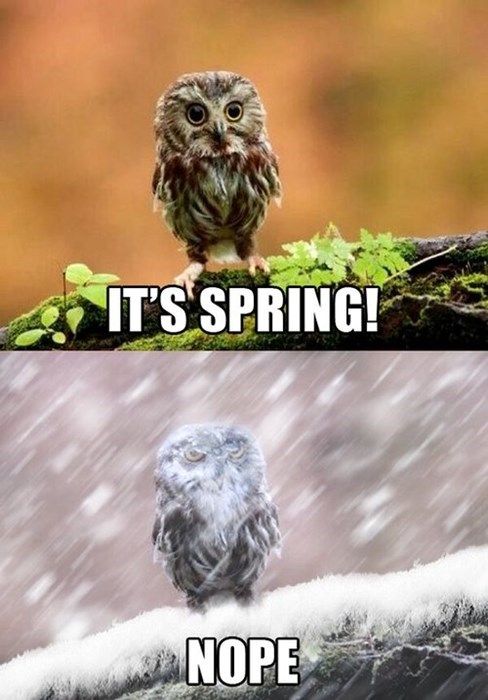
fooled by spring

Seems like it has gone that way this year! But I hope winter is gone for good now (at least until next year).

I’ve listened to this several times this week. One of the most beauitful pieces of music ever written, “Gabriel’s Oboe” from Ennio Morricone’s “The Mission” has been merged with one of the grand old hymns, “How Great Thou Art.” Just lovely.

Friday’s Fave Five

 It’s Friday, time to look back over the blessings of the week with Susanne at Living to Tell the Story and other friends.

I’m a little late to the party – it has been a busy week! Here are some of my favorite parts of it:

1. Springy days. The weather has been just perfect this week, not too hot or too cold. It’s been rainy and windy today, but I accept that it’s gotta do that some times. 🙂

2. Longer days – or more sunlight to the day, at least. It’s rejuvenating.

3. A productive week. I won’t bore with with the to-do list, but I got some things done I needed to and some things I wanted to. Some weeks I’m not sure where the time goes, but I don’t seem to have much to show for them, so it is nice to get some things accomplished.

4. Timely arrivals. I had ordered something for Jim’s mom’s weekday caregiver’s birthday and paid a little extra for it to get here today. By mid-afternoon I realized that “today” might not mean before she left at 5. I prayed it would get here before she left but was mentally preparing myself that I’d just have to give it to her Monday after her birthday. But it came today at 4!

5. Forty years of being a Christian. It just hit me last night that this year is the 40th year since I believed on Jesus Christ as my Savior. Unfortunately I didn’t write down the exact day and I don’t remember what time of year it was, but I do know how old I was. What a blessing to have known Him and His forgiveness, love, and care for so long. My testimony is here. I encourage you, if you don’t know Him, or you’re not sure, take time to find out more about it. This link explains more about becoming a Christian.

“Whoever has the Son has life; whoever does not have the Son of God does not have life.” I John 5:12

And this is eternal life, that they know you the only true God, and Jesus Christ whom you have sent.” John 17:3

Jesus said to him, “I am the way, and the truth, and the life. No one comes to the Father except through me.” John 14:6