Book Review: The Brothers Karamazov

KaramazovDostoyevsky is one of those people I’ve thought about reading for a long time, but his works tend to be pretty chunky volumes. However, I did read somewhere not long ago that his books are actually fairly easy to get into, so when I saw his The Brothers Karamazov on Carrie’s  Reading to Know Classics Book Club list, that seemed like the perfect opportunity to give him a try. This book is the selection for August, but I kept thinking it was coming up in July and I wanted to get a head start on it, so I started listening to the audiobook some weeks back and just finished it a few days ago. I wanted to go ahead and write a review wile it was still fresh in my mind.

The first of the title brothers is Dmitri, also called Mitya, the oldest (about 28 when the book begins), passionate, impulsive, tempestuous. He has a running feud with his father over his inheritance and over a woman who is called Grushenka.

The second is Ivan, brilliant, logical, skeptical. He can’t reconcile the idea of God with the suffering he sees in the world, particularly that of children, and feels that if there is a God, He is malevolent. He comes to find out that the logical conclusions of his philosophies have natural but unforeseen consequences.

The youngest is Alexei, also known as Alyosha, about age 20, who lives at the monastery (Russian Orthodox) while training to become a monk. He is kind, reasonable, thoughtful, compassionate, a peacemaker and has a genuine love for people.

It’s widely believed that there is a fourth illegitimate brother called Smerdyakov. His mother was a retarded homeless girl who died in childbirth. He is found and raised by the senior Karamazov’s servant, Grigory, who raises him. He becomes a servant in the Karamazov household as well. He is epileptic and has a mean, warped streak.

The father of this brood is Fyodor (the three sons all have the middle name Fyodorovich, which means “son of Fyodor”). Fydor is wealthy but debauched, wicked, and greedy. He has had little to do with any of his sons’ upbringing, and they all hate him except for Alyosha.

It is not much of a spoiler to say that Fyodor is killed: the author refers to his coming death early on and hints at a terrible event: it’s not much of a stretch to connect the two and realize that Fyodor is going to come to a bad end. And, indeed, he does: he is murdered. One of his sons is arrested for the murder and the evidence seems pretty certain against him (again foreshadowed by the author as he often comments that this or that happened “as so-and-so testified later.”) But the evidence isn’t conclusive, leaving the reader to wonder for a while who actually killed him. Besides being a major factor in the plot, Fyodor’s murder is also a major catalyst in the lives of his sons for different reasons.

Amidst all the action there are several philosophical discussions, notably between Elder Zosima, Alyosha’s mentor, and various people, and later between Ivan and Alyosha, touching on the nature of God, free will and whether it is a burden, moral responsibility, and other subjects.

I am heavily indebted to SparkNotes for getting much more out of this book than I would have from a surface reading/listening. I liked reading the chapter analysis and summaries at intervals (but I have learned from past experience not to  look at the plot overview or character analysis there until finishing a book because they reveal key details of the story). The chapter analyses did help me see the connection between the philosophical discussions and the action: those discussions weren’t isolated rabbit trails: they were integral to the story (possibly the main points of the story), and the action played out the truths discussed. For instance, I hadn’t connected Alyosha’s ministrations to a dying child (Ilyusha) to his earlier discussion with Ivan, but SparkNotes pointed out:

Ivan looks at the abstract idea of suffering children and is unable to reconcile the idea with his rational precepts about how God ought to be. His solution is to reject God. Alyosha, on the other hand, sees an actual suffering child and believes that it is God’s will for him to try to alleviate the child’s suffering to whatever degree he can. His solution is to help Ilyusha. Again, Dostoevsky shows how the psychology of skepticism walls itself off, in elaborate proofs and theorems, from having a positive effect on the world, while the psychology of faith, simplistic though it may be, concerns itself with doing good for others. This very subtle response to the indictment of God presented by Ivan in Book V brings the philosophical debate of the novel onto a plane of real human action, and shows the inadequacy of Ivan’s philosophy—which Ivan himself would readily acknowledge—to do good in the real world.

As with many older classics, this book can seem a little tedious and wordy by today’s standards. Newer stories start off with action that grabs you and makes you want to know what happens next  or causes you to care about a character right away: older books have a lot of explanation and description first. The first style is usually more exciting; the latter takes a little more patience but does usually pay off in the end.

This story that has more layers than one would think at first, and it is causing me to think and make connections long after I’ve finished it – a hallmark of a classic. I didn’t agree with much of the theology, but the overall theme of a quiet faith lived out in everyday life with love and service towards one’s fellow man appealed to me.

I also enjoyed reading more of Dostoyevsky’s background at Wikipedia and SparkNotes.

I usually like audiobooks for classics, for several reasons, but in this case it was probably not the best way to go. For one thing, the multitude of polysyllabic Russian names and nicknames was hard to distinguish at first, but after a while I was able to distinguished who was who (whom?) Secondly, there were a few sections of philosophical discussion that were hard for me to follow just by listening while driving, fixing hair, etc.: those would have benefited from being able to go over them on the printed page a couple of times. Nevertheless I thought the narrator, Constantine Gregory, did a good job telling the story.

(This will also be linked to Semicolon‘s Saturday Review of Books.)

This also completes one of my selections for the  Back to the Classics Challenge hosted by Karen at Books and Chocolate.

classics2014


Book Review: My Man Jeeves

JeevesBertie Wooster is an amiable but not terribly bright English gentleman (as he says, “I’m a bit short on brain myself; the old bean would appear to have been constructed more for ornament than for use, don’t you know”). His “man,” Jeeves, is the quintessential unobtrusive English valet with not only “genius for preserving a trouser-crease,” but also a penchant for solving the various problems of Bertie and his friends.

My Man Jeeves by P. D. Wodehouse is 1919 a collection of short stories involving the fictional pair, but there are a few stories in the middle about Reggie Pepper, who doesn’t seem to have any connection with either of them. The plot lines are similar in all the stories, though: someone has some kind of problem (often another English gentleman whose source of financial support is threatening to cut him off if he doesn’t jump through certain hoops that he doesn’t want to, but some of the stories involve romantic troubles as well), appeals for help, and then Jeeves or Reggie comes up with some kind of scheme that usually involves some kind of deception that usually backfires in some comic way.

The Jeeves and Wooster books are good for a light-hearted read, especially if you like English comedy, one reason I decided to pick this up when Carrie listed it as her Reading to Know Classics Book Club selection for April. Unfortunately, the first few stories sounded very familiar, and I found that some of them were rewritten from Carry On, Jeeves (linked to my review), the only other Jeeves book I’ve read. That was irritating, but there was enough new material and enough I’d forgotten from the previous book that it wasn’t a total wash.

I have to admit that the plots got tiresome after a while, but Wodehouse’s writing is delightful. I enjoyed the narrative quite a lot and had fun picking up on certain expressions and idioms (I don’t know if the British still use these, but apparently being “in the soup” in a bad thing while being “full of beans” is good). Here are some examples:

“I’m not absolutely certain of my facts, but I rather fancy it’s Shakespeare — or, if not, it’s some equally brainy lad — who says that it’s always just when a chappie is feeling particularly top-hole, and more than usually braced with things in general that Fate sneaks up behind him with a bit of lead piping.”

Of an awkward gathering: “And so the merry party began. It was one of those jolly, happy, bread-crumbling parties where you cough twice before you speak, and then decide not to say it after all.”

“That’s always the way in this world. The chappies you’d like to lend money to won’t let you, whereas the chappies you don’t want to lend it to will do everything except actually stand you on your head and lift the specie out of your pockets.”

“Absent treatment seemed the touch. I gave it to him in waves.”

“I wasn’t particularly surprised to meet Bobbie at the club next day looking about as merry and bright as a lonely gum-drop at an Eskimo tea-party.”

The full text of this book is available online here. I listened to the audiobook, read very nicely by Simon Prebble.

(This will also be linked to Semicolon‘s Saturday Review of Books.)

This also completes one of my requirements for the  Back to the Classics Challenge hosted by Karen at Books and Chocolate.

classics2014


What’s On Your Nightstand: April 2014

What's On Your NightstandThe folks at 5 Minutes For Books host What’s On Your Nightstand? the fourth Tuesday of each month in which we can share about the books we have been reading and/or plan to read.

Oh wow – I was totally caught off guard for the Nightstand post this month. That’s more likely in months like this when there are five Thursdays, but I think I have an especially good excuse for being distracted since the premature birth of my little grandson. 🙂 Anyway – here is the super-quick version:

Since last time I have completed:

Crowded to Christ by L. E. Maxwell, reviewed here.

Bleak House by Charles Dickens via audiobook, reviewed here.

Made to Crave Action Plan Participant’s Guide by Lysa TerKeurst and Ski Chilton, reviewed here.

My Man Jeeves by P. D. Wodehouse for Carrie’s Reading to Know Classics Book Club April selection, review coming soon.

The Seamstress: A Memoir of Survival by Sara Tuvel Bernstein via audiobook, reviewed coming soon here.

I’m currently reading:

The Little White Horse by Elizabeth Goudge for Carrie’s  Reading to Know Classics Book Club for March. Yes, March. 😳 I just haven’t been inclined to pick this one up very much, but I am almost done.

Wednesdays Were Pretty Normal: A Boy, Cancer, and God by Michael Kelley

Mere Christianity by C. S. Lewis, a reread that I enjoyed it the first time but am getting much more from now.

Courageous by Randy Alcorn (audiobook).

Next up:

The Great Divorce by C. S. Lewis

The Book of Three by Alexander Lloyd, first book in the Prydain Chronicles.

I think I am going to skip the May and June selections from Carrie’s  Reading to Know Classics Book Club, just because I have so many other books to get to, but I may get an early start on July’s choice of The Brothers Karamazov by Fyodor Dostoyevsky. I have a feeling that one will take a good while. 🙂

Happy Reading!

Book Review: Bleak House

Bleak HouseIt’s hard to summarize in a line or two what Bleak House by Charles Dickens is about, as there are several story lines going on at the same time. In fact, it is a little hard to get into at first because, like A Tale of Two Cities, different strands of the whole are mentioned individually at first and not woven together until several chapters in (as opposed to David Copperfield, which starts at the beginning with David’s birth and progresses from there.) SparkNotes helped a lot with the early chapters, although I’d advise against reading the character list or overview until after you are well into the story due to spoilers (ditto with the Wikipedia article on the book). I followed the individual chapter discussions and analysis on Sparknotes.

The point of view switches back and forth from a third person present tense narrator to a first person past tense narrative of Esther, one of the main characters. From what little I’ve read Dickens was praised by some and criticized by others for this. The two viewpoints do give us the advantage of two perspectives and I enjoyed hearing both.

One strand of the story is the case of Jarndyce vs. Jarndyce which has been languishing in the Court of Chancery for years. Dickens based the Chancery on the real-life one, and the opening foggy scenes are symbolic of it. One note said the Jarndyce case was based on a real one that went on for 53 years. We’re not really told what the case is about except that the inheritance of some of the characters are tied up in it. John Jarndyce himself has given up on it and wants no more to do with it.

Another strand of the story involves bored, cold, haughty Lady Dedlock, whose demeanor, we discover, hides a secret sorrow and then a secret fear.

Another involves Esther Summerson, an orphaned girl who was raised by her aunt until the aunt dies, then sent to school, then asked by John Jarndyce to become a companion to his niece, Ada, who had become his ward as well as a nephew, Richard. Esther shares the narrative at points, and one of the interesting things about the writing is how her voice seems faltering at first (she claims she is not clever) and then gains confidence as she goes on.

Ada and Richard fall in love, which pleases Mr. Jarndyce, but he urges Richard to choose a profession before the relationship goes any further. Richard is affable and likable but doesn’t have any clear interests. He tries apprenticing at a few different professions before ending up in the military. However, after visiting the Chancery one day, he gets caught up in the Jarndyce case, and it becomes the focus of his life, despite his guardian’s warnings against pinning his hopes on the outcome of a case that could go on for years.

Another strand involves the poor of the town, particularly a mother, Jenny, whose baby dies, and a boy named Jo who is apparently homeless and constantly being told to “move on.” Others involve a somewhat flighty lady named Miss Flite who has been waiting for years for her own settlement and the noble soldier George Rouncewell.

One of Dickens’ skills is creating memorable characters, and there are some four dozen in this book. There is Mrs. Jellyby, caught up in the cause of Borrioboola-Gha in Africa while severely neglecting her own family. Inspector Bucket was based upon a real Scotland Yard detective and is reputed to be one of the first detectives in English literature. Mr Skimpole, whom I did not like, was also based on a real person (who evidently did not take kindly to the portrayal.) He calls himself “a child,” especially in business or money matters, but something about him seemed not quite right to me, which proved to be the case. He did not have the same endearing qualities as the feeble-minded Mr. Dick of David Copperfield.

There are different kinds of love portrayed – romantic, familial, friendship. If I can say this without giving away a major plot point, the Dedlocks certainly don’t seem the epitome of a warm and loving couple, but his response late in the novel showed he loved her deeply. I particularly loved the Bagnets and his calling her “the old girl” and asking her to tell his opinions. One of my favorite scenes was her birthday when the family was making her dinner while she tried to subtly signal to her daughters to add more of this, less of that, and nothing was done the way she would have done it herself, but she endured with grace out of love for them and their efforts.  There are a couple of mysteries, including a murder. There is a case of spontaneous combustion, which Dickens was severely criticized for including, but he countered that at the time he wrote it was thought to be a real phenomenon. There are different people affected by the Chancery, mostly negatively. There are observations of social injustice. There is sadness and joy and humor. There are a lot of secrets causing varying degrees of sorrow to those involved. There are a variety of reconciliations, a couple of them sorely delayed due to pride and shame, and the most heartbreaking is the one that did not occur but could have.

Esther’s story did end up where I hoped it would. One of the oddest things in the story (minor spoiler alert) was when her guardian proposed. That seemed a little creepy to me, but he releases her from the engagement later on. Another favorite scene is after he proposes, when Esther is in her room brushing her hair, determining to make him very happy, but crying, for reasons which she doesn’t quite know – or at least doesn’t tell the reader, but the reader guesses. It’s not a favorite scene because she is crying but because of Dickens’ way of showing what was going on in her heart without spelling it out.

I have heard the 2005 BBC production is really good and would like to see it some time. Here is a trailer for it:

But as it is over 8 hours long, I might have to wait for a heap of ironing or some sick days or summer break when there is nothing else on.

I listened to the audiobook narrated by Peter Batchelor but dipped into the hard copy at points and read its introduction and afterword as well.

Some say this is Dickens’ best; some disagree. I think it is masterfully written and I enjoyed it a lot (especially the last third or so of it), but I liked A Tale of Two Cities and David Copperfield much better. Dickens’ books usually improve upon rereading, though, so next time I visit Bleak House I might enjoy it even more.

(This will also be linked to Semicolon‘s Saturday Review of Books.)

This also completes one of my requirements for the  Back to the Classics Challenge hosted by Karen at Books and Chocolate.

classics2014

.

Book Review: The Woman in White

Woman in WhiteI had never heard of Wilkie Collins until a few years ago. When I first started listening to audiobooks, I’d scroll through the listing of classics, and his The Woman In White would come up often. I thought, “How can this be a classic if I have never heard of it?” 😳 I read the description, but it didn’t sound all that interesting. Then last year his book No Name was chosen as one of the books for Carrie’s Reading to Know Book Club. I looked at the description for it and wasn’t interested in it enough to commit the needed time to it, so I skipped that one as well. But then everyone who read it thought it was really good. So when I decided to participate in the Back to the Classics Challenge, one of the categories was “an author you’ve never read before,” and I thought this would be an opportune time to try out Mr. Collins and chose The Woman in White.

I am so glad I did. It was a totally enthralling story. I can understand now why there is not much description of his books on sites that sell them: you can’t tell much about the story without revealing surprises and clues it would be better for the reader to discover in context.

The story is laid out in a series of testimonies. Within them, at least that of the major characters, the narrative is in more of a story form, although one takes the form of a journal.

The story begins with Walter Hartwright, a drawing teacher who finds himself “out of health, out of spirits, and out of money.” A friend fortuitously comes across an opportunity for Walter to teach two young women from a prestigious family in the country, and though Walter has misgivings, he has no good reason to refuse and every reason to accept, so he does. On the eve of his departure, as he walks home from his mother’s house late one night, he is startled by a young woman totally dressed in white who asks him the way to London. There are several things strange about her manner and the whole situation, and most surprising of all is that as they discuss where Walter is headed, this woman knows the very family he is going to. Walter is at first unsure of what to do, but he not only points her in the right direction; he also escorts her to a cab and sees her off. Within minutes a carriage comes by containing two men who are looking for a woman in white.

Where they are from and why they are looking for her is a major factor in the story, so I won’t share it here and ruin the surprise, but as this woman is the title character, obviously her presence and influence will come up again.

The beginning of the book says it is a story of “what a Woman’s patience can endure, and what a Man’s resolution can achieve.” It’s noted as one of the first detective stories written as Walter, though not a professional detective, uses many such techniques to get at the truth of the conspiracy, deceit, and betrayal that arise later in the story.

Collins was a good friend of Charles Dickens, and this book was first printed in installments in one of Dickens’ magazines, but his style is quite different from Dickens’.

Though the story is perhaps a little more drawn out than a modern novel would be, I never felt the story got bogged down. I listened to it via audiobook with several narrators taking the different testimonies of the story, and by the last few chapters I was carrying my phone around with me everywhere to listen and find out how it was all going to end. I had an idea of a couple of things that were going to happen (the foreshadowing of a terrible event pointed to either one of a couple of people because those people hadn’t given any testimony yet), but I didn’t guess exactly how things would work out. I did get a library copy of the book as well to go back and look through some passages a little more closely, but there is a free (at this time) Kindle version of it. And, of course, if you’d like to know more of the plot, including a lot spoilers, there is always Wikipedia.

I’m definitely planning on exploring more of Collins’ books in the future.

Have you read The Woman in White? What did you think?

(This will also be linked to Semicolon‘s Saturday Review of Books.)

This also completes one of my requirements for the  Back to the Classics Challenge hosted by Karen at Books and Chocolate.

classics2014

Reading Challenge Update

2014tbrbuttonRoof Beam Reader, who hosts the 2014 TBR Pile Challenge, has check-in points around the 15th of each month so we can summarize how we’re doing.

Of the 12 books I’ve listed here, I’ve completed Ida Scudder, am about halfway through Made to Crave and Walking From East to West, and am a few chapters into Crowded to Christ. So I think I’m pretty much on track there.

classics2014I might as well update the other challenges, too: for the Back to the Classics Challenge, I’ve completed two from the required categories of my list (The Blue Castle by L. M. Montgomery and The Scarlet Pimpernel by Baroness Orczy), and am about 3/4 of the way through The Woman in White by Wilkie Collins (which I am finding riveting!) From the optional categories I’ve completed A Study in Scarlet by Sir Arthur Conan Doyle and am about 1/4 of the way through Farmer Boy by Laura Ingalls Wilder. That leaves me three from the required and two from the optional lists, so I think I am in good shape there, too.

The Blue Castle by L. M. Montgomery was also read in connection with Carrie’s  L. M. Montgomery Reading Challenge and Reading to Know Classics Book Club and Farmer Boy is part of my Laura Ingalls Wilder Reading Challenge. Crowded to Christ is also part of the The Cloud of Witnesses Challenge. And Crowded to Christ, Made to Crave, Ida Scudder and Walking From East to West are all eligible for the Nonfiction Reading Challenge in which I am aiming to read 11-15  nonfiction books.

It’s funny how just having made these lists is spurring me on to more purposeful reading. And now I am going to have to read more Sherlock Holmes and Wilkie Collins when I get done with these challenges!

What’s On Your Nightstand: January 2014

What's On Your NightstandThe folks at 5 Minutes For Books host What’s On Your Nightstand? the fourth Tuesday of each month in which we can share about the books we have been reading and/or plan to read.

Usually I anticipate the Nightstand posts and have them ready, but for some reason this month I completely forgot about it until I saw Nightstand posts listed on several of my friends’ blogs in my Feedly! So I’m going to whip this one together.

It has been a good month for reading!

Since last time I have completed:

Unglued: Making Wise Choices in the Midst of Raw Emotions by Lysa TerKeurst, reviewed here.

Jennifer: An O’Malley Love Story by Dee Henderson, short review here.

Unspoken by Dee Henderson, reviewed here.

The Blue Castle by L. M. Montgomery, reviewed here. for Carrie’s January selection for her Reading to Know Classics Book Club her L. M. Montgomery Reading Challenge.

Lost and Found by Ginny Yttrup, reviewed here.

The Incorrigible Children of Ashton Place: Book IV: The Interrupted Tale by Maryrose Wood, short review here.

A Study in Scarlet, the first Sherlock Holmes book by Sir Arthur Conan Doyle, audiobook, reviewed here.

The Scarlet Pimpernel by Baroness Orczy, audiobook, reviewed here.

A Tale of Two Cities, audiobook, by Charles Dickens for Carrie’s Reading to Know Book Club for December.

Bonhoeffer: Pastor, Martyr, Prophet, Spy by Eric Metaxas was finished months ago but I just reviewed it here.

Two devotional books I read through last year were A Quiet Place: Daily Devotional Readings by Nancy Leigh DeMoss and One Year Christian History by E. Michael and Sharon Rusten, both reviewed just briefly here.

I also listed my top ten books read in 2013 here.

I’m currently reading:

Made to Crave: Satisfying Your Deepest Desire With God, Not Food by Lisa TerKeurst along with a online Bible study using Made to Crave hosted by Proverbs 31 Ministries. I will probably post a general review of the book here when I finish it, but I’m blogging about the individual chapters on my I Corinthians 10:31 blog under the label Made to Crave study.

Walking From East to West: God in the Shadows by Ravi Zacharias

Crowded to Christ by L. E. Maxwell

Ida Scudder: Healing Bodies, Touching Hearts by Janet and Geoff Benge

Next up:

The Woman in White by Wilkie Collins. I’ve never read him before but he was a contemporary of Dickens and all reviews of this  book are high.

Farmer Boy by Laura Ingalls Wilder for my Laura Ingalls Wilder Reading Challenge (more on that below).

Other than that I am not sure, but it will be something from the book challenges I am participating in here and here. Those challenges are really spurring me on!

I invite you to participate in the Laura Ingalls Wilder Reading Challenge which runs through February, where we read books by or about or somehow related to LIW. I’ll have a post up Feb 1. where you can share what you plan to read and check out what others are reading.

Laura Ingalls Wilder Reading Challenge
Happy reading!

Book Review: The Scarlet Pimpernel

PimpernelThe Scarlet Pimpernel by Baroness Orczy is the forerunner of the heroes with a secret identity genre, at least according to Wikipedia. It was originally published as a play in 1903, then as a novel in 1905.

A scarlet pimpernel is a small red flower in England, and it’s also adopted as the name and sign of an English man who dons different disguises to help rescue those slated for the guillotine in France during the Reign of Terror of the French Revolution in 1792. He is rumored to have 19 men under his command, and his exploits have made him the talk of England, with everyone wondering about his true identity.

Citizen Chauvelin is an agent who has come from France specifically to find out the identity of the Scarlet Pimpernel and to stop him. He calls on an old friend, Lady Marguerite Blakeney, a Frenchwoman married to the very rich but very foppish English Sir Percy Blakeney. Chauvelin is convinced that in the circles in which Marguerite moves, she is sure to hear something that might be helpful to him. To ensure her cooperation, he threatens the safety of her brother with papers that show that he is in league with the Scarlet Pimpernel and therefore in danger of his life.

Marguerite wrestles with her conscience: she is as enamored of the Scarlet Pimpernel as everyone else and does not want to be the downfall of a brave man. Though she is French, she feels her countrymen have gone way too far in the Revolution. On the other hand, her she loves her brother dearly, and he is her only remaining family member.

She considers turning to her husband for help, but they have been estranged since the first days of their marriage, although they put up a good front for everyone else. Marguerite had once spoken out against the Marquis de St. Cyr, unwittingly causing him to be arrested and sent to the guillotine. Her husband can’t forgive her for that and doesn’t trust her. Besides, he’s slow, lazy, and dimwitted, so she doesn’t feel she can confide in him.

I’ll leave the plot there so as not to spoil it. I wouldn’t say Baroness Orczy is the best writer – there are places in the book that are tedious, other places a bit overwrought – but this is certainly an exciting book, with intrigue, suspense, danger, and everything we love about heroes in disguise.

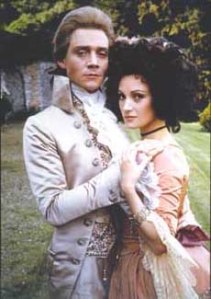
Scarlet PimpernelI first came across this story years ago as a film starring Jane Seymour and Anthony Andrews (and a young Ian McKellen [Gandalf] as Chauvelin), which I loved. There is a good bit more swashbuckling and derring-do in the film than in the book, and the film shows the audience who the Scarlet Pimpernel is right off the bat, whereas the book slowly unfolds it. The film is based not only on the book The Scarlet Pimpernel but also Eldorado (which I haven’t read), which includes more about Marguerite’s brother and the rescue of the captive Dauphin. Many of the details are changed or in a different order, but they did keep the overall story arc the same, and they especially captured the angst of Marguerite and Percy’s love for each other that they each keep hidden at first because of their misunderstandings.

For those who would want to know, there is smattering of “damns” and “dems” and “demmed.” There are also what I did not recognize as minced oaths, but when I looked them up I saw that they were. I wish those weren’t there. :-/ But otherwise this is a fun story.

I listened to the audiobook read by a Mary Sarah, who was not the best narrator, but the book was still enjoyable.

(This will also be linked to Semicolon‘s Saturday Review of Books.)

This also completes one of my requirements for the  Back to the Classics Challenge hosted by Karen at Books and Chocolate.

classics2014

Daniel Deronda

Daniel Deronda is a young man of uncertain parentage brought up to be an English gentleman as the ward of kind-hearted Sir Hugo Malinger in England in the 1870s. The pain and shame of the possibility of being illegitimate and the lack of knowing his family has worked in him a tender heart and an inclination to help and rescue others in need. He is uncertain about what to do with his life, dropping out of university and resistant to Sir Hugo’s urging that he take up politics. “To make a little difference for the better was what he was not contented to live without; but how to make it?”

But though he is the title character, he appears silently in the first chapter and then not again until about the 15th. Those intervening chapters and the intertwining storyline are taken up with Gwendolen Harleth, a beautiful, vain, self-centered, seemingly heartless young woman. Used to getting everything she wants, her world is shaken when her family loses its fortune and the only option they can find is to move and for her to “take a situation” as a governess. To escape that fate she goes against her conscience to marry Henley Grandcourt. She knows he has a shameful secret, but she doesn’t know he knows she knows, and his knowledge gives him power over her. She was initially attracted to him because he didn’t fawn and act “ridiculous” around her like the other smitten young men in her wake, and he was rich and seemed to indulge her. But after the marriage, the niceties are off and he turns out to be a cold and cruel man whose main source of pleasure is in mastering others.

Daniel had crossed her path in the first chapter, and when they meet again, her misery in her marriage and her tormented conscience draw her to him almost as an alternate conscience and confessor.

Meanwhile Daniel finds Mirah Lapidoth at the lowest point in her life and undertakes to help her as much as he can. She is a young Jewess who was taken from her mother and brother and forced to work on the stage, but she escaped and returned to try to find them again. In Daniel’s search through the Jewish quarter of town for Mirah’s family, he meets a young zealous Jew named Mordecai, who is dying and thinks Daniel is the answer to his prayers for a successor and future leader of his people. Daniel can’t help him in that aspect because he is not Jewish, but Mordecai insists he could be since he doesn’t know his own parentage. Though Daniel continues to resist him, they do become friends and Daniel learns more about Jewish culture.

The rest of the book is taken up with the intersection and development of these lives and Daniel’s ultimately finding his identity and purpose.  In fact, identity could be an overarching theme of the book: Daniel searches for his, Gwendolen wrestles with hers, Grandcourt hides his, Mirah and Mordecai are guided by theirs.

This is the first of George Eliot’s books that I’ve ever read, though I heard a performance of Silas Marner (and want to read it as well as Middlemarch some time). I enjoyed the psychology of her writing, the way she delved into and displayed each character’s pysche. Though, as with many older classics, there is a lot more explaining than there is in modern work, the author still tucks in neat scenes that expose a lot about the characters without further explanation, like the one where Grandcourt shows his cruelty by baiting one dog and then rejecting it.

Since Eliot is a “a writer who, for many, embodies the ideals of the liberal, secular humanism of the Victorian age,” according to Wikipedia, obviously the book is written from that standpoint, and though there are Biblical allusions, grace and forgiveness are largely and sadly missing: e.g., when Gwendolen confesses to having hateful thoughts and is stricken by her conscience, she is urged to try to live a better life, serve a purpose outside herself, etc., rather than to confess to God and seek His help. That’s not surprising when you read a bit about Eliot and find that she either missed or resisted that grace in her own life as well.There are also some weird mystical allusions in regard to Mordecai, who thinks his soul will be reincarnated in Daniel.

The Wikipedia article on Daniel Deronda also goes into the influences leading to the Jewish elements in the book in a time when society was rather anti-Semitic. I thought these lines from the book were telling:

Deronda, like his neighbors, had regarded Judaism as a sort of eccentric fossilized form which an accomplished man might dispense with studying, and leave to specialists. But Mirah, with her terrified flight from one parent, and her yearning after the other, had flashed on him the hitherto neglected reality that Judaism was something still throbbing in human lives, still making for them the only conceivable vesture of the world…This awakening of a new interest–this passing from the supposition that we hold the right opinions on a subject we are careless about, to a sudden care for it, and a sense that our opinions were ignorance–is an effectual remedy for ennui, which, unhappily, cannot be secured on a physician’s prescription.

I first became acquainted with this novel when I saw the BBC film several years ago starring Hugh Dancy as Daniel, Romola Garai as Gwendolen, and Hugh Bonneville (currently of Downton Abbey fame) as Grandcourt. I think it was one of the first period dramas I ever saw, and except for too many shots of Gwendolen’s cleavage, I was enamored with movie. I just watched it again this week on Netflix and I was less so. The filmmakers were attentive to many details, such as Daniel’s tendency to grasp his coat high near the collar and Grandcourt’s to keep a thumb and forefinger in one pocket, and many lines and scenes are taken straight from the book. But they turned Daniel and Gwendolen’s relationship into more of a romance, almost an adulterous one, and changed some scenes and lines in others (such as Gwendolen’s visit to Mirah). I still enjoyed the film, though not as much as I would have without the changes, and it does follow the overall structure of the book, but of course it condenses it.

I listened to much of the book via audiobook, and Nadia May’s reading and accents were delightful. But some of the philosophical parts were harder to comprehend without pondering the words in print, so I referred often to the free (at this time) e-book version as well.

I’m thankful to Heather at Do Not Let This Universe Forget You for choosing Daniel Deronda for Carrie’s Reading to Know Book Club for August. I enjoyed the journey!

(This will also be linked to Semicolon‘s Saturday Review of Books.)

Book Review: The Picture of Dorian Gray

Dorian GrayThe Picture of Dorian Gray by Oscar Wilde begins with a preface from Wilde about art in which he says some pretty preposterous things, such as “There is no such thing as a moral or an immoral book” and “No artist has ethical sympathies. An ethical sympathy in an artist is an unpardonable mannerism of style.” Though this fits in with his views of “art for art’s sake,” his story seems to contradict the view that art is amoral in itself. Since it was added in a later edition of the novel, after the first printing caused a ruckus, perhaps he meant it as a disclaimer.

The story itself begins with an artist, Basil Hallward, and his friend, Lord Henry Wotten, discussing Basil’s painting of an extremely good-looking young man, Dorian Gray. Lord Henry feels the painting is Basil’s best work and wants to know the subject, but Basil demurs, saying that Dorian has come to mean much to him and to have greatly influenced his art. Basil doesn’t want Henry to even meet Dorian, but as fate would have it, Dorian arrives just at that moment. Basil urges Henry not to spoil or badly influence Dorian, but Henry just laughs — and then proceeds to spoil Dorian by telling him how beautiful he is, how sad it is that his youth and beauty won’t last long, how he needs to adopt a new hedonism and live for his senses, that “Nothing can cure the soul but the senses, just as nothing can cure the senses but the soul.” He awakens new feelings and sensations in Dorian such that when Dorian sees the completed painting of himself, he mourns “How sad it is! I shall grow old, and horrible, and dreadful. But this picture will remain always young. It will never be older than this particular day of June…. If it were only the other way! If it were I who was to be always young, and the picture that was to grow old! For that–for that–I would give everything! Yes, there is nothing in the whole world I would not give! I would give my soul for that!”

And mysteriously, somehow that’s what happens. He doesn’t realize it until after he falls in love with an actress and then, when she disappoints and embarrasses him, he mercilessly spurns her. When he next sees the portrait, he notices a hint of cruelty about the mouth that he hadn’t noticed before. At first he thinks he is imagining it, but then he decides to make amends by writing to the actress and apologizing, only to find that she has taken her own life. He doesn’t feel her death as deeply as he thinks he should, and Lord Henry soothes him that it’s all right, it’s even an artistic end to her existence. Thus Dorian decides “Eternal youth, infinite passion, pleasures subtle and secret, wild joys and wilder sins–he was to have all these things. The portrait was to bear the burden of his shame: that was all…For there would be a real pleasure in watching it. He would be able to follow his mind into its secret places. This portrait would be to him the most magical of mirrors. As it had revealed to him his own body, so it would reveal to him his own soul.”

Dorian locks the painting away in an unused upper room so no one else can see its transformation and then proceeds to try every kind of “infinite passion, pleasures subtle and secret, wild joys and wilder sins.” He still wrestles with his conscience at times, but convinces himself that every sin is really someone else’s fault and due to their provocation.

“There were moments, indeed, at night, when, lying sleepless in his own delicately scented chamber, or in the sordid room of the little ill-famed tavern near the docks which, under an assumed name and in disguise, it was his habit to frequent, he would think of the ruin he had brought upon his soul with a pity that was all the more poignant because it was purely selfish. But moments such as these were rare. That curiosity about life which Lord Henry had first stirred in him, as they sat together in the garden of their friend, seemed to increase with gratification. The more he knew, the more he desired to know. He had mad hungers that grew more ravenous as he fed them.”

Though in some quarters he gains a bad reputation, most people feel as one girl did who, when “He had told her once that he was wicked, she had laughed at him and answered that wicked people were always very old and very ugly,” or, as Lord Henry had thought upon first meeting him, “There was something in his face that made one trust him at once. All the candour of youth was there, as well as all youth’s passionate purity. One felt that he had kept himself unspotted from the world. No wonder Basil Hallward worshipped him.” When a later turn to “do good” has no edifying effect on the portrait, he realizes even that desire was filled with vanity and hypocrisy. He retains his youth and beauty for the next eighteen years while the portrait continues to age and degrade, until he comes to an abrupt tragic end.

Though this was not a pleasant book to read, it is fascinating on several levels. At first I felt some sympathy for Dorian in that he seemed innocent and simple until Henry influenced him. But even before that Basil said of him, “As a rule, he is charming to me, and we sit in the studio and talk of a thousand things. Now and then, however, he is horribly thoughtless, and seems to take a real delight in giving me pain. Then I feel, Harry, that I have given away my whole soul to some one who treats it as if it were a flower to put in his coat, a bit of decoration to charm his vanity, an ornament for a summer’s day.” So perhaps Henry just stirred the flames of what was already there.

Lord Henry is an enigma as well. He says perfectly horrible things, such as

“We are punished for our refusals. Every impulse that we strive to strangle broods in the mind and poisons us. The body sins once, and has done with its sin, for action is a mode of purification. Nothing remains then but the recollection of a pleasure, or the luxury of a regret. The only way to get rid of a temptation is to yield to it. Resist it, and your soul grows sick with longing for the things it has forbidden to itself, with desire for what its monstrous laws have made monstrous and unlawful,”

Yet his friends don’t seem to take him seriously, saying things like, “You never say a moral thing, and you never do a wrong thing. Your cynicism is simply a pose.” and “I don’t agree with a single word that you have said, and, what is more, Harry, I feel sure you don’t either.” When Dorian tells Henry that a book he had given him had poisoned him, Henry replies,

“My dear boy, you are really beginning to moralize. You will soon be going about like the converted, and the revivalist, warning people against all the sins of which you have grown tired. You are much too delightful to do that. Besides, it is no use. You and I are what we are, and will be what we will be. As for being poisoned by a book, there is no such thing as that. Art has no influence upon action. It annihilates the desire to act. It is superbly sterile. The books that the world calls immoral are books that show the world its own shame. That is all.”

Yet earlier Dorian muses, “Words! Mere words! How terrible they were! How clear, and vivid, and cruel! One could not escape from them. And yet what a subtle magic there was in them! They seemed to be able to give a plastic form to formless things, and to have a music of their own as sweet as that of viol or of lute. Mere words! Was there anything so real as words?” contradicting both Lord Henry’s opinion and Wilde’s preface.

Henry seems fascinated and delighted by the psychological effect his own words have on Dorian, even though he has no idea of the extremes to which Dorian takes them, yet he morally “gets away with” his horrible influence. Early in the book when he is just hearing about Dorian, he picks a flower to pieces while he talks and listens, symbolic of the destruction his influence will have not only on a beautiful flower but a beautiful person.

There are several take-aways from reading Dorian Gray:

That last reference, oddly, was brought up in the book by Lord Henry, though he quickly denounced the thought that man even had  soul (yet he felt art did). It’s amazing that there are so many Scriptural principles in the story since Wilde, as far as I can tell, was not a believer. I’m not sure what Wilde’s purpose would have been in writing it other than just an interesting story if he didn’t believe there was any morality to it, but despite his beliefs or lack of them, truth shines through.

The Kindle version is free and the audiobook is $2.99 at the time of this writing, and the text is online here and other places.

Reading to Know - Book Club

(This will also be linked to Semicolon‘s Saturday Review of Books.)