Book Review: My Antonia

My Antonia by Willa CatherThough I had heard of Willa Cather, I had never read her books and had no plans to. Then Hope’s great review of Cather’s My Antonia piqued my interest.

When ten-year-old Jim Burden’s parents died, he was sent to live with his grandparents in Nebraska. Arriving on the same train was a Czech (called Bohemian then) family, the Shimerdas, who became Jim’s grandparents’ neighbors.

The Shimerdas had one crooked relative in the area who sold them his cave of a home and some equipment for much more than they were worth.  Since they could not speak English, couldn’t ask for advice, and didn’t know any better, they paid his prices. But that meant almost all the money they brought with them was gone. The family had a hard time getting started, not only because of language barriers, poverty, and getting acclimated to new ways, but also for lack of what Jim’s grandmother called horse-sense.

The oldest daughter of the family was a bright, eager girl a few years older than Jim named Antonia (pronounced with accents on the first and third syllables—An’-ton-EE-ah). She learned English more quickly than the rest, and she and Jim became childhood friends traipsing over the countryside together. Jim taught two of the Shimerda girls English, and Antonia spent time helping Jim’s grandmother in the kitchen.

After a few years, Jim’s grandparents got too old to maintain the farm and moved into town. Antonia and many of the other immigrant girls worked in town and sent money home.

The story is told from Jim’s point of view, and he describes their adventures and relates many stories of townsfolk. We also see Antonia’s growth and development through his eyes. Though he had something of a crush on her for a while, he becomes more of a longtime family friend. Later he goes to college and law school and returns home less frequently, but he does see Antonia at intervals. She’s had a very hard life on many fronts, but maintained a strong spirit. He says of her near the end, “I know so many women who have kept all the things that she had lost, but whose inner glow has faded. Whatever else was gone, Antonia had not lost the fire of life.”

The book is partly about growing up on the prairie in the late 19th century. Cather herself moved to Nebraska from Virginia as a child, as Jim Burden did. Partly the book is about the immigrant experience of that time. But ultimately I think the story is about the resilience of people like Antonia.

Unfortunately, some people’s ideas of immigrants hasn’t changed much over time:

I thought the attitude of the town people toward these girls very stupid. If I told my schoolmates that Lena Lingard’s grandfather was a clergyman, and much respected in Norway, they looked at me blankly. What did it matter? All foreigners were ignorant people who couldn’t speak English. There was not a man in Black Hawk who had the intelligence or cultivation, much less the personal distinction, of Antonia’s father. Yet people saw no difference between her and the three Marys; they were all Bohemians, all ‘hired girls.’

I liked Jim’s (Cather’s?) summation:

Those girls had grown up in the first bitter-hard times, and had got little schooling themselves. But the younger brothers and sisters, for whom they made such sacrifices and who have had ‘advantages,’ never seem to me, when I meet them now, half as interesting or as well educated. The older girls, who helped to break up the wild sod, learned so much from life, from poverty, from their mothers and grandmothers; they had all, like Antonia, been early awakened and made observant by coming at a tender age from an old country to a new.

I can remember a score of these country girls who were in service in Black Hawk during the few years I lived there, and I can remember something unusual and engaging about each of them. Physically they were almost a race apart, and out-of-door work had given them a vigour which, when they got over their first shyness on coming to town, developed into a positive carriage and freedom of movement, and made them conspicuous among Black Hawk women.

The girls who once worked in Black Hawk kitchens are to-day managing big farms and fine families of their own; their children are better off than the children of the town women they used to serve.

I always knew I should live long enough to see my country girls come into their own, and I have. To-day the best that a harassed Black Hawk merchant can hope for is to sell provisions and farm machinery and automobiles to the rich farms where that first crop of stalwart Bohemian and Scandinavian girls are now the mistresses.

I love how Cather phrases some things:

Misfortune seemed to settle like an evil bird on the roof of the log house, and to flap its wings there, warning human beings away.

We burrowed down in the straw and curled up close together, watching the angry red die out of the west and the stars begin to shine in the clear, windy sky.

Grandfather’s prayers were often very interesting. He had the gift of simple and moving expression. Because he talked so little, his words had a peculiar force; they were not worn dull from constant use. His prayers reflected what he was thinking about at the time, and it was chiefly through them that we got to know his feelings and his views about things.

The week following Christmas brought in a thaw, and by New Year’s Day all the world about us was a broth of grey slush, and the guttered slope between the windmill and the barn was running black water.

In the winter bleakness a hunger for colour came over people, like the Laplander’s craving for fats and sugar.

The sun was going down in a limpid, gold-washed sky.

This book is the third in Cather’s Prairie trilogy, O Pioneers! and The Song of the Lark being the first two.

I enjoyed listening to the audiobook nicely narrated by Grover Gardner. I looked up some quotes in the online Gutenberg version and noticed some differences in the introduction there from my version. Wikipedia explains differences between the first and later editions. There are a number of Kindle editions at various prices.

I thoroughly enjoyed My Antonia. Some sources say this is Cather’s best, so her other work may fall short of this one. But I’d still like to explore some of her other books.

I’m counting this book as my 20th Century Classic for the Back to the Classics Reading Challenge.

Have you read My Antonia or Cather’s other books? What did you think?

(Sharing with Carole’s Books You Loved, Booknificent Thursday)

Book Review: Lark Rise

Lark Rise is the first book in a semi-autobiographical trilogy by Flora Thompson about her childhood in an English hamlet in the later 1800s. She writes some forty years later, looking back on a quiet, pastoral life that was later marked by great changes. Nowadays, the three books (Lark Rise, Over to Candleford, and Candleford Green) are usually published together under the title Lark Rise to Candleford.

This first book has no real overarching plot. It’s more a series of vignettes about life in those times: how the women kept house, traveling visitors from puppeteers to peddlers, how the squire and rector and their families were viewed, harvest traditions and celebrations, how school was conducted, etc. Often one individual or family’s story would be told as an example of the topic being described. Throughout the book we see some scenes or stories though the eyes of Laura, a young girl based on Thompson.

Thompson does not paint the village, the people, or the times as idyllic. The folks were poor but proud, hard-working, and mostly unsentimental. But they had their foibles, individually and collectively.

One aspect that was particularly interesting to me was that most families had several (as many as ten or twelve) children in a two-bedroom house. To ease the food supply and create more space, young girls were sent to “service” in another town as young as eleven. Mrs. Thompson detailed how girls began and then rose through the ranks from the lowest maid, sending home much-needed money and cast-off clothing from their employers (which meant hamlet fashion was just a season or two behind the cities, but the ladies didn’t mind).

One sad story had to do with a older man who was so ill, he could no longer live alone. His neighbors helped as much as possible, sending him food and such. But their houses were full and the coffers empty. The only option was the workhouse infirmary. “But they made one terrible mistake. They were dealing with a man of intelligence and spirit, and they treated him as they might have done one in the extreme of senile decay.” The doctor made arrangements without consulting the man, and came to his house to take him for “a drive.” “As soon as he realized where he was being taken, the old soldier, the independent old bachelor, the kind family friend, collapsed and cried like a child” and died six weeks later.

I enjoyed hearing how some of the women worked to brighten up their poor homes: “A well-whitened hearth, a home-made rag rug in bright colours, and a few geraniums on the window sill would cost nothing, but make a great difference to the general effect.”

The villagers, sadly, didn’t value “book learning” much. What little I’ve found about Thompson says she was largely self-taught. “She [his mother] hoped Edmund would not turn out to be clever. Brains were no good to a working man; they only made him discontented and saucy and lose his jobs.”

This aptly described an acidic postman: “So he went on, always leaving a sting behind, a gloomy, grumpy old man who seemed to resent having to serve such humble people.” Haven’t you known people like that, who always “leave a sting behind”?

This book wasn’t riveting, except for a few of the stories. But overall was a pleasant read. I hope the next two books have more of a plot to them, but I look forward to finding out more about Laura either way. I think the next book takes her to her first employment in a post office. After I read all three, I look forward to viewing the series made for TV based on the books.

I’ve had the trilogy bound together into one hefty volume for some years. But I listened to the audiobook nicely read by Karen Cass and dipped back into the book to look more closely at some of the quotes.

I’m counting this as my Classic with a Place in the Title for the Back to the Classics Reading Challenge.

(Sharing with Carole’s Books You Loved, Booknificent Thursday)

Book Review: Doctor Thorne

Doctor Thorne by Anthony TrollopeIn Anthony Trollope’s Doctor Thorne, the title character is a country doctor in a little English village. He had never married, but he had taken in his niece, Mary, when she was a child. She was the offspring of his ne’er-do-well brother and a girl in the village. His brother had been killed by the brother of the girl he seduced, and that girl, Mary’s mother, moved to America. Because Mary was with a caretaker and then away at school, by the time she came to Doctor Thorne’s home, no one made the connection between her and Thorne’s brother.

The leading family in the area were the Greshams of Greshamsbury. The squire and the doctor were good friends. Lady Gresham had come from a more highborn family and thus had lofty ideas of rank, birth, and privilege. Against her better judgment, she allowed Mary Thorne to come to her home to be taught with and to play with her daughters. Lady Gresham did not know Mary’s birth status, but even the niece of a country doctor was not the sort of person she would have preferred her children to be close to. But Mary was a good girl, and the squire in particular loved having her.

The Greshams had one son, Frank. By the time Frank came of age, his father’s debts had greatly reduced the estate. The only hope for the family’s financial survival was for Frank to marry money. But—Frank had fallen in love with Mary. He claimed he didn’t need the estate; he would learn a profession. His parents, his mother in particular, chalked his attitude up to immaturity and schemed to keep him and Mary apart.

Meanwhile, Roger Scatcherd, Mary’s unknown uncle who had killed her father, had served time for manslaughter. When he was released from prison, his skill and knowledge with railroads made him a lot of money. He eventually became a baronet. But now he was stuck between two classes. The lower classes with whom he would have formerly associated now saw him as above them. But the high society looked down on him as below them, even though he had more money than most of them. His besetting sin was drinking alcohol, which ruined his heath. Unfortunately, his son was following in his father’s footsteps.

Other subplots include Frank’s sisters’ romantic encounters, an election between Scatcherd and Frank’s sister’s beau, a wealthy and unconventional American girl who comes to visit, and an ongoing feud between Dr. Thorne and the elite doctors in nearby Barchester.

This book is the third in Trollope’s Chronicles of Barsetshire series. I haven’t read the other books in the series, or anything else by Trollope. I became aware of this story while looking for something to watch while riding my exercise bike. I discovered a series on Amazon Prime developed by Julian Fellowes of Downton Abbey fame. I enjoyed the series so much, I soon sought out the audiobook.

In Fellowes’ series, he introduces and closes each installment in a cozy wing chair by a fireplace. Trollope’s narration seemed to me to be in a similar style, as if he were sitting across from the reader while telling this story. I don’t know if that image was in my mind because of the series, or if Fellowes felt the same way about Trollope’s writing.

I love the way Trollope addresses the reader throughout the story.

As Dr Thorne is our hero—or I should rather say my hero, a privilege of selecting for themselves in this respect being left to all my readers—and as Miss Mary Thorne is to be our heroine, a point on which no choice whatsoever is left to any one, it is necessary that they shall be introduced and explained and described in a proper, formal manner. I quite feel that an apology is due for beginning a novel with two long dull chapters full of description. I am perfectly aware of the danger of such a course. In so doing I sin against the golden rule which requires us all to put our best foot foremost, the wisdom of which is fully recognised by novelists, myself among the number. It can hardly be expected that any one will consent to go through with a fiction that offers so little of allurement in its first pages; but twist it as I will I cannot do otherwise. I find that I cannot make poor Mr Gresham hem and haw and turn himself uneasily in his arm-chair in a natural manner till I have said why he is uneasy. I cannot bring in my doctor speaking his mind freely among the bigwigs till I have explained that it is in accordance with his usual character to do so. This is unartistic on my part, and shows want of imagination as well as want of skill. Whether or not I can atone for these faults by straightforward, simple, plain story-telling—that, indeed, is very doubtful.

Another favorite line:

What had he not done for her, that uncle of hers, who had been more loving to her than any father! How was he, too, to be paid? Paid, indeed! Love can only be paid in its own coin: it knows of no other legal tender.

As I watched the series, I felt it had elements of Jane Austen and Charles Dickens. The TV series was fairly predictable, but still enjoyable. The book, of course, is much more nuanced.

My only complaint is that there seemed to be a good bit of repetition: some of the same points of conversation seemed to come up several times, sometimes with the same people.

But overall, I loved the book and want to read the rest of the Chronicles of Barsetshire.

I listened to the audiobook superbly narrated by David Shaw-Parker.

Here’s a trailer for the TV series:

Have you read anything by Trollope? What did you think?

(Sharing with Carole’s Books You Loved, Booknificent)


Book Review: Hard Times

In Charles Dickens’ book, Hard Times, Thomas Gradgrind is a member of Parliament who also runs a school. His philosophy of education emphasizes pure fact: no fancy, no imagination, not even any morality. He discovers one poor student in the school Sissy, who can’t seem to learn her facts. When he goes to talk to her father, he discovers that her father had worked in the circus but has mysteriously left. So he offers to take Cissy in to help care for his near-invalid wife if she promises never to return to the circus.

Gradgrind’s own children have been raised according to his philosophy at home. Both his oldest two, Louisa and Tom, are rather bored. The implications of their education play out differently for each of them.

Gradgrind’s close friend, Josiah Bounderby, is a blustery self-made man who boasts of his rise from “street kid” to a successful banker. He eventually takes on Tom as an apprentice and married Louisa. Louisa has no love for Bounderby, but as her father presents the facts of the case, marriage seems reasonable.

In another area of town lives Stephen Blackpool, one of what Bounderby calls “hands”—common workmen. Stephen was 40, but “looked older, but he had had a hard life” with seemingly all thorns and no roses. “He was a good power-loom weaver, and a man of perfect integrity” though not particularly intelligent.

Eventually Stephen’s path crosses that of the other characters and reasons for his hard life become known. His refusal to go in with the unionists gets him in trouble with them and Bounderby. When he leaves to find work elsewhere, he’s framed for a bank robbery.

Usually when I start a classic novel, I get some background information about it first. I didn’t this time: I just let the story draw me in. I wondered who would advocate a “just facts” education and why. After reading the book, I learned that a philosophy called Utilitarianism was going around at the time. You can read more about it at Wikipedia if you’re interested. Louisa’s path follows that of the son of one of Utilitarianism’s advocates, who felt he was emotionally stunted as a result of his upbringing. Tom’s maturity and character was stunted, too, but in a different way. Perhaps it’s better to say he was more warped than stunted.

The two most highly moral, compassionate, and common-sense characters, Sissy and Stephen, were not raised in this philosophy, and eventually they show some of the others a different way. Some of the characters end up sadder but wiser, “making .. facts and figures subservient to Faith, Hope, and Charity.” Dickens almost portrays all the poor as virtuous and the rich and powerful as corrupt, but he makes the characters complicated enough that they don’t fall into stereotypes. As he often writes not only for social awareness, but for social change, he appeals to the reader that “It rests with you and me, whether, in our two fields of action, similar things shall be or not.”

This is the shortest of Dickens’ novels and the only one not to have any scenes in London. This is his tenth novel and, like most of his others, first appeared in serial form. He infuses the story with his characteristic humor, pathos, and memorable characters and descriptions and keeps the reader thinking long after the book ends.

I listened to the audiobook, nicely read by Peter Batchelor, and read parts on the Project Gutenberg copy online here.

(Sharing with Carole’s Books You Loved, Booknificent)

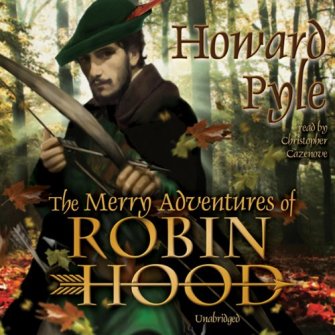
Book Review: The Merry Adventures of Robin Hood

Legends of Robin Hood have been floating around since the 14th century. Scholars debate whether early ballads and stories were based on a real person. In his earliest versions, Robin was just a crook, sometimes short-tempered, according to Wikipedia. He did not rob from the poor, but he didn’t give to them, either. Some of the aspects we know of Robin survived from the earliest stories; others were added or adapted over the years. Wikipedia details Robin’s history and variations.

The Merry Adventures of Robin Hood was the first version written specifically for children by Howard Pyle in 1883. This is the version many films and later aspects of the story are based on.

In this story, Robin is a yeoman, which seems to be a type of middle class between peasants and aristocrats (other versions cast Robin as a nobleman). He first becomes an outlaw by shooting an arrow at someone who shot at him first, subsequently killing the man. This man happened to be related to the Sheriff of Nottingham, who thenceforth became Robin’s enemy.

As Robin hid out in Sherwood Forest, others soon came to join him. Some who were poor and hungry had killed the king’s deer and fled the law. Others had goods and land confiscated by the king and had nowhere else to go.

To support themselves, Robin and his “merry men” stopped rich travelers and “invited” them to feast in Sherwood Forest, then demanded payment of them. In some cases, Robin divided up the money gathered in this way into thirds, keeping a third for his men, a third for charity, and giving a third back. Robin justified this theft because he figured those he robbed had either gotten their gain unfairly or, like wealthy clergymen, were keeping for themselves what they should be giving to others.

The poor loved Robin because he helped many of them. The classes that Robin robbed from, obviously, did not.

This book details many of the well-known stories about Robin—his first bout with Little John, his altercation of Friar Tuck (someone not in the earliest legends), the archery match in Nottingham where Robin went in disguise. Maid Marian in mentioned but never appears. Other stories I had not heard of were included as well, like how Robin met and helped Allen-a-dale to free his beloved from an arranged marriage, Robin’s deadly run-in with villain Guy of Gisborne, the recruitment of Midge, the Miller’s Son, and other tales.

The book came to a very satisfying end, until it got to the epilogue, where Robin’s death by betrayal is told.

There is an odd mention of “Cain’s wife had never opened the pottle that held misfortunes and let them forth like a cloud of flies to pester us.” That sounds like a convoluted version of Pandora’s box. And I chuckled at his phrase because a former pastor used to say it, and I didn’t know it came from this book: “There is many a slip betwixt the cup and the lip,” meaning plans don’t always work out like we hoped. Maybe it was a common saying that Pyle incorporated.

As I first started listening to the audiobook, I wished I had known of and read this book to my boys. The more I heard, though, the more I wrestled with whether that would have been a good idea or not. There’s something appealing about this version of Robin, “honest … in his own way”: someone who stands up for the little guy, who “never harmed harmless man,”  rights wrongs, bests the foolish and evil. But I could never condone vigilantism, for many reasons. And many differences in the book are solved by fighting. Plus there are copious amounts ale, beer, and the like consumed. If we had read the book as a family, we would have had to stop and discuss a lot of issues along the way. Setting aside those objections, though, the rest was fun.

There are many film version of Robin, but the only one I ever saw was the animated Disney one. I’ve seen the character in some shows like Once Upon a Time and Shrek.

I listened to the audiobook superbly read by Christopher Cazenove in a voice and accent perfect for this type of tale. Project Gutenberg has a version online here.

I read/listened to this book for the Back to the Classics challenge, but I am not sure which category to place it in yet. It would fit in two or three. I’ll wait til I read some others and then see where to place this one.

Have you ever read this version of Robin Hood? What did you think?

(Sharing with Carole’s Books You Loved, Booknificent)

Back to the Classics Challenge Wrap-up 2019

btcc reading challenge 2019

Karen at Books and Chocolate hosts the Back to the Classics Challenge. She came up with categories and we come up with a classic at least 50 years old to fit each category. She also gives away a prize – a $30 gift card to Amazon.com or The Book Depository. You get one entry for the prize drawing for six categories completed, two entries for nine categories completed, and three entries if you complete all twelve.

The classics I read this year were (titles link back to my reviews):

A.19th Century ClassicThe Mill on the Floss by George Eliot (1860)(Finished 7/15/19)

B. 20th Century Classic (published between 1900 to 1969): How Green Was My Valley by Richard Llewellyn (1939) (Finished 3/20/19)

C. Classic by a Woman AuthorA Little Princess by Frances Hodgson Burnett (1905)(Finished 2/14/19)

D. Classic in Translation (written originally in a language different from your own): Swiss Family Robinson by Johann David Wyss (Finished 11/23/19)

E. Classic Comic Novel. The Pickwick Papers by Charles Dickens (1836)(Finished 5/20/19)

F. Classic Tragic Novel. Wuthering Heights by Emily Bronte (1847)(Finished 6/12/19)

G. Very Long Classic (500 or more pages): Anna Karenina by Tolstoy (Finished 9/11/19)

H. Classic Novella (250 or fewer pages): The Inheritance by Louisa May Alcott, 150 pages. (1849)(Finished 6/23/19)

I. Classic From the Americas (includes the Caribbean). The Magnificent Ambersons by Booth Tarkington. (1918)(Finished 9/24/19)

J. Classic From Africa, Asia, or Oceania (includes Australia). Moby Dick by Herman Melville. (Finished 10/28/19)

K. Classic From a Place You’ve Lived. The Gilded Age by Mark Twain and Charles Dudley Warner (Finished 12/16/19)

L. Classic Play. King Lear by William Shakespeare. (Finished 12/28/19)

Karen likes for us to compute how many entries we earned: I read all twelve, so I have three entries.

I enjoy this challenge because it broadens my horizons. I would not have read some of these books if not for this challenge. I have not seen anything yet about this challenge for next year, and I’m sorry that it looks like it won’t continue. But I’ll keep reading classics. Someone has said that a classic is a book that has never finished saying what it has to say. These books still speak today.

Do you like to read classics? Have you read any of these?

Book Review: The Gilded Age

The Gilded Age: A Tale of Today is not one of Mark Twain’s more well-known books. It’s the only one he wrote with a collaborator, Charles Dudley Warner, who was also a friend and neighbor. The story goes that their wives challenged them “to write a better novel than what they were used to reading.”

But this book is distinctive for an additional reason: its name became applied to the era after Reconstruction until the 1900s. According to this site, “American economy grew at its fastest rate in history” during this period. Such a rise gave way to more industrialization and a class of sudden and ultra-wealthy citizens. “The period also was marked by social movements for reform, the creation of machine politics, and continued mass immigration.” according to the same site.

Twain’s and Warner’s novel satirizes much that was characteristic of the era. But the story itself focuses on a few individuals.

The Hawkins family is poor but decent, located in Obedstown, TN. The family patriarch, Si, has bought 75,000 acres of Tennessee land. It’s not worth much at present, but with the expected changes on the horizon—the expansion of the railroad and discovery of coal for fuel—Si expects some day the land can be sold for a fortune and provide for his children.

In the meantime, their old friend Eschol Sellers has written to urge them to come to Missouri for the wealth of opportunities there. Mrs. Hawkins supports her husband’s decisions, but following Sellers has not boded well for them in the past. He means well, but he always comes up with grand schemes that never quite work out as expected.

On their way, they acquire two more children by adoption who have been newly orphaned. Their fortunes go up and down—mostly down. Si is tempted to sell the Tennessee land several times, but holds out. The older children venture out to work and help the family.

Parallel to the Hawkins and Sellers story is that of two friends, Harry and Phillip, who set put to make their fortune by becoming civil engineers for the railroad. Harry seems like a more refined version of Sellers, but Phillip is earnest and wants to truly learn the job.

The young men eventually cross paths with Laura Hawkins, the adopted daughter who has grown into a fascinating beauty. Henry is smitten. Laura is not unkind, but neither is she interested in Henry. Phillip is also in love with a girl who wants to become a doctor and isn’t interested in committing herself to a relationship.

Laura has an unfortunate relationship with a man who swept her off her feet and encouraged her to elope. When he gets tired of her, he confesses that he was already married and therefore his marriage to her was a sham. He leaves her. Laura changes as a result, becoming more calculating and ruthless.

Sellers, Laura, and Washington Hawkins end up in Washington DC in a grand scheme to get Congress to buy the Tennessee land to establish a college for Negroes. The book’s authors seems to believe that there is not a sincere, uncorrupt senator or representative, and we see a lot of the machinations of the political process: “The chances are that a man cannot get into congress now without resorting to arts and means that should render him unfit to go there.”

Some of the characters end in tragedy. Some are singed by circumstances but wiser in the end. A couple receive a hard-won happy ending.

Some sections are autobiographical. Twain’s biography says that his father had his own version of Tennessee land that always seemed to hold out hope for a good future, and his brother was killed in a steamboat accident similar to the one that orphaned Laura. One section of the book describing Phillip has a footnote that his life to that point mirrored Warner’s.

I understood how the book’s title could be applied to the era. Of course, the era wasn’t named the Gilded Age at the time Twain and Warner wrote. So, though they were satirizing the times, I think they also might have been pointing out the futility of so many individuals in the story who were seeking after the next great elusive thing instead of settling down and working hard for their goals and livelihoods.

Though this book is satire, it also has some wonderfully sweet and poignant moments.

The book kind of dragged in the middle for me, with the young men’s relationships and everyone’s schemes not going anywhere. But it picked up again in the end, with some parts being riveting.

There are a few “damns” in it. The portrayal of black people was probably accurate to the times but is condescending and insensitive in places.

Eschol Sellers’ first name is different in some versions because a real Eschol Sellers showed up and protested after the book was first published. Sellers was based on a cousin of Twain’s who was influential in his father’s land deal.

A few of my favorite quotes:

He . . . was not wanting in courage, but be would have been a better soldier if he had been less engaged in contrivances for circumventing the enemy by strategy unknown to the books. It happened to him to be captured in one of his self-appointed expeditions, but the federal colonel released him, after a short examination, satisfied that he could most injure the confederate forces opposed to the Unionists by returning him to his regiment.

There are many young men like him in American society, of his age, opportunities, education and abilities, who have really been educated for nothing and have let themselves drift, in the hope that they will find somehow, and by some sudden turn of good luck, the golden road to fortune. He was not idle or lazy, he had energy and a disposition to carve his own way. But he was born into a time when all young men of his age caught the fever of speculation, and expected to get on in the world by the omission of some of the regular processes which have been appointed from of old. And examples were not wanting to encourage him.

Whatever her thoughts may have been they were unknown to Philip, as they are to these historians; if she was seeming to be what she was not, and carrying a burden heavier than any one else carried, because she had to bear it alone, she was only doing what thousands of women do, with a self-renunciation and heroism, of which men, impatient and complaining, have no conception. Have not these big babies with beards filled all literature with their outcries, their griefs and their lamentations? It is always the gentle sex which is hard and cruel and fickle and implacable.

I listened to the audiobook wonderfully read by Bronson Pinchot. He did an amazing job with the nuances, inflections, and numerous accents. One nouveau riche character is Irish but has traveled in France and changed her last name to a French pronunciation. Bronson nails an Irish accent trying to sound French as well as a variety of Southern accents.

This book first came to my attention when I was searching for a book set in TN for the “Classics from a place you have lived” category of the Back to the Classics challenge. As it turned out, only parts of the book take place in TN. But many of the main characters are from TN, and the “Tennessee land” is almost a character itself, so I am hoping this book will still qualify.

Have you ever read this book? What did you think?

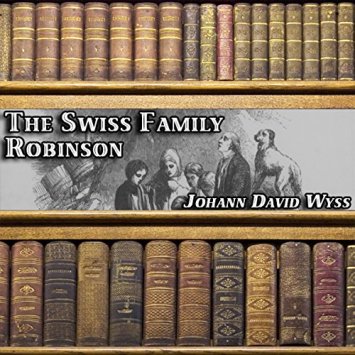
Book Review: The Swiss Family Robinson

Finding a good translation of Swiss Family Robinson is not as easy as one would think.

The book was written by a Swiss pastor, Johann David Wyss, and originally published in 1812. Wyss wrote the story for his sons to teach about spiritual and family values, industriousness, and wise uses of plants and animals. One of his sons edited the book and one of them illustrated it (both named Johann, like their father, but with different middle names).

After that, the book passed through multiple hands which translated and added to or deleted from the story. I listened to an audiobook version and scanned a Kindle version which were alike at the beginning but had different characters and scenes in the second half.

The story, as I am sure you know, involves a family of two parents and four sons shipwrecked on an island somewhere in the East Indies. The family name is not Robinson: their last name is never mentioned. The book is styled somewhat after Robinson Crusoe: he is even referred to often in the book.

Their first order of business is to get as much as they can off the ship before it sinks and to find suitable shelter. They are able to gather some food from the ship, but then need to search the island to see what they can find.

Fortunately, the father has a wealth of knowledge of botany. He knows the scientific names of plants as well as their uses.  One book I read recently said ministers of a certain era were expected to know a lot about botany. That may be the case here, or it may have just been an interest of Wyss’, or he may have crammed as much as possible into the story as a teaching tool.

They also get acquainted with the fauna as well as the flora. They use some animals as food and tame others to help them in their work.

The first half of the book details how they discovered the resources of the island and made a place for themselves. The only real danger they run into is a pack of jackals.

At the end of this section (what I think is the end of the original book), the family is content on their island and want to remain there. They’ve constructed various building projects and have plans for a sawmill and other industries. The father’s only concern is that his children will be alone when he and his wife pass on.

In the version I listened to, the father then espies a vessel at sea after about four years on the island. He meets a couple of men from the ship and gives them the journal he has kept. The men were exploring the island to see if it was suitable for the ship to land. They plan to put their people on boats and bring them in the next day. But a storm drives them out to sea again, and the family fears they ship is lost.

There’s a lot more drama in the second half: a couple of serious injuries, a massive storm, encounters with “savages” from another island. They discover a European missionary and a widow with two daughters on this island. The ship they had encountered was not lost at sea, but eventually made it home, along with the father’s journal. Another ship comes back to find them, and then decisions are made as to their future.

In the Kindle version, which happened to be the Kingston translation and is apparently more well known, the time jump in the second half is closer to ten years. The family discovers a girl who has been shipwrecked, Jenny Montrose. Eventually a ship comes looking for her, and decisions have to made about everyone’s future.

The first part is interesting, but a little dry, since the only action is discovering certain plants and animals, building a couple of different homes, handling whatever problems come up. The second half drew me in more since there was more action.

The four boys’ personalities are well-drawn and distinct.

Christian values form a major part of the story. The father corrects the children in various ways (especially in manifestations of pride). The family prays together, keeps Sunday set apart, applies Christian principles to life. One example, when they first discover the sailors on the ship have left them behind:

See how those on whose skill and good faith we depended have left us cruelly to our fate in the hour of danger. God will never do so. He has not forsaken us, and we will trust Him still. Only let us bestir ourselves, and each cheerily do his best. Who has anything to propose?

All in all, it was an enjoyable story. It was written for young people, but I wonder how it reads for young people now.

Near the end, the father in the story writes:

And my great wish is that young people who read this record of our lives and adventures, should learn from it how admirably suited is the peaceful, industrious and pious life of a cheerful and united family, to the formation of strong, pure and manly character.

You’re probably familiar with the 1960 Disney film version (which added pirates to the mix). We saw it ages ago, but I’d like to see it again some time now that I’ve read the book. There have been various other film versions as well. When my children were young, we saw a cartoon series version from the viewpoint of a daughter.

Besides Wikipedia, a couple of interesting articles about the book are:

I read this book for the Classics in Translation category of the Back to the Classics challenge.

Have you ever read Swiss Family Robinson? What did you think?

(Sharing with Literary Musing Monday, Carole’s Books You Loved, Booknificent)

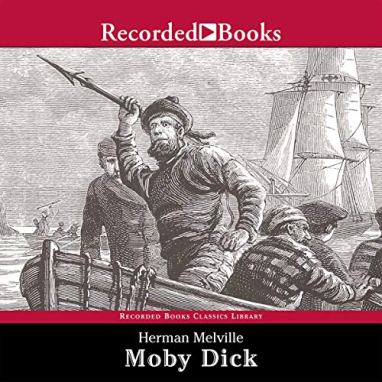
Book Review: Moby Dick

According to Wikipedia, Herman Melville wrote to his publisher that he was working on “a romance of adventure, founded upon certain wild legends in the Southern Sperm Whale Fisheries, and illustrated by the author’s own personal experience, of two years & more, as a harpooneer.” That book was Moby Dick, based on a real whale named Mocha Dick.

Unfortunately, the book did not do well during Melville’s life time. Interest in it was renewed at the centennial of his birth, with many then praising it.

One of literature’s most famous opening lines, “Call me Ishmael,” may indicate that Ismael is not his real name. On the other hand, most of the characters go by one name, first or last, so maybe Ishmael sets the precedent right off the bat. Ishmael is not a full-time seaman. He is a schoolmaster who gets a hankering to go out to sea sometimes when land life gets too much for him. He’s a loquacious narrator, telling minute details of the story, giving several examples of a concept, and going into teacher mode to describe whaling practices, features of the whale, whales depicted in art and why the artists get them wrong, etc. etc.

Ishmael starts off making his way to Nantucket to look for a sailing vessel. He explains that instead of going to sea as a passenger who has to pay, he goes as sailor who gets paid for the voyage. The inns are crowded, so he has to share not only a room, but a bed with a stranger. He’s mortified to discover in the middle of the night that his bedmate is a cannibal, Queequeg. But eventually the two become fast friends.

They are hired for the Pequod, a whaling vessel, by the owners. They don’t meet the captain yet, as he is recovering from an illness.

Even before they set sail, foreshadowings abound that something dire might happen. The preacher in Nantucket gives a sermon about Jonah and a strange man calling himself Elijah gives cryptic warnings.

The sailors meet the three mates with vastly different personalities. Starbuck, the first mate, is 30, thin, serious, pious, a bit superstitious, courageous but not foolish. The second mate, Stubb, was “happy-go-lucky; neither craven nor valiant; taking perils as they came with an indifferent air; and while engaged in the most imminent crisis of the chase, toiling away, calm and collected as a journeyman joiner engaged for the year. Good-humored, easy, and careless, he presided over his whale-boat as if the most deadly encounter were but a dinner, and his crew all invited guests.” It was quite funny to hear how Stubb both scolded and encouraged his crewmen when they were in the thick of capturing a whale. The third mate, Flask, was “short, stout, ruddy young fellow, very pugnacious concerning whales, who somehow seemed to think that the great leviathans had personally and hereditarily affronted him; and therefore it was a sort of point of honor with him, to destroy them whenever encountered.”

We don’t see Captain Ahab until chapter 28. He’s described as grim with grey hair and a scar down one side of his face. He had lost one leg and replaced it with a prosthesis made of whale bone. Later he tells the crew that he had lost his leg in a battle with a legendary white whale named Moby Dick, and his main mission is finding and exacting his revenge on the whale.

As the Pequod meets up with other boats (which meetings are called gams), Ahab has no interest in chatting with the other captains about anything except whether they’ve seen Moby Dick.

If you’re at all familiar with the story, you know the voyage doesn’t end well.

Ahab’s mission is more of an obsession. Though Starbuck tries to talk Ahab out of his vengeance, Ahab won’t listen.

When Melville is telling the story, it’s as exciting, riveting, and hard to put down as anything I’ve ever read. But interspersed between story incidents are detailed explanations and Ismael’s thoughts about everything that could possibly be connected with whales and whaling. Wikipedia cites various theories about the reasons behind the book’s layout. Some of these side excursions are interesting, some boring. With some, you wonder if the narrator is writing tongue in cheek, like when he posits that perhaps St. George’s dragon was actually a whale. He wonders what the stuff the whale spouts is made up of and muses:

He is both ponderous and profound. And I am convinced that from the heads of all ponderous profound beings, such as Plato, Pyrrho, the Devil, Jupiter, Dante, and so on, there always goes up a certain semi-visible steam, while in the act of thinking deep thoughts. While composing a little treatise on Eternity, I had the curiosity to place a mirror before me; and ere long saw reflected there, a curious involved worming and undulation in the atmosphere over my head. The invariable moisture of my hair, while plunged in deep thought, after six cups of hot tea in my thin shingled attic, of an August noon; this seems an additional argument for the above supposition.

When he comments that pirates think themselves above whalers:

I should like to know whether that profession of theirs has any peculiar glory about it. It sometimes ends in uncommon elevation, indeed; but only at the gallows. And besides, when a man is elevated in that odd fashion, he has no proper foundation for his superior altitude. Hence, I conclude, that in boasting himself to be high lifted above a whaleman, in that assertion the pirate has no solid basis to stand on.

Ishmael comments on his own storytelling:

So far as what there may be of a narrative in this book; and, indeed, as indirectly touching one or two very interesting and curious particulars in the habits of sperm whales, the foregoing chapter, in its earlier part, is as important a one as will be found in this volume; but the leading matter of it requires to be still further and more familiarly enlarged upon, in order to be adequately understood, and moreover to take away any incredulity which a profound ignorance of the entire subject may induce in some minds, as to the natural verity of the main points of this affair.

Like a lot of older books, this one has some Christian overtones. But I wouldn’t call it a Christian book. Ismael calls himself a Presbyterian, but I disagreed with Ishmael when he felt that joining in with Queequeg’s worship of a little idol he carried around with him was doing unto his neighbor as he would want his neighbor to do to him—not with all that the Bible says about idols. Starbuck is probably the closest to a genuine Christian. Ahab is full-out blasphemous.

I listened to the audiobook superbly read by Frank Muller. When the narration first started, I was disappointed Muller didn’t give Ishmael and craggy old sea-dog kind of a voice. But then I quickly realized that voice would not have been right for Ishmael as an educated man who was not a full-time sailor. Muller does give that kind of voice to Ahab, though, to great effect. Muller did all the voices and inflections well, and I am thankful I experienced the book with this narration.  I also read some parts online via Project Gutenberg here.

I read (or listened to) Moby Dick for the Back to the Classics Challenge category of a “Classic From Africa, Asia, or Oceania (includes Australia).” Moby Dick covers a lot of territory—in fact a beautifully illustrated map is here. But a great chunk of the plot takes place in the waters between those continents.

(Sharing with Carole’s Books You Loved, Booknificent)

Book Review: The Magnificent Ambersons

Booth Tarkington won a Pulitzer prize for The Magnificent Ambersons, set in Indiana in the late nineteenth to early twentieth centuries.

One one level, the story focuses on Georgie Amberson Minifer, only grandchild of the great Major Amberson. “His grandfather had been the most striking figure of success in the town: ‘As rich as Major Amberson!’ they used to say.” The town was proud of the Major, and his mansion was the big finale when people took visitors on a tour. But Georgie was considered a “princely terror” who felt his entitlement even as a child. Many people looked forward to the day when Georgie would “get his comeuppance.”

As a reader, I began to look forward to the same thing and wondered how it would come about. I also wondered if it would be the ruin of him or the making of him. Even though Georgie is not a likeable character at first, one does feel sorry for him during his “comeuppance.”

On another level, the book masterfully conveyed the changes of the times: the advent of the automobile, which many considered just a fad at first; the growth of the little town into a big city with the problems that kind of growth can bring; the decline of “old families” and their pedigrees and the rise of industrialism and entrepreneurship.

But automobiles have come, and they bring a greater change in our life than most of us suspect. They are here, and almost all outward things are going to be different because of what they bring. They are going to alter war, and they are going to alter peace. I think men’s minds are going to be changed in subtle ways because of automobiles; just how, though, I could hardly guess. But you can’t have the immense outward changes that they will cause without some inward ones, and it may be that George is right, and that the spiritual alteration will be bad for us.

The city was so big, now, that people disappeared into it unnoticed, and the disappearance of Fanny and her nephew was not exceptional. People no longer knew their neighbours as a matter of course; one lived for years next door to strangers—that sharpest of all the changes since the old days—and a friend would lose sight of a friend for a year, and not know it

A big part of the first chapter describes the various ways the rich distinguished themselves in fashion, facial hair, architecture, and such. It was an enjoyable observation of changing styles. I found it interesting that the term “hand-me-downs” came not from getting clothes that had belonged to someone else, but from getting them “off the shelf” rather than specially made from a tailor: “Trousers with a crease were considered plebeian; the crease proved that the garment had lain upon a shelf, and hence was ‘ready-made’; these betraying trousers were called ‘hand-me-downs,’ in allusion to the shelf.”

It took me just a bit to get into the story, as it begins with a heap of description. One thing I most appreciated about Tarkington’s writing was his skill in conveying things to the reader through Georgie’s eyes that Georgie himself missed. For instance, various people comment on his father not looking well, but Georgie thinks he looks just as he always did—and then Georgie is surprised to find out his father really is ill. Georgie’s fairly young throughout the book, so he’s forgiven for a bit of immaturity. But his lack of understanding other people or situations comes more from his exalted view of his own opinion.

Gossip can be a problem for anyone, but it’s a partuclar bane for the rich and famous. I found the advice Georgie’s uncle George gave him worth consideration:

In this town, naturally, anything about any Amberson has always been a stone dropped into the centre of a pond, and a lie would send the ripples as far as a truth would.

“Gossip is never fatal, Georgie,” he said, “until it is denied. Gossip goes on about every human being alive and about all the dead that are alive enough to be remembered, and yet almost never does any harm until some defender makes a controversy. Gossip’s a nasty thing, but it’s sickly, and if people of good intentions will let it entirely alone, it will die, ninety-nine times out of a hundred.”

People who have repeated a slander either get ashamed or forget it, if they’re let alone. Challenge them, and in self-defense they believe everything they’ve said: they’d rather believe you a sinner than believe themselves liars, naturally. Submit to gossip and you kill it; fight it and you make it strong. People will forget almost any slander except one that’s been fought.

Nobody has a good name in a bad mouth. Nobody has a good name in a silly mouth, either.

I also found especially interesting the Major’s thoughts when he knows his time is coming near:

The Major was engaged in the profoundest thinking of his life. No business plans which had ever absorbed him could compare in momentousness with the plans that absorbed him now, for he had to plan how to enter the unknown country where he was not even sure of being recognized as an Amberson—not sure of anything, except that Isabel would help him if she could. His absorption produced the outward effect of reverie, but of course it was not. The Major was occupied with the first really important matter that had taken his attention since he came home invalided, after the Gettysburg campaign, and went into business; and he realized that everything which had worried him or delighted him during this lifetime between then and to-day—all his buying and building and trading and banking—that it all was trifling and waste beside what concerned him now.

For those who would want to know, the book has a few objectionable elements: a smattering of bad words and taking the Lord’s name in vain, the condescending view of “darkeys” and a couple of uses of the “n” word, and one character visiting a medium. That character (not Georgie) said he wasn’t superstitious, only believed what the medium said for about ten minutes, and realized he had inadvertently supplied her with information enough for what she told him. But the incident was a major turning point in his attitude, and I was disappointed Tarkington used it to bring that about.

Wikipedia says, “In the 1910s and 1920s, Tarkington was regarded as the great American novelist, as important as Mark Twain.” I’m nor sure why he’s not read as much today. I’m thankful I chose this book for the Classics from the Americas category of the Back to the Classics challenge. I enjoyed Tarkington’s story and insights very much.

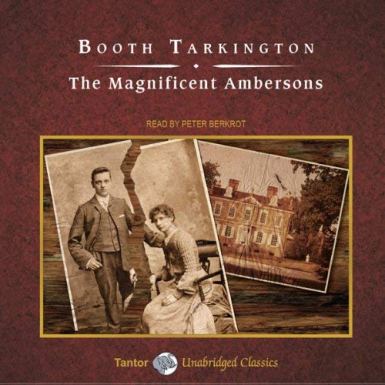
I mostly listened to the audiobook read by Peter Berkrot, but I read the last few chapters in the free Kindle version because I can read faster than the narrator does, and I wanted to finish it. It’s also online free through Project Gutenberg. There are a couple of movie versions of the book, but I haven’t seen any of them.

(Sharing with Carole’s Books You Loved, Booknificent Thursday)