Laudable Linkage

Laudable Linkage

Here are some of the good reads found this week:

Contentment Isn’t Only for Hard Times, HT to Challies. “I was about as happy as a person could be. I say ‘about’ because one unwelcome thought intruded: It’s not going to last. I was only visiting for a couple of weeks, and then I’d be back to the daily grind of work and responsibilities. In that moment, amid deep joy, the grace of contentment was just as essential as it is when my life is falling apart. I need contentment to receive God’s immense blessings gratefully, even knowing they’re temporary.”

It’s OK to Be OK, HT to Challies. “We need to fight two battles at once. We need to keep telling people that life is hard, the world is fallen, and we all fall short in sin. It’s OK to struggle, and when we do, we need to ask for help . . . However, we don’t need to equate authenticity with struggle. We need to leave room for people to be authentically happy—for life to go well sometimes.”

On Magic. “What is magic, in essence? It’s an attempt to get the gods to do what you want. And that is to turn the universe upside down and inside out. God is not our servant; he is not here to do what we want. We are here to do what he wants. If I do this or this or that, God will do what I want. That’s, ironically, godless thinking.”

Don’t Be Proud of What You Had No Say In, HT to Challies. “Many of the things that people tend to be proud of are things that we have no say in at all,” like height, natural beauty and abilities. “There is a difference between a gift and a talent. A gift is something you receive that you did not earn. A talent is something that you have developed over time, often based on a gift you have received.”

15 Resolves for Maintaining Spiritual Balance in Severe Interpersonal Conflicts, HT to Challies. I’d add one that has been a help to me: remembering the other person is beloved by God, and God wants the highest and best for that person, too.

Beware the Instagram Bible. I think I shared this a few years ago, but I needed to look it up again this week. “Beware the Instagram Bible, my daughters—those filtered frames festooned with feathered verses, adorned in all manner of loops and tails, bedecked with blossoms, saturated with sunsets, culled and curated just for you. Beware lest it become for you your source of daily bread. It’s telling a partial truth.”

When You Can’t Forgive Yourself After an Abortion, HT to Challies. Although the context is about abortion, the truths here are good for anyone who feels they can’t forgive themselves for something they have done.

Updated to add: I stay away from politics here on the blog, but I wanted to say I was saddened and shocked by the events of last weekend. Violence is not the answer no matter what party one is in.

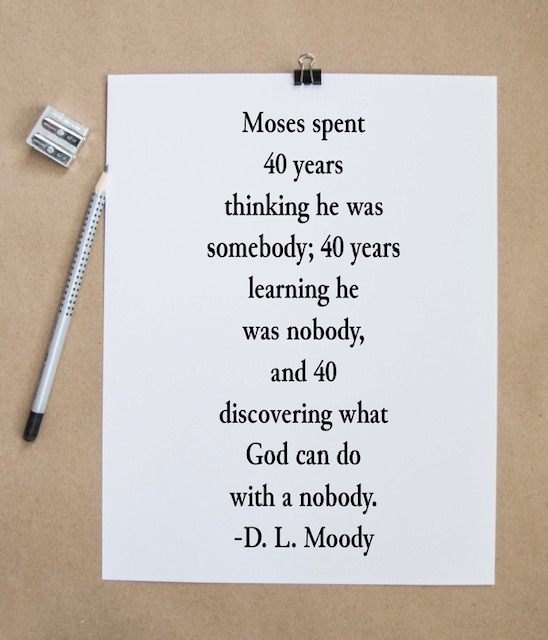
D. L. Moody quote about what God can do with a nobody

Moses spent 40 years thinking he was somebody; 40 years learning he was nobody,
and 40 discovering what God can do with a nobody. — D.L. Moody

When You’re Not the Chosen One

When you're not the chosen one

We probably all know what it’s like not to be chosen in some way.

Some of us were always among the last chosen for any kind of physical game. Others were chosen last for the spelling bee.

We might not have been chosen for cheerleader, class president, or homecoming queen. Perhaps the person we liked in college chose someone else.

As adults we might not get the expected promotion or desired assignment.

As writers, we watch others get agents or contracts or win contests while we don’t seem to be making any progress.

I thought of this in the contrasting reactions of Esau and Jonathan in the Bible. In the normal scheme of things, each would have succeeded his father as leader. But God chose someone else instead.

Esau was the oldest son in his family, a position of privilege and honor in Bible times. Yet before he and his twin brother, Jacob, were even born, God said “the older shall serve the younger” (Genesis 25:23). Neither of them were ideal sons, but this pronouncement was made before they had done anything.

What was Esau’s response when Jacob received the birthright and blessing that would normally have gone to Esau? He hated Jacob and planned to kill him after their father died. (Genesis 27:41). Granted, Jacob obtained those things by deception and manipulation rather than waiting for God’s timing. But Esau had shown by his previous actions where his values were.

Jonathan was the oldest son of Israel’s first king, Saul. God rejected Saul due to his disobedience (1 Samuel 15). Jonathan could have ranted and raved that it wasn’t his fault that his father disobeyed God. Jonathan had good character and a good reputation. Why not make him king instead of his father?

But Jonathan didn’t grouse and complain and whine. He protected David from the machinations of Saul.

Years later, David had his own “not chosen” moment.

David wanted to build a temple where people could worship God. Nathan, the prophet of God, thought that was a good idea.

But that night, God told Nathan that David was not to build the temple. One of his sons, Solomon, would. God had other things, great things in store for David.

Did David sulk? No, he responded in humility, thankfulness, and love. Then he did everything in his power to help and prepare Solomon.

What are some things we can learn from not being the chosen one?

Sometimes not being chosen has nothing to do with merit. Jonathan was a fine, godly young man. But God had chosen David to be the next king.

But sometimes not being chosen does result from one’s actions. Saul lost his kingship because of disobedience. He still could have repented and gotten right with God, even if he was never reinstated as king. But he didn’t. Others in Scripture were removed from their positions for disobedience as well.

God sets up one and puts down another (Psalm 75:6-7). Sometimes we’ve prayed hard and long for election results that did not go the way we thought they would. All we know is that God has the big picture in mind.

God gives gifts and abilities. Though I probably could have worked hard and improved in playing some athletic game, if I had wanted to, I would never have been a star athlete. My gifts were elsewhere.

One of my favorite passages tells how God gifted different people to do various kinds of work on the tabernacle, even down to those who worked with metal, wood, weaving, and embroidery. The New Testament lists different spiritual gifts God distributes to Christians. One of those passages is 1 Corinthians 12, where Paul goes on to compare the church to a body, where it would be strange if we were all eyes or hands. We need different parts of the body to perform their function.

God has a plan for us. He may have chosen someone else for the particular opportunity we had in mind. But that doesn’t mean we’re on the bench. We need to seek His will for us and serve in the capacity He brings before us.

We can help and support the chosen one. Just as Jonathan helped David and David helped Solomon, we can aid the person chosen to do what we wanted to do.

One of our former pastors said he viewed his position as that of Elisha, who “poured water on the hands of Elijah” (2 Kings 3:11). That phrase conveys service and attending to the needs of another. This associate pastor wanted to serve and help the senior pastor as much as he could.

We can be content in God’s will and calling. In the book On Asking God Why, Elisabeth Elliot tells of a time when missionary Amy Carmichael was to attend a missions conference with a dear friend, nicknamed Twin. But when she saw the list of assigned seats for dinner, Twin was to be seated next to another friend, Mina. Amy wrote to her family:

Well, I was very glad that dear Mina should have Twin, and I don’t think I grudged her to her one little bit, and yet at the bottom of my heart there was just a touch of disappointment, for I had almost fancied I had somebody of my very own again, and there was a little ache somewhere. I could not rejoice in it. . .I longed, yes longed, to be glad, to be filled with such a wealth of unselfish love that I should be far gladder to see those two together than I should have been to have had Twin to myself. And while I was asking for it, it came. For the very first time I felt a rush, a real joy in it, His joy, a thing one cannot pump up or imitate or force in any way. . .Half-unconsciously, perhaps, I had been saying, ‘Thou and Twin are enough for me’–one so soon clings to the gift instead of only to the Giver.

It’s all about God’s glory and purposes. When Israel was going to fight against the Midianites who were oppressing them, God told Gideon his army was too big (Judges 7). They would be proud and attribute their win to their own abilities. God told Gideon to tell everyone who was afraid to go home: 22,000 did, leaving 10,000 still ready to fight. God said that was still too many. He sent them all to some nearby water to get a drink. Some of the men bent down and lapped the water like a dog. Others knelt down and cupped the water into their hands to drink. I’ve heard many sermons where the preacher read between the lines and proposed all kinds of reasons why God chose one group over the other. But that’s just speculation. The Bible doesn’t give us God’s reasoning. Personally, I think God just chose whichever group was the smallest. The 300 who lapped went on and won a miraculous victory that showcased God’s power, not their own.

Amy Carmichael’s original ministry in India involved evangelizing women. God used her remarkably in that capacity. Then she learned that little girls were being sold into temple prostitution.  Elisabeth Elliot writes that Amy “prayed that God would enable her to find a way to rescue some of them, even though not one had ever been known to escape. Several years later, God began to answer that prayer…and in a few years Amy Carmichael was Amma (“Mother”) to a rapidly growing Indian family that, by the late 1940s, numbered about 900.” Amy struggled a bit with the fact that this ministry to girls (which later included boys) was quite different from what she had been doing. She was even criticized in some corners. But she felt that teaching, training, protecting, and taking care of children was only a different ministry, not  lesser one.

Elisabeth Elliot wrote this about jobs, but it’s true for positions and ministries and opportunities as well:

This job has been given to me to do. Therefore, it is a gift. Therefore, it is a privilege. Therefore, it is an offering I may make to God. Therefore, it is to be done gladly, if it is done for Him. Here, not somewhere else, I may learn God’s way. In this job, not in some other, God looks for faithfulness.

In a sense, we’re all chosen. We may not have gotten what we originally wanted. But for those who trust in Christ’s saving work on the cross to atone for their sins, “we are his workmanship, created in Christ Jesus for good works, which God prepared beforehand, that we should walk in them” (Ephesians 2:10). Whether we serve out in front or in obscurity, in a desired or unwanted position, with people who love us or people who try us, we can serve God by His grace, for His honor and glory.

Ephesians 2:10

(I often link up with some of these bloggers.)

Laudable Linkage

Laudable Linkage

Here’s some of the good blogging that particularly resonated with me this week:

The One Thing We All Need Right Now. “Never mind for a minute about platforms and hashtags, soap boxes and sides, movements and slogans. There’s really only one solution, one remedy, one antidote to the sickness that plagues our world today.”

Fighting for Faith When Doubts Abound, HT to Challies. “If my child is in danger, I would do whatever I could to rescue him or protect him from it. If I were to sit idly by and do nothing, I certainly wouldn’t be a very good and loving parent. But I’ve learned that I too often come to conclusions about who God is by interpreting a circumstance through the limited understanding of my humanity.”

A Hope-Filled Message for the Tired, Worn, and Overwhelmed. “It’s been a tough season, hasn’t it? I don’t know your specifics, but the effect those circumstances are having on your heart, body and mind? I think I can make some experience-informed guesses about that, and here’s what I want to say about it. Don’t equate how you feel today with your worth, your usefulness, your attractiveness or your future fruit-bearing potential.

Contentment Doesn’t Mean You Must Stay in the Same Circumstance Forever, HT to Challies. I wondered about this in the past: if we’re to be content in all things, should we not try to change our circumstances? This gives a valid answer.

Treasures in Jars of Clay, HT to Challies. “As a missionary, I often feel like family members, friends, and supporters put us on a pedestal. That my sacrifice and calling as a missionary in Uganda are far beyond what any “normal” Christian would be able to manage. 2 Corinthians 4 gives a beautiful description of reality though. I am only a clay jar. A plain, fragile clay jar.”

Rescuing Abraham, HT to Challies. A different and interesting take on the two situations in which Abraham said Sarah was his sister rather than his wife.

Three Powerful Reasons You Should Tell Your Story. “The way you live your days will be, when all is said and done, the sum total of your story. Your story puts the gospel in context, demonstrates God’s generosity, and proves His faithfulness.”

God keeps His eye on the clock and His hand on the thermostat of affliction.

The quote above is from Be Exultant (Psalms 90-150): Praising God for His Mighty Works by Warren W. Wiersbe, p. 126.

Laudable Linkage

Here’s another round of good reads:

Do Christians Still Have Evil Desires? HT to Challies. “So, is the ground of judgment the acting out of sins, beyond merely harboring the impulse within? Or is this very tendency in us, a diminished but still present earthly desire towards sin’s allure, also ground for eternal judgment? Or is putting to death sin the complete eradication of evil desires from in us? Or is it (by grace) tamping down those desires that will always be there, but not acting out consistently on those impulses? If so, how would that apply to not just the acted-out sins, but specifically to ‘evil desires’?” John Piper answers these in a very helpful way.

Are You an Addict? “Chemicals are one of the ways that people, even God’s people, unbiblically cope with life’s trials. Others might immerse themselves in gaming, sex, or fantasy entertainment. Others use exercise, current events, food, dieting, obsession with sports teams, and even sleeping to escape from life’s realities. Many of these are good things, but they are being used in the wrong way. I had to take a long look at myself, and I found some unpleasant things that I had not even considered a problem before. I had to ask myself some difficult questions.”

Is There an Easy and Transformational Way to Study the Bible? “My dad was a kind man, but he demanded respect and obedience. When he spoke, he didn’t mean, ‘Hear my words, but do whatever you want.’ He meant, ‘Hear my words, understand what I’m saying, and respond in proper obedience.’ Our kind heavenly Father calls us to the same, if not a greater, level of hearing.”

6 Wrong Ways to Approach Difficult Passages, HT to Knowable Word. “It doesn’t take long for a Christian who’s studying the Bible to come across challenging passages. When we do, we should always remember the basics of interpretation: looking for the author’s intended message, reading it in context and with the whole of Scripture in view, even considering how believers throughout history have interpreted it. But following those principles isn’t enough. There are still common mistakes we can make when we study—or seek to teach from—difficult texts in Scripture.”

The Mustard Seed Mum: Pressured to Be Perfect? HT to Challies. “It’s not a competition, even if it feels like it. So what if your child’s best friend’s mother bakes brownies better than you? You’re the best mama for your kids. God put you in a position to look after these precious children. You can trust Him to help you do it.”

Looking for Contentment? It’s Not What You Think. “The more I reflect upon Paul’s letters, the more the Lord continues to refine my incomplete notions of contentment. Paul is not carefree, unburdened, and surrounded by trouble-free relationships. In fact, considering the larger picture of Paul’s ministry gives me a fuller picture of what contentment is by gaining insight into what it is not.”

Is There Such Thing As Random? How God Orchestrates People In His Perfect Timing. HT to Challies. “We don’t choose our moments of suffering, or the times we are pressed into service; they usually come on suddenly and without warning.”

Touch This Tree and You’ll Want to Die, HT to Challies. An interesting and awful natural phenomenon and a good object lesson.

How to Turn a Clique Inside Out, HT to Challies. “Close friendships are a wonderful blessing. But who are they blessing? In a clique, the blessings of friendship stay locked inside a tight circle of friends. The friends themselves tend not to notice, because they are too busy enjoying their own close relationships with each other. But for the people looking in from the outside, the view is not as pretty. They see backs, not faces.”

A Time to Hustle and a Time to Stroll. We tend one way or the other, but there’s a time for each.

And to end with a smile, I had not seen this particular Geico commercial about living in a Victorian house until Karen Wittemeyer shared it.

Happy Saturday!

A Christian Philosophy of Things

My daughter-in-law recently shared a scenario I remember occurring with my own children. Her son, my grandson, accidentally broke something and was upset. In an effort to comfort him, his parents assured him it was all right, it was just a thing, it could be replaced.

Then the next time something broke, he nonchalantly said, “It’s okay, we can get another one.”

It’s been a couple of decades since my own were very young, and I can’t remember how I handled this with them. I think over time and experience, they learned that accidents are ok, but deliberate destruction is not; some things can be replaced easily, some things cannot.

I’m not prone to watch talk shows, but I caught part of one years ago in which a child said that when he got into trouble for jumping on the couch, it made him feel like his parents loved the couch more than him. I remember thinking, “It’s not unloving to teach a child to take care of property.” But perhaps the way the situation was handled added fuel to the fire. I remember a song my parents used to listen to told a story about a man getting after his daughter about not messing up the grass in the yard that he had worked so hard to maintain. Now he had a beautiful yard, but he was estranged from his daughter.

It’s possible to love our “stuff” more than we love people, or at least to give them the impression that we do. But teaching a child to take care of things in itself is not putting the things above the child. I’ve known adults with an “Oh, well” attitude towards things which they probably think is non-materialistic, but which seems careless.

How do we find that balance between not esteeming things too highly or too carelessly?

Here are some principles that help me.

Everything we have belongs to God. We don’t have anything that didn’t ultimately come from God. We’re just stewards of our possessions.

“The earth is the Lord’s and the fullness thereof, the world and those who dwell therein” (Psalm 24:1).

Who has first given to me, that I should repay him? Whatever is under the whole heaven is mine. (Job 41:11)

“All things were made through him, and without him was not any thing made that was made” (John 1:3). Even if we grew, carved, crafted, or assembled something, the raw materials as well as the ability to do anything with them came from God.

We can’t take it with us. “As he came from his mother’s womb he shall go again, naked as he came, and shall take nothing for his toil that he may carry away in his hand (Ecclesiastes 5:15). Ecclesiastes speaks often of the vanity of working for things and then leaving them behind to someone else.

We’re accountable for what we do with our things. “One who is faithful in a very little is also faithful in much, and one who is dishonest in a very little is also dishonest in much. If then you have not been faithful in the unrighteous wealth, who will entrust to you the true riches? And if you have not been faithful in that which is another’s, who will give you that which is your own?” (Luke 16:10-12). “Moreover, it is required of stewards that they be found trustworthy” (1 Corinthians 4:2).

Good stewardship includes careful use of things. This verse always convicts me, and I like the way the KJV puts it: “The slothful man roasteth not that which he took in hunting: but the substance of a diligent man is precious (Proverbs 12:27). According to the Pulpit Commentary at the bottom of this page, this could refer to someone who caught game but was too lazy to roast it, so it went bad (that’s the part that convicts me when I clean rotted stuff out of the refrigerator), or someone who catches game but then doesn’t attend to it, so it escapes. Either way, the slothful, or lazy person, doesn’t attend to what he has, but “the substance of a diligent man is precious” (some translations say “prized.”)

I hate to see people throw out perfectly good items just because they don’t need or want them anymore. Sometimes people will come by and take for themselves anything you have on the streets to be thrown out. Some people like to “dumpster dive” for treasures. So maybe people who take their unwanted stuff to dumps figure someone might find it there. But our local recycling and trash center doesn’t allow anything to be taken out, probably for safety purposes. I don’t like to mess with sales, but I like to take any unused items in good condition to the local thrift store.

Possessions are not wrong. I fear that some in the minimalist camp equate what they consider excess as sin. There’s nothing in the Bible that says we have to live as starkly as possible. We shouldn’t be covetous, and we have to understand that things cost money and take up space and time to maintain. But different people have different tolerance levels for “stuff.” I used to wonder whether it was wrong to want to wear pretty clothes or decorate my home. But I realized that God could have made the world just utilitarian, yet He didn’t. He created a wonderful variety of vibrant colors, animals, flora, etc. Edith Schaeffer made a strong case for this in a chapter on Interior Decorating in The Hidden Art of Homemaking. One of her quotes there:

If you have been afraid that your love of beautiful flowers and the flickering flame of the candle is somehow less spiritual than living in starkness and ugliness, remember that He who created you to be creative gave you the things with which to make beauty and the sensitivity to appreciate and respond to His creation (p. 109).

Possessions are temporary. “Do not lay up for yourselves treasures on earth, where moth and rust destroy and where thieves break in and steal, but lay up for yourselves treasures in heaven, where neither moth nor rust destroys and where thieves do not break in and steal. For where your treasure is, there your heart will be also.(Matthew 6:19-21). 

Possessions can be idols. Jesus called one man who laid up many goods but did not prepare for eternity a “rich fool.” He reminded His listeners “one’s life does not consist in the abundance of his possessions” (Luke 12:15). The “rich young ruler” came to Jesus once to ask what he needed to do to get to heaven. Jesus told him to sell all he had and give it to the poor. Note: this is not something He says to everyone, but He knew that this man’s riches were an idol to him. The man “went away sorrowful, for he had great possessions” (Matthew 19:22). Jesus went onto say that it is “only with difficulty will a rich person enter the kingdom of heaven” (Matthew 19:23). Paul writes to Timothy:

 As for the rich in this present age, charge them not to be haughty, nor to set their hopes on the uncertainty of riches, but on God, who richly provides us with everything to enjoy. They are to do good, to be rich in good works, to be generous and ready to share, thus storing up treasure for themselves as a good foundation for the future, so that they may take hold of that which is truly life. (1 Timothy 6:17-19).

Possessions can be a distraction. Amy Carmichael told of a woman she was trying to share the gospel with in Japan. The weather was cold and Amy suffered from neuralgia, so she wore some fur-lined gloves. The women listened and seemed to be just about to turn to God when she noticed Amy’s gloves and asked about them.

She was old and ill and easily distracted. I cannot remember whether or not we were able to recall her to what mattered so much more than gloves. But this I do remember. I went home, took off my English clothes, put on my Japanese kimono, and never again, I trust, risked so much for the sake of so little (Frank Houghton, Amy Carmichael of Dohnavur, p. 59).

Similarly, in Isobel Kuhn‘s early ministry in China, she was a newlywed taking joy in setting up housekeeping. When a couple of Chinese women came to visit, she was thrilled to receive them. They were among the poorest people, and their culture was very different. One of the women blew her nose in her hands and wiped them on Isobel’s rug. The other held her child apart from her while the child wet on the rug. The women had dirt floors in their homes, so they were unaware they had done anything “wrong.” Isobel “managed to remain courteous” while the women were there. But once they left, “Hot resentment rose in my heart, and then there followed my first battle over things.” She concluded:

If your finery hinders your testimony throw it out. In our Lord’s own words, if thine hand offend thee, cut it off; He was not against our possessing hands, but against our using
them to hold on to sinful or hindering things.

So I faced my choice. In our first home—what was to come first? An attractive sitting-room just for ourselves? Or a room suited to share with the local Chinese?

Our engagement motto hung silently on the wall—God first. Mentally I offered that pretty rattan furniture to the Lord to be wrecked by the country peasants if they chose (Isobel Kuhn, Whom God Has Joined, pp. 21-22).

When they moved to their next station, she sold these items and bought easily washable furnishings like the Chinese had.

We’re commanded to be generous. It’s easy to look at millionaires and think, “Yeah, those rich people need to be generous!” But the Macedonians were commended for giving “according to their means” out of “extreme poverty” (2 Corinthians 8:1-5). We’re all richer than someone. What’s considered poor these days would be considered quite rich by people in some other countries or by people from a hundred years ago.

We only give back to God what is His. David and other leaders donated materials for Solomon to build the temple. David prayed before the assembly, acknowledging “all that is in the heavens and in the earth is yours” (1 Chronicles 29:11-13)(See point 1). Then he said:

But who am I, and what is my people, that we should be able thus to offer willingly? For all things come from you, and of your own have we given you . . . O Lord our God, all this abundance that we have provided for building you a house for your holy name comes from your hand and is all your own. (1 Chronicles 29:14, 16)

We hold possessions loosely. Rosalind and Jonathan Goforth’s lost nearly everything not once, but four times in their missionary experience: through fire, flood, the Boxer rebellion when they fled for their lives, and damage when they were on furlough and others moved their things to a leaky storage shed. Rosalind found this fourth loss “the hardest to bear,” possibly since it came about “because ‘someone had blundered'” (Rosalind Goforth, Goforth of China, p. 210).

When, in the privacy of their own room, the “weaker vessel” broke down and wept bitter, rebellious tears, Goforth sought to comfort her by saying, “My dear, after all, they’re only things and the Word say, ‘Take joyfully the spoiling of your goods!’ Cheer up, we’ll get along somehow” (p. 211).

Jonathan quotes there from Hebrews 10:32-35, where the writer recalls some of the sufferings the Hebrews had endured:

But recall the former days when, after you were enlightened, you endured a hard struggle with sufferings, sometimes being publicly exposed to reproach and affliction, and sometimes being partners with those so treated. For you had compassion on those in prison, and you joyfully accepted the plundering of your property, since you knew that you yourselves had a better possession and an abiding one. Therefore do not throw away your confidence, which has a great reward.

We trust God for things we need. “Daily bread” is one of the things Jesus instructs us to pray for (Matthew 6:11). He also said, “Do not be anxious about your life, what you will eat or what you will drink, nor about your body, what you will put on. Is not life more than food, and the body more than clothing?” (Matthew 6:25). He pointed out the birds and flowers that our heavenly Father feeds and cares for. Then He reminded His listeners, “Your heavenly Father knows that you need them all. But seek first the kingdom of God and his righteousness, and all these things will be added to you” (verses 32b-33).

God often provides through honest work: Proverbs and Ecclesiastes say much about diligence, hard work, and reward. The New Testament condemns “idleness” (2 Thessalonians 3:6-10) and commends work:

If anyone is not willing to work, let him not eat. For we hear that some among you walk in idleness, not busy at work, but busybodies. Now such persons we command and encourage in the Lord Jesus Christ to do their work quietly and to earn their own living. (2 Thessalonians 3:10-12)

We not only work for our needs, but to provide for our families. In the context of the church providing for destitute widows, Paul writes, “But if anyone does not provide for his relatives, and especially for members of his household, he has denied the faith and is worse than an unbeliever” (1 Timothy 5:8).

So, though God usually meets our needs through providing opportunity and strength to work, when no work is available, or it’s not enough for the needs, we’re not to worry. We seek Him and trust Him to provide. I heard one preacher say that when his car had a problem and he didn’t have the money to fix it, remembering that all we have belongs to God, he prayed, “God, Your car needs work.”

It seems the more I search, the more I find in the Bible concerning how we should think about things. Other aspects include not stealing other people’s things, covetousness, and contentment.

But these prevailing truths help me. Everything we have comes from God and belongs to Him. Some day we’ll give an account of how we handled what He gave us. Therefore we take care of them, use them wisely, hold them loosely, give generously to others, and trust Him to provide. He “richly provides us with everything to enjoy” (1 Timothy 6:17). It’s okay to enjoy the material blessings He provides. But we don’t set our hearts on them or esteem them more highly than we should. We understand that God, people, and eternal truths are more important.

(Sharing with Sunday Scripture Blessings, Selah, Scripture and a Snapshot, Hearth and Soul, Senior Salon, Inspire Me Monday, Tell His Story, Purposeful Faith, InstaEncouragement, Recharge Wednesday, Worth Beyond Rubies, Share a Link Wednesday, Let’s Have Coffee, Heart Encouragement, Grace and Truth, Faith on Fire, Blogger Voices Network)


Philippians 4:13 is for losers, too

Philippians 4:13 I can do all things through Christ who strengthens meTwo rival Christian school basketball teams get revved up for their annual match.

All day long they hear Philippians 4:13: “I can do all things through Christ which strengtheneth me” (KJV).

Someone quotes it at the pep rally. Both coaches share it in the locker room. Some players repeat it to themselves. Some write the reference on their person.

Both teams hit the court trusting God to help them win the game.

But one will have to lose.

Did Philippians 4:13 fail the losers somehow? Did they not have enough faith? Did God not hear their prayers?

Have you ever read Philippians 4:13 in context? Switching to the ESV now, here’s the rest of what Paul said:

Not that I am speaking of being in need, for I have learned in whatever situation I am to be content. I know how to be brought low, and I know how to abound. In any and every circumstance, I have learned the secret of facing plenty and hunger, abundance and need. I can do all things through him who strengthens me.

Notice, Paul wasn’t just trusting God for grace in abundance and plenty. He also relied on God’s strength when brought low, in need, in hunger.

Hunger? Wait—doesn’t God know we need to eat? He made us to need food. Why would He let people hunger for a time?

Well, in one case He said:

And he humbled you and let you hunger and fed you with manna, which you did not know, nor did your fathers know, that he might make you know that man does not live by bread alone, but man lives by every word that comes from the mouth of the Lord (Deuteronomy 8:3).

So He might let us suffer need or fail in an endeavor to humble us. Sometimes not getting what we want or need causes us to do some soul-searching. James 4:3 says, “You ask and do not receive, because you ask wrongly, to spend it on your passions.” Perhaps a victory would have done us more harm than good.

He might be bringing sin to our attention. Israel faced a stunning defeat at Ai, which they should have won easily, because there was “sin in the camp.”

He might be working to make us more dependent on Himself. Sadly, when things are going well, we tend to forget we need him. We lean on our own strength instead of His.

He might be trying to help us remember that everything we have comes from Him. In order to strengthen our faith, sometimes God has to put us in situations requiring faith.

He might be teaching us to lose graciously. To honor others. Not to envy someone else’s success—especially when we think we deserved that success.

He might be spurring us to work harder or better. Our salvation depends on God’s work in us and not our own efforts. And He miraculously delivers us out of some situations. But in others, He wants us to trust Him and put forth effort. Someone said, “God feeds the birds, but He doesn’t throw food in their nests.” We can’t ace the test without studying. We can’t lose weight without exercising and making wise food choices. We can’t grow in grace without spending time in God’s Word and obeying what it says. Paul said, “For this I toil, struggling with all his energy that he powerfully works within me” (Colossians 1:29).

He might be drawing us closer in our personal relationship with Himself, reminding us that that’s more important than whatever it is we’re hoping for.

He might be reminding us that His Word is not a talisman or good luck charm.

There are a number of reasons why God might say no to our prayer or expectation.

I’m thankful Paul that he learned contentment in any situation. That tells me that contentment doesn’t come naturally, that it can be learned, and that it is a process.

Yes, it’s good to rely on God for strength, to remember that without Him we can do nothing. When a situation doesn’t come out like we hoped, when we have legitimate unmet needs, we can go to our good Father in faith, ask Him what He wants to teach us through the situation, and rest in Him to provide in His good time.

(Sharing with Inspire Me Monday, Global Blogging, Senior Salon, Hearth and Home,
Purposeful Faith, Tell His Story, InstaEncouragement,
Recharge Wednesday, Worth Beyond Rubies,
Share a Link Wednesday, Let’s Have Coffee, Legacy Link-Up,
Grace and Truth, Faith on Fire, Blogger Voices Network)

Laudable Linkage

IMG_0195

Here’s some noteworthy reads I’ve come across recently. Perhaps you’ll find something that speaks to you here.

With Thanksgiving coming up, naturally there are a lot of posts about being thankful and content. A few of the best:

Secret to a Contented Heart. “Satan doesn’t come at most of us with temptations to take drugs or rob banks. His main temptation is to rob our joy and rob God of glory by keeping a bunch of unhappy, complaining, whining women on the loose.” (Ouch—in a good way.)

Countless Blessings from a Generous God. “We’ve heard it said to count our blessings. But if we look at the shocking amount of blessings a generous God extends to us, they are hard to number.”

How to Celebrate Thanksgiving in the Chaos. “I am tempted to cancel Thanksgiving this year…I toyed with the idea for a whole 10 minutes, and then I remembered escaping from reality is never a healthy decision. Plus, the Holy Spirit also reminded me that I am called to let my little light shine in dark places. Sometimes those dark places are at the dinner table with stuffing and cranberry sauce.”

What if You Lost What You Weren’t Thankful For. “What people would you miss if you hadn’t taken time to thank God for them? Not just the ones in your family, but the ones who grow your food, repair your car, treat your illness, and serve your coffee.”

Some Counsel for Christians Leaving Toxic Church Environments, HT to Challies. Unfortunately, this is becoming all too common a problem.

There Are No Extraordinary Means, HT to Challies. “What we want are extraordinary fixes to ordinary problems. In this desire we miss the reality that there’s always something else to fix, there’s always something else to do, and there’s always something we’ll miss. Looking for extraordinary means is a roadmap to variously intense levels of personal frustration. Ordinary means of grace are sufficient because our problems are ordinary.”

Don’t Confuse Spirituality with Righteousness, HT to Challies. “I cannot achieve righteousness without spirituality. But it is possible to be ‘spiritual,’ at least on the surface, without attaining righteousness.”

“Worthy?” also HT to Challies. This deals with the idea that we tend to come to God when we feel worthy and avoid coming when we don’t feel worthy. “Are you worthy? No. But Jesus doesn’t require fitness from you. You only have to feel your need of him. You only have to see that his worthiness is sufficient for you.

And finally, this is me in cold weather:

Happy Saturday!

Laudable Linkage

It’s been a while since I’ve had time to share links to posts I found interesting, so this will be a bit longer than usual, but I hope you find something here of interest:

Wonderful Hope by Bobbi’s dad, who is facing a terminal diagnosis at the same time his wife is undergoing cancer treatments.

Advice On Seeking Answers to Spiritual Issues.

Becoming Christ-Like: The Goal of the Christian’s Life? There is a subtle but important point here that resonated with me.

God Does Not View Your Labors as Filthy Rags. We have this tendency to take one verse and run away with it.

Are Christian Missionaries Narcissistic Idiots? No. Here’s why.

The Risk of Practical Love.

The girltalk blog has had a series on training your children in dealing with their emotions. 7 Reminders When Talking to Your Teen About Emotions and Helping Children Handle Their Emotions were two that stood out to me.

Give Me Gratitude or Give Me Debt.

12 Strategies for Singles and Hospitality. The tips are good whether you’re single or married.

Why Courtship Is Fundamentally Flawed. Courtship vs. dating is a hot button debate and I am a bit hesitant to just post the link without discussing it further. I may come back and do so at some point. I may not agree with every little thing but overall he made some excellent points. I did read the book in question before my kids got to that age and pulled some principles from it but did not follow it exactly. We did feel dating – at a certain age and under certain guidelines – was a good way to get to know someone before taking the relationship further but we did want to avoid continued serious relationships and breakups one after another: we didn’t feel the latter was good emotionally nor good training for marriage.

Why Prison Isn’t Restful. We need to be careful about throwaway quips on topics we really know nothing about.

For the Quiet Child (And For Their Parents)…You Can Stop Apologizing For Who You Are.

Ten Things Your Husband Hates.

5 Myths You Might Still Believe About the Puritans.

On Writing Negative Reviews. Good reasons to do so when necessary.

Have a good weekend!