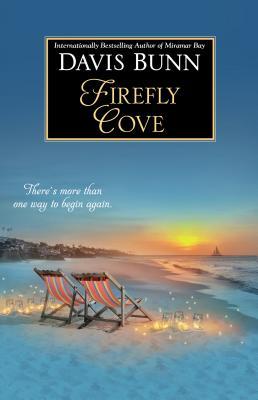
Review: Firefly Cove

Firefly Cove is the second in Davis Bunn’s Miramar Bay series.

Lucius Quarterfield lived in the 1960s and developed pleurisy when he was seven. The illness damaged his heart to the point that doctors did not give him long to live.

Though often weak and in pain, when Lucius was grown, he bought a small automobile dealership, which eventually turned into a chain.

He fell in love with a woman named Jessica, who was opposite from him in almost every way. However, since he knew he would die young, he felt it was best to pull away, to spare Jessica the pain of losing him.

After eleven months, he wants to see her and drives back to Miramar. His worst fears are realized when he has a heart attack and dies in her arms.

But then he wakes up in a cold room with a sheet over his face. People call him Luke, not Lucius. His hands and face are not his own. He discovers the date is almost fifty years ahead of his own time.

Nothing in the book’s descriptions said anything about this, and the other books in the series that I have read so far don’t have any kind of supernatural or science fiction elements. So it was jarring. Maybe the author wanted it to be as disorienting to the reader as it would have been to the character.

I don’t believe in reincarnation because Hebrews 9:27 says, “It is appointed for man to die once, and after that comes judgment.” There’s also nothing in Scripture about any human inhabiting any other human’s body. From what I have read of the author, I think he believes the same way. So I am not sure why he would have this occur in his story.

I decided to view the situation as a plot device, just like other impossibilities such as time travel.

In Lucius’s situation, the young man whose body he woke up in had just attempted his third try at suicide. His therapist’s supervisor is ready to have him locked up. He would be even more ready if Lucius told him he had actually lived fifty years before. All Lucius wants to do is find out what happened to Jessica.

Luke’s therapist, a Persian young woman named Asha, notices several differences about him right away. He looks the same but carries himself differently, speaks differently, and has even lost his French-Canadian accent. She and her supervisor think Luke’s “near death experience” led to Dissociative Identity Disorder, or a split personality. Yet he doesn’t manifest certain hallmarks of that illness.

At it’s heart, this book is a love story, though an unconventional one. The story was well-written. We’re drawn in as Lucius’s situation slowly unfolds, figuring out modern gadgets and ways, what kind of man Luke was, how he should proceed, what his future should look like. The characters were well-developed–besides Lucius, I particularly liked Asha and her grandmother. The intrigue of what’s going to happen to Luke–will he ever find Jessica, what will he do when he does, will he be able to avoid being committed to an institution, will anyone else ever believe his story–keeps us engaged, as does Asha’s story. I’m still processing what I think about the book. Even though I normally wouldn’t care for this kind of story, I found it engaging.

I’m inclined to think this might have worked better as a stand-alone novel, except that the theme of the Miramar Bay books has to do with second chances.

(Sharing with Bookish Bliss Quarterly Link-Up)

Review: Miramar Bay

Miramar Bay by Davis Bunn

When I started listening to The Christmas Hummingbird by Davis Bunn, I didn’t realize that it was the eighth novel in a series. The first few books in the series were free for Audible subscribers, so I decided to try them out.

In the first novel, Miramar Bay, Connor Larkin is an actor known for his “bad boy” good looks and for dying onscreen (97 times so far). His current gig is a fake “reality” show featuring his relationship with a Hollywood starlet. But now the studio has written an on-air wedding into the script, and Connor bolts. He had visited Miramar, on California’s central coastline, some years before, and it seemed a quiet place to hide out and think.

Connor steps into a Miramar restaurant playing Sinatra music and is drawn in. He had originally wanted to be a musician playing this type of music, but his early acting roles led him another direction. He finds himself applying for a waiter’s job at the restaurant.

Sylvie Cassick had put all her money and hopes into the restaurant and named it Castaways. Her father had been an artist, a kind man but an impractical dreamer. When her mother left them, Sylvie took on the role of trying to keep things in order and the bills paid. She had not heard from her mother in years, and her father passed away, so she’s on her own. Her staff has become dear friends. But everything hangs by a thread: one major problem or repair could cost her everything.

And then the unthinkable happens when illegal drugs are found in her fish order.

As Conner and Sylvie get to know each other, they bond over music. But when Sylvie learns who Connor really is, she can’t get over the fact that he lied to her.

Miramar is known as a place of second chances. Will Connor and Sylvie find theirs as they each face their separate crises?

Some of the characters in the later book were here, too: the sheriff, the head waitress, and a few others.

I looked online to see if Miramar is a real place, and it is: you can read more here.

I loved the small-town, close-knit community Bunn created. The characters seemed real and relatable. The plot kept me invested and interested.

As with the Christmas book, there’s not much mention of anything of a spiritual nature in this book, though everything else I’ve read from Bunn has been Christian fiction. One character visits a chapel a couple of times and prays for help. Perhaps Bunn meant this as a crossover into the general market, which would then draw readers back to his many other books. This is a good, clean read, but it was a little sad to me that the author, who knows real peace can only be found in Christ, had Connor find his peace in a community.

The only other thing some readers might find objectionable is a fair amount of alcohol consumption. One example: Sylvie’s friends “make” her drink brandy to brace herself before sharing bad news. I know this is an area where good people can differ, but to me alcohol seemed to be mentioned a lot.

I listened to the audiobook nicely read by Graham Winton. If you’re familiar with the Adventures in Odyssey radio program by Focus on the Family, Graham’s voice sounds a lot like the actor who portrays character Jason Whitaker there–so much so, that I had to look up that actor. But that actor’s name is Townsend Coleman.

(Sharing with Bookish Bliss Quarterly Link-Up)