
It seems some battles in the Christian life are fought and won all at once. I’ve heard testimonies of people who were almost instantly delivered from alcoholism or addiction or something else when they first become Christians.
For others, dealing with those temptations or others is a continual battle. Take selfishness, for instance. I can’t say, “I will never be selfish again!” Well, I could say it. But I would likely fail before the day is out.
Anxiety is like that for me. I’ve done Bible studies on it, read books about it, listened to sermons about it, and gotten victory for a while–until a new round of “what ifs” come up. Then I have to remind myself of all the truths I’ve learned before.
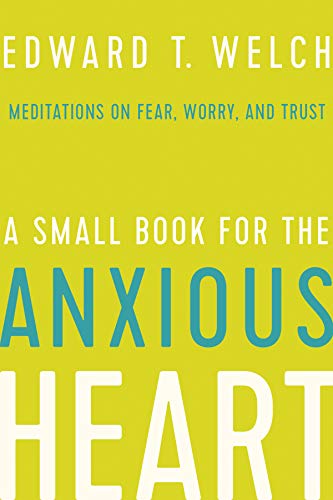
I read Ed Welch’s Running Scared: Fear, Worry, and the God of Rest several years ago in the weeks leading up to a surgery, and it was a big help. So when I saw A Small Book for the Anxious Heart: Meditations on Fear, Worry and Trust by the same author, I got it, too.
As the title says, this is a small book, a little over 4×6 inches. It’s made up of fifty short meditations. So it’s not a full treatise on anxiety. Some people would not be able to take in a larger book, so this one has purposefully been broken down into bite-sized pieces.
Some of the meditations deal with anxiety and fear generally. Some discuss particular fears; others particular passages of Scripture. Each meditation ends with a couple of discussion questions.
You often hear that you can’t experience fear and faith at the same time. Welch disagrees. He says:
Faith in Jesus will not replace your fears. Instead your faith will coexist with your fears and begin to quiet them. You will learn, by faith, to see your life from Jesus’ perspective and to trust that he is your ever-present help in trouble (Psalm 46:1) (p. 64).
Welch says that dealing with anxieties is not a matter of trying different treatments to find one that works, but of learning skills to deal with them. Change takes time:
A skill improves with practice, and some days you are better at it that others . . . It is not the disappearance of our anxieties that make us most fully human; it is that we call out to the Lord on good days and bad days. Change is measured by how we turn to Jesus in our fears. Fears and anxieties will come, so you can’t measure growth by whether they exist or not (pp. 94-95).
Here are some of the other quotes that most resonated with me:
When you put your faith in him, then Jesus is your shepherd. You need a shepherd; he is pleased to be your full-time, night-and-day shepherd. As you let go of self-trust and personal strategies for self-protection, you put your trust in him instead (p. 15).
You do not know the entire story. The end remains to be written, and the end determines the meaning of everything before it (p. 24).
There are good reasons to worry. The dilemma is that worries tell you to take matters into your own hands, but that message needs to be altered to say, “What a perfect opportunity to trust the God who is strong, loving, and faithful (p. 29).
Fear and worry can be the misuse of a fine imagination. Imagine instead an angel army surrounding you and yours [like in 2 Kings 6: 15-17]. How might that change your internal conversation about your worries? (p. 90).
[Re God giving needed grace each day like He gave the Israelites manna] When you try to think about tomorrow without having yet received power for tomorrow, you will be anxious (p. 98).
Fear . . . will not lose its power unless it is examined (p. 145).
I believe Running Scared was a bigger help to me than this book, but then, it was meant to be a little more comprehensive than this one. This book did encourage me by reminding of truths I’d read before but also sharing some new thoughts.
(I often link up with some of these bloggers.)

