Review: Exodus for You

Exodus for You

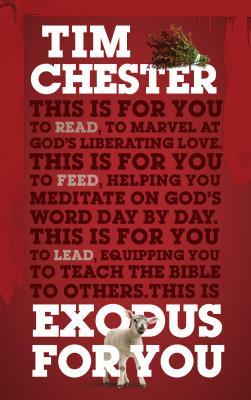
The book of Exodus has some of the most exciting and touching passages in the Bible, but also some chapters of details that aren’t quite so inspiring to read. Our ladies’ Bible study at church used Exodus for You: Thrilling You with the Liberating Love of God, where Tim Chester shares insights to better help us get the most from Exodus.

The narrative in Exodus begins some 400 years after Genesis ends. Jacob’s whole family had come to Egypt to escape famine, under the favor of son Joseph. But now a king had arisen who did not Joseph and didn’t regard his leadership and help during the famine crisis so many years ago. All this king knew was that there were enough Israelites to potentially rise up against Egypt. So he had them enslaved and commanded that male Israelite babies be killed.

During this time, Moses was born. You’re probably familiar with the story of his mother making a waterproof basket to put her baby in and setting it upon the Nile, where it was found by Pharaoh’s daughter, who took Moses to raise as her own.

The next several chapters detail Moses’ life, call of God to deliver Israel, and development as a leader.

Then we have the ten plagues in Egypt, the Israelites’ exodus, God’s deliverance through the Red Sea, the giving of the law, and the golden calf incident and its consequences. Some of the tenderest passages occur as Moses intercedes for God’s forgiveness for His people and then asks to see God’s glory. There are several chapters of details about the law and instructions for the tabernacle, it’s furnishings, and the priest’s garments. The book ends with the people obeying God by constructing the tabernacle and the glory of the Lord filling it.

God had promised to dwell with His people, and the tabernacle was a vivid picture of His fulfillment of that promise, which ultimately pointed to a fuller fulfillment to come in Christ.

Some of my favorite chapters in Chester’s book dealt with the symbolism of everything about the tabernacle. One of our Sunday School teachers from another church taught symbolism that the Bible doesn’t corroborate, like the four corners of the altar representing the four gospels, and the two cherubim over the mercy seat representing the Old and New Testaments. I don’t know if he got such ideas from a source or from his own musings. Chester does a much better job of showing from the rest of Scripture what each item symbolizes and points to.

Chester draws several parallels between the tabernacle and the garden of Eden, which was new thought for me. The cherubim guarding the entrance to Eden after Adam and Eve sinned and the cherubim oven into the curtain between the Holy and Most Holy place were pretty obvious parallels. I am still pondering some of the others (some are listed here).

I had never before heard of Chester’s description of God’s judgment and restoration through the Red Sea incident and others.as “uncreating” and “recreating.” I’m not quite sure I agree with that depiction–I have to think about it some more.

Some of my favorite quotes from Exodus for You:

God “remembered his covenant with Abraham”. What is going to drive this story is the promise to Abraham. “Remembering” is a covenantal term. It means deciding to act in order to fulfil a covenant. It’s not that the promise to Abraham had somehow slipped God’s mind. It’s not that he got distracted by other things. “Remembering” means 20
God is about to take the next step in the fulfilment of his promises (pp. 19-20).

One of the many ways in which God works good from suffering is that he uses it to make us cling to him in faith, to clarify our identity as his children and to increase our longing for the new creation (p. 21).

Moses will discover who God is through God’s saving acts. God is self-defining, and he is about to provide a definition of his name–and that definition is the exodus. In the exodus we will see the holiness of God in his judgment on Egypt. We will see the power of God in his triumph over Pharaoh and the gods of Egypt. We will see the grace of God in the redemption of Isarel. And we will see the rule of God in his words on Mt. Sinai (p. 41). 

God intends not only to make himself known to Israel but also through Israel. The law is given to shape Israel’s life so that they display the character of God. It is missional in intent (p. 141).

“You shall not make for yourself an image” (v. 4). This is to reduce God to something of our own making–not to replace him, but to make him manageable, to understand him according to our notions rather than according to his revelation in his word. Have you ever judged God or reduced him? (p. 176).

For the most part, I greatly benefited from what Chester shared in this book. 

If you’d like an overview of Exodus, the Bible Project shares it in two videos–Part 1 is here, part 2 is here

Laudable Linkage

Laudable Inkage

Some of the good reads found this week:

Awaken Your Hunger, HT to Challies. “Like tamping down my appetite as I’m tasting and assembling ingredients for dinner, I find myself quieting my hunger for God by tasting too many things that don’t satisfy. Sometimes it’s not the quality so much as the quantity: a half hour of mindless scrolling here, a couple of hours of Netflix bingeing there, the incessant input of a podcast or audiobook every time it gets quiet. I keep filling up my soul with so many things that leave me hungry but not for what I need.”

What Martha’s Problem Really Was. “Martha’s problem had nothing to do with her to-do list and everything to do with how she handled her thoughts. Luke didn’t include this account to caution women away from vacuuming, doing dishes, or cooking a nice meal for company. He included it as a warning against unguarded thoughts. Thankfully, he does include a solution.”

You Are “The Next.” “Who will be the next Nancy? The next Charlie? The next John, James, Voddie, or Kay? This may come as a surprise, but there is an answer. The answer is no one. And it’s also . . . you. Confused? Let me explain.”

When Dad Will Not Lead in the Home, HT to Challies. “One of the saddest verses of the Bible is Genesis 3:6 where God’s Word records, ‘[Eve] took of it and ate, and she also gave some to her husband who was with her, and he ate.’ In other words, Adam was standing with Eve when Satan tempted her. The one who should have defended his wife from the tempter, didn’t do anything. He was passive. And that’s what we’re talking about. Instead of spiritual leadership and initiative, we have passivity. How do we approach this problem?”

DO Something When You Are Maligned, HT to Challies. “When stressed through the ill-will or stinging insults and persistent opposition by someone who wants to cause you trouble, we know there is something to think. We are to think the truth about God and ourselves. We don’t take their evaluation as true, but only God’s. Also, we are to think of God’s loving and purposeful sovereignty over his children, meaning that difficulties can bring about good results in character and progress for the gospel. But there is also something to DO.”

The Worst Kind of Parenting Advice, HT to Challies. “I’m grateful to God that I learned early on to chew the meat and spit out the bones regarding much of the Christian parenting advice I was given, and instead to do what was right for our kids and our family. But when it comes to formulaic parenting advice, it sure is interesting that the more things change, the more they stay the same.”

Social Media Pushes Pornography on Children Within Minutes, Report Finds, HT to Challies. “Social media is now one of the primary pipelines to porn addiction for both children and young adults. Global Witness, a campaign organization that investigates the impact of Big Tech on human rights, recently conducted a number of tests to determine how quickly children could access pornography on social media platforms. According to the Guardian, Global Witness conducted one test before the implementation of the U.K.’s Online Safety Act in July, and one after. In just a few clicks, TikTok directed children’s accounts to pornography.”

Spurgeon re the Bible

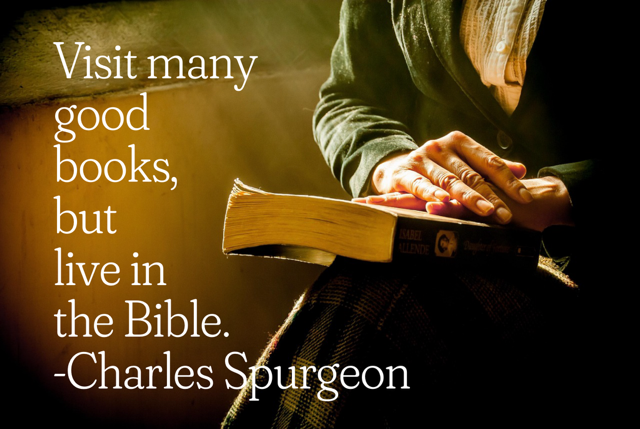
“Visit many good books, but live in the Bible.”–Charles Spurgeon

Laudable Linkage

Here’s a short list of good reads found this week:

Can I Trust the Bible? “For years, my Bible reading raised more questions than answers. In college, I joined a small group Bible study that changed everything. These women read the Bible as if it meant what it said. Do I hear a ‘Duh’?”

Every Excuse Is a Reason to Meditate on Scripture. HT to Challies. Some of the excuses that seem to keep us from reading the Bible are the very reasons we need to read it.

We’ve Got a Hunger Problem: Learning to Long for God’s Word. “We’ve got a hunger problem—or rather a fullness problem. Our lives are so packed and cluttered that we barely notice the empty place in our hearts that only God can fill. If we never feel the ache of real hunger, if we never experience longing in the quiet or the discomfort of waiting, we will never crave what is meant to nourish our souls. So, how do we prepare our hearts for the feast of God’s Word?”

I Am not Charlie Kirk. “I can understand why people want to be like Charlie but the more I started hearing people chanting ‘I am Charlie Kirk’, the more uncomfortable it felt. There was, and will always be, just one Charlie Kirk… and that’s what made him so special. And I want to believe that even Charlie himself would tell you… it’s not him you want to be like… but it’s the Christ who lived in him and through him. And just like there was only one Charlie Kirk… there’s also only one of you.”

Do Not Neglect the Give You Have, HT to Challies. “You may not have big dreams for your life. You may not expect God to do great things through you. You may seem, like Saul, ‘little in your own eyes’ (1 Samuel 15:17) — not very talented or charismatic, not much of a leader. But in the Lord Jesus Christ, God has given you a gift. And as Paul told the young Timothy, so God tells his young men today: ‘Do not neglect the gift you have’ (1 Timothy 4:14).”

No Service Is Too Small, HT to Redeeming Productivity. “Most days we don’t get married, receive a positive pregnancy test, or achieve a breakthrough in our field. Most days, we’re commuting, studying, parenting, working, doing the dishes, mowing the lawn, or paying the bills. Do those activities count in God’s eyes? Does the mundane matter to him?”

Grace for the Birth Story You Didn’t Expect, HT to Challies. “The truth of it is, things in the world don’t work as they should. Your friend’s birth story might be one of empowerment and candlelight, while yours might be one of operating rooms and oxygen masks. You may not even have been conscious when your child entered the world. You may question if you made the right decisions. Or, if it was an emergency situation, if those in control made the right decisions.”

“When you kill time, remember that it has no resurrection.” ― A.W. Tozer

Laudable Linkage

Laudable Linkage

I hope you have a great Saturday! There are a few good reads here if you have time.

Four Prayer Responses to the Murder of Charlie Kirk, HT to Tim Challies, who has curated several posts on different aspects of Kirk’s murder here.

I don’t often link to Facebook posts, but this one shared by a friend from author Tricia White Priebe points out how rejoicing over Charlie Kirk’s murder shows society’s lack of value of human dignity.

O Lord, Heal Our Land. “Anyone who lived through the late 1960s and early 1970s, as I did, can see the parallels between then and now. And yesterday’s assassination of Charlie Kirk on a college campus in Utah has left us all stunned, wondering about our own future as a nation.”

Bible Reading as a Blessing, Not a Burden, HT to Challies. “I loathe the times I’m distracted by a screen, or a crick in the neck, or an overly groggy eye. Or even worse, when the pillow seems more pleasing. I suspect I’m not alone in my laments and loathes. And I bet you want to hang on the word of God, too.”

How to Rightly Train Your Affections, HT to Challies. “While human preferences for food or favorite football teams may be value neutral, preferences are not always so. We are commanded by God to prefer certain things. Or to shift again to the language of affections, God calls his people to rejoice in, love, and desire certain things and to despise other things. Our affections, in other words, are not always value neutral. We are responsible for training them according to the revealed will of God.”

Making Space for Others, HT to the Story Warren. “Let’s scoot over.  Make room. Here, take this spot and sit by us. If you are walking into a space as a new student, neighbor, or church visitor, those can be some of the kindest words ever spoken. As a woman in my mid-fifties, I’m shocked that the awkwardness of junior high floods back so quickly when I am in a new situation. And, as a ministry leader who usually runs the room, I can forget how it feels to walk into an unfamiliar one.”

Go Ahead, Bring a Knife to a Gunfight. “God calls each one of us to battle for the right and against the wrong, and it’s a simple fact that many of us are not equipped with the kind of weapon we would prefer to carry into such a conflict. Many of us look at the weapons wielded by others and wish we had theirs instead of ours. Yet in the battle for God’s cause, he always means for us to put to use the weapon we have on hand with the conviction that he will bless our efforts, no matter how weak or paltry those weapons may seem.”

The Good Always the Enemy of the Best. “Somewhere along the way, despite our desire to give our children the best, we can find ourselves spending vast amounts of time, energy, and money pursuing the good instead. How does this happen? We become deceived. Deceived by culture. Deceived by our well-meaning friends. Deceived, sometimes, even by Christians.”

The Most Exasperating and Least Rewarding. I’ve been pondering similar thoughts recently. “If you move to a new town and search for a new church, it’s unlikely you will find one that offers everything you’d prefer a church to offer—every doctrine, every emphasis, every association, every ministry, every preference. You may love the music, but wish there was a greater emphasis on liturgy. You may appreciate the effort that goes into evangelism, but lament the lack of effort that goes into youth ministry. The preaching may be just what you are after, but the small-group ministry is sputtering. Yet churches are bundled—you have to weigh the weaknesses against the strengths and the desirable qualities against the undesirable. Perfection isn’t an option.”

Journaling God’s Faithfulness: 10 Questions to Develop This Faith-Building Habit. If you’d like to keep a spiritual journal, this post has a lot of good suggestions for what to write about.

Is Being Pro-Life Really Just “Pro-Forced Birth?” HT to Challies. No, and this article explains why. “When it comes to moral issues, like abortion, we must always be alert for the word games, rhetorical ploys, and manipulative language that distort the truth and make something evil look good.”

Don’t Do Everything for Your Kids, HT to Challies. It’s interesting that I have seen this theme in a number of blog posts lately. “What I’d like to suggest today is that just as important as giving your kids opportunities to play soccer or violin or go to that birthday party or go to the park or do that activity or play that game with them is to allow yourself time to read the Bible or a book or to spend time with your spouse. It’s possible to give too much to your children, sacrificially, at the expense of your wellbeing and the relationship with your spouse (if you have one). And that will not serve your children, yourself, or your marriage well.”

Close to Shepherd

The closer we are to the Shepherd,
the safer we are from wolves.
Unknown

Laudable Linkage

Laudable Linkage

Here are some of the posts that stood out to me this week:

None Too Old to Serve the King, HT to Chalmers Blog. “I love this scene with the feeble follower and the deposed king. What a touching moment for David, and a beautiful invitation to Barzillai. It reminds me that I serve the greater King David, and stirs in me the desire to “appear with him in glory” as he rides across the Jordan (Colossians 3:4). Does it do the same for you? I want us to imitate this elderly saint by meeting the King in the wilderness and serving him until our dying day.”

Reading the Bible for the Ten Thousandth Time. “By instinct we know that first-time readers of the Bible need guidance. But long-time readers need help too. In this article we’ll explore some of the ways to combat boredom and lethargy for experienced Bible readers.”

A Biblical Template for Prayers of Confession from Daniel 9. HT to Knowable Word. “For God’s promises and sure word aren’t a reason for inactivity and passivity. They’re fuel for confident prayer.” Though the author makes a case for corporate confession, these principles are true for private prayer as well.

All Those Things We Never Did, HT to Challies. “There remains a powerful temptation in midlife to nurse and rehearse dreams unfulfilled. The loop snags and captures with: We never did this, we never went here, we never bought this . . . The all those things we never did is a thorny and fruitless path, often culminating in a sour, self-centered existence. For the Christian, all those things we never did may humbly be replaced with: Your kingdom come; your will be done.

The Picture on the Nightstand, HT to Challies. “When a marriage is strong, it is a fortress. It shields what is fragile. Spouses are safe. Children thrive. Its strength creates overflowing benefit into entire communities. When a spouse breaks the marriage covenant, the impact is brutal. It exploits vulnerability. Spouses bleed. Children bear the weight. And the effects ripple outward.”

Should You Take Your Children to a Funeral? “Whatever the size or venue, here’s a question for parents to consider: should you take your children to a funeral? My answer is a sure yes, and here are several reasons why.”

The Rare Jewel of Contentment in Childlessness. “Paul’s testimony of contentment encouraged Bethany and me to ask God for that kind of contentment in our state of childlessness. Jeremiah Burroughs describes Christian contentment as ‘that sweet, inward, quiet, gracious frame of spirit, which freely submits to and delights in God’s wise and fatherly disposal in every condition.’”

Silent Women, Speaking Women, HT to Challies. This is one of the clearest explanations I’ve seen on the Bible passages about whether and when women are to teach in church.

Beware the New Notebook Energy. “A new planner gives me an avenue to blame my lack of follow-through on a bad system. If I can blame the system, that saves me from the day-in and day-out-ness of life. I call this New Notebook Energy: fleeing actual responsibility and good habits in favor of reorganizing and starting again.”

Ways to See and Support Foster Families. “All of a sudden, we were a part of the foster system, which came with all of the staff, the rules and regulations, the visits with social workers, the paperwork, the doctor’s visits, and so much more. I quickly realized that before this happened, I didn’t understand how much support the foster families in our church probably needed from me but hadn’t been getting. So I thought I would outline a few things that each of us can do to help foster families in our churches.”

Prayer quote

Ten minutes’ praying is better than a year’s murmuring. Charles Spurgeon

Do You Need a Fresh Word from the Lord?

Do you need a frsh word from the Lord?

Have you ever heard anyone say they needed a “fresh word” from the Lord?

I pondered recently what would prompt someone to say that.

Perhaps they’re bogged down in Leviticus.

Perhaps the old truths just seem . . . old.

Perhaps they haven’t felt the fervency they used to when reading the Bible.

Perhaps they have questions they can’t find the answer to in the Bible.

Perhaps they haven’t seen God move in life like He did in His Word.

It’s good to ask ourselves these questions and try to figure out where the problem is. I want to encourage us that the Bible is living, active, sharp, piercing, discerning (Hebrews 4:12).

The Bible is breathed out by God and profitable for teaching, for reproof, for correction, and for training in righteousness (2 Timothy 3:16).

God has granted to us all things–all things–that pertain to life and godliness, through the knowledge of him who called us to his own glory and excellence, by which he has granted to us his precious and very great promises (2 Peter 1:3-4).

All of these and other passages show that we don’t need something new and fresh from God. What He has given us is more than sufficient for our spiritual needs.

Why doesn’t it always feel that way?

Well it could be something as simple as not getting enough sleep. I know what it is to battle drowsiness all through my Bible reading and not get anything out of it. Going to bed earlier or moving devotions to later in the day might help. Doing something active before reading can help wake us up.

Distractions are a problem. I don’t know how many times I have started to pray or read and had to keep bringing my mind back from other thoughts. Sometimes I treat my thoughts like my phone and mentally swipe away all the open tabs. I pray for God’s help and then perhaps read out loud or change my position or location. I keep a notepad nearby to jot down thoughts about things I need to take care of.

Something might be blocking our communication. In any relationship, when something is wrong, our communication isn’t what it should be. If we ask God to search us and show us what is wrong, He will. We can then confess any sin and put away anything that is displeasing to Him.

What about Leviticus–what a friend referred to as the place where Bible reading plans go to die? Someone said all of the Bible is inspired but it’s not all inspiring. It helps to remind ourselves of the verses above, that this is part of God’s Word, too, and He has a purpose for it in our Bibles.

Studying some of these difficult passages with others, or using a good study aid or commentary, helps as well. They can open our eyes to things we missed in our own study.

When our ladies’ Bible study went through Hebrews, someone remarked that it would be good to study Leviticus and Hebrews together. Hebrews explains a lot of the symbolism in the Old Testament systems of worship.

Also, after reading from Leviticus or Chronicles, it might help to spend time in the psalms or in passages that have been especially meaningful to us in the past.

What about those unanswered questions? Sometimes the answers are there, but we haven’t found them yet. Asking a friend who is further along in their Christian walk or a pastor or Bible study leader can shed light.

But sometimes the answers just aren’t there. Deuteronomy 29:29 says “The secret things belong to the LORD our God, but the things that are revealed belong to us and to our children forever, that we may do all the words of this law.” God wants us to know Him well enough through the Word He has given us we can trust Him for what He hasn’t shared.

In New Testament times, people called Gnostics taught that there was a secret, special knowledge that only a few people knew. Though Gnostics are not named in the Bible, the epistles warn against their teachings. Mark Howell writes “The proclivity of many Christians is to be constantly on the lookout for some new thing to breathe life into the church. But according to Paul, the answer will not come by finding something new; it will come when the church renews its focus on something old—the Scriptures.” (Exalting Jesus in 1 & 2 Thessalonians [Christ-Centered Exposition Commentary], p. 238)

If we’re feeling bored, maybe we need to change our routine. Or we may need to pray for God to wake us again to the wonders in His Word. I love the King James word “quicken,” often translated “revive” in other versions. Many verses talk about God’s Word itself quickening us (Psalm 119:25, 50, 93; John 6:63).

We need to remember, too, that feelings aren’t always the mark of spirituality. Nothing beats those times in the Bible when God speaks to our hearts in a special way and we’re encouraged, our hearts are warmed, and we’re ready to face the day with hope and love. But just like any relationship, those warm, close times will come and go. Many of our conversations with loved ones are filled with necessary but mundane everyday details.

Every meal won’t be a Thanksgiving feast. But even the tuna casseroles and peanut butter sandwiches nourish us. Similarly, every time in the Bible won’t bring 4th of July sparks, but every reading benefits us. It’s that faithful everyday adding to and building upon what we know that strengthens us. And that in turn lays the foundation for those special, eye-opening, heart-warming moments.

We’ll always find new insights as we keep reading the Bible. But often what we need is the reminders of what we’ve learned before.

The hymn “How Firm a Foundation” begins with this stanza:

How firm a foundation, ye saints of the Lord,
Is laid for your faith in His excellent word!
What more can He say than to you He hath said,
To you who for refuge to Jesus have fled?

Dan Forrest’s arrangement of this hymn weaves that phrase from the first stanza–“What more can He say?”–between each of the other stanzas that focus on specific passages from the Bible. . 

He’s already given us “all things that pertain unto life and godliness.” What more can He say?

2 Peter 1:3-4

(I often link up with some of these bloggers.)

Laudable Linkage

Laudable Linkage

I have a short but good list of reads to share today:

Why It’s Good (and Christian) to Love Your Country, HT to Challies. “American Christians have also been pretty angsty about patriotism. In the last few years, many academics, journalists, and even some pastors have equated any love for the country with idolatry or worse, fascism and theocracy. So many well-meaning American Christians have shied away from expressions of patriotism because they don’t want to engage in false worship.”

Keep Reading Your Bible, Even if You Don’t Understand It, HT to Knowable Word. There are times to stop and dig deep in a passage we’re reading. But sometimes a passage won’t make sense until we’ve read more of the rest of the Bible.

You Don’t Need Another Prayer Technique, HT to Challies. “While my new system does help me be more organized and varied in my petitions, it hasn’t turned me into an Olympic runner in prayer. My best training came instead from an unexpected source.”

Dumb Dads: 3 Ways The Stereotype Is Harming The Archetype, HT to Challies. “By watching movies, reading stories, and entertaining the distorted pictures of dumb dads as a stereotype, we have forgotten the archetype of fatherhood. God didn’t create men and fathers to be weak and foolish. He created them to be so much more than what modern culture is preaching to our children.”

The Sandwich Generation, HT to Challies. “We are still parenting young-adult children, while at the same time attempting to gracefully maneuver through the aging years of our parents with honor. The similarities are endless; how to love our family without becoming a dictator, how to aid them in making their own decisions, how to help them navigate the path which will provide the best outcome for their future.”

America! America!
God mend thine every flaw,
Confirm thy soul in self-control,
Thy liberty in law!

Katharine Lee Bates, from “America the Beautiful”

Laudable Linkage

Laudable Linkage

I’m behind on blog-reading this week, but I found some thought-provoking posts to share.

Being the Best You Can Be. “It is good to be the best you can be. It is noble to attempt to maximize your potential and to make the greatest good on even the least gift. God calls each one of us to be faithful stewards of all that he has entrusted to us. Yet there is a world of difference between being the best you can be and wanting to be known as the best.”

Be a Man-Pleaser, Not a Man-Pleaser, HT to Challies. In other words, our people-pleasing can be good or bad, depending on our motives.

Bible Reading Blues? Study Your Stop. “If you were sitting across from me and you mentioned that you’d abandoned your Bible reading plan, I wouldn’t ask you about what went well. We’d talk about what didn’t work. We’d start with what made you stop because understanding why you didn’t finish could be the key to helping you begin again.”

Guarding the Gospel: Understanding the Dangers of Syncretism. “Syncretism is the combination or synthesis of two or more different religions or philosophies. Syncretism happens in Christian missions when people profess Christ by believing an altered version of the gospel message that lines up with their previous beliefs.”

ChatGPT May Be Eroding Critical Thinking Skills, HT to Redeeming Productivity. “Researchers used an EEG to record the writers’ brain activity across 32 regions, and found that of the three groups, ChatGPT users had the lowest brain engagement and ‘consistently underperformed at neural, linguistic, and behavioral levels.’ Over the course of several months, ChatGPT users got lazier with each subsequent essay, often resorting to copy-and-paste by the end of the study.”

Spurgeon quote

He who grows in grace remembers that he is but dust, and he therefore does not expect his fellow Christians to be anything more. Charles Spurgeon.

Your Soul Needs Food Even When It Doesn’t Want It

Your soul needs food

You’re sick. Your sinuses are inflamed, your throat is raw, your nose is red, drippy, and chafing. You have a fever and ache all over. And you don’t feel like eating.

But you do eat. Nothing sounds good, except maybe the proverbial remedy for a cold, chicken soup. But you eat because your body needs it. And the very food you don’t have an appetite for not only nourishes you, but helps your body fight infection and get well.

The same is true spiritually. When something is wrong in our lives, when we’re in some kind of dark valley—we tend to put God’s Word aside. Our appetite for it has waned.

But we need the Bible then more than ever. We may not be able to keep up with our usual routine or an intense study. But we need to keep sipping and tasting. We might spend more time in the Psalms or favorite passages than other passages. We might listen instead of read.

And the very Word we don’t have an appetite for not only nourishes us, but helps us heal. It will strengthen us and help us fight spiritual infection.

So when our appetite for the Word of God is off, we need to keep partaking. Our souls need it. We may not feel instant refreshment. It may seem a little dry. But we can ask God to open “the eyes of our heart” and minister to us.

Often a subdued appetite can be aroused by tasting food. It didn’t sound good, but once we had a few bites, we wanted more.

We may feel like reading the Bible is the last thing we want to do. But it’s been my experience, many times over, that once I start reading it, I want more.

Incline my heart to your testimonies, and not to selfish gain! Turn my eyes from looking at worthless things; and give me life in your ways (Psalm 119:36-37).

They loathed any kind of food,
    and they drew near to the gates of death.
Then they cried to the Lord in their trouble,
    and he delivered them from their distress.
He sent out his word and healed them,
    and delivered them from their destruction.
Let them thank the Lord for his steadfast love,
    for his wondrous works to the children of man!
And let them offer sacrifices of thanksgiving,
    and tell of his deeds in songs of joy!

(Psalm 107:18-22)

Jeremiah 15:16

(Revised from the archives)

(I often link up with some of these bloggers.)
Laudable Linkage

Laudable Linkage

I have quite a long list of links that piqued my interest to share this week. I hope you’ll find some useful reading here.

Occasionally I like to repeat the reminder that links don’t imply 100% endorsement of everything on a site.

What Does Trouble Do? “To live is to experience trouble. There is no path through this life that does not lead through at least some kind of difficulty, sorrow, or trial—and often through a cornucopia of them. This being the case, we rightly wonder: What does trouble do? Though we may not see an answer in the immediate circumstances of our lives, we can begin to put one together as we look at the lives of other believers.”

On Mother’s Day, Rinse and Repeat with Truth. This is one of my favorites from Michele–good not just for moms and not just on Mother’s Day. “As mothers, as women, as grace-dependent creatures, we rely on the cleansing properties of God’s Word as it removes the gunk, as it scrubs away the Slime that the culture leaves in our thoughts and our habits. And since we are constantly swimming in lies, we constantly need the truth before our eyes, in our ears, and in our minds to counteract the Slime.”

Tell the Truth About Children, HT to Challies. I’ve been considering writing a post about the worth of children. This author does an admirable job. “Perhaps we zealously undertake the rescue mission of motherhood while our hearts still cling to the names the world reserves for children: Chaos. Burdens. Busyness. Craziness. But God bestows on them different names: Heritage. Power. Blessings. Gifts. Our children do not need to ‘grow up’ to earn given titles. Rather, mothers’ hearts need to hear afresh God’s words about children.”

When Prayer Starts With Panic, HT to Challies. “Notice what Paul actually says. He does not say, ‘don’t feel anxious and then pray,’ but rather, ‘in everything, by prayer and supplication… let your requests be made known.’ It’s a call to bring our panic into conversation with God, while it’s still happening. And he even includes thanksgiving, not as a command to pretend, but as a practice to remind ourselves that God’s character remains steady—even when everything else feels fragile.”

When Christ Is En Vogue, Christians Beware, HT to Challies. “I want to have the perspective of Paul, that ‘whether in pretense or in truth, Christ is proclaimed, and in that I rejoice. Yes, and I will rejoice’ (Phil 1:18). But with this widespread cultural acceptance comes a level of danger. I want to give three warnings about the dangers of Christian popularity.”

Sharpen Your Sword for Victory in Spiritual Battles. “Sometimes we use fleshly methods to deal with spiritual matters, like lashing out when people mistreat us. Situations never end well when we utilize worldly ways. But when we use the Sword of the Spirit—which is the Word of God—we invite the Lord to intervene in our circumstances, and the outcome is different. Do you know how to sharpen your sword? It’s crucial we understand how to skillfully use and maintain the Sword of the Spirit.”

Wounded Intercession: Turning Pain Into Prayer. HT to The Story Warren. “What we see in these examples is something deeper than mere forgiveness. It’s wounded intercession: taking the wounds inflicted on us by others and turning the pain into prayer.”

On Silence During Chaos. This post is the fifth in a series by Dan Olinger about caution with how we express ourselves over political issues or news in public forums.

17 Gospel Encouragements to Overcome Barriers to Biblical Hospitality. “Hospitality is a beautiful calling, but sometimes the reality of our lives looks very different from the picture we have in our minds. We might feel like our circumstances create barriers to offering the kind of welcome we long to extend. What if biblical hospitality is simply about welcoming others as Christ has welcomed us? Many barriers to hospitality can be overcome by embracing the gospel and looking to Jesus as our example.”

How Moms Can Care for Women Experiencing Infertility, HT to Challies. “The weight of infertility is heavy, and those experiencing it need all kinds of women in the body of Christ to help carry their burden (Gal. 6:2). If you’re a mother who hasn’t experienced infertility, you can still minister to women navigating it. There are no magical words to say, but in my experience, some attitudes and actions can be a soothing salve to a wounded heart.”

Why Boys No Books? Though the topic of this post is why boys don’t read, I was especially interested in a discussion there about an essay C. S. Lewis wrote on chivalry. He says men are mostly divided into the warrior/jock type (which he calls “stern”) or the nerd/artist type (which he calls “meek”). But every now and then comes a man who is a blending of the two, which he calls a “knight,” which this author says is “A Davidic kind of man with gentle hands that can deftly strum a harp, or chop off Goliath’s head.” He then discusses how reading can help point boys to this ideal.

More Than Skin Deep, HT to Linda. “We’re urged to focus our finite energy on fixing our external appearance, as though that will bring us some sort of deep and lasting life satisfaction. Unfortunately, spending too much precious life energy on the externals is … exhausting. And although I enjoy feeling reasonably put together as occasion warrants, I really don’t want to spend my remaining lifetime on a fruitless quest to look like the me of thirty years ago.”

Job’s Friends Versus Bob’s Friends. I mentioned a few weeks ago this podcast called Dead Man Talking by Bob Roberts, someone from one of our former churches. He has stage 4 liver cancer and wanted not to “waste” it, so he and four friends from college days meet to discuss various facets of what he is learning and going through. Someone suggested the subject of Job’s friends compared to Bob’s as a joke, but a valuable discussion grew from there. I linked to the YouTube version, but the podcast is also on Spotify and Apple podcasts.

“We often treat Jesus the way Saul treated David. We want him to slay giants and sing evil spirits away, but we don’t want him to be King.” – A.W. Tozer