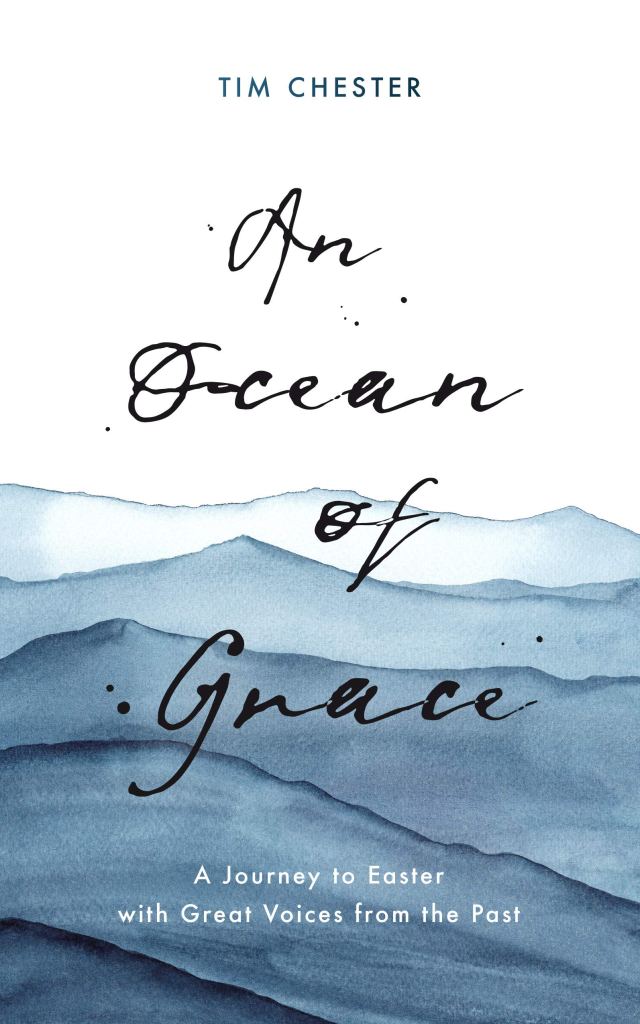
Review: An Ocean of Grace

Ocean of Grace

Tim Chester collected collected thoughtful writings about Christ’s death and resurrection and edited them into An Ocean of Grace: A Journey to Easter with Great Voices of the Past.

Some of the selections are from familiar pens: Augustine, Martin Luther, and Charles Spurgeon. Others are more obscure: Cyril of Alexander from the fifth century, Gregory of Myssa from the fourth, Cyprian of the third, and many others. I was delighted to see a piece by Anne Steele, an eighteenth-century female hymn writer. And I was surprised to see a selection from Catherine Parr, Henry VIII’s last wife, leading me to read a little more about her online. I think Spurgeon is the most recent of the authors included.

These selections are divided into daily readings from Ash Wednesday to Easter. They are grouped into themes for each week: The Light of Love, The Welcome of Grace, The Exchange of Places; The Assurance of Faith, The Gift of Christ, and The Victory of God.

In his introduction, Chester says he removed archaic language except for poetry and hymns while trying to retain the “voice” of the original authors. He also says many “descriptions have been turned into a prayer addressed to God or an exhortation addressed to our own souls.” He doesn’t say why, but he also turned what I think were prose selections into a free-verse style of poetry. I wish he had kept the selections closer to the originals–but then maybe I wouldn’t think so if I read the originals.

I began reading this book late in the season due to finishing a previous study. Because of that, and because the selections were fairly short, I read two or three a day. I think that may have lessened the impact of them. If I read this book again, I’ll plan to read one a day as the author intended.

Nevertheless, I did receive much food for thought and warmth for heart by reading this book. I have many places marked, but I will try not to overwhelm you with quotes.

In an excerpt from Catherine Parr’s The Lamentations of a Sinner, she spends several lines listing her sins and Christ’s merits. She concludes:

Shall I fall in desperation?
No, I will call upon Christ,
 the Light of the world,
  the Fountain of life,
   the relief of all careful consciences,
    the Peacemaker between God and man,
     and the only health and comfort of all true repentant sinners.

By his almighty power he can save me
and deliver me out of this miserable state.
For this is the life everlasting, O Lord,
 to believe you to be the true God,
 and him whom you sent, Jesus Christ.
By this faith I am assured,
and by this assurance I feel the forgiveness of my sins:
 this is what gives me confidence,
 this is what comforts me,
 this is what quenches all despair (p. 10).

This line of Puritan Stephen Charnock’s “A Discourse of the Knowledge of Christ Crucified” stood out to me: “May all the charms of sin be overcome by this ravishing love” (p. 27). He goes on to say:

How can we, with thoughts of the cross alive in our hearts, sin against so much tenderness, compassion and grace, and all the other perfections of you, our God, which sound so loud in our ears from the cross of Jesus? Shall we consider him hanging there to deliver us from hell and stain, and retain any desire to walk in the way which led him there? Can we take any pleasure in that which caused so much pain for our best friend? Can we love that which brought a curse better than him who bore the curse for us?” (pp. 26-27. I put this in paragraph form just to save time formatting).

This from Isaac Ambrose also stood out to me: “Surely his death is more satisfactory to God than all your sins can possibly be displeasing to God” (p. 94).

This was from Thomas Watson: “We cannot lift up Christ higher in heaven, but we may lift up him in our hearts. So let us believe him, adore him and love him, and exalt him in our lives, for all the doxologies and prayers in the world do not exalt Christ as much as a holy life” (p. 132).

I loved this closing poem from Henry Vaughan titled “Easter Hymn”:

Death, and darkness get you packing,
Nothing now to man is lacking,
All your triumphs now are ended,
And what Adam marred, is mended;
Graves are beds now for the weary,
Death a nap, to wake more merry;
Youth now, full of pious duty,
Seeks in thee for perfect beauty;
The weak and aged tired, with length
Of days, from thee look for new strength;
And infants with thy pangs contest
As pleasant, as if with the breast.
Then, unto him, who thus hath thrown
Even to contempt thy kingdom down,
And by his blood did us advance
Unto his own inheritance,
To him be glory, power, praise,
From this, unto the last of days! (p. 154).

I had a couple of formatting complaints in the book. Chester writes verse references as, for example, Isaiah 61 v 10 rather than Isaiah 61:10. The latter has been used for centuries. I have never seen the former except in Chester’s books. I wondered if perhaps it’s done that way in the UK, but I have read several books from authors from various countries without having seen this way of writing Bible references. I Googled “how to write Bible verse references” just to see if this is a new style, and I didn’t see it mentioned in any source I looked at. It’s not a big deal in the grand scheme of things. It’s more a commentary on my heart to say it irritated me. But I tried to overlook it

The other complaint is not unique to Mr. Chester, but is to all the books I have from The Good Book Company. They put the table of contents in the back of the book rather than in the front after the title page. That doesn’t make sense to me. I use the Table of Contents to look at where a book is going, not where it has been. When I am considering a new book, I look at the front cover, the back cover, the description, the table of contents, and the first few paragraphs or pages. If I look at a sample on Amazon, they usually only include the first several pages. If the Table of Contents is in the back, I am not able to see it in the sample.

I also wish Chester had listed the titles of all the readings in the Table of Contents rather than just the main section headings.

Again, these are minor issues compared to the content of the book.

There were just two or three places where I put a question mark or didn’t quite agree with how something was worded. But overall, I enjoyed this book and plan to use it again for Lenten reading in the future.

(I often link up with some of these bloggers.)

If Jesus Had Not Been Resurrected

If Jesus Had Not Been Resurrected

There’s an old Christmas song I’ve only heard a few times titled “If Jesus Had Not Come” by Albert C. Norton and Donald P. Hustad. The songwriters list several consequences we would face if Jesus never came to earth. Then the rousing chorus affirms:

But Jesus came! He came to earth,
And men beheld His manger birth!
The shepherds heard the angels sing,
The wise proclaimed Him Lord and King!
He died, He rose; and by His blood,
We too become the sons of God;
We preach the gospel in His name!
For Jesus came! Yes, Jesus came!

This Easter week, I’m thinking about what the consequences would be if Jesus had not been raised from the dead.

No resurrection for us. 1 Corinthians 15:20-23 says Jesus was the “firstfruits of those who have fallen asleep. For as by a man came death, by a man has come also the resurrection of the dead. For as in Adam all die, so also in Christ shall all be made alive. But each in his own order: Christ the firstfruits, then at his coming those who belong to Christ.” If He wasn’t raised from the dead, we won’t be, either. “If in Christ we have hope in this life only, we are of all people most to be pitied” (verse 19).

Futile faith. “If Christ has not been raised, then our preaching is in vain and your faith is in vain . . . And if Christ has not been raised, your faith is futile and you are still in your sins” (1 Corinthians 15:14, 17).

No meaning in life. Paul questions the worth of the dangers he endured for gospel’s sake if there is no resurrection. “If the dead are not raised, ‘Let us eat and drink, for tomorrow we die'” (1 Corinthians 15:30-32).

Death’s sting. Paul concludes his “resurrection chapter” with this: “For this perishable body must put on the imperishable, and this mortal body must put on immortality. When the perishable puts on the imperishable, and the mortal puts on immortality, then shall come to pass the saying that is written: ‘Death is swallowed up in victory.’ ‘O death, where is your victory? O death, where is your sting?'” (1 Corinthians 15:53-55). But if Jesus is not risen, death’s sting is still with us.

No hope. Peter begins his epistle by saying, “Blessed be the God and Father of our Lord Jesus Christ! According to his great mercy, he has caused us to be born again to a living hope through the resurrection of Jesus Christ from the dead” (1 Peter 1:3). But if there is no resurrection, we don’t have a living hope.

No inheritance. Peter speaks of an “inheritance that is imperishable, undefiled, and unfading, kept in heaven for you” which encourages us in our trials. But we’ll never receive that inheritance if there is no resurrection. (Ephesians 1 also speaks of our inheritance.)

No seeing loved ones again. When a loved one dies, or when facing our own death, one comfort is that we’ll see our loved ones again if they’ve believed on the Lord. Paul shares in 1 Thessalonians 4:13-18 that those who have already died will be reunited with those of us who are still alive when Jesus returns. Therefore we do “not grieve as others do who have no hope.” But without that hope, we’ll be swallowed up in grief.

No comfort. After sharing the expectation that we’ll see our loved ones again after death, Paul tells us to comfort (some versions say encourage) one another with these words. Likewise, Peter says we can rejoice in our sufferings when Jesus’ glory is revealed (1 Peter 4:12-14). But with no resurrection, there is no comfort.

No power. Paul prays that we may know “what is the immeasurable greatness of his power toward us who believe, according to the working of his great might that he worked in Christ when he raised him from the dead and seated him at his right hand in the heavenly places” (Ephesians 1:19-20). But with no resurrection, there is no resurrection power.

No intercession. Hebrews 7:25 says Jesus “is able to save to the uttermost those who draw near to God through him, since he always lives to make intercession for them.” I can’t imagine being without His prayers!

No wrongs set right. One of our comforts in a world where there are so many wrongs is that some day they will be set right. Paul preached that God “has fixed a day on which he will judge the world in righteousness by a man whom he has appointed; and of this he has given assurance to all by raising him from the dead” (Acts 17:31). But without the resurrection, those wrongs will never be righted.

No seeing Jesus. In this life, we love and believe in Jesus, though we do not see Him (1 Peter 1:8). We look forward to that “blessed hope, the appearing of the glory of our great God and Savior Jesus Christ, who gave himself for us to redeem us from all lawlessness and to purify for himself a people for his own possession” (Titus 2: 13-14). If he’s still buried, we won’t see Him.

No motivation. Paul concludes all he says about resurrection by encouraging, “Therefore, my beloved brothers, be steadfast, immovable, always abounding in the work of the Lord, knowing that in the Lord your labor is not in vain” (1 Corinthians 15:58). But without resurrection, our work would be largely in vain and we’d lose our impetus to keep going.

Facing God’s wrath. Paul writes of the Thessalonians who “wait for his Son from heaven, whom he raised from the dead, Jesus who delivers us from the wrath to come” (1 Thessalonians 1:10). But if Jesus was not raised from the dead, we’re not delivered.

How bleak and hopeless life would be if Jesus had not been raised from the dead.

But, thank God, He has been raised! Not only that, He is the resurrection! He told Martha, “I am the resurrection and the life. Whoever believes in me, though he die, yet shall he live” (John 11:25).

I love how Krissy Nordhoff and Michel Neale expressed the joy of Jesus’ resurrection in The Mercy Tree (these are some middle verses and the chorus):

Hope went dark that violent dayThe whole earth quaked at love’s displayThree days silent in the groundThis body born for heaven’s crown.
 
And on that bright and glorious dayWhen heaven opened up the graveHe’s alive and risen indeedPraise Him for the Mercy Tree!
 
Death has died, love has wonHallelujah!, Hallelujah!Jesus Christ has overcomeHe has risen from the dead.

May we rejoice in all Jesus accomplished through His life, death, and resurrection! Hallelujah!

1 Peter 1:3

(I often link up with some of these bloggers.)
Easter Teaches Us of New and Better Life

Several years ago, we got word that a lady in our former church had been diagnosed with Alzheimer’s. She had been one of the merriest people I’d ever known. When we went back to that town for a visit, it was hard to see her in the church lobby looking confused and suspicious.

When our former pastor announced he had pancreatic cancer a few years ago, I was stunned that God would take someone in his prime with an active ministry and love for people who was doing so much good. Our pastor admitted he was going to have to take by faith that what God had for him in heaven was going to be so much better, because what he had on earth up til that time was pretty good.

I wondered why God would let one of His beloved children end up in pain or confusion.

But then I remembered this was not their end. Alzheimer’s and cancer were just stopping places in their long journey home. God promised that their sufferings would produce and eternal weight of glory.

 So we do not lose heart. Though our outer self is wasting away, our inner self is being renewed day by day. For this light momentary affliction is preparing for us an eternal weight of glory beyond all comparison, as we look not to the things that are seen but to the things that are unseen. For the things that are seen are transient, but the things that are unseen are eternal.. (2 Corinthians 4:16-18)

We get so caught up in the things we have to and want to do, our families, our ambitions, that we forget this world isn’t all there is.

We look forward to heaven . . . some day. But when we get there, we’ll probably wish we could have come sooner.

C. S. Lewis wrote to a friend of the unpleasant effects of aging: “the growing realisation that there were a great many things one wd. never have time to do,” studies one could never take up, facing retirement and “the infernal nuisance (to put it no higher) of patching up some sort of new life somewhere,” and so on. “I am therefore (with some help from the weather and rheumatism!) trying to profit by this new realisation of my mortality. To begin to die, to loosen a few of the tentacles which the octopus world has fastened on one.” He acknowledged that a good night’s sleep or a pleasant day would likely dispel his gloomy mood. But, he went on to say:

One ought not to need gloomy moments of life for beginning detachment, nor be reentangled by the bright ones. One ought to be able to enjoy the bright ones to the full and at that very moment have the perfect readiness to leave them, confident that what calls one away is better. . . (Letters of C. S. Lewis, October 15, 1949).

It was said of those in the “hall of faith” in Hebrews 11 that they desired “a better country, that is, a heavenly one. Therefore God is not ashamed to be called their God, for he has prepared for them a city” (verse 16).

I admit I am too caught up in the bright moments of this life. God kindly breaks in and turns my attention up and away to that world to come. “Eternal glories gleam afar . . .”

I’ve found a Friend, O such a friend! All pow’r to Him is given,
To guard me on my onward course, and bring me safe to heaven.
The eternal glories gleam afar, to nerve my faint endeavor;
So now to watch, to work, to war, and then to rest forever.

James G. Small, “I’ve Found a Friend, O Such a Friend

Easter speaks to me of many things—redemption, forgiveness, new life, and more. But this year it reminds me that this world and its pleasures and problems are temporary. We’re going to spend a lot more time in eternity than we did here. Are we ready?

Jesus came to earth as the Son of God, God in flesh. He lived a perfect life in our place because we never could. He died to take on the punishment for our sin so we wouldn’t have to. When we repent of our sin and believe on Him as Lord and Savior, His righteousness goes on our account: God sees Him instead of us.

Forgiveness of sin, His presence, His peace, his help, His grace—and heaven too!

Do you know Him? Are you ready for eternity?

(Sharing with Inspire Me Monday, Hearth and Soul, Scripture and a Snapshot, Senior Salon, Tell His Story, InstaEncouragements, Recharge Wednesday, Let’s Have Coffee, Share a Link Wednesday, Heart Encouragement, Grace and Truth, Faith on Fire)

He Is Risen!

cradle

The Cradle is empty, because Jesus had to grow up a righteous man, fulfilling the prophecies of the Messiah, and take our sins on Himself, that we might be made the righteousness of God.

cross

The Cross is empty, because when He said, “It is finished”, it was. And He died.

empty-tomb-2

The Tomb is empty, because death could not hold Jesus, and He is risen, and in some mysterious way is seated at the right hand of the Father in heaven, making intercession for us, and yet amazingly dwells in His children, “Christ in you, the hope of glory”.

The Cradle, the Cross and the Tomb are all empty, that we might be filled with His Life.

~ Terry Rayburn


cutecolorsspringline2

Morning breaks upon the tomb,
Jesus scatters all its gloom.
Day of triumph through the skies–
See the glorious Saviour rise.
Christians! Dry your flowing tears,
Chase those unbelieving fears;
Look on his deserted grave,
Doubt no more his power to save.
Ye who are of death afraid,
Triumph in the scattered shade:
Drive your anxious cares away,
See the place where Jesus lay.

~ William Bengo Collyer
1782-1854

cutecolorsspringline21

Far be sorrow, tears and sighing!
Waves are calming, storms are dying,
Moses hath o’erpassed the sea,
Israel’s captive hosts are free;
Life by death slew death and saved us,
In His blood the Lamb hath saved us,
Clothing us with victory.

Jesus Christ from death has risen,
Lo! His Godhead bursts the prison,
While His Manhood passes free,
Vanquishing our misery.
Rise we free from condemnation;
Through our God’s humiliation,
Ours is now the victory.

Vain the foe’s despair and madness!
See the dayspring of our gladness!
Slaves no more of Satan we;
Children, by the Son set free;
Rise, for life with death has striven,
All the snares of hell are riven,
Rise and claim the victory.

~ Unknown author, possibly 13th century