
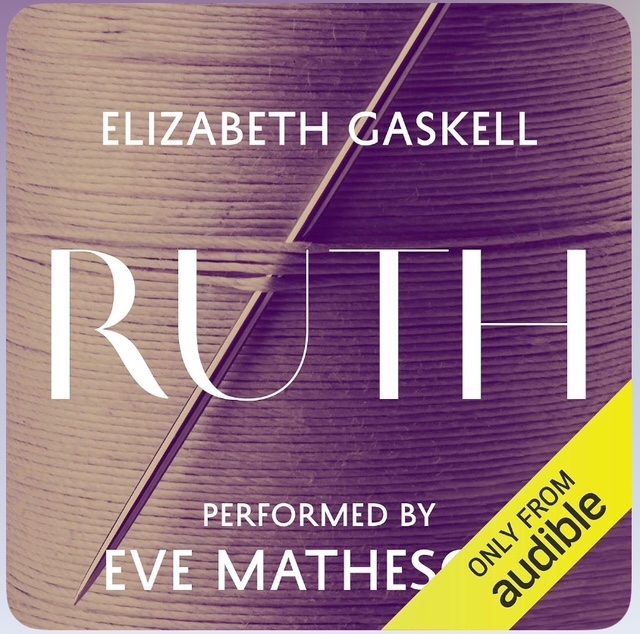
Ruth is a novel written by Elizabeth Gaskell (sometimes listed as Elizabeth Cleghorne Gaskell) in the 1850s.
Ruth’s mother died when she was twelve. Her father, absorbed in his own grief, did not pay much attention to Ruth and died when she was fifteen. The man named as Ruth’s guardian had never met her before, but obtains a postilion for her with a dressmaker.
Ruth is naive and immature, not having had her mother’s instruction as she became a young woman. When she accidentally meets a Henry Bellingham, a well-to-do young man in his twenties, he is struck by her beauty. He observes that she goes to church alone on Sundays and arranges to be where he can interact with her afterwards. After several weeks of meetings, he offers to walk with her to where she used to live, as she has often described how much she loved the area.
Ruth’s boss sees her so far from home with a young man, draws the wrong conclusion, and tells Ruth she is fired. Distressed and alone in the world, Ruth succumbs to Bellingham’s persuasion to accompany him to London.
Some time later, Ruth and Bellingham are visiting Wales when he falls seriously ill. The inn’s proprietor sends for his mother, who disgustedly ousts Ruth.
A Mr. Benson is a dissenting minister visiting the same area who ascertains Ruth’s situation. He intercepts her as she plans to attempt suicide and persuades her to live with him and his sister, Faith, and their crusty but kind-hearted housekeeper, Sally.
Faith and Sally don’t think well of Ruth at first. But her sweetness and humbleness win them over.
None of them realize that Ruth is with child at first–not even Ruth. When Ruth’s pregnancy is discovered, Mr. Benson’s sister, Faith, persuades him to say that Ruth is a distant relative who has recently been widowed. They want to give Ruth a fresh start but also want to protect her child.
As Ruth attends Mr. Benson’s church, she realizes she has done wrong and repents.
Eventually she becomes a governess to the daughters of the town’s leading citizen. But then her secret becomes known.
Mrs. Gaskell is one of the first authors to make a “fallen woman” the heroine of her story (The Scarlet Letter by Nathaniel Hawthorne came a few years earlier; Tess of the d’Urbervilles by Thomas Hardy came a few decades later). The book was controversial in its Victorian era. Gaskell rightly asserted that sometimes the fallen woman is the wronged party, that grace and forgiveness are available to all who have sinned, and that the child born of such a situation does not deserve to be branded.
Gaskell comes from a Unitarian background, which, from what I have read, I would not agree with. But much of what is said of Christ in this book seems accurate. However, there’s also talk about penance and “self-redemption,” which I don’t think are scriptural concepts.
Besides the themes of forgiveness and compassion, the book deals with the dangers of gossip and hypocrisy.
This novel is a product of its times. It’s wordy, with a lot of detailed description. Ruth is presented as almost too perfect. Some interactions are a bit overwrought.
But I loved the story. And I loved what Gaskell conveyed through the story. Both the main and secondary characters were well-developed.
I listened to the audiobook, nicely read by Eve Matheson.
(I often link up with some of these bloggers.)
 Stray Thoughts