My Lady Ludlow

My Lady Ludlow

My Lady Ludlow by Elizabeth Gaskell is a short novel–or a long novella–about an older aristocratic woman in the changing times of the late 1700s.

Her story is told by Margaret Dawson, a distant relative, now an old woman looking back on her time with Lady Ludlow. When Margaret was a teenager, her father died, leaving her mother with nine children. To help out, Lady Ludlow offered for Margaret to come stay with her, where she “did her Christian duty” by several young “gentlewomen” who were “out of means.” So Margaret traveled several hours to Lady Ludlow’s manor.

In those days, the Lord or Lady of the manor had pretty much the authority of the whole area. Lady Ludlow had a strong sense of The Way Things Should Be, based on the way things had always been. She could seem imperious and intractable, but she had a kind and generous heart.

She had frequent arguments with the young rector as well as her own steward about educating the “lower classes.” Reverend Gray wanted to open a Sunday School and then a village school, to teach doctrine and prepare young minds for the world to come. Mr. Horner, the steward, cared more about the here and now and “wanted to make every man useful and active in this world.” He had taken it upon himself to educate a bright young boy who happened to be the son of a man known for poaching. Mr. Horner thought the boy could be saved from the kind of life he was otherwise sure to grow into and possibly even come to work for the estate.

“My lady would hear of neither one or the other.” She thought the teaching of doctrine was best done by the family and church. She called reading and writing “edge-tools,” saying, “If our lower orders have these edge-tools given to them, we shall have the terrible scenes of the French Revolution acted over again in England. When I was a girl, one never heard of the rights of men, one only heard of the duties.” She thought that if the boy Mr. Horner was teaching, and others like him, learned to read and write, “his duties become complicated, and his temptations much greater, while, at the same time, he has no hereditary principles and honourable training to serve as safeguards.”

She then related a long story about friends in France who were killed during the Revolution, part of their fate hinging on a boy reading and sharing a message he should not have.

At first I wondered why Mrs. Gaskell created such a character. From what I’ve read about the author, Lady Ludlow’s views were not her views.

But, without spoiling the plot too much, Lady Ludlow gradually changes her thinking on many things. Then I realized the author was appealing to those who held the same views as Lady Ludlow, gently trying to open their eyes to other, better views.

My Lady Ludlow is one of the stories incorporated in the Cranford BBC TV series, along with the novel Cranford and another novella, Mr. Harrison’s Confessions, even though these stories don’t originally occur in the same place. The rector in the TV series is from one of the other books, so it’s sad that Rev. Gray wasn’t in the series. Mr. Horner, for some reason, is renamed Mr. Carter there. In the book, Lady Ludlow has one son remaining from her original nine, but he never appears at the manor. The TV series has him coming back as a ne’er-do-well, only interested in money, wanting to sell the estate to the railroad company. I know films can’t portray the books exactly, but when they add in their own plots, I want to say, “Go write your own books with your own characters, and don’t subvert those of others.”

Though Lady Ludlow is not as easy to like as Matty Jenkyns in Cranford, I did like the way she changed through the story.
Cranford

Cranford

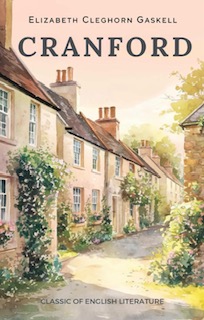
Cranford was originally written as a series of vignettes by Elizabeth Gaskell in Charles Dickens’ magazine, Household Words. She started out with just two, but he encouraged her to write more. Afterward, with a little alteration, the pieces were formed into a book.

As such, there’s not an overarching plot through the book. The stories take place in a fictional small town whose residents are mostly older single women living in genteel poverty. They live by a strict code–“calling” is only for three hours a day and only for fifteen minutes. They are constantly evaluating situations by class–how to dress for this person’s get-together, whether it was right for that person to marry this one, and so forth.

The two main characters are sisters, Deborah and Matty Jenkyns, daughters of the former rector. Deborah is older and very strict in her views of what is acceptable and what is not. Yet she surprises others by breaking protocol sometimes in her compassion for others. She leads the way in new thinking that class is not always the basis for one’s actions.

When she passes away early on in the book, the more timid Matty has to come into her own.

The stories are told through a Miss Smith, who comes to visit often. This is what I would call a quiet book. The characters experience ups and downs, joys and sorrows. Gentle humor is sprinkled throughout.

When a man with two daughters moves into the neighborhood, the dynamics of society are shaken up a bit, especially as he doesn’t know that things like one’s financial situation are not discussed in public. A series of robberies take place just as a magician comes to town, making him a suspect. Matty comes across a former suitor she’d had to turn down decades ago.

This Kindle version of the book has a couple of interesting appendices, one on the historical context of the book, and one on Gaskell’s life. Many of the stories are based on Gaskell’s memories of living in Knutsford (including one tale of a cow dressed in flannel. She told someone she scaled down some descriptions a bit, thinking no one would believe the full version). The former article says, “The tale of Cranford, then, is the tale of England in miniature: a society caught in a moment of profound transition, learning to reconcile its cherished traditions with the irresistible tide of a new and unfamiliar age.” It also says Gaskell captured the “quiet comedies and secret sorrows of her characters.”

Gaskell’s family were Unitarians, and she married a Unitarian minister. The article describes them as “Dissenters,” though I had not associated that word with Unitarianism. The article says, “This progressive faith emphasized reason, social responsibility, and individual conscience over rigid doctrine” and “shaped her entire worldview. It instilled in her a powerful sense of moral duty and a deep-seated empathy for those on the margins of society.” I would not agree with many religious aspects of Unitarianism (they deny the doctrine of the Trinity, for one thing), but that does not come up much in the book. The emphasis here is more on “social responsibility.”

I first read Cranford about fifteen years ago, and thought it merely “pleasant.” But then I started watching the BBC series, which combines stories from this book as well as My Lady Ludlow and Mr. Harrison’s Confessions. That renewed my interest in the characters, so I went through the book again, this time via audiobook superbly read by Prunella Scales.

Though I like others of Gaskell’s books better, I liked this one much more than I did on my first reading.

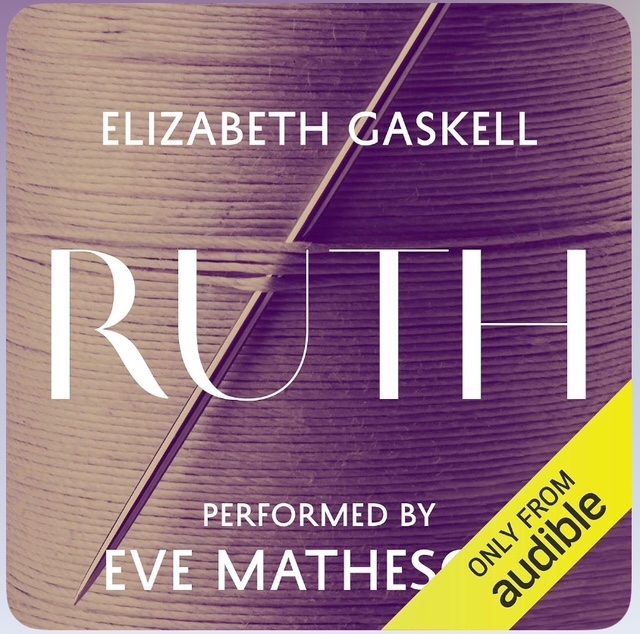
Ruth by Elizabeth Gaskell

Ruth is a novel written by Elizabeth Gaskell (sometimes listed as Elizabeth Cleghorne Gaskell) in the 1850s.

Ruth’s mother died when she was twelve. Her father, absorbed in his own grief, did not pay much attention to Ruth and died when she was fifteen. The man named as Ruth’s guardian had never met her before, but obtains a postilion for her with a dressmaker.

Ruth is naive and immature, not having had her mother’s instruction as she became a young woman. When she accidentally meets a Henry Bellingham, a well-to-do young man in his twenties, he is struck by her beauty. He observes that she goes to church alone on Sundays and arranges to be where he can interact with her afterwards. After several weeks of meetings, he offers to walk with her to where she used to live, as she has often described how much she loved the area.

Ruth’s boss sees her so far from home with a young man, draws the wrong conclusion, and tells Ruth she is fired. Distressed and alone in the world, Ruth succumbs to Bellingham’s persuasion to accompany him to London.

Some time later, Ruth and Bellingham are visiting Wales when he falls seriously ill. The inn’s proprietor sends for his mother, who disgustedly ousts Ruth.

A Mr. Benson is a dissenting minister visiting the same area who ascertains Ruth’s situation. He intercepts her as she plans to attempt suicide and persuades her to live with him and his sister, Faith, and their crusty but kind-hearted housekeeper, Sally.

Faith and Sally don’t think well of Ruth at first. But her sweetness and humbleness win them over.

None of them realize that Ruth is with child at first–not even Ruth. When Ruth’s pregnancy is discovered, Mr. Benson’s sister, Faith, persuades him to say that Ruth is a distant relative who has recently been widowed. They want to give Ruth a fresh start but also want to protect her child.

As Ruth attends Mr. Benson’s church, she realizes she has done wrong and repents.

Eventually she becomes a governess to the daughters of the town’s leading citizen. But then her secret becomes known.

Mrs. Gaskell is one of the first authors to make a “fallen woman” the heroine of her story (The Scarlet Letter by Nathaniel Hawthorne came a few years earlier; Tess of the d’Urbervilles by Thomas Hardy came a few decades later). The book was controversial in its Victorian era. Gaskell rightly asserted that sometimes the fallen woman is the wronged party, that grace and forgiveness are available to all who have sinned, and that the child born of such a situation does not deserve to be branded.

Gaskell comes from a Unitarian background, which, from what I have read, I would not agree with. But much of what is said of Christ in this book seems accurate. However, there’s also talk about penance and “self-redemption,” which I don’t think are scriptural concepts.

Besides the themes of forgiveness and compassion, the book deals with the dangers of gossip and hypocrisy.

This novel is a product of its times. It’s wordy, with a lot of detailed description. Ruth is presented as almost too perfect. Some interactions are a bit overwrought.

But I loved the story. And I loved what Gaskell conveyed through the story. Both the main and secondary characters were well-developed.

I listened to the audiobook, nicely read by Eve Matheson.

(I often link up with some of these bloggers.)

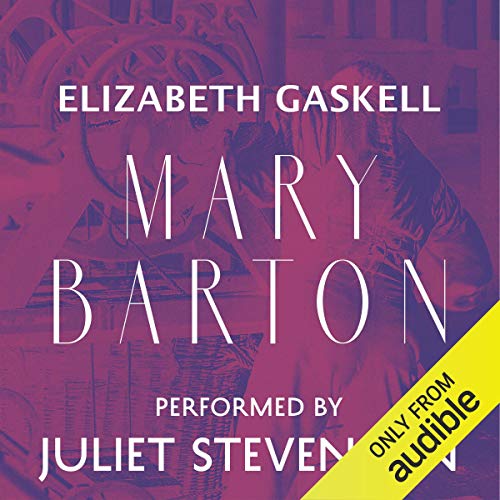
Mary Barton

19th-century writer Elizabeth Gaskell is known these days for Wives and Daughters and North and South (linked to my reviews).

But her very first book was Mary Barton. Elizabeth began writing at the urging of her husband after the loss of their son. But she was also motivated by “a deep sympathy with the care-worn men, who looked as if doomed to struggle through their lives in strange alternations between work and want; tossed to and fro by circumstances . . . Whether the bitter complaints made by them, of the neglect which they experienced from the prosperous—especially from the masters whose fortunes they had helped to build up—were well-founded or no, it is not for me to judge. It is enough to say, that this belief of the injustice and unkindness which they endure from their fellow-creatures, taints what might be resignation to God’s will, and turns it to revenge in too many of the poor uneducated factory-workers of Manchester (from the preface to Mary Barton).

Mary’s father is a mill worker who is critical of the rich in general and the “masters” (mill owners) in particular. He feels it’s unfair that the working class puts in so much effort with so little in return. The rich unfairly (it seems to him) not only have more, by seemingly little or no merit of their own, but they don’t help the poor in their need. The death of John’s wife and son fuels his views and his anger. He’s left to raise his daughter alone.

The story fast-fowards several years. Mary is now a teenager working in a dress shop. Jem, the son of family friends, has loved her since they were children. But she thinks of him as a brother. Henry Carson, the mill owner’s son, has noticed Mary and flirts with her on her breaks and after work. Mary is flattered by Henry’s attentions. She knows her father’s feelings about rich people. But she feels that once she marries Henry and her father experiences the benefit of his riches, he’ll be all right with her marriage.

Several issues between the mill owners and workers come to a head, with the workers threatening to strike. Some of the owners feel they need to concede to some of the workers’ demands. However, most of the owners, including Henry Carson, feel they need to stand firm; if they relent on any of these issues, the workers will just strike whenever they want something.

When the workers’ appeals fail, a group of them decides more drastic measures are needed.

Meanwhile, Jem comes to Mary to plead his case for her hand. She decisively tells him there is no hope. She could never love him. Not long after he leaves, however, she realizes she does love him. She agonizes over how to let him know and decides that it wouldn’t be right to go after him. She’ll just have to convey to him in more quiet manners her change of heart when they see each other. She tries to break things off with Henry, who doesn’t take no for an answer.

But Jem, taking her at her word, arranges to be away from home when Mary comes to visit his mother.

Then, suddenly, Henry is shot.

Jem is accused of the crime because his gun was found at the scene and because he was heard threatening Henry over Mary a few days earlier.

But Mary is sure she knows who the real killer is. How can she help Jem without betraying someone else?

Besides the industrial and romantic plot lines, Mary’s friend, Margaret, lives with her wise and level-headed grandfather, Job Legh. Margaret has a beautiful singing voice and but is going blind. Alice Wilson is an older lady who is everyone’s friend and the go-to helper when someone is sick, until she falls ill herself. Esther is Mary’s aunt, who disappeared from the family early on but shows up again. Jem’s mother, Jane, lose her twins and then her husband.

Elizabeth tries to help both sides of the industrial concerns to see the other truthfully. She definitely thinks the masters can be more compassionate and do more, and she spends more time on their shortcomings than the workers’. But she cautions that they have their troubles, too. In one scene, John Barton is going to a druggist’s for a friend.

It is a pretty sight to walk through a street with lighted shops; the gas is so brilliant, the display of goods so much more vividly shown than by day, and of all shops a druggist’s looks the most like the tales of our childhood, from Aladdin’s garden of enchanted fruits to the charming Rosamond with her purple jar. No such associations had Barton; yet he felt the contrast between the well-filled, well-lighted shops and the dim gloomy cellar, and it made him moody that such contrasts should exist. They are the mysterious problem of life to more than him. He wondered if any in all the hurrying crowd had come from such a house of mourning. He thought they all looked joyous, and he was angry with them. But he could not, you cannot, read the lot of those who daily pass you by in the street. How do you know the wild romances of their lives; the trials, the temptations they are even now enduring, resisting, sinking under? You may be elbowed one instant by the girl desperate in her abandonment, laughing in mad merriment with her outward gesture, while her soul is longing for the rest of the dead, and bringing itself to think of the cold-flowing river as the only mercy of God remaining to her here. You may pass the criminal, meditating crimes at which you will to-morrow shudder with horror as you read them. You may push against one, humble and unnoticed, the last upon earth, who in Heaven will for ever be in the immediate light of God’s countenance. Errands of mercy—errands of sin—did you ever think where all the thousands of people you daily meet are bound? Barton’s was an errand of mercy; but the thoughts of his heart were touched by sin, by bitter hatred of the happy, whom he, for the time, confounded with the selfish.

Just occasionally, the narrator (possibly Gaskell herself) might come across as a little preachy by today’s standards. But I think in her time, she wasn’t trying to “preach” as much as to open people’s eyes to the plight of others.

Though Wives and Daughters and North and South are still my favorite Gaskell books, I did enjoy Mary Barton very much, especially the last half.

I listened to the audiobook, which was included as part of my Audible subscription. Juliet Stevenson did a superb job with the narration and different dialects. But I also got the free Kindle version to read parts there. the novel is also only via Project Gutenberg here.

Have you read Mary Barton? What did you think?