31 Days of Inspirational Biography

For the past few years Myquillyn Smith (The Nester) has hosted 31 Days on her blog, a writing challenge wherein bloggers can choose a topic to write on every day in October in 9 different categories. It has gotten so big that this year it has its own site: 31 Days. You can find more information at What is 31 Days?

I really enjoyed participating for the first time last year with 31 Days of Missionary Stories. I decided this year to write about 31 Days of Inspirational Biography. I was originally going to call it Christian Biography, but rather than just give you an overview of someone’s life that you can find on Wikipedia, I want to share what inspired me about that person’s life. It may be an overview in some cases, or it may be one incident.

photo 3(2)

Reading Christian biographies has been one of the most influential activities of my life: I’ve learned so much by seeing faith in action, growth, example, victories as well as defeats, all of which has aided me in my own walk with the Lord.  I hope to share some of that with you.

I got several comments last year about how much time it must take to write these posts: most of them will come from newsletter articles I’ve already written. For nine years in a previous church I compiled a newsletter for our ladies’ group with a biographical section, for the same reasons listed above, and the Lord has opened the door for me to do something similar in our current church. I’ll be editing and tweaking them, but for the most part I won’t be writing these “from scratch,” so it is not taking as much time as it might appear to be.

I hope you’ll join me! As I post each day, I’ll put the links on this post so that they’ll all be in one place.

And in the meantime you might check out the 31 Days site and see if you’d like to participate. Let me know if you do!

Day 1: Frances Ridley Havergal’s Response to a Rude Waitress.
Day 2: If I Perish. Refusing to bow down to falsehood.
Day 3: A Sense of Him: One of Isobel Kuhn’s “Second Mile People
Day 4: Facing the Darkness.
Day 5: Lady Huntingdon. Saved by an “M”
Day 6: One Woman Against the Reich: The True Story of a Mother’s Struggle to Keep Her Family Faithful to God in a World Gone Mad.
Day 7: Bill Maher, “Missionary to the Handicapped
Day 8: Mimosa: Great Faith From Small Seeds.
Day 9: Dr. Sa’eed of Iran.
Day 10: Margaret Paton, Missionary to Cannibals in the South Sea Islands
Day 11: Walter Wilson, Caring Ambassador For Christ.
Day 12: Georgi and Natasha Vins, Christianity Behind the Iron Curtain
Day 13: William Tyndale, Bringing the Scripture to the People at Risk to Himself
Day 14: Anne Bradstreet, Puritan Poetess
Day 15: The “Uncommon Union” of Jonathan and Sarah Edwards
Day 16: Sarah Edwards As a Mother
Day 17: Rosaria Butterfield: How a Leftist, Feminist, Lesbian Professor Who Hated Christians…Became One.
Day 18: Darlene Deibler Rose learns “faith stripped of feelings, faith without trappings
Day 19: Corrie Ten Boom Repurposes a Concentration Camp
Day 20: Louis Zamperini: Olympian, POW, Christian
Day 21: Ann Judson, Brave and Faithful First American Woman Missionary
Day 22: Margaret Baxter, Overcoming Natural Fear to Face Persecution and Hardship
Day 23: Mrs. C. H. Spurgeon
Day 24: Rosalind Goforth: How I Know God Answers Prayer
Day 25: Rosalind Goforth Learns Submission
Day 26: Rosalind Goforth As a Young Mother Tries to Find Time For Bible Reading
Day 27: The Last CIM Missionaries in Communist China
Day 28: Charlie Wedemeyer, Living With ALS and Giving Hope to Others
Day 29: Nabeel Qureshi: A Devout Muslim Encounters Christianity
Day 30: A list of several other good biographies
Day 31: Why Read Biographies?

“But if not…”

Since our pastor has been diagnosed with cancer and given only 6 months or so to live, he has had a couple of sessions of combined adult Sunday School classes in order to discuss with us some issues and some of his vision and burden for us. A couple of weeks ago he was feeling poorly enough not to be able to make it for Sunday School for one of these sessions. Our assistant pastors took that opportunity to share a bit of their perspective and then a few men prayed for the family. That time was greatly beneficial and therapeutic for me: outside of our own family and sharing of thoughts on blogs or Facebook with other members, I hadn’t really had a chance to partake of that kind of sharing and praying together. Though I’m sorry our pastor was feeling so sick that day, I think the time was very well spent.

Though those who prayed aloud mentioned varying aspects – the pastor’s physical needs, grace for his wife and family, his two daughters who were getting married in what was supposed to have been one of the best summers of their lives, direction for the youngest daughter scheduled for college in the fall, and many others – there was a recurring theme in several of them. They prayed for the miracle of healing (and it would take a true miracle) and promised to give God the glory for it, but, acknowledging that might not be God’s will, prayed for His grace for the family and our church.

I’ve known some who belittle the Christian faith to point to this kind of praying as a lack of faith, as providing an “out” if God doesn’t answer prayer the way we ask, or even a lack of evidence for God since we can explain away the lack of an answer with it’s not being God’s will. But that’s not why we pray that way. We have good Biblical precedent.

In Daniel 3, Shadrach, Meshach, and Abednego were threatened with being thrown in a fiery furnace if they did not bow down and worship the king’s golden image. They refused and replied, “Our God whom we serve is able to deliver us from the burning fiery furnace, and he will deliver us out of thine hand, O king.  But if not, be it known unto thee, O king, that we will not serve thy gods, nor worship the golden image which thou hast set up” (verses 17-18).

Jesus, in the garden of Gethsemane the night before He was crucified, prayed, “Father, if thou be willing, remove this cup from me: nevertheless not my will, but thine, be done” “Luke 22:42).

Someone once said, “Prayer is asking God to align you with His will rather than asking Him to be aligned with yours.”

Can God heal someone diagnosed with cancer and only months to live? Sure. Why doesn’t He do so every time we ask Him to? I don’t know.

In Goforth of China when Rosalind recounted their miraculous deliverance during the Boxer rebellion, she had been asked why God didn’t deliver all the missionaries in China at that time. Some were horribly murdered. She responded:

Truly a vital question, which could not lightly be set aside! Humbly and prayerfully we pondered this “Why” in the light of Scripture. In the twelfth chapter of Acts, we read of Herod’s succeeding in putting James to death by the sword, and directly after comes the story of how Herod was hindered in carrying out his intention to kill Peter who was delivered by a miracle. Then who could read that marvelous eleventh chapter of Hebrews with its record of glorious martyrdom and miraculous deliverances without being thrilled? In face of these and many other passages, while still unable to answer the “why” we saw our Almighty God used His own prerogative to glorify His name whether in the glorious martyrdom of some or in the miraculous deliverance of others (p. 129-130).

James was killed while Peter was delivered. Uriah was killed while David lived. Many Hebrew babies died while Moses was rescued. Not only was Moses answered “no” to his request to see the Promised Land, but God admonished him not to speak about it any more. Jesus escaped Herod while the rest of the children under 2 in Bethlehem were slaughtered. Many people were healed, but God answered Paul’s request for deliverance with a “No” and a promise of His grace instead. The people in the first part of Hebrews 11 experienced glorious deliverance: the people at the end experienced trials, mocking, imprisonment, stoning, being sawn asunder, homelessness, “being destitute, afflicted, tormented” – yet these were included with the rest as “having obtained a good report through faith” (verse 39) even though they weren’t delivered.

Sometimes there are reasons why prayer isn’t answered, or at least isn’t answered the way we’d like. God has many reasons for allowing suffering, but we can’t know all the reasons or see the big picture of what He is doing in the world or even in the life of any one person and his or her sphere of influence. But those who know Him can trust Him as a father. Even the best of fathers has to sometimes say “no.”

Why does God have to use such means to accomplish His purposes? Somewhere I read that Elisabeth Elliot wrote that, though she had heard many wonderful stories of how God used her husband Jim’s death in many people’s lives, that knowledge still didn’t really satisfy. Didn’t God save people and call them to His service through other means than someone’s death? Sure, all the time. Why was that required this time? She didn’t know, but she trusted that God had His reasons. In “Thy Calvary Still All Our Questions” in the book Rose From Brier, Any Carmichael wrestled with this:

This is a Why? of a different order from that of the little mosquito. It is immeasurable greater. It strikes at the root of things. Why is pain at all, and such pain? Why did God ask Satan the question which (apparently) suggested to the Evil One to deal so cruelly with an innocent man? Why do the innocent so often suffer? Such questions generally choose a time when we are in keen physical or mental suffering, and may (the questioner hopes will) forget our comfort. They seize us like fierce living things and claw at our very souls.

Between us and a sense of the pain of the world there is usually a gate, a kind of sluice gate. In our unsuffering hours it may be shut fast. Thank God, it is shut fast for tens of millions. But let severe pain come, and it is as though the torture in us touched a secret spring, and the door opens suddenly, and straight upon us pour the lava floods of the woe of a Creation that groans and travails together….

O Lord, why?

After considering several answers which did not really satisfy her, she wrote,

But, though, indeed, we know that pain nobly born strengthens the soul, knits hearts together, leads to unselfish sacrifice (and we could not spare from our lives the Christ of the Cross), yet, when the raw nerve in our own flesh is touched, we know, with a knowledge that penetrates to a place which these words cannot reach, that our question is not answered. It is only pushed farther back, for why should that be the way of strength, and why need hearts be knit together by such sharp knitting needles, and who would not willingly choose relief rather than the pity of the pitiful?

…What, then, is the answer? I do not know. I believe that it is one of the secret things of the Lord, which will not be opened to us till we see Him who endured the Cross, see the scars in His hands and feet and side, see Him, our Beloved, face to face. I believe that in that revelation of love, which is far past our understanding now, we shall “understand even as all along we have been understood.”

And till then? What does a child do whose mother or father allows something to be done which it cannot understand? There is only one way of peace. It is the child’s way. The loving child trusts.

I believe that we who know our God, and have proved Him good past telling, will find rest there. The faith of the child rests on the character it knows. So may ours, so shall ours. Our Father does not explain, nor does He assure us as we long to be assured… But we know our Father. We know His character. Somehow, somewhere, the wrong must be put right; how we do not know, only we know that, because He is what He is, anything else is inconceivable. For the word sent to the man whose soul was among lions and who was soon to be done to death, unsuccored, though the Lord of Daniel was so near, is fathomless: “And blessed is he whosoever shall not be offended in me.”

There is only one place we can receive, not an answer to our questions, but peace — that place is Calvary. An hour at the foot of the Cross steadies the soul as nothing else can. “O Christ beloved, Thy Calvary stills all our questions.” Love that loves like that can be trusted about this.

There are many strong and positive verses about prayer that we can rely on, yet we have to include “if it be Thy will” and trust that even if God doesn’t heal or deliver or provide like we wanted Him to, He is still good and wise and accomplishing His purpose.

God is doing good things in our own church and across the country through our pastor’s situation. One of our church members has shared some of those things. If you feel led, I’m sure all involved would appreciate your prayers. In addition, some are attempting to help raise funds for the family’s needs through https://www.idoitfor.org/Tom/.


tom

Trusting God in the Dark

I often post hymns texts on Sundays, but I don’t have much time at the computer on Sunday itself, so if I don’t have a post ready beforehand I’m not usually able to get to it then. That dilemma was compounded yesterday when I had two different songs on my heart and couldn’t decide which one to share. 🙂

I’ve been rediscovering a CD that I’ve had for a while but somehow got buried in my little basket I keep on the kitchen counter for CDs: Beyond All Praising by the BJU Singers and Orchestra. One of the songs that stands out to me from this CD is “In Your Silence,” words by Eileen Berry and music by Molly IJames, on the theme of trusting God even when He seems silent and distant.

In Your word I find the echoes of the questions in my mind;
Have I fallen from Your favor, is Your ear to me inclined?
When Your silence is unbroken, though my prayer ascends each day,
Father, keep my faith from failing in the face of long delay.

While You wait in gracious wisdom and my doubts begin to rise,
I recall Your loving kindness, and lift my hopeful eyes.
While Your hand withholds the answer, I will not withhold my heart.
I will love you in Your silence, I will trust You in the dark.

When the troubled thoughts within me hold me wakeful in the night,
And the shadows that surround me seem to hide me from Your sight.
Father, bring to my remembrance mercies shown in days gone by.
Help me rest upon Your promise: You will not neglect my cry!

While You wait in gracious wisdom and my doubts begin to rise,
I recall Your loving kindness, and lift my hopeful eyes.
While Your hand withholds the answer, I will not withhold my heart.
I will love you in Your silence, I will trust You in the dark.

It is performed beautifully here:

I think many Christians go through times like this. Biblically Job and the psalmists share similar thoughts, and this song echoes some of the Psalms: the second stanza brings to mind Psalm 63. The last two lines of the chorus particularly resonate with me: “While Your hand withholds the answer, I will not withhold my heart. I will love you in Your silence, I will trust You in the dark.”

This song also brings to mind a section in Evidence Not Seen by Darlene Deibler Rose (linked to my review). The following occurred while she was in a Japanese prison camp, having been captured while a missionary to the New Guinea during WWII.

I knew that without God, without that consciousness of His Presence in every troubled hour, I could never have made it…Quite suddenly and unexpectedly, I felt enveloped in a spiritual vacuum. “Lord, where have You gone? What have I said or done to grieve You? Why have You withdrawn Your Presence from me? Oh Father—” In a panic I jumped to my feet, my heart frantically searching for a hidden sin, for a careless thought, for any reason why my Lord should have withdrawn His Presence from me. My prayers, my expressions of worship, seemed to go no higher than the ceiling; there seemed to be no sounding board. I prayed for forgiveness, for the Holy Spirit to search my heart. To none of my petitions was there any apparent response.

 I sank to the floor and quietly and purposefully began to search the Scriptures hidden in my heart…

 “Lord, I believe all that the Bible says. I do walk by faith and not by sight. I do not need to feel You near, because Your Word says You will never leave me nor forsake me. Lord, I confirm my faith; I believe.” The words of Hebrews 11:1 welled up, unbeckoned, to fill my mind: “Now faith is the substance of things hoped for, the evidence of things not seen.” The evidence of things not seen. Evidence not seen — that was what I put my trust in — not in feelings or moments of ecstasy, but in the unchanging Person of Jesus Christ. Suddenly I realized that I was singing:

When darkness veils His lovely face,
I rest on His unchanging grace.
In every high and stormy gale,
My anchor holds within the veil.

 On Christ the solid Rock I stand;
All other ground is sinking sand.

I was assured that my faith rested not on feelings, not on moments of ecstasy, but on the Person of my matchless, changeless Savior, in Whom is no shadow caused by turning. In a measure I felt I understood what Job meant when he declared, “Though He slay me, yet will I trust in Him” (13:35). Job knew that he could trust God, because Job knew the character of the One in Whom he had put his trust. It was faith stripped of feelings, faith without trappings. More than ever before, I knew that I could ever and always put my trust, my faith, in my glorious Lord. I encouraged myself in the Lord and His Word.

We don’t always know why God seems distant. Sometimes it is sin: though He is with us always, that fellowship can be broken when we’re sinning against Him. Sometimes, as in Darlene’s case, He is teaching us to trust in Him and His Word and not in our feelings. Sometimes, like for Daniel, answers are delayed due to spiritual opposition. There may be other reasons as well, but the answer is the same: reminding ourselves of and resting on His Word.

Though this is not a “dark” time for me, it is for a few friends, so I hope this encourages them, and I can shore these truths up for myself for when those times might come around in the future.

Who is among you that feareth the Lord, that obeyeth the voice of his servant, that walketh in darkness, and hath no light? let him trust in the name of the Lord, and stay upon his God. Isaiah 50:10


Laudable Linkage

I don’t usually do one of these every week, but the past few weeks have been filled with good reading. Here are some posts that spoke to me this week:

A “Good Girl” Wrestles With the Gospel. “My sin nature seems to be super glued to me. Being a good girl doesn’t dissolve its adhesive effect. Following the rules doesn’t make me righteous. Acting like Pollyanna isn’t the same as having a pure heart.”

Nowhere Else to Go. This really touched my heart.

What Seems to Be. “If the characters in the story could step back and see what the storyteller sees, they might not despair quite so keenly.  They would trust the twists and turns as part of the greater narrative.  May it be so for me, and for all of us.”

5 Churchy Phrases That Are Scaring Off Millennial. We shouldn’t throw out a true phrase just because someone objects to it, but we do need to make sure what we say  is truthful and appropriate.

Modesty Matters: The Heart of Modesty. I’ve read so much on modesty that I wasn’t terribly excited when I saw this title, but I appreciated the balance and the focus here. This is the first in a series.

The Silent Suffering of Miscarriage. Helpful and not so helpful things, from one who has been there.

Undercover: How book covers come to be. Thought this was fascinating.

Free ESV Online Study Bible, for a short time, to celebrate Crossway’s 75th year.

God's care

31 Days of Missionary Stories: Margaret Stringer: A Merry Heart and a Faithful Spirit

Margaret Stringer

Margaret Stringer has been one of my favorite people for years. The church we attended in SC supported her in Indonesia (formerly known as Irian Jaya, now West Papua). She was there for a little over 40 years, and she “retired” (I always put that in quotation marks, because she is one of the most active retirees I know, traveling often to churches and missions conferences) not too far from our church, so we invited her to speak at least once a year to our ladies’ group. She would have us just rolling in the floor telling about situations which I’m sure weren’t funny when they first happened.

I’ve appreciated not only her merry heart, but also her faith and obedience. Many of us can’t imagine being the lone woman to go to visit a village of cannibals at the possible risk of our own lives. That sounds like something missionaries did way back, like Mary Slessor. But there are still people who haven’t heard of the Savior, and God’s ability to meet their needs as well as the needs of His messengers are still the same.

from_cannibalism_small.jpgA few years ago she wrote a book titled From Cannibalism to Christianity: The Vakabuis Story, which tells mainly how the Lord opened one particular group of villages, from first contact to the establishment of a full-fledged church. There are hilarious moments as well as frightening ones. But what joy there is in seeing the light of understanding dawn after repeated sharing of the gospel. I don’t remember if Margaret said this in the book, but I know I heard her say while speaking to us that there were moments when she thought, “This isn’t going to make sense to them.” Imagine sharing the Word of God with someone who doesn’t know anything about it and doesn’t know who God is. Yet they did share God’s Word by faith, and the Holy Spirit gave understanding and conviction.

Secularists don’t have to worry about the people’s culture being infringed on. The people still have their own traditions and culture. But they also have hope and life. As I said in an earlier post, I don’t know why anyone, even the most unchristian person on the planet, would have any objection to helping people get rid of traditions like cannibalism and killing a twin baby. I appreciated the way Margaret endeavored to help them not to be too dependent on her. When they asked her to name the church, for instance, she told them they should name it.

One of her major accomplishments while there was reducing two languages to writing and translating the Bible into them.

When she retired she thought she would never have an opportunity to go back, but she was able take a few trips back. One night at our ladies’ group she showed some video footage (24 minutes condensed from 5 hours) while she told us what was going on, interspersed with some history here and there of the people. I tell you — seeing footage of former cannibals and headhunters now singing hymns, hearing about the most powerful and feared witch doctor in the area who became a believer and whose son is now the head of the church — that just does something to your heart.

She told us about one man during a visit who said something like, “When you left us, I was very sad for a long time. But you told us you were leaving God here, and He helped me. So when you leave this time, I will be sad, but not for as long a time, because God is here with me.” She said that’s not exactly how she put it to him, but it was so neat he got the concept that God was still there and didn’t leave when she did, and he could depend on Him.

I was amazed at her fearlessness. In one piece of footage, she was getting out of a boat to see one of the villages she used to work in, and one man took her hand and began leading her away. Her friend said, “Where are you going?” She said, “I don’t know!” As people came to greet her and hug her, the man would stop for a few minutes, and then take her hand and lead her away again. Finally he led her to his house, where he had prepared lunch for them.

One of my favorite stories she tells is not in the book but is so characteristic of her. She was new to the field, which of course was an adjustment, and she was pretty low. A number of trying things had happened, one of them a big storm that had blown through the glassless windows and ruined about 95 % of her work of language analysis. After she went to bed, something fell off the wall and hit her on the head. That was the last straw: if I remember correctly, she “fussed” in her spirit at God, saying things like, “I thought you loved me! I thought you promised to take care of me!” She got a light to see what had fallen, and it was a plaque that said…”He cares for you.” That’s one way to get the message!

Margaret has also written several articles about becoming and working as a missionary here. This video, narrated by Margaret, tells the Vakabuis story in condensed form, well worth the 30 minutes it takes to watch:

(You can see other posts in the 31 Days of Missionary Stories here.)

(This will also be linked to Semicolon‘s Saturday Review of Books.)

31 Days of Missionary Stories: Eric Liddell: Olympian and Missionary

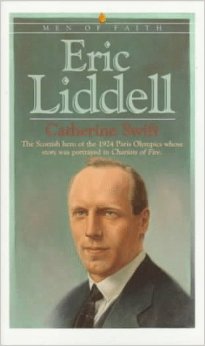
liddell The world knows the name Eric Liddell as the winner of the gold medal for the 400 meter race in the 1924 Olympics (portrayed in the film Chariots of Fire). Many know, further, that he did not originally train for that race: he had trained for the 100 meter race, but, dismayed to find that the race was to be held on Sunday, the Lord’s day, he refused to run it and was allowed to switch to the 400 meter. Perhaps fewer still know that he was born to missionary parents and went back to China as a missionary himself.

The biography Eric Liddell by Catherine Swift (Men of Faith Eric Liddell(series, Bethany House Publishers) details his parents’ testimony and early experiences in China. (Incidentally, this book includes the best concise exposition that I have ever read of the famed Chinese Boxer Rebellion, in which many missionaries were killed or driven from China.) Eric was born Jan. 16, 1902, in Tientsin in North China. His parents were originally from Scotland: Eric’s first visit there occurred during his parents’ first furlough when Eric was five.

At this time missionary children were usually educated in boarding schools, so Eric and his older brother Robbie stayed behind at the London Missionary School when their parents went back to China. Eric was thin, in frail health, and very shy at first, but flourished under the headmaster’s practice of his motto, “Healthy minds in healthy bodies.” Although gaining confidence and overcoming much of his shyness, he remained a relatively quiet personality. He began attending voluntary Bible classes in his teens, never taking part in the discussions, but thinking over them when he was alone.

He played cricket and rugby well and especially enjoyed running (interesting since there was concern during an early childhood illness that he might never run), winning many athletic honors: yet he was known for his humility and his not letting any of it go to his head.
Eric had a rather odd running style: “He had a habit of running with his head rested back on his shoulders, gazing up at the heavens instead of where he was going. His knees came right up as though he was trying to hit his own chin, and he lifted his feet far too high off the ground. His arms waved about sporadically and his fists punched at the air, making him look more like a boxer than a runner.”

During Eric’s college years he became well known for his running. At one point some students began evangelistic work in the area and had a particularly hard time reaching the men. One student thought of asking Eric to speak, thinking what fame he had would attract the men. Though he hated “the limelight,” Eric agreed to go. He very quietly and humbly spoke of God and his love for Him and trust in Him. That experience awakened in him a desire to more openly share His Lord with others and began a public ministry.

When Eric began training for the 1924 Olympics in Paris, it never occurred to him that the match would be held on Sunday, as well as two relays he could have competed in. When he saw the schedule, long before the event, he simply felt he could not participate and violate his convictions and dishonor the Lord and His Day. He did not make a big fuss about it — but others did. He received much criticism and was even accused of being a traitor to his country. The authorities tried to get the schedule changed, to no avail, then they asked Eric to compete in the 200 and 400 meter races instead. On Wednesday of the Olympic Games, Eric ran in the 200 meter race, winning a bronze medal, which no Scotsman had even done. Then on Friday, as he was leaving his hotel for the 400 meter race, his regular masseur handed him a slip of paper. Later in a quiet moment, Eric unfolded the paper to read, “In the old book it says, ‘He that honors me I will honor.’ Wishing you the best of success always.” This reinforced to Eric the word he had been resting on, “Whosoever believeth in me shall not be ashamed,” and encouraged him. To everyone’s surprise, he not only won the gold medal in that race, but set a new world record.

Just a few weeks later he publicly announced his plans to be a missionary in China, teaching at a college in the city in which he was born. He spent another year in England, holding campaigns and studying theology.

Eric ministered in China for several years, married, had two daughters and was expecting a third while unrest brewed: nationalists and Communists were fighting each other while the Japanese were creeping in. Eventually the Japanese gained control of their area and were talking about sending all missionaries to internment camps. Eric sent his wife and daughters to Canada. The Christians who were left found creative ways to get around the ban on church services, such as inviting each other to “tea” on Sundays. Just a few weeks before Eric expected to leave, all British and American missionaries were sent to an internment camp several miles away. Eric quietly ministered there in many ways. In another book, A Boy’s War, David Michell, who was a boy in the internment camps at the time, tells of his memories of “Uncle Eric,” as he was known to the children. Eric fell ill and gradually grew worse: eventually he and others knew from his symptoms that he had a brain tumor. His last words were, “It’s complete surrender,” a phrase he had used often in his life and ministry.

The world was stunned to learn of Eric’s death at the age of 43 just a few weeks before World War II ended. Memorial services were held in many places. His life still reaches out even now, nearly 60 years after his death, as an example of quiet, humble servitude and a life that honors God.

Here is a video of Eric Liddell’s and Harold Abraham’s races in the 1924 Olympics:

And this is pretty neat: Day of Discovery took Liddell’s three grown daughters back to China for the first time since their father had sent them to safety in 1941:

One quote of Liddell’s that I have in my files is “Circumstances may appear to wreck our lives and God’s plans, but God is not helpless among the ruins.” I don’t remember the context in which he said these words, but they are a fitting epitaph to his life.

(You can see a list of other posts in the 31 Days of Missionary Stories here.)

(This will also be linked to Semicolon‘s Saturday Review of Books.)

31 Days of Missionary Stories: Gladys Aylward: The Small Woman With Big Faith

AylwardGladys Aylward felt she was called to China as a missionary: yet, as she sat in an office of the China Inland Mission, the principal of the Women’s Training Center told her he felt she could not learn a difficult language like Chinese at her “advanced” age of almost 30. He did tell her there was an elderly couple just returned from China who needed assistance, and she agreed to go help them. Their talk of China continued to fan the flame of interest, and after hearing about many older single women missionaries in China, she decided to try to go to China on her own and be of help to one of them.

She went back to her former employment as a parlor maid to earn money to go. Her new employer had been an adventurer with a library full of books, many of them about China, some of which he had written himself. She was able to feast her soul on these and on study of God’s Word after her work was done. She was especially encouraged by the story of Nehemiah, wanting to go on a mission for God while he was the king’s cupbearer; she saw a parallel to her own situation. By making herself available to other manors to work during her time off, the Lord blessed with providing the finances to go; meanwhile, she had contacted a lady missionary and received word that she wanted her to come.

On October 15, 1932 (81 years ago today) She set off on a harrowing journey to China which included riding a train until it could go no farther due to fighting in Russia, having to walk back to the nearest station alone, spending the night huddled up under her luggage during a Siberian winter, having her passport stolen with the occupation changed from “Missionary” to “Machinist,”  with the help of kind strangers narrowly missing being sent to a work camp against her will. Finally arriving at her destination after several days and various means of travel, she found the lady she was to work with, Jeannie Lawson,  and the building she wanted to make into an inn badly in need of repair and cleaning. When they were finally ready, but with no customers after several days of advertising, Jeannie told Gladys to go out and grab the lead mule of the passing mule train and lead it into the inn, and the rest of the mule pack, with the muleteers, would follow. This Gladys did several times until the muleteers began coming out of their own preference. A Chinese cook, Yang, prepared meals and told rather mixed-up versions of Bible stories until  the muleteers were comfortable enough with Jeannie and Gladys for them to tell Bible stories.

After some months of this work, and many of the muleteers becoming Christians (even some who weren’t Christians passed the stories along to others), Jeannie suffered a severe fall from which she never recovered.

Shortly thereafter the local Mandarin told Gladys that the government had outlawed the long-held practice of foot-binding and asked her to go throughout his district to inform people of the new law and to inspect the women’s feet. After some consideration Gladys agreed to go, but warned him that she would speak of the Lord Jesus Christ to the people. He had no problem with that, and thus the Lord provided an unparalleled and unexpected way to evangelize the area with government escort.

At one time Gladys was officially summoned to a prison: the prisoners were rioting and killing each other, and the soldiers were too afraid to intervene. The warden wanted Gladys to go in and stop the fighting, because she spoke of a God Who was all-powerful and would protect her! Gladys realized the truth of what she proclaimed was on trial, so she agreed to go into the prison. By the grace of God, the prisoners listened to her. She saw that they were near-starving and had nothing to do with their time, and she was able to speak to the warden on their behalf and also to start visiting them with the gospel.

Once Gladys came face to face with a woman on the street trying to sell her ill, malnourished child. She tried to speak to the Mandarin about it, but he refused to interfere and told Gladys not to, either.  But she couldn’t leave the child in her plight, so Gladys “bought” her. That eventually led to her taking in a number of children through various means.

In 1936 Gladys became a Chinese citizen.

In 1938 the Japanese bombed and overtook the city, causing survivors  to flee. At this time the Mandarin became a Christian.  Eventually Gladys took over 100 orphans by foot over  mountains, then waited for miraculous provision of a boat to cross the Yellow River to an orphanage in Sian.

A film of her story was made during her lifetime, entitled The Inn of the Sixth Happiness, starring Ingrid Bergman as herself. Gladys called it “lie upon lie.” It upset her greatly that Hollywood changed details and names: there was a significant meaning to the inn’s real name, The Inn of Eight Happinesses.  Worst of all was the depiction that she had dumped the orphans in Sian to go live “happily ever after” with a Chinese colonel.

She passed away at the age of 67, a shining example of overcoming obstacles by God’s grace.

Sources: Gladys Aylward, Missionary to China by Sam Wellman and Gladys Aylward by Catherine Swift.

(You can see a list of other posts in the 31 Days of Missionary Stories here.)

31 Days of Missionary Stories: With All Our Feebleness

Hebrews 11 is sometimes called the hall of fame of faith or the Christian Hall of Fame, telling of the victories and triumphs of various people in the Bible. But verse 36 has a rather startling turn: “and others…” were tortured, tried, stoned, made to wander in deserts. That doesn’t sound very victorious. But they all “obtained a good report through faith,” though they  had “received not the promise” yet (verse 39).

amy-carmichael-2Probably many Christians are more familiar with the name of Amy Carmichael than of some of the other missionaries I’ve mentioned in this series. Most know that she was missionary to India. She began a rather robust itinerant evangelistic ministry with a group of other women, but when God began bringing children her way whose families were going to sell them to temples for illicit purposes, she gradually became convinced that He would have her care for these children, though it meant a drastic change in her ministry and lifestyle. Over time a whole compound known as Dohnavur was developed.

What some may not know is that she was an invalid for the last 20 years or so of her life. She remained in India, still in charge of Dohnavur, still encouraging, advising, praying, and writing, but she was in much pain and had limited mobility those years. In Amy Carmichael of Dohnavur by Frank Houghton, he includes this poem before telling of this part of her life:

Two glad services are ours,
Both the Master loves to bless.
First we serve with all our powers–
Then with all our feebleness.

Nothing else the soul uplifts,
Save to serve Him night and day,
Serve Him when He gives His gifts–
Serve Him when He takes away.

~ C. A. Fox

Elisabeth Elliot said of limitations, “For it is with the equipment that I have been given that I am to glorify God. It is this job, not that one, that He gave me.” The limitations that we think are hindering our ministry are often the very thing God uses to shape our ministry for Him.

One day Amy received a shipment of tracts for the ill. As she read them, they just did not do anything for her. As she pondered that, she realized it was because they were written from well people telling sick people how they ought to feel. Over many years she had written notes of encouragement to various ones in the Dohnavur Hospital (named, in the descriptive Indian way, Place of Heavenly Healing), and some of these were compiled in a book titled Rose From Brier. They are rich in their spiritual encouragement and insight, partly precisely because they were written by one who had shared in the fellowship of sufferings.

In another of Amy’s books, she wrote the following:

This prayer was written for the ill and for the very tired. It is so easy to fail when not feeling fit. As I thought of them, I also remembered those who, thank God, are not ill and yet can be hard-pressed. Sometimes in the midst of the rush of things it seems impossible always to be peaceful, always to be inwardly sweet. Is that not so? Yet that and nothing less is our high calling. So the prayer is really for us all.

Before the winds that blow do cease,
Teach me to dwell within Thy calm;
Before the pain has passed in peace,
Give me, my God, to sing a psalm,
Let me not lose the chance to prove
The fulness of enabling love,
O Love of God, do this for me;
Maintain a constant victory.

Before I leave the desert land
For meadows of immortal flowers,
Lead me where streams at Thy command
Flow by the borders of the hours,
That when the thirsty come, I may
Show them the fountains in the way.
O Love of God, do this for me;
Maintain a constant victory.

Blessed be God, even the Father of our Lord Jesus Christ, the Father of mercies, and the God of all comfort;Who comforteth us in all our tribulation, that we may be able to comfort them which are in any trouble, by the comfort wherewith we ourselves are comforted of God.
For as the sufferings of Christ abound in us, so our consolation also aboundeth by Christ.
II Corinthian 1:3-5

God hath caused me to be fruitful in the land of my affliction.
Genesis 41:52b

(You can see a list of other posts in the 31 Days of Missionary Stories here.)

31 Days of Missionary Stories: Gracia Burham and God’s Grace in Captivity

Several years ago I had heard of Gracia Burnham’s In the Presence of My Enemies and somewhere read an excerpt from it, but I avoided reading it. I couldn’t face it. I’m not sure why: maybe because it was too fresh, maybe because the people responsible for the Burnham’s captivity were still alive (maybe not the specific people, but the extremist Islamic groups are still active), maybe because in the portion that I read, Gracia was having to deal with something that I struggle with. But the youth pastor at the church we were attending saw a DVD presentation of Gracia sharing her testimony at another church where he was ministering and recommended it to me. I ordered it, watched it, and was so touched on so many levels. I then felt that I had to read the book. (Sadly, the DVD does not seem to be available any more – I couldn’t find it after searching the Web for a while.)

For those who might not be aware, Martin and Gracia Burnham were missionaries with New Tribes Mission in the Philippines: he was a missionary pilot who reminded me a lot of one of my former church’s missionaries who also pilots a small plane. They had gone for a quick weekend get-away to celebrate their anniversary at a resort. They didn’t usually go to the “touristy” areas, but decided to go this once. During their stay, an Islamic extremist group stormed the resort and took guests and a few staff members hostage. Several of the hostages were able to arrange for ransom and were released after a few months. Some were killed along the way. The Burnhams were held for over a year. Martin was killed in a rescue attempt by the Philippine military and Gracia was wounded.

I don’t want to take away from what she shares in the book, so I won’t go into the details of the story here. I do want to mention just a couple of impressions, though.

As the Burnhams struggled with negative thoughts and attitudes toward their captors, I kept finding myself thinking at first, “But they had a right to feel that way!” I knew better, but that was the thought that kept coming. They had to put into practice the Bible’s teaching about loving their enemies, praying for those who were despitefully using them, in a very real way and only by God’s grace.

I also was grieved that I did not pray for them more. Often when I hear reports of stories like theirs on the news, I try at least to pray right then in the midst of whatever I am doing. I may have prayed for them in that way, but I don’t remember. The scripture came to mind to remember those in bonds as if bound with them, and I failed to do that for the Burnhams, but this caused me to determine not to neglect that ministry again.

I was also struck by the Muslim group’s twisted sense of logic. They wanted Islam to rule the world so it would be ruled by “righteousness.” They advocated the cutting off of someone’s hand for stealing — but excused their own stealing because they “needed” the stolen items for their cause. When people died in the course of what they did, it was “their destiny.” They had a strong sense of “justice” but saw mercy as a weakness. When discussing that last point with one of their captors, Martin said, “You know, I hope my children don’t take up the attitude you have. I hope they don’t ever shoot some Muslims because of what you have done to us.” The man to whom they were speaking looked shocked. “Done to you? What is my sin against you? I have never done anything to you.” Martin and Gracia could only look at each other incredulously.

Gracia tells of her very human struggles, like depression, anger, and resentment over their situation and the realization that not only was her attitude not helping, but it was hurting. She writes, “I knew that I had a choice. I could give in to my resentment and allow it to dig me into a deeper and deeper hole both psychologically and emotionally, or I could choose to believe what God’s Word says to be true whether I felt it was or not.” That was a turning point for her as she chose to believe God and handed over her pain and anger to Him. I thought how often we get tripped up over pain, resentment, and anger over much lesser things.

She shares also how the Lord provided for them in unexpected ways, how she and Martin encouraged each other, how they had to battle a captive’s mindset, how they were able to talk about the Lord with their captors and other hostages, as well as the details of how she and Martin originally came together as a couple and what happened in the aftermath of her captivity.

A few years later Gracia wrote To Fly Again: Surviving the Tailspins of Life (linked to my review), which includes an update of how she and her children were doing after all that had happened to them, her recovery from the trauma, and encouragement to others who have gone through any kind of traumatic event.

I found this video on YouTube, and I think some of the footage is from the original DVD:

I also found this report of Gracia’s going back to testify against her captors.

God’s Word is true no matter what, and thankfully He doesn’t see fit to put all of us through that kind of experience, but when someone who has been through what she has speaks of God’s goodness and faithfulness, the truth of God’s Word and the reality of His Presence….it rings true. There is an authenticity about that person’s testimony. Their faith, their beliefs have been tried in the fires of testing. Gracia’s testimony touched me deeply. I don’t know if I could have gone through what she did – in fact, I’m pretty sure I couldn’t. But God gives His grace for various trials when we need it. Though I hope I never have to face that particular kind of trial, we will all face trials of some kind, and we can trust He will see us through them as he promised.

I Peter 1:6-8:

Wherein ye greatly rejoice, though now for a season, if need be, ye are in heaviness through manifold temptations:
That the trial of your faith, being much more precious than of gold that perisheth, though it be tried with fire, might be found unto praise and honour and glory at the appearing of Jesus Christ: Whom having not seen, ye love; in whom, though now ye see him not, yet believing, ye rejoice with joy unspeakable and full of glory…

(You can see other posts in the 31 Days of Missionary Stories here.)

(This will also be linked to Semicolon‘s Saturday Review of Books.)

31 Days of Missionary Stories: Darlene Deibler Rose, Missionary POW

Evidence Not SeenEvidence Not Seen: A Woman’s Miraculous Faith in the Jungles of World War II tells the story of a few eventful years in the life of Darlene Deibler Rose, who became a POW during WWII while she ministered in New Guinea. She and her new husband, Russell Deibler, left to minister in the field of New Guinea in 1938. They were pioneer missionaries in a quite rugged area.

On one of Russell’s survey visits, the chieftain he was talking with said he believed Russell and the others with him were spirits because they were all men. “Who gave birth to you?” he asked. Russell explained that he did have a wife, but his “chieftain” said she could not come because the trail was so dangerous that many men had died. The chieftain replied, “Your wife would have made it. Wherever we go, the women follow and carry the loads.” He said if she were so weak she could not make it, he would send men to help her. Meanwhile, others of the tribe decided to test whether some of the men were spirits or human by shooting arrows at them to see whether the arrows passed through or killed them, and, unfortunately, some of the tribe members were killed when the government officials who were along shot them in self-defense. On reading this in a letter from Russell, Darlene prayed, “Lord, if those people are ever to believe and understand about you, women are going to have to go there.” Immediately she felt an assurance that she was supposed to go. She dashed out to find their mission leader, who said he had a letter from Russell giving his consent for her to go.

At her first meeting with the people, they shoved her sleeve up to see if her arms were white “all the way up” and wanted to pinch her flesh to see if it was real. The chieftain did not believe she was a woman until she took off her hat and took the pins out of her heir, letting her hair fall over her shoulders. From the first moment she felt that these were her people, and she approached them and the living conditions with grace, courage, and humor.

By May of 1940, they heard that Nazis had invaded Holland; it fell within five days. Soon word came from government officials that their post must be evacuated, though they begged to stay.

They moved to another area, and within five months learned that their post was to be reopened. But then Russell was appointed assistant field chairman by a unanimous vote of the other missionaries. Russell and Darlene were both grief-stricken, but felt it was the Lord’s will, and reminding themselves that they had been willing to go anywhere, remained in Macassar.

Meanwhile, they heard news of war increasing until finally Pearl Harbor was attacked. They sought the Lord’s counsel as they continued to work and hear news reports of the Japanese taking islands near to them. One day a Dutch policeman came and told the missionaries that they had a ship on the coast and wanted to evacuate all foreigners as well as Dutch women and children. Their field chairman, Dr. Jaffray, encouraged them all to take time to pray about whether the Lord would have them stay or go so that they would have His assurance, whatever happened, that they were right where He wanted them to be. None felt led to leave. Three days later they learned that the ship had been torpedoed and sunk with no survivors.

By March 8, 1942, their island had been taken by the Japanese. They let them stay together for a while, until one day they suddenly came to take the men. Russell’s last words to Darlene were, “Remember one thing, dear: God said that he would never leave us nor forsake us.” She never saw him again.

The women were eventually taken to a prison camp, where the bulk of the book takes place. There is not space here to tell of many of the experiences, but God proved Himself faithful many times over, protecting, assuring of His Presence, answering prayer.

The camp commander, Mr. Yamaji, was notoriously cruel. Yet God gave Darlene some measure of favor in his eyes. When news came that Russell had died, Mr. Yamaji called Darlene to his office to try to encourage her somewhat. God gave her grace to tell him she did not hate him, that she was there because God loved her…and God loved him, and perhaps He allowed her to be there to tell him. She shared with him the plan of salvation, and Mr. Yamaji broke into tears and left the room. Yet from then on she felt he trusted her, and years later she heard a report of him that seemed to indicate he had trusted the Lord.

Some time later, Darlene was arrested by the secret police and taken to another prison for “questioning.” The conditions were horrible, to say the least, and Darlene also suffered from dysentery, cerebral malaria, and beriberi. She asked the Lord to heal her of dysentery — and He healed her of all three ailments. One day she saw out of her window someone secretly passing along some bananas to one of the other women. She was in solitary confinement and knew she would never receive one, but she began to crave bananas: though she had been healed, she was still starving. Then, Mr. Yamaji came to the prison to see how she was doing and to tell the secret police that she was not a spy, and after he left he had ninety-two bananas delivered to her! Days later, when she ate the last banana, she was returned to the prison camp.

The book goes on to tell of the end of the war, an opportunity to visit Russell’s grave and speak to some of the men who knew him, the process of getting back to America, rediscovering such “luxuries” as showers, fear upon arriving back in America and not knowing what to do or how to contact her family, the Lord’s provision for that as well. She recuperated at home for a long while, and eventually remarried and went back to New Guinea as a missionary.

Darlene’s story is a marvelous one of the grace of God and her courage, faith, and endurance in the midst of the most trying of circumstances.

(You can see other posts in the 31 Days of Missionary Stories here.)

(This will also be linked to Semicolon‘s Saturday Review of Books.)