
When You’re Not Number One

When You're Not Number One

Fans of ball games across the country shout, “We’re Number One!” from the stands.

In reality, everyone can’t be number one. Someone has to be the second banana, play the second fiddle, act as the sidekick.

Many of us have the sad experience of not even being second. We were the last ones chosen for any kind of physical game.

One of the most dramatic battles for first place occurred between twins Jacob and Esau. In Old Testament times, the oldest son received the most inheritance, a blessing from his father, and the chosen leadership of the family.

Esau was the oldest. But God chose Jacob for a special blessing. Jacob would someday become Israel, head of the family through whom God blessed the world.

Did God choose Jacob to show a distinction, a way of saying “I am doing something different here” so it would stand out? Or did he choose the younger child because he knew the oldest was not fit to carry out His will? I don’t know—there may be a number of reasons.

However, instead of waiting and trusting God to work out His purposes, Jacob’s mother, Rebekah, felt they had to “help” orchestrate the circumstances by deceit, which did not work out well. Jacob got what he wanted, but he had to flee from Esau’s life-threatening anger. Esau seemed to have mellowed out a bit when Jacob returned twenty years later, but the Edomites, Esau’s descendants, were Israel’s enemies for centuries.

Jacob had twelve sons. Instead of learning from the tragedy of his family’s favoritism, he perpetuated it by having a favorite son: Joseph. Joseph’s brothers hated him and took the first opportunity to get rid of him.

There were other factors in both these cases besides the chosen status of a younger brother, factors which caused understandable anger. But they caused me to think of others in the Bible who found they were not the chosen ones.

Bad examples from the Bible

Cain was angry God accepted Abel’s offering and not his. Instead of repenting and adjusting his ways, he killed Abel.

Miriam and Aaron were jealous of Moses’ position. So were the sons of Korah. Each suffered God’s wrath.

King Saul had been chosen by God to be Israel’s first king. But his pride and disobedience led God to set Saul aside for David. Saul responded in anger, jealousy, and further sin.

Ahithophel was a counselor to David who deserted him when David’s son, Absalom, revolted against his father and staged a coup (2 Samuel 16-17). When Ahithophel’s counsel was not taken, he set his affairs in order and killed himself.

Absalom tried to take the throne by force. He was killed despite his father’s wishes.

The apostle John warned about Diotrephes, who “likes to put himself first” and did not respect the apostles’ authority.

Good examples from the Bible

Jonathan was Saul’s son, next in line to become king. But when Jonathan recognized God’s hand and calling on David, he readily acquiesced and helped David escape Saul’s wrath.

David planned to build a temple for God, but God said no. David’s son was to build the temple instead. David didn’t complain. He rejoiced that God blessed his house and did everything he could to aid Solomon.

Barnabas was instrumental in introducing Paul to other Christians when they were afraid of him. But he didn’t seem to resent when Paul became the leading spokesperson.

Andrew was Simon Peter’s brother. He faithfully served, often pointing people to Jesus. Though the disciples sometimes argued over who was the greatest, by and large they did not seem to mind that Peter was their leader.

John the Baptist was not offended when his followers left to follow Jesus. He pointed them to Him and said, “He must increase, but I must decrease.”

Examples from history

Many people are familiar with D. L. Moody, a famous evangelist in the 1800s. What’s not as well-known is that Moody was led to the Lord by a faithful Sunday School teacher, Edward Kimball.

In fact, that visit set off a series of events. Under Moody’s preaching, a man named Wilbur Chapman was saved and became an evangelist. Under Chapman’s ministry, Billy Sunday was saved and also became an evangelist. Mordecai Ham was converted under Sunday’s influence. And Ham led Billy Graham to the Lord (sources here and here).

Many people know of Jim Elliot, one of five missionaries killed in 1956 when the tribe they were trying to reach speared them to death. The news went out across the globe. Jim’s wife, Elisabeth, told the men’s story in Through Gates of Splendor. Many books and articles have been written about the five men, their wives, and the tribespeople who eventually came to know the Lord. Many lives have been touched and surrendered to the Lord because of these events.

Jim had an older brother, Bert, who was a faithful missionary in Peru for some sixty years with his wife, Colleen. Bert told Randy Alcorn, “Jim and I both served Christ, but differently. Jim was a great meteor, streaking through the sky.” Randy described Bert as “a faint star that rose night after night, faithfully crossing the same path in the sky, to God’s glory.” Both were used by God, but He led them along different paths.

Sometimes God pushes people into the limelight who didn’t want to be there at first, like Moses and Gideon. He gives grace for that, but He also gives grace for the fainter stars, the lesser-known, who faithfully serve Him with the talents He has given.

Once when someone asked Edith Schaeffer, wife of Francis Schaeffer, founder of L’Abri, who the most influential Christian woman of the day was. Edith replied something like “Whoever she is, nobody knows her. She’ll be a woman whose calling is to be behind the scenes praying.” I’ve heard variations on this answer–another source quotes her as saying, “We don’t know her name. She is dying somewhere in a cancer ward or living in India.”

Whichever way Edith worded her answer, the principle is true: we don’t know who the most influential Christians are. That’s not our business. Our business is to keep our eyes on Him and serve Him with all our hearts.

No leader or CEO or head of anything can accomplish much without support staff. Christendom is the same: “Now there are varieties of gifts, but the same Spirit; and there are varieties of service, but the same Lord; and there are varieties of activities, but it is the same God who empowers them all in everyone. To each is given the manifestation of the Spirit for the common good” (1 Corinthians 12:4-7).

Elisha was said to pour water on the hands of Elijah (2 Kings 3:11), a way of saying he ministered to Elijah’s needs. Elisha became the primary prophet after Elijah’s death, but he served just as well in whatever capacity he was called to at the time.

Imagine if one person in the chain between D. L. Moody and Billy Graham hadn’t done their part. There are unseen connections like that in all of our lives. We don’t know when a kind word, a shared verse, or a prayer might be part of a long series of steps leading a person to meet the Lord or know Him better.

May God give us grace to serve Him in whatever way He wants us to, ministering to others in large or small ways, whether seen or unseen.

“As good stewards of the manifold grace of God, each of you should use whatever gift he has received to serve one another” (1 Peter 4:10, BSB).
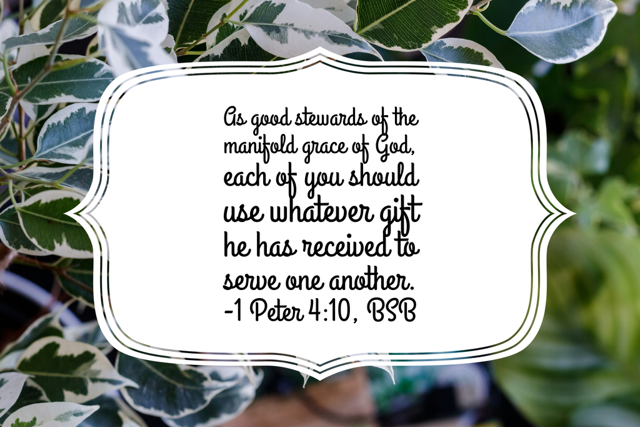
1 Peter 4:10

(I often link up with some of these bloggers.)

Laudable Linkage

Laudable Linkage

I have a fairly long list of good online articles discovered this week. Perhaps a few will be of interest to you.

Gone Are the Dark Clouds, HT to Challies. “If communicating the gospel appears daunting, remember that Christ commissions and accompanies us. Through Jesus’s work on the cross we are reconciled to God, not abandoned. We can talk about this with genuine care and love for people.”

Why Does God Say No to Good Things, HT to Challies. “We understand why God would reject requests contrary to his revealed will (e.g., for provisions to rob a bank successfully) or purely materialistic requests (e.g., to win the lottery). But why would God say no to something good—seemingly consistent with his desires?”

Satan Loves Social Media. “Every other video on the internet seems to be trying to convince women to be dissatisfied with their lives. I’m not just talking about people displaying gorgeous homes and inspiring jealousy. I’m not even talking about the vast array of ads and influencer posts that convince us we aren’t allowed to age or sport any type of physical imperfections. I’m talking about reel after reel of men and women explaining to women specifically and in great detail why we should be unhappy.”

Great Gifts but Little Faithfulness. “I have known Christians who have great gifts but low faithfulness. God has given them much and it is apparent that they are making little of it. . . . I have also known men who have few gifts but great faithfulness. God has given them little and it is apparent that they are making much of it.”

No Little People. No Little Places, HT to Challies. “As Francis Schaeffer would say, ‘No little people, no little places.’ Everything God gives us to do is big and beautiful and of eternal significance. So let’s not miss out on the chances God gives us every single day to make a difference to someone.”

I Asked the Lord That I Might Grow, but He doesn’t always answer in the ways we expected. HT to Challies.

A Key Discipline: Observe Without Judgment. “It can be jarring to worship in a church that adheres to an unfamiliar tradition. Customs may be strange and patterns may differ from what I am accustomed to. And it is at the point of such differences that I immediately find myself tempted to pass judgment.”

Stretching Joy: 10 Ways to Notice God’s Everyday Mercies, HT to Challies. “I’ve been considering lately how to amplify singular moments of joy or beauty that God gives me. I want them to be longer-lasting, more durable experiences of thanksgiving that coexist with ongoing hardship, sorrow, or struggle with sin.”

The Glory of Good Work, HT to Redeeming Productivity. “Watching someone do good work brings joy. So does hearing someone talk about how they do something difficult that’s worth doing for the good and enjoyment of others. Proverbs 22:29 says, “Do you see a man skillful in his work? He will stand before kings; he will not stand before obscure men.” God made us to enjoy seeing people who are good at their work.”

Grace and Peace in an Election Year. “In an election year, loving our politically-other neighbor may feel more costly than airfare with an extra baggage fee! Our toughest cross-cultural assignment may be extending grace to a colleague or fellow church member whose opinions seem incomprehensible to us.”

Elisabeth Elliot quote

“If we really want God’s will to be done and His kingdom to come, the chances are pretty good that my will is going to have to be undone every once in a while.” –Elisabeth Elliot

Laudable Linkage

Here are some of the thought-provoking blogs discovered this week:

If You Don’t Believe in Hell, HT to Challies. “Beliefs ripple. But we make a concerted effort to ignore that. Especially within the system of Christian faith, people can be tempted to pick and choose which doctrines they are “okay with” and which ones they leave behind. The problem lies in the ripples. Christians don’t always see how disbelief in one thing affects belief in another.”

Learning to Forgive Family, HT to Challies. First what forgiveness is and is not, and then why it is crucial.

The Glory of Godliness. “Frequently, I hear Christians talk about being more faithful, loving, or active in church. But I can’t remember the last time I heard someone say, ‘I want to be more godly.’ Why is there so little interest in godliness? Perhaps it’s because we don’t understand what it is.”

Don’t Fail to Capture the Train of Thought. “One of our greatest failures in Bible study is our tendency to treat the text atomistically. We look for inspirational words or sayings, while failing to grasp how the author used those words or sayings to persuade his audience of a message.”

I’ll Be More Faithful When I’m Older. “It’s folly to expect to wake up faithful twenty years from now if you’re not feeding your faithfulness today. If you desire to walk with Jesus more ten years from now, twenty years from now, or thirty years from now, you need to be feeding your faithfulness today.”

Slogging Blogging. This is an older post that Tim Challies recently linked back to, but it resonates with me. “I have little capacity to predict which articles will fall flat and which will make an impact on myself and others. I have trouble knowing in advance which are excellent and which are drab, which ones will somehow serve or challenge people and which will only irritate or confuse them. So all I can do is slog. All I can do is keep going and trust that the long effort will be rewarded with occasional success—the success of knowing that I’ve been able to bless or encourage or equip another person.”

Elisabeth Elliot quote

Laudable Linkage

It’s been a super-busy week, so I have just a few links for you. But I think they’re good ones.

Why We Follow Some Old Testament Laws But Not Others, HT to Challies. “Critics accuse Christians of conveniently picking and choosing from Old Testament laws. We’re quick to ‘clobber’ gay people with verses from Leviticus, they say, yet we don’t keep kosher ourselves. The complaint, though, is based on a misunderstanding about the Mosaic Covenant that even Christians fall prey to.”

Where Is Your Faith?” HT to Challies. “How do you cling to belief amidst such turmoil of the heart? How do you survive the death of a child? I can tell you, it is not what happens in that moment of complete darkness or even in the months and years that follow. Survival is forged in the pew every Sunday. It is built on the truths of Scripture that you fill your mind with day by day. It comes through knowing Who God is.”

We’re Missing It. “He wants time to love us that way and it can’t happen if He is a ‘to do’ list item, or in sound bites only throughout our day, or only while we grab coffee on our way out the door.”

Well-Worn Boots. Lessons from a pair of faithful old work boots.

Laudable Linkage

Here’s the latest thought-provoking reads seen around the Web lately.

Our Hope In the Ascension, HT to Challies. “Of all the aspects of Christ’s work in his state of exaltation, the Ascension is one of the most overlooked.”

God Matures Us Through Suffering, not Miracles, HT to Challies. “Suffering, not miraculous deliverance, is the primary way God matures his children. A supernatural event can encourage us, of course, but it doesn’t mature us. Maturity comes through trusting God when things are really hard, even seemingly unbearable. Will we trust God when the miracles don’t happen?”

A Letter to All the Marthas. “It struck me that Jesus hadn’t written Martha offHe saw her faith and hard work as well as her weaknesses. And he loved Martha just as much as Mary. I began to view Jesus’ words through a lens of love.”

Why You Should Stop Being Responsible and Start Being Faithful. “Losing my mother as a teenager accompanied by my father’s paralyzing grief amped my firstborn sense of responsibility. I equated being responsible with being dependable. But when being responsible means depending on myself and my resources instead of relying on God it’s unhealthy and ungodly.”

Are Cuss Words Sinful? HT to Challies. “You hear them in movies, television series, and in actual conversations. To some, these words sound cool, and they have made them part of their lives. Yet when you learn their meaning, cuss words will make you cringe.”

The Sugar Coating, HT to Challies. “I have some authority to say that self-pity doesn’t get you anywhere. Trust me, I’ve tried it. Even on those occasions when people who really ought to know better don’t recognise the sheer weight of the scars you bear, and you feel like you must delve into the pools of pity to shake them out of their repose—it still isn’t worth it.”

4 Guidelines for Dating Without Regrets. “Somewhere between my generation and the current one, dating became difficult—far more difficult than it had once been. I am sure the so-called “purity movement” bears at least some of the responsibility as does the modern-day hookup culture. So, too, do the ubiquity of pornography and the rise of social media and dating apps. What was once relatively straightforward seems to have become strangely complicated.”

Adventures in Aging. Melanie writes about a change of heart from being depressed about age to embracing new possibilities.

Dementia’s Drowning Caregiver. Lots of good tips.

How to Think Wisely About Becoming a Social Media Celebrity, HT to Challies. In these days when we’re told we have to have a big enough “platform” before an agent or publisher will even consider looking at our manuscripts, we need to keep grounded in God’s truth of who we are in Him.

Laudable Linkage

IMG_0195

Here are some thought-provoking reads discovered this week.

Now Ravi, Too? “Sin on the level that Christianity Today describes does not happen all at once. It grows gradually over a long period of time as sinful behavior builds layer upon layer. It starts by justifying small indiscretions and then multiplies until we find ourselves surrounded by a wall of hypocrisy. As I read the Zacharias story it prompts me to examine my own life for the ‘little’ sins that I am excusing.”

The Best and Worst of Bible Reading Plans. “In my commitment to continue to read through God’s Word, I’ve borrowed and developed various Bible reading methods and tips. Some worked well and others . . . flopped. In this article, I’ll share my greatest successes and biggest flops along with the single best advice I’ve discovered for faithfully reading and enjoying the Bible.”

You Are Going to Hate It, HT to Challies. “You know that country you’ve been dreaming about? The one that you have been praying over and researching? You’ve been talking about it endlessly these days, building a team who will support you when you move there. You are ready to uproot your family, your job, your entire life to pour your soul into the place you love so much. Call me a party pooper, but today I’m here to tell you something important: Shortly after you finally arrive in that country, you are going to hate it.” True for missionaries, but I think also for almost any calling. It’s not all sweetness and light. There will be times when “Perseverance is the whole battle.”

There’s Something About Your Faithfulness, Sister, HT to Challies. A word of encouragement for everyday faithful believers.

Why Read Full-Length Historic Christian Biographies? HT to Challies. Yes! My thoughts on this as well in a past post: Why Read Biographies? Christian biographies have helped my Christian walk immensely.

Have a great Saturday!

Laudable Linkage

I have just a short list of noteworthy reads today, but thought I’d go ahead and share them. If I don’t, I’ll likely have an extra-long list next time.

Messy Church History. HT to Challies. I’ve been thinking about writing a post concerning our profound disappointment when someone we revere is found to have a fatal flaw as well as our tendency to write people off after finding skeletons in their closets. This says much that I would have. Church history, Biblical history, is messy because it involves sinners who aren’t totally perfect yet. Only God is perfect. It’s only by His grace that He uses any of us.

I’m Not a Mary or a Martha! Mary and Martha’s story wasn’t told in order to become fodder for social media personality quizzes. Julia points out ways that we infer more from the story that’s there and do Martha a disservice.

When You Are Refined by Family Conflict. “Conflict is simply two people viewing the same situation in two different ways.” If we take time to view things from the other person’s perspective, even though we might not agree, we’ll understand better, lose our defensiveness, and be able to look for bridges across the divide.

I shared this yesterday, and I think I may have even referenced it before, but I was so blessed by this post about Jim Elliot’s brother Bert, who was a missionary to Ecuador for over 50 years. Burt commented that “Jim and I both served Christ, but differently. Jim was a great meteor, streaking through the sky.” Randy Alcorn said yes, he was, but Burt was the faithful start that rose every night for years.

Finally, this baby copying the workout from the movie Rocky is SO cute! HT to Adam Blumer.

Happy Saturday!

Finishing Well

I am reading in Chronicles just now. Though it has a reputation for being pretty dry, it actually has many great truths in it. Chronicles covers the history of the kings of Israel and Judah from the time of Solomon until the Babylonian captivity. Most of the kings were bad, in that they did not follow Jehovah God in the way He prescribed, and many followed idols and false gods instead. Most of the few who did start out well did not finish well. And though “finishing well” is probably not what “the” theme of the book is, it stands out for consideration.

Solomon, for all his wisdom and all the blessings he experienced during his early reign, fell away when his many wives led him to other gods.

“Asa did that which was good and right in the eyes of the LORD his God” (II Chronicles 14:2), was marvelously helped in battle after prayer, took down idols, removed even his own mother from her position because of the image she made. But in later years he sought the help of a pagan king instead of God and even imprisoned the prophet who came to warn him (16:1-10). He ended up with diseased feet for which he did not seek the Lord at all.

“Joash did that which was right in the sight of the LORD all the days of Jehoiada the priest” (24:2), but after Jehoiada died, Joash fell away to the point of killing Jehoaida’s son (24:19-27).

Amaziah “did that which was right in the sight of the LORD, but not with a perfect heart” (25:2). He received great help from the Lord when he did things His way, yet instead of continuing to follow Him, he “he brought the gods of the children of Seir, and set them up to be his gods, and bowed down himself before them, and burned incense unto them.  Wherefore the anger of the LORD was kindled against Amaziah” (25:14-15).

Uzziah, “as long as he sought the LORD, God made him to prosper” (26:5), and “And God helped him against the Philistines” and other enemies, “and his name spread abroad even to the entering in of Egypt; for he strengthened himself exceedingly” (26:7-8). “And his name spread far abroad; for he was marvellously helped, till he was strong. But when he was strong, his heart was lifted up to his destruction: for he transgressed against the LORD his God, and went into the temple of the LORD to burn incense upon the altar of incense” (26:15-16). The NASB puts it this way: “But when he became strong, his heart was so proud that he acted corruptly, and he was unfaithful to the LORD his God.”

Josiah was one of Judah’s best kings, leading a revival after the book of the law was found during temple repairs, yet he went to battle and “hearkened not unto the words of Necho from the mouth of God” and ended up dying of wounds received in that battle.

Will I forget the things I knew, like Solomon did, and be led away by other loves, or will I keep my first love? Will I forget from whence my help comes, like Asa did, and look for help elsewhere? Will I fall away after my spiritual mentors are gone, like Joash? Do I serve God with a perfect (complete) heart, or am I holding anything back, like Amaziah? Will I be lifted up with pride like Uzziah? Will I neglect to listen to wise counsel from God’s Word, like Josiah?

May I heed the warnings and lessons in these examples. May God save me from these and other failures and help me to keep my eyes on Him and to finish well.

(Adapted from the archives)

(Sharing with Inspire Me Mondays, Literary Musing Monday, Testimony Tuesday, Tell His Story, Wise Woman, Woman to Woman Word-filled Wednesday, Faith on Fire)

Save

Save

Save

Save