

I often start my prayer time with what we call “the Lord’s prayer” in Matthew 6:7-14. Doing so helps me keep on track rather than being so easily distracted. I use the phrases in the prayer as a launching point. When I pray for daily bread, I mention other needs of the day. When I pray for forgiveness, I ask God to search me and show me anything I need to confess to Him.
The prayer begins, “Our father in heaven.” I thank God for being my Father, for taking me into His family, for giving us that picture of a loving father to help us understand more what He is like.
When I was a child, I had an image in my mind of a father as a soft-spoken man in a cardigan, button-down shirt, slacks, and slippers, with a newspaper in one hand and a pipe in the other.
That’s not a picture of my own father.
For years I wondered where in the world that idea came from. I assumed it stuck with me from some book I had read as a child. I finally realized that portrayal came from Fred MacMurray, the father in the TV show, My Three Sons.
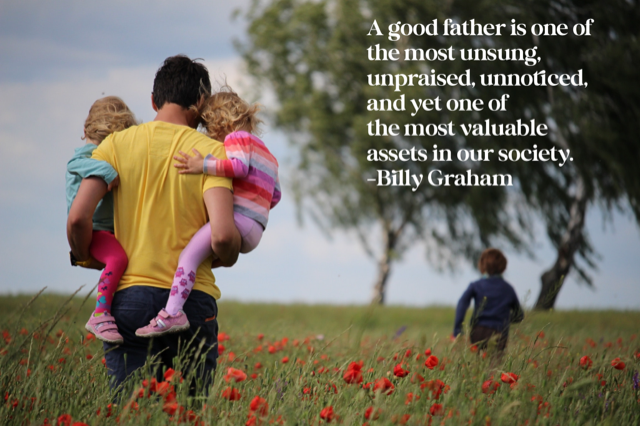
No father is perfect, and some fall far from the ideal. But the fact that we have good and bad concepts of what a father should be points us to the reality that there is such a thing as a good father. Our image of what a father’s care should be helps us form a concept of God’s loving care in our minds.
The Bible tells us what qualities God has as a father, mirrored in good earthly fathers.
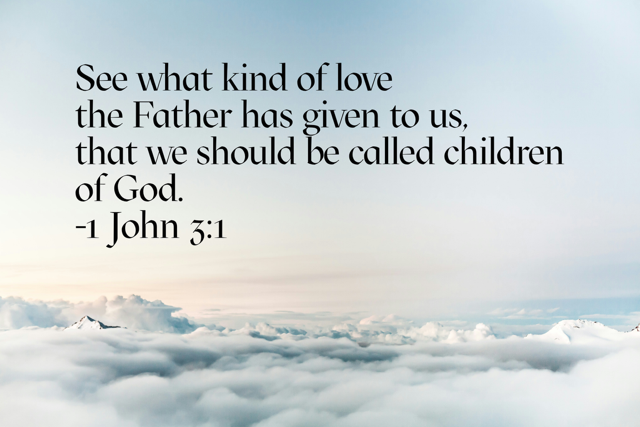
Love. “See what kind of love the Father has given to us, that we should be called children of God; and so we are”(1 John 3:1). Romans 5:6-8 tells us that God loved us when we were weak, ungodly, and sinful. He didn’t wait for us to clean up our act before coming to Him: He invites us to let Him clean us up.
Teaching. “I will instruct you and teach you in the way you should go; I will counsel you with my eye upon you” (Psalm 32:8). We’re not born with wisdom. God patiently teaches us through His Word, experience, and other people.
Compassion. “As a father shows compassion to his children, so the Lord shows compassion to those who fear him. For he knows our frame; he remembers that we are dust” (Psalm 103:13-14). Some translations say He pities us. He knows our weaknesses and frailties.
Chastening. “My son, do not regard lightly the discipline of the Lord, nor be weary when reproved by him. For the Lord disciplines the one he loves, and chastises every son whom he receives” (Hebrews 12:5-6). It’s not a kindness to let a child run amok without correction. God chastens us out of love.
Providing. “Therefore do not be anxious, saying, ‘What shall we eat?’ or ‘What shall we drink?’ or ‘What shall we wear?’ For the Gentiles seek after all these things, and your heavenly Father knows that you need them all. But seek first the kingdom of God and his righteousness, and all these things will be added to you” (Matthew 6:31-33). Just before these verses, Jesus points to the birds and flowers that God takes care of, assuring us He values us more than them and He’ll take care of us, too.
Giving. “Every good gift and every perfect gift is from above, coming down from the Father of lights, with whom there is no variation or shadow due to change” (James 1:17). God has promised to give us everything we need. He often gives a great deal more than that, too.
Even more than physical gifts, God gave Himself, through His Son, to redeem us: “And the life I now live in the flesh I live by faith in the Son of God, who loved me and gave himself for me” (Galatians 2:20b).
Protection. “He who dwells in the shelter of the Most High will abide in the shadow of the Almighty. I will say to the Lord, ‘My refuge and my fortress, my God, in whom I trust.’ For he will deliver you from the snare of the fowler and from the deadly pestilence. He will cover you with his pinions, and under his wings you will find refuge; his faithfulness is a shield and buckler (Psalm 91:1-4).
Comfort. “Blessed be the God and Father of our Lord Jesus Christ, the Father of mercies and God of all comfort, who comforts us in all our affliction, so that we may be able to comfort those who are in any affliction, with the comfort with which we ourselves are comforted by God” (2 Corinthians 1:3-4). No one comforts like Him.
Forgiveness. What better picture of God’s forgiveness is there than that of the prodigal son’s father in Luke 15:11-32. The son selfishly demanded all that was coming to him and then went out and squandered it in sin and indulgence. But when he came to the end of himself and went home, the father was looking for him and joyfully ran to him and embraced him.
Though earthly fathers fail us, God never will. “For my father and my mother have forsaken me, But the LORD will take me up” (Psalm 27:10). “Can a woman forget her nursing child, that she should have no compassion on the son of her womb? Even these may forget, yet I will not forget you” (Isaiah 49:15).
If your father is no longer living, or relationships with him are strained, “Father of the fatherless and protector of widows is God in his holy habitation. God settles the solitary in a home” (Psalm 68:5-6a).
“And because you are sons, God has sent the Spirit of his Son into our hearts, crying, ‘Abba! Father!’ So you are no longer a slave, but a son, and if a son, then an heir through God” (Galatians 4:6-7). “Abba” was the Aramaic word for “father,” a term expressing both respect and endearment.
Imagine, people as sinful and self-centered as we are can call God our Father–not just in a general way, but in a deeply personal and loving way. What amazing grace.
If you’re not a child of God, please read how to become one here.
And if you do know God as a Father, I hope you’ll join me in taking time to bask in His love and care today.
(I often link up with some of these bloggers.)




 Stray Thoughts