
Freedom to Lament

Freedom to Lament

When we were taking care of my mother-in-law at home, nothing quite helped like talking to others who were doing or had done the same. They knew by experience what was involved. It’s not that we wanted to gripe about our situation, but there were difficulties and pressures these friends would understand. It’s not that other friends weren’t a help, but with these we felt a freedom to talk like we didn’t always feel with others.

That’s one reason Paul says in 2 Corinthians 2:3-4, “Blessed be the God and Father of our Lord Jesus Christ, the Father of mercies and God of all comfort, who comforts us in all our affliction, so that we may be able to comfort those who are in any affliction, with the comfort with which we ourselves are comforted by God.” God comforts us through His Word, His Spirit, and His people.

When this passage came up in our recent ladies’ Bible study, someone pointed out that we need to feel free to be vulnerable with each other, to share when we’re struggling.

I came to that realization some years ago after I contracted transverse myelitis. We got our first computer a few weeks later, and transverse myelitis was the first thing I looked up. In that era before Facebook and message boards, I found a subscriber group of TM patients and caregivers. They were a lifeline to me as I navigated a little-known disease.

I wanted to be a good testimony there. I knew that would mean not hijacking conversations to “preach,” which would not have been well-received. But I wanted to give God the glory for the help and grace He gave and point others to Him. I thought the best way to do that was to always be cheerful and positive.

Some years later, another woman came into the group who was also a Christian. She was very transparent about her frustrations and struggles with TM. She wasn’t complaining, but she was honest. She gave God glory, and it rang true because we saw how He helped her.

I realized we’re not much help to others if we come across as always having everything all together. We’re more authentic when we share our struggles and burdens.

The Sunday after the Bible study session where we discussed these things, our care group met for lunch after the Sunday morning service. Our pastor emeritus had given an excellent message that morning about God’s grace through suffering–in his case, months in the hospital in isolation with Covid, a lung transplant, a blood clot, and more. The host of our care group asked if anyone had anything to share in connection with the message.

One woman shared how hard it was after her son committed suicide. When people asked her how she was doing, and she tried to tell them, she’d have to short-circuit what she wanted to say. She could see by their faces that they weren’t ready for what was on her heart. She pointed out that we need to allow for lament in the church such as the psalmists display. About a third of the psalms are laments, which are different from complaints. The writers conveyed a range of emotions based on their troubles. They eventually reminded themselves of God’s character and love, but they had to spend their grief and confusion first before they could receive it.

Granted, the psalmists did not have as much of the Word of God as we do now, which might have helped with some of their questions. But there are always mysteries as to why God allows certain painful things or doesn’t grant things that seem beneficial.

Paul was honest about his struggles as well:

. . . far greater labors, far more imprisonments, with countless beatings, and often near death. Five times I received at the hands of the Jews the forty lashes less one. Three times I was beaten with rods. Once I was stoned. Three times I was shipwrecked; a night and a day I was adrift at sea; on frequent journeys, in danger from rivers, danger from robbers, danger from my own people, danger from Gentiles, danger in the city, danger in the wilderness, danger at sea, danger from false brothers; in toil and hardship, through many a sleepless night, in hunger and thirst, often without food, in cold and exposure. And, apart from other things, there is the daily pressure on me of my anxiety for all the churches (2 Corinthians 11:23-38).

In Peter’s epistles, he was also quite frank about suffering believers experience.

When people are hurting, we want to fix their problems and make them better. But healing takes time. Sometimes pain drowns everything else out. We can’t help others when we apply Bible verses like band-aids over gaping wounds. There is a time to share Scripture. I’ve been greatly encouraged by a shared verse at just the right time. But first we need to listen and “weep with those who weep” (Romans 12:15). Sometimes the tender care and concern shared in the midst of someone’s pain will open their hearts to receive truth.

Someone has said that Job’s friends ministered to him much more when they sat with him in silence for a week than when they started talking.

Some years ago, in our early married life, someone at church shared a prayer request for a man who had just been diagnosed with cancer. The speaker went on to say that the wife wasn’t taking the news well.

I thought, “How does someone take that kind of news well?” Wrestling through pain, confusion, and grief doesn’t mean one doesn’t have faith. This woman needed someone to come alongside her, not judge for her initial reaction to devastating news.

There is no one formula for aiding people in their worst times. We need to ask God’s guidance for what to share when. But we need to give them space to grieve. We need to listen, empathize, support, and love without judgment and pat answers.
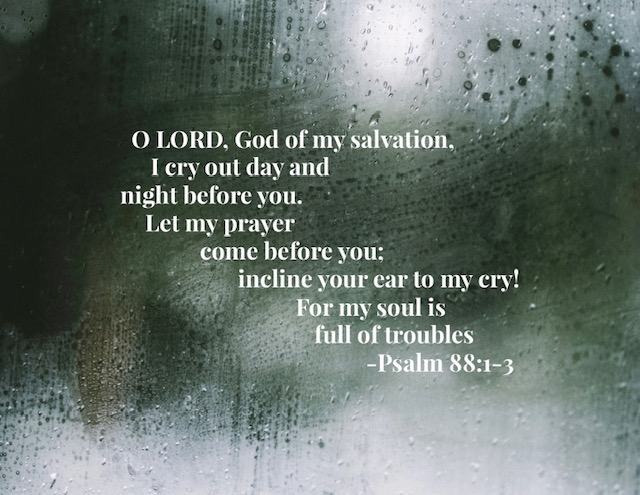
My soul is full of troubles. Psalm 88:3

(I often link up with some of these bloggers.)

Life Doesn’t Always Turn Out Like We Thought It Would

Life doesn't always turn out like we thought it would.

Several years ago, two individuals from my college who were known for their close walk with the Lord found each other and began to date. They married and attended a local church, the same one we came to later, while the husband finished his graduate degree. He became an elder. The wife was active in the ladies ministry and teaching children. They had a couple of children.

After several years, they left to go to the mission field. There never seemed a family more perfect for missionary work.

After a few years, our pastor went to visit them on the field. He had nothing but positive things to say. He reported that the wife, in particular, seemed in her element.

A few years later, though, we received devastating news. The husband had been caught in infidelity. The family came home, and the elders met with the husband. He refused to repent, saying he loved his sin too much.

The wife was crushed. Not only had her husband turned into someone she didn’t know any more, but she lost the ministry she loved and was so suited for. Plus their coworkers back on the mission field had to pick up the pieces and minister to the people who were shattered by the fall of their leader.

I don’t know if the wife asked herself these questions, but in her place, I would have wondered if I made a mistake somewhere along the way. Had I married the wrong man? Had I missed signs that he had fallen away from the Lord? Had I failed him in some way that caused him to turn to someone else?

I do know that the pastor encouraged her that the situation was not her fault. Not that she was sinless, of course. No one is. But her husband’s sins were his own and he bore the responsibility of them. She was in the center of God’s will even with such things going on in her life.

It’s a shock that you can do everything “right,” so to speak, and end up with a life seemingly in shambles.

I imagine Joseph must have felt the same way, going from the favored son to being sold as a slave by his own brothers and then thrown into an Egyptian prison.

Or Job, described by the Lord as an upright man, yet he lost everything he owned as well as ten children all in one day.

Or John the Baptist. He was the forerunner of the Messiah, preparing the way for Jesus, pointing people to Him. Yet he ended up in prison, and ultimately was beheaded.

The Apostle Paul enjoyed a little over twenty years of public ministry. He took three long missionary trips, shared the gospel with who knows how many people, instructed and encouraged believers, and wrote several epistles which were incorporated into the canon of Scripture.

To be sure, life wasn’t all rosy. Paul experienced beatings, stonings, shipwrecks, sleeplessness, hunger, and more (2 Corinthians 23-28). But overall, his life could be considered a success in terms of being able to minister to large numbers of people.

But then Paul got arrested. He had not done anything wrong, but others supposed he had, and the resulting riot ended with Paul being taken into custody.

Paul was imprisoned for two years, released for a couple, then imprisoned again for a couple of years until he was beheaded.

Paul went from a leading apostle and well-known traveling preacher to a prisoner for many of his last years.

To the world, it might look like Paul’s life ended in failure.

But God encouraged Paul all through the book of Acts that he was on the right path.

And Paul’s ministry didn’t end just because he was in prison.

In the course of explaining why he was imprisoned, Paul was able to share his testimony before Felix, the governor of Judea, Festus, the governor who replaced Felix, and King Agrippa—all people he would not have been able to talk to under normal circumstances.

Paul wrote Ephesians, Philippians, Colossians, and Philemon during his first imprisonment and 2 Timothy during his second. Philippians is one of the most joyful books in the Bible, and Philippians and Colossians both have an emphasis on Thanksgiving—though they were written from prison.

Paul was chained to a Roman guard while imprisoned, so the guards heard all he had to say to his visitors. Paul tells the Philippians, “All the saints greet you, especially those of Caesar’s household” (Philippians 4:22). So evidently the gospel had filtered even into Caesar’s staff from Paul’s witness.

Friends were able to come talk with Paul and be taught or encouraged by him. Acts ends by telling us Paul “welcomed all who came to him, proclaiming the kingdom of God and teaching about the Lord Jesus Christ with all boldness and without hindrance” (Acts 28:30-31).

“Without hindrance.”

In 2 Timothy 2:9, Paul says, “I am suffering, bound with chains as a criminal. But the word of God is not bound!” Though Paul was bound, the word of God was not.

God can redeem and work in and through a life in shambles.

It was Paul who wrote of God’s strength in our weakness: “But he said to me, ‘My grace is sufficient for you, for my power is made perfect in weakness.’ Therefore I will boast all the more gladly of my weaknesses, so that the power of Christ may rest upon me. For the sake of Christ, then, I am content with weaknesses, insults, hardships, persecutions, and calamities. For when I am weak, then I am strong” (2 Corinthians 12:9-10).

And what God can do in our lives through suffering: “Not only that, but we rejoice in our sufferings, knowing that suffering produces endurance, and endurance produces character, and character produces hope, and hope does not put us to shame, because God’s love has been poured into our hearts through the Holy Spirit who has been given to us” (Romans 5:3-5).

And the glory that waits us after suffering: “So we do not lose heart. Though our outer self is wasting away, our inner self is being renewed day by day. For this light momentary affliction is preparing for us an eternal weight of glory beyond all comparison, as we look not to the things that are seen but to the things that are unseen. For the things that are seen are transient, but the things that are unseen are eternal” (2 Corinthians 4:16-18).

Others in the Bible found the same grace to endure.

Joseph was released from prison and became second to Pharaoh, eventually saving his own family, the future nation of Israel, from starvation.

Job’s fortune, family, and health were all restored to him, but most important of all, he encountered God in a way he never had before.

John was not spared in this life, but there was a place prepared for him in heaven.

The wife I mentioned at the beginning found God’s grace to sustain while she did the best she could in difficult circumstances.

We tend to equate spiritual success and God’s blessings with smooth sailing and positive circumstances. Saints through the ages have not found this to be the case. In fact, some whose lives seem to shine brightest for the Lord have experienced great trials—maybe because they have to seek the Lord and His strength to navigate their circumstances.

Meanwhile, God’s Word encourages us to “Rejoice in hope, be patient in tribulation, be constant in prayer” (Romans 12:12) because “after you have suffered a little while, the God of all grace, who has called you to his eternal glory in Christ, will himself restore, confirm, strengthen, and establish you” (1 Peter 5:10).

1 Peter 5:10

(I often link up with some of these bloggers.)