Laudable Linkage

Laudable Linkage

I came across quite a few good reads this week:

What Would Happen if You Became a Christian? A Thought Experiment, HT to Challies. “Let me invite you into a thought experiment. What if you became a Christian? What would change? I’m talking about an actual disciple of Jesus, not a Christian in name only. What would be different if you became a Christian?”

He No Longer Sleeps. “Do you remember that Jesus is in your boat? He’s with you. He sees you. And He’s not asleep or unaware or busy with someone else.” (This post has Mendelssohn’s “He, Watching Over Israel” from Elijah in my thoughts this week.)

When You Long for Justice, HT to Challies. Mixed emotions after a sexual assault.

When Offenses Come: How to Forgive and Move On, HT to Challies. “The air of our Father’s home is grace — grace from basement to attic and floor to ceiling, grace in every room. He crowns us with grace, clothes us with grace, sings over us with grace (Romans 5:2). Far be it from us, then, as the children of this God, to replace his grace with malice, gossip, passive-aggressive paybacks, or bitter distancing from a brother or sister whom God has forgiven.”

Do Children Need to Consent to Puberty? HT to Challies. I am continually amazed at the world’s warped thought processes. This article explains why the answer to the title question is “No.”

On Winning the War: The World. This is the second in a series of fighting against a Christian’s enemies: the world, the flesh, and the devil.

On the Other Side of the Wall. A lovely tribute and a great way to think about loved ones who have passed on.

The Messages We Receive, HT to Challies. “Messages about who we are—our identity—are powerful. They can shape how we see ourselves, how we see the world, and how we see God. It is a matter that regularly comes up in counseling conversations. When people have hard experiences in their lives or have been mistreated by others, it always proves valuable to explore what messages those experiences have communicated about who they are.” I especially like her examples of reframing messages with God’s truth about us.

What Is My Spiritual Gift? Maybe You’re Asking the Wrong Question, HT to Challies. “In view of the ink spilt and bytes downloaded on the matter of discovering one’s spiritual gift, you might be surprised to learn that such introspection is completely absent in all these passages. Either Paul and Peter failed to answer such a vital question . . . or we are asking the wrong question. I think the latter is the case.”

The Plimsoll Line, HT to Challies. “’The Plimsoll line is a reference mark located on a ship’s hull that indicates the maximum depth to which the vessel may be safely immersed when loaded with cargo.’ . . . . Years ago I decided to include the Plimsoll line in my marriage.” In this case, the Plimsoll line has to do with one being an extrovert and one being an introvert.

10 Correctable Mistakes We Make When Preaching and Teaching, HT to Challies. Some of these would apply to writing as well.

67 Screen-Free Activities for Kids, HT to Redeeming Productivity.

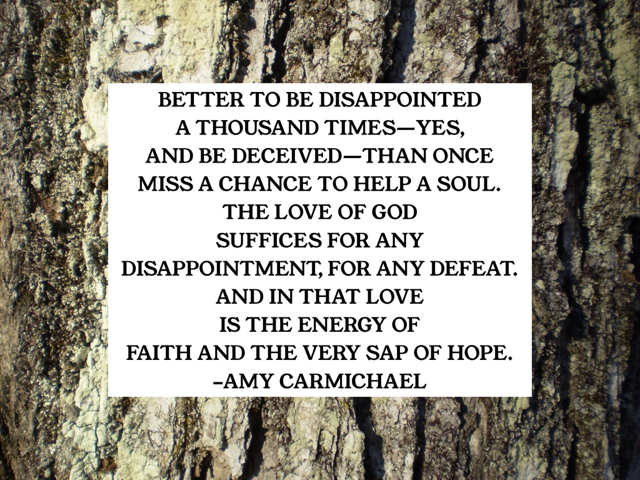
Amy Carmichael Quote

“Better to be disappointed a thousand times—yes, and be deceived—than once miss a chance to help a soul. The love of God suffices for any disappointment, for any defeat. And in that love is the energy of faith and the very sap of hope.” Amy Carmichael

Assorted Stray Thoughts

Stray Thoughts

Occasionally I have several thoughts I want to share, but each is not enough for a blog post. Some are lighthearted, others are more serious.

First of all, I want to apologize if you see a pop-up box when you comment asking you to subscribe. I *hate* when a pop-up comes up in the middle of the screen and you can’t read any further without dealing with it. I have not seen this on my own blog, but I have on other WordPress blogs, so I assume it happens on mine as well. I just spent some time scouting around to see if there was a way to turn this off, and I couldn’t find it (if you know of a way, please let me know).

I also dislike when I follow someone’s link to a blog or article where I am asked first thing to create an account (even a free account) in order to read further. Honestly, if the first thing I encounter on any blog is a pop-up, whether it’s for subscribing, creating an account, buying a book, getting a free download, or turning off ads, I’m likely to just close the site and move on. How do I know if I want to subscribe or create an account when I have not even had a chance to read anything there yet?

For sites that want you to pay to subscribe, I think those site owners are wise who allow a certain number of free reads per month. I might be more likely to subscribe if I read there and find a lot I like. But not if I can never get past the first pop-up.
____

From the time I first learned what an introvert was, I knew I was one. Reading about introversion, like Susan Cain’s Quiet: The Power of Introverts in a World That Can’t Stop Talking, helped me understand myself a great deal.

I’ve run across some Instagram accounts for introverts, but I find I can’t read them regularly. Reading them occasionally, I’ll nod my head and appreciate that someone else knows how I think and feel. Some have comics that are funny and apt. But if I read them all the time, I find myself resenting the demands of life that draw me out of my introversion. I think the point of learning about introversion (or extroversion, if that’s you) is not to make the people who know us or the world around us conform to our preferences. Every source I’ve read on introversion says we need to step out of our comfort zone sometimes. Understanding my bent and needs helps me do that. But if I was constantly filling my head with cute memes about wanting alone time, that would be my focus.
_____

Sometimes I’ll read that blogging is considered dead (often, ironically, in a blog post). I have not found that to be the case. There are scores of good blogs out there that I would like to keep up with but can’t.
_____

Sometimes I see a writer attribute our tendency to be over-busy as pride–as if that’s how we “keep up with the Joneses” these days, or as if it’s the trendy thing to talk about how busy we are. But I don’t know anyone who truly feels that way. Most super-busy people that I know would desperately like not to be that way, but they don’t know what to cut out. As we’ve developed labor- and time-saving devices, we’ve added more and more things to be done.
_____

I have not seen any Christmas items in stores yet (though I have seen Halloween things), but they seem to be displayed earlier each year. Early last fall I stopped by Cracker Barrel because I had seen something in the beachy section that I decided I wanted to get. But when I went back, the whole beachy section was gone and Christmas items were out. I wonder if retailers ever consider that they might lose sales because their Christmas decor edges out other things a shopper would be more likely to buy in the late summer or early fall.

I also wonder if anyone really buys Christmas stuff in August? I admit, if I needed something, I might look early in order to benefit from a greater selection. I like to buy Christmas cards early, but otherwise I try to avoid the temptation of the Christmas aisles. I have more Christmas decorations than I have room for–I don’t need to add any more.

One exception was when our church used to send presents to our overseas missionaries by way of surface mail. We’d have to send packages to some countries in October in order for them to arrive by Christmas. So it was nice to get wrapping paper and such then. After the Post Office did away with that rate, it was too expensive to send packages, so we just sent cash offerings to the missionaries’ accounts. That was more efficient, but I missed the personalized packages.
_____

Do you ever do this? A while back, I was intrigued with the word “adorn” in Titus 2:10, which speaks of adorning the doctrine of God our Savior. I pondered how we do that. Isn’t God’s doctrine perfect as is? How do we adorn it? As I began to study and thought about writing a post about the topic, I found I already had. 🙂
_____

I’ve gotten frustrated lately with Facebook removing a couple of my posts. I’ll receive a notification that they removed a post with a note to “Click here to see why.” I’ve clicked there, but then I am taken to a page that says everything looks good with no problems. There’s no explanation and nothing to click to appeal. One post had photos of teenagers I wasn’t related to, so perhaps that was a privacy protection thing. But the other contained two reviews of study books on Isaiah. All I can figure is that their sensor bot picked up on the name of a certain country not popular in the news media (which I am avoiding naming in case that was the problem), even though the subject was thousands of years ago.

I wouldn’t mind so much if there was an explanation and an opportunity to appeal. They really need to not let these things be done by AI.
_____

Since my husband retired at the end of last year, we went on Medicare in January. I am not a fan so far. For one thing, a blood thinner I am on for atrial fibrillation (since afib can cause blood clots) jumped from $10 for a 90-day supply to over $500. What sense does that make, that when your income goes down, your prescriptions go up? I talked to the cardiologist about alternatives, and we found one that was *only* $150 for 90 days–and it’s at a different pharmacy than we usually use because it’s cheaper there.
_____

Since I’ve been sharing some frustrations, I’ll end with some things that made me smile recently:

Our gastroenterologist’s office was decorated for summer in a luau theme, with this sign on the bathroom door:

High tides, good vibes

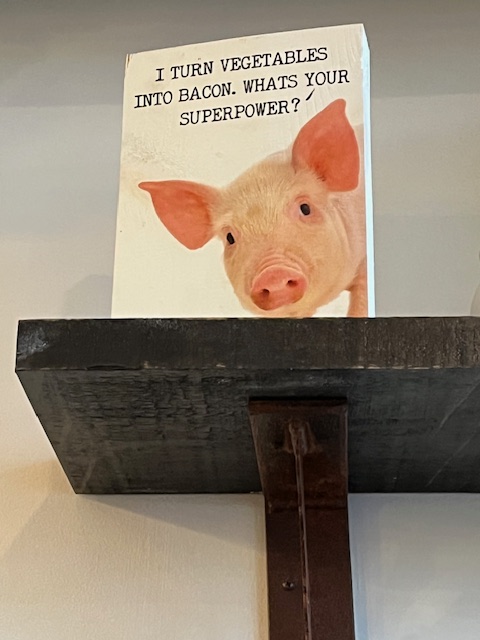
This was from a restaurant we went to a few months ago:

Turning vegetables into bacon

I was looking at the evening reading of Daily Light on the Daily Path a while back, and thought it ironic to see an ad about cremation after a verse about being made from dust . . .

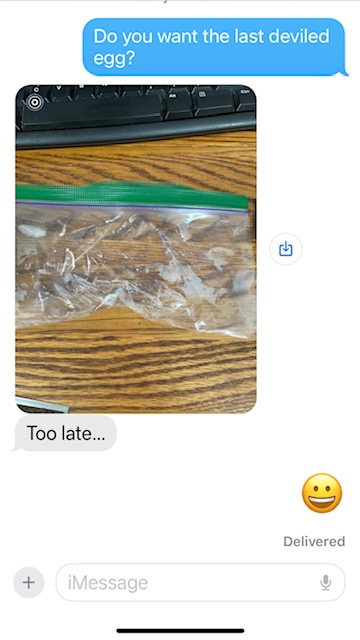
And lastly, this text exchange with my husband:

Text with Jim

To be fair, there were only two left, and I had one the night before. So technically this one was his. But I thought it was still in the refrigerator and he might not want it. 🙂

And yes, sometimes we do text each other from different rooms in the house . . . 🙂

And that’s probably enough stray thoughts for one day.

Laudable Linkage

Welcome to another gathering of great reads discovered this week:

Imperfections Make Sundays More Beautiful, HT to Challies. “I’ll admit it: these human quirks and errors sometimes exasperate me. I’m here to focus on the Lord! Your awkwardness is distracting me from worship! So mutters my self-righteous heart. Perhaps the real problem isn’t with the clumsiness of others, but with our expectations for corporate worship.”

The Bible: Reading the “Ordinary” Way, HT to Challies. Good thoughts about taking the Bible “literally,” how metaphor is used, etc.

Are You Different Enough? 5 Ways to Use Differences in Your Relationship.

The 17 Phrases That ‘Scare’ Introverts the Most, HT to Lisa. This was posted before Halloween, thus the “scary” faces.

Heartwarming Photos of Acts of Kindness, HT to Lisa.

Back to the Sources, HT to Linda, on cases of what were probably inadvertent plagiarisms by Christian authors (see the comments for how it could possibly have happened).

The 2018 Modern Mrs Darcy Gift Guide for Book Lovers, HT to Linda.

As we look ahead to Thanksgiving in the US this week:

There seems to be a theme running through most of the posts I’ve read concerning Thanksgiving so far this year: the fact that thankfulness isn’t an emotion, but an act of the will, and not always easy. Here are a few:

Gratitude Is a Gift for All Seasons. “To intentionally call to mind images of gratitude in the midst of peace and prosperity is one thing, but it takes a sinewy faith to summon them when chaos reigns and the future looks bleak.”

Being Grateful Ain’t Always Easy (Or Is It Just Me?)

Thankfulness From Those Who Suffer.

Time Out for Thanksgiving

For some Thanksgiving fun:

Free printable Thanksgiving trivia, for use as a game or conversation starter

Thanksgiving Bingo.

Thanksgiving Word Search Place Cards, HT to Laura.

And, finally, a couple of my favorite Thanksgiving quotes:

Happy Saturday!


Laudable Linkage

IMG_0195

I don’t usually post these two weeks in a row, but I came across several good reads this week, and some pertain to Easter.

Ten Things You Should Know About the Cross, HT to Challies.

What If Jesus Really DID Rise From the Dead?

Despite Loving Christian Parents, I Left the Faith, HT to Proclaim and Defend. Good tips for parents at the end.

When a Member of Your Church Is Dying, HT to Linda.

Should I Bring My Kids to a Funeral? HT to Story Warren.

The Blessing of a Good Example, HT to Challies.

9 Things That Quiet, Awkward Introvert Wishes You Knew, HT to Linda.

Are home renovations necessary?  HT to Linda. Nothing wrong with home renovations, but all the flip and fix shows popular now can make us discontent.

When I Don’t Get What I Need

I’ve always known I was an introvert, preferring small groups (or, better yet, home!) to big crowds, having a few close friends rather than being the social butterfly, needing time alone to process and think. Reading Susan Cain’s Quiet: The Power of Introverts in a World That Can’t Stop Talking helped me understand myself better and understand that these issues aren’t just preferences, that introverts’ and extroverts’ brains are wired differently. When she pointed out that introverts are drained by social interaction and need solitude to recharge whereas extroverts thrive on social interaction, the proverbial light bulb went off in my mind. “That’s it!” I thought. I had never heard it put that way before, but it just fit my experience so perfectly. I don’t want to be a hermit; I do value social interaction, but it does drain me and I function better overall with some degree of time to myself.

When my kids were in school, I had about seven hours a day to myself. Oh, that wasn’t all spent curled up reading a book or thinking: housekeeping, grocery shopping, errands, and different ministry responsibilities kept me busy. But I did have a good bit of quiet time. I thought once my kids grew up and left home, that time would naturally increase. I’d miss them intensely, but I had plenty of things I looked forward to accomplishing when that time came.

Instead, I have less solitude than ever. One child is still home but working and taking classes online at home. We’re taking care of my mother-in-law in our home, and we have a lady who stays with her in the mornings plus hospice people coming in and out throughout the week. My husband’s job has him working from home a few days a week now. I am not complaining about any of that: this is the home of all of us, not just me, and of course they all have a right to be here. But some days quiet moments are hard to come by except for early morning and late evening.

I imagine some extroverts have the opposite problem: an intense need for companionship and struggles with too much alone time.

So what do we do in such cases? Allow ourselves to get cranky because our needs aren’t getting met? Whine and complain to God about it? I’m afraid I have done both of those.

Recently, though, I was arrested by Philippians 4:11-13: “Not that I am speaking of being in need, for I have learned in whatever situation I am to be content. I know how to be brought low, and I know how to abound. In any and every circumstance, I have learned the secret of facing plenty and hunger, abundance and need. I can do all things through him who strengthens me.”

Paul mentions hunger there. He didn’t thrash around before God and say, “You made me to need food. So why don’t I have it? What are you doing?” He trusted that God would help him in any circumstance. He would either meet his need for food or take him to where there is no more hunger and thirst. He will sustain us until the time that He provides. Paul says he learned this contentment, which encourages me that it’s first of all a process, and secondly, that it can be learned.

But why would God create us to need certain things and then not provide them for a time? Just to teach us contentment? Well, one other time that God allowed His people to hunger comes to mind:

And you shall remember the whole way that the Lord your God has led you these forty years in the wilderness, that he might humble you, testing you to know what was in your heart, whether you would keep his commandments or not. And he humbled you and let you hunger and fed you with manna, which you did not know, nor did your fathers know, that he might make you know that man does not live by bread alone, but man lives by every word that comes from the mouth of the Lord. Deuteronomy 8:2-3.

A few reasons are mentioned there:

  1. To humble us.
  2. To test us (the KJV says to “prove” us). He knows what’s in our hearts, but sometimes our reactions to unmet needs are a revelation to us of just how sinfully self-centered we are. This also tests the depths of our love and commitment: that was one of Satan’s challenges to God about Job: “He only serves you because You bless him. Take away some of those blessings, and You’ll see how fast he turns away from You.” Do we only serve God with a right heart when all of our perceived needs are being met?
  3. To teach us dependence on Him to meet our needs.
  4. To remind us of what’s most important.

These are not meant to be explanations for famine: that would be a completely different study. And God may have other reasons for not answering prayers. And this doesn’t mean that we can’t or shouldn’t take means sometimes meet our needs, but sometimes those needs surface despite our best efforts. Back to the need for solitude, Jesus many times went away from the crowds and His own disciples to be alone to pray – and He also had the experience of people seeking Him out during those times and interrupting His time alone, another way in which He was tempted in all points like we are, yet without sin.

But God has been working with me for a while on changing my attitude from one of demanding what I think I need or lamenting the lack of it to trusting that He knows what I need and will provide it. And He has, many times over, in unexpected ways. Plus that restful, trustful demeanor helps me not only inwardly but outwardly. Not only is my spirit at peace, but instead of focusing on myself, I can turn my attention to others and try to minister to them for whatever purpose God brought them into my life. I confess I have failed in that more often than I like to admit, but I am trusting His grace to change.

So whatever our need, whether for solitude or companionship, affirmation or humbling, inward or outward, we can trust that God has a reason for allowing it, will give us grace while it is unmet, and will meet it in His own time and way.

Your heavenly Father knows that you need them all. But seek first the kingdom of God and his righteousness, and all these things will be added to you. Matthew 6:32b-33

And he said unto me, My grace is sufficient for thee: for my strength is made perfect in weakness. Most gladly therefore will I rather glory in my infirmities, that the power of Christ may rest upon me. Therefore I take pleasure in infirmities, in reproaches, in necessities, in persecutions, in distresses for Christ’s sake: for when I am weak, then am I strong. 2 Corinthians 12:9-10

And God is able to make all grace abound to you, so that having all sufficiency in all things at all times, you may abound in every good work.  2 Corinthians 9:8

(Sharing with Inspire Me Monday, Literary Musing Monday, Glimpses, Tell His Story, Woman to Woman Word-filled Wednesday, Writer Wednesday, Coffee For Your Heart, Porch Stories, Wise Woman, Faith on Fire)

Laudable Linkage

It’s been a while since I’ve had time to share links to posts I found interesting, so this will be a bit longer than usual, but I hope you find something here of interest:

Wonderful Hope by Bobbi’s dad, who is facing a terminal diagnosis at the same time his wife is undergoing cancer treatments.

Advice On Seeking Answers to Spiritual Issues.

Becoming Christ-Like: The Goal of the Christian’s Life? There is a subtle but important point here that resonated with me.

God Does Not View Your Labors as Filthy Rags. We have this tendency to take one verse and run away with it.

Are Christian Missionaries Narcissistic Idiots? No. Here’s why.

The Risk of Practical Love.

The girltalk blog has had a series on training your children in dealing with their emotions. 7 Reminders When Talking to Your Teen About Emotions and Helping Children Handle Their Emotions were two that stood out to me.

Give Me Gratitude or Give Me Debt.

12 Strategies for Singles and Hospitality. The tips are good whether you’re single or married.

Why Courtship Is Fundamentally Flawed. Courtship vs. dating is a hot button debate and I am a bit hesitant to just post the link without discussing it further. I may come back and do so at some point. I may not agree with every little thing but overall he made some excellent points. I did read the book in question before my kids got to that age and pulled some principles from it but did not follow it exactly. We did feel dating – at a certain age and under certain guidelines – was a good way to get to know someone before taking the relationship further but we did want to avoid continued serious relationships and breakups one after another: we didn’t feel the latter was good emotionally nor good training for marriage.

Why Prison Isn’t Restful. We need to be careful about throwaway quips on topics we really know nothing about.

For the Quiet Child (And For Their Parents)…You Can Stop Apologizing For Who You Are.

Ten Things Your Husband Hates.

5 Myths You Might Still Believe About the Puritans.

On Writing Negative Reviews. Good reasons to do so when necessary.

Have a good weekend!


Thoughts on being an introvert

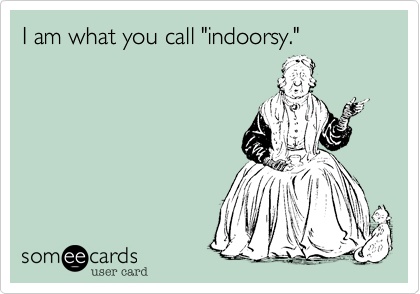
IndoorsyI don’t know if I was taught this somewhere along the way or if it was just a misconception, but as I was growing up I had the idea that an introvert was someone who was indoorsy, not as physically active (and therefore probably a little pudgy), quiet, and didn’t have many friends, whereas an extrovert was more physical, active, outgoing, talkative, and loud.

Evidently I’m not the only one with incorrect ideas of what it means to be an introvert. I was talking with a friend yesterday who said that she has sometimes been accused of being antisocial and once even of being sinful due to her introversion (the latter was said teasingly, but still, that kind of thing stings).

Over the last year I’ve found myself reading a number of books (Quiet; The Power of Introverts in a World That Can’t Stop Talking by Susan Cain and Introverts in the Church by Adam McHugh, both linked to my thoughts on them) and articles about introverts that helped clarify my own thinking and understanding. But as I was commiserating with my friend yesterday, one problem is that extroverts aren’t likely to read books about introverts, and therefore misunderstanding continues.

No one is completely all introvert or extrovert, but most people do lean strongly one way or another. The differences between the two aren’t just a matter of preference: Cain quotes a number of sources documenting that introverts are neurologically wired differently. So it behooves us (both introvert and extrovert) to understand and accept our differences, to realize that God created people differently and has different ways they can each minister, rather than trying to make each other more like ourselves or make everyone fit into one mold.

One of the main differences between the two are their sources of energy in relation to people. Introverts are drained by much social interaction: extroverts thrive on it. Introverts are not antisocial: they do like to get together with people but usually prefer smaller groups. If they are in a large gathering, they’ll likely be on the sidelines talking with one or two people rather than mixing and mingling with many (and they’ll likely collapse at home afterward).

Introverts also tend to be more analytical and slower to process their thoughts. That’s one thing that makes them lag a bit in group discussions and conversations: by the time they process what is being discussed and what they want to say, the conversation has moved on. That’s also why they can panic or at least strongly dislike being called on in a class or small group, and why they don’t think “on their feet” well and often express themselves better in writing than speaking. Introverts are generally more quiet because they’re thinking and processing (and because they prefer quietness and calmness), whereas extroverts often think things through by talking.

Not all introverts are shy: shyness may involve some of the above but may have the added factor of fear, or may just be habit. I was actually raised with the phrase, “Children are to be seen and not heard,” and it is hard to just flip the switch as an adult and start talking. God has helped me with that a lot (that may be a subject for another post). But even if shyness is due to fear, it isn’t helped by rebuking a person for it. Take whatever you’re most afraid of (public speaking, heights, spiders, etc.), and tell yourself “Just stop it!” and see how far you get. 🙂 Then apply that to a fear of people, and perhaps you’ll understand a bit better. One can learn coping mechanisms to help with shyness (and should, since one needs to learn to interact with people), but understanding and empathy help more than a superior or judgmental attitude.

Few if any introverts want to be total hermits. They do need and want people – just preferably in smaller doses. Some of us can talk a blue streak once we get to know and feel comfortable with people. And we can learn to be more talkative than we are really comfortable with. We do need to reach out and be involved in community – all those Biblical “one anothers” do involve other people. But it is comforting to know that Jesus said, “Where two or three are gathered together in my name, there am I in the midst of them” (Matthew 18:20).

There are other characteristics of introverts (which is why, after all, whole books have been written about them), but the main point I wanted to make today was just that we need to understand and respect differences. God made people different and as such He has a place and a purpose for each. The church needs both introverts and extroverts both for balance but also so they can minister to those most like themselves as well as to each other. One of my favorite e-mails came from Karla Dornacher, when I had posted a comment on her blog in a post where she had mentioned being a bit of a loner even though she does well at speaking to crowds. She responded that she couldn’t be alone in her studio so much of the time if she couldn’t be content with being alone for long stretches, and God gives us personalities to fit our callings. That was one of those proverbial light bulb moments for me. I’ve appreciated ways that God has opened for me to minister to others that fit in with the personality He has given me.

There are times, though, that He has pushed me out of my comfort zone. Every trait has its good and bad tendencies, and Adam’s book in particular cautions introverts against some of their potential problem tendencies (some of the most helpful quotes are here). We can avoid people sometimes just out of selfishness rather than need, and we need to realize that a lack of interaction can be hurtful and seem rude even if it is not meant to be. Adam also encourages us that when God does call us to make sacrifices or extend ourselves, He will provide the grace to do so.