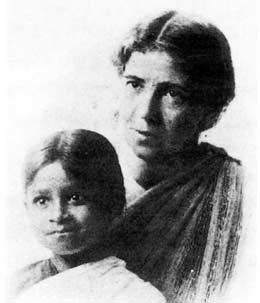
I mentioned Amy Carmichael yesterday: she was one of the first missionaries I ever read about, and her life has had a tremendous impact on me as well as on most who read about her. She would have been appalled at the thought of any attention directed toward her, but a look at her life is reveals what it is to walk closely in love and obedience to God. She was a missionary from Ireland who worked in India from 1895 to 1951 without a furlough.
One of the lessons from her life that has stayed with me over the years (in my mind, at least: it is still far from being worked out in practice as often as it should be) comes from her earliest days in India. In Amy Carmichael of Dohnavur, author Frank L. Houghton records that Amy wrote that one of the group of missionaries she first worked with was
unfair and curiously dominating in certain ways and words. One day I felt the “I” in me rising hotly, and quite clearly — so clearly that I could show you the place on the floor of the room where I was standing when I heard it — the word came, “See in it a chance to die.” To this day that word is life and release to me, and it has been to many others. See in this which seems to stir up all you most wish were not stirred up — see in it a chance to die to self in every form. Accept it as just that – a chance to die.
“And [Jesus] said to them all, If any man will come after me, let him deny himself, and take up his cross daily, and follow me” (Luke 9:23). Often we think of dying to self in the big, martyr-like ways. Yet it is in those everyday situations where, as Amy aptly put it, the “I” in us “rises hotly” that we need to deny self.
Hebrews 11 is sometimes called the hall of fame of faith or the Christian Hall of Fame, telling of the victories and triumphs of various people in the Bible. But verse 36 has a rather startling turn: “and others…” were tortured, tried, stoned, made to wander in deserts. That doesn’t sound very victorious. But they all “obtained a good report through faith,” though they had “received not the promise” yet (verse 39).
Probably many Christians are more familiar with the name of Amy Carmichael than of some of the other missionaries I’ve mentioned in this series. Most know that she was missionary to India. She began a rather robust itinerant evangelistic ministry with a group of other women, but when God began bringing children her way whose families were going to sell them to temples for illicit purposes, she gradually became convinced that He would have her care for these children, though it meant a drastic change in her ministry and lifestyle. Over time a whole compound known as Dohnavur was developed.
What some may not know is that she was an invalid for the last 20 years or so of her life. She remained in India, still in charge of Dohnavur, still encouraging, advising, praying, and writing, but she was in much pain and had limited mobility those years. In Amy Carmichael of Dohnavur by Frank Houghton, he includes this poem before telling of this part of her life:
Two glad services are ours,
Both the Master loves to bless.
First we serve with all our powers–
Then with all our feebleness.
Nothing else the soul uplifts,
Save to serve Him night and day,
Serve Him when He gives His gifts–
Serve Him when He takes away.
~ C. A. Fox
Elisabeth Elliot said of limitations, “For it is with the equipment that I have been given that I am to glorify God. It is this job, not that one, that He gave me.” The limitations that we think are hindering our ministry are often the very thing God uses to shape our ministry for Him.
One day Amy received a shipment of tracts for the ill. As she read them, they just did not do anything for her. As she pondered that, she realized it was because they were written from well people telling sick people how they ought to feel. Over many years she had written notes of encouragement to various ones in the Dohnavur Hospital (named, in the descriptive Indian way, Place of Heavenly Healing), and some of these were compiled in a book titled Rose From Brier. They are rich in their spiritual encouragement and insight, partly precisely because they were written by one who had shared in the fellowship of sufferings.
In another of Amy’s books, she wrote the following:
This prayer was written for the ill and for the very tired. It is so easy to fail when not feeling fit. As I thought of them, I also remembered those who, thank God, are not ill and yet can be hard-pressed. Sometimes in the midst of the rush of things it seems impossible always to be peaceful, always to be inwardly sweet. Is that not so? Yet that and nothing less is our high calling. So the prayer is really for us all.
Before the winds that blow do cease,
Teach me to dwell within Thy calm;
Before the pain has passed in peace,
Give me, my God, to sing a psalm,
Let me not lose the chance to prove
The fulness of enabling love,
O Love of God, do this for me;
Maintain a constant victory.
Before I leave the desert land
For meadows of immortal flowers,
Lead me where streams at Thy command
Flow by the borders of the hours,
That when the thirsty come, I may
Show them the fountains in the way.
O Love of God, do this for me;
Maintain a constant victory.
Blessed be God, even the Father of our Lord Jesus Christ, the Father of mercies, and the God of all comfort;Who comforteth us in all our tribulation, that we may be able to comfort them which are in any trouble, by the comfort wherewith we ourselves are comforted of God. For as the sufferings of Christ abound in us, so our consolation also aboundeth by Christ. II Corinthian 1:3-5
God hath caused me to be fruitful in the land of my affliction. Genesis 41:52b
Here are a few noteworthy reads from the last week or two:
20 Tips for Personal devotions in the Digital Age, HT to Challies. I don’t agree entirely with #5 about not sharing what you’ve read on social media. Sometimes that’s a blessing to read, but I agree you shouldn’t have devotions with that in mind.
Evangelism in the Workplace, especially as the culture becomes more hostile to Christianity, HT to Challies. A quote from it I especially liked: “While the Lord used Hunter to pursue me, I never felt like a project, just a friend.”
Jim Elliot’s Brother Bert: The Hero You Don’t Know, HT to Ann. Neat comparison of his being an everyday faithful star as opposed to Jim’s being a meteor. Neither is better or worse and God has places and purposes for both, and we can learn from and be inspired by both, but probably most Christians are more like Bert than Jim.
And, though the government shutdown really is not funny – I know people personally who have been laid off or furloughed until the government gets its act together – I have to admit this did make me smile:
I mentioned Isobel Kuhn yesterday. her books By Searching and In the Arena are primarily autobiographical and contain some details about her marriage, but Whom God Has Joined focuses entirely on her relationship with her husband. It was originally titled One Vision Only, and the main part of it was Isobel’s own writings sandwiched in-between biographical remarks by Carolyn Canfield. It has been long out of print and was just reprinted not too long ago without Canfield’s part.
It begins with their first notices of each other at Moody Bible Institute and the attraction they felt despite their determination not to get “sidetracked” by the opposite sex.
As they got to know one another and grew in affection, John graduated from college first and went to China. At first they were interested in different areas of China, but the China Inland Mission assigned him to the area she was interested in. When he wrote to propose, she knew what her answer would be, yet she spread the “letter out before the Lord” with a problem. She wrote, “John and I are of very opposite dispositions, each rather strong minded. Science has never discovered what happens when the irresistible force collides with the immovable object. Whatever would happen if they married one another? ‘Lord, it must occur sooner or later. Are You sufficient even for that?’” The verse the Lord gave her was Matthew 6:33: “But seek ye first the kingdom of God, and his righteousness; and all these things shall be added unto you.”
Isobel was assigned and sent to China where they were to be married. One of the first problems they faced was that there were two ladies with very different personalities who each took charge of “helping” the young couple with their wedding plans — and neither plan was what the young couple wanted. God enabled them to very graciously navigate that situation without offending either party.
Isobel wrote in a very engaging way that lets us know missionaries are “of like passions” as we are. We feel like we are right there with her feeling what she is feeling. She not only had the adjustments of marriage but the adjustments of a new culture. Though she was ready and willing for both, sometimes it still threw her for a short while. One example was in her natural “nesting” as a new wife. The CIM way was to live directly with the people as they did, and Isobel was willing for that. She did have a few things to pretty up her home a little bit — nothing extravagant. She was excited to receive her first women guests, and as she began to talk with them, one blew her nose and wiped the stuff on a rug; the other’s baby was allowed to wet all over another rug. Isobel knew that they were not being deliberately offensive: those were just the customs of the country people in that time and place. Yet, naturally, resentment welled up and she had a battle in her heart. She wrote, “If possessions would in any way interfere with our hospitality, it would be better to consign them to the river. In other words, if your finery hinders your testimony, throw it out. In our Lord’s own words, if thine hand offend thee, cut it off. He was not against our possessing hands, but against our using them to holds on to sinful or hindering things.”
In their early marriage they had disagreements over the couple who were their servants (in primitive cultures it was not unusual for missionaries to employ helpers for the many tasks that would have taken up so much time). They were not only lazy, but helped themselves to some of the Kuhn’s own things. John was slower to see it because he had always gotten along fine with them before he was married. At one point when Isobel brought up something the man had not done, hoping for John to correct him, John instead sided with him against her. Angry and resentful, Isobel walked out of the house, not caring where she went, just to get away from it all. Gradually she came to herself and realized she was in a little village as darkness was nearing. In that time and culture that was not done: “good women were in their homes at such an hour.” She felt as if the Lord were saying to her, “You have not considered Me and My honor in all this, have you?” and then convicting her that she had not even invited Him into the situation. She confessed that was true, asked Him to work it out, and went home. And He did.
Isobel was more artistic and exuberant by nature, and once when she was telling a story she mentioned that it was “pouring rain.” John corrected her, saying it was “merely raining.” She was indignant that her story was being interrupted by such a minor detail and said, “I didn’t stop to count the raindrops.” He replied that that was just what she should do. He felt she exaggerated and wanted to break her of it. He began “correcting” her prayer letters and stories and began to use the catch-phrase, “Did you count the raindrops?” It was discouraging and distressing to her and she felt it had a stilted effect on her writing. She tells how over time the Lord used this to help her husband appreciate his wife’s gift of imagination and expression and helped her to be more accurate. She comments,
Similar situations are not uncommon among all young couples. If we will just be patient with one another, God will work for us…Until the Lord is able to work out in us a perfect adjustment to one another, we must bear with one another, in love…With novels and movies which teach false ideals of marriage, young people are not prepared to ‘bear and forbear.’ They are not taught to forgive. They are not taught to endure. Divorce is too quickly seized upon as the only way out. It is the worst way out! To pray to God to awaken the other person to where he or she is hurting us, to endure patiently until God does it: this is God’s way out. And it molds the two opposite natures into one invincible whole. The passion for accuracy plus a sympathetic imagination which relives another’s joys and sorrows—that is double effectiveness. Either quality working unrestrained by itself would never have been so effective. But it cost mutual forgiveness and endurance to weld these two opposites into one! Let’s be willing for the cost.
With humor and poignancy Isobel tells of further challenges and adjustments in the midst of ministry and growing love for each other and growth in the Lord.
Isobel Kuhn was a missionary to China in the early to mid- 1900s, alongside her husband, John. She has written a number of books about the Lord’s working in their lives and ministry, all very readable and enjoyable. She has a very readable style and is quite honest and open about her faults and foibles, but her books are also laced with humor. By Searching was subtitled My Journey Through Doubt Into Faith and describes just that. She had grown up in a Christian family yet wasn’t truly saved. When a professor at college condescendingly told her she only believed because that was what her parents told her, she realized he was right, and thoroughly let herself go into the “worldly” activities she hadn’t been allowed to pursue. This book traces her journey to true faith in Christ and her first steps in her walk with Him. In the Arena is not exactly a sequel, but it highlights many decisions, experiences, and trials in which God manifested Himself. I reviewed both books together here.
One incident that had lasting effects occurred during Isobel’s training at Bible college. Many students did not have a quiet time or devotional time with the Lord, because they spent so much time studying the Bible. “But,” Isobel wrote in In The Arena, “reading the Scriptures for a technical grasp of the general argument in a book, and reading it as in the Lord’s presence, asking Him to speak a word on which to lean that day — those were two very different things. One was no substitute for the other. Yet I knew also that some students were trying to let classwork reading do for personal quiet time. Deadness of souls was inevitable.”
As she prayed about it, she felt led to form a habit of spending one hour a day, sometimes in two half-hour segments twice a day, “in the Lord’s presence, in prayer or reading the Word. The purpose was to form the habit of putting God in the centre of our day and fitting the work of life around Him rather than letting the day’s business occupy the central place and trying to fix a quiet time with the Lord somewhere shoved into the odd corner or leisure moment.”
She and nine others covenanted to do this for about a year and meet together monthly to worship together, confess failure, and encourage each other. She wrote, “It was never my thought that this covenant should become law. My thought was merely deliberately to form a habit which would allow the Lord to speak personally to us all the days of our lives….somehow news of [this covenant] spread, and others began to join. Then—it seems as if some human beings always have to go to extremes—some signed a covenant binding them to this hour a day for life. I did not sign it. What about days of illness or emergency, when it might be impossible to keep an hour quietly? There was no need to vow; there was only need to form a habit of putting God first.”
The following is from In the Arena and tells of how this decision was tested.
This is the background of my platform of secret choices. It was the evening of the Junior-Senior party. I was a junior and had been asked to lead the devotional with which all such parties closed. I was also on the programme as Grandma in a Dutch scene, off and on all through the banquet. The week before had been so full of work and study that I had not had one moment to sit down and prepare a devotional. Work…had delayed me, and I arrived at the supper half-hour, hungry, exhausted, and without any devotion prepared. Besides this, I still had half an hour due on my quiet time! After the party we juniors had to clean up and I would not get to my room til midnight — the day would be gone.
Here was my platform of secret choices. That supper half-hour. (1) Should I go down and eat my supper? (2) Should I skip supper and try to prepare the devotional message? (3) Should I put God first and give that half-hour to him? The supper bell rang, and my roommate left for the dining room. I stood for a moment irresolute; then, throwing myself on my knees by my bedside I sobbed out in a whisper, “Oh, Lord, I choose you!” As I just lay in His presence too weary to form words, the sense of His presence filled the room. The weariness and faintness all left me. I felt relaxed, refreshed, bathed in His love. And as I half knelt, half lay there, saying nothing, but just loving Him, drinking in His tenderness, He spoke to me. Quietly, but point by point, He outlined for me the devotional message I needed to close that evening’s programme. It was an unforgettable experience and an unforgettable lesson. Putting Him first always pays.
In the exhilaration of that wonder I ran down to the banquet hall, slipped into my costume, and went through the programme. At the end, when the devotional message was needed, I gave very simply what He had told me during the supper hour. Such a quiet hush came over that festive scene, I knew He had spoken, and I was content.
More than twenty years passed. I was home on furlough and visiting the Institute. It was the day of the Junior-Senior party and a group of us were reminiscing. “One Junior-Senior party a always stands out in my memory,” said one. “I forget who led it but it was a Dutch scene and the devotional blessed my soul. I’ve never forgotten it.” She had indicated the date, so I knew. I was thrilled through and through. Of course I did not spoil it by telling her who led that devotional. In God’s perfect workings, the instrument is [often] forgotten. It is the blessing of Himself that is remembered.
Several years ago I had heard of Gracia Burnham’s In the Presence of My Enemies and somewhere read an excerpt from it, but I avoided reading it. I couldn’t face it. I’m not sure why: maybe because it was too fresh, maybe because the people responsible for the Burnham’s captivity were still alive (maybe not the specific people, but the extremist Islamic groups are still active), maybe because in the portion that I read, Gracia was having to deal with something that I struggle with. But the youth pastor at the church we were attending saw a DVD presentation of Gracia sharing her testimony at another church where he was ministering and recommended it to me. I ordered it, watched it, and was so touched on so many levels. I then felt that I had to read the book. (Sadly, the DVD does not seem to be available any more – I couldn’t find it after searching the Web for a while.)
For those who might not be aware, Martin and Gracia Burnham were missionaries with New Tribes Mission in the Philippines: he was a missionary pilot who reminded me a lot of one of my former church’s missionaries who also pilots a small plane. They had gone for a quick weekend get-away to celebrate their anniversary at a resort. They didn’t usually go to the “touristy” areas, but decided to go this once. During their stay, an Islamic extremist group stormed the resort and took guests and a few staff members hostage. Several of the hostages were able to arrange for ransom and were released after a few months. Some were killed along the way. The Burnhams were held for over a year. Martin was killed in a rescue attempt by the Philippine military and Gracia was wounded.
I don’t want to take away from what she shares in the book, so I won’t go into the details of the story here. I do want to mention just a couple of impressions, though.
As the Burnhams struggled with negative thoughts and attitudes toward their captors, I kept finding myself thinking at first, “But they had a right to feel that way!” I knew better, but that was the thought that kept coming. They had to put into practice the Bible’s teaching about loving their enemies, praying for those who were despitefully using them, in a very real way and only by God’s grace.
I also was grieved that I did not pray for them more. Often when I hear reports of stories like theirs on the news, I try at least to pray right then in the midst of whatever I am doing. I may have prayed for them in that way, but I don’t remember. The scripture came to mind to remember those in bonds as if bound with them, and I failed to do that for the Burnhams, but this caused me to determine not to neglect that ministry again.
I was also struck by the Muslim group’s twisted sense of logic. They wanted Islam to rule the world so it would be ruled by “righteousness.” They advocated the cutting off of someone’s hand for stealing — but excused their own stealing because they “needed” the stolen items for their cause. When people died in the course of what they did, it was “their destiny.” They had a strong sense of “justice” but saw mercy as a weakness. When discussing that last point with one of their captors, Martin said, “You know, I hope my children don’t take up the attitude you have. I hope they don’t ever shoot some Muslims because of what you have done to us.” The man to whom they were speaking looked shocked. “Done to you? What is my sin against you? I have never done anything to you.” Martin and Gracia could only look at each other incredulously.
Gracia tells of her very human struggles, like depression, anger, and resentment over their situation and the realization that not only was her attitude not helping, but it was hurting. She writes, “I knew that I had a choice. I could give in to my resentment and allow it to dig me into a deeper and deeper hole both psychologically and emotionally, or I could choose to believe what God’s Word says to be true whether I felt it was or not.” That was a turning point for her as she chose to believe God and handed over her pain and anger to Him. I thought how often we get tripped up over pain, resentment, and anger over much lesser things.
She shares also how the Lord provided for them in unexpected ways, how she and Martin encouraged each other, how they had to battle a captive’s mindset, how they were able to talk about the Lord with their captors and other hostages, as well as the details of how she and Martin originally came together as a couple and what happened in the aftermath of her captivity.
A few years later Gracia wrote To Fly Again: Surviving the Tailspins of Life (linked to my review), which includes an update of how she and her children were doing after all that had happened to them, her recovery from the trauma, and encouragement to others who have gone through any kind of traumatic event.
I found this video on YouTube, and I think some of the footage is from the original DVD:
God’s Word is true no matter what, and thankfully He doesn’t see fit to put all of us through that kind of experience, but when someone who has been through what she has speaks of God’s goodness and faithfulness, the truth of God’s Word and the reality of His Presence….it rings true. There is an authenticity about that person’s testimony. Their faith, their beliefs have been tried in the fires of testing. Gracia’s testimony touched me deeply. I don’t know if I could have gone through what she did – in fact, I’m pretty sure I couldn’t. But God gives His grace for various trials when we need it. Though I hope I never have to face that particular kind of trial, we will all face trials of some kind, and we can trust He will see us through them as he promised.
I Peter 1:6-8:
Wherein ye greatly rejoice, though now for a season, if need be, ye are in heaviness through manifold temptations: That the trial of your faith, being much more precious than of gold that perisheth, though it be tried with fire, might be found unto praise and honour and glory at the appearing of Jesus Christ: Whom having not seen, ye love; in whom, though now ye see him not, yet believing, ye rejoice with joy unspeakable and full of glory…
I wanted to start off the 31 Days of Missionary Stories with God’s answer to an everyday, normal need. There are some dramatic missionary stories, but missionaries don’t spend all their time on the front lines fighting spiritual battles or out on the streets witnessing to everyone they meet. They have to deal with the same mundane affairs of life that we all do, and often those mundane affairs are more complicated than they are in America. That was especially true in previous centuries.
Jonathan and Rosalind Goforth were missionaries to China in the late 1800s and early 1900s. Mrs. Goforth has written Goforth of China, a biography of her husband; How I Know God Answers Prayer (I was delighted to find what appears to be all or most of the text of this book here, and it is free for the Kindle for a time here.); and Climbing, which includes many anecdotes she was requested to share as well as some of her own personal struggles. The following comes from Climbing.
The Goforths had just narrowly and traumatically escaped from the Boxer Rebellion in China to Shanghai. Until a ship left that they could find passage on, they had to stay in an empty house with little furniture. In the ten days they were there, her husband and son Paul bought some ready-made clothes, and she was able to have one dress made.
But the other three children! They were in rags given by the Chinese on the journey. How could I, without materials, without a machine, get an outfit made for even one, and the ocean voyage just ahead! Alone with the baby one morning I cast myself down by the little one and cried again and again to the Lord to send someone to help me. My distress was great. Help I must have, but I knew no one to whom I could turn. Then suddenly, while I was praying, the doorbell rang. On opening the door I found two women outside. They introduced themselves and told of having seen our names among those of the refugees. They were in charge of a Chinese girls’ school, but on account of the Boxer troubles, all the girls had been sent home. They then said, “We have nothing to do and thought you may need help.” Scarcely able to speak, I told them rapidly my story; how I was on my knees pleading for help when they rang the bell. A few moments followed in which we stood clasping hands, weeping, just too full for speech. Then they went away to get materials, for there was no time to lose.
In a very short time, they returned with a pile of materials of from three- to five- yard lengths. I cut out and gave directions for a number of garments. The women took all away and, with the help of some friends, made practically everything needed except for the baby, who, in the rush of getting others provided for, was forgotten! The day we sailed, I gathered a quantity of material together, planning to make the most necessary things for him on board ship. Then came the most beautiful proof of God’s overshadowing care.
We had been passing through the Inland Sea and were nearing Yokohama. I had been trying my utmost to get some necessary things ready for baby W., but my hands trembled so I could scarcely hold the needle. I struggled on, realizing my strength was going, but kept sewing til I could no longer see the needle. Rising, I folded the work, and, going down to the cabin, put it quietly, numbly into the trunk, saying, “Lord, I have done all I can. I can do no more. As you provided for the others, do so now for baby.” I then went on deck and lay down on a long chair exhausted. How long I lay there I do not know, but suddenly someone touched me and said, “There’s a large bundle come off the lighter for you: it is in your cabin.” Dazed at first, I could not take it in. Then it flashed into my mind, “It’s the answer.”
In the cabin, I found a letter attached to the bundle from Mrs. O. E., of the China Inland Mission, whose husband was at that time risking his life in China, seeking to bring out to safety women of the mission who were in peril. The letter stated that her little son, the same age as my baby, had died some months before and she felt it laid upon her to send me, for my child, his outfit. I opened the bundle to find not only a most beautiful, complete outfit for my little one, but also many things I needed for myself and the other children. It was indeed one of the Lord’s exceedingly abundant answers. Is it any wonder that those words written so long ago by the psalmist have always had a deep thrill of response in my heart?
I love the LORD, because he hath heard my voice and my supplications. Because he hath inclined his ear unto me, therefore will I call upon him as long as I live. – Psalm 116:1-2.
God cares about the souls of people and the affairs of nations. But He also cares about the needs of mother’s hearts and children’s bodies.
Five missionaries working in different outposts in Ecuador in the early to mid-1950s became burdened for a tribe of killers known then as the Aucas. Early encounters with the white man had not gone well when the rubber hunters came to harvest while also “plundering and burning the Indian homes, raping, torturing, and enslaving the people” (p. 14). But the Aucas killed not only white men, but any outsiders and even their own people. “Could Christian love wipe out the memories of past treachery and brutality?” (p. 14). The missionaries hoped so and longed to be a part of reaching this tribe with the love and gospel of Christ. Upheld by the truth that “Thou wast slain, and hast redeemed us to God by thy blood out of every kindred, and tongue, and people, and nation” (Revelation 5:9b), they began to plan and strategize as to how best to reach these hostile people.
Through Gates of Splendorby Elisabeth Elliot is the story of how these five men came to the Lord, came to be called to the mission field, their marriages, and how each was led to become part of “Operation Auca.” It’s no spoiler to say the operation ended in the death of the five, because that fact was known long before the book came to be and was probably a great impetus in it’s writing. But then it is not right, either, to say that is how Operation Auca ended, because God used it in the lives of the Aucas themselves as well as of people all over the world in the decades since. But knowing how the story “ends” lends a poignancy to the men’s lives and words.
The five men were:
Nate Saint, a brilliant pilot whose dreams of flying the big planes was cut short by an illness, but who went on to become a pilot for Missionary Aviation Fellowship, bringing much-needed supplies, human contact, and medical help to missionaries in outpost stations. He had an ingenious engineer’s mind which he used to great effect solving problems and improving life, and a healthy balance between doing everything in his power to ensure success and safety yet trusting God for the outcome.
Jim Elliot, from Portland, OR, intense and passionate, had a burning desire to share Christ with those who had never heard of Him, yet also had a humorous side and felt with George MacDonald that “It is the heart that is not yet sure of its God that is afraid to laugh in His presence” (p. 17).
Pete Fleming, from Seattle, WA, quiet, studious, would probably have been a college professor if he had not felt called to the mission field.
Roger Youderian, of Louistown, MT, severely affected by polio as a child, was called to the missionary field while serving in the military.
Ed McCully, from Milwaukee, WI, was planning to go to law school when a Bible study led him to abandon all to follow Christ wherever he might lead.
Even before Operation Auca was even remotely thought about, most of the men were willing to give themselves even unto death. Jim wrote in his journal:
“‘He makes His ministers a flame of fire.’ Am I ignitible? God deliver me from the dread asbestos of ‘other things.’ Saturate me with the oil of the Spirit that I may be a flame. But flame is transient, often short-lived. Canst thou bear this my soul – short life? In me there dwells the Spirit of the Great Short-Lived, whose zeal for God’s house consumed Him. ‘Make me Thy fuel, Flame of God.'” (p. 17).
Nate Saint, likewise, considered himself “expendable,” saying, “Every time I take off, I am ready to deliver up the life I owe to God” (p. 58), and Pete later wrote:
“I am longing now to reach the Aucas if God gives me the honor of proclaiming the Name among them…I would gladly give my life for that tribe if only to see an assembly of those proud, clever, smart people gathering around the table to honor the Son – gladly, gladly, gladly! What more could be given to a life?” (p. 26).
All of the wives, as well, were willing to live in “primitive” conditions and to be used in God’s service in whatever way He saw fit.
But they were not careless. Every step of Operation Auca was steeped in thought, discussion, sometimes disagreement, and prayer for the best outcome for all involved. And every step looked like it was going well.
What then led the Aucas then to kill the five men? When God opened the tribe to visits later, at first they said it was because they thought the men might be cannibals. In a later book I believe someone was told that the photographs the missionaries had scared them: they thought somehow it involved the soul of the person in the photograph. In Steve Saint’s more recent book, End of the Spear, he was told that an argument had broken out among the Auca men involving a woman, and one man wanted to prevent the bloodshed amongst the tribe and turned their anger towards the white men. It is possible that all of these factors played a part, or that as the Aucas (now known by their own name of Waodani [going by Steve’s spelling of it since he has worked with them for years, but I have also seen it as Huaorani or Waorani]) got to know white people and their language better, they may have felt more of a freedom of expression in later years that they did at first.
I first read this book in college, and the lives of these men and their wives and their dedication and love for the Lord touched me greatly. I have read it many times since, and it never fails to speak to me. The version I read this time is the same one I read in college, a brown around the edges 1977 fifth printing: the first printing was in 1956. It was interesting to see what I had underlined in previous readings and what stood out to me this time. It also touched off a lifetime of reading missionary biographies, reading just about everything Elisabeth Elliot has written and reading several other books about Operation Auca and the lives of those involved.
If you’d like to read more about any of these, I recommend the following:
The Dayuma Story by Rachel Saint, sister of pilot Nate Saint. Dayuma was the Auca girl who had escaped the tribe years earlier, taught the men Auca phrases, and later went back to share the gospel with her tribe.
The Savage My Kinsman by Elisabeth Elliot about her years of working with the Aucas after Jim’s death.
Unfolding Destinies by Olive Fleming Liefeld, widow of Pete Fleming.
End of the Spear by Steve Saint, Nate’s son. If you don’t read any others, I’d recommend this one as it is a more recent book and a fuller account of the events then and since, plus it is just plain good reading.
I’m sure there are other books and biographies out there (I have one of Nate Saint on my bookshelf that I’ve not read yet). but these are the ones I have read. In addition, Elisabeth Elliot touches on the experiences of her time in the Ecuadorian jungle in several of her other books. One of my favorites is in The Savage My Kinsman when she quotes William Cullen Bryant’s poem, “To a Waterfowl,” and applies it to herself, especially the last line: “He, who, from zone to zone, Guides through the boundless sky thy certain flight, In the long way that I must tread alone, Will lead my steps aright.”
There are also several films and film clips of interest:
Through Gates of Splendor, narrated by Elisabeth Elliot, using footage that she, Nate Saint, and Life Magazine had taken.
A “This Is Your Life” feature of Rachel Saint, part 1 and 2.
Beyond the Gates of Splendor, a documentary made 50 years after the events. This is one I would recommend above all the others if you only have time for one. It is in four parts on Vimeo (Part 1, 2, 3, and 4), but I found the audio a bit hard to hear.
I wanted to say just a word, too, to those who criticize missionary efforts and who believe that primitive tribes should be left as they are. By the Waodani’s own admission, the tribe probably would have become extinct now if someone had not come to tell them of a better way of life. Why would anyone want to deny them that? In Spirit of the Rainforest (different people and field, but also a primitive tribe) this rather lengthy quote explains some of their feelings (I started just to link to it, but I feel it is so important that I copied it here):
“The naba wants to know why you want to change the way you live out here in the jungle,” Keleewa said to Hairy after Doesn’t-Miss talked.
Hairy was surprised at the question. “Because we’re miserable out here. We are miserable all the time. The people from Honey [predominantly Christian village] came here and made peace with us many seasons ago and their village keeps getting better. We want that for us. If it means throwing spirits away and getting new ones, we will do it. [This is not something said lightly. Many were under the impression that they would be killed if they tried to get rid of their spirits.] But we need someone to teach us these new ways.”
Hairy didn’t have spirits because he was not a shaman. But he followed everything the spirits told his shaman. I knew my spirits would be very irritated if Hairy quit following the spirits. No one who has killed as often and as long s Hairy could ever stop it…
Doesn’t Miss talked with Keleewa for a while. Keleewa paused and thought how to say what the naba said. Then he told Hairy, “He says there are many people in his land that don’t think that he, or any of us, should be here helping you at all. They say that you’re happy here and that we should leave you alone. He wants to know what an experienced killer like you would say to them.”
Hairy grew even more serious. “I say to you, please don’t listen to the people who say that. We need help so bad. We are so miserable here and out misery never stops. Night and day it goes on. Do those people think we don’t suffer when bugs bite us? If they think this is such a happy place out here in the jungle, why aren’t they moving here to enjoy this beautiful life with us?”
Doesn’t-Miss was quiet. Then he got out of his hammock and walked down the trail…When he was too far away to hear, Hairy said to Keleewa, “Is he stupid? Doesn’t he have eyes? Can’t he see these lean-tos we call houses? Can’t he see us roam the jungle every day, searching for food that isn’t here, so we can starve slower? Can’t he see that our village is almost gone, that this move we are making now is our last hope to stay alive?”
Keleewa was slow to answer. He knew Hairy wouldn’t understand what he was about to say. “Most nabas think just like him,” Keleewa told Hairy, and shook his head because he knew he couldn’t explain why.
“Nobody’s that stupid,” Hairy snapped. “They must hate us. They think we’re animals” (pp. 180-183).
Why would even any non-Christian want to see a whole people group extinguished due to infighting or disease? Especially these days when we clamor to save the spotted owl and other endangered species? Shouldn’t endangered people be at least equally as important as endangered animals?
Would anyone in their right minds really want such practices as burying a widow along with her husband or killing twins or deformed babies to continue? So many primitive tribes practice these kinds of things.
Why deny these people the choice of hearing that there are other ways? Why not allow them to hear the gospel and let them make their own choice? So many who bask in the multitudes of freedoms we have here in the US would rather keep people like this in darkness in the name of preserving their culture. Most missionaries I know of these days consciously and conscientiously try not to “Americanize” the native churches but rather try to respect their culture and form churches within that culture while introducing healthier ways of living and civil practices. Who could possibly have a problem with that?
Thank you, Carrie, for allowing me to choose this book for the Reading to Know Book Club in a year of featuring classics. It truly is a Christian and a missionary classic, and I am glad folks are revisiting it or discovering it for the first time.
I’ll leave you with the song the men sang the night before they launched “Operation Auca,” and from which the title of the book is taken (words and thoughts are here.)
(This will also be linked to Semicolon‘s Saturday Review of Books.)
It was the first week of January, 1956, that Operation Auca finally began to come to fruition for five missionary couples in Ecuador: Jim and Elisabeth Elliot, Roger and Barbara Youderian, Nate and Marj Saint, Ed and Marilou McCully, and Pete and Olive Fleming. On January 8, one of the men radioed the wives back at their stations, “Pray, girls: today’s the day!” On this date, January 9, the scheduled radio contact did not come and a missionary friend flew over the area where the men had been camped and saw their airplane stripped of fabric but saw no one. It was two days later that the first bodies were found. The men had been speared to death on January 8.
I can only imagine what it was like for those five women to go through those days with hope but no word and then to finally learn that their husband were gone and they were alone thousands of miles from home.
Yet, as many of you know, God used this incident to greatly impact both the Aucas (now know as Waodani or Huaorani) and the rest of the world. Later Rachel Saint (sister to Nate) and Elisabeth Elliot and her daughter Valerie were invited to come and live with the Aucas, and eventually many of them were led to the Lord: one of the killers even became a surrogate grandfather to Steve Saint’s children.
And not til eternity will we know the full impact of these men and their wives. Many lives have been touched, stirred, and inspired. Sometimes we still wrestle with why things happened as they did, but there is no doubt God used them.
A good post on the impact of Jim Elliot in particular is Today Jim Elliot was Killed. If you ever have the chance, see the documentary Beyond the Gates of Splendor. It is in four parts on Vimeo (Part 1, 2, 3, and 4), but I found the audio a bit hard to hear even turned all the way up.
In June for Carrie’s Reading to Know Book Club I’ll be hosting the reading of Through Gates of Splendor, Elisabeth Elliot’s book on the five families, what led them to Ecuador, and how their families coped in the aftermath of the men’s deaths. But when I realized this was the anniversary of that time, I couldn’t let it go by without acknowledgment.
I’ll leave you with some excerpts someone put together of the wives’ testimonies from Beyond the Gates of Splendor.










 Stray Thoughts