Review: Proverbs for Life for Women

Proverbs for Life for Women

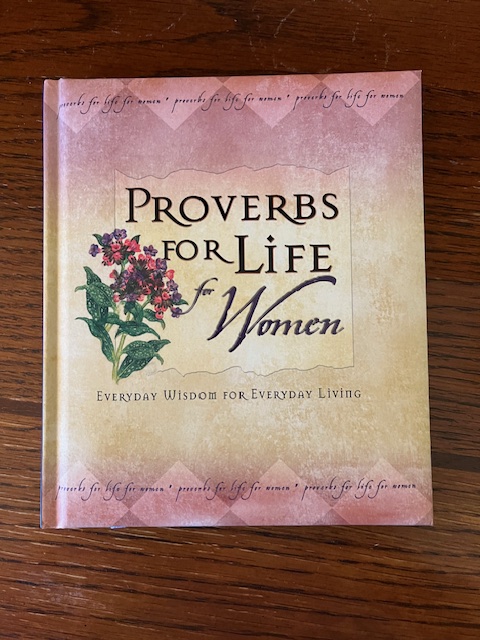
Proverbs for Life for Women is a gift book compiled by Lila Empson for Zondervan in 2003.

The book looks very much like a gift book. It has a puffy hardback cover, lovely pages, and a ribbon bookmark. The size is a little under 6×7″.

There are about 46 readings grouped into several categories: the Righteous Woman, Virtuous Woman, Faithful Woman, Confident Woman, etc.

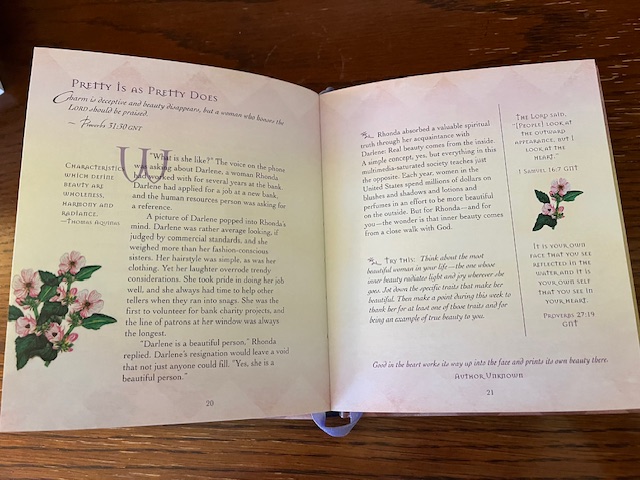
Each reading contains a verse from the book of Proverbs in the Bible, a story illustrating the proverb, a conclusion, a “Try this” action suggestion, and a few other proverbs or quotes.

Proverbs for Life for Women

This book mostly uses the Good News Translation of the Bible (formerly Good News or Modern Man, now often called Today’s English Version). This is not my favorite version, for a number of reasons. It translates the thought of a passage rather than the words. It succeeds in its goal of having an easily readable text, but it sacrifices some accuracy. I think a different Bible translation would have made this book a lot stronger.

Also, I wouldn’t endorse all the people the book quotes from.

Just about the time I thought this book seemed a little lightweight in content, I’d read a section that was particularly helpful and meaningful.

So, this book has a lot of good points, more good than bad. But it could have been much better with a little tweaking.

(I often link up with some of these bloggers.)

Review: Be Skillful (Proverbs)

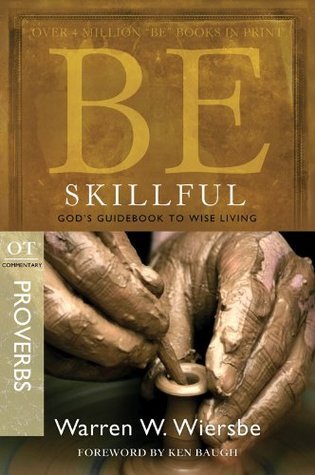
Be Skillful: Wiersbe Commentary on Proverbs.

In Be Skillful (Proverbs): God’s Guidebook to Wise Living, pastor and Bible teacher Warren Wiersbe notes, “We are living in the information age, but we certainly are not living in the age of wisdom” (p. 11, Kindle version).

The book of Proverbs is one of the Bible’s wisdom books. Of course, we can gain wisdom all through the Bible, but Job, Psalms, Proverbs, Ecclesiastes, and the Song of Solomon, are grouped together as wisdom books.

Wiersbe goes on to say, “It isn’t enough simply to be educated and have knowledge, as important as education is. We also need wisdom, which is the ability to use knowledge. Wise men and women have the competence to grasp the meaning of a situation and understand what to do and how to do it in the right way at the right time” (p. 16).

“Biblical wisdom has little if any relationship to a person’s IQ or education, because it is a matter of moral and spiritual understanding. It has to do with character and values; it means looking at the world through the grid of God’s truth” (p. 17).

“Biblical wisdom begins with a right relationship with the Lord. The wise person believes that there is a God, that He is the Creator and Ruler of all things, and that He has put within His creation a divine order that, if obeyed, leads ultimately to success” (p. 17).

“The first essential for an effective study of Proverbs is faith in Jesus Christ so that you can honestly call God your Father. You can’t make a life until you first have life, and this life comes through faith in Jesus Christ (John 3: 16, 36)” (p. 26).

The bulk of Proverbs is made up of individual sayings. “Proverbs are pithy statements that summarize in a few choice words practical truths relating to some aspect of everyday life. The Spanish novelist Cervantes defined a proverb as ‘a short sentence based on long experience'” (p. 20). But these proverbs are not just clever sayings: they are God’s inspired Word and profitable for doctrine, correction, reproof, and instruction just like the rest of the Bible (2 Timothy 3:16-17).

Normally, Dr. Wiersbe’s comments follow the chapters of the book of the Bible he is discussing. In this commentary, however, he groups his remarks as to the categories in Proverbs: the contrast between wisdom and foolishness, diligence and laziness, the virtuous woman and the “strange” woman, etc., and characters like the drunkard, glutton, the simple, scoffer, fool, king, parents and children, and so on.

As to why God directed the writers of Proverbs to lay out the book this way, Wiersbe has a couple of suggestions. Most people didn’t have their own copies of the Scriptures. Short, pictorial statements would have been easier to remember that a lecture. Plus, “Just as the Bible itself isn’t arranged like a systematic theology, neither is Proverbs. What Solomon wrote is more like a kaleidoscope than a stained-glass window: We never know what the next pattern will be” (p. 22). Some make a practice of reading a chapter of Proverbs each day of the month. They receive wisdom on a variety of topics to carry with them throughout the day.

It had been a while since I had read Proverbs. I enjoyed thinking through it again along with Dr. Wiersbe’s insights.

(I often link up with some of these bloggers.)

Laudable Linkage

Some good reads found this week:

Does Maturity Still Matter? HT to Challies. “The spectacle of businesses, journalistic organizations, and even ministries catering to their ‘most emotionally immature’ members is familiar. Even more important is the dynamic Sayers describes, whereby those hyperactive members become ‘de facto leaders,’ because their actual leaders—and, by extension, their peers—come to see avoiding controversy as job number one.”

Forgiving Ourselves, HT to Challies. “If God’s forgiveness of us is to be the paradigm for our forgiveness of others, is it, therefore, also to be the paradigm for our forgiveness of ourselves? And could this then be a solution to all the problems we face in regard to our own failures and sins?”

Mama Bear, HT to the Story Warren. “As moms, our job is to raise these little people who have been entrusted to us and teach them to be capable, productive adults who chase after God. Perhaps the largest part of that is teaching them how to deal with when things in life don’t go the way they want,” whether due to their own shortcomings or someone else’s perceived unfairness. We need balance here–it’s possible to go too far one way or the other.

Beyond Safe: 6 Prayers for the Mom of the Graduate. This is good for moms in general. Our tendency is to pray and work for our kids to remain “safe.” But God may call them to take risks.

To Surprise Us at the Last Day. A lovely reminder that sometimes God’s work is hidden. Lesley touches on a similar theme with Whether Quickly or Not.

Beware the Leech’s Daughters. Insight on a puzzling verse in Proverbs and what it might mean.

Spurgeon on criticism

Someone posted this quote on Facebook recently:

“Brother, if any man thinks ill of you, do not be angry with him; for you are worse than he thinks you to be. If he charges you falsely on some point, yet be satisfied, for if he knew you better he might change the accusation, and you would be no gainer by the correction. If you have your moral portrait painted, and it is ugly, be satisfied; for it only needs a few blacker touches, and it would be still nearer the truth.” Spurgeon

The first sentence especially resonated with me. I was just discussing with my son yesterday that the first response to any criticism should be to examine it to see if there is any truth to it. I’m amazed at people who can’t take the merest suggestion that they might be doing something not quite right without becoming defensive and blowing up, or, in opposite fashion, becoming wounded and closing in on themselves.

Yet I have to admit, my first response to criticism isn’t, “Thank you: you’ve give me something to think about.” I might not say so out loud, but my first thoughts are likely to be something like, “You don’t understand,” or, “How DARE you!” or, “Oh yeah? Well take a look at yourself and deal with your own faults!” Not very pretty, is it? My first response should probably be, “Yes, and you don’t know the half of it!”

It should be no surprise to us that we’re not perfect, and no surprise that someone else notices that fact from time to time. Proverbs has much to say about hearing reproof:

For the commandment is a lamp; and the law is light; and reproofs of instruction are the way of life. Proverbs 6:23.

He is in the way of life that keepeth instruction: but he that refuseth reproof erreth. Proverbs 10:17.

Poverty and shame shall be to him that refuseth instruction: but he that regardeth reproof shall be honoured. Proverbs 13:18.

The ear that heareth the reproof of life abideth among the wise. Proverbs 15:31.

He that refuseth instruction despiseth his own soul: but he that heareth reproof getteth understanding. Proverbs 15:32.

A reproof entereth more into a wise man than an hundred stripes into a fool. Proverbs 17:10.

We can take comfort in the fact that God sees believers through His Son, Jesus Christ, and that once we savingly believe on Him, His righteousness is transferred to our account because He took our sinfulness on His. Because of His amazing grace, those who have believed on Christ for salvation become God’s children, and will have a home with Him in heaven. Our eternal life begins NOW, not when we die.

Yet until we get to heaven, we have a sin nature to contend with, and we’re instructed to “grow in grace, and in the knowledge of our Lord and Savior Jesus Christ” (II Peter 3:18). II Timothy 3:16-17 tell us: “All Scripture is breathed out by God and profitable for teaching, for reproof, for correction, and for training in righteousness, that the man of God may be complete, equipped for every good work” (ESV). Part of that growing, completion, equipping, is realizing those areas where we have a problem and then seeking God’s grace and relying on His Word to change us. So when we receive a criticism, instead of just brushing it off, we can see if God means to use it to show us something we need to know about ourselves.

There is only one perfect person in the universe, and as we behold Him, He changes us to be more like Himself:  But we all, with open face beholding as in a glass the glory of the Lord, are changed into the same image from glory to glory, even as by the Spirit of the Lord. II Corinthians 3:18.