Review: Be Exultant

Be Exultant: Wiersbe commentary on Psalms

In my current trek through the Bible, I’ve just finished the book of Psalms. I had not planned to end the book right before Thanksgiving, but I was glad it worked out that way.

Once again, I used Warren Wiersbe’s short “Be” commentary as a companion, along with the ESV Study Bible notes.

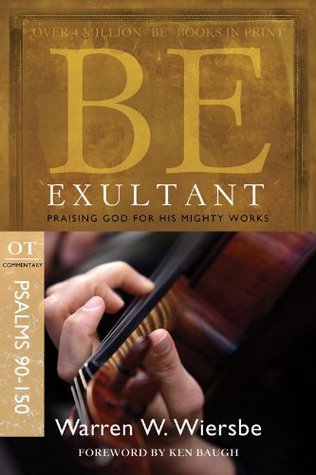
Since Psalms is the longest book of the Bible at 150 chapters, Wiersbe divided his commentary on the book into two parts. I reviewed the first one here: Be Worshipful (Psalms 1-89): Glorifying God for Who He Is. The second is Be Exultant (Psalms 90-150): Praising God for His Mighty Works.

As I said in the earlier review, the book of Psalms is Israel’s songbook. The passages cover Israel’s history from creation to the latest happenings of the day, their return after being exiled in Babylon for seventy years.

Though David wrote a majority of the psalms, various other authors contributed as well.

The writers composed in caves, in hiding, in their rooms, under persecution, in celebration.

Many of the psalms are deeply personal, yet benefit the whole congregation.

The psalms are deeply doctrinal, some prophesying of the Messiah to come, many quoted in the New Testament.

But many people value the psalms most for their wide range of emotion, from the highest praise and exaltation to the lowest depths of misery. The psalms give us many examples of someone pouring out their heart to God in confusion, sorrow, pain, or guilt, then reminding themselves of what they know to be true about God.

Here are some of the quotes from Wiersbe’s book that most stood out to me:

Life is brief, so Moses prayed, “Teach us.” Life is difficult, and he prayed, “Satisfy us.” His work at times seemed futile, so he prayed, “Establish the work of our hands.” God answered those prayers for Moses, and He will answer them for us. The future is your friend when Jesus is your Savior and Lord (p. 25, Kindle version).

It is better to suffer in the will of God than to invite trouble by disobeying God’s will (1 Peter 2: 18–25) (p. 26).

This hidden life of worship and communion makes possible the public life of obedience and service (p. 26).

To rely on our faith is to put faith in faith, but to rely on God’s faithfulness is to put faith in the Lord. Our assurance is in the Word of God and the God of the Word (p. 102).

The Word of God performs many wonderful ministries in the life of the devoted believer. It keeps us clean (v. 9), gives us joy (vv. 14, 111, 162), guides us (vv. 24, 33–35, 105), and establishes our values (vv. 11, 37, 72, 103, 127, 148, 162). The Word helps us to pray effectively (v. 58) and gives us hope (v. 49) and peace (v. 165) and freedom (vv. 45, 133) (p. 110).

What a precious treasure is the Word of God (vv. 14, 72, 127, 162; 61: 5)! It is like a deep mine filled with gold, silver, and precious gems, and we must take time to “dig” for these treasures (Prov. 2: 1–9; 3: 13–15; 8: 10–11; 1 Cor. 3: 9–23). A mere surface reading of Scripture will not put spiritual treasure into our hearts. Mining treasure is hard work, but it is joyful work when we “mine” the Bible, as the Spirit guides us into truth. Then, the Spirit helps us to “mint” the treasure so we can invest it in our lives (obedience) and in the lives of others (witness) (p. 131).

Wrong ideas about God will ultimately lead to wrong ideas about who we are and what we should do, and this leads to a wrong life on the wrong path toward the wrong destiny
(p. 193).

I’m thankful once again for Dr. Wiersbe’s insights.

Review: Be Worshipful

Be Worshipful by Wiersbe on Psalms

Psalms is the longest book of the Bible at 150 chapters, so Warren Wiersbe divided his commentaries on the Psalms into two books. The first is Be Worshipful (Psalms 1-89): Glorifying God for Who He Is.

“The book of Psalms has been and still is the irreplaceable devotional guide, prayer book, and hymnal of the people of God,” (p. 15). About one-third of the psalms don’t list an author, but King David wrote the majority of the others. The sons of Korah, Asaph, Solomon, Ethan, and Moses wrote others. All, however, wrote under the inspiration of the Holy Spirit.

Except for Moses’ psalm, the rest span the time of King David through the divided kingdom and Israel’s exile into Babylon.

“Some of the psalms are laments to the Lord, written by people in dire circumstances. There are also messianic psalms that point forward to the Lord Jesus Christ. There are also psalms of praise and thanksgiving, royal psalms, wisdom psalms, psalms of affirmation and trust, penitential psalms, and even imprecatory psalms calling down God’s wrath on the enemy” (p. 16).

The psalms’ poetry is not rhyming and rhythmic like English poetry. Hebrew poetry expresses itself in parallel lines. The second line of a pair might say the same as the first differently, or contrast with the first, or expand on the first. But the psalms uses similar literary devices as our poetry: simile, metaphor, imagery, symbolism, synecdoche (referring to one part to represent the whole, like keeping hands clean representing keeping one’s life clean), hyperbole, apostrophe (addressing a thing as if it were a person, like Wisdom), anthropomorphism, and others.

“There are over four hundred quotations or allusions to the psalms in the New Testament” (p. 16).

The psalms cover a lot of different subjects. “But primarily, the Psalms are about God and His relationship to His creation, the nations of the world, Israel, and His believing people” (p. 16).

“The psalms teach us to seek God with a whole heart, to tell Him the truth and tell Him everything, and to worship Him because of who He is, not just because of what He gives. They show us how to accept trials and turn them into triumphs, and when we’ve failed, they show us how to repent and receive God’s gracious forgiveness. The God described in the book of Psalms is both transcendent and immanent, far above us and yet personally with us in our pilgrim journey. He is ‘God Most High’ and ‘Immanuel—God with us'” (p. 18).

Wiersbe writes a few pages of comments on each psalm, explaining, drawing out truth, sharing insights. He includes discussion questions at the end of the book.

Many of the comments I have highlighted refer to specific contexts of psalms that would be impossible to explain without sharing all of Wiersbe’s comments on that particular section. But here are a few general comments I found helpful:

Those who have problems with the military aspects of some of David’s psalms should remember that David went to war only when the enemy attacked Israel. He did not invade other nations just to gain territory, and he was fighting the Lord’s battles (1 Sam. 17:47; 25: 28; 2 Chron. 20:15). The covenant God made with David (2 Sam. 7:11) assured him of victory over his enemies (p. 85).

Though David occasionally fell, as we all do, the habitual bent of his life was toward the Lord and His Word (p. 106).

The secret of David’s public confidence was his private obedience: He took time to fellowship with the Lord and get directions from Him. David knew that the most important part of his life was the part that only God could see, and this was one priority he would not negotiate” (p. 108).

David tried to “cover” his sins, but his schemes didn’t work. They never do (Prov. 28: 13), but when God covers the sins we confess to Him, they are hidden from sight and never seen again. (See Isa. 38:17; 43:25; 44:22; Jer. 31:34; 1 John 1:7–9.) (p. 121).

Chastening isn’t a judge punishing a criminal; it’s a loving Father dealing with His disobedient children to bring them willingly to the place of surrender. According to Hebrews 12:1–13, God’s chastening is proof that He loves us and that we are genuinely His children (p. 122).

[Re David praying against enemies} This was not a personal vendetta on David’s part, but a concern for the future of the nation of Israel and the dynasty of David. As ruler of the land, David wielded the sword of justice (Rom. 13:1–4), and nations today punish treason with death (p. 152).

The greatest danger a nation faces is not the invading enemy on the outside but the eroding enemy on the inside—a people gradually turning away from the faith of their fathers. Each generation must pass along to the next generation who the Lord is, what He has done, and what they must do in response to His goodness and faithfulness (71:18; 78:4, 6; 79:13; 109:13; 145:4; 2 Tim. 2:2) (p. 178).

It is our regular worship that prepares us for the crisis experiences of life (p. 207).

The psalms are not just emotional: they are full of truth and doctrine. Yet I love that the psalms show the writers’ hearts as they wrestle with problems, unanswered prayer, confusion, God’s seeming distance. Most of the psalms of lament end with the psalmist reminding himself the truth he knows about God and restoring his hope and confidence. And who can beat the praise psalms for lifting one’s heart in thanksgiving and worship.

The Bible tells us to study God’s Word, not just read it casually. Yet it’s possible to go too far the other way and examine a passage’s pieces, losing the main message or emphasis. I had to wrestle with this since I was using both the ESV Study Bible notes as well as Wiersbe’s commentary. Both were beneficial, but sometimes I left a passage with my head swimming. It helped to go back and read the passage again as a unit and as poetry after reading the comments and notes.

I appreciated the help Wiersbe’s commentary was to understanding and gaining more from the psalms.

Laudable Linkage

Here are some of the good reads found this week:

The Myth of a Balanced Life. “Are we looking for some perfect equilibrium—the precisely right amount of sleep, exercise, and time with family, work, and church? And if we found that perfect formula, is that then supposed to become the norm for every day of the week? What about when you have kids? What about when you’re traveling? What about the weekend?” I appreciate the better perspective presented here.

Is There a Danger of Worshiping the Bible Instead of God? HT to Challies. “I agree that there is a danger of having our faith in the wrong object. And there have been some people who seemingly hold the Bible in higher esteem than they do Jesus. But seen properly, the Bible is not a competitor with God; on the contrary, it is our God-given means of knowing Him through His revealed truth.

A Pastor’s Journey with Anxiety, HT to Challies. A pastor shares his own experience, what he has learned, and shares how to walk alongside others who are struggling.

The Psalms: A Tool for Cultivating Godly Emotions, HT to Knowable Word. “The Psalms not only help us know what we can say in prayer (often one of our biggest struggles), they help us know what to feel. They . . . share all shades of human emotion from deepest despair to exuberant praise. We find saints processing the good and bad of life in a godly way. Reading and praying the Psalms takes us into their emotional world, how they wrestled with God and eventually found hope.”

When the Sermon Fizzles Instead of Sizzles. It may or may not be the pastor’s fault. It may be ours.

Becoming Writers Who Write the Truth Beautifully, HT to Challies. “To be published doesn’t mean you’re a good writer. There are many books out there; some contain the most beautifully written heresies while others contain solid truths slapped together with cringe-worthy analogies and dense, dry paragraphs. As believers, we want to be not just published writers but good writers. Someone who brings truth and beauty together in the written word.”

Beautiful Hand-Painted Bookmarks, HT to the Story Warren. This touched my heart. A 100-year-old housebound woman has found a unique way to share God’s love with others.

A Confession of Praise

A study Bible footnote unexpectedly intersected with thoughts about Thanksgiving.

I’m not a Hebrew scholar by any means. But the ESV Study Bible noted that the Hebrew word todah could be translated as “make confession” or “give thanks or praise,” depending on the context. The footnote goes on to say, “Some overlap of these meanings is not surprising because rightful confession is itself a kind of worship of God” (p. 820).

We don’t usually connect confession of sin with worship and praise, but the one does lead to the other, doesn’t it? Once we’ve confessed sin to the Lord and rested in His grace and forgiveness, we overflow with joy and thankfulness.

“Blessed is the one whose transgression is forgiven, whose sin is covered. Blessed is the man against whom the Lord counts no iniquity, and in whose spirit there is no deceit” (Psalm 32:1-2).

But I began to wonder at another connection.

I was taught that confession of sin means saying the same thing God says about it. In other words, we don’t downplay our sin. We’re honest about it. We don’t say, “Oh, I just told a little fib.” No, to adequately confess sin, we have to call it what it is and own up to it: “I lied.”

So I wonder if giving thanks or praise carries that same connotation. When we praise God, we’re agreeing with what He says about Himself. It’s not that He needs the affirmation, but we need to recognize Him for who He is. And when we do, we can’t help but praise Him. And the more we behold Him, the more our cares and concerns melt away, because we remind ourselves He is more than able to handle any need we have.

Confessing also seems to carry the connotation of personal experience. I might share or rejoice in what God has done in someone else’s life. But if I am confessing, whether it’s sin or praise, I’m sharing what God has done in my life.

In Psalm 95:2, todah is the word translated thanksgiving: “Let us come into his presence with thanksgiving; let us make a joyful noise to him with songs of praise!”

Many of the psalms combine confession of sin, thankfulness for God’s grace, amazement at His greatness, and confession of His people’s personal experience of His provision, protection.

Psalm 145 is a beautiful example of this. Part of it says:

One generation shall commend your works to another,
    and shall declare your mighty acts.
On the glorious splendor of your majesty,
    and on your wondrous works, I will meditate.
They shall speak of the might of your awesome deeds,
    and I will declare your greatness.
They shall pour forth the fame of your abundant goodness
    and shall sing aloud of your righteousness.

The Lord is gracious and merciful,
    slow to anger and abounding in steadfast love.
The Lord is good to all,
    and his mercy is over all that he has made.

10 All your works shall give thanks to you, O Lord,
    and all your saints shall bless you!
11 They shall speak of the glory of your kingdom
    and tell of your power,
12 to make known to the children of man your mighty deeds,
    and the glorious splendor of your kingdom.
13 Your kingdom is an everlasting kingdom,
    and your dominion endures throughout all generations.

Psalm 65 does as well:

Praise is due to you, O God, in Zion,
    and to you shall vows be performed.
O you who hear prayer,
    to you shall all flesh come.
When iniquities prevail against me,
    you atone for our transgressions.
Blessed is the one you choose and bring near,
    to dwell in your courts!
We shall be satisfied with the goodness of your house,
    the holiness of your temple!

These thoughts brought to mind Ron and Shelly Hamilton’s song, “Worthy of Praise”:

My heart overflows with praise to the Lord
I will lift up my voice to the King
He brought me out of the pit of despair
And taught my heart to sing


Worthy of all my praise
You are worthy of all my praise
I bow at Your throne
And I worship You alone
Lord You are worthy
Worthy of praise

I wish you all a wonderful Thanksgiving filled with food, family, and praise for Him who is worthy.

(I often link up with some of these bloggers.)

Laudable Linkage

Our hearts go out to those in Uvalde, TX, with the recent mass shooting there. Our hearts are heavy with the sorrow and senselessness of it. I appreciated what Susanne had to say at the beginning of her Friday’s Fave Five this week. A couple of other posts that I found helpful:

Uvalde, HT to The Story Warren. “In these moments, everyone is searching for answers. Everyone wants to figure out something to do, something that will somehow stop the hurting. We try to find meaning in the unimaginable, try to make sense of an atrocious act. Can I offer some advice? If you know these families–or anyone facing grief–you don’t have to offer answers. You don’t have to come up with reasons. You don’t have to try to find the silver lining or the lesson to be learned. Don’t turn their tragedy into a talking point or something political. Instead, just sit with them in their grief.”

When Violence Touches a Child’s Life, HT to Challies. “Rather than react out of fear, we must help our kids by demonstrating an appropriate level of sobriety and sorrow by such events, while exhibiting that our hope is in Christ. The challenge is to find the right balance—teaching young people awareness and caution while equally encouraging trust in a sovereign God.

Here are some of the other good reads found online recently:

Abiding in Christ: A Practical Description. “The word abide is a simple term. It means to remain, stay, or dwell. To abide is to continue in the same place for some stretch of time. The meaning is uncomplicated, but how does a believer abide in a Person?”

Bend Me Toward the Light, HT to Challies. “Written into creation is God’s plan for growth. Sunlight is essential, as is water. When our plants die, it’s often because of lack of light or moisture. So, if one of those things is less accessible than it should be, a plant will lean toward what it needs. We humans, on the other hand, will bend toward whatever gives us the most pleasure, physical comfort, and approval, no matter how it affects our health and growth.”

The Psalms Know What You Feel, HT to The Story Warren. “The psalms, however, are not a simple chorus repeated over and over again, but a symphony, filled with as many experiences and emotions as humans endure and feel. The five books that make up Psalms really are a master class in human adversity.”

Loving With a Limp, HT to Challies. “But should that surprise us? That God would inflict hurt to bring healing? Many will not imagine, nor accept, a God who could act this way. But he does, and he remains good. Even as he wrenched Jacob’s hip, even as muscle and fibre tore in ways that would never recover, God was healing a heart that was hard and deceitful, crafting through the pain and discomfort that became Jacob’s constant companion, a man that would birth a nation, and even the Messiah.”

How to Spot a Wolf, HT to Challies. “The Bible commands Christians, ‘Have confidence in your leaders and submit to their authority, because they keep watch over you as those who must give an account’ (Heb. 13:17, NIV). But God’s Word also tells of times when we shouldn’t trust and submit to leaders. What are the circumstances when honoring God means disobeying, fleeing, or even calling out those who minister in his name?”

What’s the Best Bible for Me? “Are you about to head to the bookstore (or, more likely, your laptop) to buy a Bible? The process may overwhelm you if you’re not prepared because choosing one has never been more complicated. We have more options but fewer bookstores where we can hold a Bible and flip through its pages. I’d love to help you take out some of the guesswork so you can make your decision based on more than a pretty cover.”

A Call to Raise Daughters Who Are Wise to Domestic Abuse, HT to Challies. “Abuse is easy to discern when it looks like something everyone knows is bad—a close-fisted punch, a shove down a stairwell, a locked closet. Abuse is much harder to discern when it looks similar to something good—like assertive leadership, exclusive affection, or clear direction.”

Expectations, HT to The Story Warren. “I heard an excerpt from a Christian podcast a few days ago and it hit me wrong. Two women were talking and one said something along the lines of, ‘I wish I had lowered my expectations for my children.’ She went on to explain how that was the better, more loving thing to do–how we should make it a point to welcome people just as they are and reassure them that however they show up is good enough. I call bull (sorry if you think that’s too blunt).”

The Hidden Danger of Productivity Systems. “When we learn to depend on our ways to getting things done and accomplishing our goals, we cease to rely on God. We believe that our systems can make us successful, rather than God Himself. And if we happen to achieve success, we run the risk of becoming complacent.”

Art Fan: How to Cheer Kids On to Creative New Heights. “Performing arts like dance, music, and theater do provide athletic-like opportunities to fill theater seats and shout Bravo!, but recitals, concerts, and performances tend to come around far less often than sporting events. Then there are art forms like painting, photography, or poetry that don’t readily provide fans with stand-up-and-cheer type opportunities.” One family came up with ways to encourage their children’s artistic endeavors.