Book Review: Dear Mr. Knightley

Dear Mr KnightleyThe cover and title of Dear Mr. Knightley almost makes you think it will be a cute modern takeoff of Jane Austen’s Emma. But it’s far from that, and, oh my, so rich on so many levels.

Samantha Moore (known as Sam) has spent most of her life in the foster care system. Because of her past and being so often moved about, she finds it hard to relate to people: to protect herself from being hurt she hides her true self. She confesses, “I let go of people and relationships to protect myself, and then I detached so completely that I lost the ability to relate.” At one foster care home she discovered classic books. She became fast friends with Jane Eyre and loved the “safe, ordered, and confined” world of Jane Austen. Classic books became her refuge, and in many cases she responds to people by quoting them, thus hiding her real self.

When presented with the opportunity to receive a grant to go to graduate school, she decides to take it. One unusual stipulation is that the grantor wants to receive “personal progress letters” from her on a regular basis. To preserve his anonymity and give her more freedom to express herself, he goes by the pseudonym George Knightley. Sam accepts the conditions and finds school much harder than she thought and trying to open up and relate to people even harder. He letters to Mr. Knightley become “one-sided soul purgings,” made possible because of the anonymity and because she is sure they will never actually meet.

Much of the book unfolds her growth as a person and in her relationships, including one with a young hostile 14 year old who comes to the group home where she lives and with a couple of new friends at school. When she (literally) runs into her favorite contemporary author, who is speaking at a class in her school, she introduces herself and is invited to coffee, and so starts a tentative friendship with him. But just when she is learning to trust, will a betrayal set her back?

I don’t want to say much more about the plot than that, but I loved watching Sam’s growth. A quick glance at some reviews at Amazon and Goodreads showed that some readers thought she was “a jerk” and didn’t like her. But that’s the whole point: she comes across that way (not in her letters, but to her potential friends) in the “I’m going to drive you away before you drive me away” stance that many people who have been deeply wounded take to protect themselves. Watching the ups and downs of her beginning to realize how she’s been coming across, open up, take risks, learn to trust was full of pathos. Similarly, her naivete, which some criticized, was, I thought, quite understandable since she hadn’t been in any kind of a setting where people tried to teach her about life, the world, and relationships until she came to Grace House, a group home, as a teenager. She eventually learns that “self-protection keeps you from love.”

I also loved the multitude of classic book references and quotes, not only from Austen and Bronte, but also Dickens, Dantes (The Count of Monte Cristo), L. M. Montgomery, and C. S. Lewis. I especially liked a passage where Sam reads about Eustace becoming a dragon in The Voyage of the Dawn Treader and realizes her own dragonish tendencies and her need to be delivered from them. Sam (and Reay) loves many of the same books I do. We became friends when she wrote that “George Knightly is a good and honorable man – even better than Fitzwilliam Darcy, and few women put anyone above Mr. Darcy. Yes, Darcy’s got the tempestuous masculinity and brooding looks, but Knightley is a kinder, softer man with no pretense or dissimulation. Yes, he’s a gentleman. And I can write with candor to a silent gentleman, and I can believe that he will not violate this trust.” Yes! I’ve always liked Knightley better than Darcy.

I appreciated the way the faith element was brought in very naturally. Sam isn’t open to it at first because she thinks “He doesn’t pay attention to me. But…I want to badly to believe that God cares, that all of this matters to Him, that all this pain has a purpose and that none of it tarnishes me forever.” After her encounter with a couple who show her Christ’s love, who “drop hints and hope like bread crumbs for me to follow,” she writes, “How can I not believe that there is a God who exists and loves, when the people before me are infused with that love and pour it out daily? I still can’t grasp that it’s for me, but what if it is?”

I’m normally not a fan of epistolary novels, because not many people really write letters at all these days, much less letters full of plot points and dialogue, but I could easily set that aside and just get into the story and its telling in this way. Even though I think such letters are still probably unrealistic, the style fit this story well. This is the first novel I have been this wrapped up in in a long time, eagerly looking for ways to get in more reading throughout the day (the Kindle app on the phone is nice for that: it’s a little harder to read on a small screen but handy if you find yourself with a few minutes to spare here and there).

I had gotten this book when it was either free or very inexpensive for the Kindle app, and then had forgotten about it. I’m thankful the Austen in August reading challenge reminded me it was there. Katherine Reay is a favorite new author. This is her first novel, and I eagerly await more.

Austen in August

(This will also be linked to Semicolon‘s Saturday Review of Books.)

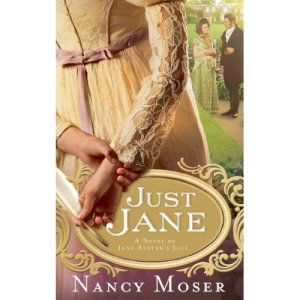
Book Review: Just Jane

Just JaneJust Jane: A Novel of Jane Austen’s Life by Nancy Moser caught my eye when it came through as free or inexpensive for the Kindle app because I so enjoyed How Do I Love Thee?, her novelization of Elizabeth Barrett Browning’s life.

The novel is written from Jane’s point of view beginning when she is in her early twenties. She’s the seventh of eight children, the youngest of two girls. She enjoys writing and her family enjoys hearing her stories, but there doesn’t seem to be much thought of publishing yet. She has had some encounters with a Tom Lefroy to the point where she believes they have an understanding. While he is away at law school she cherishes hopes of their coming union. But, if you know her life story, you know she never hears from Tom and he marries someone else.

She continues at home doing all the things a single woman in the 1800s would do, with the addition of writing, until her family moves to Bath. She not only doesn’t want to go, but she is furious that the decision was made without even consulting her. She has lived in the rural village of Steventon all her life and hates Bath. She has no choice but to move with her family, but she does not write during the years they live there.

Though she has another romantic encounter or two, she never marries. When her family moves again to more commodious accommodations, she is inspired to pick up her pen again. Her first novel is rejected, which may be an additional reason she stops writing for a while, but eventually, as the world knows, she is finally published. She writes anonymously at first but eventually her secret comes out.

The book ends some years before her death, but the author provides a postscript with details of her remaining years. I much appreciated a section at the back where Moser tells what is fact and fiction in the book. Unfortunately, many of Jane’s letters were destroyed, and though Moser drew from them and even seamlessly wove some into the story, she had to fill in the best she could with what she knew.

I thought I would really like this book since I liked the earlier book of Moser’s and since I generally enjoy Austen’s books. I didn’t dislike it per se, I just didn’t love it as much as I thought I would. Sometimes when you approach a book with high expectations it makes it especially hard for it to live up to them. I felt there was too much information about her family: by the time she’s in her mid-twenties, most of her brothers have either already married or are getting married, and the drama of their relationships wasn’t really what I was reading the book for. Then again, I’m sure she and her parents and sister would have been involved and interested, so it was definitely a part of her life and I can understand its inclusion. I missed her humor: some of her writing has been described as “biting satire” (some of the “bite” goes a little too far for me sometimes),  but some of it has a lighter touch. I just finished listening to Northhanger Abbey and loved some of the humorous interchanges with Henry especially (also the name of her favorite brother) and the way she subtly gets across to the reader some of the things naive Catherine Morland misses in her first foray away from home. I also thought she came across as somewhat negative (downright grouchy sometimes), but near the end she did say that she wrestled with discontentment and was guilty of “the unforgivable act of complaining. For what good comes from that particular vice – for the complainer or her unlucky listener?” Moser says in her afterword that Jane was “witty, wise, discerning, creative, loyal. She was also stubborn, judgmental, insecure, and needy. She was…a lot like us.” She did learn along the way that she could “wallow in unhappiness or make a determined choice to leave it behind and move forward. Life is not fair – nor often understandable. But it is ours to live to the best of our ability.”

I did empathize with what seemed to be an inclination towards introversion: though she loved visiting family and having them visit, there were times she declined certain activities because she just needed some time alone. She “embraces silence and solitude.” Though she attended balls in her younger years, she seemed to be more of a homebody later on.

So…upon reflection I guess I did appreciate more from it than I thought. 🙂 That’s one thing reviews are good for – going back over the story and trying to put it all into perspective. I did enjoy her more at the end of the book than at the beginning or middle and appreciated what she learned about contentment and life and finding one’s place.

And I loved the cover!

One last note that I especially liked: when one reviewer seems to portray Jane’s work as “educational,” she says, “I didn’t mean for it to be educational…at least not with any conscious intent.” Her sister Cassandra replies, “Your stories portray true life. In that there is always education.” Amen to that. I think that’s what resonates with us in the books that most appeal to us, no matter the setting: when they depict something of real life and touch our hearts with truth.

Linking to the Austen in August challenge:

Austen in August

(This will also be linked to Semicolon‘s Saturday Review of Books.)
 

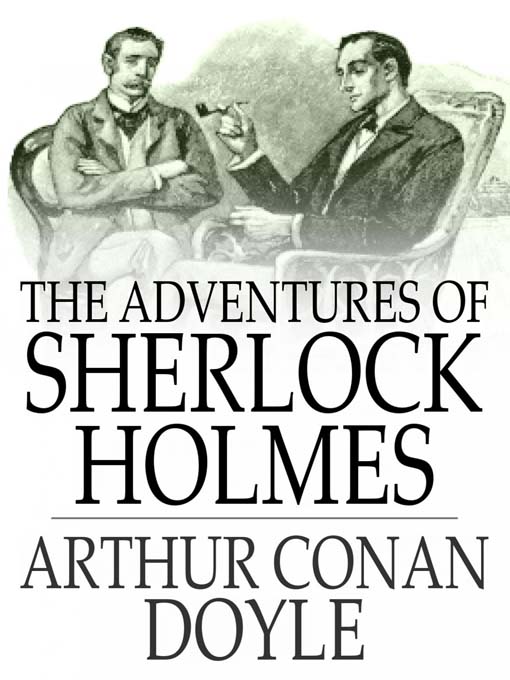
Book Review: The Adventures of Sherlock Holmes

Adventures of Sherlock HolmesThe Adventures of Sherlock Holmes by Sir Arthur Conan Doyle is a collection of short stories published after the first two novels. All were originally published in magazines. I’m not a great fan of short stories, but it was a nice break to have each case end with the chapter rather than having novel-long plots and twists and characters to keep up with. I enjoyed the audiobook read very nicely by actor Derek Jacobi.

The format of the stories is much the same as the novels. The ones in this volume are not told in chronological order: some occured while Watson still lived with Homes, others occured after Watson married. At the beginning of many of them Watson explained why he chose to chronicle that particular case out of the many Holmes had solved. Though there are similar characteristics in each story, Doyle did an excellent job in keeping them from becoming formulaic and predictable. Some involve the police, some don’t. In a few Holmes let the perpetrator go for various reasons (in one, the man did not have long to live; another involved a young man whom Holmes thought would go right after the scare of almost getting into big trouble). Some involved a crime that had already been done, some involved a crime that had yet to be committed, some involved other mysteries.

This book contains twelve stories: probably the most notable is “A Scandal in Bohemia” for the mention of Irene Adler. Some portrayals of this story of Holmes cast her as a love interest, but in this story she is not that. He admires her wit, which rivals his own, and the fact that she is one of very few people who have ever outsmarted him. In fact, Watson says,

It was not that he felt any emotion akin to love for Irene Adler. All emotions, and that one particularly, were abhorrent to his cold, precise but admirably balanced mind. He was, I take it, the most perfect reasoning and observing machine that the world has seen, but as a lover he would have placed himself in a false position. He never spoke of the softer passions, save with a gibe and a sneer. They were admirable things for the observer — excellent for drawing the veil from men’s motives and actions. But for the trained reasoner to admit such intrusions into his own delicate and finely adjusted temperament was to introduce a distracting factor which might throw a doubt upon all his mental results. Grit in a sensitive instrument, or a crack in one of his own high-power lenses, would not be more disturbing than a strong emotion in a nature such as his.

I thought it interesting, after wondering aloud in my review of The Sign of Four whether a genius in one area has to be unbalanced in others, that Watson says Holmes has a “precise but admirably balanced mind” while explaining that emotions were “abhorrent” to him — which seems a little unbalanced to me. 🙂

I enjoyed more unfolding of Holmes’ personality. Some accounts I’ve read cast him as manic-depressive or autistic, but I think (at least so far) that he was just a classic introvert. He claims Watson as his only actual friend, spends a great deal of time alone and thinking, but can be genial and even soothing when he needs to be. Some modern versions also portray him as rude, but in these first three books I haven’t seen that, at least that I can remember.

I’m glad that more modern versions of Holmes’ stories cast Watson as a strong character rather than a doddering old man who is only along as a sidekick. He is a skilled doctor and apparently handy with a revolver (from his army days) since Holmes asks him to bring it along for particularly dangerous cases.

I’m trying to read the Holmes stories in publication order, and the next is another collection of short stories, The Memoirs of Sherlock Holmes. I may skip ahead to The Hound of the Baskervilles, which I’ve been particularly wanting to get to. I don’t think the reader will lose anything by reading them in any order: I just wanted to partake of them as the general public would have at first in order to see how they unfold. But I’ll put off that decision for a little while in order to take a break from Holmes to participate in the Austen in August challenge.

(This will also be linked to Semicolon‘s Saturday Review of Books.)
Austen in August Challenge

Austen in August

I just saw yesterday, while perusing the What’s on Your Nightstand posts, that Lost Generation Reader is sponsoring an Austen in August reading challenge (HT to Bluerose). As the name indicates, the idea is to read something by or about Jane Austen during the month of August. Since I’ve already started Just Jane, a novelization of her life by Nancy Moser, I’m delighted to be able to jump in without straining much from the other challenges I am participating in this year. I’ll also listen to Northhanger Abbey via audiobook. I have more Austen books both on hand and in my audiobook library, so after I finish these two I’ll decide if I want to add any more.

What’s On Your Nightstand: July 2014

What's On Your NightstandThe folks at 5 Minutes For Books host What’s On Your Nightstand? the fourth Tuesday of each month in which we can share about the books we have been reading and/or plan to read.

Ack! This is one of those early 4th Tuesdays that snuck up on me! I didn’t realize it was a Nightstand Tuesday until seeing others in my feed reader. Here goes:

Since last time I have completed:

The Knowledge of the Holy by A. W. Tozer, reviewed here.

Women of the Word by Jen Wilkin, reviewed here, easily one of my top ten books of the year.

How to Read Slowly: Reading for Comprehension by James W. Sire, reviewed here.

The Sign of the Four by Sir Arthur Conan Doyle, second of the Sherlock Homes novels, via audiobook, reviewed here.

The Book of Three by Alexander Lloyd, first book in the Prydain Chronicles, reviewed here.

I will Repay by Baroness Orzcy, part of The Scarlet Pimpernel series, via audiobook primarily, reviewed here.

I’m currently reading:

Just Jane: A Novel of Jane Austen’s Life by Nancy Moser

On Stories by C. S. Lewis

Gospel Meditations for the Hurting by Chris Anderson and Joe Tyrpak

The Adventures of Sherlock Holmes by Sir Arthur Conan Doyle, audiobook.

Next up:

Why We Are Not Emergent: By Two Guys Who Should Be by Kevin DeYoung, Ted Kluck, and David F. Wells. This will finish my TBR Challenge list. Woot! Unless I do the alternates, which I’d like to do, but I’m going to take a break from this list and read some other things that have stacked up in the meantime.

Undetected by Dee Henderson

I also did a fun little A-Z Bookish Questionnaire if you’d like to look in or maybe try it yourself.

Happy reading!

Book Review: How to Read Slowly

How to Read SlowlyI don’t remember how the book How to Read Slowly: Reading For Comprehension by James W. Sire first came to my attention, but it caught my eye when it did. I didn’t want to change my reading speed necessarily, but I did want to learn how to retain more from what I read, especially non-fiction (stories seem to stay with me longer and better with less effort). Even with marking quotes, using sticky tabs to mark the most important passages, and sometimes even outlining the chapters, I still tend to forget a great deal. Even though this was a book about comprehension rather than retention, I figured the one would aid the other.

I had not known Sire was a Christian when I bought the book, but right at the beginning he states that though this book would be beneficial to any reader, he primarily wanted to encourage “Christians to think and read well. Christians, of all people, should reflect the mind of their Maker. Learning to read well is a step toward loving God with your mind. It is a leap toward thinking God’s thoughts after Him” (p. 12). To which I say a hearty “Amen!”

With both instruction and example, Sire shows how to detect an author’s world view, how to read “between the lines” while not “inventing or imagining what is not really there” (p. 42),  how to “track the flow” of author’s argument or reasoning process. He has a whole chapter on poetry, another on reading fiction, another on reading in context (not imprinting our current way of thinking on older books, but understanding the context in which they were written). He gives tips for how to read, what to look for, what to mark, and encourages a lot of rereading. He talks about the difference between reading nonfiction and imaginative literature.

Here are some quotes that stood out to me:

What is the primary reason for reading poetry or any imaginative literature? Beyond all psychologizing as to real or apparent motives, we read literature because we enjoy it — and we enjoy it because we are grabbed by it, our attention is arrested. We say, “Aha! Yes, that’s how it is.”

In great literature — poetry and fiction — we see ourselves, our friends, our enemies, the world around us. We see our interests portrayed in bold relief — our questions asked better than we can ask them, our problems pictured better than we can picture them by ourselves, our fantasies realized beyond our fondest dreams, our fears confirmed in horrors more horrible than our nightmares, our hopes fulfilled past our ability to yearn or desire. In literature we catch reality in a mirror…

Life is short, but art is long. Sophocles is dead, but Oedipus lives on…Each of us when we read a great piece of literature is a little more human than before (pp 58-59).

Well-wrought poems and works of imaginative literature can do for us what stone-cold prose can never do. They can help us grasp the full dimension of ways of life other than our own (p. 86).

Our ability to read well depends to a large degree on just how clearly we understand ourselves and how much we realize ours is not the only way to look at reality….I am not saying we ought not to disagree with anything we read. Indeed not. We must disagree if the thrust is in opposition to what we take — after reflection, study, and prayer — to be the truth. But we must also be sure that we have “heard” the other person as he or she wishes to be heard (p. 141).

We have more to fear from naivete with regard to error than we do from clear knowledge of error that we recognize as error….A knowledge of the truth is the best defense against error (p. 146).

One thing the Bible does not do: it does not denigrate the mind. The Bible is not anti-intellectual. Rather it gives the reason why all of us know what we know, why we can think with some degree of accuracy, and why we fail to think with complete accuracy (p. 148).

Every avid reader struggles with the sheer amount of good books on our shelves that we haven’t gotten to as well as the ones we see in stores or online or recommended by friends. Sire says, “We will never catch up. But we can get on with it…Reading does get done. The point is to start and then to read well. How far we get, how many books we read, must not become the issue” (p. 155).

I don’t know if I would say that I enjoyed the book – it’s not something I’d pick up for fun. But I did benefit from it. It feels a little like high school or college English class in some places (not surprisingly, Sire taught English literature and philosophy at various colleges), but I liked classroom English, so I didn’t mind that aspect of the book. The section on the mechanics of poetry got a little technical for me (I had not known, or else had forgotten, what a spondee was), but I appreciate his illustration that even the meter and rhythm of a poem illustrate its message. I just don’t know how many people are seriously going to count syllables and abab cdcd the rhyming lines outside of a classroom unless they’re really into poetry. But that’s the only part that went a little overboard (for me. Someone else may have found it fascinating). This is a book I would highly recommend for anyone interested in the subject.

(This will also be linked to Semicolon‘s Saturday Review of Books.)

A-Z Bookish Questionnaire

booksflr

I saw this at Carrie‘s, who saw it at Amy‘s, and thought it looked like fun. All links behind book titles are to my reviews.

Author you’ve read the most books from: Probably Elisabeth Elliot.

Best sequel ever: I had to sit and think about this one for a long time. I don’t know if I’d say this is the best sequel ever, but I do like the sequels of the Mitford books, especially In This Mountain.  It’s not quite as light and cheery as the others, because Father Tim struggles with retirement, his wife’s fame while his work (and importance, so he thinks) seems to be declining, depression, and a serious setback with his diabetes. But I love how he works through it and comes out of it. Then again, I also like the sequels to the Narnia series, Little Women, the Little House books, Anne of Green Gables (especially the book of the first year of Anne’s marriage), and others.

Currently reading: Just Jane by Nancy Moser (a fictionalized account of Jane Austen’s life), How to Read Slowly by James W. Sire, Women of the Word by Jen Wilkens, and listening to The Adventures of Sherlock Holmes via audiobook.

Drink of choice while reading: Decaf coffee or Decaf Diet Coke.

E-reader or physical book? I prefer physical books, but now that I have gotten used to using the Kindle app for my iPad mini, I enjoy it, too. Can’t beat the free or inexpensive books for it – my library has grown exponentially.

Fictional character you probably would have actually dated in high school: Hmm. I don’t usually think of the characters I read about in that way, and so far I’m not coming up with anyone high school or college age that I would have been interested in back then. Except maybe Laurie in Little Women as played by Christian Bale in the film – though he really wasn’t my type.

Glad you gave this book a chance: The Woman in White by Wilkie Collins. I read descriptions about several of his books, but they just didn’t sound interesting to me. But when so many who read a different book of his for Carrie’s Classic Book Club loved it, I thought maybe I should give him a chance. Loved this and plan to read more in the future.

Hidden gem book: Five Little Peppers and How They Grew. It’s been a long time since I’ve read it and I probably should again, but it was rather a plain book that I didn’t know anything about when I started, but I loved it.

Just finished: I Will Repay by Baronness Orczy and The Knowledge of the Holy by A. W. Tozer.

Kinds of books you won’t read: Anything sexually explicit or with too much bad language, horror books, mysteries that are creepy or too scary.

Longest book you’ve read: Les Miserables by Victor Hugo. All 1440+ pages of the unabridged version.

Major book hangover because of: I’m not sure what a book hangover is supposed to be. If it means one that continues to impact or speak to you after you’ve read it, that would be the Bible.

Number of bookcases you own: 3 tall ones, 2 short ones, and I have at least 4 boxes of books in closets.

One book you have read multiple times. Oh, my. Many, for many reasons. If I had to choose just one….well, let’s make it one nonfiction and one fiction. 🙂 Fiction: Little Women – fun to read at different stages of life and see it through different characters. Nonfiction, besides the Bible: Through Gates of Splendor.

Preferred place to read: Sitting sideways on the couch in the family room.

Quote that you like, from a book you’ve read: Oh my, again. I usually have multiple quotes marked in every book. To go with a recent one: “I believe there is scarcely an error in doctrine or a failure in applying Christian ethics that cannot be traced finally to imperfect and ignoble thoughts about God,” A. W. Tozer in The Knowledge of the Holy.

Reading regret: The only book that comes to mind that I have regretted reading (I think that’s what this question is asking) is one that we picked up at a library visit when my kids were little. When my son asked about it, I just felt a check in my spirit about it, but we got it anyway. When I looked at it when we got home, it was a pretty awful (both in writing and in subject) New Age book encouraging kids to disobey and drop everything they’d ever believed, complete with a “spirit guide” coauthor who had his own afterword in the back. 😦 It did open up a discussion with the one son who had shown interest in it. The only others that just came to mind were some unsavory ones my dad had around the house in my preteen years (he was not a Christian at the time and I wasn’t yet, either). 😦 It pays to be careful what you read, because those things do come back to your mind.

Series you started and need to finish: The Mysterious Benedict Society, Sherlock Holmes (working on the latter.)

Three of your all-time favorite books: This is another hard one. I’m going to invoke my executive privilege as owner of this blog and name 3 nonfiction and 3 fiction. 🙂 Aside from the Bible and the ones I mentioned before as having read multiple times, By Searching by Isobel Kuhn, Climbing by Rosalind Goforth, Evidence Not Seen by Darlene Deibler Rose. For fiction: Jane Eyre, Les Miserables, and A Tale of Two Cities.

Unapologetic fangirl for: The Incorrigible Children of Ashton Place series, especially the audiobooks read by Katherine Kellgren. Clever writing, rollicking good fun, but not without some pathos. I hope, when the series ends and we finally find out how the children got left in the woods to be raised by wolves and what their connection is to some others in the story, that it’s not going to be something I’d have a problem with.

Very excited for this release more than all the others: Besides the next in the above-mentioned Ashton Place series (I don’t know when it might be), a new one in Jan Karon’s Mitford series due out in September: Somewhere Safe With Somebody Good.

Worst bookish habit: My husband would probably say buying and keeping too many books. 🙂 I honestly can’t think of one. I like to take good care of them. Unless it’s the urge to get ahead of the story, but I generally don’t like to read or skip ahead any more. I like to read it as it unfolds even if it drags a bit in places.

X marks the spot: If this means bookmarks, I tend to use just whatever scrap of paper is at hand, though I have some nice bookmarks in my desk drawer (I just don’t think to go get them). If it refers to marking quotes or points I want to remember, I use the little Post-it notes sticky tab strips. But I do mark my books with a pencil as well – most of them, anyway.

Your latest book purchase: Physical book: Women of the Word by Jen Wilkins; Kindle app: Hidden Places by Lynn Austin.

Zzz snatcher book: If this means a book that has kept me awake reading it – it has been a while since that happened. I tend to fall asleep if I read past bedtime. But the ones with the potential to are Dee Henderson’s books, the last one being Unspoken. I’ve got her newest one on my shelf but have been trying to save it as a reward after I finish some of my reading challenge lists.

Let me know if you do this, and I’ll come by and see what you have to say.

Book Review: I Will Repay

I Will RepayWhen I mentioned to someone that I liked The Scarlet Pimpernel, about an Englishman who disguised himself and rescued those slated for the guillotine during the French Revolution, this person (sadly, I’ve forgotten who) told me the author, Baroness Orczy, wrote several books about The Scarlet Pimpernel’s adventures and she really liked I Will Repay. So I put I Will Repay on my TBR list, and recently took advantage of its being free for the Kindle and only $2.99 at Audible.com (at the time of this writing) to get both and use their “Whispersync” connection to go back and forth between text and audio, depending on my circumstances.

The story begins with a heated argument between young Vicomte de Marny and the older Paul Déroulède. Between rage and too much to drink, de Marny insists on a duel. Déroulède easily wins the duel, but de Marny tries to fight further. When Déroulède puts up his sword to disarm him, de Marny charges at that moment right into Déroulède’s sword and dies.

The young man is carried home to his invalid father and 14 year old sister Juliette. They are told by the young man’s friends that he died “in fair fight,” but the father, described as “almost a dotard,” makes Juliette swear that she will somehow avenge her brother’s death. He adds to the oath the torment he says that her brother’s soul will undergo until she exacts her revenge (though, of course, in reality nothing we say or do after a person has died has an effect on the state of their soul). Juliette, grieving, young, and impressionable, agrees to this oath and lives under the weight of it for the next ten years.

By this time the French Revolution is well underway. Juliette’s father has died and Déroulède has become a favorite of the people, probably due to the bourgeois ancestry which had kept him from being fully accepted by the aristocracy despite his wealth. Juliette tricks her way into becoming a guest in his home, but it takes several weeks for a plan to come to mind to deal with him. In the meantime, she finds qualities about him that she likes, and he falls in love with her rather quickly. Thus she is torn between her feelings and her oath to her father on her dead brother’s body. “That awful oath, sworn so solemnly, had been her relentless tyrant; and her religion – a religion of superstition and of false ideals – had blinded her, and dragged her into crime.”

When I first started the book, I was a little dismayed because I’ve always thought the whole tradition of duels was rather silly, and I was afraid the ensuing romance would be fairly silly, too. However, I was greatly surprised by the depth of the novel as well as the unexpected twists and turns the plot took. I had an idea how the story would ultimately end up, but it didn’t go any of the routes I thought it would. This is one audiobook that I looked for ways to listen to beyond the usual, even carrying it around with me while I dusted.

In a conversation with Sir Percy Blakeney, aka the Scarlet Pimpernel, Déroulède describes Juliette as a saint and an angel and says he has fallen “madly, blindly, stupidly, hopelessly” in love. Sir Percy responds,

“And ’twill be when you understand that your idol has feet of clay that you’ll learn the real lesson of love,” said Blakeney earnestly.

“Is it love to worship a saint in heaven, whom you dare not touch, who hovers above you like a cloud, which floats away from you even as you gaze? To love is to feel one being in the world at one with us, our equal in sin as well as in virtue. To love, for us men, is to clasp one woman with our arms, feeling that she lives and breathes just as we do, suffers as we do, thinks with us, loves with us, and, above all, sins with us. Your mock saint who stands in a niche is not a woman if she have not suffered, still less a woman if she have not sinned. Fall
at the feet of your idol an you wish, but drag her down to your level after that – the only level she should ever reach, that of your heart.”

I disagree that you have to sin together to really be in love, but I do agree that a couple needs to understand that they’re both sinners and that they’ll need grace to live with one another, that true love happens when that happens, not when we’re in a state of near worship. And indeed, Déroulède finds later “She had ceased to be a saint or a madonna; she had fallen from her pedestal so low that he could not find the way to descend and grope after the fragments of his ideal.” What happens then I will leave for you to discover.

And even though this is not a religious book per se, it does contain spiritual truth when more than one character has to learn that “‘Vengeance!’ which is not for man…[is] God’s alone.”

All in all I really enjoyed this novel. I don’t know that I’ll seek out any more of the Scarlet Pimpernel’s adventures any time soon. I like a good swashbuckling adventure every now and then, but I don’t like to make a steady diet of them. Still, these books are as good a source as any of this kind of tale, so the next time I am in the mood for one, perhaps I’ll look up another in the series.

Some readers will want to know that the word “demmed” for “damned” occurs a handful of times.

The full text of I Will Repay can be found online through Project Gutenberg.

(This will also be linked to Semicolon‘s Saturday Review of Books.)
This also completes one of my selections for the  Back to the Classics Challenge hosted by Karen at Books and Chocolate.

classics2014

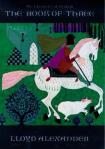
Book Review: The Book of Three

The Book of ThreeThe Prydain Chronicles by Alexander Lloyd are well-known children’s classics, but somehow I had never heard of them until the last few years. I saw them mentioned favorably at various blogs, so when I saw the first three books either on sale or free (I forget which) for the Kindle app, I got them.

The first in the five part series is The Book of Three. Young Taran lives with a retired soldier named Coll and an old “enchanter” named Dallben. He has ambitions to do great, heroic things, but in the meantime he is made Assistant Pig-Keeper. The pig he is charged with keeping is not just any old farm pig, however: this one, called Hen Wen, is a white oracular pig: she can tell prophesies and help information come to light. Taran fails at his first major responsibility when Hen Wen runs away. He sets out to find her even though he has been told not to leave the farm.

While searching for the pig, Taran is startled to see the dreaded Horned King, the champion of Arawn Death-Lord ride by with his soldiers. One throws a sword at him which wounds him, but not fatally. After running for his life and passing out, he awakens to find his wounds being treated by none other than Prince Gwydion in disguise.

Gwydion and Taran face unexpected battle and are captured. Taran escapes but is sure that Gwydion has died when the castle where they were held collapses. He decides he must go to warn the king of the advancing army of the Horned King. Along the way he is joined by a minor king named Fflewddur Fflam who is moonlighting as a bard and whose harp strings break whenever he stretches the truth, Princess Eilonwy, who talks a lot and has been learning magic, and Gurgi, sort of between man and beast who refers to himself in the third person and speaks in rhymes (“crunchings are munchings,” his reference to food,””sneakings and peekings,” “smackings and whackings,” etc.).

In his quest Taran has to come face to face with his own shortcomings and learn that heroism is not only not easy, but it isn’t always displayed in mighty public acts.

The books are somewhat loosely based on Welsh mythology (with which I am not familiar). The author grew to love the land and language of Wales when he was stationed there during WWII while in the army.

A few of the notable quotes from the book:

“Neither refuse to give help when it is needed,… nor refuse to accept it when it is offered.”

“It is not the trappings that make the prince, nor, indeed, the sword that makes the warrior.”

“I have studied the race of men. I have seen that alone you stand as weak reeds by a lake. You must learn to help yourselves, that is true; but you must also learn to help one another.”

I enjoyed some of the humor in the story, such as this exchange:

“By all means,” cried the bard, his eyes lighting up. “A Fflam to the rescue! Storm the castle! Carry it by assault! Batter down the gates!”

“There’s not much of it left to storm,” said Eilonwy.

“Oh?” said Fflewddur, with disappointment. “Very well, we shall do the best we can.”

I have to admit it took me a while to get into the story, and I didn’t like it at first. I didn’t really care for the princess: I hate when girls continually take things said in innocence and twist them around to mean something else and get offended by them, and the princess here did that quite a lot. Then again, she is young as well, so possibly her maturing will come about in one of the next books.  I thought the idea of an oracular pig was silly, and the story seemed to resemble The Lord of the Rings a little too closely in the beginning with the undead Cauldron Born soldiers a little too similar to the Ring Wraiths, and Gurgi sounding very much like Gollum. As the story went on, however, Gurgi developed into quite a different personality than Gollum and the story took on its own direction and feel.

I do like coming of age “quest” stories where the protagonist has to reach beyond his abilities and learn about himself and life in the process, and this story fits that bill nicely.  The author says in his after-word, “Most of us are called on to perform tasks far beyond what we can do. Our capabilities seldom match our aspirations, and we are often woefully unprepared. To this extent, we are all Assistant Pig-Keepers at heart.”

(This will also be linked to Semicolon‘s Saturday Review of Books.)

Book Review: The Sign of Four

sign of fourThe Sign of Four by Arthur Conan Doyle is the second Sherlock Homes novel. It was originally published in a magazine as The Sign of the Four and later published as a novel. Later publications shortened the name to The Sign of Four.

Sherlock and Watson are visited by a Miss Mary Morstan. Her father had disappeared ten years earlier and she began receiving a valuable pearl from an anonymous source every year for the last six years. She’s just received a note saying she is a wronged woman and requesting a meeting. She can bring two friends as long as they are not police. Sherlock and Watson agree to go. Mary shows them an odd paper found among her father’s things that appears to be a map with four crosses and four names, three of them English and one Indian.

When they arrive at their destination they are greeted by one of two twin brothers who were sons of an associate of Mary’s father. I’ll leave what he told them and what they found there for you to discover if you read the book. 🙂

Hearing that Holmes engaged in drug usage caused me to hold his stories at arm’s length at first, but Wikipedia explains that the drugs he uses are not illegal at the time. He uses them when he is extremely bored or when he feels his brain needs the stimulation. This book introduces the habit and Watson’s disapproval, which he finally works up the nerve to express to Holmes. According to Wikipedia, in later stories Watson is eventually able to “wean” Holmes off of them. The drug use doesn’t play a major role in this book, but it’s there, mainly at the beginning.

This book also delves more into Holmes’s pysche and personality, which I found as interesting as the mysteries. We saw in the first book that Holmes had a brilliant intellect and developed his skills for deductive reasoning and crime solving almost to the exclusion of others, even to the point of not knowing that the earth revolved around the sun or caring since it didn’t affect his work. Some years ago I saw an documentary on Einstein which showed him to have a horrible relationship with his wife. I almost wondered then whether becoming a genius in one area required one to be out of balance in other areas. I don’t know – I’ll have to explore that idea further if I read about any more geniuses. 🙂 But it appears to be true in Holmes’ case: if he is not solving a crime or developing a skill which will help in the future, he’s utterly bored and doesn’t know what to do with himself. This book humanizes him a bit and we see him as more than just a brilliant intellect.

Part of my interest in reading Holmes’ stories is spurred by some modern adaptions of them, mainly the BBC television production of Sherlock starring Benedict Cumberbatch, which depicts Holmes as a modern London city-dweller and adapts the stories in the current culture and technology.  I’ve only seen the first three episodes and have been advised that the fourth (or actually the first episode in the second season, concerning Irene Adler) is best avoided. But I’ve enjoyed the three I’ve seen and thought they were quite well done. They don’t follow the original stories exactly but there are enough similarities to make the modern Sherlock as much like the original as possible within a modern framework.

But even though the TV series touched off my reading of the Holmes books, they are interesting enough that I want to continue to read them for themselves. For this book I listened to the audiobook ably narrated by David Timson. The text of the story can be found online here.

(This will also be linked to Semicolon‘s Saturday Review of Books.)