Review: As Dawn Breaks

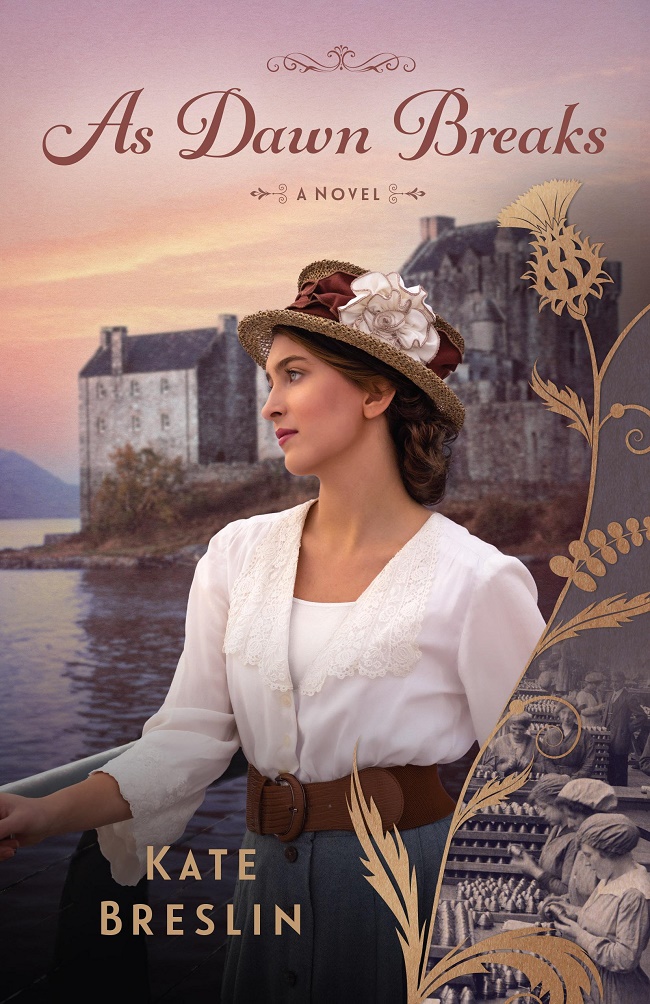
As Dawn Breaks

In Kate Breslin’s novel, As Dawn Breaks, Rosalind Graham works in a Chilwell munitions factory in England in 1918. Her parents had passed away long ago, and her uncle took Rosalind and her two brothers in. But the arrangement was far from cozy. Rosalind’s uncle is forcing her to marry a ruthless man she doesn’t love.

Shortly before the wedding, Rose’s best friend from the factory, Tilly, sends her to her apartment to get ready for a bridal shower. But while Rose is away, the factory blows up, killing hundreds, including Tilly.

Stunned and devastated, Rose eventually realizes the explosion offers her a way out of her dilemma. She can take on Tilly’s identity and leave, and everyone will think Rose died in the explosion. Though she hates to make her brothers think she’s dead, it’s the only way she can see to help herself and them. She plans to find a job in another town and then retrieve her brothers when she has saved enough money.

Rose/Tilly ends up in another munitions factory in Gretna, Scotland. She’s put in charge of a group, and one of the young women says her family will let her rent a room. She revels in a warm, caring, normal family life.

RAF Captain Alex Baird heads for home in Gretna on an undercover mission. Sources indicate the Gretna factory might be next for the saboteur. Alex is charged with working in the factory to find clues as to what might happen and who might be involved.

Alex is stunned to find a woman, Rose, who he knows as Tilly, renting his bedroom. He didn’t know his father was unable to work and needed to make money by renting out his room. Rose and Alex don’t get on well at first, but eventually they form a bond over their love for his family.

Then Alex receives word to surveil Tilly, who is suspected of having some connection in the Chilwell bombing. Rose knows nothing of Tilly’s involvement and wonders at Alex’s sudden interest in everything she does.

Meanwhile, Alex has secrets of his own that not even his parents know.

I didn’t know, when I read Kate Breslin’s Far Side of the Sea a couple of months ago, that it was the third of a five-part series. As Dawn Breaks is the fourth and has been in my Kindle app for a couple of years now. Each of the books is understandable alone, but it’s fun to follow some of the characters through the series.

I enjoyed the characters, and there was plenty of suspense in wondering what Tilly had been involved in, whether Rose would be blamed, whether the saboteur would be found in time, and other plot lines. I thought one of the threads was wrapped up a little too easily, but overall I enjoyed the book very much.


Review and Giveaway: Chasing Shadows

Chasing Shadows by Lynn Austin

In Chasing Shadows, a novel by Lynn Austin, people of the Netherlands thought they would be safe during WW2 because their country was neutral. But the Nazis invaded and took over anyway.

Lena de Vries is a farmer’s wife with a son and two daughters. She loves her life, though she has frequent arguments with her daughter, Ans.

Ans doesn’t care for farm life and doesn’t embrace her family’s faith. When she has an opportunity to move to Leiden, she takes it. She’s offered a job as a companion to a woman named Eloise with “melancholia”–her symptoms sound like what we would call bipolar disorder today. Eloise is depressed by her losses during WW1. When the Nazis invade, she’s in danger of sinking further. Ans starts helping in small, but ever-increasing ways with the Resistance. When Eloise finds ways she can help, too, she’s energized.

Ans had begun dating a Dutch policeman, Erik. The Nazis took over the police force, but Erik thought the best way to cope was just to get along with them. But they increasingly require more and more, and he and Ans differ about where they should draw the line.

Jewess Miriam Jacobs fled Germany with her father, who procured a teaching position in Leiden. They planned to send for Miriam’s mother later. But when the Nazis came, there was nowhere to escape. The coastline and borders were monitored. Some Jews who had escaped to other countries were turned away. One by one, the Nazis followed the same procedures as they had in Germany: limiting Jewish activity, requiring yellow stars on their clothing, eliminating their positions. When word came that Jews were being deported to settlement camps, Miriam and her father know they have to hide.

Meanwhile, Lena has to learn to let go—first of Ans when she leaves, then her husband Pieter when he trains for fighting, then her teenage son when the Nazis scoop up young men to build trenches and such. She and her husband hide both Jews and Dutch police who went underground rather than work for the Nazis. Though their food supply continues to dwindle, Lena can’t turn away the hungry that come to her farm.

I loved that this book didn’t cover just one thread–the Jewish persecution or the dangers of being in the Resistance or strains on the homefront—but dealt with facets of all of them. It was fully orbed, covering how the war affected and caused suffering for everyone. For instance, when the queen, in exile, orders railroad workers to strike, deportations of the Jews cease and Nazi supplies are stopped–but so are everyone else’s. There was widespread starving, especially in cities. People who had homes chopped up furniture to burn to keep warm, and animals of any kind (including cats and horses) weren’t safe from being caught and eaten.

Plus the three main characters are at different stages in life and at different levels in their faith. And each has to make nearly impossible choices.

I was so attached to these characters that I was sad to let them go when the story was over.

As it happens, I somehow ended up with two copies of this book. I think I bought it on sale but maybe forgot I had already received it for my birthday. Then the audiobook (nicely read by Stina Nielsen) came up free in the Audible “Plus” catalog, and I figured I’d get to it sooner via audio. But I still liked having the print books to refer to certain passages and read the book’s back material.

So I’d like to offer these two paperback books to a couple of my readers. I’m sorry I’ll have to restrict the giveaway to continental US addresses due to postage prices. If you’d like to enter a drawing for a copy of this book, leave a comment on this post. I’ll count all the comments on this post as entries unless you tell me you’d rather not be in the drawing. I’ll draw two names one week from today and contact the winners via email. If I can’t reach you or don’t hear back from you within a couple of days after that, I’ll draw another name.

I wish I could give you all a copy!

The giveaway is closed. Congratulations to Kitty and Sarah!

Laudable Linkage

Laudable Linkage

I found a lot of good reading this week:

A Comforting Resource for People Who Have Lost Parents. My friend, Lois, lost both parents within five weeks of each other a few year ago. Some of her blog posts since then have been about processing their loss and working through grief. She found a lot of resources for losing a child or a spouse, but not much on losing parents. That seemed to be treated as just a normal part of life. Though the death of one’s parents is inevitable, grief still runs deep. Lois has just pulled these posts together in one resource page. She tells about it and links to the Help for Parent Loss page there.

How Can I Cultivate a Listening Life in a Noisy World? “Do we demonstrate through our choices that we truly believe that we NEED God’s Word? Are we still ‘the people of the Book?'”

Can a Christian Have Mental Illness? HT to Challies. “Some Christians believe that Christians cannot have mental illness. If a professing Christian is depressed, anxious, or bipolar, they think it’s because they are not a real Christian, or that there is some terrible sin they haven’t repented of, or that they need to repent of the depression or whatever the problem is. Nearly half (48 percent) of evangelicals believe that serious mental illness can be overcome with prayer and Bible study alone. The result of this condemnation of mental illness as sin is that many Christians do not admit they have a mental illness, they don’t talk about it, and they don’t reach out for help.”

We Need Every Word, HT to Challies. “I want to feast on the Bible passages I love, the ones that make me feel some note of pleasure or comfort. I want the reminders that I’m loved, the encouragements to hold fast, and the songs of praise that remind me of God’s faithfulness. I don’t always want the lists or the history or the stories that don’t seem to affect me.”

Why We Are Tempted not to Pray, HT to Challies. “Prayer should stupefy us. ‘You mean, this all-powerful God who keeps galaxies spinning is interested in you telling him about your day and might alter the course of the entire cosmos because you asked him if you could have a parking space?’”

Being Involved in Church as a Teen, HT to Challies. “But being born into a church as a baby, and then growing up through Sunday school and youth group, can often make it hard to be taken seriously. Even older Christians with the best intentions can miss the mark. It can feel a bit awkward when they ask you the same questions every time they see you in church. It takes time and effort from both sides to help and encourage one another, and ultimately, have more meaningful relationships.”

Is the Lord’s Day the Christian Sabbath? HT to Challies. “At the outset, I need to say that this issue is one that I think Christians should not divide over. The view I present below is not the one I grew up with, but I have no particular ambition to convert people to my view — except that, with regard to those who have the duty to teach God’s word, it is important to do so properly, ‘rightly handling the word of truth’, preaching the full counsel of God with all His authority, but never giving human ideas that same authority.”

The Ritual of Rearranging Books, HT to Linda. “Taking all the books down was a chance to organize and cull, but primarily, it was an experience in simply remembering what was there, how it got there, and why. You can look at shelved books until the cows come home, but it’s not the same as actually taking them off the shelves.”

Seeing the Light on Religious Fiction, HT to Linda. “As I complete my 40th year working with books, I’ve changed my mind about an entire publishing genre that I once held at arm’s length at best, and treated with something akin to critical dismissal at worst. I feel like the proverbial old dog who has suddenly learned a new trick. The genre? Religious fiction.” I especially loved this one!

Routine leads to devotion, especially in Bible study.

The quote here is from “Just Not Feeling It”: How Routine Awakens Devotion.

Review: Bleak Landing

Bleak Landing

In Terrie Todd’s novel, Bleak Landing, Bridget O’Sulliovan’s family had come to the small town of Bleak Landing in Canada from Ireland when she was seven. But her mother and brother died on the voyage. Her father took to drinking, gambling, and beating Bridget, making sure she knew he wished she had been the one to die.

Bridget didn’t fare much better at school. Her fiery red hair, Irish accent, rundown home, and drunken father all made her a target for bullying. Her two worst enemies were Victor Harrison and Bruce Nilsen, who locked her in the school outhouse one day. She vowed then that she’d leave Bleak Landing the first chance she got.

Her resolve was strengthened when she learned that one of her father’s gambling debts involved her.

Leave she did when she was fifteen, finding a job in a textile mill, then in a mansion as a cook’s helper, rising up the ranks to lady’s maid.

She becomes best friends with Maxine, a chatty girl she met at the mill. Maxine and her family are Christians. Bridget thinks they are nice and appreciates their hospitality, but doesn’t feel God has done her any favors.

Several years later, Bridget learns in a roundabout way that her father died and there’s some dispute about his property. At first she doesn’t care. She doesn’t want to see Bleak Landing again, and the property wasn’t much to speak of anyway. But when she loses her job and apartment during the Depression, her father’s property is the only thing in the world she owns besides the clothes she wore.

When she gets back to Bleak Landing, though, no one recognizes her except Victor. She looks much different and doesn’t have any identification.

Victor, during all these years, fought during WWI, was injured, came home, and trained to be a pastor. He regretted the way he treated Bridget when they were kids, but had no way to make amends to her. But will she forgive him and let him help her?

Bridget’s story was heart-breaking at first. She rises above her circumstances, but she doesn’t let anyone in and doesn’t share anything about her past with anyone. It’s a wonder, humanly speaking, that Maxine put up with her negativity, especially not knowing what caused it.. But eventually Bridget’s heart softens as she realizes she might need more than spunk to get through life.

I wouldn’t agree with every little theological point made, and I am not a fan of ecumenism between gospel-preaching and works-based churches.

But otherwise, I loved the characters and story.

Review: A Beautiful Disguise

A Beautiful Disguise by Roseanna M. White

In A Beautiful Disguise, a novel by Roseanna M. White, siblings Yates and Marigold Fairfax had an idyllic childhood in Edwardian England. Their father loved entertainment and spent lavish money on it, even buying a circus. They grew up playing with the animals, learning the trapeze, loving the performers like family.

The Fairfaxes didn’t know, until their father’s death when they were young adults, that all the entertainment came at a steep price. They weren’t in debt, but there was no money. They needed not only to take care of themselves and the family estate, but the circus performers who depended on them.

They decided to use their skills to start an investigations company: The Imposters, LTD. They’d maintain their positions as Lord and Lady Fairfax in 1908 British society, not so much because they cared about position, but because that’s the world they knew and moved in and where their clientele would come from. Marigold remade many of her mother’s beautiful old gowns into outlandish costumes with ostrich plumes and wide hat brims so that people would notice her persona, not her. Her friend, Gemma, alias newspaper columnist G. M. Parker, played up Marigold’s “Lady M” by reporting on her lavish clothing. It worked so well that Gemma could sometimes pose as Marigold because people usually looked at her outfits, not her face.

Sir Merritt Livingstone was a faithful soldier for ten years. But a severe bout of pneumonia took ages to recover from. He’s still not at full steam, so he’s been given a desk job in the War Office Intelligence Division. One of his agents has not been heard from in an unusual amount of time. His most recent coded telegram simply contained the name of Merritt’s boss, Lord Henning. Merritt doesn’t want to believe anything ill of Henning, but he has to discreetly find out what’s going on.

Sounds like a job for the Imposters.

When Merritt meets the intriguing Lady M. at a ball, he has no idea she’s half the team looking into his request.

At first it might sound odd for a titled family to own a circus. The Fairfaxes family home was in Northumberland while they spent “the season” in London, so much of society didn’t know they had a lion in their back yard and a high wire set-up in their gym. But the circus situation worked into the story believably and smoothly. In fact, it was fun and different. Yates’ and Marigold’s acrobatic training came in handy climbing window ledges to eavesdrop, and their stage makeup allowed them to disguise themselves.

The characters and plot are well-drawn and compelling. The faith element is woven in naturally.

I listened to the audiobook wonderfully read by Susan Lyons. I missed the author’s notes at the end, which I wished audiobooks included. But I did see this blog post where Roseanna introduced the series and this interview, in which she shares some of her inspiration.

I thoroughly enjoyed this book and can’t wait for the sequel.

Review: Yesterday’s Tides

Yesterday's Tides novel by Roseanna M. White

Roseanna M. White’s novel, Yesterday’s Tides, has two related story lines taking place in 1914 and 1942 on Ocracoke Island in North Carolina’s Outer Banks.

In 1914, Louisa Adair helps her mother and “Grann” run an inn. She’d like to go to teacher’s college, but there isn’t enough money. Plus, she’s needed at home.

Though Louisa has blue eyes, her skin coloring is darker than most people’s. Her mother will not tell her anything about her deceased father except that he was a good man. A few people are prejudiced against her, thinking she must be of mixed race.

When two college-age cousins, one from Maryland and one from England, come to the inn for the summer, Louisa has no idea how her life will change as a result. Louisa has no plans to fall in love: she keeps a polite reserve with the inn’s male guests. But she and Remington Culbreth, from England, find themselves in each other’s company often. Just after they do fall in love, WWI breaks out and Remington is called to service at home. Will their relationship survive not only the war, but the differences in their families and lifestyles?

In 1942, Evie Farrow now runs the inn with her grandmother. One day while taking some baked goods to the neighbors, a loud explosion is heard in the distant waters. While Evie’s Coast Guard friends prepare to investigate and help, Evie heads home to pray. When a badly burned Englishman washes up near the inn, somehow Evie knows not to report him. He says he is military, but he’s not in uniform. What mutterings she hears as he goes in and out of consciousness alert her to the fact that he is an intelligence officer. But what would an English spy be doing in Ocracoke?

When he wakes up, she learns his name is Sterling Bertrand and he is tracking a German operative. But it will take weeks for his wounds to heal. Meanwhile, he wonders just how far he can trust Evie, who seems to have secrets of her own.

I’ve read many dual timeline novels, and usually there are enough differences between the two timelines to keep from getting confused. I had a little harder time with this one, since both stories took place at an inn in Ocracoke and involved a visiting Englishman. I think I would have had an easier time with reading rather than listening. I didn’t catch some of the names that were the same in both timelines, so I kept getting surprised at the connections. I don’t think that would have happened if I were reading instead of listening.

As it happened, partway through the audiobook I discovered that I did have a Kindle copy! So I went back and forth between reading and listening.

One delight with this book was running into some characters from Roseanna’s previous books. I won’t say which ones, as that might give away parts of the plot. You don’t have to have read those books to understand this one, but it was a fun surprise to see those characters again. Evidently Remington was in an earlier book as well, but, though I remember the story and situation, I don’t remember him.

I’m sorry to say I was not thrilled with the audiobook narrator. Some of her accents seemed a little off to me. Plus she had an odd cadence, her inflection going up when it didn’t need to.

There are so many layers to this novel, and so much more to it than there appears to be at first. I loved the stories, and after finishing the book, I just wanted to sit with the characters a bit more before saying goodbye to them and starting another story.

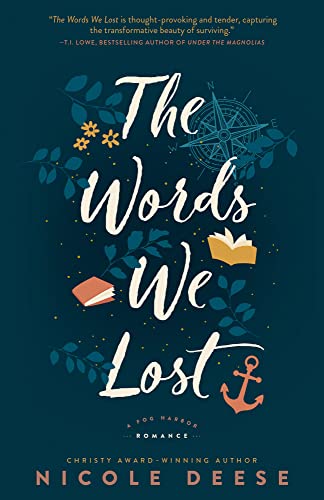
Review: The Words We Lost

The Word We Lost novel

In The Words We Lost by Nicole Deese, Ingrid Erikson moved to western Washington state with her father and became friends with cousins Cece and Joel Campbell when they were all teenagers.

Cece grew up to write a novel, which Ingrid, as an intern at a publishing house, sneaked to her editor. The editor loved the manuscript, bought it, and Cece’s series became runaway best-sellers.

But then Cece tragically died on the operating table during surgery to remove a brain tumor.

Besides losing Cece, Ingrid’s father died several years before. Ingrid blamed Joel and broke contact with him. So she lost all the people and the place she loved most and moved hundreds of miles away.

Ingrid is now a senior acquisitions editor, but she has a hard time functioning due to her grief. She relies heavily on her own intern, Chip. But her new boss can see she’s faltering.

Then Joel suddenly shows up unannounced. The family lawyer discovered a sealed letter addressed to him and Ingrid from Cece. She wanted them to come back home together to retrieve a package.

Ingrid’s boss gives her an ultimatum: find the rumored missing fourth manuscript to Cece’s series, or lose her job.

Ingrid isn’t sure she can go back to the area that she loves, but that brought her so much pain—and do so with Joel. But she doesn’t have a choice if she wants to keep her job.

I bought this book because I loved two of Nicole’s other books I had read. I got the audiobook at first, but the narrator just hit me wrong somehow. So I returned the book and got the Kindle version.

Then the first few pages held one of my pet peeves in writing. 🙂

But once we got past all that and I settled into the story, I loved it just as much as the others.

Some of the quotes I liked:

Success is a slow, long process of repetition (p. 90, Kindle version).

No heartache has ever gone unseen, and no darkness is ever too solid for light to overcome (p. 156).

God is often made visible by the hands and feet of the people He places in our lives (p. 177).

We can’t change the time we’ve spent, just how we choose to spend the time we have left (p. 228).

Even though there are still things to talk and sing and laugh about in this life, there are also things to miss and lament and grieve, too. Both are welcome and both are necessary (p. 367).

I enjoyed the depth of the characters and was pulled into their heartaches. The last few chapters unravel a bit of mystery. After the first few pages, I loved how the story developed and then concluded. I also loved the double meaning in the title. I’m happy to recommend this book to you.


Review: Dreams of Savannah

In Dreams of Savannah by Roseanna M. White, Cordelia Owens is a pampered Southern belle who loves to dream and write stories. She also loves Phineas Dunn, a lifelong friend newly recruited to the Confederate Navy, and promises to wait for him forever.

When she learns Phineas has been lost at sea, she weaves heroic tales for his mother and sister to help them keep up hope.

When Phineas was shot and fell overboard, he thought he was done for. But somehow he washes up on an island near Cuba. He’s rescued by a person he never imagined existed: an educated free black man from England. He has no way to let his family or his commanding officer know what has happened to him. All he can do is try to get well as fast as possible and get home. But his injuries are severe.

As the weeks drag by, a distant cousin of Cordelia’s comes to Savannah, assigned to the Confederate regiment there. Her parents are impressed by his manners, standing, and wealth. They like Phineas well enough, but his family’s credentials just don’t compare. They put pressure on Cordelia to turn her attention to her cousin. But even if she had not promised Phin she would wait forever, she would not have her cousin. There’s a predatory gleam in his eyes when her parents aren’t around.

When Phineas finally returns, he is still suffering from his injury. Worse, he has fallen in his own estimation. He wanted to be the hero of Cordelia’s stories. He doesn’t feel worthy of her, but he still vies for her hand. Her parents keep pushing her toward her cousin.

Both Cordelia and Phineas are from good families who are known to be kind to their slaves. Phineas’ father was, in fact, planning to free his slaves until doing so became illegal in Georgia.

But different experiences and people begin to change their perspectives. The question now is what to do. Is it enough just to be good to one’s slaves? Could they be mocked, scorned, or even arrested if their views on slavery changed? And how could their views change without changing their actions as well?

At the beginning of this book, Cordelia came across to me as young and somewhat silly (one of her fears for Phineas was that he might be attacked by a giant squid. . . ). I’m not sure how old she was, something hard to go back and find in an audiobook. Also, the Southern belle vibe came across a little too thick, replete with “fiddale-faddle” and “fiddel-dee-dee” (making me wonder for the first time why “fiddle’ was in so many expressions then).

But after I settled into the story, I began to enjoy it more. Cordelia is immature at the beginning. But the circumstances of the story cause her to grow. Even her story-telling matures over time.

It would be hard to write a book of changing viewpoints towards slavery and black people set in the 1861 South without attributing to the characters twenty-first century sensibilities. But Roseanna avoided that and had beliefs change and grow in the context of what was going on at the time.

A couple of my favorite quotes:

She certainly shouldn’t be refused happiness because of your convoluted ideas about your precious blood making her better than her mother . . . Because let me just tell you . . . your blood doesn’t have that power. There’s only one Man’s blood in all of history that can make us better than we are—and your are not Him.

She didn’t need to be a heroine in some fantastic tale of derring-do. That wasn’t what the Lord had given her. No, He’d given her words. Words to live by. Words to create with. Words that maybe, just maybe, could change the world beyond her house as surely as they had changed the one within.

I listened to the audiobook nicely narrated by Sarah Zimmerman.

So far, I have loved every book of Roseanna’s that I have read, including this one.

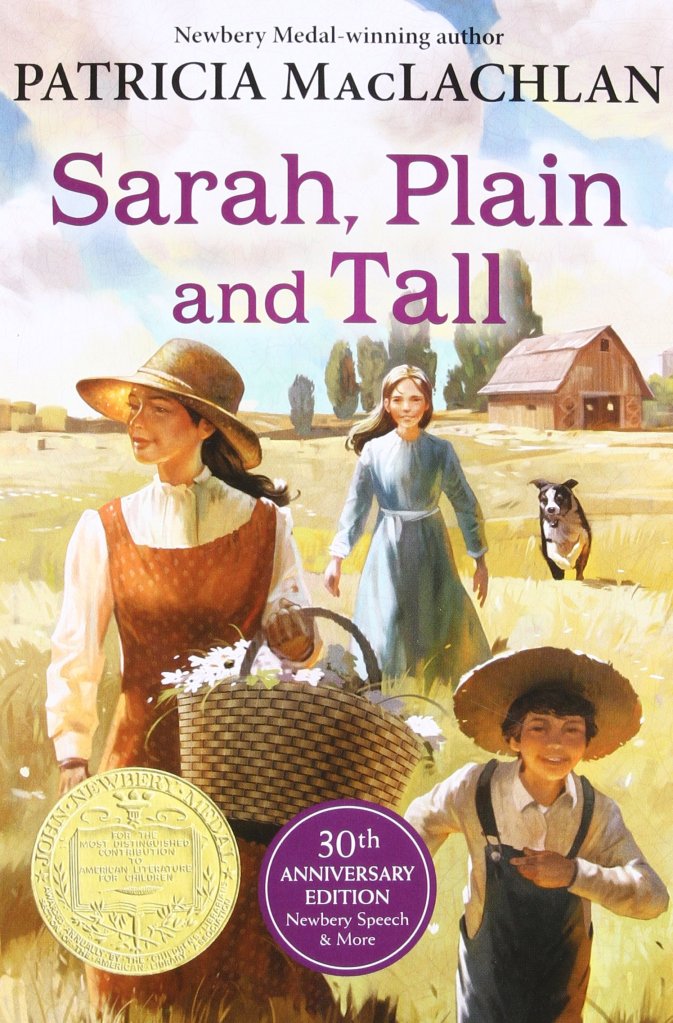
Sarah, Plain and Tall

I saw the film version of Sarah, Plain and Tall with Glenn Close several years ago and loved it. I hadn’t known then that it was based on a children’s book by Patricia MacLachlan. I just recently read the Kindle version.

The story opens with Anna, her younger brother Caleb, and their widowed father living on the prairie in the late 19th century. Written from Anna’s point of view, she notes that her parents used to sing all the time, but her Papa never does any more.

Papa tells the children he has placed an advertisement for a wife and received a reply from Sarah, a woman in Maine. She lives with her brother, but he is getting married. She’s concerned she will miss the sea, but she’s willing to come out by train to the prairie and meet the family.

Sarah exchanges letters with papa, Anna, and Caleb until she arrives. Sarah is different and does unusual things. They all like each other, but the children are afraid Sarah misses the sea too much to stay.

This was a lovely story written in a simple yet beautiful style.

A few of my favorite quotes:

Outside, the prairie reached out and touched the places where the sky came down.

My brother William is a fisherman, and he tells me that when he is in the middle of a fog-bound sea the water is a color for which there is no name.

There is no sea here. But the land rolls a little like the sea.

I shook my head, turning the white stone over and over in my hand. I wished everything was as perfect as the stone. I wished that Papa and Caleb and I were perfect for Sarah. I wished we had a sea of our own.

This book won a Newberry Medal, and the Kindle version I read included the author’s speech upon receiving it. She said the story was based on a real Sarah from Maine who had traveled to the prairie to become the wife and mother of a friend of the author’s mother. This speech contained a couple more favorite quotes:

Every writer should have a loving reader who has the courage to write both “I love this” and “Ugh” on the same page.

When Julius Lester praises children’s literature as the “literature that gives full attention to the ordinary,” he echoes my parents’ belief that it is the daily grace and dignity with which we survive that children most need and wish to know about in books.

My parents believed in the truths of literature, and it was my mother who urged me to “read a book and find out who you are,” for there are those of us who read or write to slip happily into the characters of those we’d like to be. It is, I believe, our way of getting to know the good and bad of us, rehearsing to be more humane, “revising our lives in our books,” as John Gardner wrote, “so that we won’t have to make the same mistakes again.”

I knew there was one sequel to the book, Skylark. But I hadn’t known there were three more. The Kindle version contains the first chapter of each of the books. Someday I hope to read the rest.

I wanted to rewatch the videos of both Sarah, Plain and Tall and Skylark, but they don’t appear to be available to stream from anywhere. I might see if the library has the DVDs.

Have you read or watched Sarah, Plain and Tall? What did you think?

Review: When the Day Comes

When the Day Comes by Gabrielle Meyer has an intriguing and unique premise for a novel.

Libby Conant is a time crosser. She lives in 1774 Williamsburg with her widowed mother and two sisters. She and her mother took over the printing of the Virginia Gazette after her father died, but they are barely making ends meet. Creditors threaten prison. Then the Conants are awarded the public printing contract from the House of Burgesses. They print Thomas Jefferson’s pamphlets as well as public notices. The Revolutionary War is about to break out, and tensions run high between rebels and loyalists.

Libby has loved Henry Montgomery since they were both children. She thinks he has feelings for her as well, but they move in different social circles. Plus he has secrets of his own. Whose side is he really on?

When Libby goes to sleep in Williamsburg, she wakes up as Anna Elisabeth Wells, only daughter to a prominent, wealthy family in 1914 New York. Her father’s fortune was self-made, which is not enough for her mother’s ambition for rank which values “old money.” Her mother has paraded Libby around for two seasons in New York, and now they are going to London to see what the titled male population is like there.

Libby does not want to marry, at least not before her twenty-first birthday. She enjoys working with the suffragette movement, which her mother disdains. Mother Wells is one of the most manipulative women ever and overrides Libby’s wishes and protests in her pursuit of the right suitor.

War is looming on this timeline as well, though no one knows it yet. Libby only knows because her mother in 1774 was a time crosser as well who lived in the twenty-first century.

When Libby goes to sleep in New York, she wakes up in Williamsburg again, with no loss of time in either place. Thus has it been since she was born and thus it will be until she turns twenty-one. Then she will have to choose which path she wants to live in permanently. Her body will die in the path she does not choose, but she will retain her memories of that time. If she tries to knowingly alter history in either path, she’ll forfeit her life in that path.

Libby is sure which path she will choose. She likes the conveniences of the Gilded Age in 1914, but she’s not interested in status and wealth. She’s needed in 1774 to help her family and the cause of freedom. And even if her love for Henry can never come to fruition, she wants to be where he is.

But unexpected circumstances may force her into a different choice.

This book came out last year, and I kept seeing it favorably mentioned among bloggers I follow. I still wasn’t quite sure I’d be interested, but I decided to give the audiobook a try. And . . . wow. This book was fascinating. The characters are well-drawn. It was fun seeing a few historical figures in the story. The plot kept a good pace, even with the intricacies of two timelines. I loved the eventual emphasis on the need to trust God rather than strive after our own way. I didn’t see the ending coming at all, but it was supremely satisfying.

As usual, the audiobook did not contain the author’s notes. I was curious about how she got and developed the idea for this book and found an interview with her about it here.

I enjoyed this book so much, I immediately started the sequel, In this Moment. Highly recommended.